REVIEW 2 major objections 5 minor 52 references
Spectroscopic Signature of Chemical Bond Dissociation Revealed by Calculated Core-Electron Spectra
T0 review · 2 major / 5 minor · reviewed 2026-08-14 · deepseek-v4-flash
Pith's one-line read Carbon 1s photoelectron line jumps at 3 Å as C–I bond breaks
desk verdict A testable and new prediction of a C1s XPS binding-energy jump in CH3I photodissociation, but the one-center continuum approximation deserves a sensitivity check before relying on the exact jump position. read the letter →
The pith
A machine-rendered reading of the paper's core claim, the machinery that carries it, and where it could break.
The reading
What carries the argument
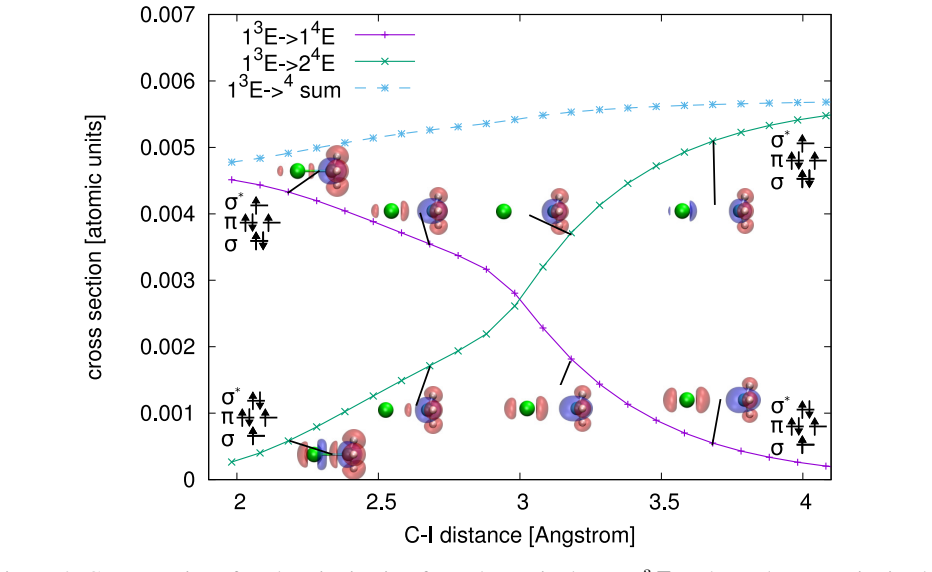
The mechanism that carries the argument is the bond-length-dependent swap in partial photoionization cross sections between two quadruplet core-hole states of the dissociating molecule. At short C–I distances the lower core-hole state dominates because the valence electrons can reorganize to screen the carbon core hole; past about 3 Å this rearrangement is blocked, the configurational character of the two states exchanges, and the ionization cross section shifts to the higher state. The calculations combine multi-configuration time-dependent Hartree wavepacket dynamics on ab initio spin-orbit-coupled potential energy surfaces for the excited states with core-ionization transition dipole matrix elements evaluated in the one-center approximation, where the outgoing photoelectron is described by an atomic carbon continuum function.
What would settle it
Measure the time-resolved carbon 1s photoelectron spectrum of UV-excited methyl iodide with a soft-x-ray probe of about 1 eV resolution: if the dominant line does not jump by about 5 eV near 20 fs while intensity transfers from roughly 290 eV to a roughly 295 eV satellite, the central prediction fails. A computational falsifier is to recompute the partial photoionization cross sections with a full multicenter continuum description instead of the one-center approximation; the predicted swap should survive if the mechanism is real.
Extended reading notes
Core claim
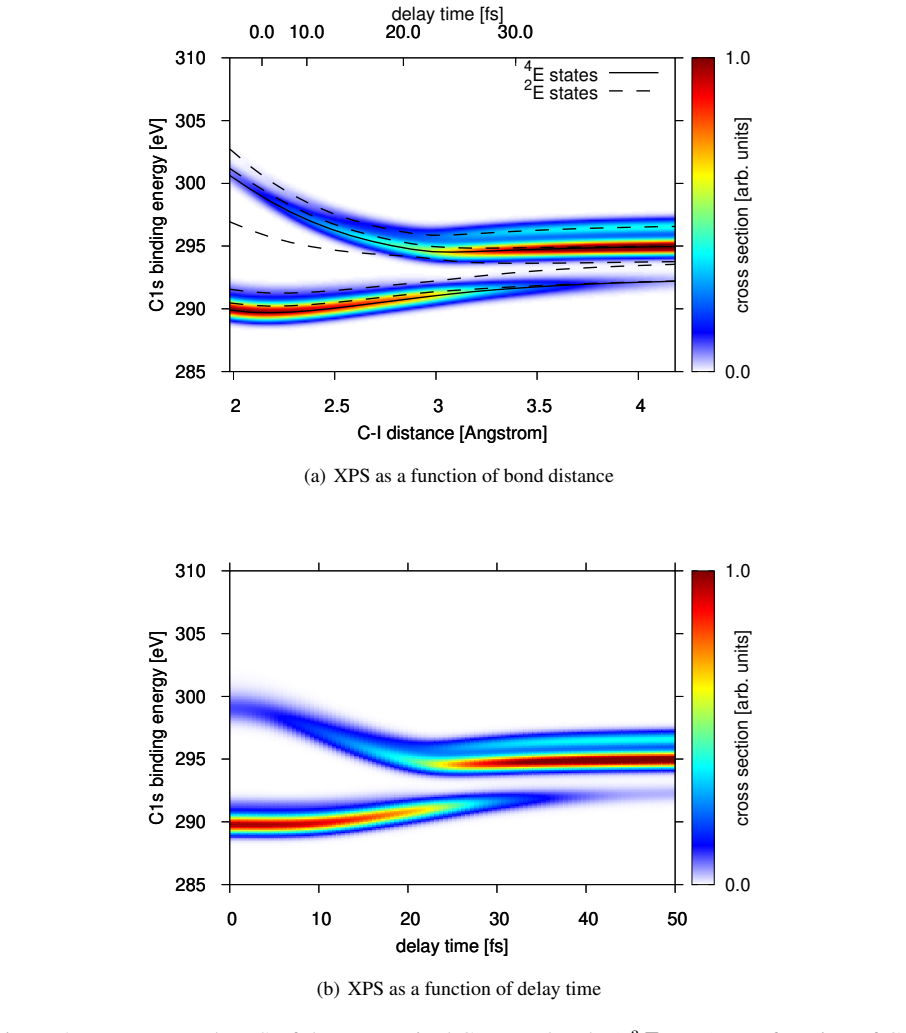
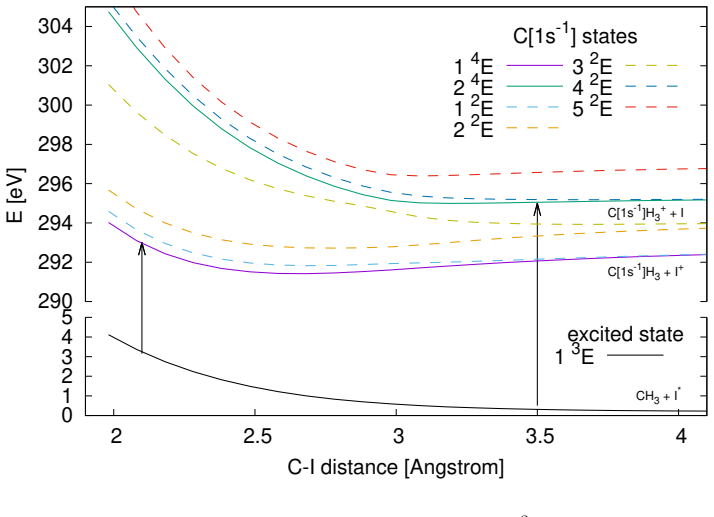
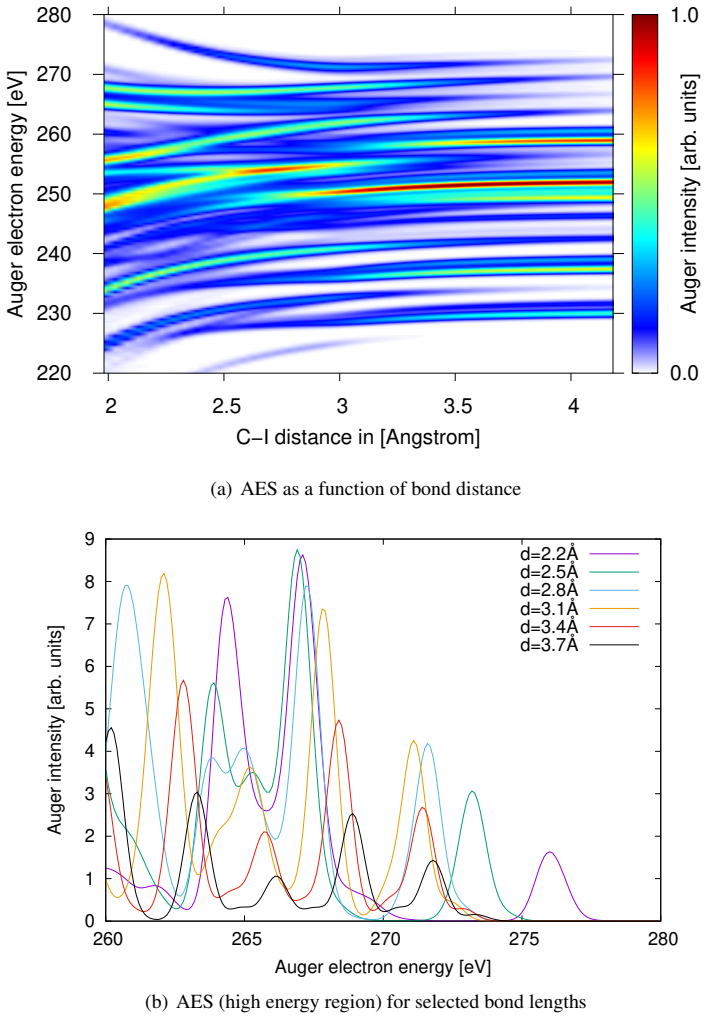
The central claim is that the carbon K-edge XPS of UV-excited CH$_3$I is not a smoothly shifting line but a spectrum whose dominant feature jumps by several eV at a critical C–I separation of about 3 Å, corresponding to a delay of about 20 fs. At equilibrium the spectrum is dominated by ionization into the lower quadruplet core-hole state $^1{}^4E$, a state whose valence electron density rearranges to screen the carbon core hole by drawing charge from iodine; as the bond stretches past roughly 3 Å, photoionization into this state is depleted and the higher $^2{}^4E$ state, which leaves the charge on the methyl group, takes over. The paper attributes the switch to a change in configurational mixing: the $^1{}^4E$ state acquires increasing $\sigma \to \sigma^*$ character while the $^2{}^4E$ state loses it, so the initial $\pi \to \sigma^*$ excited-state wave packet preferentially ionizes into different core-hole states at different bond lengths. The predicted XPS jump therefore marks the point where interatomic charge rearrangement upon core ionization is blocked, consistent with a classical over-the-barrier estimate of about 3.3 Å. Time-resolved Auger spectra show a related signature: a fast electron line near 277 eV that gains intensity near 3 Å and disappears at larger separations.
Load-bearing premise
The prediction rests on the one-center approximation used for the ionization matrix elements, which models the outgoing photoelectron as an atomic carbon continuum wave; if that approximation misses how the ionization probability changes with bond length, the cross-section swap and the XPS jump could be computational artifacts.
Editorial extensions
If this is right
- Time-resolved carbon K-edge XPS can serve as a direct map of the C–I dissociation coordinate: the line jump at about 3 Å fixes the instant, roughly 20 fs, at which the wave packet crosses the critical distance.
- The predicted cross-section swap means the yield of I+ fragments from the carbon-core-ionized molecule should show a sharp delay-time dependence, because the two core-hole states dissociate to different charge distributions.
- The transient Auger satellite above 270 eV appears only in an intermediate bond-length window, making it a specific marker for the dissociation step rather than for the reactants or products.
- The same class of XPS jumps should appear in other dissociating molecules, because the underlying physics is valence electron rearrangement upon core-hole creation.
- The jump survives when finite experimental time resolution is included, so current free-electron laser sources can test the prediction.
Reading between the lines
- If confirmed, the critical distance of about 3 Å could serve as a general spectroscopic ruler for charge-transfer blocking: one could estimate jump distances in related molecules from the over-the-barrier radius without running a full wavepacket calculation.
- Slow-dissociating analogues of methyl iodide might stretch the jump in time, making the predicted crossover easier to resolve experimentally and allowing the cross-section swap to be tracked as a continuous intensity transfer.
- A decisive computational check of the one-center approximation would be to recompute the bond-length-dependent partial cross sections with a continuum wave function built from multicenter molecular orbitals; if the swap persists, the prediction is robust.
- A pump–probe experiment with a probe energy tuned across the carbon edge could look for the predicted transfer of intensity from the main line to the shake-up satellite rather than only the energy shift of the main line.
Signed reviews
Editorial analysis
A structured set of objections, weighed in public.
Referee Report
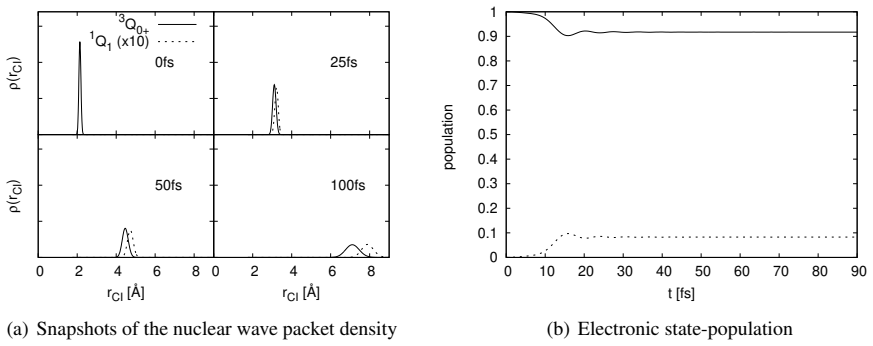
Summary. The paper simulates time-resolved carbon 1s photoelectron (XPS) and Auger (AES) spectra for the UV-photodissociation of CH3I. It combines a previously validated five-dimensional MCTDH wavepacket simulation on the 3Q0+/1Q1 potential-energy surfaces (Ref. 34) with electronic-structure calculations of core-ionization matrix elements and Auger rates using the XMOLECULE toolkit. The central prediction is that the C1s XPS binding energy shows a pronounced jump at a C-I distance of about 3 Å (approximately 20 fs delay), caused by a swap in partial photoionization cross sections between two quadruplet core-ionized states, 14E and 24E. This swap is attributed to the distance-dependent blocking of valence electron transfer from iodine to the core-ionized CH3 moiety. The Auger spectrum is also calculated and shows bond-length-dependent features, including a satellite that appears only in an intermediate distance range. The authors argue these signatures map the bond-breaking coordinate directly and are general for charge-rearrangement processes accompanying core ionization.
Significance. If the predictions hold, the paper makes an important contribution by showing that time-resolved core-level spectroscopy can probe the bond-breaking coordinate not only through binding-energy shifts but through changes in partial ionization cross sections and satellite intensities. The calculations are internally consistent, the nuclear dynamics come from a well-established MCTDH surface, and the spectral predictions are not fitted to the target observable. The predicted XPS jump and cross-section swap are falsifiable with current FEL capabilities. However, the central prediction rests on a specific computational approximation for the continuum electron (the one-center approximation) that has not been benchmarked for this molecule, and the paper provides no sensitivity analysis of the key cross-section curves. With a sensitivity test and a quantitative statement of uncertainty, the significance would be substantially strengthened.
major comments (2)
- [Methods, after Eq. (5)] The partial photoionization cross sections shown in Fig. 4 are evaluated using the one-center approximation, in which the continuum photoelectron is described by an atomic carbon continuum wavefunction. The predicted XPS jump in Fig. 2(b) is entirely a redistribution of intensity between the 14E and 24E final states (the sum of the two partial cross sections is roughly flat in Fig. 4), and these two states differ precisely in whether valence electron density is transferred from iodine to the methyl group. An atomic carbon continuum cannot describe electron scattering and phase shifts off the iodine atom, so the bond-length dependence of the relative 14E:24E matrix elements could be substantially in error. This is a load-bearing point, because the jump position and magnitude are the main results. Please add a sensitivity test using a multicenter continuum representation (or another independent method) at several bond lengths near 2.2–4.0 Å, and report the resulting change in the critical distance and jump amplitude. The Auger rates in Eq. (7) inherit the same approximation and should be included in this sensitivity check for the AES predictions.
- [Results and Methods, hydrogen geometry] The spectra are computed with the hydrogen atoms fixed at their equilibrium positions (caption of Fig. 2 and Methods), while the MCTDH dynamics explicitly includes C-H stretch, H3-C-I bend, and umbrella motion, and the text states that the CH3 fragment becomes nearly planar as the C-I bond dissociates (first paragraph of the Results section). Because the configurational mixing between the 14E and 24E core-ionized states depends on the valence orbital structure, the frozen-H approximation could alter the critical distance at which the cross sections swap. Please quantify this effect, for example by repeating the cross-section calculation at a representative planar CH3 geometry and comparing the Fig. 4 curves.
minor comments (5)
- [Methods, paragraph after Eq. (3)] The phrase 'and the the definitions' contains a duplicated article; please correct it.
- [Eq. (6)] Equation (6) uses the standard δ symbol for a function that is actually a smoothed, geometry-averaged line shape, since it involves an integral over the vibrational density; a different notation (e.g., g or L) would avoid confusion.
- [Abstract] The phrase 'with unprecedented details' is vague; a quantitative statement of the achieved temporal and spatial (bond-length) resolution would be more informative.
- [Fig. 2(a) and Fig. 4] The color scale and 'cross section [arb. units]' labels in Figs. 2(a) and 4 make the absolute normalization unclear; please state explicitly how the intensities are normalized in each panel.
- [Supporting Information] The manuscript relies on the Supporting Information for the finite-time-resolution analysis and the over-the-barrier model; please ensure the SI is included with the submission or provide a brief summary of those results in the main text so that the claims are verifiable.
Circularity Check
No significant circularity: the predicted XPS jump and cross-section swap are computed from ab initio matrix elements and independent prior dynamics, not fitted to the target result.
full rationale
The paper's central prediction—the C1s XPS line jump and intensity swap at a C–I distance near 3 Å—is derived from a chain that does not reduce to its own inputs. The nuclear dynamics come from previously published MCTDH simulations on ab initio potential energy surfaces (Ref. 34, Hammerich et al., J. Chem. Phys. 1994), which are independent of the XPS calculation. The photoelectron spectra are computed from Eq. (4)–(5) using dipole matrix elements evaluated with the one-center approximation and CASCI(6,4)/6-311G wavefunctions, and the Auger spectra from Eq. (7) with the same type of electronic-structure input. The bond-length-dependent swap between the 14E and 24E partial cross sections emerges from configurational mixing in the core-ionized states, not from any fitted parameter or imposed constraint. The supporting over-the-barrier charge-transfer argument is invoked only as a consistency check (Rc = 3.3 Å model versus 3.0 Å computed), not as an input. The authors cite their own XMOLECULE toolkit (Refs. 38–40) for the computational method, but the method is described, parameter-free, and the Supporting Information provides comparison with available experimental data; this is legitimate tool citation, not load-bearing circularity. The one-center continuum approximation is a genuine accuracy concern—it could affect the predicted intensity redistribution—but that is a validity or correctness risk, not a circularity of the derivation. No equation reduces the predicted observable to a fitted constant or to a self-citation chain.
Assumptions & free parameters
free parameters (2)
- XPS Gaussian broadening width =
1 eV FWHM
- AES Gaussian broadening width =
1 eV FWHM
assumptions (5)
- domain assumption One-center approximation with atomic carbon continuum wave functions yields accurate bond-length-dependent core-ionization matrix elements.
- domain assumption Spin-orbit coupling in the carbon core-ionized states can be neglected; the 3Q0+ state can be represented by the non-spin-orbit-coupled 13E state.
- domain assumption Hydrogen positions can be fixed at their equilibrium values when computing the XPS and AES spectra.
- domain assumption The MCTDH dynamics initialized by sudden excitation on the PES from Refs. 34 and 48 is accurate.
- domain assumption Molecular geometry is static during the ~5-10 fs core-hole lifetime in the Auger calculation.
Cite this review
Pith. "Pith review of Spectroscopic Signature of Chemical Bond Dissociation Revealed by Calculated Core-Electron Spectra." pith.science (2026). https://pith.science/paper/EXFQXWUM
@misc{pith2026190806930,
  author       = {Pith},
  title        = {Pith review of: Spectroscopic Signature of Chemical Bond Dissociation Revealed by Calculated Core-Electron Spectra},
  year         = {2026},
  howpublished = {\url{https://pith.science/paper/EXFQXWUM}},
  note         = {Machine review of arXiv:1908.06930}
}
abstract
The advent of ultrashort soft x-ray pulse sources permits the use of established gas phase spectroscopy methods to investigate ultrafast photochemistry in isolated molecules with element and site specificity. In the present study, we simulate excited state wavepacket dynamics of a prototypical process, the ultrafast photodissociation of methyl iodide. Based on the simulation, we calculate time-dependent excited state carbon edge photoelectron and Auger electron spectra. We observe distinct signatures in both types of spectra and show their direct connection to C-I bond dissociation and charge rearrangement processes in the molecule. We demonstrate at the CH$_3$I molecule that the observed signatures allow us to map the time-dependent dynamics of ultrafast photo-induced bond breaking with unprecedented details.
Figures
Figures from the paper (3 more)
Reference graph
Works this paper leans on
-
[1]
Cheng, Y.-C.; Fleming, G. R. Dynamics of Light Harvesting in Photosynthesis. Ann. Rev. Phys. Chem. 2009, 60, 241--262
work page 2009
-
[2]
M.; Manzoni, C.; Brida, D.; Tomasello, G.; Orlandi, G.; Kukura, P.; Mathies, R
Polli, D.; Alto \`e , P.; Weingart, O.; Spillane, K. M.; Manzoni, C.; Brida, D.; Tomasello, G.; Orlandi, G.; Kukura, P.; Mathies, R. A. et al. Conical Intersection Dynamics of the Primary Photoisomerization Event in Vision. Nature 2010, 467, 440--443
work page 2010
-
[3]
S.; Schalk, O.; Martinez, T.; M ller, K
Wolf, T.; Kuhlman, T. S.; Schalk, O.; Martinez, T.; M ller, K. B.; Stolow, A.; Unterreiner, A.-N. Hexamethylcyclopentadiene: Time-Resolved Photoelectron Spectroscopy and Ab Initio Multiple Spawning Simulations. Phys. Chem. Chem. Phys. 2014, 16, 11770--11779
work page 2014
-
[4]
Horton, S. L.; Liu, Y.; Forbes, R.; Makhija, V.; Lausten, R.; Stolow, A.; Hockett, P.; Marquetand, P.; Rozgonyi, T.; Weinacht, T. Excited State Dynamics of CH 2 I 2 and CH 2 BrI Studied with UV Pump VUV Probe Photoelectron Spectroscopy. J. Chem. Phys. 2019, 150, 174201
work page 2019
-
[5]
Coates, M. R.; Larsen, M. A. B.; Forbes, R.; Neville, S. P.; Boguslavskiy, A. E.; Wilkinson, I.; S lling, T. I.; Lausten, R.; Stolow, A.; Schuurman, M. S. Vacuum Ultraviolet Excited State Dynamics of the Smallest Ring, Cyclopropane. II . Time -Resolved Photoelectron Spectroscopy and Ab Initio Dynamics. J. Chem. Phys. 2018, 149, 144311
work page 2018
-
[6]
J.; Schalk, O.; Geng, T.; Thomas, R
MacDonell, R. J.; Schalk, O.; Geng, T.; Thomas, R. D.; Feifel, R.; Hansson, T.; Schuurman, M. S. Excited State Dynamics of Acrylonitrile: Substituent Effects at Conical Intersections Interrogated via Time-Resolved Photoelectron Spectroscopy and Ab Initio Simulation. J. Chem. Phys. 2016, 145, 114306
work page 2016
-
[7]
Schalk, O.; Geng, T.; Thompson, T.; Baluyot, N.; Thomas, R. D.; Tapavicza, E.; Hansson, T. Cyclohexadiene Revisited : A Time - Resolved Photoelectron Spectroscopy and Ab Initio Study . J. Phys. Chem. A 2016, 120, 2320--2329
work page 2016
-
[8]
M.; Downes-Ward , B.; Woodhouse, J.; Parkes, M
Warne, E. M.; Downes-Ward , B.; Woodhouse, J.; Parkes, M. A.; Bellshaw, D.; Springate, E.; Majchrzak, P.; Zhang, Y.; Karras, G.; Wyatt, A. S. et al. Photodissociation Dynamics of CH 3 I Probed via Multiphoton Ionisation Photoelectron Spectroscopy. Phys. Chem. Chem. Phys. 2019, 21, 11142--11149
work page 2019
Show all 52 references
-
[9]
Emma, P.; Akre, R.; Arthur, J.; Bionta, R.; Bostedt, C.; Bozek, J.; Brachmann, A.; Bucksbaum, P.; Coffee, R.; Decker, F.-J. et al. First Lasing and Operation of an ngstrom-Wavelength Free-Electron Laser. Nat. Photonics 2010, 4, 641--647
2010
-
[10]
Pertot, Y.; Schmidt, C.; Matthews, M.; Chauvet, A.; Huppert, M.; Svoboda, V.; von Conta, A.; Tehlar, A.; Baykusheva, D.; Wolf, J.-P. et al. Time-Resolved x-Ray Absorption Spectroscopy with a Water Window High-Harmonic Source. Science 2017, 355, 264--267
2017
-
[11]
R.; Bhattacherjee, A.; Pemmaraju, C
Attar, A. R.; Bhattacherjee, A.; Pemmaraju, C. D.; Schnorr, K.; Closser, K. D.; Prendergast, D.; Leone, S. R. Femtosecond X-Ray Spectroscopy of an Electrocyclic Ring-Opening Reaction. Science 2017, 356, 54--59
2017
-
[12]
M.; Silva, F.; Cousin, S
Teichmann, S. M.; Silva, F.; Cousin, S. L.; Hemmer, M.; Biegert, J. 0.5- keV Soft X -Ray Attosecond Continua. Nat. Commun. 2016, 7, 11493
2016
-
[13]
S.; Austin, D
Johnson, A. S.; Austin, D. R.; Wood, D. A.; Brahms, C.; Gregory, A.; Holzner, K. B.; Jarosch, S.; Larsen, E. W.; Parker, S.; Str \"u ber, C. S. et al. High-Flux Soft x-Ray Harmonic Generation from Ionization-Shaped Few-Cycle Laser Pulses. Sci. Adv. 2018, 4, eaar3761
2018
-
[14]
A.; Bassanese, S.; Biedron, S
Allaria, E.; Appio, R.; Badano, L.; Barletta, W. A.; Bassanese, S.; Biedron, S. G.; Borga, A.; Busetto, E.; Castronovo, D.; Cinquegrana, P. et al. Highly Coherent and Stable Pulses from the FERMI Seeded Free-Electron Laser in the Extreme Ultraviolet. Nat. Photonics 2012, 6, 699--704
2012
-
[15]
Ackermann, W.; Asova, G.; Ayvazyan, V.; Azima, A.; Baboi, N.; B \"a hr, J.; Balandin, V.; Beutner, B.; Brandt, A.; Bolzmann, A. et al. Operation of a Free-Electron Laser from the Extreme Ultraviolet to the Water Window. Nat. Photonics 2007, 1, 336--342
2007
-
[16]
K.; Farrell, J
McFarland, B. K.; Farrell, J. P.; Miyabe, S.; Tarantelli, F.; Aguilar, A.; Berrah, N.; Bostedt, C.; Bozek, J. D.; Bucksbaum, P. H.; Castagna, J. C. et al. Ultrafast X -Ray Auger Probing of Photoexcited Molecular Dynamics. Nat. Commun. 2014, 5, 4235
2014
-
[17]
Wolf, T. J. A.; Myhre, R. H.; Cryan, J. P.; Coriani, S.; Squibb, R. J.; Battistoni, A.; Berrah, N.; Bostedt, C.; Bucksbaum, P.; Coslovich, G. et al. Probing Ultrafast * /n * Internal Conversion in Organic Chromophores via K -Edge Resonant Absorption. Nat. Commun. 2017, 8, 29
2017
-
[18]
Wolf, T. J. A.; Holzmeier, F.; Wagner, I.; Berrah, N.; Bostedt, C.; Bozek, J.; Bucksbaum, P.; Coffee, R.; Cryan, J.; Farrell, J. et al. Observing Femtosecond Fragmentation Using Ultrafast X -Ray- Induced Auger Spectra . Appl. Sci. 2017, 7, 681
2017
-
[19]
C.; D \"u sterer, S
Brau e, F.; Goldsztejn, G.; Amini, K.; Boll, R.; Bari, S.; Bomme, C.; Brouard, M.; Burt, M.; de Miranda , B. C.; D \"u sterer, S. et al. Time-Resolved Inner-Shell Photoelectron Spectroscopy: From a Bound Molecule to an Isolated Atom. Phys. Rev. A 2018, 97, 043429
2018
-
[20]
R.; Pemmaraju, C
Siefermann, K. R.; Pemmaraju, C. D.; Neppl, S.; Shavorskiy, A.; Cordones, A. A.; Vura-Weis , J.; Slaughter, D. S.; Sturm, F. P.; Weise, F.; Bluhm, H. et al. Atomic- Scale Perspective of Ultrafast Charge Transfer at a Dye Semiconductor Interface . J. Phys. Chem. Lett. 2014, 5, ...
2014
-
[21]
Sann, H.; Havermeier, T.; M \"u ller, C.; Kim, H.-K.; Trinter, F.; Waitz, M.; Voigtsberger, J.; Sturm, F.; Bauer, T.; Wallauer, R. et al. Imaging the Temporal Evolution of Molecular Orbitals during Ultrafast Dissociation . Phys. Rev. Lett. 2016, 117, 243002
2016
-
[22]
ESCA Applied to Free Molecules ; North-Holland Publishing Co
Siegbahn, K.; Nordling, C.; Fallmann, C. ESCA Applied to Free Molecules ; North-Holland Publishing Co. Amsterdam , 1969
1969
-
[23]
S.; Illas, F.; Pacchioni, G.; Parmigiani, F
Bagus, P. S.; Illas, F.; Pacchioni, G.; Parmigiani, F. Mechanisms Responsible for Chemical Shifts of Core-Level Binding Energies and Their Relationship to Chemical Bonding. J. Electron. Spectrosc. Relat. Phenom. 1999, 100, 215--236
1999
-
[24]
F.; Groenhof, G.; Grubm \"u ller, H
Inhester, L.; Burmeister, C. F.; Groenhof, G.; Grubm \"u ller, H. Auger Spectrum of a Water Molecule after Single and Double Core Ionization. J. Chem. Phys. 2012, 136, 144304
2012
-
[25]
Marchenko, T.; Inhester, L.; Goldsztejn, G.; Travnikova, O.; Journel, L.; Guillemin, R.; Ismail, I.; Koulentianos, D.; Ceolin, D.; P \"u ttner, R. et al. Ultrafast Nuclear Dynamics in the Double-Core Ionized Water Molecule Observed via Auger Spectroscopy. Phys. Rev. A 2018,
2018
-
[26]
W.; Coffee, R.; Carron, S.; Schorb, S
Erk, B.; Boll, R.; Trippel, S.; Anielski, D.; Foucar, L.; Rudek, B.; Epp, S. W.; Coffee, R.; Carron, S.; Schorb, S. et al. Imaging Charge Transfer in Iodomethane upon X-Ray Photoabsorption. Science 2014, 345, 288--291
2014
-
[27]
D.; Burkett, M.; Carron, S.; Ferguson, K
Boll, R.; Erk, B.; Coffee, R.; Trippel, S.; Kierspel, T.; Bomme, C.; Bozek, J. D.; Burkett, M.; Carron, S.; Ferguson, K. R. et al. Charge Transfer in Dissociating Iodomethane and Fluoromethane Molecules Ionized by Intense Femtosecond X -Ray Pulses. Struct. Dyn. 2016, 3, 043207
2016
-
[28]
J.; Erk, B.; Boll, R.; Toyota, K.; Hao, Y.; Vendrell, O
Rudenko, A.; Inhester, L.; Hanasaki, K.; Li, X.; Robatjazi, S. J.; Erk, B.; Boll, R.; Toyota, K.; Hao, Y.; Vendrell, O. et al. Femtosecond Response of Polyatomic Molecules to Ultra -Intense Hard X -Rays. Nature 2017, 546, 129--132
2017
-
[29]
Theoretical Evidence for the Sensitivity of Charge-Rearrangement-Enhanced x-Ray Ionization to Molecular Size
Hao, Y.; Inhester, L.; Son, S.-K.; Santra, R. Theoretical Evidence for the Sensitivity of Charge-Rearrangement-Enhanced x-Ray Ionization to Molecular Size. Phys. Rev. A 2019, 100, 013402
2019
-
[30]
G.; Gonz \'a lez-V \'a zquez , J.; Banares, L
de Nalda , R.; Dur \'a , J.; Garc \'i a-Vela , A.; Izquierdo, J. G.; Gonz \'a lez-V \'a zquez , J.; Banares, L. A Detailed Experimental and Theoretical Study of the Femtosecond A -Band Photodissociation of CH _ 3 I . J. Chem. Phys. 2008, 128, 244309
2008
-
[31]
Control of Ultrafast Molecular Photodissociation by Laser-Field-Induced Potentials
Corrales, M.; Gonz \'a lez-V \'a zquez , J.; Balerdi, G.; Sol \'a , I.; De Nalda, R.; Ba \ n ares, L. Control of Ultrafast Molecular Photodissociation by Laser-Field-Induced Potentials. Nat. Chem. 2014, 6, 785
2014
-
[32]
Tehlar, A.; W \"o rner, H. J. Time-Resolved High-Harmonic Spectroscopy of the Photodissociation of CH 3 I and CF 3 I . Mol. Phys. 2013, 111, 2057--2067
2013
-
[33]
Gedanken, A.; Rowe, M. D. Magnetic Circular Dichroism Spectra of the Methyl Halides. Resolution of the n * Continuum. Chem. Phys. Lett. 1975, 34, 39--43
1975
-
[34]
D.; Manthe, U.; Kosloff, R.; Meyer, H.-D.; Cederbaum, L
Hammerich, A. D.; Manthe, U.; Kosloff, R.; Meyer, H.-D.; Cederbaum, L. S. Time-Dependent Photodissociation of Methyl Iodide with Five Active Modes. J. Chem. Phys. 1994, 101, 5623--5646
1994
-
[35]
R.; Bhattacherjee, A.; Leone, S
Attar, A. R.; Bhattacherjee, A.; Leone, S. R. Direct Observation of the Transition - State Region in the Photodissociation of CH3I by Femtosecond Extreme Ultraviolet Transient Absorption Spectroscopy . J. Phys. Chem. Lett. 2015, 6, 5072--5077
2015
-
[36]
Drescher, L.; Galbraith, M. C. E.; Reitsma, G.; Dura, J.; Zhavoronkov, N.; Patchkovskii, S.; Vrakking, M. J. J.; Mikosch, J. Communication: XUV Transient Absorption Spectroscopy of Iodomethane and Iodobenzene Photodissociation. J. Chem. Phys. 2016, 145, 011101
2016
-
[37]
Time- Resolved Dissociation Dynamics of Iodomethane Resulting from Rydberg and Valence Excitation
Baumann, A.; Rompotis, D.; Schepp, O.; Wieland, M.; Drescher, M. Time- Resolved Dissociation Dynamics of Iodomethane Resulting from Rydberg and Valence Excitation . J. Phys. Chem. A 2018, 122, 4779--4784
2018
-
[38]
Efficient Electronic Structure Calculation for Molecular Ionization Dynamics at High X-Ray Intensity
Hao, Y.; Inhester, L.; Hanasaki, K.; Son, S.-K.; Santra, R. Efficient Electronic Structure Calculation for Molecular Ionization Dynamics at High X-Ray Intensity. Struct. Dyn. 2015, 2, 041707
2015
-
[39]
X-Ray Multiphoton Ionization Dynamics of a Water Molecule Irradiated by an x-Ray Free-Electron Laser Pulse
Inhester, L.; Hanasaki, K.; Hao, Y.; Son, S.-K.; Santra, R. X-Ray Multiphoton Ionization Dynamics of a Water Molecule Irradiated by an x-Ray Free-Electron Laser Pulse. Phys. Rev. A 2016, 94, 023422
2016
-
[40]
H.; Bostedt, C.; Travnikova, O.; Marchenko, T.; Son, S.-K.; Santra, R
Inhester, L.; Oostenrijk, B.; Patanen, M.; Kokkonen, E.; Southworth, S. H.; Bostedt, C.; Travnikova, O.; Marchenko, T.; Son, S.-K.; Santra, R. et al. Chemical Understanding of the Limited Site - Specificity in Molecular Inner - Shell Photofragmentation . J. Phys. Chem. Lett. 2...
2018
-
[41]
Ab Initio Surface Hopping Excited-State Molecular Dynamics Approach on the Basis of Spin Orbit Coupled States: An Application to the A -Band Photodissociation of CH3I
Kamiya, M.; Taketsugu, T. Ab Initio Surface Hopping Excited-State Molecular Dynamics Approach on the Basis of Spin Orbit Coupled States: An Application to the A -Band Photodissociation of CH3I . J. Comput. Chem. 2019, 40, 456--463
2019
-
[42]
N.; Bancroft, G
Cutler, J. N.; Bancroft, G. M.; Tan, K. H. Ligand-field Splittings and Core-level Linewidths in I 4d Photoelectron Spectra of Iodine Molecules. J. Chem. Phys. 1992, 97, 7932--7943
1992
-
[43]
Potential Energy Surfaces of Core - Hole and Shake - Up States for Dissociative Ionization Studies
Corral, I.; Gonz \'a lez-V \'a zquez , J.; Mart \'i n, F. Potential Energy Surfaces of Core - Hole and Shake - Up States for Dissociative Ionization Studies . J. Chem. Theory Comput. 2017, 13, 1723--1736
2017
-
[44]
Oscillatory Behavior of Charge Transfer Cross Sections as a Function of the Charge of Projectiles in Low-Energy Collisions
Ryufuku, H.; Sasaki, K.; Watanabe, T. Oscillatory Behavior of Charge Transfer Cross Sections as a Function of the Charge of Projectiles in Low-Energy Collisions. Phys. Rev. A 1980, 21, 745--750
1980
-
[45]
H.; Goodman, G
Berkowitz, J.; Batson, C. H.; Goodman, G. L. Photoionization of Atomic Iodine and Atomic Tellurium. Phys. Rev. A 1981, 24, 149--160
1981
-
[46]
B.; Gutman, D
Berkowitz, J.; Ellison, G. B.; Gutman, D. Three Methods to Measure RH Bond Energies. J. Phys. Chem. 1994, 98, 2744--2765
1994
-
[47]
H.; J \"a ckle, A.; Worth, G
Beck, M. H.; J \"a ckle, A.; Worth, G. A.; Meyer, H.-D. The Multiconfiguration Time-Dependent Hartree ( MCTDH ) Method. a Highly Efficient Algorithm for Propagating Wavepackets. Phys. Rep. 2000, 324, 1--105
2000
-
[48]
I^)YI9oHF3x# b DHKH@ Zu`,MHeY -pMKHJH̒Y[- #sLJL?)i,ߤԘ͙hy_+ d̬19q I)!KZ.[._ N Ƅ @ AD0 B D F M v/D
Amatatsu, Y.; Morokuma, K.; Yabushita, S. Ab Initio Potential Energy Surfaces and Trajectory Studies of A -band Photodissociation Dynamics: CH3I * CH3 + I and CH3 + I *. J. Chem. Phys. 1991, 94, 4858--4876 mcitethebibliography document methane_AES.eps00006640000000000000000000...
1991
-
[49]
Erk, B. et al. Imaging Charge Transfer in Iodomethane upon X-Ray Photoabsorption. Science 2014, 345, 288--291
2014
-
[50]
A.; Chen, H.-W.; Jolly, W
Bakke, A. A.; Chen, H.-W.; Jolly, W. L. A Table of Absolute Core-Electron Binding-Energies for Gaseous Atoms and Molecules. J. Electron. Spectrosc. Relat. Phenom. 1980, 20, 333--366
1980
-
[51]
K.; Tse, J
Creber, D. K.; Tse, J. S.; Bancroft, G. M. Experimental and Theoretical Shakeup Studies. III . The 1s Shakeup in CH4 , NH3 , and H2O . J. Chem. Phys. 1980, 72, 4291--4299
1980
-
[52]
a ki, A.; Neeb, M.; Kempgens, B.; K \
Kivim \"a ki, A.; Neeb, M.; Kempgens, B.; K \"o ppe, H. M.; Bradshaw, A. M. The C 1s Auger Decay Spectrum of the Molecule: The Effects of Vibrational Fine Structure, Double Excitations and Shake-up Transitions. J. Phys. B: At. Mol. Opt. Phys. 1996, 29, 2701--2709 mcitethebibli...
1996
Reviewed August 14, 2026 · model on record in the stance chip above.
Discussion (0). Continue with ORCID to comment.