REVIEW 3 major objections 5 minor 69 references
Neutrino Fluence from Gamma-Ray Bursts: Off-Axis View of Structured Jets
T0 review · 3 major / 5 minor · reviewed 2026-08-14 · deepseek-v4-flash
Pith's one-line read For structured gamma-ray burst jets, neutrinos observed far off the jet axis can arrive at fluence comparable to an on-axis view, and far above the naive uniform-jet off-axis rescaling.
desk verdict Clean Doppler-integral formalism and a useful scaling relation for off-axis structured jets, with an honest but model-dependent GRB 170817A application. read the letter →
The pith
A machine-rendered reading of the paper's core claim, the machinery that carries it, and where it could break.
The reading
What carries the argument
The machinery is the Doppler-boosted fluence integral for thin relativistic shells, $F = (1+z)/(4\pi d_L^2)\int d\Omega_*\, D^3(\Omega_*)/\Gamma(\theta_*)\, dE_*/d\Omega_*$, from which the paper defines the jet scaling factor $N_{\rm jet}$ and average Doppler factor $D_{\rm jet}$ and derives the revised off-axis scaling $F_{\rm off}(\epsilon)\simeq (N_{\rm jet}(\theta_v)/N_{\rm jet}(0))\, \eta^{-2} F_{\rm on}(\epsilon/\eta)$ with $\eta = D_{\rm jet}(\theta_v)/D_{\rm jet}(0)$. For neutrinos the load-bearing new ingredient is the proton-photon opacity $\tau_{p\gamma}(\theta_*) \propto \Gamma^{-5}(\theta_*)\, dE_\gamma^*/d\Omega_*$, which gives the neutrino angular distribution a different, broader profile than the gamma-ray distribution. That opacity scaling, rather than geometry alone, produces the claimed off-axis enhancement.
What would settle it
Recompute the off-axis neutrino fluence using Eq. (20) with a prompt-emission-constrained jet profile for GRB 170817A, of the kind fixed by the gamma-ray time structure and Doppler factor rather than by the afterglow fit; if the TeV fluence at $\theta_v\simeq 15^\circ$ falls to within a factor of a few of the naive uniform-jet $D_{\rm off}^3/D_{\rm on}^3$ rescaling, the claimed enhancement rests on the afterglow-profile assumption and would not survive alternative prompt-jet structures.
Extended reading notes
Core claim
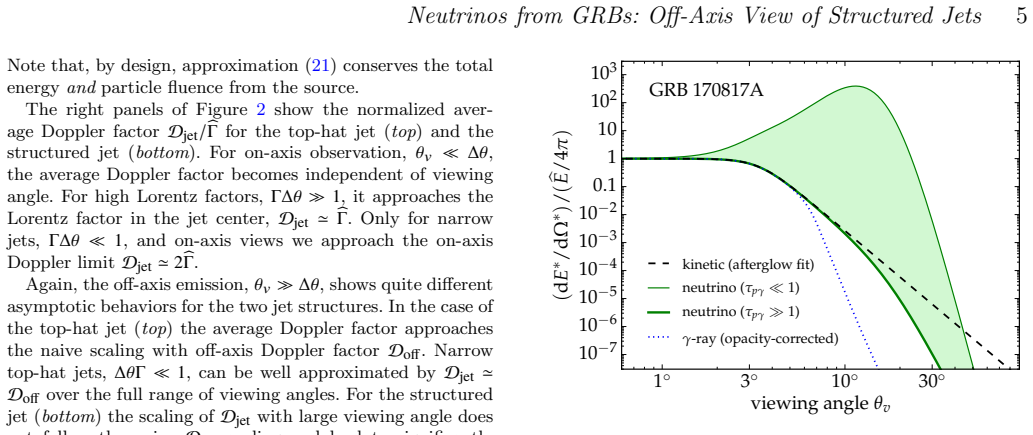
The central claim is that for a structured jet, the neutrino fluence is not obtained by rescaling an on-axis calculation with a single Doppler factor; one must integrate the Doppler-boosted emissivity over the jet and, for neutrinos, include an angular-dependent proton-photon opacity. In the low-opacity regime, the neutrino energy per solid angle scales as $(dE_{\rm IC}/d\Omega_*)^2/\Gamma^5$, which enhances emission from jet angles around 10 to 20 degrees relative to the gamma-ray brightness. For the structured jet model inferred from the afterglow of GRB 170817A ($s_1=5.5$, $s_2=3.5$, $\Delta\theta\simeq 3.4^\circ$, $\hat{\Gamma}\simeq 250$, $\theta_v\simeq 15^\circ$), the paper predicts that the off-axis muon-neutrino fluence is comparable to the on-axis prediction in the TeV energy range and orders of magnitude above the off-axis uniform-jet expectation.
Load-bearing premise
The load-bearing premise is that the afterglow-derived jet structure and Lorentz-factor profile also describe the prompt-emission outflow at the internal-shock radius, and that the internal photon target spectrum is captured by one of the two adopted peak models; if the prompt jet is narrower, slower, or has a different photon spectrum, the claimed off-axis neutrino enhancement can weaken or disappear.
Editorial extensions
If this is right
- The reference signal for neutrino searches from compact-binary mergers must be the structured-jet fluence, not the on-axis uniform-jet prediction rescaled by a single Doppler factor; using the latter can underestimate the expected off-axis signal by orders of magnitude.
- Equation (23) gives a practical route to convert existing on-axis neutrino calculations into off-axis predictions for any jet structure and viewing angle whenever the internal spectrum varies only mildly across the shell.
- For GRB 170817A-like events, the TeV off-axis neutrino fluence can be comparable to the on-axis fluence, so a large viewing angle does not by itself suppress the neutrino signal as much as it suppresses the gamma-ray signal.
- The predicted fluence remains below the current 90% confidence upper limits, so the immediate consequence is not a detection but a corrected expected signal for stacking and future searches.
Reading between the lines
- Because the angular profile of neutrino energy follows $\tau_{p\gamma}\propto \Gamma^{-5}$ in the low-opacity regime, the same broadening should apply to other products of proton-photon interactions, such as ultra-high-energy cosmic rays that escape before energy losses.
- The paper's comparison assumes the afterglow-derived jet also describes the prompt outflow; if future prompt-emission fits for GRB 170817A favor a narrower core, the enhancement at 15 degrees would shrink, and comparing prompt and afterglow structures becomes a direct test of jet dissipation physics.
- Using the same formalism with alternative short-GRB jet profiles, for example a sharper core or different power-law indices, would bracket how generic the off-axis enhancement is across structured-jet models.
Signed reviews
Editorial analysis
A structured set of objections, weighed in public.
Referee Report
Summary. This paper derives a general relation between the internal emissivity of a relativistic, axisymmetric structured jet and the observed photon or neutrino fluence at an arbitrary viewing angle, using the standard D^3 Doppler transformation and a thin-shell geometry (Eqs. 1-20). It introduces a jet scaling factor Njet and an average Doppler factor Djet, leading to a revised off-axis scaling relation for particle fluences (Eq. 23) that reduces to the naive (D_off/D_on)^3 scaling only for top-hat jets at large viewing angle. The formalism is then applied to neutrino production from p-gamma interactions in internal shocks, with a numerical illustration for GRB 170817A using the structured jet profile inferred from afterglow fits by Ghirlanda et al. (2019). The central numerical result is that the predicted off-axis neutrino fluence at theta_v = 15 degrees is comparable to the on-axis prediction in the TeV range and orders of magnitude above the expectation from an off-axis observation of a uniform jet, because low-opacity regions at jet angles of about 10-20 degrees contribute strongly.
Significance. If the derivation is accepted, the paper provides a clean and useful generalization of the standard on-axis uniform-jet neutrino fluence calculation, and it clarifies why structured jets can produce neutrino angular distributions that are much broader than the gamma-ray angular distribution. The exact expression (20), the reduction of the approximate scaling relation (23) to known limits, and the explicit identification of the assumptions behind the approximation are genuine strengths. The application to GRB 170817A is a concrete and in principle falsifiable model prediction, although the predicted fluence is currently orders of magnitude below the available ANTARES, Auger, and IceCube upper limits shown in Fig. 4. The main weakness is not the Lorentz-transformation formalism, which is standard and internally consistent, but the dependence of the numerical result on unquantified input assumptions about the prompt-phase jet structure and the internal photon target spectrum.
major comments (3)
- [§5.2, Fig. 4; Eqs. (16), (17), (29), (A6)] The headline claim that the off-axis neutrino fluence at theta_v = 15 degrees is comparable to the on-axis prediction in the TeV range and orders of magnitude above the uniform-jet expectation is driven by low-opacity emission from jet angles of about 10-20 degrees (Fig. 3). In this regime Eq. (29) gives dE_nu/dOmega proportional to Gamma^{-5} (dE_IC/dOmega)^2, so the result is extremely sensitive to the Lorentz-factor and energy profiles adopted from the afterglow fit of Ghirlanda et al. (2019) and to the internal-shock efficiency model of Eq. (A6) with eta_infinity = 0.2. The afterglow fit constrains the external forward shock, not the prompt internal-shock dissipation radius, and the manuscript neither propagates the fit uncertainties nor tests alternative structured-jet profiles such as those of Lazzati et al. (2018), Troja et al. (2018), Margutti et al. (2018), and Lamb et al. (2019). A quantitative variation of s1, s2, Delta-theta, and Gamma-hat within the allowed ranges is needed to determine whether the claimed enhancement is a robust prediction or an artifact of the chosen prompt-jet model.
- [§5.1, Eqs. (32)-(33), Fig. 4] The neutrino fluence calculation requires the internal photon target spectrum, which is fixed by one of two ad hoc peak-energy models. The paper itself states that model (a) implies an on-axis photon peak of about 20 MeV, in tension with the Fermi-GBM GRB peak-energy distribution, and model (b) is introduced phenomenologically; Fig. 4 shows that the two models change the on-axis neutrino fluence by up to two orders of magnitude at EeV energies. The conclusion that the off-axis and on-axis fluences are 'similar in the TeV range' should therefore be accompanied by a demonstration that this comparison is insensitive to the target-spectrum model, or the claim should be explicitly hedged as applying only under one of the adopted spectral assumptions.
- [§4, Eq. (23)] The approximate scaling relation (23) is derived under the assumption that the relative emission spectrum n'(theta*, epsilon')/u'(theta*) is nearly angle-independent, and the paper correctly notes in Section 4 that this condition can fail in structured jets with strong local variations of magnetic fields and photon densities. Since the paper recommends the exact expression (20) for such cases, the numerical neutrino results should state explicitly whether they are obtained from Eq. (20) or from the approximate Eq. (23), particularly because the approximate relation is one of the paper's stated main results and is presented without this caveat in the conclusions.
minor comments (5)
- [§5.2] The sentence 'For low-opacity (tau_pgamma >> 1) regions' should read 'tau_pgamma << 1'; the opposite inequality is used in the same paragraph and in Fig. 3.
- [§5.2] There is a typo in 'GRB 170717A'; it should be 'GRB 170817A'.
- [§5.2] The reference to 'the thick green line in Fig. 4' appears to be a mis-reference: the angular distributions of neutrino emissivity are shown in Fig. 3, whereas Fig. 4 shows fluence spectra.
- [§6] The conclusion states that the average Doppler factor is 'defined by Eq. (23)', but Djet is defined in Eq. (22); this should be corrected.
- [Throughout] The name 'Thompson scattering' appears in a few places; it should be 'Thomson scattering'.
Circularity Check
No circularity: the scaling formalism is derived from first principles, jet parameters come from an external afterglow fit, and neutrino fluence is normalized to observed gamma rays rather than fitted to neutrino data.
full rationale
The paper's central derivation is self-contained. Equations (3) through (23) follow from standard Lorentz transformations of specific emissivity, the Doppler factor, and the definition of an average Doppler boost; they are not set up to reproduce the off-axis neutrino enhancement by construction. The structured jet parameters (s1=5.5, s2=3.5, Gamma-hat=250, E-hat=2.5e52 erg, theta_v=15 deg) are taken from the external afterglow analysis of Ghirlanda et al. (2019), not from the present authors' prior work and not from the neutrino result. The neutrino calculation normalizes the internal photon density using the observed Fermi-GBM gamma-ray fluence (Eq. 26) and uses the standard p-gamma opacity expression (Eq. 27); the claimed off-axis enhancement emerges from the angular integral over the structured jet, and is not equivalent to any fitted parameter. The two photon-peak models (Eqs. 32 and 33) are explicitly presented as assumptions, and the paper itself notes the tension of model (a) with the on-axis peak photon energy distribution and the phenomenological character of model (b); these are model uncertainties, not circular inputs. The self-citations (Ahlers et al. 2011; Bustamante & Ahlers 2019) are used only for IceCube constraints and standard neutrino flavor mixing, respectively, and are not load-bearing for the claimed off-axis enhancement. No circular step can be identified from the paper's equations or citations.
Assumptions & free parameters
free parameters (11)
- s1 (structured jet energy profile index) =
5.5
- s2 (structured jet Lorentz factor profile index) =
3.5
- Delta-theta (jet half-opening angle) =
3.4 degrees
- Gamma-hat (core Lorentz factor) =
250
- theta_v (observer viewing angle) =
15 degrees
- E-hat (core kinetic energy) =
2.5e52 erg
- epsilon-gamma (gamma-ray energy fraction) =
0.41 +/- 0.09
- eta-infinity (asymptotic internal shock efficiency) =
0.2 (assumed, x about 0.75)
- xi_p (baryonic loading) =
1 (assumed)
- xi_B (magnetic energy ratio) =
0.1 (assumed)
- Peak photon energy model (a) or (b) =
Fixed comoving 75 keV, or fixed engine frame equivalent to 178 keV on-axis
assumptions (6)
- domain assumption Prompt gamma-ray emission is produced by internal shocks in a relativistic outflow.
- domain assumption The jet is axisymmetric, radial, with isotropic rest-frame emissivity and no counter-jet.
- domain assumption Thin-shell geometry with dissipation radius r_dis = 2 Gamma^2 c Delta-t_eng and shell width c Delta-t_eng.
- domain assumption SOPHIA Monte Carlo with synchrotron-loss modifications correctly models p-gamma cascades.
- standard math Standard Lorentz transformations of emissivity and the relation d_L = (1+z)^2 d_A are valid.
- domain assumption The afterglow-inferred structured jet model applies to the prompt emission phase.
Cite this review
Pith. "Pith review of Neutrino Fluence from Gamma-Ray Bursts: Off-Axis View of Structured Jets." pith.science (2026). https://pith.science/paper/XASZL7EQ
@misc{pith2026190806953,
  author       = {Pith},
  title        = {Pith review of: Neutrino Fluence from Gamma-Ray Bursts: Off-Axis View of Structured Jets},
  year         = {2026},
  howpublished = {\url{https://pith.science/paper/XASZL7EQ}},
  note         = {Machine review of arXiv:1908.06953}
}
read the original abstract
We investigate the expected high-energy neutrino fluence from internal shocks produced in the relativistic outflow of gamma-ray bursts. Previous model predictions have primarily focussed on on-axis observations of uniform jets. Here we present a generalization to account for arbitrary viewing angles and jet structures. Based on this formalism, we provide an improved scaling relation that expresses off-axis neutrino fluences in terms of on-axis model predictions. We also find that the neutrino fluence from structured jets can exhibit a strong angular dependence relative to that of gamma-rays and can be far more extended. We examine this behavior in detail for the recent short gamma-ray burst GRB 170817A observed in coincidence with the gravitational wave event GW170817.
Figures


Figures from the paper (1 more)

Reference graph
Works this paper leans on
-
[1]
G., et al., 2017, @doi [Astrophys
Aartsen M. G., et al., 2017, @doi [Astrophys. J.] 10.3847/1538-4357/aa7569 , 843, 112
-
[2]
Abbasi R., et al., 2012, @doi [Nature] 10.1038/nature11068 , 484, 351
-
[3]
P., et al., 2017a, @doi [Astrophys
Abbott B. P., et al., 2017a, @doi [Astrophys. J.] 10.3847/2041-8213/aa91c9 , 848, L12
-
[4]
P., et al., 2017b, @doi [Astrophys
Abbott B. P., et al., 2017b, @doi [Astrophys. J.] 10.3847/2041-8213/aa920c , 848, L13
-
[5]
C., Halzen F., 2011, @doi [Astropart
Ahlers M., Gonzalez-Garcia M. C., Halzen F., 2011, @doi [Astropart. Phys.] 10.1016/j.astropartphys.2011.05.008 , 35, 87
-
[6]
J.] 10.3847/2041-8213/aa9aed , 850, L35
Albert A., et al., 2017, @doi [Astrophys. J.] 10.3847/2041-8213/aa9aed , 850, L35
- [7]
-
[8]
A., Hooper D., Sarkar S., Taylor A
Anchordoqui L. A., Hooper D., Sarkar S., Taylor A. M., 2008, @doi [Astropart. Phys.] 10.1016/j.astropartphys.2007.10.006 , 29, 1
Show all 69 references
-
[9]
M., 2010, @doi [Mon
Beloborodov A. M., 2010, @doi [Mon. Not. Roy. Astron. Soc.] 10.1111/j.1365-2966.2010.16770.x , 407, 1033
2010
-
[10]
Biehl D., Heinze J., Winter W., 2018, @doi [Mon. Not. Roy. Astron. Soc.] 10.1093/mnras/sty285 , 476, 1191
2018 doi
-
[11]
D., Znajek R
Blandford R. D., Znajek R. L., 1977, @doi [Mon. Not. Roy. Astron. Soc.] 10.1093/mnras/179.3.433 , 179, 433
1977 doi
-
[12]
R., 1970, @doi [Phys
Blumenthal G. R., 1970, @doi [Phys. Rev.] 10.1103/PhysRevD.1.1596 , D1, 1596
1970 doi
-
[13]
Bustamante M., Ahlers M., 2019, @doi [Phys. Rev. Lett.] 10.1103/PhysRevLett.122.241101 , 122, 241101
2019 doi
-
[14]
B., Tamborra I., 2018, @doi [Astrophys
Denton P. B., Tamborra I., 2018, @doi [Astrophys. J.] 10.3847/1538-4357/aaab4a , 855, 37
2018 doi
-
[15]
J.] 10.1086/425310 , 614, L13
Eichler D., Levinson A., 2004, @doi [Astrophys. J.] 10.1086/425310 , 614, L13
2004 doi
-
[16]
N., 1989, @doi [Nature] 10.1038/340126a0 , 340, 126
Eichler D., Livio M., Piran T., Schramm D. N., 1989, @doi [Nature] 10.1038/340126a0 , 340, 126
1989 doi
-
[17]
Ghirlanda G., et al., 2019, @doi [Science] 10.1126/science.aau8815 , 363, 968
2019 doi
-
[18]
J.] 10.3847/2041-8213/aa8f41 , 848, L14
Goldstein A., et al., 2017, @doi [Astrophys. J.] 10.3847/2041-8213/aa8f41 , 848, L14
2017 doi
-
[19]
J.] 10.1086/306884 , 513, 679
Granot J., Piran T., Sari R., 1999, @doi [Astrophys. J.] 10.1086/306884 , 513, 679
1999 doi
-
[20]
E., 2002, @doi [Astrophys
Granot J., Panaitescu A., Kumar P., Woosley S. E., 2002, @doi [Astrophys. J.] 10.1086/340991 , 570, L61
2002 doi
-
[21]
Gruber D., et al., 2014, @doi [Astrophys. J. Suppl.] 10.1088/0067-0049/211/1/12 , 211, 12
2014 doi
-
[22]
Phys.] 10.1016/S0927-6505(03)00211-1 , 20, 429
Guetta D., Hooper D., Alvarez-Muniz J., Halzen F., Reuveni E., 2004, @doi [Astropart. Phys.] 10.1016/S0927-6505(03)00211-1 , 20, 429
2004 doi
-
[23]
J.] 10.1088/0004-637X/752/1/29 , 752, 29
He H.-N., Liu R.-Y., Wang X.-Y., Nagataki S., Murase K., Dai Z.-G., 2012, @doi [Astrophys. J.] 10.1088/0004-637X/752/1/29 , 752, 29
2012 doi
-
[24]
S., 2012, CAPS, 51, 169
Hjorth J., Bloom J. S., 2012, CAPS, 51, 169
2012
-
[25]
Hummer S., Baerwald P., Winter W., 2012, @doi [Phys. Rev. Lett.] 10.1103/PhysRevLett.108.231101 , 108, 231101
2012 doi
-
[26]
Ioka K., Nakamura T., 2019, @doi [Mon. Not. Roy. Astron. Soc.] 10.1093/mnras/stz1650 , 487, 4884
2019 doi
-
[27]
J.] 10.1086/524405 , 670, L77
Ioka K., Murase K., Toma K., Nagataki S., Nakamura T., 2007, @doi [Astrophys. J.] 10.1086/524405 , 670, L77
2007 doi
-
[28]
S., Murase K., M \'e sz \'a ros P., Kiuchi K., 2017, @doi [Astrophys
Kimura S. S., Murase K., M \'e sz \'a ros P., Kiuchi K., 2017, @doi [Astrophys. J.] 10.3847/2041-8213/aa8d14 , 848, L4
2017 doi
-
[29]
J.] 10.1086/512791 , 490, 92
Kobayashi S., Piran T., Sari R., 1997, @doi [Astrophys. J.] 10.1086/512791 , 490, 92
1997 doi
-
[30]
P., et al., 2019, @doi [Astrophys
Lamb G. P., et al., 2019, @doi [Astrophys. J.] 10.3847/2041-8213/aaf96b , 870, L15
2019 doi
-
[31]
C., 2010, @doi [Astrophys
Lazzati D., Begelman M. C., 2010, @doi [Astrophys. J.] 10.1088/0004-637X/725/1/1137 , 725, 1137
2010 doi
-
[32]
J., L \'o pez-C \'a mara D., Cantiello M., Ciolfi R., Giacomazzo B., Workman J
Lazzati D., Perna R., Morsony B. J., L \'o pez-C \'a mara D., Cantiello M., Ciolfi R., Giacomazzo B., Workman J. C., 2018, @doi [Phys. Rev. Lett.] 10.1103/PhysRevLett.120.241103 , 120, 241103
2018 doi
-
[33]
Rev.] 10.1103/PhysRevD.85.027301 , D85, 027301
Li Z., 2012, @doi [Phys. Rev.] 10.1103/PhysRevD.85.027301 , D85, 027301
2012 doi
-
[34]
Rev.] 10.1103/PhysRevD.75.123005 , D75, 123005
Lipari P., Lusignoli M., Meloni D., 2007, @doi [Phys. Rev.] 10.1103/PhysRevD.75.123005 , D75, 123005
2007 doi
-
[35]
Rev.] 10.1016/j.newar.2017.07.001 , 79, 1
Liu T., Gu W.-M., Zhang B., 2017, @doi [New Astron. Rev.] 10.1016/j.newar.2017.07.001 , 79, 1
2017 doi
-
[36]
D., et al., 2018, @doi [Nat
Lyman J. D., et al., 2018, @doi [Nat. Astron.] 10.1038/s41550-018-0511-3 , 2, 751
2018 doi
-
[37]
J.] 10.3847/2041-8213/aab2ad , 856, L18
Margutti R., et al., 2018, @doi [Astrophys. J.] 10.3847/2041-8213/aab2ad , 856, L18
2018 doi
-
[38]
J., 1993, @doi [Astrophys
M \'e sz \'a ros P., Rees M. J., 1993, @doi [Astrophys. J.] 10.1086/172360 , 405, 278
1993 doi
-
[39]
J., 1994, @doi [Mon
M \'e sz \'a ros P., Rees M. J., 1994, @doi [Mon. Not. Roy. Astron. Soc.] 10.1093/mnras/269.1.41L , 269, L41
1994 doi
-
[40]
J., Papathanassiou H., 1994, @doi [Astrophys
M \'e sz \'a ros P., Rees M. J., Papathanassiou H., 1994, @doi [Astrophys. J.] 10.1086/174559 , 432, 181
1994 doi
-
[41]
P., Protheroe R
M \"u cke A., Engel R., Rachen J. P., Protheroe R. J., Stanev T., 2000, @doi [Comput. Phys. Commun.] 10.1016/S0010-4655(99)00446-4 , 124, 290
2000 doi
-
[42]
Murase K., Ioka K., 2013, @doi [Phys. Rev. Lett.] 10.1103/PhysRevLett.111.121102 , 111, 121102
2013 doi
-
[43]
Rev.] 10.1103/PhysRevD.73.063002 , D73, 063002
Murase K., Nagataki S., 2006, @doi [Phys. Rev.] 10.1103/PhysRevD.73.063002 , D73, 063002
2006 doi
-
[44]
J.] 10.1086/509323 , 651, L5
Murase K., Ioka K., Nagataki S., Nakamura T., 2006, @doi [Astrophys. J.] 10.1086/509323 , 651, L5
2006 doi
-
[45]
J.] 10.1086/321717 , 554, L163
Nakamura T., Ioka K., 2001, @doi [Astrophys. J.] 10.1086/321717 , 554, L163
2001 doi
-
[46]
J.] 10.1086/186493 , 395, L83
Narayan R., Paczynski B., Piran T., 1992, @doi [Astrophys. J.] 10.1086/186493 , 395, L83
1992 doi
-
[47]
Paczynski B., 1986, @doi [ ] 10.1086/184740 , https://ui.adsabs.harvard.edu/abs/1986ApJ...308L..43P 308, L43
1986 doi
-
[48]
H., 1994, @doi [Astrophys
Paczynski B., Xu G. H., 1994, @doi [Astrophys. J.] 10.1086/174178 , 427, 708
1994 doi
-
[49]
E., Fryer C., 1999, @doi [Astrophys
Popham R., Woosley S. E., Fryer C., 1999, @doi [Astrophys. J.] 10.1086/307259 , 518, 356
1999 doi
-
[50]
J., M \'e sz \'a ros P., 1992, Mon
Rees M. J., M \'e sz \'a ros P., 1992, Mon. Not. Roy. Astron. Soc., 258, 41
1992
-
[51]
J., M \'e sz \'a ros P., 1994, @doi [Astrophys
Rees M. J., M \'e sz \'a ros P., 1994, @doi [Astrophys. J.] 10.1086/187446 , 430, L93
1994 doi
-
[52]
J., M \'e sz \'a ros P., 2005, @doi [Astrophys
Rees M. J., M \'e sz \'a ros P., 2005, @doi [Astrophys. J.] 10.1086/430818 , 628, 847
2005 doi
-
[53]
B., Lightman A
Rybicki G. B., Lightman A. P., 1979, Radiative processes in astrophysics . Wiley, New York
1979
-
[54]
S., Ghisellini G., Pescalli A., Ghirlanda G., Nappo F., 2015, @doi [Mon
Salafia O. S., Ghisellini G., Pescalli A., Ghirlanda G., Nappo F., 2015, @doi [Mon. Not. Roy. Astron. Soc.] 10.1093/mnras/stv766 , 450, 3549
2015 doi
-
[55]
S., Ghisellini G., Pescalli A., Ghirlanda G., Nappo F., 2016, @doi [Mon
Salafia O. S., Ghisellini G., Pescalli A., Ghirlanda G., Nappo F., 2016, @doi [Mon. Not. Roy. Astron. Soc.] 10.1093/mnras/stw1549 , 461, 3607
2016 doi
-
[56]
Rev.] 10.1103/PhysRevD.93.083003 , D93, 083003
Senno N., Murase K., M \'e sz \'a ros P., 2016, @doi [Phys. Rev.] 10.1103/PhysRevD.93.083003 , D93, 083003
2016 doi
-
[57]
J.] 10.1086/185887 , 365, L55
Shemi A., Piran T., 1990, @doi [Astrophys. J.] 10.1086/185887 , 365, L55
1990 doi
-
[58]
Tamborra I., Ando S., 2015, @doi [JCAP] 10.1088/1475-7516/2015/9/036, 10.1088/1475-7516/2015/09/036 , 1509, 036
2015 doi
-
[59]
Tavecchio F., Ghisellini G., 2015, @doi [Mon. Not. Roy. Astron. Soc.] 10.1093/mnras/stv1023 , 451, 1502
2015 doi
-
[60]
J.] 10.1088/2041-8205/793/1/L18 , 793, L18
Tavecchio F., Ghisellini G., Guetta D., 2014, @doi [Astrophys. J.] 10.1088/2041-8205/793/1/L18 , 793, L18
2014 doi
-
[61]
Troja E., et al., 2018, @doi [Mon. Not. Roy. Astron. Soc.] 10.1093/mnrasl/sly061 , 478, L18
2018 doi
-
[62]
A., et al., 2017, @doi [Astrophys
Villar V. A., et al., 2017, @doi [Astrophys. J.] 10.3847/2041-8213/aa9c84 , 851, L21
2017 doi
-
[63]
Waxman E., 1995, @doi [Phys. Rev. Lett.] 10.1103/PhysRevLett.75.386 , 75, 386
1995 doi
-
[64]
N., 1997, @doi [Phys
Waxman E., Bahcall J. N., 1997, @doi [Phys. Rev. Lett.] 10.1103/PhysRevLett.78.2292 , 78, 2292
1997 doi
-
[65]
Woods E., Loeb A., 1999, @doi [ ] 10.1086/307738 , https://ui.adsabs.harvard.edu/abs/1999ApJ...523..187W 523, 187
1999 doi
-
[66]
E., 1993, @doi [Astrophys
Woosley S. E., 1993, @doi [Astrophys. J.] 10.1086/172359 , 405, 273
1993 doi
-
[67]
J.] 10.1086/378736 , 594, L79
Yamazaki R., Yonetoku D., Nakamura T., 2003, @doi [Astrophys. J.] 10.1086/378736 , 594, L79
2003 doi
-
[68]
Cambridge University Press, UK
Zhang B., 2018, The Physics of Gamma-Ray Bursts . Cambridge University Press, UK
2018
-
[69]
Zhang B., Kumar P., 2013, @doi [Phys. Rev. Lett.] 10.1103/PhysRevLett.110.121101 , 110, 121101
2013 doi
Reviewed August 14, 2026 · model on record in the stance chip above.
Discussion (0). Continue with ORCID to comment.