REVIEW 2 major objections 4 minor 56 references
String and conventional order parameters in the solvable modulated quantum chain
T0 review · 2 major / 4 minor · reviewed 2026-08-14 · deepseek-v4-flash
Pith's one-line read The topologically nontrivial phase of this solvable chain is ordered by a π/2-modulated string correlation function, not by any local magnetization.
desk verdict A useful exact-solvability study of a known model, whose main new claim—q=pi/2 modulated string order—rests on finite-size determinants without convergence analysis, and whose winding-number section contains a printed formula that cannot yield the stated Nw=1. read the letter →
The pith
A machine-rendered reading of the paper's core claim, the machinery that carries it, and where it could break.
The reading
What carries the argument
The central objects are the Majorana string operators $O_x(m)=\prod_{l=1}^{m-1} i b_l a_{l+1}$ and $O_z(n)=\prod_{l=1}^n i b_l a_l$; long-distance limits of their correlation functions give local and string order parameters. After a Bogoliubov transformation of the free-fermion Hamiltonian, the two-point Majorana correlation functions are known explicitly, and each string correlation function becomes a determinant of a block Toeplitz matrix built from these two-point functions. The order parameters are extracted as the thermodynamic limits of those determinants, evaluated numerically at $N=70$ for the general case; in special limits the determinants reduce to known Toeplitz results that serve as checks. The winding number is computed from the off-diagonal block $\hat D(k)=\hat A(k)+\hat B(k)$ of the Hamiltonian in the reduced Brillouin zone.
What would settle it
Compute the $O_z$ string correlation function at substantially larger system sizes, for instance $N=140$ and $N=280$, or with an independent method, and extrapolate the period-four component: if the $q=\pi/2$ oscillating component decays to zero rather than saturating to a nonzero value as $N\to\infty$, the claimed modulated string order is absent. A fully analytic evaluation of the block Toeplitz determinant asymptote, via a generalization of Szegő's theorem, would also settle the question directly.
Extended reading notes
Core claim
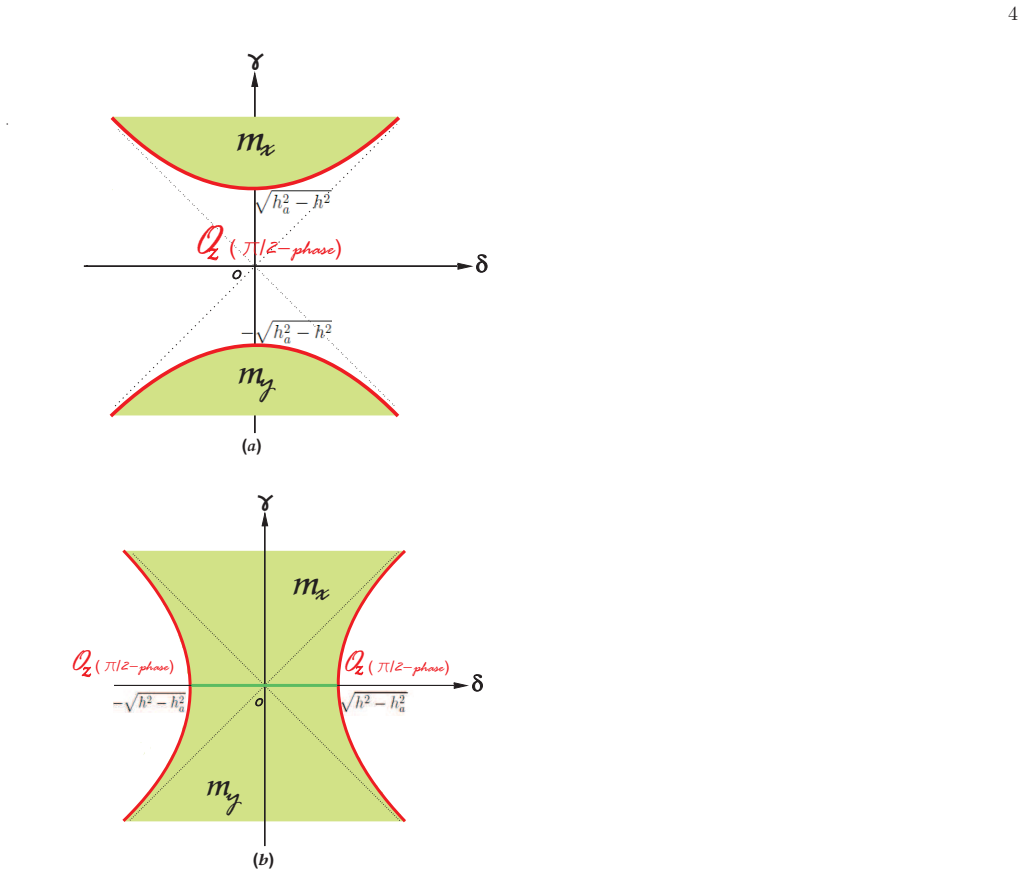
The paper establishes that, in the phase inside the circle $h^2+\gamma^2=h_a^2+\delta^2$, the $O_z$ string correlation function does not decay to a constant but approaches an alternating sequence of period four, with the asymptotic form depending on whether the string ends sit on even or odd sites. This corresponds to a modulated string order parameter with wavenumber $q=\pi/2$. The same calculation shows that in the paramagnetic phase the string correlation is positive and trivial, that in the ferromagnetic or antiferromagnetic phase it decays to zero, and that the only long-range order inside the circle is this modulated nonlocal string order. The topological winding number is $N_w=1$ in that phase and $N_w=0$ elsewhere, so the topologically nontrivial phase is characterized by the modulated string order. The paper presents explicit formulas for the spontaneous magnetizations, verifies their limiting analytical forms, and reports that numerical evaluation of the block Toeplitz determinants at finite size supports the modulated string order as a genuine thermodynamic-limit order parameter.
Load-bearing premise
The central result depends on the assumption that a finite-size numerical determinant, evaluated for a chain of 70 unit cells, correctly captures the infinite-chain long-range string order; the paper does not provide an analytic proof or error bars for this convergence.
Editorial extensions
If this is right
- If the $q=\pi/2$ modulated string order is real, the topological phase has a bulk nonlocal order parameter that survives in the thermodynamic limit, so the phase can be identified without relying on edge modes.
- The string order parameter enters through a second-order phase transition, so the topological phase boundary is a conventional quantum critical line whose critical exponents (2D Ising, except on the $\gamma=0$ incommensurate line) can be checked by scaling of the string correlation function.
- The local transverse magnetizations and their cusps still locate the phase boundaries, but they cannot serve as order parameters for the topological phase; the string order parameter is needed.
- The predicted period-four modulation of the string correlation function is a concrete signature that could be searched for in fabricated spin chains or cold-atom chains, where string correlations have been measured.
Reading between the lines
- If the same period-four modulated string order appears in interacting variants of the dimerized Kitaev chain, it could serve as a robust bulk signature of the topological phase even when free-fermion solvability is lost.
- The $q=\pi/2$ modulation likely reflects a hidden translation-symmetry-breaking pattern in the string variables, so the topological phase may carry additional order beyond the winding number; this could be probed through entanglement or reduced-density-matrix spectra.
- A direct numerical check at larger system sizes with an independent method would settle whether the finite-size determinants have converged, and an analytic evaluation of the block Toeplitz asymptote would place the result on a fully rigorous footing.
Signed reviews
Editorial analysis
A structured set of objections, weighed in public.
Referee Report
Summary. This paper analyzes the exactly solvable dimerized XY spin chain in uniform and staggered transverse fields, equivalently the dimerized Kitaev chain with a modulated chemical potential. The authors derive the single-particle spectrum, the phase diagram, field-induced magnetizations, spontaneous longitudinal magnetizations, string order parameters, and winding numbers. The central new claim is that the topologically nontrivial phase located inside the circle h^2+γ^2=h_a^2+δ^2 in Fig. 1 is characterized by a nonlocal string order parameter O_z with spatial modulation of wavenumber q=π/2, and that this order sets in via a second-order quantum phase transition. The order parameters are computed from Majorana correlation functions whose asymptotics are evaluated as finite-size block Toeplitz determinants (N=70 in Fig. 6), supplemented by analytic checks in the limits h_a=0 and h=h_a=0.
Significance. If the central claim survives scrutiny, the paper makes a useful contribution to the theory of nonlocal order in exactly solvable one-dimensional models: it identifies a modulated string order in a Kitaev-type chain and connects it to the topological phase, with no fitting parameters. The strengths are the systematic Bogoliubov/Majorana framework, the reproduction of known analytic limits (Pfeuty, Eq. (68); h=h_a=0, Eqs. (69) and (77)), and the explicit construction of the block Toeplitz determinants for both local and string correlations. The main risks are the purely numerical support for the infinite-size string-order asymptote and an incorrect printed formula for the winding number; both are addressable within the scope of a revision.
major comments (2)
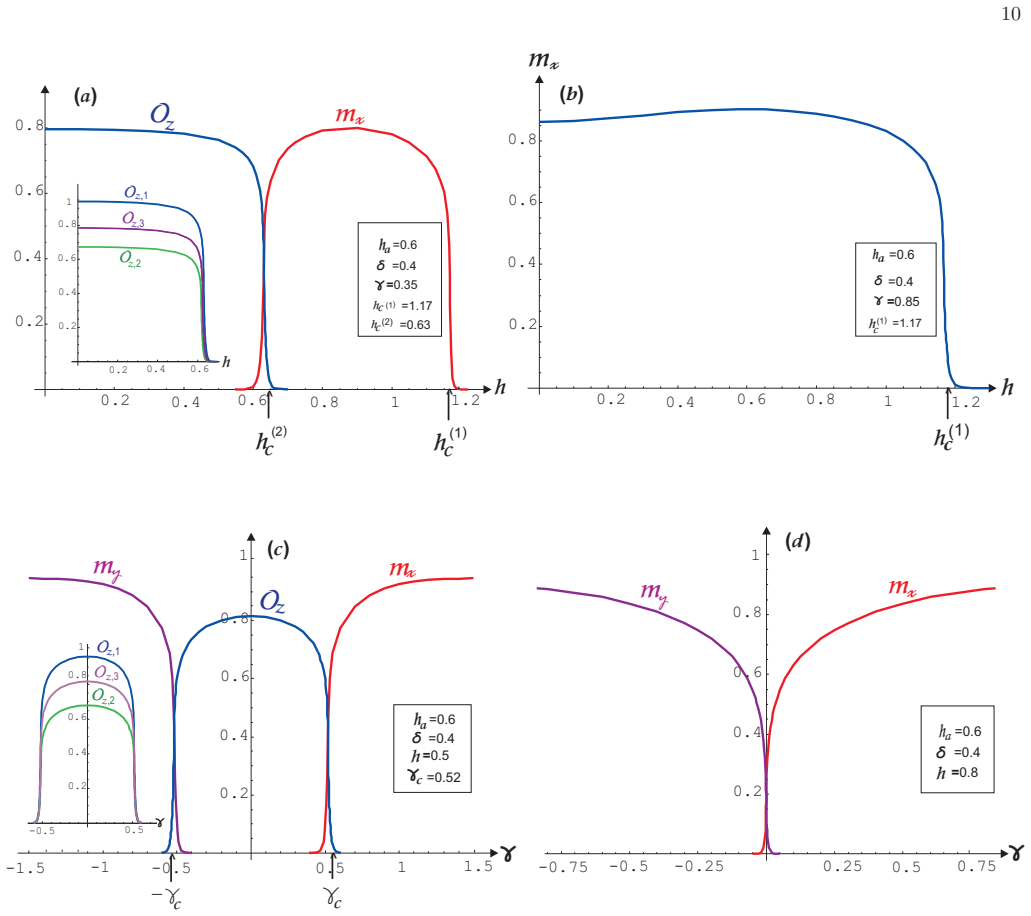
- [Section III.C and Fig. 6] The central claim of long-range q=π/2 modulated string order inside the circle rests on the block Toeplitz determinants (66) and (71) evaluated at N=70 (140×140 matrices), while the authors state in Sec. III.B that analytic asymptotics were not derived. A finite-size determinant can be nonzero even when its infinite-size limit vanishes, particularly near the critical lines where correlations decay algebraically. The stability statement for M≳30 in Sec. III.B and the smooth-decay check near critical points are useful but are not a quantitative convergence analysis for the string order parameter; the paper should provide an N-scaling study (e.g., O_z versus 1/N) and error estimates for representative paths, including points approaching the circle boundary, to justify the thermodynamic-limit extrapolation.
- [Section III.D, Eq. (82)] The printed winding-number formula is internally inconsistent: from Eq. (80) one has λ_+(k)+λ_-(k)=2h, independent of k, so the boundary term in Eq. (82) vanishes identically for h≠0 and is undefined at h=0; it cannot produce the reported value N_w=1 in Fig. 1. The winding number (81) must be evaluated from the phase of the product λ_+(k)λ_-(k), i.e., from det D(k), so Eq. (82) needs to be corrected and the N_w values for all phases re-derived from the corrected expression.
minor comments (4)
- [Fig. 6 caption] The plotted O_z is described as the average of the three parameters O_{z,i}, but O_{z,i} are independent sector amplitudes; please define the physical string order parameter explicitly and show the individual O_{z,i} for a representative point in the topological phase.
- [Sec. III.B] The notation M≳30 is garbled as 'M /greaterorsimilar30' in the manuscript; please fix the typesetting and specify whether M refers to N or to the full 2N×2N matrix.
- [Eqs. (25), (26), (41)] The meaning of cos2k should be clarified (cos^2 k versus cos 2k); the current notation is ambiguous and appears in several formulas.
- [Abstract] The phrase 'awaiting for its experimental confirmation' is speculative; the conclusion is more careful, but the abstract should perhaps read 'which could be tested experimentally' or similar.
Circularity Check
No circularity: order parameters are computed directly from the Hamiltonian via Toeplitz determinants; self-citations are supporting checks, not load-bearing inputs.
full rationale
No circular step is present. The string/local order parameters are evaluated from the Majorana two-point functions (48)-(53), obtained by direct Bogoliubov diagonalization of the Hamiltonian, and the Toeplitz determinants (66)/(71) contain no fitted parameters and assume no target asymptote. The analytical limits used as checks—Pfeuty's m_x^2 (68), the h=0 duality result (69), and the h=h_a=0 SOP (77)—are independent benchmarks; even though (69)/(77) are taken from the authors' earlier refs. 13 and 14, they are parameter-free results with stated assumptions, and the paper verifies them against its own numerical determinants rather than using them as inputs. The self-citations to refs. 13 and 14 supply definitions and duality relations, not the q=pi/2 claim. The q=pi/2 modulated order is extracted from the numerical plateau of the determinant at N=70; this is a finite-size support limitation, not circularity. The paper itself flags this in Sec. III.B: "At this point we were unable to derive analytical results for asymptotics of the above block Toeplitz determinants. So we resort to direct numerical calculations for large finite-size matrices." Separately, Eq. (82) as printed is internally inconsistent: with lambda_plus/minus(k) from Eq. (80), lambda_plus(k)+lambda_minus(k)=2h is k-independent, so the argument-difference formula cannot yield the reported Nw=1. That is a correctness/typo concern, not a circularity. No fitted quantity is renamed as a prediction, and no self-citation chain forces the central result.
Assumptions & free parameters
assumptions (5)
- standard math The Jordan-Wigner transformation maps Hamiltonian (1) to the free-fermion Hamiltonian (2) without additional approximations.
- domain assumption The phase diagram boundaries given by Eqs. (19)-(21) from Perk et al. are correct.
- ad hoc to paper The thermodynamic limit of finite-size block Toeplitz determinants (N=70) gives the true long-range order parameter asymptote.
- standard math The Bogoliubov matrices Phi and Psi constructed from eigenvectors of (A+/-B)(A-/+B) satisfy the required unitarity and reality conditions.
- domain assumption The universality class of the transitions is 2D Ising (except the IC line) inferred from the free-fermion spectrum and gap structure.
Cite this review
Pith. "Pith review of String and conventional order parameters in the solvable modulated quantum chain." pith.science (2026). https://pith.science/paper/CTSHYL67
@misc{pith2026190806962,
  author       = {Pith},
  title        = {Pith review of: String and conventional order parameters in the solvable modulated quantum chain},
  year         = {2026},
  howpublished = {\url{https://pith.science/paper/CTSHYL67}},
  note         = {Machine review of arXiv:1908.06962}
}
abstract
The phase diagram and the order parameters of the exactly solvable quantum 1D model are analysed. The model in its spin representation is the dimerized XY spin chain in the presence of uniform and staggered transverse fields. In the fermionic representation this model is the dimerized non-interacting Kitaev chain with a modulated chemical potential. The model has a rich phase diagram which contains phases with local and non-local (string) orders. We have calculated within the same systematic framework the local order parameters (spontaneous magnetization) and the non-local string order parameters, along with the topological winding numbers for all domains of the phase diagram. The topologically nontrivial phase is shown to have a peculiar oscillating string order with the wavenumber $q=\pi/2$, awaiting for its experimental confirmation.
Figures

Figures from the paper (2 more)
Reference graph
Works this paper leans on
-
[1]
L.D. Landau and E.M. Lifshitz, Statistical Physics Part 1. Course of Theoretical Physics Vol. 5 , 3rd ed., (Butterworth-Heinemann, Oxford, 1980)
work page 1980
-
[2]
E. Fradkin, Field Theories of Condensed Matter Physics, 2nd edition (Cambridge University Press, New York, 2013)
work page 2013
-
[3]
B.A. Bernevig and T.L. Hughes, Topological Insulators and Topological Superconductors (Princeton University Press, Princeton, 2013)
work page 2013
- [4]
-
[5]
Montorsi and M
A. Montorsi and M. Roncaglia, Phys. Rev. Lett. 109, 236404 (2012)
2012
-
[6]
M. Oshikawa, J. Phys. Condens. Matt. 4, 7469 (1992); T. Kennedy and H. Tasaki, Phys. Rev. B 45, 304 (1992); M. Kohmoto and H. Tasaki, Phys. Rev. B 46, 3486 (1992)
work page 1992
-
[7]
H. Watanabe, Phys. Rev. B 52 , 12508 (1995); Y. Nishiyama, N. Hatano and M. Suzuki, J. Phys. Soc. Jpn. 64 , 1967 (1995); D. G. Shelton, A. A. Nersesyan, and A. M. Tsvelik, Phys. Rev. B 53, 8521 (1996)
work page 1995
-
[8]
Kitaev, Ann
A. Kitaev, Ann. Phys. 321, 2 (2006)
2006
Show all 56 references
-
[9]
Martin-Delgado, R
M.A. Martin-Delgado, R. Shankar, and G. Sierra, Phys. Rev. Lett. 77, 3443 (1996); M.A. Martin-Delgado, J. Dukelsky, and G. Sierra, Phys. Lett. A 250, 430 (1998); J. Almeida, M.A. Martin-Delgado, and G. Sierra, Phys. Rev. B 76, 184428 (2007); ibid 77, 094415 (2008); J. Phys. A ...
1996
-
[10]
E.H. Kim, G. Fath, J. Solyom, and D. J. Scalapino, Phys. Rev. B 62, 14965 (2000); G. Fath, O. Legeza, and J. Solyom, Phys. Rev. B 63 , 134403 (2001); E.H. Kim, O. Legeza, and J. Solyom, Phys. Rev. B 77, 205121 (2008)
2000
-
[11]
Gibson, R
S.J. Gibson, R. Meyer, and G.Y. Chitov, Phys. Rev. B 83, 104423 (2011); G.Y. Chitov, B.W. Ramakko, and M. Azzouz, Phys. Rev. B 77, 224433 (2008); M. Azzouz, K. Shahin, and G.Y. Chitov, Phys. Rev. B 76, 132410 (2007)
2011
-
[12]
Catuneanu, E.S
A. Catuneanu, E.S. S rensen, and H.-Y. Kee, Phys. Rev. B 99, 195112 (2019); C.E. Agrapidis, J. van den Brink, and S. Nishimoto, Phys. Rev. B 99, 224418 (2019)
2019
-
[13]
Chitov and T
G.Y. Chitov and T. Pandey, J. Stat. Mech. (2017) 043101
2017
-
[14]
Chitov, Phys
G.Y. Chitov, Phys. Rev. B 97, 085131 (2018)
2018
-
[15]
den Nijs and K
M. den Nijs and K. Rommelse, Phys. Rev. B 40, 4709 (1989)
1989
-
[16]
Kogut, Rev
J.B. Kogut, Rev. Mod. Phys. 51, 659 (1979)
1979
-
[17]
Chen and J
H.-D. Chen and J. Hu, Phys. Rev. B 76, 193101 (2007)
2007
-
[18]
Feng, G.-M
X.-Y. Feng, G.-M. Zhang, and T. Xiang, Phys. Rev. Lett. 98, 087204 (2007)
2007
-
[19]
Chen and Z
H.-D. Chen and Z. Nussinov, J. Phys. A: Math. Theor. 41, 075001 (2008); E. Cobanera, G. Ortiz, and Z. Nussinov Phys. Rev. B 87, 041105(R) (2013)
2008
-
[20]
Berg, E.G
E. Berg, E.G. Dalla Torre, T. Giamarchi, and E. Altman, Phys. Rev. B 77, 245119 (2008)
2008
-
[21]
S.P. Rath, W. Simeth, M. Endres, and W. Zwerger, Annals of Physics 334, 256 (2013)
2013
-
[22]
Endres, et al, Science 334, 200 (2011)
M. Endres, et al, Science 334, 200 (2011)
2011
-
[23]
Perk, H.W
J.H.H. Perk, H.W. Capel, M.J. Zuilhof, and Th. J. Siskens, Physica A 81, 319 (1975)
1975
-
[24]
Dutta, G
A. Dutta, G. Aeppli, B.K. Chakrabarti, U. Divakaran, T.F. Rosenbaum, and D. Sen, Quantum Phase Transitions in Transverse Field Spin Models: From Statistical Physics to Quantum Information (Cambridge University Press, New Delhi, 2015)
2015
-
[25]
Kitaev, Usp
A. Kitaev, Usp. Fiz. Nauk (Suppl.) 44, 131 (2001)
2001
-
[26]
DeGottardi, D
W. DeGottardi, D. Sen, and S. Vishveshwara, New J. Phys. 13, 065028 (2011); Phys. Rev. Lett. 110, 146404 (2013)
2011
-
[27]
Lang and S
L.-J. Lang and S. Chen, Phys. Rev. B 86, 205135 (2012)
2012
-
[28]
Cai, L.-J
X. Cai, L.-J. Lang, S. Chen, and Y. Wang, Phys. Rev. Lett. 110, 176403 (2013); X. Cai, J. Phys.: Condens. Matter 26, 155701 (2014)
2013
-
[29]
Wakatsuki, M
R. Wakatsuki, M. Ezawa, Y. Tanaka, and N. Nagaosa, Phys. Rev. B 90, 014505 (2014)
2014
-
[30]
Q.-B. Zeng, S. Chen, R. L\" u , Phys. Rev. B 94, 125408 (2016)
2016
-
[31]
Miao, H.-K
J.-J. Miao, H.-K. Jin, F.-C. Zhang, and Y. Zhou, Phys. Rev. Lett. 118, 267701 (2017)
2017
-
[32]
Ezawa, Phys
M. Ezawa, Phys. Rev. B 96, 121105(R) (2017)
2017
-
[33]
Wang, J.-J
Y. Wang, J.-J. Miao, H.-K. Jin, and S. Chen, Phys. Rev. B 96, 205428 (2017)
2017
-
[34]
Ohta and K
T. Ohta and K. Totsuka, J. Phys. Soc. Jpn. 85, 074003 (2016)
2016
-
[35]
Ghadimi, T
R. Ghadimi, T. Sugimoto, and T. Tohyama, J. Phys. Soc. Jpn. 86, 11407 (2017)
2017
-
[36]
Katsura, D
H. Katsura, D. Schuricht, and M. Takahashi, Phys. Rev. B 92, 115137 (2015); K. Kawabata, R. Kobayashi, N. Wu, and H. Katsura, Phys. Rev. B 95, 195140 (2017)
2015
-
[37]
Monthus, J
C. Monthus, J. Phys. A: Math. Theor. 51, 465301 (2018)
2018
-
[38]
Wang, Phys
Y. Wang, Phys. Rev. E 98, 042128 (2018)
2018
-
[39]
Ye, G.-H
F. Ye, G.-H. Ding, and B.-W. Xu, Commun. Theor. Phys. (Beijing, China) 37, 492 (2002); F. Ye and B.-W. Xu, Commun. Theor. Phys. (Beijing, China) 39, 487 (2003)
2002
-
[40]
de Lima, L.L
J.P. de Lima, L.L. Gon c alves, and T.F.A. Alves, Phys. Rev. B 75, 214406 (2007)
2007
-
[41]
Divakaran, A
U. Divakaran, A. Dutta, and D. Sen, Phys. Rev. B 78, 144301 (2008)
2008
-
[42]
E.H. Lieb, T. Schultz, and D. Mattis, Ann. Phys. (N.Y.) 16, 407 (1961)
1961
-
[43]
Franchini, An Introduction to Integrable Techniques for One-Dimensional Quantum Systems, Lecture Notes in Physics 940, (Springer, Heidelberg, 2017)
F. Franchini, An Introduction to Integrable Techniques for One-Dimensional Quantum Systems, Lecture Notes in Physics 940, (Springer, Heidelberg, 2017)
2017
-
[44]
Capel and J.H.H
H.W. Capel and J.H.H. Perk, Physica A 87, 211 (1977). For more literature and a recent overview on such transformation and dual n -cluster Hamiltonians, see J.H.H. Perk, arXiv:1710.03384
1977 arXiv
-
[45]
Fradkin and L
E. Fradkin and L. Susskind, Phys. Rev. D 17, 2637 (1978)
1978
-
[46]
Widom, Adv
H. Widom, Adv. Math. 21(1), 1 (1976)
1976
-
[47]
Basor, J
E. Basor, J. Dubail, T. Emig, and R. Santachiara, J. Stat. Phys. 174, 28 (2019)
2019
-
[48]
Pfeuty, Ann
P. Pfeuty, Ann. Phys. (N.Y.) 57, 79 (1970)
1970
-
[49]
McCoy, Advanced Statistical Mechanics (Oxford University Press, New York, 2010)
B.M. McCoy, Advanced Statistical Mechanics (Oxford University Press, New York, 2010)
2010
-
[50]
Wu, Phys
N. Wu, Phys. Lett. A 376, 3530 (2012)
2012
-
[51]
Y. Niu, S. B. Chung, C.-H. Hsu, I. Mandal, S. Raghu, and S. Chakravarty, Phys. Rev. B 85, 035110 (2012)
2012
-
[52]
Schnyder and S
A.P. Schnyder and S. Ryu, Phys. Rev. B 84, 060504(R) (2011)
2011
-
[53]
It belongs to the different universality class of the conformal charge c=1
The exception is the IC critical line when = 0 . It belongs to the different universality class of the conformal charge c=1 . (The 2D Ising belongs to the c= 12 class)
-
[54]
It takes about 1-2 minutes per point for 140 140 matrix size
In this work we used Mathematica to calculate block Toeplitz determinants. It takes about 1-2 minutes per point for 140 140 matrix size
-
[55]
A similar identity can be derived for the spins on even sites: eqnarray _ 2m ^x _ 2n ^x &=& O_ x,e (m) O_ x,e (n) O_ x,o (m-1) O_ x,o (n-1) \\ &=& _ 2m ^x _ 2n ^x _ 2m-1 ^x _ 2n-1 ^x SigOtauEven eqnarray
-
[56]
Instead, GT2017 it is easier to apply the duality transformations ( sigmaX , sigmaY ) with the interchange x y
In analytical work it is not convenient to deal with O_ y,e/o as strings of dual spins Oye , Oyo . Instead, GT2017 it is easier to apply the duality transformations ( sigmaX , sigmaY ) with the interchange x y . Then the r.h.s. of Eqs. Oye and Oyo become _ 0 ^y _ 2m ^y and _ 1...
Reviewed August 14, 2026 · model on record in the stance chip above.
Discussion (0). Continue with ORCID to comment.