REVIEW 2 major objections 3 minor 2 cited by
Reviving Millicharged Dark Matter for 21-cm Cosmology
T0 review · 2 major / 3 minor · reviewed 2026-08-14 · deepseek-v4-flash
Pith's one-line read A long-range force between a tiny millicharged dark-matter fraction and a cold dark-matter bath can cool the early-universe gas enough to explain the EDGES 21-cm absorption anomaly.
desk verdict The CDM heat-sink mechanism is a genuinely new idea that deserves referee time, but the high-mass contours rest on an unproven sign assumption about non-Born atom scattering. read the letter →
The pith
A machine-rendered reading of the paper's core claim, the machinery that carries it, and where it could break.
The reading
What carries the argument
The load-bearing device is the replacement of the two-bath cooling problem with a three-bath one. The paper writes temperature and bulk-velocity evolution equations for baryons, mDM, and CDM, with transfer cross sections of the Rutherford form $\sigma_T\propto v_{\rm rel}^{-4}$ for both mDM-baryon and mDM-CDM scattering; the mDM-baryon cross section is regulated by the plasma Debye mass, the mDM-CDM cross section by a sub-keV dark mediator. The key parametric identity is the heat-capacity bound: the cooling bath must stay cool enough to absorb the heat. In the standard mDM scenario this bound gives $m_m\lesssim 67$ MeV at $f_m=0.4\%$; with the CDM bath as heat sink the analytic bound becomes $m_C\lesssim 18$ GeV, and the full numerical treatment places the viable CDM mass around a few GeV. A second ingredient is the loop-induced CDM-SM coupling: in a vector-portal realization, a loop of mDM generates mixing between the dark mediator and the photon, giving a CDM-electron cross section that depends on the millicharged mass splitting and sets the direct-detection target.
What would settle it
A full quantum-mechanical computation of mDM scattering off neutral hydrogen and helium at cosmic-dawn relative velocities ($v_{\rm rel}\sim 10^{-6}$) that yields a cooling rate below the Born-approximation estimate would falsify the paper's EDGES-fit contours; conversely, a null SENSEI-100g one-year search at the predicted loop-induced CDM-electron cross section in the 10 MeV-to-few-GeV CDM mass window would rule out the benchmark vector-portal realization.
Extended reading notes
Core claim
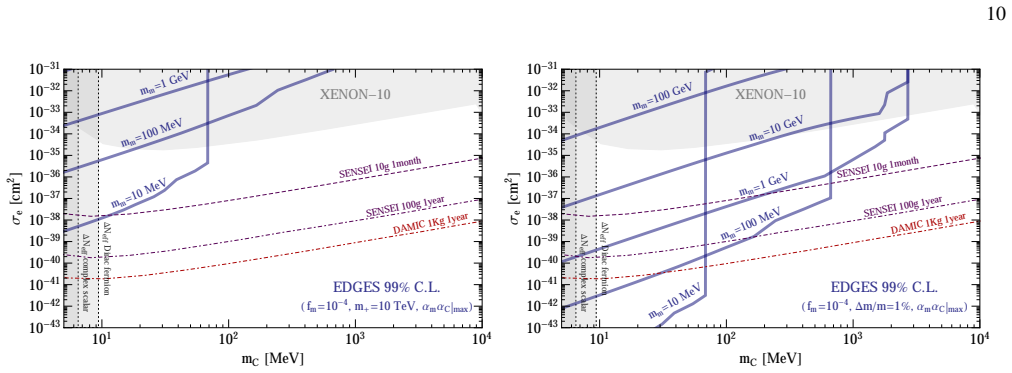
The central claim is that a millicharged dark-matter (mDM) subcomponent that also interacts with the dominant cold dark-matter (CDM) bath through a new long-range force can cool baryons efficiently enough to explain the anomalous 21-cm absorption reported by EDGES, without violating CMB, BBN, or collider bounds. The mechanism is a three-fluid thermal system: Rutherford-like $\sigma_T\propto v_{\rm rel}^{-4}$ scattering moves heat from baryons to mDM, and the same velocity-enhanced scattering moves it onward to a CDM bath whose much larger number density supplies the heat capacity. With the mDM-CDM coupling set below the CMB drag bound, the allowed mDM mass extends to $m_m\lesssim 200$ GeV and the mDM fraction down to $f_m\sim 10^{-8}$, while the CDM mass is bracketed by BBN at $m_C\gtrsim 10$ MeV and by a heat-capacity bound near a few GeV. The CDM acquires an electron-scattering cross section through an mDM loop that, in the minimal vector-portal model, lies below current XENON-10 and SENSEI limits but within reach of future SENSEI and DAMIC exposures.
Load-bearing premise
The paper assumes that the breakdown of the Born approximation for millicharged particles scattering off neutral hydrogen and helium, where resonances and bound states can form, will only increase the low-velocity cooling rate and therefore enlarge the viable parameter space; if a full quantum treatment instead suppressed that rate, the EDGES-fit contours and the derived direct-detection predictions would shift.
Editorial extensions
If this is right
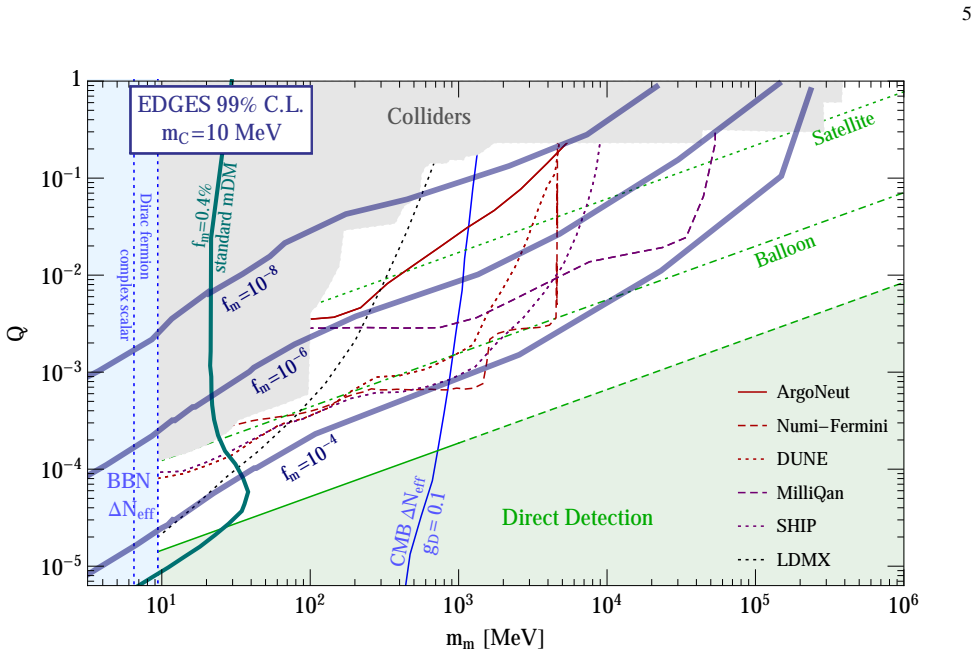
- If the scenario is correct, the millicharged component can be as rare as $10^{-8}$ of the dark matter and as heavy as roughly 200 GeV, with charges $Q$ between $10^{-5}$ and 1 in a window above direct-detection limits and below collider bounds.
- The dominant cold dark matter must weigh between about 10 MeV and a few GeV, because a lighter or heavier CDM cannot satisfy BBN and simultaneously absorb enough heat to produce the required baryon cooling.
- The mDM loop that gives CDM its Standard-Model coupling produces a CDM-electron recoil cross section that near-future SENSEI and DAMIC exposures should be able to probe or exclude in minimal models.
- Beam-dump and collider searches for millicharged particles, together with balloon- or satellite-borne single-electron-threshold detectors, can cover much of the allowed charge-mass plane, so the explanation is testable rather than merely consistent.
- The same long-range mDM-CDM force induces CDM self-interactions, giving an independent observable consequence bounded by colliding-cluster and cluster-ellipticity constraints.
Reading between the lines
- Beyond the paper: the heat-sink trick should generalize to any subdominant dark-matter component with a velocity-enhanced scattering rate to baryons, not only a millicharged one, as long as a dominant cold bath with large number density is present.
- Beyond the paper: the loop-induced CDM cross section's sensitivity to the millicharged mass splitting means a positive CDM direct-detection signal would constrain the internal spectrum of the millicharged sector, turning a cosmology anomaly into a spectroscopy tool.
- Beyond the paper: the paper saturates the mDM-CDM coupling at the CMB bound when presenting direct-detection targets; if that coupling is smaller by orders of magnitude, the predicted CDM cross section drops by up to two orders of magnitude, so a null direct-detection result would not rule out the cooling mechanism itself.
- Beyond the paper: a future measurement of the full 21-cm absorption trough shape, not just its depth, could distinguish this three-bath cooling from an excess radio background or other new-physics explanations, because the cooling turns on sharply when the ionization fraction falls.
Editorial analysis
A structured set of objections, weighed in public.
Referee Report
Summary. The paper proposes a dark sector in which a small millicharged dark matter (mDM) component is coupled to the dominant cold dark matter (CDM) component through a new long-range force. The CDM acts as a large heat sink, making baryon cooling at cosmic dawn much more efficient than in the standard mDM scenario. Using analytic scaling arguments and a numerical three-fluid treatment based on a published code (Ref. [59]), the authors show that the mDM mass range extends to roughly 10 MeV–200 GeV, the mDM fraction can be as small as 10^-8, and the scenario can explain the EDGES 99% CL absorption feature. They further derive a loop-induced CDM–electron scattering cross section that falls within the reach of near-future low-threshold direct detection experiments.
Significance. If established, this is a significant contribution: it revives millicharged DM as a viable explanation of the EDGES anomaly while opening a broad and testable parameter region, with distinctive signatures in beam-dump and low-threshold direct-detection experiments. The analytic parametric understanding of the heat-capacity mechanism is a clear strength, and the numerical framework is grounded in a published code. The authors are also transparent about the main limitations of their analysis, including the Born approximation for atom scattering and the heuristic nature of the CMB constraint recast. The central heat-capacity argument is robust. However, two load-bearing approximations currently control the quantitative contours in Fig. 2 and the direct-detection predictions in Fig. 4, so the quantitative claims should be strengthened before the paper reaches its final form.
major comments (2)
- [Sec. IVD and App. B2] The statement that beyond-Born corrections to mDM–neutral atom scattering 'will only enhance the mDM-baryon scattering rate, thereby enlarging the viable parameter space further' is an assumption, not a derivation. The Born self-consistency condition in Eq. (B16) is badly violated at the low relative velocities relevant near z ~ 17 for the large-Q, heavy-mDM region, and Sec. IVD states that atom scattering changes the required Q by O(5) for mDM masses above 100 MeV. Low-energy scattering off a finite-range neutral atom need not follow the v^-4 Born extrapolation: without a near-threshold resonance the rate can saturate, and inelastic channels can deplete the elastic channel. Since the fm = 10^-8 contour in Fig. 2 and the claimed extension to masses of ~200 GeV rely on this sign, a full quantum computation, or at least a concrete estimate of the size and sign of the correction, is needed before the quantitative claims can be taken as established. This does not undercut the heat-capacity argument itself, but it directly controls the outer contours of the claimed parameter space.
- [App. C2, Eqs. (C17)–(C20), and Fig. 2] The recast CMB constraint relies on the 'heuristic' 0.1 safety factor introduced after Eq. (C20). This bound fixes the maximal αmαC used for the Fig. 2 contours and, via Eq. (21), the CDM direct-detection cross sections shown in Fig. 4. Because no dedicated CMB analysis is provided, the quantitative location of the contours and the predicted CDM cross sections carry an unquantified systematic. The paper should either provide a dedicated CMB analysis or a sensitivity study showing how Fig. 2 and Fig. 4 shift when the 0.1 factor is varied over a reasonable range (for example, from 1 to 0.01). A statement that a full analysis would 'likely relax' the bound is useful context but does not quantify the impact on the results.
minor comments (3)
- [Around Eq. (C20)] The definition of αmαC|max would be clearer if the heuristic 0.1 safety factor appeared explicitly in the equation itself rather than only in the surrounding text.
- [Fig. 2, dashed green line] The dashed green line is described as an extrapolation of the results of Ref. [47] to higher masses; stating the assumed energy-loss model and its uncertainty in the caption would improve reproducibility.
- [Eq. (21) and abstract] The direct-detection cross section in Eq. (21) is a benchmark-dependent quantity: the numerical values in Fig. 4 assume a specific UV completion (m+ = 10 TeV in the left panel, or a 1% mass splitting) and the maximal αmαC allowed by the heuristic CMB recast. The text states these assumptions, but the abstract's 'testable predictions' could be read more strongly; a qualifier such as 'within the benchmark models considered' would be appropriate.
Circularity Check
No significant circularity: the EDGES fit is treated as an input condition, and the CDM direct detection cross section is a derived consequence of the fitted parameters, not the quantity being fit.
full rationale
The paper's central derivation chain is self-contained and not circular. The mDM charge Q and fraction f_m contours in Fig. 2 are explicitly obtained by requiring the baryon cooling to match the EDGES 99% CL absorption signal; this is a fit to an external observable, not a hidden input. The framework's new ingredient, a long-range mDM-CDM interaction, is analyzed from the thermodynamic equations in App. A-C, with the mDM-CDM cross section given by Eq. (14) and the heat-capacity argument bounding m_C in Eq. (17). The CDM direct detection cross section in Eq. (21) is computed from the loop-induced mixing of App. D using the values of Q and alpha_m alpha_C that were chosen to fit EDGES and saturate the CMB bound; this is a model-dependent consequence of those fitted parameters, not a renaming of the EDGES input. The paper does not claim a parameter-free prediction of the 21-cm signal; rather it maps parameters that explain EDGES onto distinct observables. The treatment of mDM-atom scattering beyond the Born approximation in Sec. IVD and App. B2 assumes that full quantum corrections 'will only enhance the mDM-baryon scattering rate'; this is an untested sign assumption about neglected physics, but it is not a circular reduction of the derivation to its inputs. The self-citations to Refs. [7, 47, 59, 60] provide established methods or independent numerical frameworks and do not carry the load of the central claim. Overall, no load-bearing step reduces by construction to its own inputs.
Assumptions & free parameters
free parameters (8)
- Q =
10^-5 to 1 (scanned)
- fm =
10^-8 to 0.004 (scanned)
- mm =
10 MeV to 200 GeV (scanned)
- mC =
10 MeV to a few GeV (scanned; fixed to 10 or 100 MeV in benchmark plots)
- alpha_m alpha_C =
maximal value allowed by Eq. (C20), e.g. 4e-16 or 2e-15 in benchmarks
- mediator mass m_phi =
< keV (assumed)
- m+ (UV cutoff) =
10 TeV in Fig. 4 left panel
- Delta_m/m (mass splitting) =
10^-2 in Fig. 4 right panel
assumptions (6)
- domain assumption mDM and CDM are in thermal equilibrium with the SM at early times.
- domain assumption mDM is tightly coupled to baryons before recombination, so the CMB constraint can be recast as Eq. (19).
- ad hoc to paper The Born approximation describes mDM-atom scattering at the redshifts relevant for the EDGES fit, and beyond-Born corrections only increase the cooling rate.
- standard math The transfer cross section is given by the classical Rutherford formula with Debye screening, Eq. (10).
- domain assumption Annihilation heating of the baryon or dark sector fluids is negligible in the parameter space considered.
- domain assumption T_gamma is the standard CMB temperature at z=17; no exotic photon heating.
invented entities (1)
-
Light vector mediator V (or scalar) mediating a long-range force between mDM and CDM
independent evidence
Cite this review
Pith. "Pith review of Reviving Millicharged Dark Matter for 21-cm Cosmology." pith.science (2026). https://pith.science/paper/ZGQ5EDMA
@misc{pith2026190806986,
  author       = {Pith},
  title        = {Pith review of: Reviving Millicharged Dark Matter for 21-cm Cosmology},
  year         = {2026},
  howpublished = {\url{https://pith.science/paper/ZGQ5EDMA}},
  note         = {Machine review of arXiv:1908.06986}
}
abstract
The existence of millicharged dark matter (mDM) can leave a measurable imprint on 21-cm cosmology through mDM-baryon scattering. However, the minimal scenario is severely constrained by existing cosmological bounds on both the fraction of dark matter that can be millicharged and the mass of mDM particles. We point out that introducing a long-range force between a millicharged subcomponent of dark matter and the dominant cold dark matter (CDM) component leads to efficient cooling of baryons in the early universe, while also significantly extending the range of viable mDM masses. Such a scenario can explain the anomalous absorption signal in the sky-averaged 21-cm spectrum observed by EDGES, and leads to a number of testable predictions for the properties of the dark sector. The mDM mass can then lie between 10 MeV and a few hundreds of GeVs, and its scattering cross section with baryons lies within an unconstrained window of parameter space above direct detection limits and below current bounds from colliders. In this allowed region, mDM can make up as little as $10^{-8}$ of the total dark matter energy density. The CDM mass ranges from 10 MeV to a few GeVs, and has an interaction cross section with the Standard Model that is induced by a loop of mDM particles. This cross section is generically within reach of near-future low-threshold direct detection experiments.
Figures


Figures from the paper (4 more)


Forward citations
Cited by 2 Pith papers
-
Constraints on millicharged particles from nuclear gamma-decays
Nuclear gamma cascades in reactors produce millicharged particle pairs, giving the strongest constraints on millicharge for masses between 0.7 and 2 MeV.
-
Constraints on Strongly-Interacting Dark Matter from the James Webb Space Telescope
JWST NIRSpec dark calibration images exclude previously allowed high-cross-section parameter space for sub-GeV dark matter coupled to an ultralight dark photon, for subcomponent fractions as low as about 0.01%.
Reference graph
Works this paper leans on
-
[59]
H. Liu, G. W. Ridgway, and T. R. Slatyer, (2019), arXiv:1904.09296 [astro-ph.CO]
arXiv 2019
-
[1]
H. Tashiro, K. Kadota, and J. Silk, Phys. Rev.D90, 083522 (2014), arXiv:1408.2571 [astro-ph.CO]
arXiv 2014
-
[2]
J. B. Muñoz, E. D. Kovetz, and Y. Ali-Haïmoud, Phys. Rev. D92, 083528 (2015), arXiv:1509.00029 [astro-ph.CO]
arXiv 2015
-
[3]
A. Loeb and M. Zaldarriaga, Phys. Rev. Lett.92, 211301 (2004), arXiv:astro-ph/0312134 [astro-ph]
arXiv 2004
-
[4]
E. G. Adelberger, B. R. Heckel, and A. E. Nelson, Ann. Rev. Nucl.Part.Sci. 53,77(2003),arXiv:hep-ph/0307284[hep-ph]
arXiv 2003
- [5]
-
[6]
H. An, M. Pospelov, J. Pradler, and A. Ritz, Phys. Lett.B747, 331 (2015), arXiv:1412.8378 [hep-ph]
arXiv 2015
-
[7]
Rev.D98, 103005 (2018), arXiv:1803.03091 [hep-ph]
R.Barkana,N.J.Outmezguine,D.Redigolo, andT.Volansky, Phys. Rev.D98, 103005 (2018), arXiv:1803.03091 [hep-ph]
arXiv 2018
Show all 111 references
-
[8]
J. B. Muñoz and A. Loeb, (2018), arXiv:1802.10094 [astro- ph.CO]
2018 arXiv
-
[9]
Barkana, Nature555, 71 (2018)
R. Barkana, Nature555, 71 (2018)
2018
-
[10]
Berlin, D
A. Berlin, D. Hooper, G. Krnjaic, and S. D. McDermott, (2018), arXiv:1803.02804 [hep-ph]
2018 arXiv
-
[11]
D’Amico, P
G. D’Amico, P. Panci, and A. Strumia, Phys. Rev. Lett.121, 011103 (2018), arXiv:1803.03629 [astro-ph.CO]
2018 arXiv
-
[12]
Liu and T
H. Liu and T. R. Slatyer, Phys. Rev.D98, 023501 (2018), arXiv:1803.09739 [astro-ph.CO]
2018 arXiv
-
[13]
Mitridate and A
A. Mitridate and A. Podo, JCAP 1805, 069 (2018), arXiv:1803.11169 [hep-ph]
2018 arXiv
-
[14]
S. L. Dubovsky, D. S. Gorbunov, and G. I. Rubtsov, JETP Lett. 79, 1 (2004), [Pisma Zh. Eksp. Teor. Fiz.79,3(2004)], arXiv:hep-ph/0311189 [hep-ph]
2004 arXiv
-
[15]
Rev.D88, 117701 (2013), arXiv:1310.2376 [hep-ph]
A.D.Dolgov,S.L.Dubovsky,G.I.Rubtsov, andI.I.Tkachev, Phys. Rev.D88, 117701 (2013), arXiv:1310.2376 [hep-ph]
2013 arXiv
-
[16]
Kamionkowski, Phys
E.D.Kovetz,V.Poulin,V.Gluscevic,K.K.Boddy,R.Barkana, and M. Kamionkowski, Phys. Rev. D98, 103529 (2018), arXiv:1807.11482 [astro-ph.CO]
2018 arXiv
-
[17]
de Putter, O
R. de Putter, O. Doré, J. Gleyzes, D. Green, and J. Meyers, Phys.Rev.Lett. 122,041301(2019),arXiv:1805.11616[astro- ph.CO]
2019 arXiv
-
[18]
K. K. Boddy, V. Gluscevic, V. Poulin, E. D. Kovetz, M. Kamionkowski, and R. Barkana, Phys. Rev.D98, 123506 (2018), arXiv:1808.00001 [astro-ph.CO]
2018 arXiv
-
[19]
Creque-Sarbinowski, L
C. Creque-Sarbinowski, L. Ji, E. D. Kovetz, and M. Kamionkowski, (2019), arXiv:1903.09154 [astro-ph.CO]
2019 arXiv
-
[20]
Mahesh, Nature555, 67 (2018)
J.D.Bowman,A.E.E.Rogers,R.A.Monsalve,T.J.Mozdzen, and N. Mahesh, Nature555, 67 (2018)
2018
-
[21]
Boehm, M
C. Boehm, M. J. Dolan, and C. McCabe, JCAP1308, 041 (2013), arXiv:1303.6270 [hep-ph]
2013 arXiv
-
[22]
R.Essig,A.Manalaysay,J.Mardon,P.Sorensen, andT.Volan- sky, Phys. Rev. Lett.109, 021301 (2012), arXiv:1206.2644 [astro-ph.CO]
2012 arXiv
-
[23]
Essig, T
R. Essig, T. Volansky, and T.-T. Yu, Phys. Rev.D96, 043017 (2017), arXiv:1703.00910 [hep-ph]
2017 arXiv
-
[24]
Abramoffet al.(SENSEI), Phys
O. Abramoffet al.(SENSEI), Phys. Rev. Lett.122, 161801 (2019), arXiv:1901.10478 [hep-ex]
2019 arXiv
-
[25]
Battaglieriet al., inU.S
M. Battaglieriet al., inU.S. Cosmic Visions: New Ideas in Dark Matter College Park, MD, USA, March 23-25, 2017 (2017) arXiv:1707.04591 [hep-ph]
2017 arXiv
-
[26]
J. L. Feng, M. Kaplinghat, H. Tu, and H.-B. Yu, JCAP0907, 004 (2009), arXiv:0905.3039 [hep-ph]
2009 arXiv
-
[27]
Kahlhoefer, K
F. Kahlhoefer, K. Schmidt-Hoberg, M. T. Frandsen, and S. Sarkar, Mon. Not. Roy. Astron. Soc.437, 2865 (2014), arXiv:1308.3419 [astro-ph.CO]
2014 arXiv
-
[28]
Astrophys
R.Barrena,A.Biviano,M.Ramella,E.E.Falco, andS.Seitz, Astron. Astrophys. 386, 816 (2002), arXiv:astro-ph/0202323 [astro-ph]
2002 arXiv
-
[29]
Miralda-Escude, Astrophys
J. Miralda-Escude, Astrophys. J.564, 60 (2002), arXiv:astro- ph/0002050 [astro-ph]
2002
-
[30]
A. H. G. Peter, M. Rocha, J. S. Bullock, and M. Kaplinghat, Mon.Not.Roy.Astron.Soc. 430,105(2013),arXiv:1208.3026 [astro-ph.CO]
2013 arXiv
-
[31]
Tulin and H.-B
S. Tulin and H.-B. Yu, Phys. Rept. 730, 1 (2018), arXiv:1705.02358 [hep-ph]
2018 arXiv
-
[32]
P.Agrawal,F.-Y.Cyr-Racine,L.Randall, andJ.Scholtz,JCAP 1705, 022 (2017), arXiv:1610.04611 [hep-ph]
2017 arXiv
-
[33]
Ackerman, M
L. Ackerman, M. R. Buckley, S. M. Carroll, and M.Kamionkowski, Proceedings,7thInternationalHeidelberg Conference on Dark Matter in Astro and Particle Physics (DARK 2009): Christchurch, New Zealand, January 18- 24, 2009, Phys. Rev. D79, 023519 (2009), [,277(2008)], arXiv:0810.5...
2009 arXiv
- [34]
-
[35]
81,1175(1998),arXiv:hep- ex/9804008 [hep-ex]
A.A.Prinz etal.,Phys.Rev.Lett. 81,1175(1998),arXiv:hep- ex/9804008 [hep-ex]
1998
-
[36]
Akerset al.(OPAL), Z
R. Akerset al.(OPAL), Z. Phys.C67, 203 (1995)
1995
-
[37]
Davidson, S
S. Davidson, S. Hannestad, and G. Raffelt, JHEP05, 003 (2000), arXiv:hep-ph/0001179 [hep-ph]
2000 arXiv
-
[38]
A. Haas, C. S. Hill, E. Izaguirre, and I. Yavin, Phys. Lett. B746, 117 (2015), arXiv:1410.6816 [hep-ph]
2015 arXiv
-
[39]
Ballet al., (2016), arXiv:1607.04669 [physics.ins-det]
A. Ballet al., (2016), arXiv:1607.04669 [physics.ins-det]
2016 arXiv
-
[40]
Magill, R
G. Magill, R. Plestid, M. Pospelov, and Y.-D. Tsai, Phys. Rev. Lett. 122, 071801 (2019), arXiv:1806.03310 [hep-ph]
2019 arXiv
-
[41]
Berlin, N
A. Berlin, N. Blinov, G. Krnjaic, P. Schuster, and N. Toro, Phys. Rev.D99, 075001 (2019), arXiv:1807.01730 [hep-ph]
2019 arXiv
-
[42]
K.J.KellyandY.-D.Tsai, (2018),arXiv:1812.03998[hep-ph]. 12
2018 arXiv
-
[43]
R.Harnik,Z.Liu, andO.Palamara, (2019),arXiv:1902.03246 [hep-ph]
2019 arXiv
-
[44]
Rev.D41, 3594 (1990)
G.D.Starkman, A.Gould, R.Esmailzadeh, andS.Dimopou- los, Phys. Rev.D41, 3594 (1990)
1990
-
[45]
M. S. Mahdawi and G. R. Farrar, (2017), arXiv:1712.01170 [hep-ph]
2017 arXiv
-
[46]
Crisler, R
M. Crisler, R. Essig, J. Estrada, G. Fernandez, J. Tiffenberg, M.Sofoharo,T.Volansky, andT.-T.Yu(SENSEI),Phys.Rev. Lett. 121, 061803 (2018), arXiv:1804.00088 [hep-ex]
2018 arXiv
-
[47]
T.Emken,R.Essig,C.Kouvaris, andM.Sholapurkar, (2019), arXiv:1905.06348 [hep-ph]
2019 arXiv
-
[48]
Essig, J
R. Essig, J. Mardon, O. Slone, and T. Volansky, Phys. Rev. D95, 056011 (2017), arXiv:1608.02940 [hep-ph]
2017 arXiv
-
[49]
Schutz and K
K. Schutz and K. M. Zurek, Phys. Rev. Lett.117, 121302 (2016), arXiv:1604.08206 [hep-ph]
2016 arXiv
-
[50]
Knapen, T
S. Knapen, T. Lin, and K. M. Zurek, Phys. Rev.D95, 056019 (2017), arXiv:1611.06228 [hep-ph]
2017 arXiv
-
[51]
Budnik, O
R. Budnik, O. Chesnovsky, O. Slone, and T. Volansky, Phys. Lett. B782, 242 (2018), arXiv:1705.03016 [hep-ph]
2018 arXiv
-
[52]
Rev.D97, 015004 (2018), arXiv:1708.08929 [hep-ph]
Y.Hochberg,Y.Kahn,M.Lisanti,K.M.Zurek,A.G.Grushin, R.Ilan,S.M.Griffin,Z.-F.Liu,S.F.Weber, andJ.B.Neaton, Phys. Rev.D97, 015004 (2018), arXiv:1708.08929 [hep-ph]
2018 arXiv
-
[53]
P. C. Bunting, G. Gratta, T. Melia, and S. Rajendran, Phys. Rev. D95, 095001 (2017), arXiv:1701.06566 [hep-ph]
2017 arXiv
-
[54]
B785, 386 (2018), arXiv:1712.06598 [hep-ph]
S.Knapen,T.Lin,M.Pyle, andK.M.Zurek,Phys.Lett. B785, 386 (2018), arXiv:1712.06598 [hep-ph]
2018 arXiv
-
[55]
Rajendran, N
S. Rajendran, N. Zobrist, A. O. Sushkov, R. Walsworth, and M. Lukin, Phys. Rev.D96, 035009 (2017), arXiv:1705.09760 [hep-ph]
2017 arXiv
-
[56]
Griffin, S
S. Griffin, S. Knapen, T. Lin, and K. M. Zurek, Phys. Rev. D98, 115034 (2018), arXiv:1807.10291 [hep-ph]
2018 arXiv
- [57]
-
[58]
Essig, J
R. Essig, J. Pérez-Ríos, H. Ramani, and O. Slone, (2019), arXiv:1907.07682 [hep-ph]
2019 arXiv
-
[60]
D85,076007 (2012), arXiv:1108.5383 [hep-ph]
R.Essig,J.Mardon, andT.Volansky,Phys.Rev. D85,076007 (2012), arXiv:1108.5383 [hep-ph]
2012 arXiv
-
[61]
Madau, A
P. Madau, A. Meiksin, and M. J. Rees, Astrophys. J.475, 429 (1997), arXiv:astro-ph/9608010 [astro-ph]
1997 arXiv
-
[62]
Feng and G
C. Feng and G. Holder, Astrophys. J. 858, L17 (2018), arXiv:1802.07432 [astro-ph.CO]
2018 arXiv
-
[63]
Ewall-Wice, T
A. Ewall-Wice, T. C. Chang, J. Lazio, O. Dore, M. Seif- fert, and R. A. Monsalve, Astrophys. J. 868, 63 (2018), arXiv:1803.01815 [astro-ph.CO]
2018 arXiv
-
[64]
M.Pospelov,J.Pradler,J.T.Ruderman, andA.Urbano,Phys. Rev. Lett.121, 031103 (2018), arXiv:1803.07048 [hep-ph]
2018 arXiv
-
[65]
S. A. Wouthuysen, aj57, 31 (1952)
1952
-
[66]
G. B. Field, Proceedings of the IRE46, 240 (1958)
1958
-
[67]
602,1(2004), arXiv:astro-ph/0303395 [astro-ph]
X.-L.ChenandJ.Miralda-Escude,Astrophys.J. 602,1(2004), arXiv:astro-ph/0303395 [astro-ph]
2004 arXiv
-
[68]
Cohen, A
A. Cohen, A. Fialkov, R. Barkana, and M. Lotem, Mon. Not. Roy. Astron. Soc.472, 1915 (2017), arXiv:1609.02312 [astro- ph.CO]
2017 arXiv
-
[69]
T.Venumadhav,L.Dai,A.Kaurov, andM.Zaldarriaga,Phys. Rev. D98, 103513 (2018), arXiv:1804.02406 [astro-ph.CO]
2018 arXiv
-
[70]
Fialkov and R
A. Fialkov and R. Barkana, Mon. Not. Roy. Astron. Soc.486, 1763 (2019), arXiv:1902.02438 [astro-ph.CO]
2019 arXiv
-
[71]
R.Hills,G.Kulkarni,P.D.Meerburg, andE.Puchwein,Nature 564, E32 (2018), arXiv:1805.01421 [astro-ph.CO]
2018 arXiv
-
[72]
Tauscher, D
K. Tauscher, D. Rapetti, and J. O. Burns, JCAP1812, 015 (2018), arXiv:1810.00076 [astro-ph.CO]
2018 arXiv
-
[73]
R. F. Bradley, K. Tauscher, D. Rapetti, and J. O. Burns, As- trophys. J.874, 153 (2019), arXiv:1810.09015 [astro-ph.IM]
2019 arXiv
-
[74]
Spinelli, G
M. Spinelli, G. Bernardi, and M. G. Santos, (2019), arXiv:1908.05303 [astro-ph.CO]
2019 arXiv
-
[75]
T. C. Voytek, A. Natarajan, J. M. Jáuregui García, J. B. Pe- terson, and O. López-Cruz, Astrophys. J. 782, L9 (2014), arXiv:1311.0014 [astro-ph.CO]
2014 arXiv
-
[76]
858,54(2018),arXiv:1711.11281 [astro-ph.CO]
S.Singh etal.,Astrophys.J. 858,54(2018),arXiv:1711.11281 [astro-ph.CO]
2018 arXiv
-
[77]
D. C. Price et al., MNRAS 478 (2018), 10.1093/mn- ras/sty1244, arXiv:1709.09313 [astro-ph.IM]
2018 arXiv
-
[78]
Philipet al., Journal of Astronomical Instrumentation8, 1950004 (2019), arXiv:1806.09531 [astro-ph.IM]
L. Philipet al., Journal of Astronomical Instrumentation8, 1950004 (2019), arXiv:1806.09531 [astro-ph.IM]
2019 arXiv
-
[79]
J. O. Burns et al. , Astrophys. J. 844, 33 (2017), arXiv:1704.02651 [astro-ph.IM]
2017 arXiv
-
[80]
B. D. Nhan, D. D. Bordenave, R. F. Bradley, J. O. Burns, P. J. Klima,K.Tauscher, andD.Rapetti, (2018),arXiv:1811.04917 [astro-ph.IM]
2018 arXiv
-
[81]
S. A. Khrapak, A. V. Ivlev, G. E. Morfill, and S. K. Zhdanov, Phys. Rev. Lett.90, 225002 (2003)
2003
-
[82]
S. A. Khrapak, A. V. Ivlev, G. E. Morfill, S. K. Zhdanov, and H. M. Thomas, IEEE Transactions on Plasma Science32, 555 (2004)
2004
-
[83]
104, 151301 (2010), arXiv:0911.0422 [hep-ph]
J.L.Feng,M.Kaplinghat, andH.-B.Yu,Phys.Rev.Lett. 104, 151301 (2010), arXiv:0911.0422 [hep-ph]
2010 arXiv
-
[84]
Tulin, H.-B
S. Tulin, H.-B. Yu, and K. M. Zurek, Phys. Rev.D87, 115007 (2013), arXiv:1302.3898 [hep-ph]
2013 arXiv
-
[85]
D83, 063509 (2011), arXiv:1011.2907 [hep-ph]
S.D.McDermott,H.-B.Yu, andK.M.Zurek,Phys.Rev. D83, 063509 (2011), arXiv:1011.2907 [hep-ph]
2011 arXiv
-
[86]
D89, 023519 (2014), arXiv:1311.2937 [astro-ph.CO]
C.Dvorkin,K.Blum, andM.Kamionkowski,Phys.Rev. D89, 023519 (2014), arXiv:1311.2937 [astro-ph.CO]
2014 arXiv
-
[87]
Badertscher, P
A. Badertscher, P. Crivelli, W. Fetscher, U. Gendotti, S. Gni- nenko, V. Postoev, A. Rubbia, V. Samoylenko, and D. Sillou, Phys. Rev.D75, 032004 (2007), arXiv:hep-ex/0609059 [hep- ex]
2007 arXiv
-
[88]
Chatrchyanet al.(CMS), Phys
S. Chatrchyanet al.(CMS), Phys. Rev.D87, 092008 (2013), arXiv:1210.2311 [hep-ex]
2013 arXiv
-
[89]
Ali-Haïmoud, P
Y. Ali-Haïmoud, P. D. Meerburg, and S. Yuan, Phys. Rev. D89, 083506 (2014), arXiv:1312.4948 [astro-ph.CO]
2014 arXiv
-
[90]
Tseliakhovich and C
D. Tseliakhovich and C. Hirata, Phys. Rev. D82, 083520 (2010), arXiv:1005.2416 [astro-ph.CO]
2010 arXiv
-
[91]
C.Anderson etal.,JINST 7,P10019(2012),arXiv:1205.6747 [physics.ins-det]
2012 arXiv
-
[92]
J. H. Yoo (milliQan), in39th International Conference on HighEnergyPhysics(ICHEP2018)Seoul,Gangnam-Gu,Ko- rea, Republic of, July 4-11, 2018(2018) arXiv:1810.06733 [physics.ins-det]
2018 arXiv
-
[93]
M. S. Mahdawi and G. R. Farrar, JCAP1810, 007 (2018), arXiv:1804.03073 [hep-ph]
2018 arXiv
-
[94]
J. Rich, R. Rocchia, and M. Spiro,NEW AND EXOTIC PHE- NOMENA. PROCEEDINGS, 7TH MORIOND WORKSHOP, LES ARCS, FRANCE, JANUARY 24-31, 1987, Phys. Lett. B194, 173 (1987), [,221(1987)]
1987
-
[95]
Bhoonah, J
A. Bhoonah, J. Bramante, F. Elahi, and S. Schon, Phys. Rev. Lett. 121, 131101 (2018), arXiv:1806.06857 [hep-ph]
2018 arXiv
-
[96]
Bhoonah, J
A. Bhoonah, J. Bramante, F. Elahi, and S. Schon, Phys. Rev. D100, 023001 (2019), arXiv:1812.10919 [hep-ph]
2019 arXiv
-
[97]
D.WadekarandG.R.Farrar, (2019),arXiv:1903.12190[hep- ph]
2019 arXiv
-
[98]
Chuzhoy and E
L. Chuzhoy and E. W. Kolb, JCAP 0907, 014 (2009), arXiv:0809.0436 [astro-ph]
2009 arXiv
-
[99]
J. H. Chang, R. Essig, N. J. Outmezguine, D. Redigolo, and T. Volansky, to appear. 13
-
[100]
B333, 173 (1990)
A.DeRujula, S.L.Glashow, andU.Sarid,Nucl.Phys. B333, 173 (1990)
1990
-
[101]
Yu, JHEP05, 046 (2016), arXiv:1509.01598 [hep- ph]
R.Essig,M.Fernandez-Serra,J.Mardon,A.Soto,T.Volansky, and T.-T. Yu, JHEP05, 046 (2016), arXiv:1509.01598 [hep- ph]
2016 arXiv
-
[102]
M. R. Buckley and P. J. Fox, Phys. Rev.D81, 083522 (2010), arXiv:0911.3898 [hep-ph]
2010 arXiv
-
[103]
L.PitaevskiiandE.Lifshitz, PhysicalKinetics,v.10(Elsevier Science, 2012)
2012
-
[104]
Jackiw,Intermediate Quantum Mechanics: Third Edition, Advanced Books Classics (Avalon Publishing, 1997)
R. Jackiw,Intermediate Quantum Mechanics: Third Edition, Advanced Books Classics (Avalon Publishing, 1997)
1997
-
[105]
drag term
L.I.Schiff,QuantumMechanics: ThirdEdition (McGraw-Hill New York, 1968). Appendix A: Temperature Evolution Formalism Inthisappendix,wepresentageneraltreatmentforthetemperatureevolutionoftwonon-relativisticfluidsinteractingthrough elastic processes. As previously derived in Refs. ...
1968
-
[106]
Heat Transfer Rate and Drag Term Weareinterestedincalculatingtwomacroscopicquantities,theheattransferrateandthedragterm. Werelatethosequantities to the underlying particle physics through the thermal average of energy and momentum that is transferred when particles in each flui...
-
[107]
Form Factor Integrals The thermodynamic functions˙Q andD defined above are given in terms of the following two integrals: ID≡ ⟨ σTvrel⃗ vrel·⃗Vrel ⟩ = ∫ d3vrelf(vrel)vrel⃗ vrel·⃗VrelσT (vrel) , IT≡ ⟨ σTvrel⃗ vrel· ( ⃗ vrel−⃗Vrel )⟩ = ∫ d3vrelf(vrel)vrel⃗ vrel· ( ⃗ vrel−⃗Vrel ) ...
-
[108]
Born Approximation a. Ionized Fraction The differentialmDM−I low energy scattering cross section withI =e,p is given by dσI dΩ = 4Q2α2 EM µ2 I (m2 φ +q2)2 , (B1) whereµI is theI-mDM reduced mass andmφ is the mediator mass, which we always take to be much smaller than the typica...
-
[109]
Beyond the Born Approximation a. Ionized Fraction For scattering in a Yukawa potential, at low momentum transfer compared to the Yukawa potential energy, the Born approxi- mation no longer faithfully describes the scattering process [84, 102]. As was further shown in Ref. [84]...
-
[110]
For simplicity we will assume throughout that the different constituents of the baryonic fluid always maintain thermal equilibrium
Three Fluid System and Parameter Space We are interested in the thermodynamic evolution equation of three coupled fluids: CDM, mDM and baryons. For simplicity we will assume throughout that the different constituents of the baryonic fluid always maintain thermal equilibrium. The ...
-
[111]
WefirstdiscusstheCMBconstraintsandhowtheexistinganalysis of the standard mDM case (without interactions with CDM) can be extended to our framework
Parameter Constraints Wediscussherethecosmologicalconstraintsonoursetup. WefirstdiscusstheCMBconstraintsandhowtheexistinganalysis of the standard mDM case (without interactions with CDM) can be extended to our framework. We then comment on how the effects of annihilations can be...
Reviewed August 14, 2026 · model on record in the stance chip above.
Discussion (0). Continue with ORCID to comment.