REVIEW 2 major objections 5 minor 62 references
How Flow Isolation May Set the Mass Scale for Super-Earth Planets
T0 review · 2 major / 5 minor · reviewed 2026-08-14 · deepseek-v4-flash
Pith's one-line read A growing planet's atmosphere can deflect gas and pebbles around it; once its Bondi radius exceeds the pebble-capture radius, pebble accretion stops, fixing a characteristic 'flow isolation mass' near super-Earth scales that the paper…
desk verdict A clearly argued analytic derivation of a flow isolation mass for super-Earths, with the central static-atmosphere premise still unproven against published recycling simulations. read the letter →
The pith
A machine-rendered reading of the paper's core claim, the machinery that carries it, and where it could break.
The reading
What carries the argument
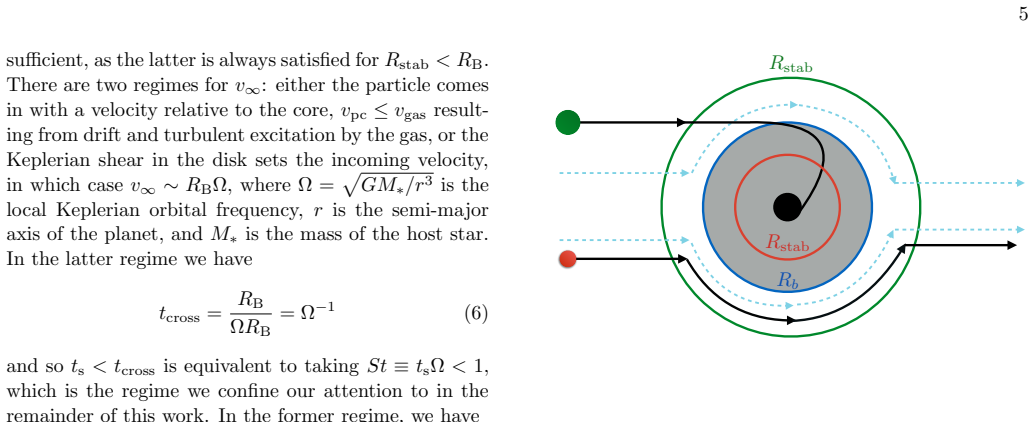
The load-bearing comparison is between two radii. $R_{\rm stab}$ is the largest impact parameter at which pebble accretion can capture a particle, set by balancing the planet's gravity against the gas drag force, with $R_{\rm stab} = \min(R_{\rm WS}, R_{\rm shear}, R_H)$ and upper limit $R_H$, the Hill radius; $R_B = GM_p/c_s^2$ is the Bondi radius, taken as the scale of the static atmosphere that deflects the gas. Particles are characterized by the Stokes number $St = t_s \Omega$, the particle stopping time in units of the orbital time, so small particles have small $St$ and follow the gas closely. The flow isolation condition is $f R_{\rm stab}(St_{\max}) = R_B$; once the atmosphere's radius exceeds the capture radius for the largest pebble present, all available pebbles are diverted around the planet and growth ceases. The paper also shows that the companion condition, that the particle be able to respond to the deflected flow ($t_s < R_B/v_\infty$), is automatically satisfied for $St<1$ whenever $R_{\rm stab}<R_B$, so the single radius comparison carries the argument.
What would settle it
A resolved hydrodynamical simulation of a 1–10 Earth-mass planet with a luminous, accreting atmosphere embedded in a gas disk could settle the matter: if the simulation shows gas recycling through the atmosphere and pebbles of all available sizes still reaching the planet, the flow isolation mass is wrong; if streamlines divert pebbles once the Bondi radius exceeds the capture radius, the mechanism is confirmed. Observationally, a survey of super-Earth systems around stars of different masses could check the predicted near-linear scaling of the characteristic mass with stellar mass, and a broad mass distribution without such a scaling would count against the claim.
Extended reading notes
Core claim
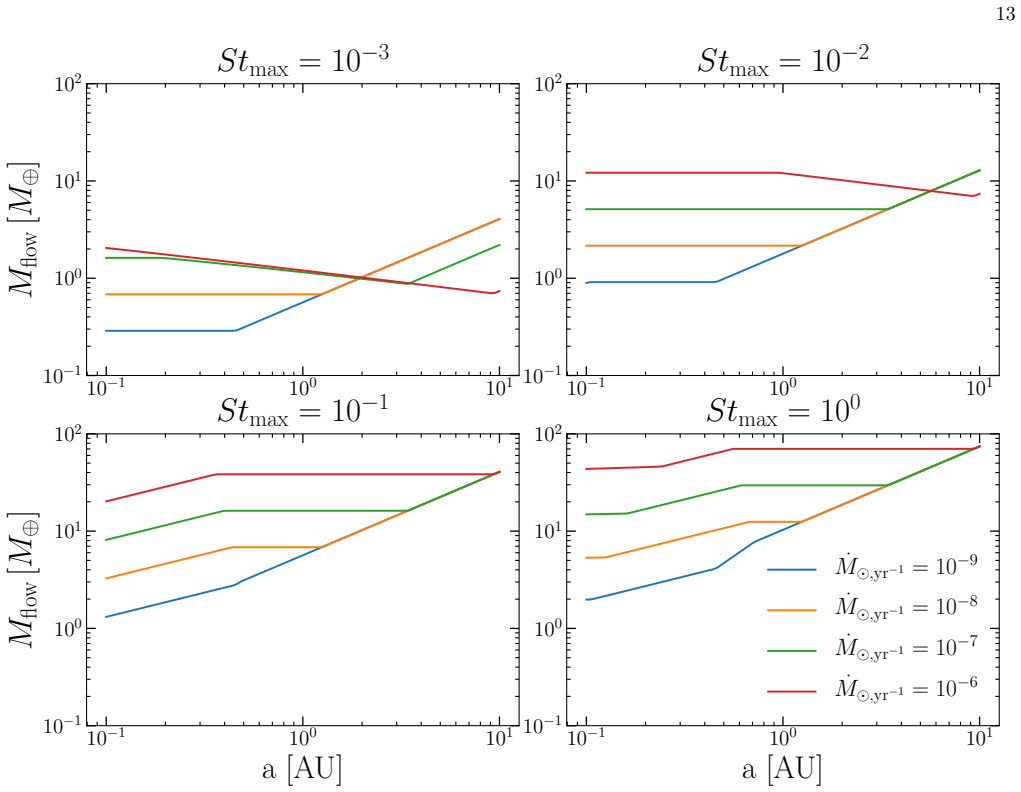
The central claim is that a planet growing by pebble accretion halts when its atmosphere's Bondi radius, $R_B = GM_p/c_s^2$, reaches the scale at which gas-drag-assisted capture would otherwise operate, expressed as $f R_{\rm stab}(St_{\max}) = R_B$, with $St_{\max}$ the largest Stokes number of available pebbles. For linear drag the resulting mass, relative to the thermal mass $M_{\rm th}=3(H/r)^3 M_*$, is $M_{\rm flow}/M_{\rm th} = \min\left[ f^2 (c_s/3 v_{\rm gas})\,St_{\max},\, (f^{3/2}/3)\sqrt{St_{\max}},\, (f'/3)^{3/2}\right]$ (Equation 46). With $f=f'=1.75$ and the fiducial disk, the inner-region value is $M_{\rm flow} = 6.8\,M_\oplus\, St_1^{1/2} \dot{M}_8^{3/8} M_{*,\odot}^{-1/8} \Sigma_{3000}^{3/8}$ (Equation 54), a super-Earth scale nearly independent of semi-major axis. The paper further claims that this single mass scale reproduces the observed intra-system similarity of super-Earth sizes, a characteristic planet mass near $8\,M_\oplus$ growing roughly linearly with stellar mass, and the preferential association of inner super-Earths with outer gas giants, while contrasting flow isolation with the pebble isolation mass.
Load-bearing premise
The argument depends on the growing planet's atmosphere being a dense, static obstacle that forces the nebular gas to flow around it at roughly the Bondi radius; if gas instead streams through the atmosphere and carries pebbles inward, the flow isolation cutoff does not operate and the central mass-scale claim fails.
Editorial extensions
If this is right
- In the inner, viscously heated disk the flow isolation mass is nearly independent of semi-major axis, so planets forming at different distances in the same disk end up with similar masses and, absent atmospheric loss, similar sizes.
- Because the inner-disk scaling is $M_{\rm flow}\propto \dot{M}^{3/8}\Sigma^{3/8}$ and both disk accretion rate and surface density are taken to rise roughly linearly with stellar mass, the characteristic mass scales about linearly with stellar mass, matching the inferred super-Earth scale near $8\,M_\oplus$.
- If pebble accretion is halted by flow isolation before the critical core mass for runaway gas accretion is reached, super-Earths remain a common final state instead of runaway growth into gas giants.
- In the outer, passively heated disk the flow isolation mass increases with semi-major axis, so systems that produce inner super-Earths by this route should preferentially host gas giants farther out.
- When the largest available pebbles are small ($St_{\max}\lesssim 0.1$), flow isolation gives a lower limiting mass than the pebble isolation mass, offering a way to distinguish the two mechanisms in outer-disk populations.
Reading between the lines
- If the mechanism is right, the super-Earth mass function should show a pile-up whose peak tracks the disk accretion rate; comparing planet populations around stars with different accretion histories would test the predicted $3/8$ power dependence of the mass scale.
- The calibration factors $f$ and $f'$, both set to 1.75, are the principal free dials: direct hydrodynamical measurement of gas deflection around an accreting, luminous atmosphere could shift the predicted mass by a factor of 2–3 while preserving its scalings.
- A sharp, testable consequence left implicit in the paper is that the cutoff is size-selective: a planet approaching the flow isolation mass should stop accreting the smallest pebbles first, narrowing the pebble size distribution delivered to the planet from below.
- If the static-atmosphere premise fails and nebular gas recycles through the planet's atmosphere, pebble accretion could continue past super-Earth masses and the observed characteristic scale would require another explanation, such as pebble isolation; a resolved simulation of a sub-thermal planet with an accreting envelope would discriminate the two.
Editorial analysis
A structured set of objections, weighed in public.
Referee Report
Summary. The paper proposes that "flow isolation"—the deflection of nebular gas and gas-coupled pebbles around a growing planet's atmosphere—sets a characteristic mass scale for close-in super-Earths. Using the pebble accretion framework of Rosenthal et al. (2018), the authors define the flow isolation mass by equating the maximum pebble accretion impact parameter to the planet's Bondi radius through Equation (12), f R_stab(St_max) = R_B, with f = 1.75. They derive analytic scalings in Section 3.3, present the fiducial inner-disk result M_flow = 6.8 M_Earth St_1^(1/2) Mdot_8^(3/8) M_*^(-1/8) Sigma_3000^(3/8) in Equation (54), and argue that this scale explains the similar sizes within Kepler multi-planet systems, the Wu (2019) characteristic mass near 8 M_Earth, and the association of inner super-Earths with outer gas giants.
Significance. If the mechanism operates, it addresses a real problem in pebble accretion theory: growth timescales near super-Earth masses are so short that without a shutdown mechanism, pebble-accreting planets would either stall at sub-Earth masses or run away to gas giants. The paper gives a transparent analytic derivation, explicit disk-model prescriptions, and concrete, falsifiable scaling laws, including a predicted linear scaling with stellar mass. It also honestly flags its main free parameters. The central issue is that the existence of the cutoff depends on a static-atmosphere premise that is not established against published atmospheric recycling simulations; the quantitative normalization also rests on an uncalibrated coefficient f. The observational comparisons are suggestive but not unique, as the paper itself acknowledges for the outer-giant correlation.
major comments (2)
- [§2 and §3.4, Eq. (12), Eqs. (48)–(50)] The central criterion f R_stab(St_max) = R_B presupposes that the growing planet's atmosphere acts as a static obstacle forcing nebular gas to flow around it at the Bondi scale. The only response to the recycling simulations cited in footnote 1 (Ormel et al. 2015; Cimerman et al. 2017) is the order-of-magnitude argument in Section 3.4. That argument compares the kinetic energy of intercepted gas with the gravitational binding energy of the atmosphere, so it addresses whether the atmosphere can be unbound or ablated. Recycling flows, however, exchange envelope gas on dynamical timescales through convection and shear-driven circulation without requiring the atmosphere to become unbound; a bound but recycled envelope is not necessarily the solid obstacle that flow isolation requires. If gas streamlines enter the Bondi sphere, the R_stab cutoff does not operate and the flow isolation mass scale does not exist. The manuscript needs either a direct hydrodynamical calculation of flow around a sub-thermal planet with an accreting atmosphere, or a substantially stronger argument ruling out through-flow, before the central claim can be accepted.
- [§3.3.1, Eqs. (12), (46), and (54)] The quantitative normalization M_flow = 6.8 M_Earth in Equation (54), and hence the claimed agreement with Wu (2019)'s ~8 M_Earth scale, depends on the coefficient f = 1.75 introduced in Equation (12). The text states that f is undetermined and that its value should be set by comparison with numerical simulations, which is left to future work. Since M_flow scales as f^(3/2), varying f over a plausible order-unity range changes the inner-disk mass by a factor of about 2–3 (for example, f = 1 gives roughly 3 M_Earth with the same disk parameters). No calibration or sensitivity study is presented, so the agreement with the observed normalization is not an independent test of the model. The authors should either calibrate f against published or new simulations or show explicitly that the claimed observational agreement persists over a range of f.
minor comments (5)
- [§2] There is a typo, "In pratice," which should read "In practice."
- [§3.3.1] The term "flow isolation mass" is used with a broader meaning than in Rosenthal et al. (2018); the text notes this, but a brief explicit definition at first use would help readers avoid confusion between the two definitions.
- [§5.1] The discussion of Weiss et al. (2018) mentions the Zhu (2019) detection-bias interpretation only in passing; given that this caveat directly affects the claimed explanation of intra-system size similarity, it deserves a fuller treatment in the main text.
- [§5.3] The paper acknowledges that the inner-super-Earth/outer-gas-giant correlation is not unique to flow isolation and also follows from pebble isolation or classical isolation models; this non-uniqueness should be stated in the abstract or conclusions so that the claimed observational support is not overstated.
- [Figure 1] The red hatched region is labeled as the region where growth cannot occur because of flow isolation, but the caption does not specify which mass scale or atmosphere size is used; adding this information would make the figure self-contained.
Circularity Check
No significant circularity: the flow isolation mass is derived from independent pebble-accretion and disk inputs, then compared with Kepler trends; the uncalibrated f and static-atmosphere premise are physical assumptions, not tautological inputs.
full rationale
The central derivation starts from the independently published pebble-accretion impact parameter Rstab (Eqs. 39-41), standard drag prescriptions, and the Bondi radius; the criterion fRstab(Stmax)=RB (Eq. 12) defines a new mass scale rather than importing the observed super-Earth mass or the Kepler trends. The comparison with Wu (2019) is a comparison of scaling behavior: the linear stellar-mass dependence (Eq. 60) follows from adopted empirical scalings Mdot proportional to M*^2 and Sigma proportional to M*, not from Wu's characteristic mass formula, so the match is not constructed by fitting the target observation. The coefficient f=1.75 is explicitly left uncalibrated and chosen a priori ('We leave this comparison for future work'), so it is not a fitted parameter renamed as a prediction; it shifts the normalization by an order-unity factor but does not generate the predicted scaling or the semi-major-axis independence. The paper does rely on the authors' earlier R18 model for the pebble-accretion framework and on Powell et al. for the fiducial surface density, but those are published parameter-free models with stated assumptions that do not include the target result, and the paper's own formulas are independently checkable; this is normal self-citation, not load-bearing circularity. The main physical premise, that a sub-thermal planet's atmosphere deflects the nebular flow on the Bondi scale, is supported by an external simulation (Ormel 2013) and defended against the recycling simulations by the binding-energy estimate in Section 3.4. That defense may be incomplete, since it addresses whether the atmosphere becomes unbound rather than whether gas flows through a bound, recycled envelope; however, a disputed or under-supported physical premise is a correctness risk, not a circular reduction of the derivation to its inputs. No equation in the paper is equivalent to its inputs by construction, and the Kepler comparisons are genuine postdictions of trends rather than rewritings of the assumed disk scalings.
Assumptions & free parameters
free parameters (5)
- f (flow isolation criterion coefficient) =
1.75
- f' (thermal-mass regime coefficient) =
1.75
- u_frag (fragmentation velocity) =
1 and 10 m/s (two cases)
- Sigma_0 (disk surface density at 1 au) =
3000 g cm^-2
- kappa (Rosseland mean opacity) =
0.1 cm^2/g
assumptions (6)
- domain assumption The growing planet's atmosphere is a static, denser obstacle that forces the nebular gas to flow around it at the Bondi radius R_B.
- domain assumption The pebble accretion impact parameter R_stab is correctly described by the model of Rosenthal et al. (2018), including the piecewise drag law and the min(R_WS, R_shear, R_H) prescription.
- domain assumption The maximum particle size in the disk is set by turbulent and laminar fragmentation as modeled in Equation (59), with u_frag in the lab-measured range.
- domain assumption The fiducial disk temperature is T = max(T_visc, T_irr) with the given viscous heating and irradiation profiles, and Sigma = 3000 g cm^-2 r^-1.
- domain assumption Planets form in situ at their observed semi-major axes; Type I migration is neglected.
- domain assumption Gas flows are subsonic, v_gas < c_s, for planets below the thermal mass.
Cite this review
Pith. "Pith review of How Flow Isolation May Set the Mass Scale for Super-Earth Planets." pith.science (2026). https://pith.science/paper/IRGSCWQG
@misc{pith2026190806991,
  author       = {Pith},
  title        = {Pith review of: How Flow Isolation May Set the Mass Scale for Super-Earth Planets},
  year         = {2026},
  howpublished = {\url{https://pith.science/paper/IRGSCWQG}},
  note         = {Machine review of arXiv:1908.06991}
}
abstract
Much recent work on planet formation has focused on the growth of planets by accretion of grains whose aerodynamic properties make them marginally coupled to the nebular gas, a theory commonly referred to as "pebble accretion". While pebble accretion can ameliorate some of the issues presented by growth by purely gravitational processes, it has other issues when compared with observations of exoplanetary systems. A particular concern is the preponderance of planets that end their growth as "super-Earths" or "sub-Neptunes", with masses in the range 2-10 $M_\oplus$. Once planets reach this mass scale, timescales for growth by pebble accretion are so rapid that ubiquitously ending growth here is difficult. In this work, we highlight this issue in detail using our previously published model of pebble accretion, and also propose a possible solution: feedback between the growing planet's atmosphere and the gas disk inhibits accretion of smaller particle sizes by forcing them to flow around the growing planet instead of being accreted. For reasonable fiducial disk parameters this "flow isolation" will inhibit accretion of all available particle sizes once the planet reaches super-Earth masses. We also demonstrate that the characteristics of this "flow isolation mass" agree with previously published trends identified in the \textit{Kepler} planets.
Figures


Figures from the paper (4 more)



Reference graph
Works this paper leans on
-
[1]
Alcal´ a, J. M., Natta, A., Manara, C. F., et al. 2014, A&A, 561, A2
work page 2014
-
[2]
Andrews, S. M. 2015, PASP, 127, 961 17
work page 2015
-
[3]
M., Rosenfeld, K
Andrews, S. M., Rosenfeld, K. A., Kraus, A. L., & Wilner, D. J. 2013, ApJ, 771, 129
2013
-
[4]
Dullemond, C. P. 2009, ApJ, 700, 1502
work page 2009
- [5]
- [6]
-
[7]
2012, A&A, 539, A148
Birnstiel, T., Klahr, H., & Ercolano, B. 2012, A&A, 539, A148
2012
-
[8]
2019, A&A, 623, A88
Bitsch, B., Izidoro, A., Johansen, A., et al. 2019, A&A, 623, A88
2019
Show all 62 references
-
[9]
2015, A&A, 582, A112
Bitsch, B., Lambrechts, M., & Johansen, A. 2015, A&A, 582, A112
2015
-
[10]
2018, A&A, 612, A30
Bitsch, B., Morbidelli, A., Johansen, A., et al. 2018, A&A, 612, A30
2018
-
[11]
2008, ARA&A, 46, 21
Blum, J., & Wurm, G. 2008, ARA&A, 46, 21
2008
-
[12]
J., Koch, D., Basri, G., et al
Borucki, W. J., Koch, D., Basri, G., et al. 2010, Science, 327, 977
2010
-
[13]
P., & Henning, T
Brauer, F., Dullemond, C. P., & Henning, T. 2008, A&A, 480, 859 Br¨ ugger, N., Alibert, Y., Ataiee, S., & Benz, W. 2018, A&A, 619, A174
2008
-
[14]
L., Knutson, H
Bryan, M. L., Knutson, H. A., Lee, E. J., et al. 2019, AJ, 157, 52
2019
-
[15]
Chambers, J. E. 2016, ApJ, 825, 63
2016
-
[16]
Cheng, N. S. 2009, Powder Technology, 189, 395
2009
-
[17]
Chiang, E., & Youdin, A. N. 2010, Annual Review of Earth and Planetary Sciences, 38, 493
2010
-
[18]
I., & Goldreich, P
Chiang, E. I., & Goldreich, P. 1997, ApJ, 490, 368
1997
-
[19]
P., Kuiper, R., & Ormel, C
Cimerman, N. P., Kuiper, R., & Ormel, C. W. 2017, MNRAS, 471, 4662
2017
-
[20]
I., Lee, E
Dawson, R. I., Lee, E. J., & Chiang, E. 2016, ApJ, 822, 54
2016
-
[21]
2013, ApJ, 766, 81
Fressin, F., Torres, G., Charbonneau, D., et al. 2013, ApJ, 766, 81
2013
-
[22]
2004, ARA&A, 42, 549
Goldreich, P., Lithwick, Y., & Sari, R. 2004, ARA&A, 42, 549
2004
-
[23]
Guillot, T., Ida, S., & Ormel, C. W. 2014, A&A, 572, A72
2014
-
[24]
2016, A&A, 591, A72
Ida, S., Guillot, T., & Morbidelli, A. 2016, A&A, 591, A72
2016
-
[25]
N., et al
Izidoro, A., Bitsch, B., Raymond, S. N., et al. 2019, arXiv e-prints, arXiv:1902.08772
2019 arXiv
-
[26]
2010, MNRAS, 404, 475
Johansen, A., & Lacerda, P. 2010, MNRAS, 404, 475
2010
-
[27]
2017, Annual Review of Earth and Planetary Sciences, 45, 359
Johansen, A., & Lambrechts, M. 2017, Annual Review of Earth and Planetary Sciences, 45, 359
2017
-
[28]
M., & Murray-Clay, R
Kratter, K. M., & Murray-Clay, R. A. 2011, ApJ, 740, 1
2011
-
[29]
2012, A&A, 544, A32 —
Lambrechts, M., & Johansen, A. 2012, A&A, 544, A32 —. 2014, A&A, 572, A107
2012
-
[30]
2014, A&A, 572, A35
Lambrechts, M., Johansen, A., & Morbidelli, A. 2014, A&A, 572, A35
2014
-
[31]
A., et al
Lambrechts, M., Morbidelli, A., Jacobson, S. A., et al. 2019, A&A, 627, A83
2019
-
[32]
F., Kretke, K
Levison, H. F., Kretke, K. A., Walsh, K. J., & Bottke, W. F. 2015, Proceedings of the National Academy of Science, 112, 14180
2015
-
[33]
Lin, D. N. C., & Papaloizou, J. C. B. 1993, in Protostars and Planets III, ed. E. H. Levy & J. I. Lunine, 749
1993
-
[34]
W., Lee, E
Lin, J. W., Lee, E. J., & Chiang, E. 2018, ArXiv e-prints, arXiv:1806.00487 [astro-ph.EP]
2018 arXiv
-
[35]
Lissauer, J. J. 1993, ARA&A, 31, 129
1993
-
[36]
Mamajek, E. E. 2009, in American Institute of Physics Conference Series, Vol. 1158, American Institute of Physics Conference Series, ed. T. Usuda, M. Tamura, & M. Ishii, 3
2009
-
[37]
2017, ApJL, 849, L33
Millholland, S., Wang, S., & Laughlin, G. 2017, ApJL, 849, L33
2017
-
[38]
2015, Icarus, 258, 418
Morbidelli, A., Lambrechts, M., Jacobson, S., & Bitsch, B. 2015, Icarus, 258, 418
2015
-
[39]
1986, Icarus, 67, 375
Nakagawa, Y., Sekiya, M., & Hayashi, C. 1986, Icarus, 67, 375
1986
-
[40]
2006, A&A, 452, 245
Natta, A., Testi, L., & Randich, S. 2006, A&A, 452, 245
2006
-
[41]
K., & Morbidelli, A
Ogihara, M., Kokubo, E., Suzuki, T. K., & Morbidelli, A. 2018, A&A, 615, A63
2018
-
[42]
2011, ApJ, 738, 141
Oka, A., Nakamoto, T., & Ida, S. 2011, ApJ, 738, 141
2011
-
[43]
Ormel, C. W. 2013, MNRAS, 428, 3526
2013
-
[44]
W., & Cuzzi, J
Ormel, C. W., & Cuzzi, J. N. 2007, A&A, 466, 413
2007
-
[45]
W., & Klahr, H
Ormel, C. W., & Klahr, H. H. 2010, A&A, 520, A43
2010
-
[46]
W., & Kobayashi, H
Ormel, C. W., & Kobayashi, H. 2012, ApJ, 747, 115
2012
-
[47]
W., Shi, J.-M., & Kuiper, R
Ormel, C. W., Shi, J.-M., & Kuiper, R. 2015, MNRAS, 447, 3512
2015
-
[48]
J., et al
Pascucci, I., Testi, L., Herczeg, G. J., et al. 2016, ApJ, 831, 125
2016
-
[49]
B., & Murray-Clay, R
Perets, H. B., & Murray-Clay, R. A. 2011, ApJ, 733, 56
2011
-
[50]
M., Schlichting, H
Powell, D., Murray-Clay, R., P´ erez, L. M., Schlichting, H. E., & Rosenthal, M. 2019, ApJ, 878, 116 Rafikov, R. R. 2006, ApJ, 648, 666
2019
-
[51]
M., & Murray-Clay, R
Rosenthal, M. M., & Murray-Clay, R. A. 2018, ApJ, 864, 66
2018
-
[52]
2018, ApJ, 861, 74
Wolansky, N. 2018, ApJ, 861, 74
2018
-
[53]
Schlichting, H. E. 2014, ApJL, 795, L15
2014
-
[54]
I., & Sunyaev, R
Shakura, N. I., & Sunyaev, R. A. 1973, A&A, 24, 337
1973
-
[55]
T., & Leinhardt, Z
Stewart, S. T., & Leinhardt, Z. M. 2009, ApJL, 691, L133
2009
-
[56]
G., & Degl’Innocenti, S
Tognelli, E., Prada Moroni, P. G., & Degl’Innocenti, S. 2011, A&A, 533, A109
2011
-
[57]
G., & Ormel, C
Visser, R. G., & Ormel, C. W. 2016, A&A, 586, A66
2016
-
[58]
Weidenschilling, S. J. 1977, MNRAS, 180, 57
1977
-
[59]
M., Marcy, G
Weiss, L. M., Marcy, G. W., Petigura, E. A., et al. 2018, AJ, 155, 48 18
2018
-
[60]
Xu, Z., Bai, X.-N., & Murray-Clay, R. A. 2017, ApJ, 847, 52
2017
- [61]
-
[62]
2018, AJ, 156, 92
Zhu, W., & Wu, Y. 2018, AJ, 156, 92
2018
Reviewed August 14, 2026 · model on record in the stance chip above.
Discussion (0). Continue with ORCID to comment.