REVIEW 4 major objections 4 minor 57 references
Boundless: Generative Adversarial Networks for Image Extension
T0 review · 4 major / 4 minor · reviewed 2026-08-14 · deepseek-v4-flash
Pith's one-line read Semantic conditioning lets a GAN extend images up to three times their width with coherent content.
desk verdict The semantic conditioning trick is real and worth knowing, but the headline FID numbers rest on a nonstandard metric and uneven baselines, so treat the quantitative claims as provisional. read the letter →
The pith
A machine-rendered reading of the paper's core claim, the machinery that carries it, and where it could break.
The reading
What carries the argument
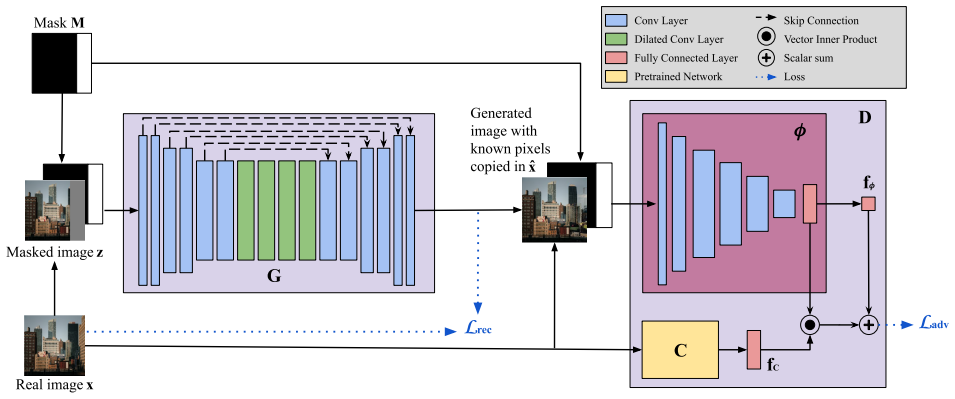
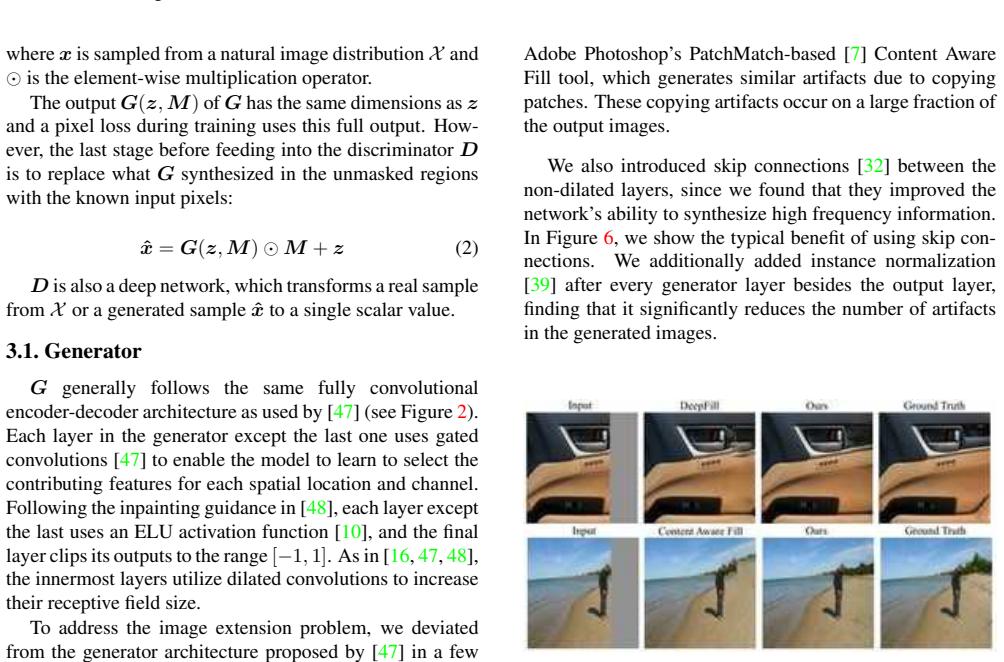
The load-bearing mechanism is a conditional projection discriminator built from Eq. (4): $D(x^*, M, x) = f_\varphi(\varphi(x^*, M)) + \langle \varphi(x^*, M), f_C(C(x)) \rangle$, where $C$ is a pretrained InceptionV3 network (softmax removed) applied to the full ground-truth image, with activations normalized by subtracting the dataset mean and dividing by the $\ell^2$ norm. The same network $\varphi$ also sees the masked image $x^*$ and the mask $M$, so it can check both seam realism and semantic agreement with the target. Because $C(x)$ is available only at training time, it acts as a stabilizer that teaches the generator what a plausible continuation looks like without requiring semantic labels at test time. The generator itself is a gated-convolution encoder-decoder with skip connections, instance normalization, and an $\ell^1$ reconstruction loss combined with a Wasserstein GAN hinge adversarial loss.
What would settle it
Train or evaluate the same model on a held-out set of images whose object categories (people, cars, furniture) were not in the 50 training classes, and measure FID and semantic coherence on 75% extensions. If the model cannot extend objects coherently and instead produces scene-like texture, the central claim of reliable large extrapolation is restricted to the training distribution.
Extended reading notes
Core claim
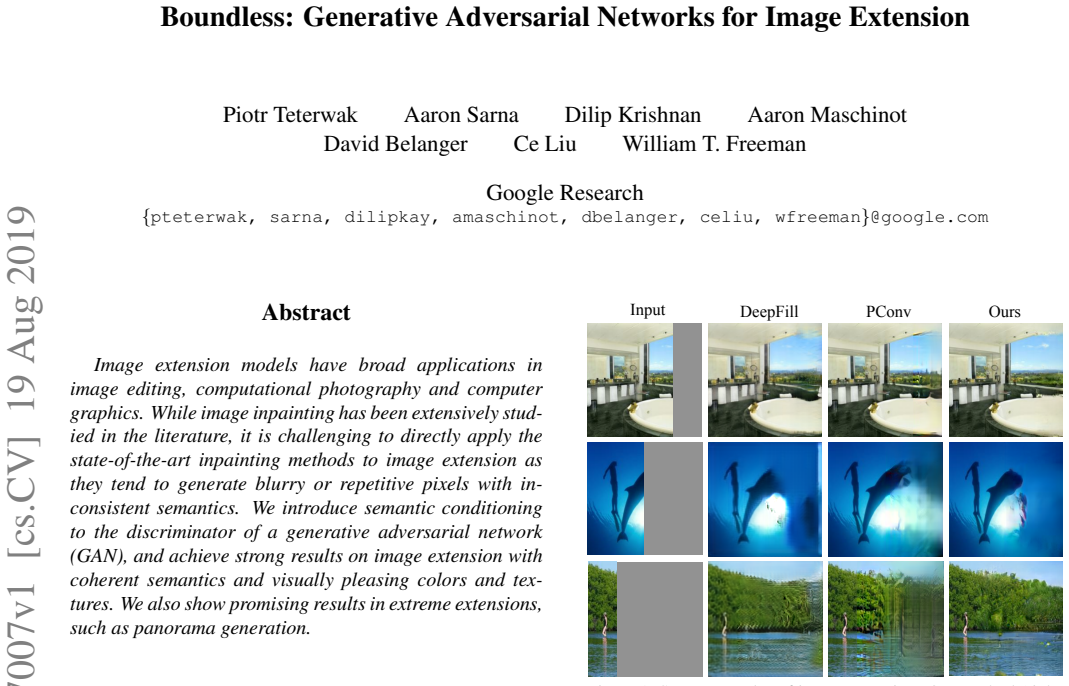
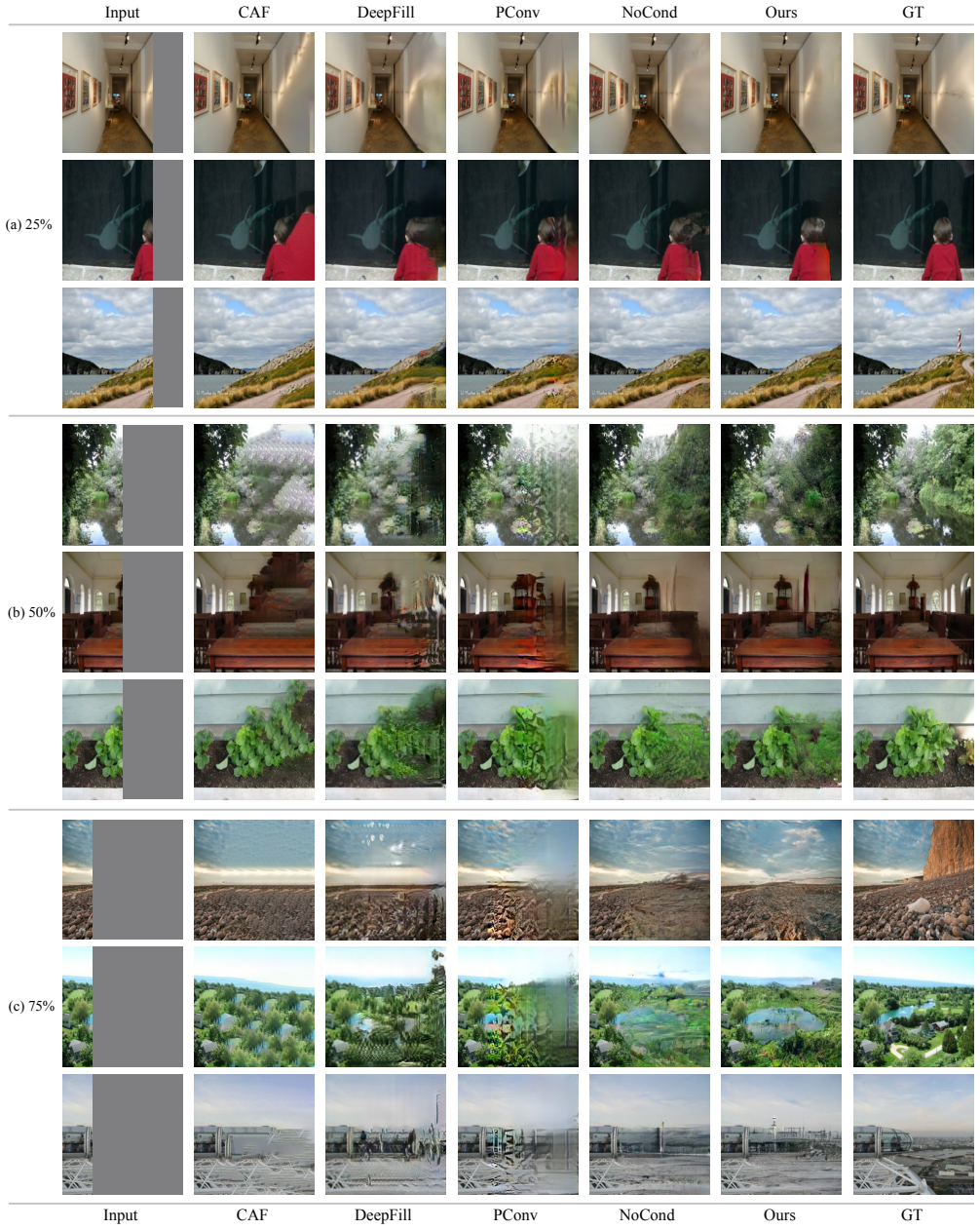
The central claim is that a Wasserstein GAN whose discriminator is conditioned on deep semantic features of the true image produces image extensions that remain coherent at scales where prior inpainting models fail. Concretely, with the rightmost 75% of a 257x257 image masked, the model's Frechet Inception Distance drops from 31.21 (DeepFill) and 31.83 (PartialConv) to 8.79, and the generated content keeps scene-level semantics rather than blurring or repeating patches. The method also extends recursively to a panorama width about 2.7 times the original. The authors additionally show that the semantic conditioning outperforms perceptual and feature-matching losses at the largest extension, and that the full model matches state-of-the-art inpainting on a central hole.
Load-bearing premise
The discriminator is trained with direct access to semantic features of the true continuation, and the method assumes that this training-only signal teaches the generator to produce correct extensions when that signal is absent at test time, rather than teaching it to exploit the specific ground truth.
Editorial extensions
If this is right
- Image extension becomes a practical tool for editing: the model can fill side regions at 3:1, 1:1, and 1:3 context-to-mask ratios with plausible scene structure rather than blur or repeated texture.
- Recursive application of the 25% model produces panoramas about 2.7 times the original width, suggesting the same trained model can be reused for arbitrarily wide extrapolation.
- Because the conditioning uses pretrained features, the stabilizer transfers to any adversarial task with a paired ground truth at training time, such as super-resolution, colorization, or video extrapolation.
- On video frames, small perturbations of the input yield different yet coherent extensions, indicating that the generator has not collapsed to a single memorized output and can explore the space of plausible completions.
Reading between the lines
- A natural stress test the authors leave implicit is semantic scrambling: shuffle $C(x)$ across images of the same class during training. If FID stays unchanged, the discriminator is not actually using the semantic content, and the gains would be attributable to extra conditioning signal alone.
- The conditioning scheme suggests a recipe for other one-sided extrapolation tasks (depth, layout, audio): provide the discriminator with a cheap pretrained embedding of the full target during training, then drop it at inference; this could be tested directly on those modalities.
- The admitted weakness on objects—vehicles, people, furniture—hints that the model learns scene-level statistics rather than object priors; combining semantic conditioning with an object-aware generator or a layout loss is a testable extension likely to close the largest remaining gap.
- Because the test-time model never receives semantic features, the gap between training and inference could be probed by an adversarial evaluation: an evaluator can look for systematic semantic drift as extension distance grows, and quantify whether the drift rate matches the paper's panorama observations.
Signed reviews
Editorial analysis
A structured set of objections, weighed in public.
Referee Report
Summary. The paper proposes a GAN-based method for image extension (outpainting), in which a generator with gated convolutions, skip connections, and instance normalization extends an image beyond its border, and a discriminator is conditioned both on the mask and on semantic features of the ground-truth full image extracted by a pretrained InceptionV3 network. The discriminator conditioning is a projection-based adaptation of the cGAN projection discriminator, using C(x) of the full image instead of a class label. The method is evaluated on Places365 subsets at 25%, 50%, and 75% extension widths, against DeepFill, Partial Convolutions, Content-Aware Fill, and an ablation without conditioning, plus comparisons with perceptual loss and feature matching. The authors report a large FID improvement at 75% extension (19.17 to 8.79) and demonstrate recursive extension for panorama-like outputs. The paper also includes ablations on skip connections, instance normalization, conditioning, and batch size, and a qualitative failure analysis.
Significance. If the quantitative results hold, the paper offers a useful architectural contribution: using pretrained semantic features to condition the discriminator in a projection-GAN manner, rather than simply adding a perceptual or feature-matching loss to the generator. The qualitative comparisons, especially at 75% extension, suggest that the method produces more coherent structures than inpainting baselines, and the recursive panorama experiment is a valuable stress test. The paper is also commendable for disclosing the training-only nature of the ground-truth conditioning, for reporting ablations, and for providing architecture tables in the supplementary material. The central claim of a large gain at large extrapolation widths, however, rests on an evaluation protocol that is not standard and on baselines that are not fully matched, so the significance is contingent on the evaluation being strengthened.
major comments (4)
- [Section 4, Table 1] The headline quantitative claim, that the conditioned model improves FID from 19.17 to 8.79 at 75% extension, is computed with a diagonal-covariance FID on only 500 test images. This is not the standard FID of Heusel et al.; a diagonal covariance ignores correlations between Inception feature dimensions, so a model that matches marginal means and variances without matching the joint distribution can appear artificially good. Please recompute with the full covariance matrix (or another standard metric with sufficient samples), and provide confidence intervals or significance tests. If the diagonal FID is retained, its limitations should be explicitly discussed and the claim should be tempered accordingly.
- [Section 4.1, baselines] The comparison against DeepFill is unbalanced: DeepFill was trained for 5 days on a P100 at 0.8 steps/sec, while the proposed model trains at 4.7 steps/sec, meaning the proposed model sees roughly six times more training steps. PConv was not retrained for the specific extension masks used here. As a result, the reported gains over these baselines may reflect training budget or mask distribution rather than the architectural contribution. Please train baselines to comparable convergence (e.g., same number of steps or matched wall-clock on comparable hardware) or provide learning curves showing that the baselines have converged.
- [Section 4.3 and contribution 1] The abstract and contribution list state that the method works 'reliably for large extrapolations (up to 3 times the width of the original),' but Section 4.3 reports that the recursive panorama generation shows 'degradation and semantic drift' as the model moves away from the original image. The quantitative results in Table 1 are for single-step extensions of at most 75% of the image width, not for the recursive 3x setting. Please qualify the 'reliably' claim to match the evidence, and ideally provide quantitative results for the recursive setting.
- [Section 3.2, Eq. (4)] The discriminator is conditioned on C(x), the InceptionV3 features of the full ground-truth image, which is available only at training time. This creates a train-test mismatch: at test time the generator receives no such semantic signal. The paper discloses this design choice but does not analyze the risk that the generator may exploit the discriminator's access to the target and learn to reproduce the specific ground truth rather than a distribution of plausible extensions. Please add a discussion of this risk and, ideally, an experiment that varies the conditioning signal during training or measures diversity of outputs for a fixed input.
minor comments (4)
- [Section 4.1] The text contains a typo: 'reprents' should be 'represents.'
- [Section 4, Table 1 caption] The caption says 'The mask types are: 25% extension (3:1 ratio of context to mask), 50% extension (1:1 ratio), 75% (1:3 ratio)', but the ratio convention is confusing; please clarify whether the ratio is context-to-mask width or mask-to-context width.
- [Section 4, Table 2 and surrounding text] Table 2 shows that at 75% extension the proposed method has lower PSNR (8.07) than Perceptual (9.65) and Feature Matching (8.87), while the FID is much better. Please state explicitly that PSNR is not aligned with the paper's quality claim and consider reporting additional metrics that do not rely solely on the nonstandard FID.
- [Supplementary Section 6.3] The supplementary states that the mask size is sampled from a uniform distribution around the target size plus/minus 4 pixels, but the main text does not mention this jittering; please include this detail in the main paper's training description for reproducibility.
Circularity Check
No significant circularity: the paper is an empirical GAN method with no fitted prediction passed off as derivation, and the training-only conditioning does not reduce by construction to the reported results.
full rationale
This is an empirical computer vision paper rather than a derivation chain, and I find no step in which a claimed prediction is equivalent by construction to an input or fitted parameter. The main candidate is the discriminator conditioning in Eq. 4, D(x*, M, x) = f_phi(phi(x*,M)) + <phi(x*,M), f_C(C(x))>, which uses the InceptionV3 features C(x) of the full ground-truth image during training. However, the paper explicitly states that the discriminator is used only during training, and the generator's test-time input is (z, M) alone; no test-time output is defined in terms of C(x). The FID metric also uses Inception features, but FID is an external evaluation statistic on held-out images, not the fitted objective or a quantity derived from the model's equations, so metric overlap is a methodological concern, not circularity. The diagonal-covariance FID and the recursive panorama claim raise reproducibility and overstatement concerns, but these are correctness risks, not circular steps. Citations to the authors' earlier work appear only as related work and are not load-bearing for the central claim. Therefore the correct finding is no significant circularity, with score 0.
Assumptions & free parameters
free parameters (4)
- lambda (adversarial loss weight) =
0.01
- Projection output dimension =
256
- Training batch size =
256
- Mask size jitter =
target plus/minus 4 pixels
assumptions (4)
- domain assumption Pretrained InceptionV3 on ImageNet provides a semantically meaningful embedding for Places365 scene images.
- domain assumption FID on the full output image, computed with a diagonal covariance on 500 test images, correlates with perceptual quality.
- ad hoc to paper Conditioning the discriminator on the full ground-truth image during training transfers to test-time generation without that conditioning.
- domain assumption Replacing generated pixels in known regions with original pixels before the discriminator (Eq. 2) is a valid way to focus the discriminator on the seam and generated region.
Cite this review
Pith. "Pith review of Boundless: Generative Adversarial Networks for Image Extension." pith.science (2026). https://pith.science/paper/3ZUTUQF2
@misc{pith2026190807007,
  author       = {Pith},
  title        = {Pith review of: Boundless: Generative Adversarial Networks for Image Extension},
  year         = {2026},
  howpublished = {\url{https://pith.science/paper/3ZUTUQF2}},
  note         = {Machine review of arXiv:1908.07007}
}
read the original abstract
Image extension models have broad applications in image editing, computational photography and computer graphics. While image inpainting has been extensively studied in the literature, it is challenging to directly apply the state-of-the-art inpainting methods to image extension as they tend to generate blurry or repetitive pixels with inconsistent semantics. We introduce semantic conditioning to the discriminator of a generative adversarial network (GAN), and achieve strong results on image extension with coherent semantics and visually pleasing colors and textures. We also show promising results in extreme extensions, such as panorama generation.
Figures
Figures from the paper (11 more)


Reference graph
Works this paper leans on
-
[44]
Wide- context semantic image extrapolation
Yi Wang, Xin Tao, Xiaoyong Shen, and Jiaya Jia. Wide- context semantic image extrapolation. In IEEE Conference on Computer Vision and Pattern Recognition (CVPR), 2019. 2
work page 2019
-
[1]
Tensorflow: A system for large-scale machine learning
Mart ´ın Abadi, Paul Barham, Jianmin Chen, Zhifeng Chen, Andy Davis, Jeffrey Dean, Matthieu Devin, Sanjay Ghe- mawat, Geoffrey Irving, Michael Isard, et al. Tensorflow: A system for large-scale machine learning. In 12th {USENIX} Symposium on Operating Systems Design and Implementa- tion ({OSDI} 16), pages 265–283, 2016. 4
2016
-
[2]
Youtube-8m: A large- scale video classification benchmark
Sami Abu-El-Haija, Nisarg Kothari, Joonseok Lee, Paul Natsev, George Toderici, Balakrishnan Varadarajan, and Sudheendra Vijayanarasimhan. Youtube-8m: A large- scale video classification benchmark. arXiv preprint arXiv:1609.08675, 2016. 7, 12
arXiv 2016
-
[3]
Aseem Agarwala, Ke Colin Zheng, Chris Pal, Maneesh Agrawala, Michael Cohen, Brian Curless, David Salesin, and Richard Szeliski. Panoramic video textures. In ACM Transactions on Graphics (TOG) , volume 24, pages 821–
-
[4]
Wasserstein generative adversarial networks
Martin Arjovsky, Soumith Chintala, and L ´eon Bottou. Wasserstein generative adversarial networks. In Interna- tional Conference on Machine Learning , pages 214–223,
-
[5]
Seam carving for content- aware image resizing
Shai Avidan and Ariel Shamir. Seam carving for content- aware image resizing. In ACM Transactions on graphics (TOG), volume 26, page 10. ACM, 2007. 1
work page 2007
-
[6]
Filling-in by joint interpolation of vector fields and gray levels
Coloma Ballester, M Bertalmio, V Caselles, Guillermo Sapiro, and Joan Verdera. Filling-in by joint interpolation of vector fields and gray levels. IEEE TRANSACTIONS ON IMAGE PROCESSING, 10(8), 2001. 2
work page 2001
-
[7]
Patchmatch: A randomized correspon- dence algorithm for structural image editing
Connelly Barnes, Eli Shechtman, Adam Finkelstein, and Dan B Goldman. Patchmatch: A randomized correspon- dence algorithm for structural image editing. In ACM Trans- actions on Graphics (ToG), volume 28, page 24. ACM, 2009. 1, 2, 3, 5
work page 2009
Show all 57 references
-
[8]
Image inpainting
Marcelo Bertalmio, Guillermo Sapiro, Vincent Caselles, and Coloma Ballester. Image inpainting. In Proceedings of the 27th annual conference on Computer graphics and in- teractive techniques, pages 417–424. ACM Press/Addison- Wesley Publishing Co., 2000. 2
2000
-
[9]
Large scale gan training for high fidelity natural image synthesis
Andrew Brock, Jeff Donahue, and Karen Simonyan. Large scale gan training for high fidelity natural image synthesis. In International Conference on Learning Representations ,
-
[10]
Fast and accurate deep network learning by exponential linear units (elus)
Djork-Arn ´e Clevert, Thomas Unterthiner, and Sepp Hochre- iter. Fast and accurate deep network learning by exponential linear units (elus). In International Conference on Learning Representations, 2016. 3, 11
2016
-
[11]
Imagenet: A large-scale hierarchical image database
Jia Deng, Wei Dong, Richard Socher, Li-Jia Li, Kai Li, and Li Fei-Fei. Imagenet: A large-scale hierarchical image database. In 2009 IEEE conference on computer vision and pattern recognition, pages 248–255. Ieee, 2009. 4, 11
2009
-
[12]
Image quilting for texture synthesis and transfer
Alexei A Efros and William T Freeman. Image quilting for texture synthesis and transfer. In Proceedings of the 28th an- nual conference on Computer graphics and interactive tech- niques, pages 341–346. ACM, 2001. 2
2001
-
[13]
Texture synthesis by non-parametric sampling
Alexei A Efros and Thomas K Leung. Texture synthesis by non-parametric sampling. In Proceedings of the sev- enth IEEE international conference on computer vision , vol- ume 2, pages 1033–1038. IEEE, 1999. 2
1999
-
[14]
Generative adversarial nets
Ian Goodfellow, Jean Pouget-Abadie, Mehdi Mirza, Bing Xu, David Warde-Farley, Sherjil Ozair, Aaron Courville, and Yoshua Bengio. Generative adversarial nets. In Z. Ghahra- mani, M. Welling, C. Cortes, N. D. Lawrence, and K. Q. Weinberger, editors, Advances in Neural Informatio...
2014
-
[15]
Gans trained by a two time-scale update rule converge to a local nash equilib- rium
Martin Heusel, Hubert Ramsauer, Thomas Unterthiner, Bernhard Nessler, and Sepp Hochreiter. Gans trained by a two time-scale update rule converge to a local nash equilib- rium. In Advances in Neural Information Processing Sys- tems, pages 6626–6637, 2017. 5
2017
-
[16]
Globally and locally consistent image completion
Satoshi Iizuka, Edgar Simo-Serra, and Hiroshi Ishikawa. Globally and locally consistent image completion. ACM Transactions on Graphics (ToG), 36(4):107, 2017. 2, 3
2017
-
[17]
Globally and Locally Consistent Image Completion
Satoshi Iizuka, Edgar Simo-Serra, and Hiroshi Ishikawa. Globally and Locally Consistent Image Completion. ACM Transactions on Graphics (Proc. of SIGGRAPH 2017) , 36(4):107:1–107:14, 2017. 2
2017
-
[18]
Perceptual losses for real-time style transfer and super-resolution
Justin Johnson, Alexandre Alahi, and Li Fei-Fei. Perceptual losses for real-time style transfer and super-resolution. In European conference on computer vision , pages 694–711. Springer, 2016. 4, 5
2016
-
[19]
Infinite images: Creating and ex- ploring a large photorealistic virtual space
Biliana Kaneva, Josef Sivic, Antonio Torralba, Shai Avidan, and William T Freeman. Infinite images: Creating and ex- ploring a large photorealistic virtual space. Proceedings of the IEEE, 98(8):1391–1407, 2010. 1
2010
-
[20]
Adam: A method for stochastic optimization
Diederik P Kingma and Jimmy Ba. Adam: A method for stochastic optimization. In International Conference on Learning Representations, 2015. 4
2015
-
[21]
Auto-encoding varia- tional bayes
Diederik P Kingma and Max Welling. Auto-encoding varia- tional bayes. In International Conference on Learning Rep- resentations, 2014. 2
2014
-
[22]
Aspect ratio problems in television today and some new solutions
Mike Knee and Roberta Piroddi. Aspect ratio problems in television today and some new solutions. SMPTE Motion Imaging Journal, 119(1):35–41, 2010. 1
2010
-
[23]
Quality prediction for image completion
Johannes Kopf, Wolf Kienzle, Steven Drucker, and Sing Bing Kang. Quality prediction for image completion. ACM Transactions on Graphics (TOG) , 31(6):131, 2012. 1, 2
2012
-
[24]
Photo- realistic single image super-resolution using a generative ad- versarial network
Christian Ledig, Lucas Theis, Ferenc Husz´ar, Jose Caballero, Andrew Cunningham, Alejandro Acosta, Andrew Aitken, Alykhan Tejani, Johannes Totz, Zehan Wang, et al. Photo- realistic single image super-resolution using a generative ad- versarial network. In Proceedings of the IE...
-
[25]
Geometric gan
Jae Hyun Lim and Jong Chul Ye. Geometric gan. arXiv preprint arXiv:1705.02894, 2017. 4
2017 arXiv
-
[26]
Reda, Kevin J
Guilin Liu, Fitsum A. Reda, Kevin J. Shih, Ting-Chun Wang, Andrew Tao, and Bryan Catanzaro. Image inpainting for ir- regular holes using partial convolutions. In The European Conference on Computer Vision (ECCV), 2018. 1, 2, 5, 6
2018
-
[27]
Recti- fier nonlinearities improve neural network acoustic models
Andrew L Maas, Awni Y Hannun, and Andrew Y Ng. Recti- fier nonlinearities improve neural network acoustic models. In Proc. icml, volume 30, page 3, 2013. 4, 11
2013
-
[28]
Spectral normalization for generative ad- versarial networks
Takeru Miyato, Toshiki Kataoka, Masanori Koyama, and Yuichi Yoshida. Spectral normalization for generative ad- versarial networks. In International Conference on Learning Representations, 2018. 2, 4, 11
2018
-
[29]
cGANs with projec- tion discriminator
Takeru Miyato and Masanori Koyama. cGANs with projec- tion discriminator. In International Conference on Learning Representations, 2018. 2, 4, 11
2018
-
[30]
Deepak Pathak, Philipp Kr ¨ahenb¨uhl, Jeff Donahue, Trevor Darrell, and Alexei A. Efros. Context encoders: Feature learning by inpainting. 2016 IEEE Conference on Computer Vision and Pattern Recognition (CVPR) , pages 2536–2544,
2016
-
[31]
Pois- son image editing
Patrick P ´erez, Michel Gangnet, and Andrew Blake. Pois- son image editing. ACM Transactions on graphics (TOG) , 22(3):313–318, 2003. 1
2003
-
[32]
U- net: Convolutional networks for biomedical image segmen- tation
Olaf Ronneberger, Philipp Fischer, and Thomas Brox. U- net: Convolutional networks for biomedical image segmen- tation. In International Conference on Medical image com- puting and computer-assisted intervention , pages 234–241. Springer, 2015. 3
2015
-
[33]
Im- proved seam carving for video retargeting
Michael Rubinstein, Ariel Shamir, and Shai Avidan. Im- proved seam carving for video retargeting. In ACM transac- tions on graphics (TOG) , volume 27, page 16. ACM, 2008. 1
2008
-
[34]
Photo uncrop
Qi Shan, Brian Curless, Yasutaka Furukawa, Carlos Hernan- dez, and Steven M Seitz. Photo uncrop. In European Con- ference on Computer Vision , pages 16–31. Springer, 2014. 2
2014
-
[35]
Summarizing visual data using bidirectional similar- ity
Denis Simakov, Yaron Caspi, Eli Shechtman, and Michal Irani. Summarizing visual data using bidirectional similar- ity. In 2008 IEEE Conference on Computer Vision and Pat- tern Recognition, pages 1–8. IEEE, 2008. 2
2008
-
[36]
Creating and exploring a large photorealistic virtual space
Josef Sivic, Biliana Kaneva, Antonio Torralba, Shai Avidan, and William T Freeman. Creating and exploring a large photorealistic virtual space. In 2008 IEEE Computer Soci- ety Conference on Computer Vision and Pattern Recognition Workshops, pages 1–8. IEEE, 2008. 2
2008
-
[37]
Rethinking the inception archi- tecture for computer vision
Christian Szegedy, Vincent Vanhoucke, Sergey Ioffe, Jon Shlens, and Zbigniew Wojna. Rethinking the inception archi- tecture for computer vision. In Proceedings of the IEEE con- ference on computer vision and pattern recognition , pages 2818–2826, 2016. 4, 11
2016
-
[38]
Hierar- chical implicit models and likelihood-free variational infer- ence
Dustin Tran, Rajesh Ranganath, and David Blei. Hierar- chical implicit models and likelihood-free variational infer- ence. In I. Guyon, U. V . Luxburg, S. Bengio, H. Wallach, R. Fergus, S. Vishwanathan, and R. Garnett, editors, Advances in Neural Information Processing Systems...
-
[39]
Im- proved texture networks: Maximizing quality and diversity in feed-forward stylization and texture synthesis
Dmitry Ulyanov, Andrea Vedaldi, and Victor Lempitsky. Im- proved texture networks: Maximizing quality and diversity in feed-forward stylization and texture synthesis. In Pro- ceedings of the IEEE Conference on Computer Vision and Pattern Recognition, pages 6924–6932, 2017. 3
2017
-
[40]
Pixel recurrent neural networks
A ¨aron Van Den Oord, Nal Kalchbrenner, and Koray Kavukcuoglu. Pixel recurrent neural networks. In Proceed- ings of the 33rd International Conference on International Conference on Machine Learning-V olume 48 , pages 1747–
-
[41]
Biggerpicture: data-driven image extrapo- lation using graph matching
Miao Wang, Yukun Lai, Yuan Liang, Ralph Robert Martin, and Shi-Min Hu. Biggerpicture: data-driven image extrapo- lation using graph matching. ACM Transactions on Graph- ics, 33(6), 2014. 1, 2
2014
-
[42]
High-resolution image syn- thesis and semantic manipulation with conditional gans
Ting-Chun Wang, Ming-Yu Liu, Jun-Yan Zhu, Andrew Tao, Jan Kautz, and Bryan Catanzaro. High-resolution image syn- thesis and semantic manipulation with conditional gans. In Proceedings of the IEEE Conference on Computer Vision and Pattern Recognition, 2018. 5, 7
2018
-
[43]
Image inpainting via generative multi-column convolu- tional neural networks
Yi Wang, Xin Tao, Xiaojuan Qi, Xiaoyong Shen, and Jiaya Jia. Image inpainting via generative multi-column convolu- tional neural networks. In Advances in Neural Information Processing Systems, pages 329–338, 2018. 2
2018
-
[45]
High-resolution image inpainting using multi- scale neural patch synthesis
Chao Yang, Xin Lu, Zhe Lin, Eli Shechtman, Oliver Wang, and Hao Li. High-resolution image inpainting using multi- scale neural patch synthesis. In Proceedings of the IEEE Conference on Computer Vision and Pattern Recognition , pages 6721–6729, 2017. 2
2017
-
[46]
Yeh ∗, Chen Chen ∗, Teck Yian Lim, Schwing Alexander G., Mark Hasegawa-Johnson, and Minh N
Raymond A. Yeh ∗, Chen Chen ∗, Teck Yian Lim, Schwing Alexander G., Mark Hasegawa-Johnson, and Minh N. Do. Semantic image inpainting with deep gener- ative models. In Proceedings of the IEEE Conference on Computer Vision and Pattern Recognition , 2017. ∗ equal contribution. 2
2017
-
[47]
Free-form image inpainting with gated convolution
Jiahui Yu, Zhe Lin, Jimei Yang, Xiaohui Shen, Xin Lu, and Thomas S Huang. Free-form image inpainting with gated convolution. arXiv preprint arXiv:1806.03589 , 2018. 2, 3, 4, 5
2018 arXiv
-
[48]
Generative image inpainting with con- textual attention
Jiahui Yu, Zhe Lin, Jimei Yang, Xiaohui Shen, Xin Lu, and Thomas S Huang. Generative image inpainting with con- textual attention. In Proceedings of the IEEE Conference on Computer Vision and Pattern Recognition , pages 5505– 5514, 2018. 1, 2, 3, 5, 6, 12
2018
-
[49]
The unreasonable effectiveness of deep features as a perceptual metric
Richard Zhang, Phillip Isola, Alexei A Efros, Eli Shecht- man, and Oliver Wang. The unreasonable effectiveness of deep features as a perceptual metric. In Proceedings of the IEEE Conference on Computer Vision and Pattern Recogni- tion, pages 586–595, 2018. 4
2018
-
[50]
Framebreak: Dramatic image extrapolation by guided shift- maps
Yinda Zhang, Jianxiong Xiao, James Hays, and Ping Tan. Framebreak: Dramatic image extrapolation by guided shift- maps. In Proceedings of the IEEE Conference on Computer Vision and Pattern Recognition, pages 1171–1178, 2013. 1, 2
2013
-
[51]
Places: A 10 million image database for scene recognition
Bolei Zhou, Agata Lapedriza, Aditya Khosla, Aude Oliva, and Antonio Torralba. Places: A 10 million image database for scene recognition. IEEE Transactions on Pattern Analy- sis and Machine Intelligence, 2017. 4, 11 Boundless: Generative Adversarial Networks for Image Extension...
2017
-
[53]
Generator NetworkG Layer ID Type Act
Network Training and Architecture Details 6.1. Generator NetworkG Layer ID Type Act. K S D Out Skip 1 Gated Conv ELU[10] 5 1 1 32 None 2 Gated Conv ELU 3 2 1 64 None 3 Gated Conv ELU 3 1 1 64 None 4 Gated Conv ELU 3 2 1 128 None 5 Gated Conv ELU 3 1 1 128 None 6 Gated Conv ELU...
-
[54]
Qualitative Results We show additional samples from on the 25%, 50%, and 75% mask image extension experiments, and refer the reader to Figures 9, 10, and 11. We also show additional results from in-painting experiment in Figure 12 and more panorama results in Figure 13.We also...
-
[55]
Exploring the Space of Plausible Extensions We invite the reader to view the accompanying video derived from a sample from the YouTube8m dataset
-
[56]
Please refer to the main paper for details on how it was created
at https://drive.google.com/file/d/ 1x6FCYPmoqSuCdeLJTD0UpQ_MQhBPv7_e/view? usp=sharing. Please refer to the main paper for details on how it was created. We encourage the reader to pause the video at arbitrary frames to see how the model pro- duces different plausible complet...
-
[57]
We note that our model is much better at textures than objects; for example vehicles, people, and furniture are challenging for the model
Failure Cases In Figure 14 we examine some of the failure modes of our image extension model. We note that our model is much better at textures than objects; for example vehicles, people, and furniture are challenging for the model. Addressing this is left to future work. Inpu...
-
[5533]
Curran Associates, Inc., 2017. 4
2017
Reviewed August 14, 2026 · model on record in the stance chip above.
Discussion (0). Continue with ORCID to comment.