REVIEW 3 major objections 4 minor 28 references
Cavity-assisted squeezing and entanglement: Non-adiabatic effects and optimal cavity-atomic ensemble matching
T0 review · 3 major / 4 minor · reviewed 2026-08-14 · deepseek-v4-flash
Pith's one-line read The paper shows that a cavity-assisted Raman source can be driven, by engineering the classical control field, to emit a predetermined Stokes mode with unit quantum efficiency, and that the control power needed is minimal when the signal…
desk verdict Solid inverse-control result for cavity-assisted Raman squeezing, but the headline T≈8tc optimum is a numerical observation with too little support to carry the claim as stated. read the letter →
The pith
A machine-rendered reading of the paper's core claim, the machinery that carries it, and where it could break.
The reading
What carries the argument
The load-bearing object is the dimensionless linear pair $$\frac{dE}{d\tau}=-\frac12 E + i k(\tau)S^\dagger + E_{\rm in},\qquad \frac{dS^\dagger}{d\tau}=-i k^*(\tau)E,$$ which describes the cavity field $E$ and the collective spin amplitude $S$ as a bosonic two-mode system whose coupling $k(\tau)$ is the control Rabi frequency rescaled by atom number, detuning, and cavity decay. The Green's functions are the solution kernels of this system, mapping initial and input amplitudes to final and output amplitudes. The shaping rule comes from the semiclassical excitation balance $ik(\tau)=\sqrt{n_0}/|S(\tau)|\,[dE_0/d\tau+E_0/2]$, which fixes the control profile needed to make the kernel $G_{ES^\dagger}(\tau,0)$ proportional to the desired output mode; this identity carries the argument. Retrieval quality is read from the efficiency $\eta=1-|G_{ES^\dagger}(T,0)|^2/(|G_{S^\dagger S^\dagger}(T,0)|^2-1)$, and the squeezing factor $e^{\pm r}=|G_{S^\dagger S^\dagger}(T,0)|\pm\sqrt{|G_{S^\dagger S^\dagger}(T,0)|^2-1}$ from the Bloch-Messiah reduction of the Bogolyubov transformation.
What would settle it
In a realized cavity-assisted Raman setup, fix the signal duration, shape, and target squeezing, and measure the control-field peak power as the cavity linewidth is varied; the claim predicts a minimum at $T/t_c\approx 8$, with $\eta=1$ for a mode that vanishes at $T$. A minimum at a clearly different ratio, or a measured efficiency measurably below one at that ratio, would settle the question against the claim.
Extended reading notes
Core claim
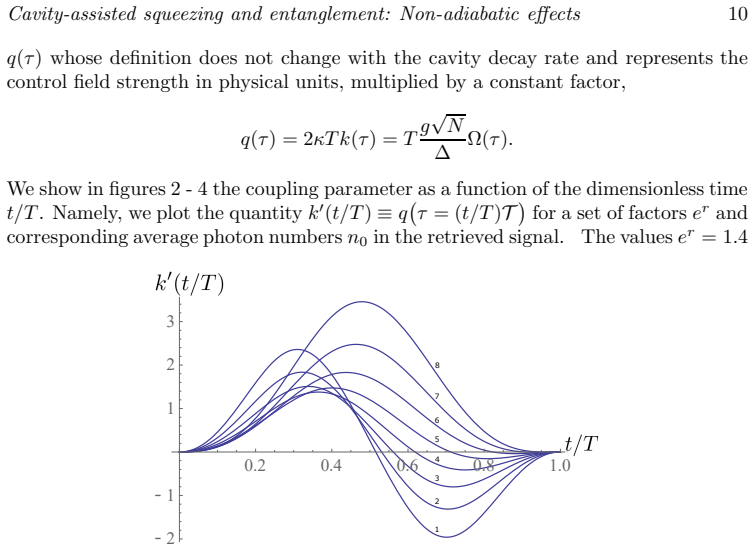
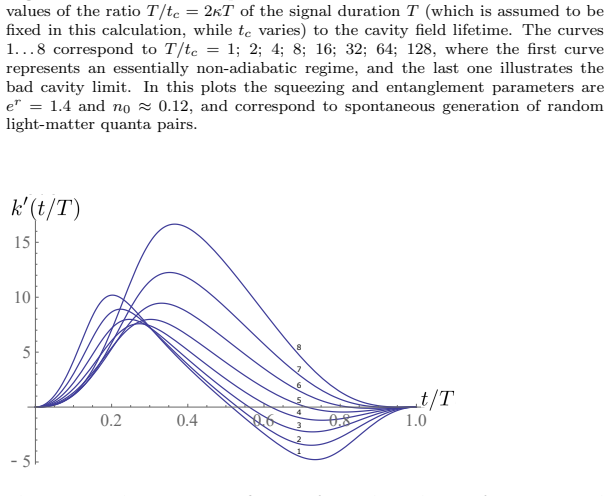
The paper studies a single-mode cavity with $N$ cold atoms in a $\Lambda$-configuration driven by a classical control field, tuned to two-photon Raman resonance. Linearizing around a fully populated ground state and adiabatically eliminating the upper atomic level reduces the dynamics to two coupled bosonic equations for the cavity field $E(\tau)$ and the collective spin $S^\dagger(\tau)$, with a dimensionless coupling $k(\tau)$ proportional to the control Rabi frequency. The authors show that any normalized output mode $E_0(\tau)$ with $E_0(T)=0$ can be retrieved with quantum efficiency $\eta=1$, provided the control profile is chosen so that the Green's function $G_{ES^\dagger}(\tau,0)$ is proportional to $E_0(\tau)$; the required profile follows from an explicit excitation-balance formula. Numerical solution of the semiclassical equations for quasi-Gaussian modes at various $T/t_c$ yields a control peak that is minimal at $T\approx 8t_c$, independent of the degree of squeezing ($e^r=1.4$, $6.5$, or $20$), i.e. independent of whether the source runs in the spontaneous low-photon or the high-gain continuous-variable regime.
Load-bearing premise
The model assumes the collective atomic spin does not decay or lose coherence during the signal duration: Eqs. (12)-(13) contain no relaxation term for $S$, even though the motivation for shorter signals is atomic relaxation; if spin decoherence acts on a timescale comparable to $T$, the derived control profiles and the $T\approx 8t_c$ optimum need not hold.
Editorial extensions
If this is right
- At $T\approx 8t_c$, one cavity choice serves both the spontaneous low-photon regime ($e^r=1.4$) and high-gain continuous-variable operation ($e^r=20$), because the optimal ratio does not depend on the degree of squeezing.
- Using a signal mode that ends at zero amplitude yields retrieval efficiency $\eta=1$: no photons are left in the cavity at $T$, and the output mode coincides with a squeezed eigenmode.
- In the non-adiabatic regime the control field must reverse sign at a time $t_s$, effectively converting some light-matter pairs back into the control field; for a given cavity and mode shape, $t_s$ is the same as in cavity-assisted memories and does not depend on the squeezing level.
- Even at $T/t_c=1$, strong squeezing and entanglement (up to $e^r=20$) can still be retrieved, at the price of a more intense, sign-reversing control field, so speeding up the interface does not by itself destroy the quantum resource.
- The universal optimum provides a simple design rule: choose the cavity finesse so that $2\kappa T\approx 8$ to minimize control power and associated nonlinear effects.
Reading between the lines
- Beyond the paper: adding a finite collective-spin decay rate to Eq. (13) and re-deriving the control profiles would test whether the $T\approx 8t_c$ optimum shifts; for decoherence times comparable to $T$, one expects the optimum to move toward shorter signals, and the efficiency formula would need a loss term.
- Beyond the paper: the shaping argument operates mode-by-mode, so the same Green's-function machinery should extend to several mutually orthogonal temporal modes, providing a route to multimode entangled states; the authors mention this possibility but do not develop it.
- Beyond the paper: the sign-switching control profile and the $\eta=1$ endpoint condition suggest a time-reversal symmetry between retrieval and storage, so the same optimal-control principle could be used to design write and read pulses for quantum memories as well as squeezing sources.
Signed reviews
Editorial analysis
A structured set of objections, weighed in public.
Referee Report
Summary. This paper investigates cavity-assisted Raman generation of light-matter squeezing and entanglement beyond the bad-cavity limit. The authors linearize the Heisenberg equations, adiabatically eliminate excited atomic coherences, and formulate input-output relations in terms of Green's functions. They apply Bloch-Messiah reduction to identify squeezed modes, define a retrieval efficiency, and derive a classical control-field profile (Eq. 34) that produces an output signal with a predefined quasi-Gaussian temporal shape. Numerical integration for eight values of T/t_c and three squeezing degrees e^r = 1.4, 6.5, 20 is reported, and the paper claims an optimal cavity-ensemble matching at T ≈ 8t_c with minimal control peak power and reduced nonlinear effects.
Significance. If the central claims are correct, the paper provides a useful design principle for cavity-assisted Raman sources: for a given signal duration and target squeezing, choosing the cavity linewidth so that T/t_c ≈ 8 minimizes the required control power, thereby suppressing AC Stark shifts and other nonlinear distortions. The analytical parts have real strengths: the Green's-function formulation of the Bloch-Messiah reduction is coherent, the control formula (34) follows directly from the linearized equations without fitted parameters, and the derivation of the squeezing factor and retrieval efficiency in Eqs. (29) and (35) is explicit. However, the headline optimal-matching claim is not established with the same rigor: no objective function is defined, the scan over T/t_c is coarse and only three values of e^r are shown, and the statement 'for any degree of squeezing and entanglement' is an extrapolation rather than a proven result.
major comments (3)
- [Section 3, Figs. 2-4] The central claim that an optimal matching is achieved for T ≈ 8t_c for any degree of squeezing and entanglement is not supported by the presented evidence. No objective function for control field peak power is defined; the conclusion appears to be drawn by visual inspection of plots for only eight discrete ratios T/t_c = 1, 2, 4, 8, 16, 32, 64, 128 and three values e^r = 1.4, 6.5, 20. A systematic minimization over a finer grid, or an analytic argument showing that the optimal ratio is independent of e^r, is needed before the 'for any degree' statement can stand. As written, the paper establishes only that for the plotted examples the peak is near T/t_c = 8.
- [Section 3, paragraph beginning 'Starting from the bad cavity limit'] The inference that the T ≈ 8t_c optimum minimizes a variety of non-linear effects, such as AC light shifts and four-wave mixing, is not demonstrated. Equations (4)-(7) and (12)-(13) contain only linearized, Hamiltonian dynamics with no nonlinear terms; the paper never defines a metric for AC light shifts or four-wave mixing. Lower peak control power is a plausible heuristic, but it is not automatically equivalent to minimal time-integrated nonlinear phase shifts or four-wave mixing losses. This claim should either be stated as a heuristic or supported by an explicit estimate of the relevant nonlinear contributions.
- [Section 3, Eq. (34) and following text] The statement that the numerically reconstructed output mode is in perfect agreement with the predefined mode E0(τ) is, by construction, a consistency check of the inverse-design formula rather than an independent validation. Since Eq. (34) is derived from requiring E(τ) = √n0 E0(τ), a perfect match is expected up to numerical error. This is not a criticism of the derivation, but the paper should present it as a verification of numerical implementation, not as empirical support for the optimality claim. Additionally, the assertion that E0(τ) in Eq. (27) is representative of all useful signal shapes is an extra assumption; its generality is not established.
minor comments (4)
- [Section 3, text after Fig. 4] The text states that the medium squeezing case is represented by e^r = 5, while Figure 3 and its caption use e^r = 6.5. This inconsistency should be corrected.
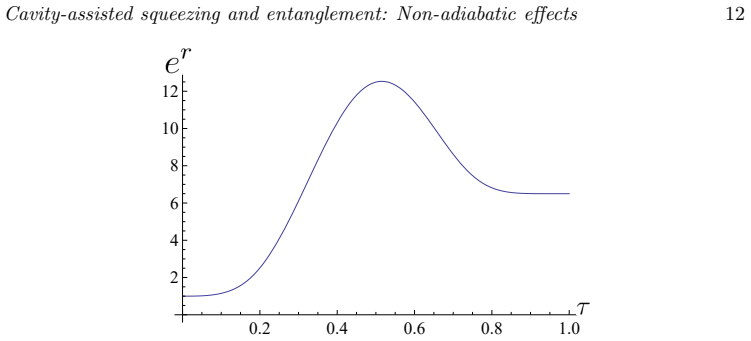
- [Figure 5] The y-axis label appears as 'e x r' and should be typeset as exp(r(τ)) or e^{r(τ)}.
- [Section 2 and Appendix] The dimensionless duration is denoted T in the Appendix and in equations such as (23), while the physical signal duration is also denoted T in the main text. This overloaded notation can confuse the reader; for example, Eq. (23) uses T both as the upper integration limit and as the physical duration. A different symbol for the dimensionless duration, such as T̃, would improve clarity.
- [Abstract] The abstract claims that the results make it possible to minimize a variety of non-linear effects, but the manuscript does not analyze any nonlinear mechanism quantitatively. It would be more precise to say that the results reduce the required control-field intensity, which is expected to suppress control-induced nonlinearities.
Circularity Check
No significant circularity; the derivation is a self-contained inverse-design calculation with no fitted parameters or load-bearing self-citations.
full rationale
The paper's central derivation is self-contained. The control-field profile is obtained by inverse design: Eq. (34) solves for k(τ) from the predefined output mode E0(τ), so the later statement that the retrieved signal matches E0 is a consistency check of the numerical implementation, not an empirical prediction. The unit-efficiency result η=1 follows from the chosen mode shape E0(T)=0 together with the imposed relation (28), and the paper explicitly presents this as a consequence of the construction rather than as an independent discovery. The T≈8tc optimal-matching claim is inferred from numerical scans over discrete T/tc and squeezing values; this is a support/rigor limitation (the scan is coarse and no objective function is explicitly minimized), but it is not circular. Self-citations [27,28] are used only as an analogy for the sign-switching control profile and are not load-bearing for the central claim. No fitted inputs are renamed as predictions, and no uniqueness theorem is imported from prior work. Therefore no circular step is present.
Assumptions & free parameters
free parameters (2)
- Target squeezing factor e^r =
1.4, 6.5, 20 (representative)
- Predefined signal shape E0(τ) =
Equation (27), normalized quasi-Gaussian with E0(0)=E0(T)=0
assumptions (6)
- domain assumption Adiabatic elimination: |Δ| is much larger than all other frequency scales, so dσ_gf/dτ and dσ_sf/dτ are set to zero.
- domain assumption Ground-state population remains approximately one; populations of s and f and their cross-coherence are negligible, making S a bosonic mode.
- domain assumption Atomic relaxation and decoherence are absent; no decay terms enter for σ_gs or S.
- domain assumption Input field and the unsqueezed output oscillator O_v are in vacuum states.
- domain assumption Single-mode cavity field and standard input-output relation E_out = √(2κ)E - E_in.
- ad hoc to paper The predefined output mode E0(τ) in Eq (27) is representative of all useful signal shapes.
Cite this review
Pith. "Pith review of Cavity-assisted squeezing and entanglement: Non-adiabatic effects and optimal cavity-atomic ensemble matching." pith.science (2026). https://pith.science/paper/XZHM5JIV
@misc{pith2026190807022,
  author       = {Pith},
  title        = {Pith review of: Cavity-assisted squeezing and entanglement: Non-adiabatic effects and optimal cavity-atomic ensemble matching},
  year         = {2026},
  howpublished = {\url{https://pith.science/paper/XZHM5JIV}},
  note         = {Machine review of arXiv:1908.07022}
}
read the original abstract
We investigate theoretically quantum entanglement of light with the collective spin polarization of a cold atomic ensemble in cavity-assisted Raman schemes. Previous works concentrated mostly on the bad cavity limit where the signals are much longer than the cavity field lifetime. In view of atomic relaxation and other imperfections, there may arise a need to speed-up the light-atoms interface operation. By increasing the cavity field lifetime, one can achieve better light-matter coupling and entanglement. In our work, we consider the non-adiabatic effects that become important beyond the bad cavity limit in both low-photon and continuous variables regime. We find classical control field time profiles that allow one to retrieve from the cavity an output quantized signal of a predefined time shape and duration, which is optimal for the homodyne detection, optical mixing or further manipulation. This is done for a wide range of the signal duration as compared to the cavity field lifetime. We discuss an optimal cavity-atomic ensemble matching in terms of the cavity field lifetime which allows one to apply less intense control field and to minimize a variety of non-linear effects, such as AC light shifts, four-wave mixing, etc, which may be potentially harmful to an experiment.
Figures

Figures from the paper (2 more)

Reference graph
Works this paper leans on
-
[1]
Raymer M G and W almsley I A 1990 The quantum coherence prop erties of stimulated Raman scattering Progress in Optics XXVIII ed E W olf (Elsevier Science Publishers)
work page 1990
- [2]
-
[3]
Kuhn A 2015 Cavity induced interfacing of atoms and Light Engineering the Atom-Photon Interaction Nano-Optics and Nanophotonics book series ed A Predojevi´ c and M W Mitchell (Switzerland: Springer International Publishing)
work page 2015
-
[4]
Chou C W de Riedmatten H Felinto D Polyakov S V Enk S J and Kim ble H J 2005 Nature 438 7069
work page 2005
-
[5]
Yuan Z-C Chen Y-A Zhao B Chen S Schmiedmayer J and Pan J-W 20 08 Nature 454 1098
-
[6]
Jing B W ang X-J Yu Y Sun P-F Jiang Y Yang S-J Jiang W-H Luo X-Y Zhang J Jiang X Bao X-H and Pan J-W 2019 Nature Photonics 13(3) 210 Cavity-assisted squeezing and entanglement: Non-adiabat ic effects 15
work page 2019
-
[7]
Borregaard J Zugenmaier M Petersen J M Shen H Vasilakis G J ensen K Polzik E S and S´ orensen A S 2016 Nature Communications 7 11356
work page 2016
-
[8]
Braunstein S L and Van Loock P 2005 Rev. Mod. Phys. 77 513
work page 2005
Show all 28 references
-
[9]
Raizen M G Orozco L A Xiao M Boyd T L and Kimble H J 1987 Phys. Rev. Lett. 59 198
1987
-
[10]
Quantum Information with Continuous Variables of Atoms and Light 2007 ed N J Cerf G Leuchs and E S Polzik (London: Imperial College Press)
2007
-
[11]
Hammerer K Sørensen A S and Polzik E S 2010 Rev. Mod. Phys. 82 1041
2010
-
[12]
Sørensen M W and Sørensen A S 2009 Phys. Rev. A 80 033804
2009
-
[13]
W asilewski W and Raymer M G 2006 Phys. Rev. A 73 063816
2006
-
[14]
Sørensen A and Mølmer K 2002 Phys. Rev. A 66 022314
2002
-
[15]
Parkins A S Solano E, and Cirac J I 2006 Phys. Rev. Lett. 96 053602
2006
-
[16]
Guzman R Retamal J C Solano E and Zagury N 2006 Phys. Rev. Lett. 96 010502
2006
-
[17]
Chen B, Qiu C Chen S Guo J Chen L Q Ou Z Y and Zhang W 2015 Phys. Rev. Lett. 115 043602
2015
-
[18]
Braunstein S L 2005 Phys. Rev. A 71 055801
2005
-
[19]
Duan L-M Giedke G Cirac J I and Zoller P 2000 Phys. Rev. Lett. 84 2722
2000
-
[20]
Vasilyev D V Sokolov I V and Polzik E S 2008 Phys. Rev. A 77 020302(R)
2008
-
[21]
Chrapkiewicz R and W asilewski W 2012 Optics Express 20(28) 29541
2012
-
[22]
Zhang X Kalachev A and Kocharovskaya O 2013 Phys. Rev. A 87 013811
2013
-
[23]
Parigi V D’Ambrosio V Arnold C Marrucci L Sciarrino F and Laurat J 2015 Nat. Commun. 6 7706
2015
-
[24]
Vetlugin A N and Sokolov I V 2016 Eur. Phys. Lett. 113 64005
2016
-
[25]
Parniak M Mazelanik M Leszczynski A Lipka M Dabrowski M a nd W asilewski W 2019 Phys. Rev. Lett. 122 063604
2019
-
[26]
Albrecht B Farrera P Heinze G Cristiani M and de Riedmatt en M 2015 Phys. Rev. Lett. 115 160501
2015
-
[27]
Veselkova N G and Sokolov I V 2017 Laser Physics 27 125203
2017
-
[28]
Veselkova N G Masalaeva N I and Sokolov I V 2019 Phys. Rev. A 99 013814
2019
Reviewed August 14, 2026 · model on record in the stance chip above.
Discussion (0). Continue with ORCID to comment.