REVIEW 4 major objections 4 minor 88 references
Superconducting and Pseudogap Transition Temperatures in High-Tc Cuprates and the $T_{c}$ Dependence on Pressure
T0 review · 4 major / 4 minor · reviewed 2026-08-14 · deepseek-v4-flash
Pith's one-line read Two competing oxygen-hole forces yield the cuprate Tc dome
desk verdict The paper's effective-Hamiltonian picture and layer scaling are worth a look, but the central dome equations have an algebraic error and the pressure comparison is circular; it needs major revision before it can be cited. read the letter →
The pith
A machine-rendered reading of the paper's core claim, the machinery that carries it, and where it could break.
The reading
What carries the argument
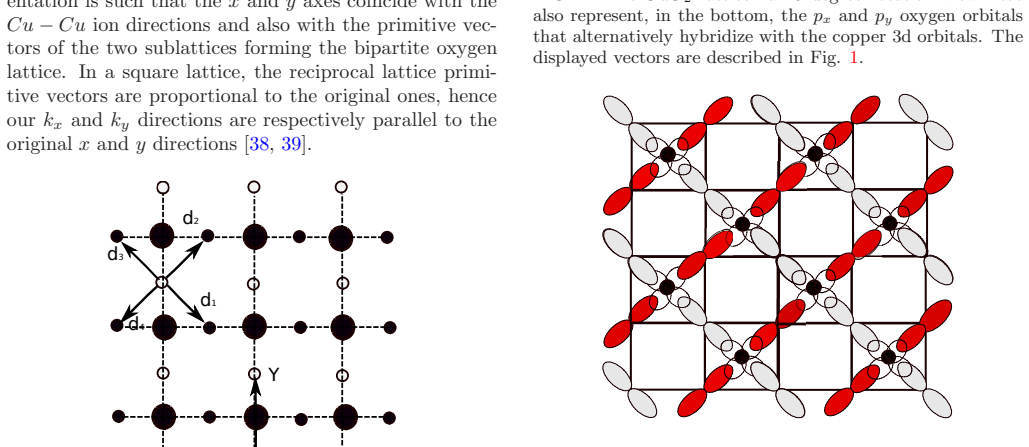
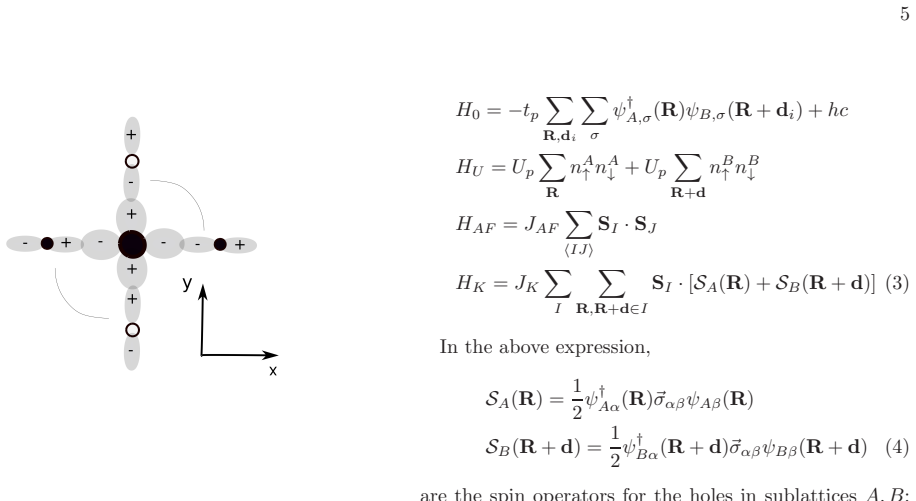
The load-bearing object is an effective Hamiltonian defined on the bipartite oxygen lattice of the CuO2 planes, formed because only one of the two oxygen p orbitals ($p_x$ or $p_y$) hybridizes with each copper $3d$ orbital. In this Hamiltonian, the attractive channel, written with a Hubbard-Stratonovich pairing field $\Phi$, and the repulsive channel, written with a field $\chi$, both inherit the sign alternation $\Delta(d_{1,3}) = -\Delta(d_{2,4})$, $M(d_{1,3}) = -M(d_{2,4})$; in momentum space this gives the d-wave factor $\cos(k_+ a) - \cos(k_- a)$ for both the superconducting gap and the pseudogap. The mechanism that produces the dome formulas is the effective potential $V_{\rm eff}[\Delta, M, \mu]$, obtained from a Nambu four-component fermion integration; minimizing it with respect to $\Delta$, $M$, and the chemical potential $\mu$ produces the gap equations whose $\Delta, M \to 0$ limits are the transition-temperature equations. The chemical potential is coupled to doping by $\mu_0(x) = 2\gamma(g_S)(x_0 - x)$, a linear relation containing the single fitted parameter $\gamma$.
What would settle it
Measure $T^*(x)$ under applied hydrostatic pressure in a cuprate such as Hg1201 or Hg1212: the model predicts $g_P$ is pressure-independent, so the pseudogap line should remain fixed while the superconducting dome moves; a measurable pressure shift of $T^*$ would falsify the central claim. A second check is the universal ratio $|\Delta_0(0,x_0)|/T_{\max} = 2\ln 2$, which can be tested by scanning tunneling or optical measurements of the zero-temperature gap at optimal doping.
Extended reading notes
Core claim
The central claim is that the cuprate phase diagram emerges from a duality between two condensates with the same d-wave symmetry, with no phonons needed. Starting from a spin-fermion-Hubbard model on the CuO2 planes, the authors trace out the localized copper spins and make a second-order expansion in $t_p/U_p$; the resulting effective Hamiltonian for oxygen holes contains an attractive term of coupling $g_S$ and a repulsive term of coupling $g_P$. The two couplings come out numerically close to values obtained from published LSCO parameters, and the two order parameters cannot be nonzero at the same time except at $g_S = g_P$, so the system chooses either a superconducting phase or a pseudogap (d-density-wave) phase. Functional integration over fermions and minimization of the effective potential yields implicit equations for $T_c(x)$ and $T^*(x)$, with optimal doping occurring when the chemical potential vanishes. The same machinery yields a universal rescaled phase diagram, an enhancement $g_S \to N g_S$ with the number of CuO2 layers, and a pressure dependence $g_S(P) = g_S e^{\kappa_g P}$ that accounts for measured $T_c$ shifts without changing the pseudogap line.
Load-bearing premise
The load-bearing premise is that the chemical potential is a linear function of doping, $\mu_0(x) = 2\gamma(g_S)(x_0 - x)$, with $\gamma$ fixed by fitting; if the true relation is nonlinear and material-dependent, the specific analytic forms of the $T_c(x)$ dome and the universal phase diagram do not follow.
Editorial extensions
If this is right
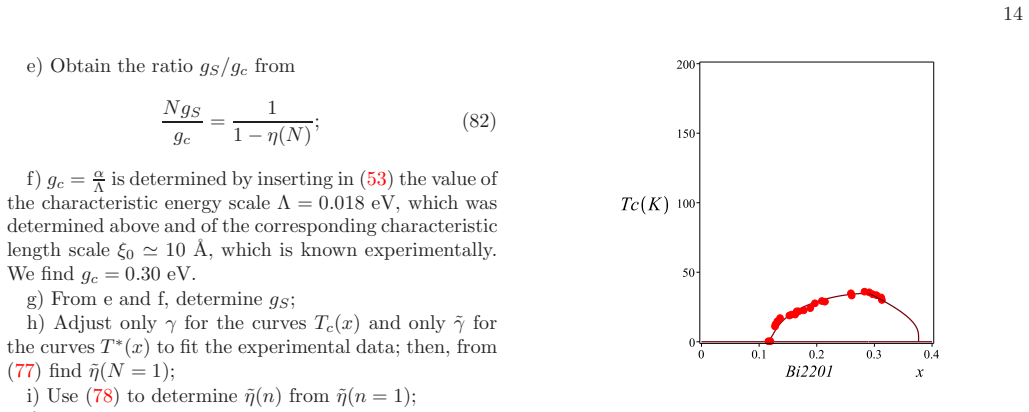
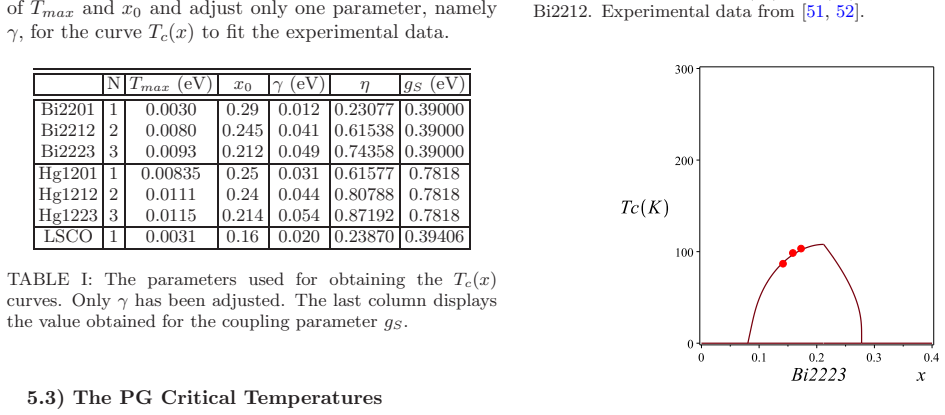
- The same equations (70) and (72) generate the $T_c(x)$ domes for LSCO, Bi2201, Bi2212, Bi2223, Hg1201, Hg1212, and Hg1223 after adjusting one parameter $\gamma$ per material, with reported close agreement to measured data.
- Optimal doping is fixed by the vanishing chemical potential, and the zero-temperature gap satisfies $|\Delta_0(0,x_0)|/T_{\max} = 2\ln 2$ for all cuprates covered by the theory.
- Multi-layer enhancement follows from $g_S \to Ng_S$, predicting $T_{\max}(N)$ for Bi and Hg families up to three layers; beyond three layers, inner planes are far from charge reservoirs and are poorly doped, which explains the observed saturation and decline.
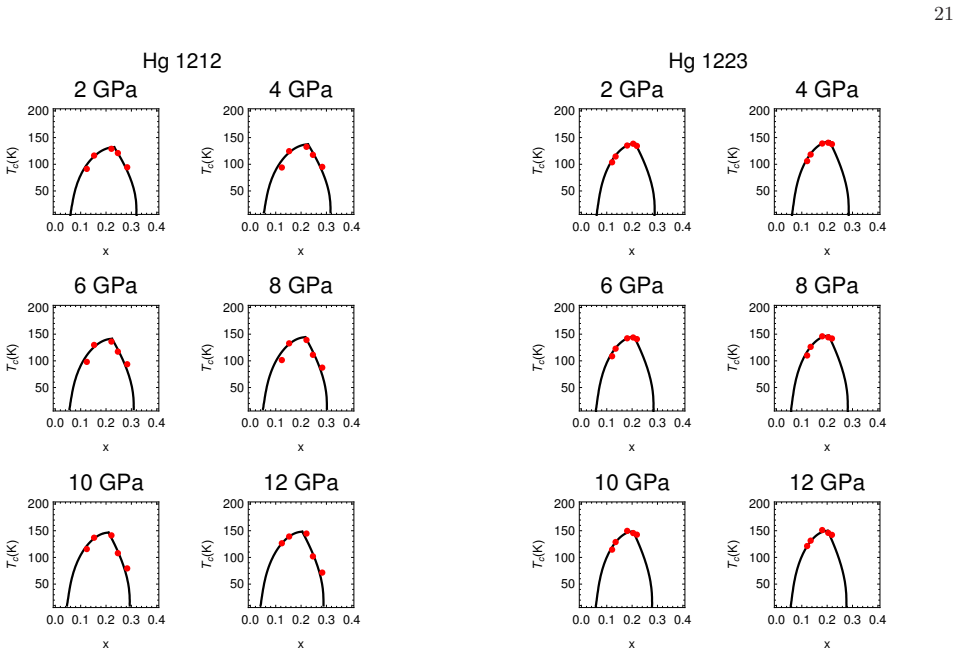
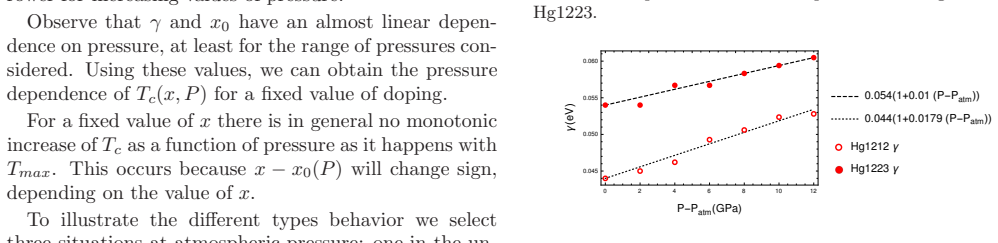
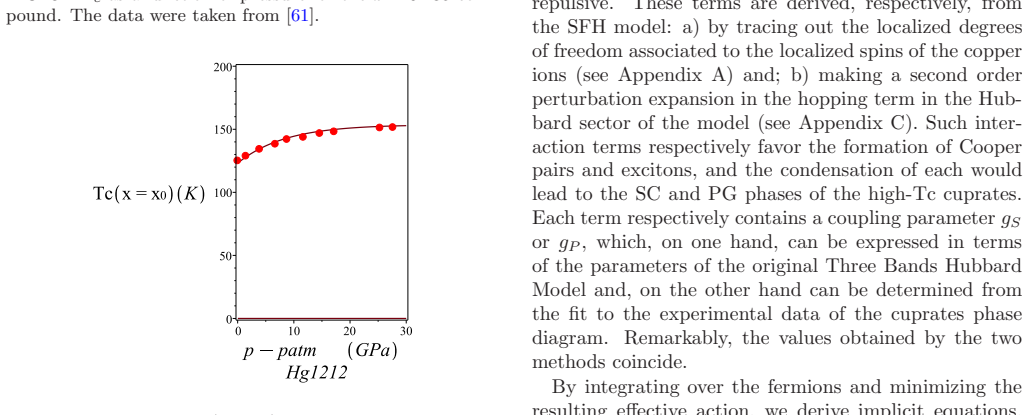
- Under pressure, $g_S$ grows exponentially with an effective compressibility $\kappa_g$, giving $T_{\max}(P)$ and $T_c(x,P)$ curves fitted to mercury-family data, while the predicted pseudogap temperature $T^*(x)$ is independent of pressure.
- Rescaling by $p = x/x_0$ and $\tau_c = T_c/T_{\max}$ collapses the calculated domes onto a universal curve governed by a single dimensionless parameter $\zeta = \gamma x_0/T_{\max}$, in line with the reported universal phase diagram.
Reading between the lines
- A testable consequence of the competition picture that goes beyond the reported fits: if the linear $\mu_0(x)$ assumption is replaced by a nonlinear material-specific relation, the dome formulas should be re-derived; the same effective-potential machinery would still predict superconducting/pseudogap mutual exclusion as long as $g_S \neq g_P$.
- The prediction that pressure does not move the pseudogap line is a distinguishing signature: $g_P = 2t_p^2/U_p$ is argued to be pressure-invariant, so a pressure scan of $T^*$ by Nernst or ARPES measurements would either support or sharply conflict with the model.
- If the universal ratio $|\Delta_0(0,x_0)|/T_{\max} = 2\ln 2$ is checked across multiple cuprate families with different optimal dopings, it becomes a sharp test of the whole derivation, since it follows directly from the logarithmic structure of the gap equation rather than from any fitted parameter.
- The same Hamiltonian could be pushed toward transport: the strange-metal and charge-ordering regimes above $T^*$ are mentioned by the authors as natural next targets, and the present formalism appears to have the ingredients (two competing order parameters and a doping-dependent chemical potential) to model them.
Signed reviews
Editorial analysis
A structured set of objections, weighed in public.
Referee Report
Summary. The paper constructs an effective Hamiltonian for itinerant oxygen holes on a bipartite oxygen lattice, starting from a spin-fermion-Hubbard model. The attractive and repulsive effective couplings gS and gP are derived by tracing out copper spins and by a second-order tp/Up expansion, and the model is used to derive implicit analytic expressions for the superconducting transition temperature Tc(x) and the pseudogap temperature T*(x). After fitting a small number of parameters, the authors compare the resulting domes with data for LSCO, Bi2201/Bi2212/Bi2223, and Hg1201/Hg1212/Hg1223, and they extend the formalism to explain the increase of optimal Tc with the number of CuO2 layers and to describe the pressure dependence of Tc. The abstract claims excellent agreement with experiment and a unified explanation of the d-wave symmetry of both order parameters and of the ARPES Fermi pockets.
Significance. If the derivation were correct, the paper would provide a universal analytic form for the cuprate phase diagram, a microscopic rationale for d-wave symmetry in both channels, a quantitative account of the layer-number dependence of Tc, and a falsifiable prediction that T* is pressure-independent. The manuscript is rich in explicit analytic expressions and direct comparisons with published data, and its prediction that pressure does not affect the pseudogap temperature is a clear testable statement. However, the central algebraic reduction from Eq. (56) to Eqs. (70)-(72) is incorrect on both branches of the dome, and the pressure analysis in Sec. 7.3 fits the model to data that were themselves generated with the model's equations. As printed, the paper does not establish its main quantitative claims, although the framework may be salvageable after a substantial reworking.
major comments (4)
- [Section 4.4, Eqs. (67)-(73)] The overdoped branch is not the |M0|->0 limit of Eq. (56). For mu0 = -q < 0, Eq. (56) gives a denominator ln2 + ln cosh(q/(2Tc)) = q/(2Tc) + ln(1 + e^{-q/Tc}), whereas Eq. (72) contains only ln(1 + e^{-mu0/Tc}) = ln(1 + e^{q/Tc}); the linear term q/(2Tc) is missing. The error originates in Eq. (71): with mu0 = -q and |M0| < q, one has |mu0 + |M0|| + |mu0 - |M0|| = 2q, so B(x) = q/(2Tc), not 0. Because x_SC^+ in Eq. (73) and the universal variable zeta in Eq. (85) are built on Eq. (72), this algebraic error propagates into the central quantitative claims of the paper.
- [Section 4.4, Eqs. (68)-(70)] The underdoped expression has the same type of problem. From Eq. (56) with mu0 > 0, the exact denominator is mu0/(2Tc) + ln(1 + e^{-mu0/Tc}). Equation (70) instead contains mu0/(2Tc) + ln2 + (1/2)(e^{-mu0/Tc} - 1), which is not an identity and is numerically poor away from optimal doping. For example, at mu0/Tmax = 1.12, which is still inside the dome whose exact edge from Eq. (56) is mu0/Tmax = 2 ln2, Eq. (56) gives Tc approximately 0.89 Tmax, whereas Eq. (70) gives approximately 0.53 Tmax. Consequently the quantum critical points in Eq. (73) are also inconsistent with Eq. (56), which yields x0 +/- Tmax ln2/gamma rather than the printed values. The statement that Eqs. (70) and (72) are derived from Eq. (56) therefore fails on both branches.
- [Section 7.3, Figs. 27-30] The pressure comparison is circular. The text states that the experimental pressure data were obtained from Ref. [61] using the paper's equations (70) and (72), rather than a parabola, to convert each measured Tc into a doping value. Those converted points are then fit with the same equations, with gamma and x0 refitted at every pressure (Figs. 29 and 30), and kappa_g is fitted in Sec. 7.2. The agreement in Figs. 27 and 28 is therefore not an independent test of the model. The authors should compare against the original Tc(P) data without converting doping through the model, or at least clearly separate the converted data from the fitted quantities.
- [Section 4.2, Eqs. (57)-(58); Tables I-II; Section 7.3] The claim that only one parameter is fitted is overstated. For each material, Tmax and x0 are experimental inputs (Table I), gamma is fitted for Tc(x), and a separate tilde gamma is fitted for T*(x) (Table II). The linear relation mu0(x) = 2 gamma (x0 - x) is introduced as the simplest parametrization and is not derived from the microscopic Hamiltonian; the dome shape and the universal zeta depend on this assumed linearity. In the pressure section, kappa_g and the linear pressure dependences of gamma and x0 are additional fitted inputs. The paper should present these as phenomenological assumptions and adjust the wording of the one-parameter claim accordingly.
minor comments (4)
- [Throughout] There are several typographical errors, including 'Altough' and 'approachs' in the introduction, and a dangling fragment 'The independent curve will be [h]' in the caption of Fig. 6; these should be corrected.
- [Section 7.1] The assumption that the moduli of compressibility kappa_J for J_AF and J_K are approximately equal is introduced without justification; it should be labeled as an additional assumption rather than a consequence of the model. The reference in the sentence 'Considering (19)' should point to Eq. (16), where gP is defined, rather than to the numerical value in Eq. (19).
- [Table I caption] The caption states 'Only gamma has been adjusted,' but Tmax and x0 are taken from experiment; the caption should specify that gamma is the only fitted parameter, with Tmax and x0 treated as experimental inputs.
- [Section 3.2] The statement that the chemical potential is proportional to x, 'mu(x) proportional to x', is inconsistent with the later affine relation mu0 = 2 gamma (x0 - x); the wording should be adjusted to avoid the contradiction.
Circularity Check
Pressure-dome comparison is circular: the plotted data are mapped by the model's own Eqs. (70)-(72), then fitted and replotted as 'prediction'; the ambient dome is a one-parameter fit.
-
fitted input called prediction
[Section 7.3, around Eqs. (70) and (72) and Figs. 27-30]
"The experimental data of the two previous figures were obtained from [61], using our equations (70) and (72), instead of a parabola for obtaining the different doping values corresponding to each value of Tc following the same procedure as in [61]."
The plotted pressure-dome points are assigned their x-coordinates by inverting the very Tc(x) equations that are then drawn as the theoretical prediction, so each point lies on the model curve by construction. The parameters x0(P) and gamma(P) shown in Figs. 29 and 30 are fitted to these model-converted points, and the phase diagrams in Figs. 27 and 28 compare the model with data that have been re-expressed through the model. This makes the pressure phase-diagram agreement a self-consistency check rather than an independent confirmation of the derived Tc(x,P).
full rationale
The main ambient-pressure Tc(x) derivation is not circular in the strict sense: Eq. (56) follows from the fermion functional integral, and the self-citations (Refs. 28, 29, 38, 42) are methodological, with the traced-spin and perturbative steps exhibited in the appendices, so they are not load-bearing self-citation. The chemical potential relation mu0(x)=2gamma(x0-x) is, however, explicitly introduced as 'the simplest parametrization' and gamma is adjusted to the experimental Tc(x) curves, so the excellent ambient-pressure dome agreement is a one-parameter fit rather than an independent prediction. The genuine circular step is in the pressure analysis: Section 7.3 obtains the plotted doping values from the model's own Eqs. (70) and (72), then fits x0(P) and gamma(P) to those converted points, so the claimed agreement is by construction. Separately, as printed, Eq. (71) is not the |M0|->0 limit of Eq. (56) for mu0<0: with mu0=-q<0, |mu0+|M0||+|mu0-|M0|| = 2q, so B(x)=q/(2Tc), not 0, and Eq. (72) omits the q/(2Tc) term. That is an internal consistency/correctness defect, not a circularity; it would need correction before the overdoped branch, x+_SC, and zeta in Eq. (85) could be regarded as derived. Overall the pressure-dome prediction reduces in part to the model's own equations, giving a partial circularity score of 6.
Assumptions & free parameters
free parameters (4)
- gamma (shape parameter for Tc dome) =
0.012 to 0.054 eV depending on material (Table I)
- tilde gamma (shape parameter for T* line) =
0.089 to 0.2708 eV depending on material (Table II)
- kappa_g (pressure compressibility of gS) =
1/17 GPa^-1
- gamma(P) and x0(P) linear slopes =
gamma: 1% and 1.79% per GPa; x0: -0.003 and -0.001 per GPa (Figs. 29-30)
assumptions (5)
- domain assumption The Spin-Fermion-Hubbard model with parameters from Hansmann et al. (2014) is the correct starting point, and the same family coupling gS applies to all members of a cuprate family.
- domain assumption The oxygen lattice is bipartite with only one of the px or py orbitals hybridizing with copper d-orbitals, leading to the d-wave form of both order parameters.
- ad hoc to paper The linear chemical potential-doping relation μ0(x) = 2γ(x0 - x) is the correct connection between stoichiometric doping and hole chemical potential.
- domain assumption Interplane interactions are negligible; the only effect of multiple CuO2 planes is the enhancement gS -> NgS.
- ad hoc to paper The pressure dependence of magnetic couplings is exponential, J(P) = J(0) exp(kappa P), with the same kappa for JAF and JK, and gP is pressure-independent because Up scales as tp^2.
Cite this review
Pith. "Pith review of Superconducting and Pseudogap Transition Temperatures in High-Tc Cuprates and the $T_{c}$ Dependence on Pressure." pith.science (2026). https://pith.science/paper/MYUUYPDE
@misc{pith2026190807028,
  author       = {Pith},
  title        = {Pith review of: Superconducting and Pseudogap Transition Temperatures in High-Tc Cuprates and the $T_c$ Dependence on Pressure},
  year         = {2026},
  howpublished = {\url{https://pith.science/paper/MYUUYPDE}},
  note         = {Machine review of arXiv:1908.07028}
}
abstract
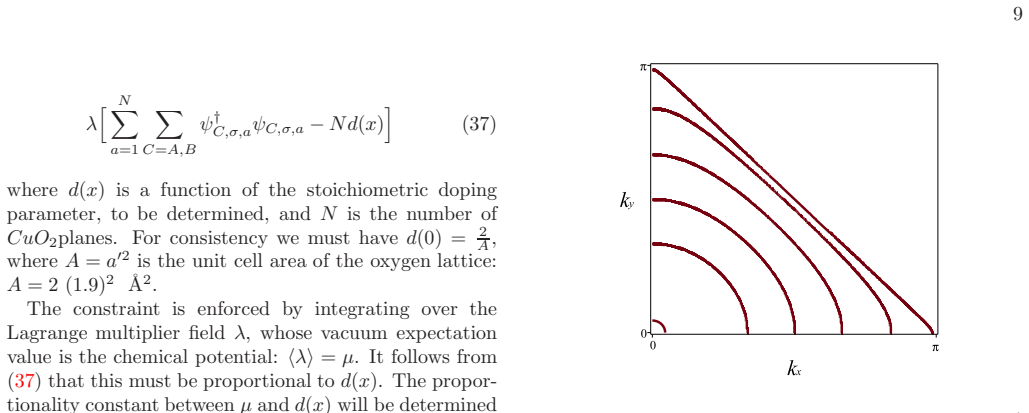
We derive analytic expressions for the critical temperatures of the superconducting (SC) and pseudogap (PG) transitions of the high-Tc cuprates as a function of doping. These are in excellent agreement with the experimental data both for single-layered materials such as LSCO, Bi2201 and Hg1201 and multi-layered ones, such as Bi2212, Bi2223, Hg1212 and Hg1223. Optimal doping occurs when the chemical potential vanishes, thus leading to an universal expression for the optimal SC transition temperatures. This allows for the obtainment of a quantitative description of the growth of such temperatures with the number of layers, N, which accurately applies to the $Bi$, $Hg$ and $Tl$ families of cuprates. We study the pressure dependence of the SC transition temperatures, obtaining excellent agreement with the experimental data for different materials and dopings. These results are obtained from an effective Hamiltonian for the itinerant oxygen holes, which includes both the electric repulsion between them and their magnetic interactions with the localized copper ions. We show that the former interaction is responsible for the SC and the latter, for the PG phases, the phase diagram of cuprates resulting from the competition of both. The Hamiltonian is defined on a bipartite oxygen lattice, which results from the fact that only the $p_x$ and $p_y$ oxygen orbitals alternatively hybridize with the $3d$ copper orbitals. From this, we can provide an unified explanation for the $d_{x^2-y^2}$ symmetry of both the SC and PG order parameters and obtain the Fermi pockets observed in ARPES experiments.
Figures

Figures from the paper (25 more)








Reference graph
Works this paper leans on
-
[61]
B. H. Bransden and C. J. Joachain, Introduction to Quantum Mechanics, Longman, UK (1989), p. 360
work page 1989
-
[1]
Tmax(n = 2) Tmax(n = 1) = η(n = 2) η(n = 1)
-
[2]
The CuO 2 planes have a lattice structure in which Cu ++ ions occupy the sites and oxygen ions the links of a square lattice, with a lattice parameter a = 3.8˚ A
The Effective Hamiltonian 2.1) The Oxygen Sublattices An outstanding feature of all High-Tc cuprates is the presence of one or more CuO 2 planes, intercepting the primitive unit cell of such compounds. The CuO 2 planes have a lattice structure in which Cu ++ ions occupy the sites and oxygen ions the links of a square lattice, with a lattice parameter a = 3...
-
[3]
In this work, we will consider only hole doping, in which electrons are progressively removed from the oxygenpx andpy orbitals, thereby creating holes in such orbitals
The Doping Process 3.1) The Mechanism of Doping The process of doping plays a central role in the physics of High-Tc cuprates. In this work, we will consider only hole doping, in which electrons are progressively removed from the oxygenpx andpy orbitals, thereby creating holes in such orbitals. The oxygen ions are themselves, placed on the sites of a squa...
-
[4]
The SC and PG T ransition T emperatures: Derivation 4.1) F ermion Integration We shall now integrate over the fermions, taking into account the doping constraint term, in order to obtain an effective potential in terms of the SC and PG order parameters and the chemical potential. The effective po- tential, despite being a function of the ground-state ex- pe...
-
[5]
The SC and PG T ransition T emperatures: Applications 5.1) Determination of Parameters We present a summary of the relevant parameters for each of the compounds considered in this study in Table I. For determining the values of the relevant parameters for each family group (Bismuth family, Mercury family, LSCO) we proceed through the following steps: a) F...
-
[6]
We now consider the following regimes: a) T >T ∗ In this case M = ∆ = 0 and µ2(x) = ǫ2(k) = v2 eff (cosk+a +cosk−a)2 (41) FIG
This leads to a second degree equation whose solution is µ(x) = ∓ √ ǫ2(k) + |M (k)|2 ±i|∆( k)| (40) Notice that the above expression becomes complex wherever a nonzero SC gap exists, reflecting the fact that no Fermi surface exists in the presence of a SC gap. We now consider the following regimes: a) T >T ∗ In this case M = ∆ = 0 and µ2(x) = ǫ2(k) = v2 ef...
-
[7]
Effects of an Applied External Pressure 7.1) Preliminary Considerations Under the effect of a change in pressure, given by ∆ P = P −P0 a linear segment with original length L0 would shrink to L, such that L −L0 L0 = −κL∆ P, (88) whereκL is the linear modulus of compressibility. For an infinitesimal change of pressure, dP , L(P ) would satisfy the linear diffe...
Show all 88 references
-
[8]
The first is the SC phase, while the second is the PG phase
(53) We see that since gS ⁄= gP it is impossible to satisfy (47) and (48) simultaneously with both ∆ 0 ⁄= 0 and M0 ⁄= 0, so we must have either ∆ 0 ⁄= 0 and M0 = 0 or ∆ 0 = 0 and M0 ⁄= 0. The first is the SC phase, while the second is the PG phase. For a fixed value of the dopin...
-
[9]
Honma and P
T. Honma and P. H. Hor, Unified electronic phase dia- gram for hole-doped high-T c cuprates, Phys. Rev. B 77, 184520 (2008)
2008
-
[10]
2.2, we have: JK = 1.17eV and JAF = 0.43eV
and ( 12), we have gS = J 2 K 8JAF gP = 2t2 p Up (16) Using the values of the magnetic coupling parameters valid for LSCO, provided in Sect. 2.2, we have: JK = 1.17eV and JAF = 0.43eV . From this, we obtain J 2 K 8JAF = 0.39793 eV (17) This corresponds, with excellent accuracy...
-
[11]
Fazekas, Lecture notes on electron correlation and magnetism, Vol
P. Fazekas, Lecture notes on electron correlation and magnetism, Vol. 5, World Scientific, Singapore (1999)
1999
-
[12]
as Σ = nA +−nB −+ +nA −+nB +− Π = nA +−nB +− +nA −+nB −+ Ξ 1 =nA ++nB −− +nA −−nB ++ Ξ 2 =nA ++nB ++ +nA −−nB −− (111) and using ( 110), we establish ( 15), up to a constant. 25 Appendix C In this Appendix, we perform a perturbation expansion in tp/Up, in H0 +HU , given by H0 ...
-
[13]
P. W. Anderson, Resonating valence bonds: A new kind of insulator?, Materials Research Bulletin 8, 153 (1973); P. Fazekas and P. W. Anderson, On the ground state properties of the anisotropic triangular antiferromagnet , Philosophical Magazine 30, 423 (1974). 26
1973
-
[14]
P. W. Anderson, The resonating valence bond state in La2CuO4 and superconductivity, Science 235, 1196 (1987)
1987
-
[15]
η(n = 3) = η(n = 1) 3 + 2 3
-
[16]
From the three equations above, using the experimen- tal values of Tmax(n = 2) and Tmax(n = 1), we deter- mine η(n = 1) = 0 .23077, η(n = 2) = 0 .61538, η(n =
η(n = 2) = η(n = 1) 2 + 1 2 (80) where the last two equations derive from ( 79), assum- ing that the coupling parameters gS are the same for all compounds of the same family. From the three equations above, using the experimen- tal values of Tmax(n = 2) and Tmax(n = 1), we det...
-
[17]
We find for all the materials of the Bi and Hg families: Λ = 0 .018eV
= 0.74358 for the Bi family and η(n = 1) = 0 .61577, η(n = 2) = 0 .80788, η(n = 3) = 0 .87192 for the Hg family; c) Now use Tmax(n) = η(n) 2 ln 2Λ (81) to determine Λ. We find for all the materials of the Bi and Hg families: Λ = 0 .018eV . d) for LSCO, use the value of Λ found ...
-
[18]
J. E. Hirsch, Antiferromagnetism, localization, and p air- ing in a two-dimensional model for CuO 2, Phys. Rev. Lett. 59, 228 (1987)
1987
-
[19]
R. T. Scalettar et al., Antiferromagnetic, charge- transfer, and pairing correlations in the three-band Hub- bard model, Phys. Rev. B44, 770 (1991)
1991
-
[20]
charge reservoir
Increasing of Tmax with the Number of Layers It is an evident experimental fact that the optimal transition temperature becomes higher as one increases the number of CuO 2 planes per primitive unit cell. Bi2201 and Hg1201, for instance, are single-layered ma- terials, which ha...
-
[21]
E. W. Huang et al., Numerical evidence of fluctuating stripes in the normal state of high-Tc cuprate supercon- ductors, Science 358, 1161 (2017)
2017
-
[22]
Eskes, L
H. Eskes, L. H. Tjeng and G. A. Sawatzky, Cluster- model calculation of the electronic structure of CuO: A model material for the high- Tc superconductors, Phys. Rev. B41, 288 (1990)
1990
-
[23]
Concluding Remarks We report here the obtainment of analytical expres- sions for Tc(x), T ∗(x) and Tc(x,P ), for several High-Tc cuprate compounds, which show an excellent agreement with the experimental data. Our starting point is a Spin- Fermion-Hubbard (SFH) Model, describi...
-
[24]
In that case, dimerization pro- duces a nonzero ground-state expectation value of that field, which generates a gap for the electrons
that ∆( k) = ∑ i=1,.., 4 ∆( di) exp [ ik · di ] M (k) = ∑ i=1,.., 4 M (di) exp [ ik · di ] (30) Then, notice that ∆ and M in ( 28), effectively act as hopping parameters for the fermion field, similarly to the dimerization field in the Su-Schriefer-Heeger model for polyacetylene ...
-
[25]
Zaanen, G
J. Zaanen, G. A. Sawatzky and J. W. Allen, Band gaps and electronic structure of transition-metal compounds, Phys. Rev. Lett. 55, 418 (1985)
1985
-
[26]
J. G. Bednorz and K. A. M¨ uller, Possible high-Tc su- perconductivity in the Ba-La-Cu-O system , Z. Phys. B64, 189 (1986)
1986
-
[27]
Dagotto, Correlated electrons in high-temperature su- perconductors, Rev
E. Dagotto, Correlated electrons in high-temperature su- perconductors, Rev. Mod. Phys. 66, 763 (1994)
1994
-
[28]
Damascelli, Z.-X
A. Damascelli, Z.-X. Shen and Z. Hussain, Angle re- solved photoemission studies of the cuprate superconduc- tors, Rev. Mod. Phys. 75, 473 (2003)
2003
-
[29]
H¨ ufner, M
S. H¨ ufner, M. A. Hossain, A. Damascelli and G. A. Sawatzky Two gaps make a high temperature supercon- ductor ? , Rep. Prog. Phys. 71, 062501 (2008)
2008
-
[30]
P.A. Lee, N. Nagaosa, and X.-G. Wen Doping a Mott insulator: physics of high-temperature superconductivit y, Rev. Mod. Phys. 78, 17 (2007)
2007
-
[31]
C. M. Varma, Theory of the pseudogap state of the cuprates, Phys. Rev. B 73, 155113 (2006)
2006
-
[32]
M. A. Kastner, R. J. Birgeneau, G. Shirane, and Y. En- doh. Magnetic, transport and optical properties of mono- layer copper oxides , Rev. Mod. Phys. 70, 897 (1998)
1998
-
[33]
Honma and P
T. Honma and P. H. Hor, Universal optimal hole-doping concentration in single-layer high-temperature cuprate superconductors, Supercond. Sci. Technol. 19, 907 (2006)
2006
-
[34]
Zhang, S
C. Zhang, S. Tewari and S. Chakravarty, Quasiparticle Nernst effect in the cuprate superconductors from the d- density-wave theory of the pseudogap phase, Phys. Rev. B 81, 104517 (2010)
2010
-
[35]
Honma, P
T. Honma, P. H. Hor, H. H. Hsieh and M. Tanimoto Universal intrinsic scale of the hole concentration in high - Tc cuprates, Phys. Rev. B 70, 214517 (2004)
2004
-
[36]
E. Razzoli, Y Sassa, G Drachuck, M Mansson, A Keren, M Shay, M H Berntsen, O Tjernberg, M Radovic, J Chang S Pailh` es, N Momono, M Oda, M Ido, O J Lip- scombe, S M Hayden, L Patthey, J Mesot and M Sh, The Fermi surface and band folding in LSCO, probed by angle-resolved photoe...
2010
-
[37]
that this must be proportional to d(x). The propor- tionality constant between µ andd(x) will be determined by fitting the experimental data As we increase the doping parameter x, the number of holes in the oxygen lattice will somehow increase as well, eventually reaching an am...
-
[38]
F. C. Zhang and T. M. Rice, Effective Hamiltonian for the superconducting Cu oxides , Phys. R. B37, 3759 (1988)
1988
-
[39]
D. J. van Harlingen, Phase-sensitive tests of the sym- metry of the pairing state in the high-temperature superconductors-Evidence for dx2− y2 symmetry, Rev. Mod. Phys. 67, 515 (1995)
1995
-
[40]
Edegger, V
B. Edegger, V. N. Muthukumar and C. Gros, Gutzwiller- R VB theory of high-temperature superconductivity: Re- sults from renormalized mean-field theory and variational Monte Carlo calculations, Advances in Physics 56, 927 (2007)
2007
-
[41]
Monthoux, A
P. Monthoux, A. V. Balatsky and D. Pines, Phys. Rev. Lett. 67, 3448 (1991)
1991
-
[42]
V. J. Emery, Theory of high- Tc superconductivity in ox- ides, Phys. Rev. Lett. 58, 2794 (1987)
1987
-
[43]
M. R. Presland et. al., General trends in oxygen sto- ichiometry effects on T c in Bi and Tl superconductors Physica C 176, 95 (1991)
1991
-
[44]
Nagano, Y
T. Nagano, Y. Tomioka, Y. Nakayama, K. Kishio and K. Kitazawa, Bulk superconductivity in both tetragonal and orthorhombic solid solutions of (La1− xSrx)2CuO4− δ , Phys. Rev. B 48, 9689 (1993)
1993
-
[45]
Y. F. Kung et al., Characterizing the three-orbital Hub - bard model with determinant quantum Monte Carlo., Phys. Rev. B93.15: 155166 (2016)
2016
-
[46]
Kakinuma, Y
N. Kakinuma, Y. Ono and Y. Koike, Anomalies of T c, resistivity, and thermoelectric power in the overdoped re- gion of La2− xSrxCu 1− yZnyO4, Phys. Rev. B 59, 1491 (1999)
1999
-
[47]
and ( 49) imply µ0(x) = d(x) gc 2η(NgS) (54) where gc =α/Λ. In order to find the critical temperature Tc(x), we im- pose on ( 47) the condition ∆ 0 = 0 and M0 = 0, which expresses the fact that the system is in one of the points belonging to the critical curve which separates t...
-
[48]
(64) Now (49) yields the following expression for the chem- ical potential ˜µ0 = 2˜γ(NgP )(˜x0 −x)
in the limit M0 → 0, which leads to T ∗(x) = lim M0→0 αη (Ng P ) 2gc F (∆ 0 = 0,M 0, ˜µ0(x)). (64) Now (49) yields the following expression for the chem- ical potential ˜µ0 = 2˜γ(NgP )(˜x0 −x). (65) Observe that, because M0 ⁄= 0 in the PG phase, the chemical potential ˜ µ0(x),...
-
[49]
Macridin, Phonons, charge and spin in correlated systems., Rijksuniversiteit Gr¨ oningen, The Netherlands, PhD Thesis (2003)
A. Macridin, Phonons, charge and spin in correlated systems., Rijksuniversiteit Gr¨ oningen, The Netherlands, PhD Thesis (2003)
2003
-
[50]
Zaanen and A
J. Zaanen and A. M. Ole´ s, Canonical perturbation the- ory and the two-band model for high-T, superconductors, Phys. Rev. B37, 9423 (1988)
1988
-
[51]
considered at the values: m = 2,...,N , we have N − 1 linear equations relating the η(mg)’s, namely, η(mg) = m − 1 m + 1 mη(1g). (78) Notice that, in order to obtain the above equation, we must assume the coupling parameters, either g =gS (or g =gP , below) in η(Ng ) are the s...
-
[52]
V. J. Emery and G. Reiter, Mechanism for high- temperature superconductivity, Phys. Rev. B38, 4547 (1988)
1988
-
[53]
C. M. Varma and S. Schmitt-Rink,Charge transfer exci- tations and superconductivity in ”ionic” metals, Sol. St. Comm. 62, 681 (1987)
1987
-
[54]
E. C. Marino and M. B. S. Neto, Magnetic-texture- driven charge pairing in the spin-fermion Hubbard model and superconductivity in the high-T c cuprates, Phys. Rev. B66, 224512 (2002)
2002
-
[55]
E. C. Marino and L. H. C. M. Nunes, Competing effec- tive interactions of Dirac electrons in the Spin-Fermion system, Ann. of Phys. 340, 13 (2014)
2014
-
[56]
Hansmann, N
P. Hansmann, N. Parragh, A. Toschi, G. Sangiovanni and K. Held, Importance of d-p Coulomb interactions for High-Tc cuprates and other oxides N. J. of Phys 16, 033009 (2014)
2014
-
[57]
with ( 55) we can express the optimal temperature as Tmax = Λ 2 ln 2η(NgS) (59) This should be compared with the corresponding BCS result, namely (see [ 38], for instance) Tc;BCS = 2γ π ℏωDe− 1 gBCS N (EF ) (60) where γ is the exponential of the Euler’s constant C ≃ 0.577 and ...
-
[58]
E. C. Marino and M. B. S. Neto, Quantum skyrmions and the destruction of long-range antiferromagnetic order in the high-Tc superconductors LSCO and YBCO, Phys. Rev. B64, 092511 (2001)
2001
-
[59]
Chakravarty, R
S. Chakravarty, R. B. Laughlin, D. K. Morr and C. Nayak, Hidden Order in Cuprates, Phys. Rev. B 63, 094503 (2001)
2001
-
[60]
Chakravarty, C
S. Chakravarty, C. Nayak and S. Tewari and , Angular- resolved photoemmission spectra in cuprates from d- density wave theory, Phys. Rev. B 68, 100504 (R) (2003)
2003
-
[62]
W. Su, J. R. Schrieffer and A. J. Heeger, Solitons in polyacetylene, Phys. Rev. Letters 42, 1698 (1979)
1979
-
[63]
E. C. Marino, Quantum Field Theory Approach to Condensed Matter Physics, Cambridge University Press, Cambridge, UK (2017)
2017
-
[65]
Vafek and A
O. Vafek and A. Vishwanath, Dirac Fermions in Solids: From High-Tc Cuprates and Graphene to Topological In- sulators and Weyl Semimetals, Ann. Rev. Cond. Mat. Phys. 5, 83 (2014)
2014
-
[66]
L. K. Lim, A. Lazarides, A. Hemmerich and C. M. Smith, Strongly interacting two-dimensional Dirac fermions, Europhys. Lett. 88, 36001 (2009)
2009
-
[67]
E. C. Marino and L. H. C. M. Nunes, Quantum critical- ity and superconductivity in quasi-two-dimensional Dirac electronic systems, Nucl. Phys. B741, 404 (2006)
2006
-
[70]
P. G. Radaelli, D. G. Hinks, A. W. Mitchell, B. A. Hunter, J. L. Wagner, B. Dabrowski, K. G. Vandervoort, H. K. Viswanathan and J. D. Jorgensen, Structural and superconducting properties of La2− xSrxCuO4 as a func- tion of Sr content, Phys. Rev. B 49, 4163 (1994)
1994
-
[72]
Komiya, H
S. Komiya, H. D. Chen, S. C. Zhang and Y. Ando, Magic Doping Fractions for High-Temperature Superconductors, Phys. Rev. Lett. 94, 207004 (2005)
2005
-
[73]
Y. Ando, Y. Hanaki, S. Ono, T. Murayama, K. Segawa, N. Miyamoto, and S. Komiya, Carrier concentrations in Bi2Sr2− zLazCuO6+δ single crystals and their relation to the Hall coefficient and thermopower, Phys. Rev. B 61, R14956 (2000)
2000
-
[74]
for determining the SC critical temperature It is instructive to compare our result with the empir- ical curve, known since a long time [ 8, 9, 43], obtained by fitting the data for the LSCO dome, by the following parabola Tc(x) = Tmax [ 1 − 82.616(x0 −x)2] . In Fig. 21 we supe...
-
[75]
Okada and H
Y. Okada and H. Ikuta, R dependence of superconducti- vity and thermopower in the Bi2Sr2− xRxCuOy (R = La, Sm and Eu) system Physica C 445-448, 84 (2006)
2006
-
[76]
Cyr-Choini` ere, R
O. Cyr-Choini` ere, R. Daou, F. Lalibert´ e, C. Colligno n, S. Badoux, D. LeBoeuf, J. Chang, B. J. Ramshaw, D. A. Bonn, W. N. Hardy, R. Liang, J.-Q. Yan, J.-G. Cheng, J.-S. Zhou, J. B. Goodenough, S. Pyon, T. Takayama, H. Takagi, N. Doiron-Leyraud, and Louis Taillefer Pseudo- ...
2018
-
[77]
A summary of the results found by following the steps described above is shown in Table I
find ˜η(N = 1); i) Use ( 78) to determine ˜η(n) from ˜η(n = 1); j) Determine gP from NgP gc = 1 1 − ˜η(N ) ; (83) and from gc, found in item d. A summary of the results found by following the steps described above is shown in Table I. 5.2) The SC Crit- ical T emperatures We now...
-
[78]
Yamamoto, W
A. Yamamoto, W. Z. Hu and S. Tajima, Thermoelec- tric power and resistivity of HgBa 2CuO4+δ over a wide doping range, Phys. Rev. B 63, 024504 (2000)
2000
-
[79]
J. A. Wilson and M. Farbod, A view of pseudogap for- mation and the HTSC mechanism from the perspective of Seebeck results on HgBa 2CuO4+δ Supercond. Sci. Tech. 13, 307 (2000)
2000
-
[80]
Ando and T
Y. Ando and T. Murayama, Nonuniversal power law of the Hall scattering rate in a single-layer cuprate Bi2Sr2− xLaxCuO6 Phys. Rev. B 60, R6991 (1999)
1999
-
[81]
Akoshima, T
M. Akoshima, T. Noji, Y. Ono and Y. Koike, Anoma- lous suppression of superconductivity in Zn-substituted Bi2Sr2Ca 1− xYx(Cu 1− yZny)2O8+δ , Phys. Rev. B 57, 7491 (1998)
1998
-
[82]
Fujii, I
T. Fujii, I. Terasaki, T. Watanabe and A. Matsuda, Dop- ing dependence of anisotropic resistivities in the trilay- ered superconductor Bi2Sr2Ca 2Cu 3O10+δ , Phys. Rev. B 66, 024507 (2002)
2002
-
[83]
Fukuoka, A
A. Fukuoka, A. Tokiwa-Yamamoto, M. Itoh, R. Usami, S. Adachi and K. Tanabe, Dependence of Tc and transport properties on the Cu valence in HgBa 2Ca n− 1Cu nO2(n+1)+δ (n=2,3) superconductors, Phys. Rev. B 55, 6612 (1997)
1997
-
[84]
J. L. Cohn, C. P. Popoviciu, Q. M. Lin and C. W. Chu, Hole localization in underdoped superconducting cuprates near 1 8 doping, Phys. Rev. B 59, 3823 (1999)
1999
-
[85]
Mukuda, N
H. Mukuda, N. Shiki, N. Kimoto, M. Yashima, Y. Ki- taoka, K. Tokiwa and A. Iyo, Novel Interplay between High-Tc Superconductivity and Antiferromagnetism in Tl-based Six-CuO2-Layered Cuprates: 205Tl- and 63Cu- NMR Probes, J. Phys. Soc. Japan 85, 083701 (2017)
2017
-
[86]
Maeda, Y
H. Maeda, Y. Tanaka, M. Fukutumi, and T. Asano, A New High-Tc Oxide Superconductor without a Rare Earth Element Jpn. J. Appl. Phys. 27, L209 (1988) ; Z. Z. Sheng and A. M. Hermann,Bulk superconductivity at 120 K in the Tl-Ca-Ba-Cu-O system, Nature 332, 138 (1988)
1988
-
[87]
Rocquefelte, K
X. Rocquefelte, K. Schwarz and P. Blaha, Theoretical investigation of the magnetic exchange interactions in copper (II) oxides under chemical and physical pressures, Scientific Reports 2, 759 (2012)
2012
-
[88]
Yamamoto, N
A. Yamamoto, N. Takeshita, C. Terakura, and Y. Tokura, High pressure effects revisited for the cuprate superconductor family with highest critical temperature, Nature Communications 6, 8990 (2015)
2015
-
[89]
L. Gao, F. Chen, R. L. Meng, Y. Y. Xue and C. W. Chu, Superconductivity up to 147 K in HgBa 2CaCu2O6+δ under quasi-hydrostatic pressure, Philosophical Magazin e Lett. 68, 345 (1993)
1993
-
[90]
Deng,et al., Higher superconducting transition tem per- ature by breaking the universal pressure relation, Proc
L. Deng,et al., Higher superconducting transition tem per- ature by breaking the universal pressure relation, Proc. of the Nat. Acad. of Sci. 116, 2004 (2019)
2019
-
[96]
into ( 51), we obtain the following curves for Tmax(P ), respectively, for Hg 1212 andHg 1223, after adjusting the parameter κg to the sin- gle value κg = 1 17GPa −1 for both compounds. FIG. 24: Optimal temperature of Hg1212 as a function of pressure, according to our theoreti...
-
[98]
(100) Here H[sN] = HAF [sN] +HK[sN,ψ ]
as a functional integral over N (see, for in- stance [ 38]): TrSIe −β [ HAF [SI ]+HK [SI,ψ ] ] = ∫ DN exp { ∫ β 0 dτ [ ⟨N(τ )| d dτ |N(τ )⟩ −H[sN] ] } . (100) Here H[sN] = HAF [sN] +HK[sN,ψ ]. (101) 24 We now separate N in antiferromagnetic and ferro- magnetic components, deno...
Reviewed August 14, 2026 · model on record in the stance chip above.
Discussion (0). Continue with ORCID to comment.