REVIEW 1 major objections 4 minor 51 references
Astrophysics-independent determination of dark matter parameters from two direct detection signals
T0 review · 1 major / 4 minor · reviewed 2026-08-14 · deepseek-v4-flash
Pith's one-line read The dark matter mass can be extracted from two direct detection signals without assuming the galaxy's dark matter velocity distribution, using a distribution-free two-sample test in velocity-squared space.
desk verdict A genuinely useful nonparametric mass test with a real but fixable overclaim: power-law halos break the claimed astrophysics independence. read the letter →
The pith
A machine-rendered reading of the paper's core claim, the machinery that carries it, and where it could break.
The reading
What carries the argument
The load-bearing object is the weighted empirical cumulative distribution in squared minimum velocity $v^2$. For detector $D$, each event's recoil energy is mapped to $v_m^2 = m_{A_D} E_R / (2 \mu_{A_D}^2)$ for an assumed $m_\chi$, and the event is weighted by the other detector's nuclear form factor $F^2_{D'}(E_R)$, relying on the fact that the halo integral $\eta(v_m)$ is a detector-independent function of $v_m$. The product $h(v^2) = F_1^2(v^2) F_2^2(v^2) \eta(v^2)$ is the common distribution both reweighted samples should follow, so the Cramér–von Mises statistic between the two empirical CDFs provides a $p$-value for each tested mass.
What would settle it
Generate mock event sets from spin-independent scattering with a known 50 GeV dark matter mass but add an extra recoil-energy dependence in the cross section that is not included in the assumed form factors, for example a $1/E_R$ factor; if the Cramér–von Mises test rejects the true mass at 90% confidence in a large fraction of realizations, the core equality fails and the method's interaction assumption is falsified.
Extended reading notes
Core claim
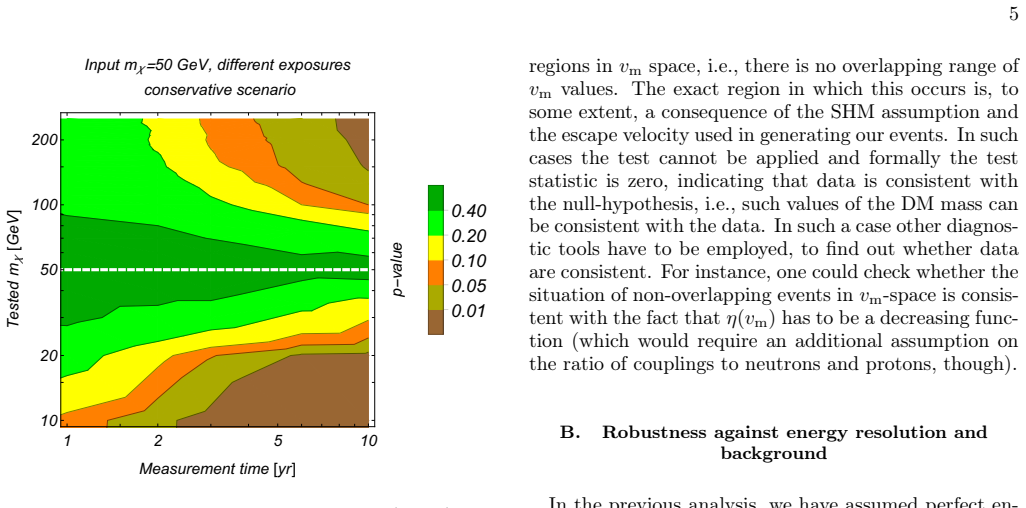
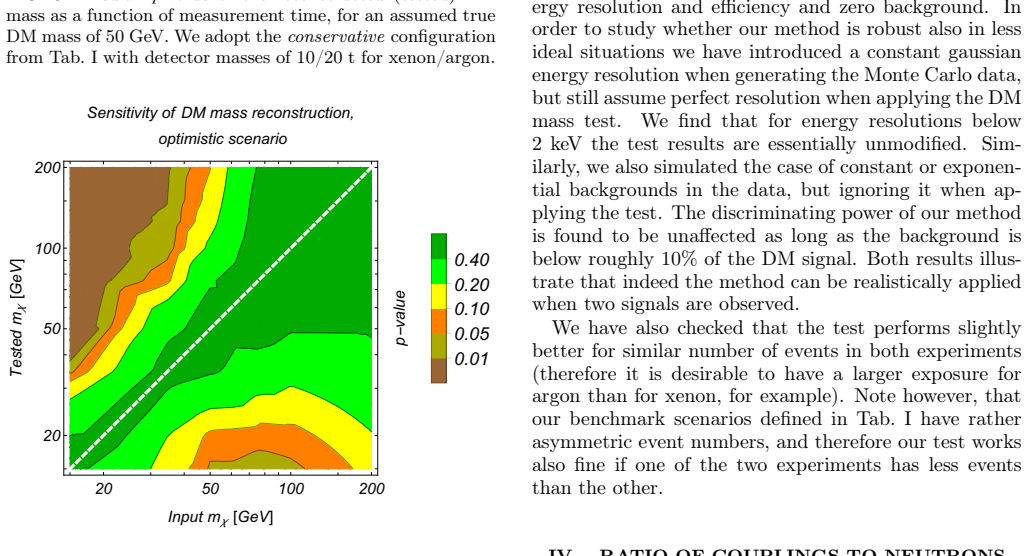
The central claim is that the normalized weighted event distributions in $v^2$ space are equal for two experiments only when the correct dark matter mass $m_\chi$ is used to convert recoil energies into velocities. For an assumed mass, each sample is reweighted with the other experiment's nuclear form factor, producing empirical cumulative distributions that ought to agree under the null hypothesis; disagreement, quantified by the Cramér–von Mises statistic, rejects that mass. Applied to Monte Carlo realizations of xenon and argon detectors, the paper finds median 90% confidence intervals of $[7,38]$ GeV for a true 20 GeV mass, $[21,190]$ GeV for a true 50 GeV mass, and a lower bound of at least 23 GeV for a true 100 GeV mass in the optimistic configuration. The method also detects inconsistency: if no mass yields a high $p$-value, at least one signal fails the assumed dark matter scattering hypothesis.
Load-bearing premise
The method assumes the dark matter–nucleus interaction is known and factorizable—specifically elastic spin-independent scattering with known nuclear form factors—so unmodelled energy or momentum dependence in the cross section would break the equality of the reweighted distributions even at the true mass.
Editorial extensions
If this is right
- Two positive signals from different target nuclei can pin down the dark matter mass with no assumption about the local velocity distribution, removing the largest astrophysical nuisance in direct detection fits.
- With a few hundred events, masses between roughly 20 and 70 GeV can be bracketed, while heavier masses yield only a lower bound—a kinematic limit that applies to any mass-measurement method from nuclear recoils.
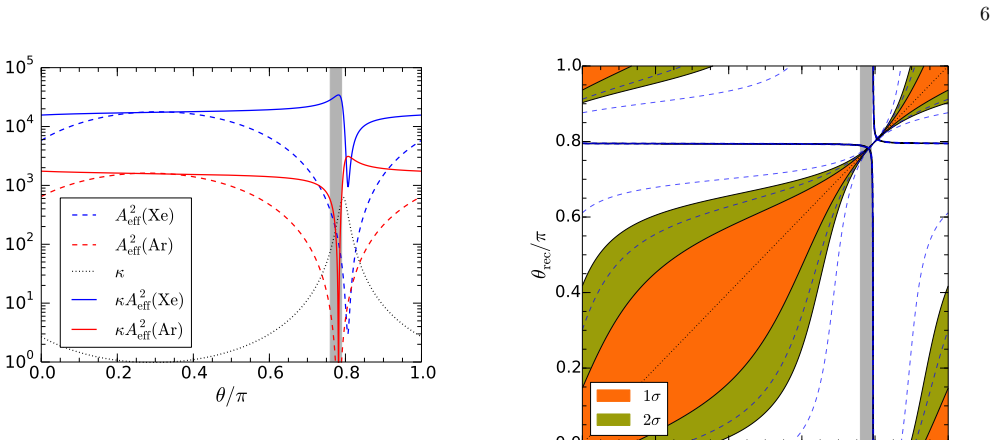
- Once the mass is known, the relative event rates in the two detectors constrain the ratio of dark matter couplings to neutrons and protons; a residual two-fold degeneracy requires a third target to resolve.
- The test is robust to energy resolution below about 2 keV and to backgrounds below about 10% of the signal, and it can flag when one signal is not compatible with the assumed elastic spin-independent scattering hypothesis.
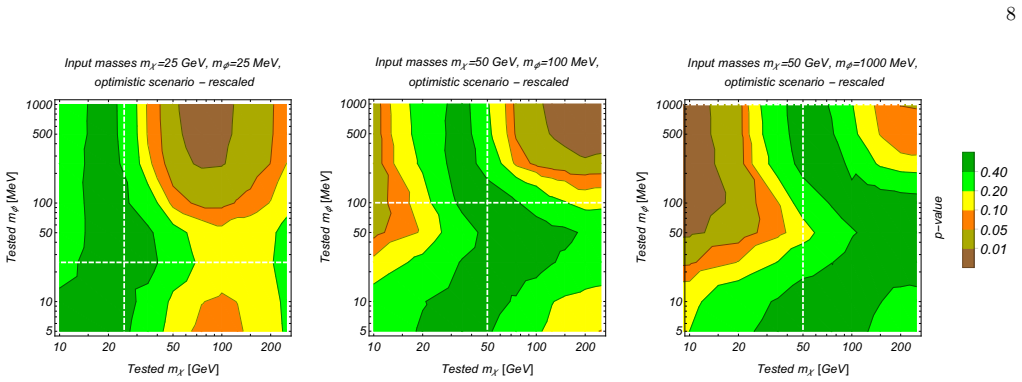
- For a light mediator the same reweighting works with a modified effective form factor, and although the mediator mass itself is hard to determine, regions of the $(m_\phi, m_\chi)$ plane can be excluded halo-independently.
Reading between the lines
- If the true interaction is not the assumed spin-independent elastic one, the equalizing reweighting is biased and the true mass could be rejected; treating the interaction model as a discrete hypothesis and comparing p-values across models would make the method self-diagnosing.
- Because the method only uses relative event weights, the same two-sample construction could be applied to annually modulated event rates, where the time modulation provides another handle that the paper does not exploit.
- The coupling-ratio degeneracy suggests a concrete extension: adding a third target with a very different proton-to-neutron ratio, such as a light nucleus alongside xenon and argon, should break the sign ambiguity shown in the paper.
- After the mass is fixed, the data could be fed into a separate halo-reconstruction step, making the astrophysics-independent mass estimate a prior for mapping the full velocity distribution.
Signed reviews
Editorial analysis
A structured set of objections, weighed in public.
Referee Report
Summary. The paper proposes a halo-independent method to determine the dark matter mass from two direct-detection signals in experiments with different target nuclei. Recoil energies are converted to squared minimum velocities using an assumed mass, and events in each experiment are reweighted by the other experiment's nuclear form factor, so that under the true mass the two weighted samples should share a common distribution proportional to the product of the two form factors times the halo integral. A Cramér-von Mises two-sample test is used to assign a p-value to each assumed mass. The method is demonstrated on xenon/argon benchmark configurations, with quoted 90% CL ranges such as [7,38] GeV for a true 20 GeV mass in the optimistic configuration, robustness checks against energy resolution and background, an extension to the ratio of neutron and proton couplings, and an extension to light mediators.
Significance. If the central uniqueness claim holds, this would be a valuable and practical complement to parametric halo fits: it avoids binning and does not require fitting the velocity distribution, and the authors provide explicit Monte Carlo verification of the null distribution of the weighted test statistic, robustness studies, and concrete sensitivity projections for realistic experiments. These are genuine strengths. However, the advertised claim of full astrophysical independence is stronger than what the mathematical construction actually delivers, because a simple family of halos breaks the uniqueness of the inferred mass. The paper's main conclusion is defensible only after an explicit non-scale-invariance assumption is added and the claims are correspondingly qualified.
major comments (1)
- [Sec. III, Eqs. (5)-(8)] The claimed uniqueness of the true mass is not valid for scale-invariant halos. For an assumed mass m, the equality of the two reweighted densities reduces, after the common form-factor product F_1^2(E_1(x)) F_2^2(E_2(x)) cancels, to eta(r_1(m) sqrt(x)) proportional to eta(r_2(m) sqrt(x)), where r_D(m) = mu_AD(m)/mu_AD(m_true). If eta(v) = C v^{-alpha}, then this ratio is (r_1/r_2)^{-alpha}, a constant, so after normalization the two weighted PDFs are identical for every m and the CvM p-value will be large for all masses; no mass can be excluded. This degeneracy occurs under the paper's own SI/Helm assumptions and is not a form-factor artefact. The consistency check suggested in Sec. VI, that eta(v_m) must be decreasing, does not remove the degeneracy because power laws are decreasing. The abstract and Sec. VI statements that the results are 'completely independent of any astrophysical assumption' are therefore too strong; the method requires an explicit non-scale-invariance assumption over the probed velocity range, or an additional characterization of the halos for which it is valid.
minor comments (4)
- [Sec. III, Eq. (9)] The prefactor (n_tilde_1 + n_tilde_2)^2 / (n_tilde_1 n_tilde_2) is written on the left-hand side of the defining equation, which is easy to misread as part of the statistic rather than as a separate normalization; the authors should define T_CvM explicitly and state the prefactor separately.
- [Footnote 1] The Radon-Nikodym justification should refer to absolute continuity of the weighted measure with respect to the original measure, which follows from boundedness of the form factors, rather than to the weighted distribution being 'equal or smaller' than the original distribution pointwise.
- [Sec. III.A, Figs. 1-2] The quoted 90% CL ranges such as [7,38] GeV for a true 20 GeV mass are derived from the median p-value curve; the authors should state this explicitly, since the 68% and 95% bands in the figures show considerable realization-to-realization spread.
- [Sec. V, Eq. (14)] The arbitrary reference recoil energy E_ref in Eq. (14) should be accompanied by a statement of whether the numerical results depend on its choice.
Circularity Check
No circularity: the mass-determination test is derived from the factorized direct-detection rate and benchmarked on Monte Carlo data with injected true masses; no fitted parameter is renamed as a prediction and no load-bearing self-citation chain forces the result.
full rationale
The paper's load-bearing relation is Eq. (5), where h(v^2) = F_1^2(v^2) F_2^2(v^2) eta(v^2). This is derived, not assumed, from the factorizable event rate in Eq. (1), using the physical fact that the velocity integral eta(v_m) is detector-independent. The claim that the weighted velocity-space distributions coincide only for the true mass is a consequence of that rate law under the stated elastic spin-independent assumption, not a definition of the tested mass. The actual mass inference is a standard nonparametric two-sample problem: for each assumed m_chi the recoil energies are transformed to v^2 via Eq. (2), the samples are reweighted via Eqs. (7)-(8), and the Cramer-von Mises statistic in Eq. (9) tests whether the two weighted empirical CDFs come from the same PDF. The reported 90% CL ranges (e.g., [7,38] GeV for a true 20 GeV mass in the optimistic configuration) are obtained from 10^3 Monte Carlo realizations with injected true masses, exposures, and thresholds from Table I; they are benchmark sensitivities, not fits to the same data that define the result. The coupling-ratio extraction in Sec. IV likewise uses the weighted-sum estimator in Eq. (12) for the integrated quantity in Eq. (10); this is a direct estimator, not a circular fit. Self-citations in the paper (e.g., Refs. [13,14,18,24,30,33,34]) are contextual and not load-bearing: the halo-independence of eta(v_m) is attributed to Refs. [8,9] (Fox, Liu, Weiner; Fox, Kribs, Tait), and the nonparametric test itself is new. The paper explicitly acknowledges that nuclear form factors and hence an interaction-type assumption are crucial inputs, and that the decreasing-eta consistency check is not built into the test; these are honest limitations rather than circular inputs. A skeptical concern that power-law halos can make the weighted distributions match for every assumed mass (at least when form-factor structure is negligible) would be a correctness/robustness limitation of the uniqueness claim under scale-invariant halos, not a reduction of the method to its own inputs. No circular step can be exhibited from the paper's own equations, so the appropriate finding is no significant circularity.
Assumptions & free parameters
assumptions (5)
- domain assumption The time-averaged dark matter velocity distribution seen by the two detectors has the same shape.
- domain assumption The dark matter-nucleus interaction is elastic, spin-independent, and its energy dependence is described by known nuclear form factors.
- standard math The reweighted Cramér-von Mises statistic follows the standard asymptotic null distribution used to compute p-values.
- standard math Nuclear form factors are bounded by one, supporting the Radon-Nikodym convergence of the reweighted empirical CDFs.
- domain assumption There is a non-empty overlap of the velocity-squared ranges probed by the two detectors for candidate masses.
Cite this review
Pith. "Pith review of Astrophysics-independent determination of dark matter parameters from two direct detection signals." pith.science (2026). https://pith.science/paper/CVCKQFFM
@misc{pith2026190807037,
  author       = {Pith},
  title        = {Pith review of: Astrophysics-independent determination of dark matter parameters from two direct detection signals},
  year         = {2026},
  howpublished = {\url{https://pith.science/paper/CVCKQFFM}},
  note         = {Machine review of arXiv:1908.07037}
}
abstract
Next-generation dark matter direct detection experiments will explore several orders of magnitude in the dark matter--nucleus scattering cross section below current upper limits. In case a signal is discovered the immediate task will be to determine the dark matter mass and to study the underlying interactions. We develop a framework to determine the dark matter mass from signals in two experiments with different targets, independent of astrophysics. Our method relies on a distribution-free, nonparametric two-sample hypothesis test in velocity space, which neither requires binning of the data, nor any fitting of parametrisations of the velocity distribution. We apply our method to realistic configurations of xenon and argon detectors such as XENONnT/DARWIN and DarkSide, and estimate the precision with which the DM mass can be determined. Once the dark matter mass is identified, the ratio of coupling strengths to neutrons and protons can be constrained by using the same data. The test can be applied for event samples of order 20 events, but promising sensitivities require $\gtrsim 100$ events.
Figures


Figures from the paper (3 more)
Reference graph
Works this paper leans on
-
[1]
M. W. Goodman and E. Witten, Phys. Rev.D31, 3059 (1985), [,325(1984)]
work page 1985
-
[2]
WIMP Dark Matter Direct-Detection Searches in Noble Gases
L. Baudis, Proceedings, 13th International Conference 9 on Topics in Astroparticle and Underground Physics (TAUP 2013): Asilomar, California, September 8-13, 2013, Phys. Dark Univ. 4, 50 (2014), arXiv:1408.4371 [astro-ph.IM]
work page Pith review arXiv 2014
-
[3]
T. Marrodan Undagoitia and L. Rauch, J. Phys.G43, 013001 (2016), arXiv:1509.08767 [physics.ins-det]
arXiv 2016
-
[4]
J. Liu, X. Chen, and X. Ji, Nature Phys.13, 212 (2017), arXiv:1709.00688 [astro-ph.CO]
arXiv 2017
-
[5]
M. Pato, L. Baudis, G. Bertone, R. Ruiz de Austri, L. E. Strigari, and R. Trotta, Phys. Rev.D83, 083505 (2011), arXiv:1012.3458 [astro-ph.CO]
work page Pith review arXiv 2011
-
[6]
A. H. G. Peter, V. Gluscevic, A. M. Green, B. J. Ka- vanagh, and S. K. Lee, Phys. Dark Univ.5-6, 45 (2014), arXiv:1310.7039 [astro-ph.CO]
work page Pith review arXiv 2014
-
[7]
Identifying the Theory of Dark Matter with Direct Detection
V. Gluscevic, M. I. Gresham, S. D. McDermott, A. H. G. Peter, and K. M. Zurek, JCAP 1512, 057 (2015), arXiv:1506.04454 [hep-ph]
work page Pith review arXiv 2015
-
[8]
P. J. Fox, J. Liu, and N. Weiner, Phys.Rev.D83, 103514 (2011), arXiv:1011.1915 [hep-ph]
arXiv 2011
Show all 51 references
-
[9]
P. J. Fox, G. D. Kribs, and T. M. Tait, Phys.Rev.D83, 034007 (2011), arXiv:1011.1910 [hep-ph]
2011 arXiv
- [10]
- [11]
-
[12]
M. T. Frandsen, F. Kahlhoefer, C. McCabe, S. Sarkar, and K. Schmidt-Hoberg, JCAP 1201, 024 (2012), arXiv:1111.0292 [hep-ph]
2012 arXiv
-
[13]
Herrero-Garcia, T
J. Herrero-Garcia, T. Schwetz, and J. Zupan, JCAP 1203, 005 (2012), arXiv:1112.1627 [hep-ph]
2012 arXiv
-
[14]
Herrero-Garcia, T
J. Herrero-Garcia, T. Schwetz, and J. Zupan, Phys. Rev. Lett. 109, 141301 (2012), arXiv:1205.0134 [hep-ph]
2012 arXiv
-
[15]
Gondolo and G
P. Gondolo and G. B. Gelmini, JCAP1212, 015 (2012), arXiv:1202.6359 [hep-ph]
2012 arXiv
-
[16]
Del Nobile, G
E. Del Nobile, G. B. Gelmini, P. Gondolo, and J.-H. Huh, JCAP 1310, 026 (2013), arXiv:1304.6183 [hep-ph]
2013 arXiv
-
[17]
Del Nobile, G
E. Del Nobile, G. Gelmini, P. Gondolo, and J.-H. Huh, JCAP 1310, 048 (2013), arXiv:1306.5273 [hep-ph]
2013 arXiv
-
[18]
Bozorgnia, J
N. Bozorgnia, J. Herrero-Garcia, T. Schwetz, and J. Zu- pan, JCAP 1307, 049 (2013), arXiv:1305.3575 [hep-ph]
2013 arXiv
-
[19]
M. T. Frandsen, F. Kahlhoefer, C. McCabe, S. Sarkar, and K. Schmidt-Hoberg, JCAP 1307, 023 (2013), arXiv:1304.6066 [hep-ph]
2013 arXiv
-
[20]
Feldstein and F
B. Feldstein and F. Kahlhoefer, JCAP1408, 065 (2014), arXiv:1403.4606 [hep-ph]
2014 arXiv
-
[21]
P. J. Fox, Y. Kahn, and M. McCullough, JCAP1410, 076 (2014), arXiv:1403.6830 [hep-ph]
2014 arXiv
-
[22]
Feldstein and F
B. Feldstein and F. Kahlhoefer, JCAP1412, 052 (2014), arXiv:1409.5446 [hep-ph]
2014 arXiv
-
[23]
J. F. Cherry, M. T. Frandsen, and I. M. Shoemaker, JCAP 1410, 022 (2014), arXiv:1405.1420 [hep-ph]
2014 arXiv
-
[24]
Bozorgnia and T
N. Bozorgnia and T. Schwetz, JCAP1412, 015 (2014), arXiv:1410.6160 [astro-ph.CO]
2014 arXiv
-
[25]
G. B. Gelmini, J.-H. Huh, and S. J. Witte, JCAP1610, 029 (2016), arXiv:1607.02445 [hep-ph]
2016 arXiv
-
[26]
G. B. Gelmini, J.-H. Huh, and S. J. Witte, JCAP1712, 039 (2017), arXiv:1707.07019 [hep-ph]
2017 arXiv
- [27]
-
[28]
Kahlhoefer, F
F. Kahlhoefer, F. Reindl, K. Schäffner, K. Schmidt- Hoberg, and S. Wild, JCAP 1805, 074 (2018), arXiv:1802.10175 [hep-ph]
2018 arXiv
-
[29]
Catena, A
R. Catena, A. Ibarra, A. Rappelt, and S. Wild, JCAP 1807, 028 (2018), arXiv:1801.08466 [hep-ph]
2018 arXiv
-
[30]
Blennow, J
M. Blennow, J. Herrero-Garcia, and T. Schwetz, JCAP 1505, 036 (2015), arXiv:1502.03342 [hep-ph]
2015 arXiv
-
[31]
Ferrer, A
F. Ferrer, A. Ibarra, and S. Wild, JCAP 1509, 052 (2015), arXiv:1506.03386 [hep-ph]
2015 arXiv
-
[32]
Ibarra, B
A. Ibarra, B. J. Kavanagh, and A. Rappelt, JCAP1812, 018 (2018), arXiv:1806.08714 [hep-ph]
2018 arXiv
-
[33]
Blennow, J
M. Blennow, J. Herrero-Garcia, T. Schwetz, and S. Vogl, JCAP 1508, 039 (2015), arXiv:1505.05710 [hep-ph]
2015 arXiv
-
[34]
Herrero-Garcia, JCAP 1509, 012 (2015), arXiv:1506.03503 [hep-ph]
J. Herrero-Garcia, JCAP 1509, 012 (2015), arXiv:1506.03503 [hep-ph]
2015 arXiv
- [35]
-
[36]
B. J. Kavanagh and A. M. Green, Phys. Rev. D86, 065027 (2012), arXiv:1207.2039 [astro-ph.CO]
2012 arXiv
-
[37]
B. J. Kavanagh and A. M. Green, Phys. Rev. Lett.111, 031302 (2013), arXiv:1303.6868 [astro-ph.CO]
2013 arXiv
-
[38]
B. J. Kavanagh, Phys. Rev. D89, 085026 (2014), arXiv:1312.1852 [astro-ph.CO]
2014 arXiv
-
[39]
D. S. Akeribet al. (LUX), Phys. Rev. Lett.118, 021303 (2017), arXiv:1608.07648 [astro-ph.CO]
2017 arXiv
-
[40]
Cui et al
X. Cui et al. (PandaX-II), Phys. Rev. Lett.119, 181302 (2017), arXiv:1708.06917 [astro-ph.CO]
2017 arXiv
-
[41]
Aprileet al
E. Aprileet al. (XENON), Phys. Rev. Lett.121, 111302 (2018), arXiv:1805.12562 [astro-ph.CO]
2018 arXiv
- [42]
-
[43]
D. S. Akerib et al. (LZ), (2015), arXiv:1509.02910 [physics.ins-det]
2015 arXiv
-
[44]
Aprile et al
E. Aprile et al. (XENON1T), JINST 9, P11006 (2014), arXiv:1406.2374 [astro-ph.IM]
2014 arXiv
-
[45]
Aalbers et al
J. Aalbers et al. (DARWIN), JCAP 1611, 017 (2016), arXiv:1606.07001 [astro-ph.IM]
2016 arXiv
-
[46]
N. Fatemighomi (DEAP-3600), in 35th International Symposium on Physics in Collision (PIC 2015) Coven- try, United Kingdom, September 15-19, 2015 (2016) arXiv:1609.07990 [physics.ins-det]
2016 arXiv
-
[47]
Calvo et al
J. Calvo et al. (ArDM), JCAP 1703, 003 (2017), arXiv:1612.06375 [physics.ins-det]
2017 arXiv
-
[48]
C. E. Aalsethet al., Eur. Phys. J. Plus133, 131 (2018), arXiv:1707.08145 [physics.ins-det]
2018 arXiv
-
[49]
J. F. Monahan, Numerical Methods of Statistics (Cam- bridge University Press, 2011)
2011
-
[50]
T. W. Anderson and D. A. Darling, The Annals of Math- ematical Statistics 23, 193 (1952)
1952
-
[51]
Drees and C.-L
M. Drees and C.-L. Shan, JCAP 0706, 011 (2007), arXiv:astro-ph/0703651 [ASTRO-PH]
2007 arXiv
Reviewed August 14, 2026 · model on record in the stance chip above.
Discussion (0). Continue with ORCID to comment.