REVIEW 3 major objections 7 minor 3 references
Mobile community sensing with smallholder farmers in a developing nation; A scaled pilot for crop health monitoring
T0 review · 3 major / 7 minor · reviewed 2026-08-14 · deepseek-v4-flash
Pith's one-line read A scaled pilot in Uganda shows that smallholder farmers with basic smartphones can sustain multi-month, nationwide crop disease surveillance.
desk verdict Honest, useful field report of a 175-farmer cassava surveillance deployment, but the central 'viability at scale' claim outruns the evidence on support costs and incentive dependence. read the letter →
The pith
A machine-rendered reading of the paper's core claim, the machinery that carries it, and where it could break.
The reading
What carries the argument
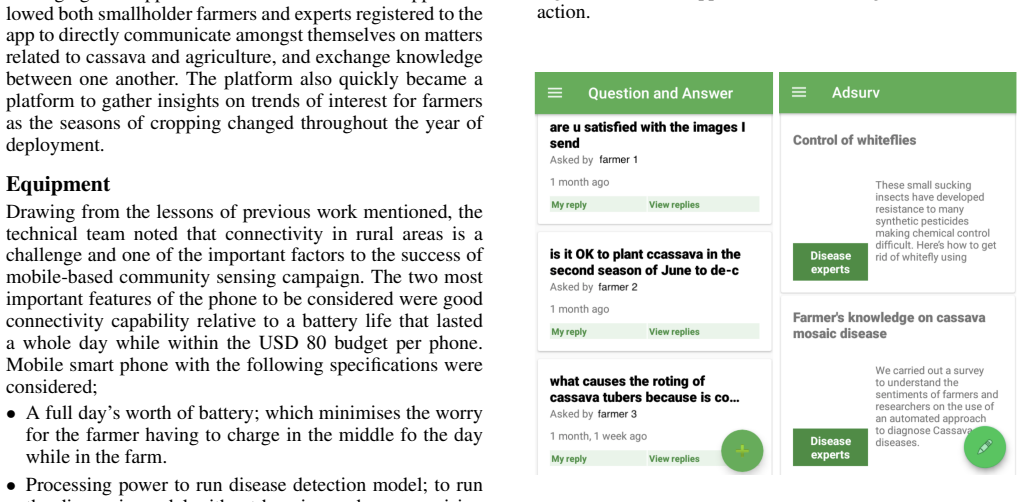
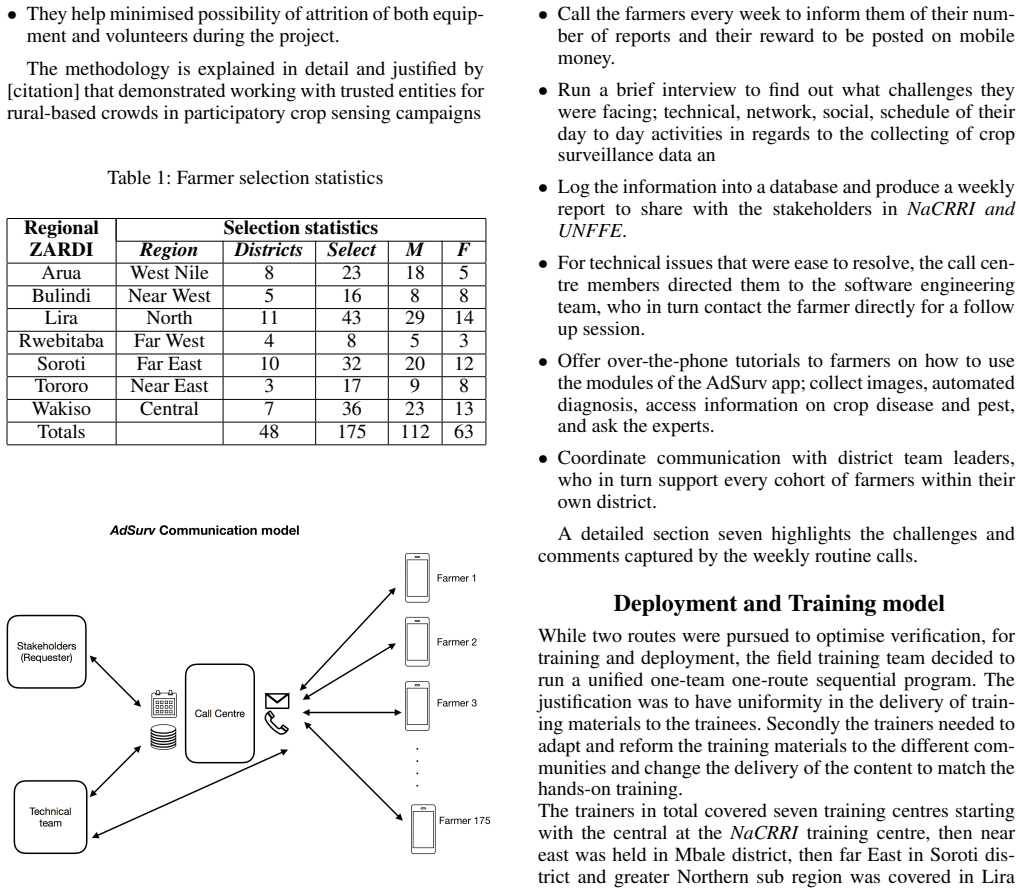
The carrying mechanism is the redesigned AdSurv mobile app combined with a human support scaffold. AdSurv has four modules: geo-tagged image collection with labels and comments; an on-device classifier that diagnoses the four main cassava diseases within seconds; an offline news feed; and a chat/Q&A channel connecting farmers to experts. Around the app, the paper builds a selection process that verifies farmers through trusted local organisations, a one-day training at each of seven regional centres using peer-to-peer learning, elected district farmer leaders who provide local troubleshooting, a six-person call centre that makes weekly calls to check on rewards and problems, and tiered mobile-money payment schemes that were adjusted five times during the pilot. That scaffold, not the app alone, is what sustained participation from a cohort where 75% of farmers were new to smartphones.
What would settle it
Run the same app, selection criteria, and mobile-money incentives with a second cohort of 175 farmers, but remove the weekly call-centre calls and district-leader scaffold; if per-farmer submission rates fall far below those of the pilot, the claim that the model scales is refuted. A cheaper check: compute the pilot's cost per submitted image, including call-centre labour, training, and phone subsidies, and compare it with the cost of a conventional expert survey covering the same districts.
Extended reading notes
Core claim
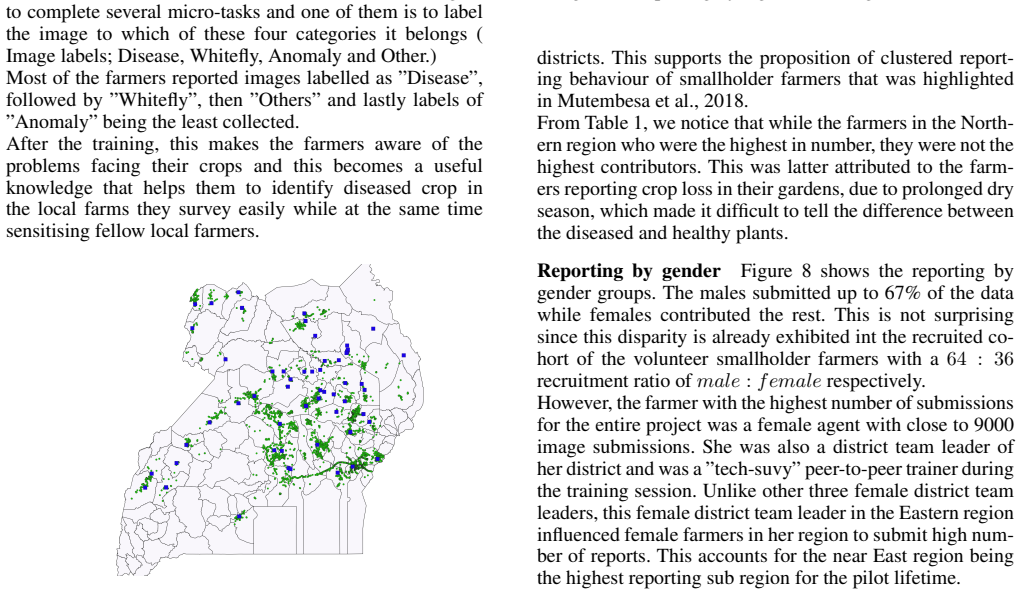
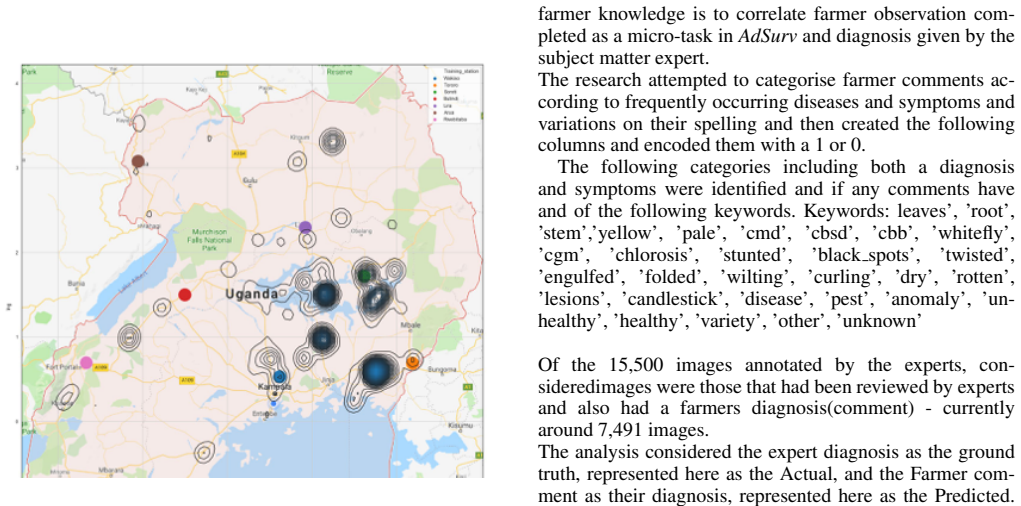
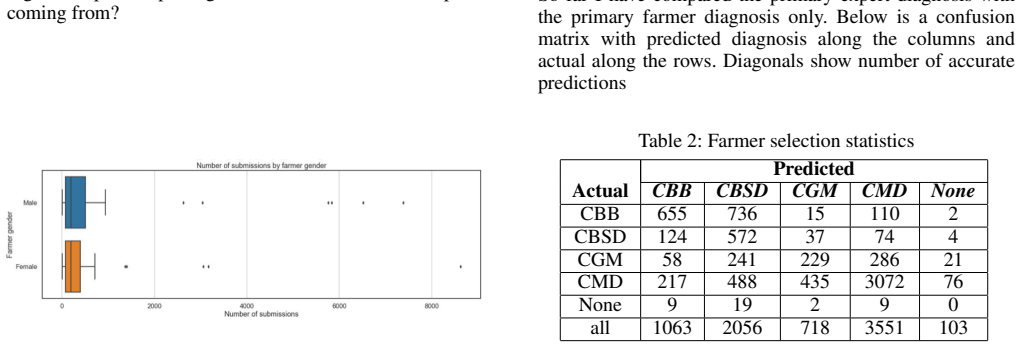
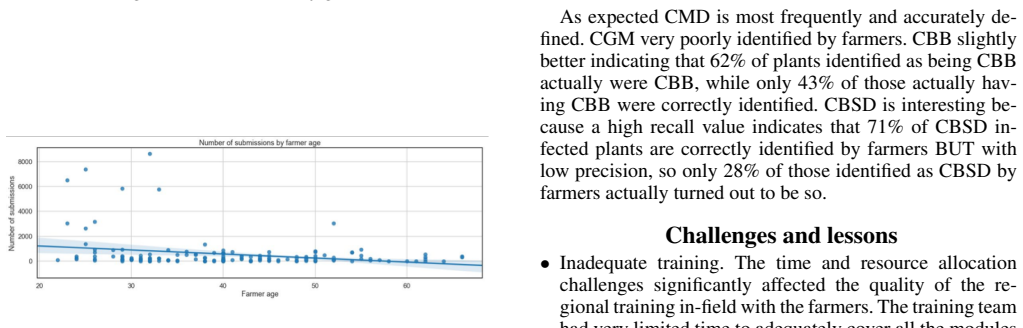
The central claim, stated in the paper's conclusion, is that mobile-phone-based community sensing with local volunteers is viable for monitoring phenomena that matter to underserved rural communities. The evidence is the pilot itself: 175 farmers across five agricultural regions of Uganda submitted 87,000+ images over 227 days, with most reports coming in during the first four months and the top contributor a female district leader who submitted close to 9,000 images. The paper argues that the data are usable for monitoring cassava disease, tracing the movement of planting materials, mapping varieties and multiplication sites, and identifying communities with weak access to agricultural extension. It also reports early comparisons of farmer diagnoses with expert labels on about 7,500 images, showing that farmers identify Cassava Mosaic Disease well but struggle with Cassava Green Mite, while Cassava Brown Streak Disease is detected with high recall but low precision.
Load-bearing premise
The viability claim rests on farmers continuing to participate as the network grows beyond the pilot, where sustained reporting required intensive per-farmer support—six call-centre staff for 175 farmers, in-person regional training, district leaders, and free phones—that the paper itself concedes becomes intractable to manage as participant strategies change.
Editorial extensions
If this is right
- A volunteer farmer network of this size can produce tens of thousands of geotagged surveillance images over more than seven months without expert field visits.
- The accumulated images can support practical monitoring: tracing planting-material movement between districts, mapping cassava varieties and multiplication sites, and locating communities with little or no extension access.
- The farmer–expert chat and on-device diagnosis modules bring expert knowledge to farmers in near real time, even though farmer accuracy on the hardest disease, Cassava Green Mite, remains low.
- The operating model—selection criteria, peer-to-peer training, district leaders, call centre, and mobile-money incentives—is presented as a replicable template for other community-sensing domains.
Reading between the lines
- The pilot's own support numbers suggest that per-farmer human support, not the app, is the binding constraint: six call-centre staff for 175 farmers, and over 70% of calls about basic phone use, imply a cost curve that must fall before a truly national rollout.
- The heavy clustering of reports within districts and the outsized performance of one female district leader point to social leadership and peer effects as at least as important as payment mechanics; a randomised trial of leadership roles across districts could test this directly.
- The roughly 7,500 farmer-labelled images with expert ground truth form a training set that could improve the on-device classifier and calibrate citizen-reported disease maps, an extension the paper does not pursue.
Signed reviews
Editorial analysis
A structured set of objections, weighed in public.
Referee Report
Summary. This paper reports a scaled pilot of mobile community sensing for cassava crop health monitoring in Uganda. The authors recruited and verified 175 smallholder farmers across five agricultural regions, provided smartphones running a modified AdSurv app with data collection, automated disease diagnosis, a news feed, and chat/Q&A modules, and supported participants with a six-person call centre, district farmer leaders, peer-to-peer training, and weekly mobile-money incentives. Over 227 days the network submitted more than 87,000 geo-tagged images. The paper presents the deployment and training models, the five successive payment schemes, reporting trends by region, gender, and age, and a preliminary comparison of farmer-labelled diagnoses against expert diagnoses. The authors conclude that the pilot demonstrates the viability of mobile-phone-based community sensing with local volunteers for monitoring phenomena important to underserved rural communities.
Significance. If accepted with appropriate caveats, this is a valuable empirical contribution to the community-sensing and ICT4D literatures. It is, to my knowledge, one of the largest reported deployments of volunteer smartphone-based crop surveillance in a low-resource setting, and it provides concrete operational details: recruitment and verification criteria, training and peer-learning methods, a call-centre communication model, and a transparent account of incentive-scheme changes and their effects on submission volumes. The paper also makes an honest effort to characterize participation by gender and age and to compare farmer and expert diagnoses. The main weakness is that the central 'viability at scale' claim is overstated in light of the paper's own evidence about support intensity, incentive dependence, and the small fraction of expert-verified images. The dataset and descriptive statistics are plausible, but the paper does not yet provide the cost or scalability analysis needed to support its strongest conclusion. The work would benefit from being reframed as a feasibility demonstration with open scalability questions, which is a significant but achievable revision.
major comments (3)
- [Conclusion; Challenges and lessons] The central claim that this paper 'demonstrates the viability of mobile phone based community sensing' with volunteers at scale is not supported by the deployment-cost evidence in the manuscript. The call-centre model used a six-person team for 175 farmers, i.e. roughly one agent per 29 farmers, and the Challenges section reports that 75% of farmers were smartphone-naive and that over 70% of call-centre interactions concerned basic phone usage rather than app-specific issues. No data are provided on per-farmer support costs, on how support demand changed over the deployment, or on any mechanism by which per-farmer support would fall as the cohort grows. The paper itself states that 'when working with a large cohort of volunteers, it becomes intractable to follow the changes in strategies of participants.' Without such evidence, the conclusion should be reframed as a demonstration of feasibility at the pilot's scale, with scalability treated as an open question rather than an established property.
- [Incentive Structure; Discussion of Results] The submission trend in Figure 5 is tightly coupled to the payment schemes, which undermines the inference that the data flow reflects a sustainable community-sensing model. The text reports that the highest submission volumes occurred in June, July, and August 2018, which are 'the same times where drastic changes were made for the payment scheme,' and that the subsequent decline was 'because of budget exhaustion and anticipating the end of the project.' The paper does not report total incentive expenditures, cost per submitted report, or any phase without monetary incentives against which intrinsic participation could be assessed. Consequently, the 87,000-image total is presented as evidence of the model's viability, but the reader cannot determine whether the model is viable at any scale without a cost model or a clear statement that the observed participation was incentive-driven. The authors should either provide the missing cost analysis or explicitly limit the viability claim to a paid crowdsourcing model.
- [Insights into farmer diagnosis] The expert-validation analysis covers too small a portion of the collected data to support the paper's broader claims about disease monitoring. Of the 87,000+ images, only 7,491 had both an expert review and a farmer comment (out of 15,500 expert-annotated images), i.e. under 9% of the total collection. The manuscript does not describe how these 7,491 images were selected or whether they are representative of the full dataset, and it does not assess the quality or usability of the remaining 91%. The confusion-matrix analysis also compares only the primary expert diagnosis with the primary farmer comment, which is an appropriate starting point but insufficient to establish that the pipeline can 'guide precision expert surveys in areas of high disease incidence.' The authors should condition their claims on the expert-verified subset or provide a clear sampling/verification plan for the rest of the data.
minor comments (7)
- [Abstract; Related Work] The wording 'to compliment low-resourced agricultural expert surveys' should be 'to complement', and 'to suite smallholder farmer agents' should be 'to suit'; there are also several other grammar and punctuation issues throughout.
- [Equipment] There is a typo in 'middle fo the day' that should read 'middle of the day'.
- [Call centre communication model] The text says 'Fig. 2 shows the AdSurv communication model,' but Figure 2 is captioned as the live chat and news feed modules; this figure reference is incorrect.
- [Insights into farmer diagnosis] Table 2 is captioned 'Farmer selection statistics' but actually contains the confusion matrix; it should be relabeled to avoid confusion with Table 1.
- [Discussion of Results] The text refers to two different occurrences of 'Figure 8': one for the image-label category distribution and one for submissions by gender; the figures need renumbering or more specific cross-references.
- [AdSurv mobile app and platform; A crowd selection model] There are unresolved citation placeholders: '[CITATION]' after the classifier description, '[citation]' for the trusted-entity methodology, and an empty link to the training manuals; these must be completed for reproducibility.
- [Challenges and lessons] The first bullet in the Challenges section ends with the incomplete phrase 'and the run'; the sentence also has subject-verb agreement problems and should be rewritten.
Circularity Check
No circular derivation: the pilot's claims rest on newly collected field data, not on its own definitions or fitted predictions.
full rationale
This paper is a field deployment report rather than a formal derivation, so there is no equation chain in which an output is defined in terms of its input. The central observations—87,000+ images, reporting trends, spatial clustering, gender and age participation, and the farmer-vs-expert diagnosis confusion matrix—are measured field data, not quantities constructed from the paper's assumptions. The many references to the authors' 2018 pilot (Mutembesa et al., 2018) are used as design antecedents and as a source of the clustered-reporting hypothesis, but the current pilot's data independently display those patterns; the 2018 results are not invoked to force the conclusion. The diagnosis analysis treats expert labels as ground truth and farmer comments as predictions, which are independent annotations, so no fitted parameter is renamed as a prediction. The paper's own Challenges section concedes that tracking large cohorts is intractable and that 75% of farmers were smartphone-naive, but that concession bears on the strength of the viability claim, not on circularity. The strongest claim is an interpretation of independent evidence rather than a construction, and any weakness in scalability support is an evidentiary limitation, not a circular step.
Assumptions & free parameters
free parameters (5)
- First-batch reward (UGX 5000 for 20 submissions) =
5000 UGX
- Per-report base value =
250 UGX
- Per-report cumulative increment =
25 UGX
- Reward batch size =
40, 50, or 100 reports per scheme
- Submission cap for incremental reward =
400, 500, or 800 reports per scheme
assumptions (5)
- domain assumption Expert diagnosis is ground truth for farmer diagnosis accuracy.
- domain assumption The five agricultural zones chosen by NaCRRI and UNFFE experts are representative of active cassava-growing areas.
- domain assumption Selected farmers are able to operate smartphones and the app after one-day training plus peer support.
- domain assumption Mobile money is a reliable and accessible reward channel for all participating farmers.
- domain assumption The 2018 pilot's design recommendations transfer to a sixfold larger cohort.
Cite this review
Pith. "Pith review of Mobile community sensing with smallholder farmers in a developing nation; A scaled pilot for crop health monitoring." pith.science (2026). https://pith.science/paper/SPE266SO
@misc{pith2026190807047,
  author       = {Pith},
  title        = {Pith review of: Mobile community sensing with smallholder farmers in a developing nation; A scaled pilot for crop health monitoring},
  year         = {2026},
  howpublished = {\url{https://pith.science/paper/SPE266SO}},
  note         = {Machine review of arXiv:1908.07047}
}
read the original abstract
Previously, crowdsourcing experiments in surveillance of crop diseases and pest have been trialed as small scale community sensing campaigns with select cohort of smallholder farmers, extension and experts. While those pilots have demonstrated the viability of community sensing with mobile phones to collect massive amounts of real-time data all year round, to compliment low-resourced agricultural expert surveys, they are limited in generalising ideas for scaled implementations of a community sensing system with farmer communities. This work presents a case of scaled deployment of the mobile ad hoc surveillance for crowdsourcing real-time surveillance data on cassava from over 175 smallholder farmers across Uganda. This paper describes a modified mobile ad hoc surveillance ecosystem to suite smallholder farmer agents, a communication model and data collection model designed to cover the spatial interests for the scale of surveillance, a deployment plan, the training methodology and incentives structure. The paper also presents very early results of contributions from farmer agents, that could be usable in monitoring the movement of planting materials between districts, mapping cassava varieties, multiplication sites, and communities with little or no access to agricultural extension services, and possibly guide precision expert surveys in areas of high disease incidence.
Figures

Figures from the paper (6 more)


Reference graph
Works this paper leans on
-
[2000]
The current pandemic of cassava mosaic virus disease in East Africa and its control
The current pandemic of cassava mosaic virus disease in east africa and its control. The current pandemic of cassava mosaic virus disease in East Africa and its control. Paolacci, G.; Chandler, J.; and Ipeirotis, P. G. 2010. Running experiments on amazon mechanical turk. Quinn, A. J., and Bederson, B. B. 2011. Human com- putation: a survey and taxonomy of...
work page 2010
-
[2013]
In Proceedings of the 4th Annual Symposium on Computing for Development, 9
A mobile market for agricultural trade in Uganda. In Proceedings of the 4th Annual Symposium on Computing for Development, 9. ACM. Stevens, M., and DHondt, E. 2010. Crowdsourcing of pollution data using smartphones. In Workshop on Ubiqui- tous Crowdsourcing. Thiagarajan, A.; Ravindranath, L.; LaCurts, K.; Mad- den, S.; Balakrishnan, H.; Toledo, S.; and Er...
work page 2010
-
[2015]
In Third AAAI Conference on Human Computation and Crowdsourcing
Crowdsourcing in the field: A case study using local crowds for event reporting. In Third AAAI Conference on Human Computation and Crowdsourcing. Chatzimilioudis, G.; Konstantinidis, A.; Laoudias, C.; and Zeinalipour-Yazti, D. 2012. Crowdsourcing with smart- phones. IEEE Internet Computing 16(5):3644. Chklovski, T., and Gil, Y . 2005. Towards managing know...
work page 2012
Reviewed August 14, 2026 · model on record in the stance chip above.
Discussion (0). Continue with ORCID to comment.