REVIEW 4 major objections 4 minor 22 references
BoxNet: A Deep Learning Method for 2D Bounding Box Estimation from Bird's-Eye View Point Cloud
T0 review · 4 major / 4 minor · reviewed 2026-08-14 · deepseek-v4-flash
Pith's one-line read BoxNet shows that a simple point-order-invariant network can regress a 2D bounding box from bird's-eye-view LiDAR points, cutting car center error to 0.14 m and orientation error to 1.8 degrees on KITTI.
desk verdict A plausible but under-specified empirical study of learned 2D box geometry from object-level BEV points; the split ambiguity must be fixed before the headline numbers can be trusted. read the letter →
The pith
A machine-rendered reading of the paper's core claim, the machinery that carries it, and where it could break.
The reading
What carries the argument
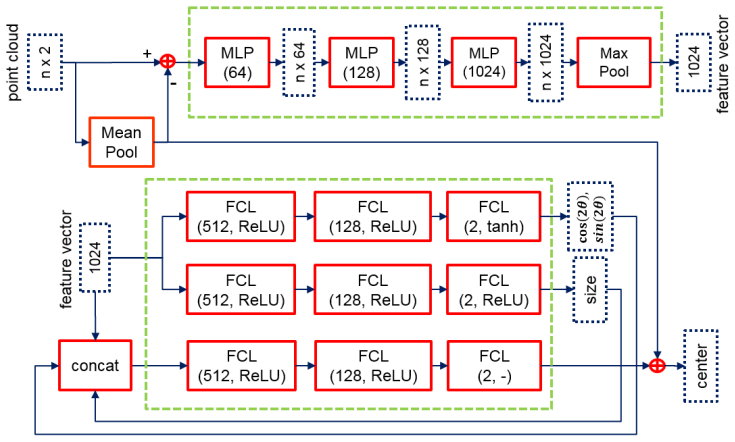
The load-bearing objects are the double-angle orientation encoding and the mean-relative center regression. Because heading is not estimated, the orientation lies on $(-\pi/2, \pi/2]$; the network regresses $(\cos 2\theta, \sin 2\theta)$, which is continuous at the wrap-around, and recovers $\theta = \operatorname{atan2}(\sin 2\theta, \cos 2\theta)/2$. The center head estimates $(\tilde c_x, \tilde c_y)$, the box center relative to the point-cloud mean, and the absolute center is obtained by adding the mean back; concatenating the predicted angle and size with the pooled feature vector improves the center estimate. The feature extractor uses shared MLPs and a max-pooling layer, so the prediction does not depend on point ordering, and the size head uses ReLU to output positive width and length learned from training data.
What would settle it
Reproduce the car experiments with clusters produced by an off-the-shelf detector or segmenter on KITTI instead of ground-truth boxes; if average IoU falls toward the L-shape baseline or center error exceeds roughly 0.2 m, the reported gains depend on clean ground-truth cropping.
Extended reading notes
Core claim
The central claim is that the geometry of an object — center, width, length, and orientation — can be recovered from a set of unordered 2D bird's-eye-view LiDAR points by a small regression network with three heads. The orientation head outputs $(\cos 2\theta, \sin 2\theta)$ rather than $\theta$ itself, because the bounding-box orientation is defined on $(-\pi/2, \pi/2]$ and the doubled-angle representation is continuous across the discontinuity at $\pm \pi/2$. The center head predicts the offset from the point-cloud mean, and the recovered absolute center plus learned width and length produce the box. For cars, the average center error is 0.1401 m, the orientation error is 1.8057 degrees, and the IoU is 0.8787, versus 0.3941 m, 8.4223 degrees, and 0.6825 for the best L-shape fitting baseline.
Load-bearing premise
The evaluation assumes every test input is a clean point cluster clipped from a ground-truth bounding box, with no upstream detector noise; if real clusters contain background, partial, or merged objects, the reported improvements over L-shape fitting may shrink.
Editorial extensions
If this is right
- For cars, average IoU rises from 0.6825 for the best L-shape fitting variant to 0.8787 for BoxNet on the same KITTI test samples, so a trained regressor aligns boxes with true extents far better than optimization-based fitting.
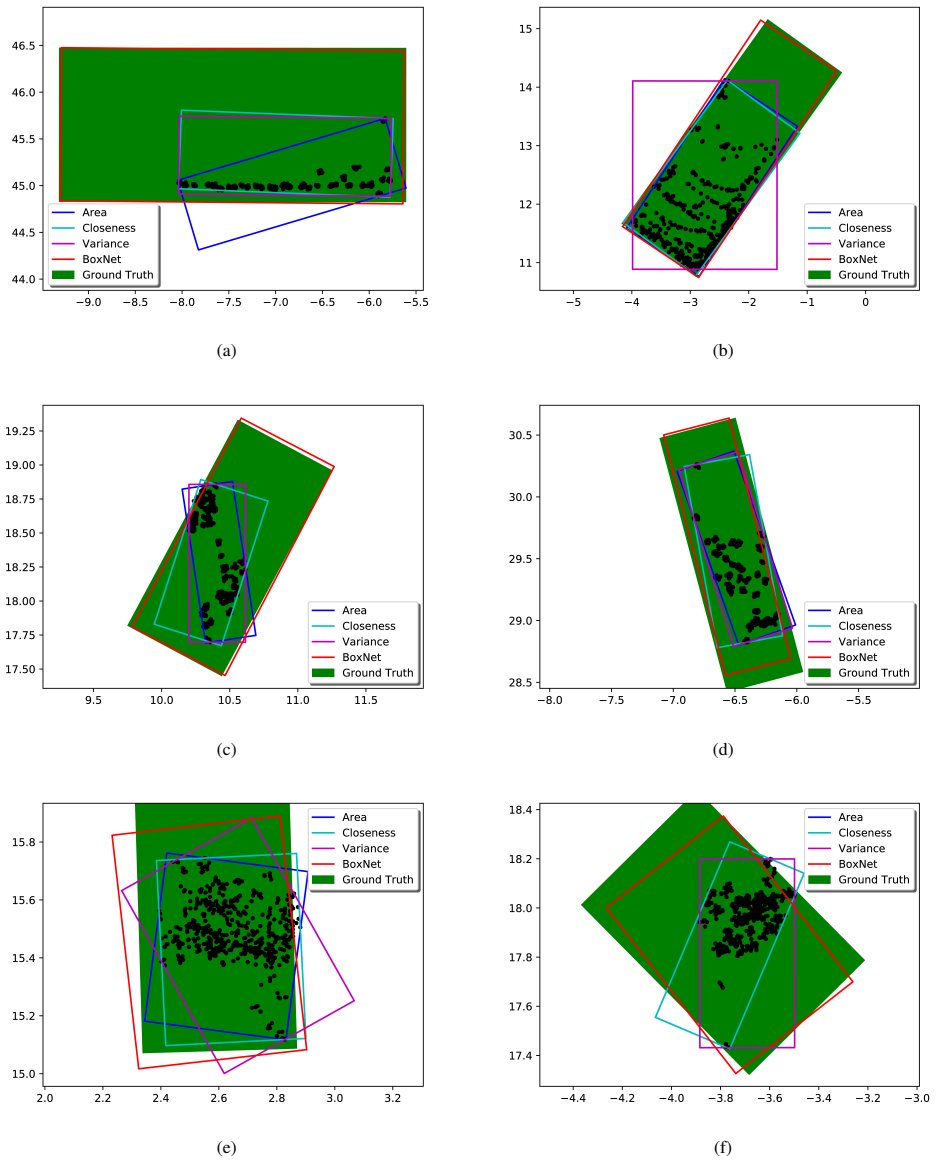
- Because the size head learns a width/length prior from training data, BoxNet can output the full object size even when only a partial set of points is visible, a situation L-shape fitting cannot handle because it fits only the observed points.
- Point-order invariance removes the need to sort, cluster, or segment points before fitting, which simplifies use in tracking and data-association pipelines.
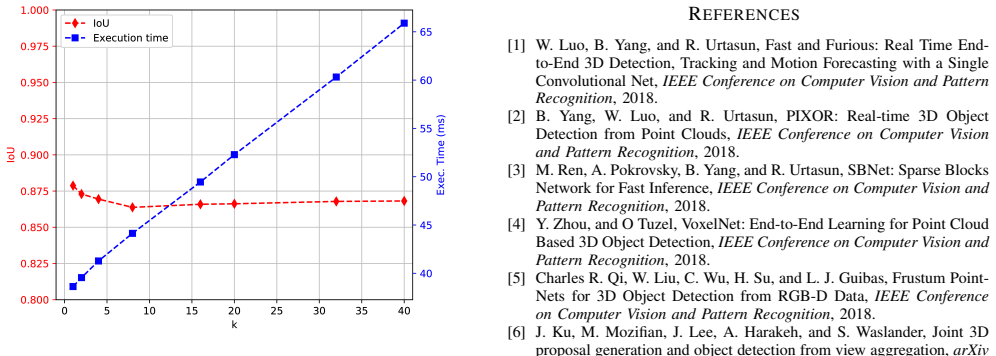
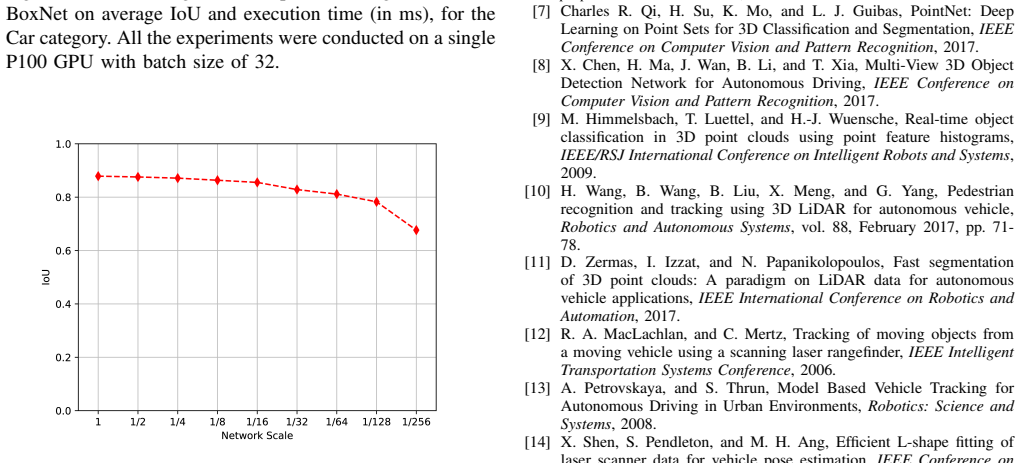
- Shrinking the network to 1/16 of its baseline size costs less than 2% average IoU, and inference takes roughly 7.4–8.5 ms on a P100 GPU, so the accuracy gain does not require a heavy model.
- The improvement is class-dependent: orientation error drops sharply for all classes, but pedestrian center error stays near 0.10 m and remains comparable to SLF, because near-square boxes give no clear primary axis.
Reading between the lines
- Not tested in the paper: running BoxNet on point clusters produced by a real detector or segmenter, rather than clusters cut from ground-truth boxes; because training never sees imperfect clusters, this test would show how much of the reported gain survives upstream noise.
- The double-angle encoding likely transfers to any orientation-regression problem with 180-degree symmetry, such as 2D vehicle boxes in images, since it removes angle wrap-around ambiguity without needing a classification head.
- The ablation with a nearest-neighbor convolution suggests boundary points carry more regression signal than local neighbor structure; weighting or explicitly sampling boundary points could improve accuracy on sparse and heavily occluded objects.
- Extending the architecture to full 3D boxes by adding height while keeping the double-angle yaw encoding is a natural next step, and the same mean-relative center trick should apply in three dimensions.
Signed reviews
Editorial analysis
A structured set of objections, weighed in public.
Referee Report
Summary. The paper proposes BoxNet, a PointNet-style regression network that takes an unordered set of 2D bird's-eye-view (BEV) LiDAR points belonging to a single object and predicts a 2D bounding box, parameterized by center, width, length, and orientation. To handle the periodicity of an unoriented box, the orientation head regresses the double-angle vector [cos(2θ), sin(2θ)] and recovers θ by arctan2; to ease center regression, the network predicts the offset from the input point-cloud mean. The method is evaluated on KITTI 3D object data after extracting points inside ground-truth boxes, and is compared with three variants of Search-based L-shape Fitting (SLF), reporting large improvements for cars, more modest improvements for cyclists, and mixed center-error results for pedestrians. Ablations study the angle representation, the relative-center parametrization, feature concatenation, EdgeConv layers, and network width.
Significance. If the reported numbers are trustworthy, the paper gives useful evidence that a simple permutation-invariant network can outperform optimization-based L-shape fitting on ground-truth-box BEV point sets, especially when only partial object geometry is observed, and that the double-angle orientation target and mean-relative center parametrization are effective design choices. The paper is deliberately scoped as an intermediate module for downstream tracking or detection, not as a full detector, and the comparison against a published non-learning baseline on a public benchmark is appropriate. The ablation study is informative and the execution-time reporting is a useful addition. However, the central quantitative claim of "significant improvement" is not currently fully supported: the train/test split is not specified at frame or track level, no uncertainty estimates are provided, and the evaluation protocol is restricted to points extracted from ground-truth boxes.
major comments (4)
- [Section IV-A, Table I] The paper must specify how the 15,000/5,000 train/test split was constructed. KITTI contains multiple objects per frame and the same object across consecutive frames, so a random object-level split can place near-identical point patterns in both training and testing. As written, the protocol is consistent with such a sample-level split, which would inflate BoxNet's reported car center error of 0.14 m, orientation error of 1.81 degrees, and IoU of 0.879, and would exaggerate the margin over SLF. The split must be performed at frame or track level, and the manuscript should state this explicitly; if the original experiments used an object-level split, they need to be rerun with a non-overlapping split.
- [Section IV-D, Tables II-VII] All quantitative results are reported as single point estimates without standard deviations, confidence intervals, or the number of random seeds/restarts. Given that the central claim is that BoxNet significantly improves over SLF, the paper should report variability across at least several training runs and evaluated splits, especially for the smaller cyclist and pedestrian sets where stochastic effects are likely to be larger.
- [Section IV-A] The evaluation extracts points only from the ground-truth bounding boxes of KITTI annotations. Because the paper motivates BoxNet as an intermediate step for subsequent modules such as tracking, the practical claim that it "can be applied to various scenarios" is not validated for point clusters produced by an upstream detector or segmenter, which may contain background points, partial objects, or merged objects. The authors should either test on such imperfect clusters or clearly state this as a limitation of the current study.
- [Section IV-A] The resampling of each point cloud to N = 512 points is not described. The manuscript should state whether points are randomly subsampled without replacement, sampled with replacement when the cloud is smaller than 512, or resampled deterministically, and whether the same resampling is applied to the point clouds used by SLF. If SLF runs on the original point clouds while BoxNet runs on resampled ones, or vice versa, the comparison is not fair; if SLF runs on resampled clouds, the effect of resampling on the baseline's performance should be discussed.
minor comments (4)
- [References] Reference [19] lists the first KITTI author as "A. Geger"; the correct spelling is "A. Geiger".
- [Section IV-C, Tables IV-V] The notation for the center error is inconsistent: Equation (2) defines it as errc, but the text before Table IV refers to errd and Table V uses errd. Please unify the notation.
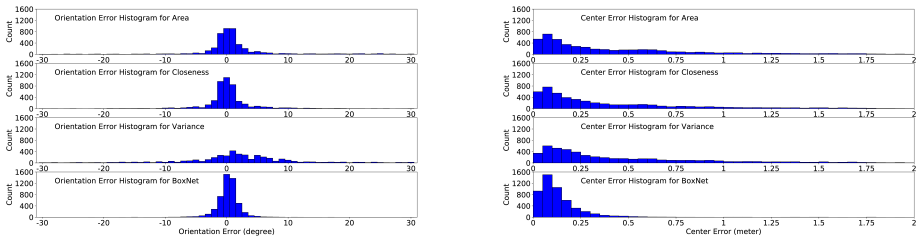
- [Figure 3] The histograms would benefit from explicit bin widths, axis labels, and a legend in the caption or figure itself; the current text does not indicate what the vertical axis represents or how the bins were chosen.
- [Section IV-F and Table VII] The word "shrinked" should be "shrunk" in the text and in Table VII.
Circularity Check
No significant circularity; BoxNet is a standard supervised regression evaluated on an external benchmark.
full rationale
The paper's derivation chain is a supervised learning pipeline: BoxNet is trained on 2D BEV points extracted from KITTI ground-truth boxes to regress center offset, width, length, and double-angle orientation, then evaluated on a separate set of samples using ground-truth labels. The predicted outputs are not defined in terms of the labels, nor are any fitted parameters renamed as predictions; the loss weights from cross-validation and the ablation comparisons are ordinary hyperparameter and architecture choices. The central quantitative claim, that BoxNet outperforms SLF on center error, orientation error, and IoU, is an empirical result against held-out annotations, not a consequence of self-citation or of the network's construction. Two concerns noted by a skeptical reader — the sample-level train/test split potentially lacking frame or track separation, and the use of ground-truth-box point extraction at test time — are validity or scope limitations, not circularity, because the evaluation still compares outputs with independent ground-truth labels. No circular step is identifiable under the specified criteria.
Assumptions & free parameters
free parameters (4)
- loss weights =
w0=1, w1=2, w2=1
- resampled point count N =
512
- minimum point threshold =
30
- learning rate schedule =
initial 0.005, exponential decay 0.7 every 250,000 steps
assumptions (4)
- domain assumption KITTI ground-truth 3D boxes and LiDAR-to-camera transforms are accurate.
- domain assumption Points inside the ground-truth 3D box, projected to BEV, are sufficient to infer the object's 2D bounding box.
- standard math The double-angle representation [cos(2θ), sin(2θ)] uniquely determines θ in the range (-π/2, π/2].
- ad hoc to paper Resampling to 512 points preserves the bounding-box-relevant geometry.
Cite this review
Pith. "Pith review of BoxNet: A Deep Learning Method for 2D Bounding Box Estimation from Bird's-Eye View Point Cloud." pith.science (2026). https://pith.science/paper/DFSXGFQU
@misc{pith2026190807085,
  author       = {Pith},
  title        = {Pith review of: BoxNet: A Deep Learning Method for 2D Bounding Box Estimation from Bird's-Eye View Point Cloud},
  year         = {2026},
  howpublished = {\url{https://pith.science/paper/DFSXGFQU}},
  note         = {Machine review of arXiv:1908.07085}
}
read the original abstract
We present a learning-based method to estimate the object bounding box from its 2D bird's-eye view (BEV) LiDAR points. Our method, entitled BoxNet, exploits a simple deep neural network that can efficiently handle unordered points. The method takes as input the 2D coordinates of all the points and the output is a vector consisting of both the box pose (position and orientation in LiDAR coordinate system) and its size (width and length). In order to deal with the angle discontinuity problem, we propose to estimate the double-angle sinusoidal values rather than the angle itself. We also predict the center relative to the point cloud mean to boost the performance of estimating the location of the box. The proposed method does not rely on the ordering of points as in many existing approaches, and can accurately predict the actual size of the bounding box based on the prior information that is obtained from the training data. BoxNet is validated using the KITTI 3D object dataset, with significant improvement compared with the state-of-the-art non-learning based methods
Figures

Figures from the paper (4 more)

Reference graph
Works this paper leans on
-
[1]
W. Luo, B. Yang, and R. Urtasun, Fast and Furious: Real Time End- to-End 3D Detection, Tracking and Motion Forecasting with a Single Convolutional Net, IEEE Conference on Computer Vision and Pattern Recognition, 2018
work page 2018
-
[2]
B. Yang, W. Luo, and R. Urtasun, PIXOR: Real-time 3D Object Detection from Point Clouds, IEEE Conference on Computer Vision and Pattern Recognition , 2018
work page 2018
-
[3]
M. Ren, A. Pokrovsky, B. Yang, and R. Urtasun, SBNet: Sparse Blocks Network for Fast Inference, IEEE Conference on Computer Vision and Pattern Recognition, 2018
work page 2018
-
[4]
Y . Zhou, and O Tuzel, V oxelNet: End-to-End Learning for Point Cloud Based 3D Object Detection, IEEE Conference on Computer Vision and Pattern Recognition, 2018
work page 2018
-
[5]
Charles R. Qi, W. Liu, C. Wu, H. Su, and L. J. Guibas, Frustum Point- Nets for 3D Object Detection from RGB-D Data, IEEE Conference on Computer Vision and Pattern Recognition , 2018
work page 2018
-
[6]
J. Ku, M. Mozifian, J. Lee, A. Harakeh, and S. Waslander, Joint 3D proposal generation and object detection from view aggregation, arXiv preprint arXiv: 1712.02294 , December 2017
arXiv 2017
-
[7]
Charles R. Qi, H. Su, K. Mo, and L. J. Guibas, PointNet: Deep Learning on Point Sets for 3D Classification and Segmentation, IEEE Conference on Computer Vision and Pattern Recognition , 2017
work page 2017
-
[8]
X. Chen, H. Ma, J. Wan, B. Li, and T. Xia, Multi-View 3D Object Detection Network for Autonomous Driving, IEEE Conference on Computer Vision and Pattern Recognition , 2017
work page 2017
Show all 22 references
-
[9]
Himmelsbach, T
M. Himmelsbach, T. Luettel, and H.-J. Wuensche, Real-time object classification in 3D point clouds using point feature histograms, IEEE/RSJ International Conference on Intelligent Robots and Systems , 2009
2009
-
[10]
H. Wang, B. Wang, B. Liu, X. Meng, and G. Yang, Pedestrian recognition and tracking using 3D LiDAR for autonomous vehicle, Robotics and Autonomous Systems , vol. 88, February 2017, pp. 71- 78
2017
-
[11]
Zermas, I
D. Zermas, I. Izzat, and N. Papanikolopoulos, Fast segmentation of 3D point clouds: A paradigm on LiDAR data for autonomous vehicle applications, IEEE International Conference on Robotics and Automation, 2017
2017
-
[12]
R. A. MacLachlan, and C. Mertz, Tracking of moving objects from a moving vehicle using a scanning laser rangefinder, IEEE Intelligent Transportation Systems Conference , 2006
2006
-
[13]
Petrovskaya, and S
A. Petrovskaya, and S. Thrun, Model Based Vehicle Tracking for Autonomous Driving in Urban Environments, Robotics: Science and Systems, 2008
2008
-
[14]
X. Shen, S. Pendleton, and M. H. Ang, Efficient L-shape fitting of laser scanner data for vehicle pose estimation, IEEE Conference on Robotics, Automation and Mechatronics , 2015
2015
-
[15]
H. Zhao, Q. Zhang, M. Chiba, R. Shibasaki, J. Cui, and H. Zha, Moving Object Classification using Horizontal Laser Scan Data, IEEE International Conference on Robotics and Automation , 2009
2009
-
[16]
Zhang, W
X. Zhang, W. Xu, C. Dong, and J. M. Dolan, Efficient L-shape fitting for vehicle detection using laser scanners, IEEE Intelligent V ehicle Symposium, 2017
2017
-
[17]
D. Kim, K. Jo, M. Lee, and M. Sunwoo, L-shape model switching- based precise motion tracking of moving vehicles using laser scanners, IEEE Transactions on Intelligent Transportation Systems , 19(2), 2018
2018
-
[18]
Mousavian, D
A. Mousavian, D. Anguelov, J. Flynn, and J Kosecka, 3D Bounding Box Estimation Using Deep Learning and Geometry, arXiv preprint arXiv: 1612.00496 , December 2016
2016 arXiv
-
[19]
Geger, P
A. Geger, P. Lenz, C. Stiller, and R. Urtasun, Vision meets robotics: The KITTI dataset, The International Journal of Robotics Research , 32(11), 2013
2013
-
[20]
X. Chen, K. Kundu, Y . Zhu, H. Ma, S. Fidler and R. Urtasun, 3D Object Proposals Using Stereo Imagery for Accurate Object Class Detection, IEEE Transactions on Pattern Analysis and Machine Intelligence, 40(5), pp. 1259-1272, May 2018
2018
-
[21]
X. Chen, K. Kundu, Z. Zhang, H. Ma, S. Fidler and R. Urtasun, Monocular 3D Object Detection for Autonomous Driving, 2016 IEEE Conference on Computer Vision and Pattern Recognition (CVPR) , pp. 2147-2156, June 2016
2016
-
[22]
Y . Wang, Y . Sun, Z. Liu, S. E. Sarma, M. M. Bronstein and J. M. Solomon, Dynamic Graph CNN for Learning on Point Clouds , arXiv preprint arXiv:1801.07829, 2018
2018 arXiv
Reviewed August 14, 2026 · model on record in the stance chip above.
Discussion (0). Continue with ORCID to comment.