REVIEW 2 major objections 4 minor 127 references
Linear stability analysis for large dynamical systems on directed random graphs
T0 review · 2 major / 4 minor · reviewed 2026-08-14 · deepseek-v4-flash
Pith's one-line read For infinitely large random directed graphs, stability reduces to a four-parameter leading-eigenvalue formula.
desk verdict A substantial, numerically well-supported extension of the cavity approach to directed sparse graphs; the main formulas are honestly labeled conjectures, and the load-bearing stable-eigenvalue assumption is formal for boundary eigenvalues and should be tested directly. read the letter →
The pith
A machine-rendered reading of the paper's core claim, the machinery that carries it, and where it could break.
The reading
What carries the argument
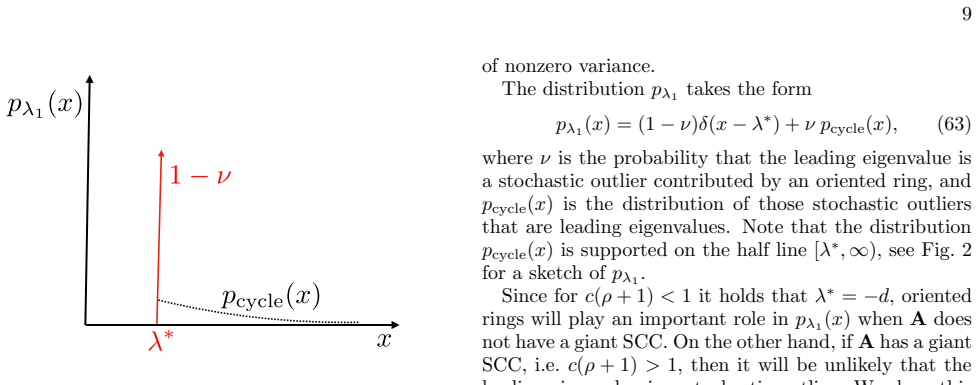
The machinery is the locally tree-like and oriented property of random directed configuration-model graphs: with probability one, the finite neighbourhood of any node is an oriented tree, so there are no finite feedback loops that amplify perturbations. On such graphs the Schur-complement recursion for eigenvector entries closes, producing the distributional equations (48) and (49) for the entry distribution $p_R$ and the associated edge-rooted distribution $q_R$. Eigenvalues of interest are located by asking for which $\lambda$ these equations admit a normalizable solution: the outlier $\lambda_{\mathrm{isol}}$ corresponds to a solution with nonzero first moment, while the continuum boundary $\lambda_{\mathrm{b}}$ corresponds to a zero-mean solution. Finite-length oriented rings, whose eigenvalues lie on a circle of radius $\gamma = (\prod_j |J_j|)^{1/\ell}$ centred at $-d$, supply the residual stochastic outliers that give $\lambda_1$ a nonzero variance.
What would settle it
Fix unweighted couplings $J_{jk}=1$ on directed configuration-model graphs with $c(\rho+1)>1$ and growing size $n$: the paper predicts $\lambda_1 \to -d+c(\rho+1)$ with vanishing variance. Observing $\lambda_1$ drifting with $n$, diverging, or fluctuating with non-vanishing sample variance would falsify the central formula. Repeating the check on power-law degree distributions with exponent just above $2$ tests the unbounded-support stability claim directly.
Extended reading notes
Core claim
The paper's central discovery is that for an infinitely large directed configuration-model graph with degree distribution $p_{K^{\mathrm{in}},K^{\mathrm{out}}}$ and i.i.d. couplings $J_{jk}$, the typical leading eigenvalue is $\lambda^{*} = \max\{\lambda_{\mathrm{isol}}, |\lambda_{\mathrm{b}}+d|-d\}$, with $\lambda_{\mathrm{isol}} = -d + c(\rho+1)\langle J\rangle$ and $|\lambda_{\mathrm{b}}+d|^{2} = c(\rho+1)\langle J^{2}\rangle$, whenever the graph has a giant strongly connected component, $c(\rho+1)>1$; below that threshold the spectrum collapses to $\{-d\}$ apart from stochastic outliers created by oriented rings. The leading eigenvalue is thus finite and self-averaging in the giant-component regime, in contrast to undirected sparse graphs. The same recursive scheme yields the statistics of the eigenvector entries and identifies the destabilizing mode: when the outlier $\lambda_{\mathrm{isol}}$ dominates, the mode is ferromagnetic with positive mean entry; when the continuum boundary $\lambda_{\mathrm{b}}$ dominates, the mode is spin-glass-like with zero mean entry.
Load-bearing premise
The load-bearing premise is that the boundary eigenvalue and the outlier eigenvalue remain eigenvalues after any single node is deleted; this 'stability of the eigenvalue' is assumed rather than proved, and the paper explicitly presents the general results as conjectures.
Editorial extensions
If this is right
- With a giant strongly connected component, the typical leading eigenvalue is deterministic: sample-to-sample fluctuations vanish as $n\to\infty$, and only rare oriented rings with large enough weights can produce outliers.
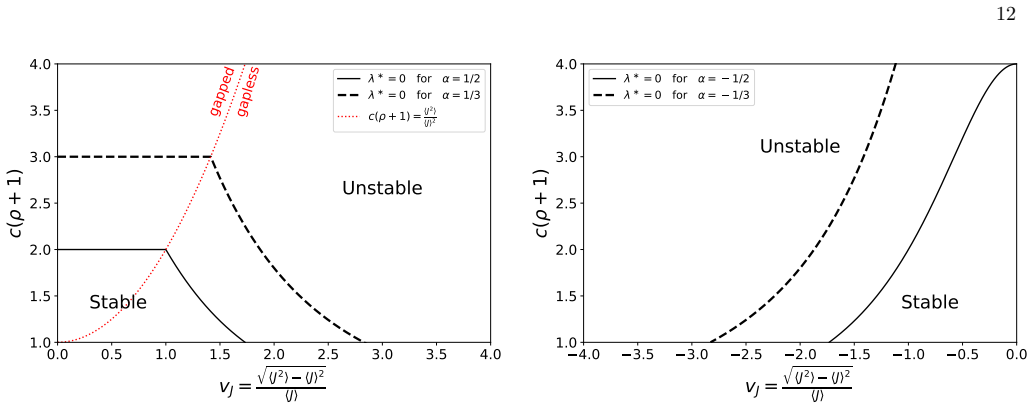
- The phase boundary depends only on $c(\rho+1)$, $\langle J\rangle$, $\langle J^2\rangle$, and $d$, so decreasing the indegree–outdegree correlation $\rho$ stabilizes the system when coupling fluctuations are moderate, while increasing the mean coupling or its variance moves it toward instability.
- For small coupling fluctuations the destabilizing mode is a ferromagnetic outlier whose position is independent of $\langle J^2\rangle$; for larger fluctuations the leading eigenvalue sits at the continuum boundary and the mode is spin-glass-like with zero mean.
- Directed locally tree-like networks can remain stable at arbitrarily large size, including power-law degree distributions with unbounded support, because the leading eigenvalue does not diverge with the largest degree; this is the paper's main contrast with undirected networks.
- In the dense limit the formula formally reduces to $n\langle J\rangle$ when $\langle J\rangle>0$ and $\sqrt{n\langle J^2\rangle}$ otherwise, recovering the classical dense random-matrix results and showing the sparse theory contains the dense one as a limiting case.
Reading between the lines
- Beyond the paper, if typical stability depends only on $c(\rho+1)$, $\langle J\rangle$, and $\langle J^2\rangle$, then any rewiring that preserves these three parameters cannot change typical linear stability; meaningful interventions must act on at least one of them.
- Beyond the paper, the boundary-and-outlier logic should carry over to discrete-time dynamics, where stability is governed by the spectral radius rather than the largest real part; making this explicit would require the distribution of complex outliers from oriented rings, not just the real edge.
- Beyond the paper, a direct test of the conjecture is deletion-stability: on finite power-law graphs, delete single nodes and check whether the candidate boundary eigenvalue persists; a failure in the heavy-tailed regime would mark exactly where the unbounded-support claim breaks down.
Signed reviews
Editorial analysis
A structured set of objections, weighed in public.
Referee Report
Summary. The paper studies the leading eigenvalue and associated right/left eigenvectors of sparse non-Hermitian random matrices of the form A = -d I + J∘C, where C is the adjacency matrix of a directed configuration-model graph with prescribed joint in/out degree distribution and J has i.i.d. entries. Using recursions derived from the Schur formula under a locally tree-like and oriented assumption, the authors obtain closed-form expressions for the boundary of the continuous spectrum, |λ_b+d|² = c(ρ+1)⟨J²⟩, and for the deterministic outlier λ_isol = -d + c(ρ+1)⟨J⟩. From these they construct a universal stability phase diagram depending only on c(ρ+1), ⟨J⟩, ⟨J²⟩, and d, and they characterize the destabilizing mode as ferromagnetic or spin-glass-like. The analytical predictions are compared with full diagonalization for n=4000 on Poisson, geometric, and power-law directed random graphs, with good agreement outside the most strongly fluctuating regimes. The paper also extends the formalism to diagonal disorder and to undirected random graphs and discusses the role of finite oriented cycles, which can create stochastic outliers. The general results are presented as conjectures, with a rigorous proof available only for directed Erdős-Rényi graphs with J=1 via Ref. [97].
Significance. If the central formulas are correct, the paper delivers a strikingly simple and universal criterion for the stability of large dynamical systems on directed random graphs, and it establishes that such systems can remain stable at infinite size even for degree distributions with unbounded support, in contrast to their undirected counterparts. The paper's strengths include a self-contained re-derivation of the cavity recursion relations through the Schur formula, a clear identification of the conjecture status in Sec. VII, and extensive finite-size numerical checks with no parameter fitting: the theoretical curves use only the prescribed ensemble parameters c, ρ, ⟨J⟩, and ⟨J²⟩. The results, if established, would have broad relevance for ecological, neural, and financial network stability, and the universal phase diagram is a useful organizing principle for sparse non-Hermitian random matrix theory.
major comments (2)
- [Appendix F] The derivation of the central recursions (48)-(49), and hence of the boundary formula (53) and the outlier formula (57), assumes that the eigenvalue λ is 'stable', i.e., that λ is an eigenvalue of A and also of every single-node-deleted principal submatrix A^(j). For the boundary eigenvalue λ_b of ∂σ_ac this assumption is not literally satisfied for finite matrices: λ_b is a limit point of the spectrum rather than an isolated eigenvalue, so the residue identity (F2) and the equality R_k = R_k^(j) in (E3) are only formal. The finite-size diagonalizations in Sec. V corroborate the final formulas but do not test deletion stability of λ_b itself. Since Eq. (53) is load-bearing for the universal phase diagram, the paper should either provide a rigorous asymptotic justification (for example, a regularization that takes η→0 after n→∞, or a local weak convergence proof) or add a direct numerical deletion test and reframe the general claims as well-supported conjectures rather than exact theory.
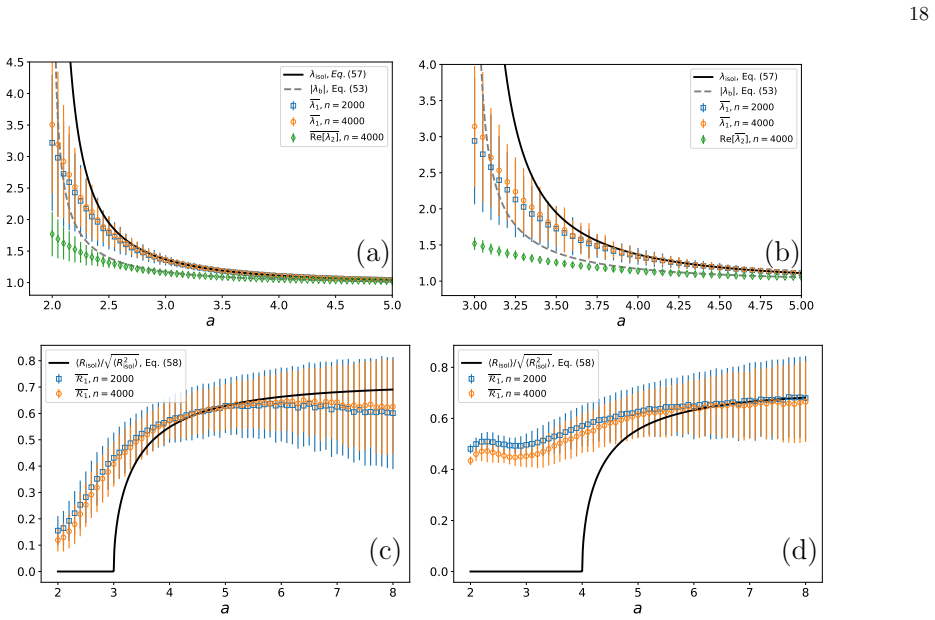
- [Sec. V C] The numerical evidence for the headline claim that systems remain stable for degree distributions with unbounded support is weakest precisely in the regime of unbounded second moments. For the uncorrelated power-law ensemble of Eq. (99), deviations from Eqs. (57) and (53) are substantial for a≲3, and for the perfectly correlated ensemble of Eq. (100) for a≲4; these deviations are attributed to finite-size effects, but only n=2000 and n=4000 are shown, with no finite-size scaling or extrapolation to n→∞. A finite-size scaling analysis is needed to support the claim that the deviations vanish in the infinite-size limit and that the unbounded-support stability result is numerically established.
minor comments (4)
- [Appendix I] In the paragraph after Eq. (I2), the equation numbers appear to be swapped: solving Eq. (I1) for ⟨R⟩_q≠0 yields Eq. (108) for the outlier, while setting ⟨R⟩_q=0 in Eq. (I2) yields Eq. (109) for the boundary, not the reverse as written.
- [Figs. 3 and 4] The axis labels in Figs. 3 and 4 render the effective connectivity as 'c( + 1)', with the ρ missing; the labels should read c(ρ+1).
- [Abstract and Sec. VII] The abstract and Sec. III describe the theory as 'exact', while Sec. VII states that Eqs. (53), (57), (58), (48), (49), (45), (56), and (60) are conjectures for all ensembles except directed Erdős-Rényi graphs with J=1. The wording should be aligned so that the conjecture status is transparent already in the abstract and introduction.
- [Appendix I] There is a typo in the sentence 'setting ⟨R⟩_q = 0 in Eq. (I2), ew obtain Eq. (108)' where 'ew' should read 'we'; the same sentence also contains the equation-number swap noted above.
Circularity Check
No significant circularity: the central eigenvalue formulas are derived from internally re-derived Schur/cavity recursions and are corroborated by independent finite-size numerical diagonalization with no parameter fitting.
full rationale
The paper's central results, Eqs. (53), (57), and (71), are obtained from the recursive distributional equations (48)-(49), which are derived in Appendices E and F via the Schur formula rather than merely imported from a prior citation. The derivation is self-contained: Appendix F starts from the resolvent and the Schur block-inversion formula, obtains recursion relations for eigenvector entries under the locally-tree-like and oriented assumptions, and Appendix G solves the moment equations to produce the boundary formula |λ_b + d|² = c(ρ+1)⟨J²⟩ and the outlier formula λ_isol = -d + c(ρ+1)⟨J⟩. No parameter is fitted to the numerical data; the theoretical curves use the prescribed ensemble parameters c, ρ, ⟨J⟩, and ⟨J²⟩, and the finite-size diagonalizations at n=4000 provide independent corroboration. The paper does cite the authors' earlier work Ref. [44] where the recursion relations were first derived via the cavity method, but this citation is not load-bearing because the present paper gives an alternative derivation and states that the relations are re-derived: 'In the present paper, we present an alternative derivation of the recursion relations based on the Schur formula'. The conjecture status of the general results, explicitly stated in Sec. VII, is a limitation of rigor rather than a sign of circular reasoning. The unproven 'stable eigenvalue' assumption in Appendix F is an assumption about the validity of the Schur-based residue formula for boundary eigenvalues; it is not an input that is equivalent to the predicted formulas. Thus the derivation chain does not reduce to its inputs by construction, and no circular step can be exhibited.
Assumptions & free parameters
assumptions (4)
- domain assumption Random directed graphs with prescribed degree distribution are locally tree-like and oriented in the n→∞ limit for finite mean degree c (Sec. II C 3).
- ad hoc to paper The leading eigenvalue λ1 (for outlier or boundary) is 'stable': if λ is an eigenvalue of A, it is also an eigenvalue of the principal submatrix A^(j) obtained by deleting any node j (Appendix F, Eq. F2 and surrounding text).
- standard math The self-consistent moment equations (G3)-(G8) admit a unique normalizable solution that corresponds to the physical eigenvector statistics, with the trivial delta solution discarded.
- standard math Eigenvalues of oriented rings are located on a circle of radius γ and contribute independently as stochastic outliers (Appendix C).
Cite this review
Pith. "Pith review of Linear stability analysis for large dynamical systems on directed random graphs." pith.science (2026). https://pith.science/paper/GHFAHE3H
@misc{pith2026190807092,
  author       = {Pith},
  title        = {Pith review of: Linear stability analysis for large dynamical systems on directed random graphs},
  year         = {2026},
  howpublished = {\url{https://pith.science/paper/GHFAHE3H}},
  note         = {Machine review of arXiv:1908.07092}
}
read the original abstract
We present a linear stability analysis of stationary states (or fixed points) in large dynamical systems defined on random directed graphs with a prescribed distribution of indegrees and outdegrees. We obtain two remarkable results for such dynamical systems: First, infinitely large systems on directed graphs can be stable even when the degree distribution has unbounded support; this result is surprising since their counterparts on nondirected graphs are unstable when system size is large enough. Second, we show that the phase transition between the stable and unstable phase is universal in the sense that it depends only on a few parameters, such as, the mean degree and a degree correlation coefficient. In addition, in the unstable regime we characterize the nature of the destabilizing mode, which also exhibits universal features. These results follow from an exact theory for the leading eigenvalue of infinitely large graphs that are locally tree-like and oriented, as well as, for the right and left eigenvectors associated with the leading eigenvalue. We corroborate analytical results for infinitely large graphs with numerical experiments on random graphs of finite size. We discuss how the presented theory can be extended to graphs with diagonal disorder and to graphs that contain nondirected links. Finally, we discuss the influence of small cycles and how they can destabilize large dynamical systems when they induce strong enough feedback loops.
Figures

Figures from the paper (4 more)



Reference graph
Works this paper leans on
-
[97]
Detection thresholds in very sparse matrix completion
C. Bordenave, S. Coste, and R. R. Nadakuditi, “De- tection thresholds in very sparse matrix completion,” arXiv preprint arXiv:2005.06062 , 2020
work page Pith review arXiv 2005
-
[1]
Barrat, M
A. Barrat, M. Barthelemy, and A. Vespignani, Dynam- ical processes on complex networks . Cambridge univer- sity press, 2008
2008
-
[2]
Newman, Networks: an introduction
M. Newman, Networks: an introduction . Oxford uni- versity press, 2010
2010
-
[3]
Barth´ elemy,Spatial networks, vol
M. Barth´ elemy,Spatial networks, vol. 499. Phys. Rep., 2011
2011
-
[4]
S. N. Dorogovtsev and J. F. Mendes, Evolution of net- works: From biological nets to the Internet and WWW . OUP Oxford, 2013
2013
-
[5]
Barab´ asi,Network science
A.-L. Barab´ asi,Network science. Cambridge university press, 2016
2016
-
[6]
Contagion in financial net- works,
P. Gai and S. Kapadia, “Contagion in financial net- works,” Proceedings of the Royal Society A: Mathe- matical, Physical and Engineering Sciences , vol. 466, no. 2120, pp. 2401–2423, 2010
2010
-
[7]
Systemic risk in bank- ing ecosystems,
A. G. Haldane and R. M. May, “Systemic risk in bank- ing ecosystems,” Nature, vol. 469, no. 7330, p. 351, 2011
2011
Show all 127 references
-
[8]
Pathways towards instability in financial net- works,
M. Bardoscia, S. Battiston, F. Caccioli, and G. Cal- darelli, “Pathways towards instability in financial net- works,” Nature Communications, vol. 8, p. 14416, 2017
2017
-
[9]
The diversity–stability debate,
K. S. McCann, “The diversity–stability debate,” Na- ture, vol. 405, no. 6783, p. 228, 2000
2000
-
[10]
Food-web structure and network theory: the role of connectance and size,
J. A. Dunne, R. J. Williams, and N. D. Martinez, “Food-web structure and network theory: the role of connectance and size,” Proceedings of the National Academy of Sciences, vol. 99, no. 20, pp. 12917–12922, 2002
2002
-
[11]
Disentangling the web of life,
J. Bascompte, “Disentangling the web of life,” Science, vol. 325, no. 5939, pp. 416–419, 2009
2009
-
[12]
The architecture of mutualistic networks minimizes competition and in- creases biodiversity,
U. Bastolla, M. A. Fortuna, A. Pascual-Garc´ ıa, A. Fer- rera, B. Luque, and J. Bascompte, “The architecture of mutualistic networks minimizes competition and in- creases biodiversity,”Nature, vol. 458, no. 7241, p. 1018, 2009
2009
-
[13]
Stability criteria for complex ecosystems,
S. Allesina and S. Tang, “Stability criteria for complex ecosystems,” Nature, vol. 483, no. 7388, p. 205, 2012
2012
-
[14]
The ecology of the microbiome: networks, competition, and stabil- ity,
K. Z. Coyte, J. Schluter, and K. R. Foster, “The ecology of the microbiome: networks, competition, and stabil- ity,” Science, vol. 350, no. 6261, pp. 663–666, 2015
2015
-
[15]
Dynam- ics of rumor spreading in complex networks,
Y. Moreno, M. Nekovee, and A. F. Pacheco, “Dynam- ics of rumor spreading in complex networks,” Physical Review E, vol. 69, no. 6, p. 066130, 2004
2004
-
[16]
Localization and spreading of diseases in complex networks,
A. V. Goltsev, S. N. Dorogovtsev, J. G. Oliveira, and J. F. Mendes, “Localization and spreading of diseases in complex networks,” Physical review letters, vol. 109, no. 12, p. 128702, 2012
2012
-
[17]
Virality pre- diction and community structure in social networks,
L. Weng, F. Menczer, and Y.-Y. Ahn, “Virality pre- diction and community structure in social networks,” Scientific reports, vol. 3, p. 2522, 2013
2013
-
[18]
Homeomorphism of systems of dif- ferential equations,
D. M. Grobman, “Homeomorphism of systems of dif- ferential equations,” Doklady Akademii Nauk SSSR , vol. 128, no. 5, pp. 880–881, 1959
1959
-
[19]
A lemma in the theory of structural stabil- ity of differential equations,
P. Hartman, “A lemma in the theory of structural stabil- ity of differential equations,” Proceedings of the Amer- ican Mathematical Society, vol. 11, no. 4, pp. 610–620, 1960
1960
-
[20]
Will a large complex system be stable?,
R. M. May, “Will a large complex system be stable?,” Nature, vol. 238, no. 5364, pp. 413–414, 1972
1972
-
[21]
Chaos in random neural networks,
H. Sompolinsky, A. Crisanti, and H.-J. Sommers, “Chaos in random neural networks,”Physical review let- ters, vol. 61, no. 3, p. 259, 1988
1988
-
[22]
Proper- ties of networks with partially structured and partially random connectivity,
Y. Ahmadian, F. Fumarola, and K. D. Miller, “Proper- ties of networks with partially structured and partially random connectivity,” Physical Review E, vol. 91, no. 1, p. 012820, 2015
2015
-
[23]
Low-dimensional dynamics of structured random net- works,
J. Aljadeff, D. Renfrew, M. Vegu´ e, and T. O. Sharpee, “Low-dimensional dynamics of structured random net- works,” Physical Review E , vol. 93, no. 2, p. 022302, 2016
2016
-
[24]
Transition to chaos in random neuronal networks,
J. Kadmon and H. Sompolinsky, “Transition to chaos in random neuronal networks,” Physical Review X, vol. 5, no. 4, p. 041030, 2015
2015
-
[25]
Non-hermitian localization in biological networks,
A. Amir, N. Hatano, and D. R. Nelson, “Non-hermitian localization in biological networks,” Physical Review E, vol. 93, no. 4, p. 042310, 2016
2016
-
[26]
Ef- fect of population abundances on the stability of large random ecosystems,
T. Gibbs, J. Grilli, T. Rogers, and S. Allesina, “Ef- fect of population abundances on the stability of large random ecosystems,” Physical Review E, vol. 98, no. 2, p. 022410, 2018
2018
-
[27]
Sub- populations and stability in microbial communities,
P. A. Haas, N. M. Oliveira, and R. E. Goldstein, “Sub- populations and stability in microbial communities,” Physical Review Research, vol. 2, no. 2, p. 022036, 2020
2020
-
[28]
Graph structure in the web,
A. Broder, R. Kumar, F. Maghoul, P. Raghavan, S. Ra- jagopalan, R. Stata, A. Tomkins, and J. Wiener, “Graph structure in the web,” Computer networks , vol. 33, no. 1-6, pp. 309–320, 2000
2000
-
[29]
Pastor-Satorras and A
R. Pastor-Satorras and A. Vespignani, Evolution and structure of the Internet: A statistical physics approach . Cambridge University Press, 2007
2007
-
[30]
Dynamics of sparsely connected networks of excitatory and inhibitory spiking neurons,
N. Brunel, “Dynamics of sparsely connected networks of excitatory and inhibitory spiking neurons,” Journal of computational neuroscience, vol. 8, no. 3, pp. 183–208, 2000. 33
2000
-
[31]
M. A. Arbib, ed., The handbook of brain theory and neural networks. MIT press, 2003
2003
-
[32]
Sporns, Networks of the Brain
O. Sporns, Networks of the Brain . MIT press, 2010
2010
-
[33]
Measurement and anal- ysis of online social networks,
A. Mislove, M. Marcon, K. P. Gummadi, P. Dr- uschel, and B. Bhattacharjee, “Measurement and anal- ysis of online social networks,” in Proceedings of the 7th ACM SIGCOMM conference on Internet measurement , pp. 29–42, 2007
2007
-
[34]
Infor- mation network or social network? the structure of the twitter follow graph,
S. A. Myers, A. Sharma, P. Gupta, and J. Lin, “Infor- mation network or social network? the structure of the twitter follow graph,” in Proceedings of the 23rd Inter- national Conference on World Wide Web , pp. 493–498, 2014
2014
-
[35]
A critical point for random graphs with a given degree sequence,
M. Molloy and B. Reed, “A critical point for random graphs with a given degree sequence,” Random Struc- tures & Algorithms, vol. 6, no. 23, pp. 161–180, 1995
1995
-
[36]
The size of the giant compo- nent of a random graph with a given degree sequence,
M. Molloy and B. Reed, “The size of the giant compo- nent of a random graph with a given degree sequence,” Combinatorics, Probability and Computing, vol. 7, no. 3, p. 295305, 1998
1998
-
[37]
Bollob´ as and B
B. Bollob´ as and B. B´ ela,Random graphs. No. 73, Cam- bridge university press, 2001
2001
-
[38]
Gibbs measures and phase transitions on sparse random graphs,
A. Dembo and A. Montanari, “Gibbs measures and phase transitions on sparse random graphs,” Brazil- ian Journal of Probability and Statistics , vol. 24, no. 2, pp. 137–211, 2010
2010
-
[39]
Ran- dom graphs with arbitrary degree distributions and their applications,
M. E. Newman, S. H. Strogatz, and D. J. Watts, “Ran- dom graphs with arbitrary degree distributions and their applications,” Physical review E , vol. 64, no. 2, p. 026118, 2001
2001
-
[40]
Giant strongly connected component of di- rected networks,
S. N. Dorogovtsev, J. F. F. Mendes, and A. N. Samukhin, “Giant strongly connected component of di- rected networks,” Physical Review E , vol. 64, no. 2, p. 025101, 2001
2001
-
[41]
Mapping the structure of directed networks: Beyond the bow-tie diagram,
G. Tim´ ar, A. Goltsev, S. Dorogovtsev, and J. Mendes, “Mapping the structure of directed networks: Beyond the bow-tie diagram,” Physical review letters , vol. 118, no. 7, p. 078301, 2017
2017
-
[42]
Cavity approach to the spectral density of non-hermitian sparse matrices,
T. Rogers and I. P. Castillo, “Cavity approach to the spectral density of non-hermitian sparse matrices,” Physical Review E, vol. 79, no. 1, p. 012101, 2009
2009
-
[43]
Predicting the stability of large structured food webs,
S. Allesina, J. Grilli, G. Barab´ as, S. Tang, J. Aljad- eff, and A. Maritan, “Predicting the stability of large structured food webs,” Nature communications, vol. 6, p. 7842, 2015
2015
-
[44]
Eigenvalue outliers of non- hermitian random matrices with a local tree structure,
I. Neri and F. L. Metz, “Eigenvalue outliers of non- hermitian random matrices with a local tree structure,” Physical review letters, vol. 117, no. 22, p. 224101, 2016
2016
-
[45]
Spectral theory of sparse non-hermitian random matrices,
F. L. Metz, I. Neri, and T. Rogers, “Spectral theory of sparse non-hermitian random matrices,” J. Phys. A: Math. Theor., vol. 52, p. 434003, 2019
2019
-
[46]
Universal tran- sient behavior in large dynamical systems on networks,
W. Tarnowski, I. Neri, and P. Vivo, “Universal tran- sient behavior in large dynamical systems on networks,” Phys. Rev. Research, vol. 2, p. 023333, Jun 2020
2020
-
[47]
The largest eigenvalue of sparse random graphs,
M. Krivelevich and B. Sudakov, “The largest eigenvalue of sparse random graphs,” Combinatorics, Probability and Computing, vol. 12, no. 1, pp. 61–72, 2003
2003
-
[48]
The spectra of random graphs with given expected degrees,
F. Chung, L. Lu, and V. Vu, “The spectra of random graphs with given expected degrees,” Internet Mathe- matics, vol. 1, no. 3, pp. 257–275, 2004
2004
-
[49]
Top eigen- pair statistics for weighted sparse graphs,
V. A. Susca, P. Vivo, and R. K¨ uhn, “Top eigen- pair statistics for weighted sparse graphs,” Journal of Physics A: Mathematical and Theoretical , vol. 52, no. 48, p. 485002, 2019
2019
-
[50]
Cav- ity approach to the spectral density of sparse symmet- ric random matrices,
T. Rogers, I. P. Castillo, R. K¨ uhn, and K. Takeda, “Cav- ity approach to the spectral density of sparse symmet- ric random matrices,” Physical Review E, vol. 78, no. 3, p. 031116, 2008
2008
-
[51]
Spectral density of random graphs with topological constraints,
T. Rogers, C. P. Vicente, K. Takeda, and I. P. Castillo, “Spectral density of random graphs with topological constraints,” Journal of Physics A: Mathematical and Theoretical, vol. 43, no. 19, p. 195002, 2010
2010
-
[52]
Spectra of sparse regular graphs with loops,
F. L. Metz, I. Neri, and D. Boll´ e, “Spectra of sparse regular graphs with loops,” Physical Review E, vol. 84, no. 5, p. 055101, 2011
2011
-
[53]
On the spectra of large sparse graphs with cycles,
D. Boll´ e, F. L. Metz, and I. Neri, “On the spectra of large sparse graphs with cycles,” Spectral analy- sis, differential equations and mathematical physics: a festschrift in honor of Fritz Gesztesys 60th birthday , pp. 35–58, 2013
2013
-
[54]
The bethe lattice spin glass revisited,
M. M´ ezard and G. Parisi, “The bethe lattice spin glass revisited,” The European Physical Journal B-Condensed Matter and Complex Systems , vol. 20, no. 2, pp. 217– 233, 2001
2001
-
[55]
The cavity method at zero temperature,
M. M´ ezard and G. Parisi, “The cavity method at zero temperature,” Journal of Statistical Physics , vol. 111, no. 1-2, pp. 1–34, 2003
2003
-
[56]
Resolvent of large ran- dom graphs,
C. Bordenave and M. Lelarge, “Resolvent of large ran- dom graphs,” Random Structures & Algorithms, vol. 37, no. 3, pp. 332–352, 2010
2010
-
[57]
Emergence of the giant weak component in directed random graphs with arbitrary degree distribu- tions,
I. Kryven, “Emergence of the giant weak component in directed random graphs with arbitrary degree distribu- tions,” Phys. Rev. E , vol. 94, p. 012315, Jul 2016
2016
-
[58]
The objective method: probabilistic combinatorial optimization and local weak convergence,
D. Aldous and J. M. Steele, “The objective method: probabilistic combinatorial optimization and local weak convergence,” in Probability on discrete structures , pp. 1–72, Springer, 2004
2004
-
[59]
The asymptotic distribution of short cycles in random regular graphs,
N. C. Wormald, “The asymptotic distribution of short cycles in random regular graphs,” Journal of Combi- natorial Theory, Series B , vol. 31, no. 2, pp. 168–182, 1981
1981
-
[60]
R. A. Horn and C. R. Johnson, Matrix Analysis. Cam- bridge University Press, 1985
1985
-
[61]
R. A. Horn and C. R. Johnson, Matrix analysis. Cam- bridge university press, 2012
2012
-
[62]
Approximating the largest eigenvalue of network adjacency matrices,
J. G. Restrepo, E. Ott, and B. R. Hunt, “Approximating the largest eigenvalue of network adjacency matrices,” Physical Review E, vol. 76, no. 5, p. 056119, 2007
2007
-
[63]
Cav- ity approach to the first eigenvalue problem in a family of symmetric random sparse matrices,
Y. Kabashima, H. Takahashi, and O. Watanabe, “Cav- ity approach to the first eigenvalue problem in a family of symmetric random sparse matrices,” in Journal of Physics: Conference Series , vol. 233, p. 012001, IOP Publishing, 2010
2010
-
[64]
First eigen- value/eigenvector in sparse random symmetric matrices: influences of degree fluctuation,
Y. Kabashima and H. Takahashi, “First eigen- value/eigenvector in sparse random symmetric matrices: influences of degree fluctuation,” Journal of Physics A: Mathematical and Theoretical, vol. 45, no. 32, p. 325001, 2012
2012
-
[65]
Fat-tailed distribution derived from the first eigenvector of a symmetric random sparse matrix,
H. Takahashi, “Fat-tailed distribution derived from the first eigenvector of a symmetric random sparse matrix,” Journal of Physics A: Mathematical and Theoretical , vol. 47, no. 6, p. 065003, 2014
2014
-
[66]
Spherical model of a spin-glass,
J. Kosterlitz, D. Thouless, and R. C. Jones, “Spherical model of a spin-glass,” Physical Review Letters, vol. 36, no. 20, p. 1217, 1976
1976
-
[67]
Circular law,
V. L. Girko, “Circular law,” Theory of Probability & Its Applications, vol. 29, no. 4, pp. 694–706, 1985
1985
-
[68]
Circular law,
Z. D. Bai, “Circular law,” The Annals of Probability , vol. 25, no. 1, pp. 494–529, 1997. 34
1997
-
[69]
The circular law for ran- dom matrices,
F. G¨ otze and A. Tikhomirov, “The circular law for ran- dom matrices,” The Annals of Probability, vol. 38, no. 4, pp. 1444–1491, 2010
2010
-
[70]
Random matrices: Universality of esds and the circular law,
T. Tao and V. Vu, “Random matrices: Universality of esds and the circular law,” The Annals of Probability , vol. 38, no. 5, pp. 2023–2065, 2010
2023
-
[71]
Around the circular law,
C. Bordenave and D. Chafa¨ ı, “Around the circular law,” Probability surveys, vol. 9, 2012
2012
-
[72]
Outliers in the spectrum of iid matrices with bounded rank perturbations,
T. Tao, “Outliers in the spectrum of iid matrices with bounded rank perturbations,” Probability Theory and Related Fields, vol. 155, no. 1-2, pp. 231–263, 2013
2013
-
[73]
Nonlinear analogue of the may- wigner instability transition,
Y. V. Fyodorov and B. A. Khoruzhenko, “Nonlinear analogue of the may- wigner instability transition,”Pro- ceedings of the National Academy of Sciences , vol. 113, no. 25, pp. 6827–6832, 2016
2016
-
[74]
A ferromagnet with a glass transition,
S. Franz, M. M´ ezard, F. Ricci-Tersenghi, M. Weigt, and R. Zecchina, “A ferromagnet with a glass transition,” EPL (Europhysics Letters), vol. 55, no. 4, p. 465, 2001
2001
-
[75]
Classes of small-world networks,
L. A. N. Amaral, A. Scala, M. Barthelemy, and H. E. Stanley, “Classes of small-world networks,” Proceedings of the national academy of sciences , vol. 97, no. 21, pp. 11149–11152, 2000
2000
-
[76]
Statistical mechanics of complex networks,
R. Albert and A.-L. Barab´ asi, “Statistical mechanics of complex networks,” Rev. Mod. Phys., vol. 74, pp. 47–97, Jan 2002
2002
-
[77]
Power- law distributions in empirical data,
A. Clauset, C. R. Shalizi, and M. E. Newman, “Power- law distributions in empirical data,” SIAM review , vol. 51, no. 4, pp. 661–703, 2009
2009
-
[78]
A self- consistent theory of localization,
R. Abou-Chacra, D. Thouless, and P. Anderson, “A self- consistent theory of localization,” Journal of Physics C: Solid State Physics , vol. 6, no. 10, p. 1734, 1973
1973
-
[79]
Localization tran- sition in symmetric random matrices,
F. L. Metz, I. Neri, and D. Boll´ e, “Localization tran- sition in symmetric random matrices,” Physical Review E, vol. 82, no. 3, p. 031135, 2010
2010
-
[80]
Instabilities in complex mixtures with a large number of components,
R. P. Sear and J. A. Cuesta, “Instabilities in complex mixtures with a large number of components,” Physical review letters, vol. 91, no. 24, p. 245701, 2003
2003
-
[81]
Eigenvalue spectra of random matrices for neural networks,
K. Rajan and L. Abbott, “Eigenvalue spectra of random matrices for neural networks,” Physical review letters , vol. 97, no. 18, p. 188104, 2006
2006
-
[82]
Modularity and stability in ecological communities,
J. Grilli, T. Rogers, and S. Allesina, “Modularity and stability in ecological communities,” Nature communi- cations, vol. 7, p. 12031, 2016
2016
-
[83]
Transition to chaos in random networks with cell-type-specific con- nectivity,
J. Aljadeff, M. Stern, and T. Sharpee, “Transition to chaos in random networks with cell-type-specific con- nectivity,” Phys. Rev. Lett. , vol. 114, p. 088101, Feb 2015
2015
-
[84]
Low-dimensional dynamics of structured random net- works,
J. Aljadeff, D. Renfrew, M. Vegu´ e, and T. O. Sharpee, “Low-dimensional dynamics of structured random net- works,” Phys. Rev. E , vol. 93, p. 022302, Feb 2016
2016
-
[85]
Eigenvalue spectra of large correlated random matrices,
A. Kuczala and T. O. Sharpee, “Eigenvalue spectra of large correlated random matrices,” Physical Review E , vol. 94, no. 5, p. 050101, 2016
2016
-
[86]
May’s instability in large economies,
J. Moran and J.-P. Bouchaud, “May’s instability in large economies,” Phys. Rev. E, vol. 100, p. 032307, Sep 2019
2019
-
[87]
Localization transitions in non-hermitian quantum mechanics,
N. Hatano and D. R. Nelson, “Localization transitions in non-hermitian quantum mechanics,” Physical review letters, vol. 77, no. 3, p. 570, 1996
1996
-
[88]
Eigenvalue repulsion and eigenvector localization in sparse non-hermitian random matrices,
G. H. Zhang and D. R. Nelson, “Eigenvalue repulsion and eigenvector localization in sparse non-hermitian random matrices,” Physical Review E , vol. 100, no. 5, p. 052315, 2019
2019
-
[89]
Connectance of large dynamic (cybernetic) systems: critical values for stabil- ity,
M. R. Gardner and W. R. Ashby, “Connectance of large dynamic (cybernetic) systems: critical values for stabil- ity,” Nature, vol. 228, no. 5273, p. 784, 1970
1970
-
[90]
The may-wigner stability theorem,
H. M. Hastings, “The may-wigner stability theorem,” Journal of Theoretical Biology , vol. 97, no. 2, pp. 155– 166, 1982
1982
-
[91]
Spectral clustering of bi- ological sequence data,
W. Pentney and M. Meila, “Spectral clustering of bi- ological sequence data,” in AAAI ’05, Proceedings of the 20th national conference on Artificial Intelligence , vol. 2, pp. 845–850, 2005
2005
-
[92]
Spectral redemption in clustering sparse networks,
F. Krzakala, C. Moore, E. Mossel, J. Neeman, A. Sly, L. Zdeborov´ a, and P. Zhang, “Spectral redemption in clustering sparse networks,” Proceedings of the National Academy of Sciences, vol. 110, no. 52, pp. 20935–20940, 2013
2013
-
[93]
Eigenvector-like measures of centrality for asymmetric relations,
P. Bonacich and P. Lloyd, “Eigenvector-like measures of centrality for asymmetric relations,” Social networks, vol. 23, no. 3, pp. 191–201, 2001
2001
-
[94]
A. N. Langville and C. D. Meyer, Google’s PageRank and beyond: The science of search engine rankings . Princeton University Press, 2011
2011
-
[95]
Google matrix analysis of directed networks,
L. Ermann, K. M. Frahm, and D. L. Shepelyansky, “Google matrix analysis of directed networks,” Reviews of modern physics , vol. 87, no. 4, p. 1261, 2015
2015
-
[96]
Con- strained low-rank matrix estimation: Phase transitions, approximate message passing and applications,
T. Lesieur, F. Krzakala, and L. Zdeborov´ a, “Con- strained low-rank matrix estimation: Phase transitions, approximate message passing and applications,” Jour- nal of Statistical Mechanics: Theory and Experiment , vol. 2017, no. 7, p. 073403, 2017
2017
-
[98]
Non- backtracking spectrum of random graphs: community detection and non-regular ramanujan graphs,
C. Bordenave, M. Lelarge, and L. Massouli´ e, “Non- backtracking spectrum of random graphs: community detection and non-regular ramanujan graphs,” in 2015 IEEE 56th Annual Symposium on Foundations of Com- puter Science, pp. 1347–1357, IEEE, 2015
2015
-
[99]
Statistical physics of inference: Thresholds and algorithms,
L. Zdeborov´ a and F. Krzakala, “Statistical physics of inference: Thresholds and algorithms,” Advances in Physics, vol. 65, no. 5, pp. 453–552, 2016
2016
-
[100]
Algorithmic detectability threshold of the stochastic block model,
T. Kawamoto, “Algorithmic detectability threshold of the stochastic block model,” Physical Review E, vol. 97, no. 3, p. 032301, 2018
2018
-
[101]
The laplacian spectrum of graphs,
B. Mohar, Y. Alavi, G. Chartrand, and O. Oellermann, “The laplacian spectrum of graphs,”Graph theory, com- binatorics, and applications , vol. 2, no. 871-898, p. 12, 1991
1991
-
[102]
Random symmetric matrices with a constraint: The spectral density of random impedance networks,
J. St¨ aring, B. Mehlig, Y. V. Fyodorov, and J. Luck, “Random symmetric matrices with a constraint: The spectral density of random impedance networks,” Phys- ical Review E, vol. 67, no. 4, p. 047101, 2003
2003
-
[103]
Spectra of random stochastic matrices and relaxation in complex systems,
R. K¨ uhn, “Spectra of random stochastic matrices and relaxation in complex systems,” EPL (Europhysics Let- ters), vol. 109, no. 6, p. 60003, 2015
2015
-
[104]
The exact laplacian spectrum for the dyson hierarchical network,
E. Agliari and F. Tavani, “The exact laplacian spectrum for the dyson hierarchical network,” Scientific reports, vol. 7, p. 39962, 2017
2017
-
[105]
Glassy dy- namics on networks: local spectra and return proba- bilities,
R. G. Margiotta, R. K¨ uhn, and P. Sollich, “Glassy dy- namics on networks: local spectra and return proba- bilities,” Journal of Statistical Mechanics: Theory and Experiment, vol. 2019, no. 9, p. 093304, 2019
2019
-
[106]
D. A. Levin and Y. Peres, Markov chains and mixing times, vol. 107. American Mathematical Soc., 2009
2009
-
[107]
An eigenvalue method for computing the largest relaxation time of disordered sys- tems,
C. Monthus and T. Garel, “An eigenvalue method for computing the largest relaxation time of disordered sys- tems,” Journal of Statistical Mechanics: Theory and Experiment, vol. 2009, no. 12, p. P12017, 2009. 35
2009
-
[108]
Immune networks: multitasking capabili- ties near saturation,
E. Agliari, A. Annibale, A. Barra, A. Coolen, and D. Tantari, “Immune networks: multitasking capabili- ties near saturation,” Journal of Physics A: Mathemat- ical and Theoretical, vol. 46, no. 41, p. 415003, 2013
2013
-
[109]
Asymptotic eval- uation of certain markov process expectations for large time, i,
M. D. Donsker and S. S. Varadhan, “Asymptotic eval- uation of certain markov process expectations for large time, i,” Communications on Pure and Applied Mathe- matics, vol. 28, no. 1, pp. 1–47, 1975
1975
-
[110]
Asymptotic evaluation of certain markov process expectations for large time, ii,
M. Donsker and S. Varadhan, “Asymptotic evaluation of certain markov process expectations for large time, ii,” Communications on Pure and Applied Mathematics, vol. 28, no. 2, pp. 279–301, 1975
1975
-
[111]
Asymptotic evalua- tion of certain markov process expectations for large timeiii,
M. Donsker and S. Varadhan, “Asymptotic evalua- tion of certain markov process expectations for large timeiii,” Communications on pure and applied Mathe- matics, vol. 29, no. 4, pp. 389–461, 1976
1976
-
[112]
Asymptotic eval- uation of certain markov process expectations for large time. iv,
M. D. Donsker and S. S. Varadhan, “Asymptotic eval- uation of certain markov process expectations for large time. iv,” Communications on Pure and Applied Math- ematics, vol. 36, no. 2, pp. 183–212, 1983
1983
-
[113]
Rare events statistics of random walks on networks: localisa- tion and other dynamical phase transitions,
C. De Bacco, A. Guggiola, R. K¨ uhn, and P. Paga, “Rare events statistics of random walks on networks: localisa- tion and other dynamical phase transitions,” Journal of Physics A: Mathematical and Theoretical , vol. 49, no. 18, p. 184003, 2016
2016
-
[114]
Non-hermitian localization and delocalization,
J. Feinberg and A. Zee, “Non-hermitian localization and delocalization,” Physical Review E , vol. 59, no. 6, p. 6433, 1999
1999
-
[115]
Non-hermitian eu- clidean random matrix theory,
A. Goetschy and S. Skipetrov, “Non-hermitian eu- clidean random matrix theory,” Physical Review E , vol. 84, no. 1, p. 011150, 2011
2011
-
[116]
Spectra of sparse non-hermitian random matrices: An analytical solution,
I. Neri and F. L. Metz, “Spectra of sparse non-hermitian random matrices: An analytical solution,” Physical re- view letters, vol. 109, no. 3, p. 030602, 2012
2012
-
[117]
Spectra of networks containing short loops,
M. Newman, “Spectra of networks containing short loops,” Physical Review E , vol. 100, no. 1, p. 012314, 2019
2019
-
[118]
Uni- versal hypotrochoidic law for random matrices with cyclic correlations,
P. V. Aceituno, T. Rogers, and H. Schomerus, “Uni- versal hypotrochoidic law for random matrices with cyclic correlations,” Physical Review E , vol. 100, no. 1, p. 010302, 2019
2019
-
[119]
Con- strained markovian dynamics of random graphs,
A. Coolen, A. De Martino, and A. Annibale, “Con- strained markovian dynamics of random graphs,” Jour- nal of Statistical Physics, vol. 136, no. 6, pp. 1035–1067, 2009
2009
-
[120]
Tailored graph ensembles as proxies or null models for real networks i: tools for quantify- ing structure,
A. Annibale, A. Coolen, L. Fernandes, F. Fraternali, and J. Kleinjung, “Tailored graph ensembles as proxies or null models for real networks i: tools for quantify- ing structure,” Journal of Physics A: Mathematical and Theoretical, vol. 42, no. 48, p. 485001, 2009
2009
-
[121]
Loops of any size and hamilton cycles in random scale-free networks,
G. Bianconi and M. Marsili, “Loops of any size and hamilton cycles in random scale-free networks,” Jour- nal of Statistical Mechanics: Theory and Experiment , vol. 2005, no. 06, p. P06005, 2005
2005
-
[122]
Gaussian belief propagation: Theory and aplication,
D. Bickson, “Gaussian belief propagation: Theory and aplication,” arXiv preprint arXiv:0811.2518 , 2008
2008 arXiv
-
[123]
Correctness of belief propagation in gaussian graphical models of arbitrary topology,
Y. Weiss and W. T. Freeman, “Correctness of belief propagation in gaussian graphical models of arbitrary topology,” in Advances in neural information processing systems, pp. 673–679, 2000
2000
-
[124]
Un- derstanding belief propagation and its generalizations,
J. S. Yedidia, W. T. Freeman, and Y. Weiss, “Un- derstanding belief propagation and its generalizations,” Exploring artificial intelligence in the new millennium , vol. 8, pp. 236–239, 2003
2003
-
[125]
Bollob´ as,Modern graph theory , vol
B. Bollob´ as,Modern graph theory , vol. 184. Springer Science & Business Media, 2013
2013
-
[126]
Tao, Topics in random matrix theory, vol
T. Tao, Topics in random matrix theory, vol. 132. Amer- ican Mathematical Society Providence, RI, 2012
2012
-
[127]
Methodologies in spectral analysis of large dimensional random matrices, a review,
Z. D. Bai, “Methodologies in spectral analysis of large dimensional random matrices, a review,” in Advances In Statistics, pp. 174–240, World Scientific, 2008
2008
Reviewed August 14, 2026 · model on record in the stance chip above.
Discussion (0). Continue with ORCID to comment.