REVIEW 4 major objections 5 minor 68 references
Unpaired Image-to-Speech Synthesis with Multimodal Information Bottleneck
T0 review · 4 major / 5 minor · reviewed 2026-08-14 · deepseek-v4-flash
Pith's one-line read A shared text space can carry image content into speech, so cross-modal translation needs no paired examples.
desk verdict A genuinely new task formulation with a serious evaluation citation problem: the ASR model is mis-cited as WaveNet, so the headline numbers need to be re-grounded before they can be trusted. read the letter →
The pith
A machine-rendered reading of the paper's core claim, the machinery that carries it, and where it could break.
The reading
What carries the argument
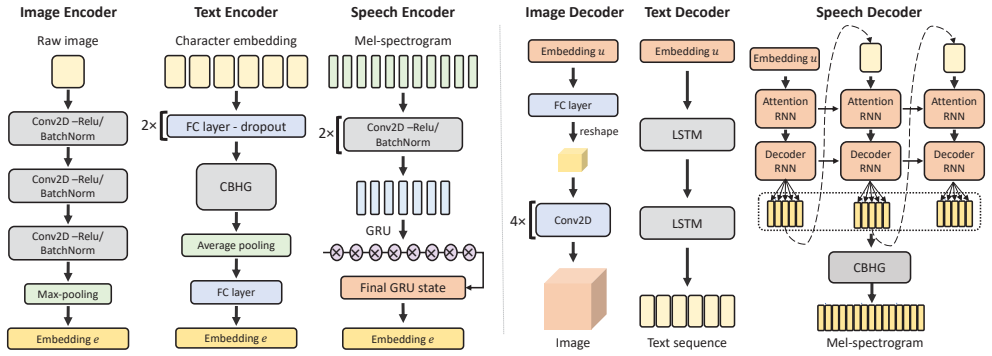
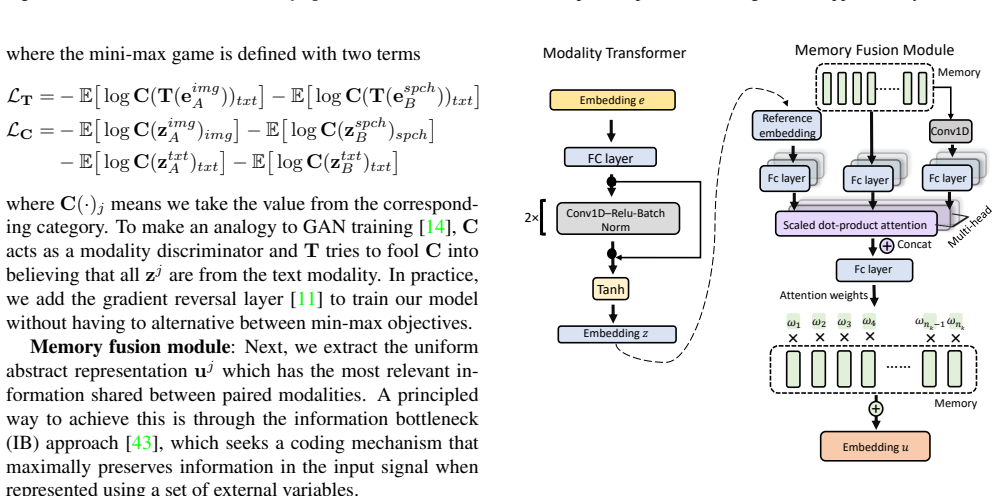
The central mechanism is the multimodal information bottleneck, made of a modality transformer and a memory fusion module. The modality transformer maps image and speech embeddings into a text-induced shared space, trained adversarially against a three-way modality classifier that tries to tell the modalities apart. The memory fusion module then reads from a shared external memory with multi-head scaled dot-product attention, producing a compact vector that is decoded into text, image, and speech. Cross-modal reconstruction losses force the memory to retain only content that transfers across modalities, which is what lets a speech decoder produce language driven by an image embedding it never saw during training.
What would settle it
Listen to the generated audio for an image whose caption contains a word absent from every text-to-speech training transcript; the model must garble or omit that word, so a clean and consistent pronunciation would contradict the claimed text bottleneck.
Extended reading notes
Core claim
The central claim is that a model can translate an image into speech without ever seeing an image-speech pair, provided a text corpus is paired with both modalities. During training, the model solves two cross-modal tasks through a shared bottleneck, so the bottleneck learns a modality-agnostic representation of the content rather than any single modality's surface detail. At test time, an image embedding is pushed through the same bottleneck and fed to the speech decoder. The paper reports that this produces recognizable speech describing the image, with a word error rate of 3.9 against 4.1 for a chained image-to-text-to-speech pipeline and 12.1 for a direct unpaired-translation baseline, and that removing either bottleneck component degrades every task. The same model also improves the underlying image-to-text and speech-to-text tasks, which the authors interpret as a data-efficiency gain.
Load-bearing premise
The shared text space must contain every meaning that needs to cross between image and speech, so any visual concept with no word in the speech corpus is unreachable.
Editorial extensions
If this is right
- Any two datasets that share one modality can be fused into a skip-modal translator, so new cross-modal tasks become available without collecting new paired data.
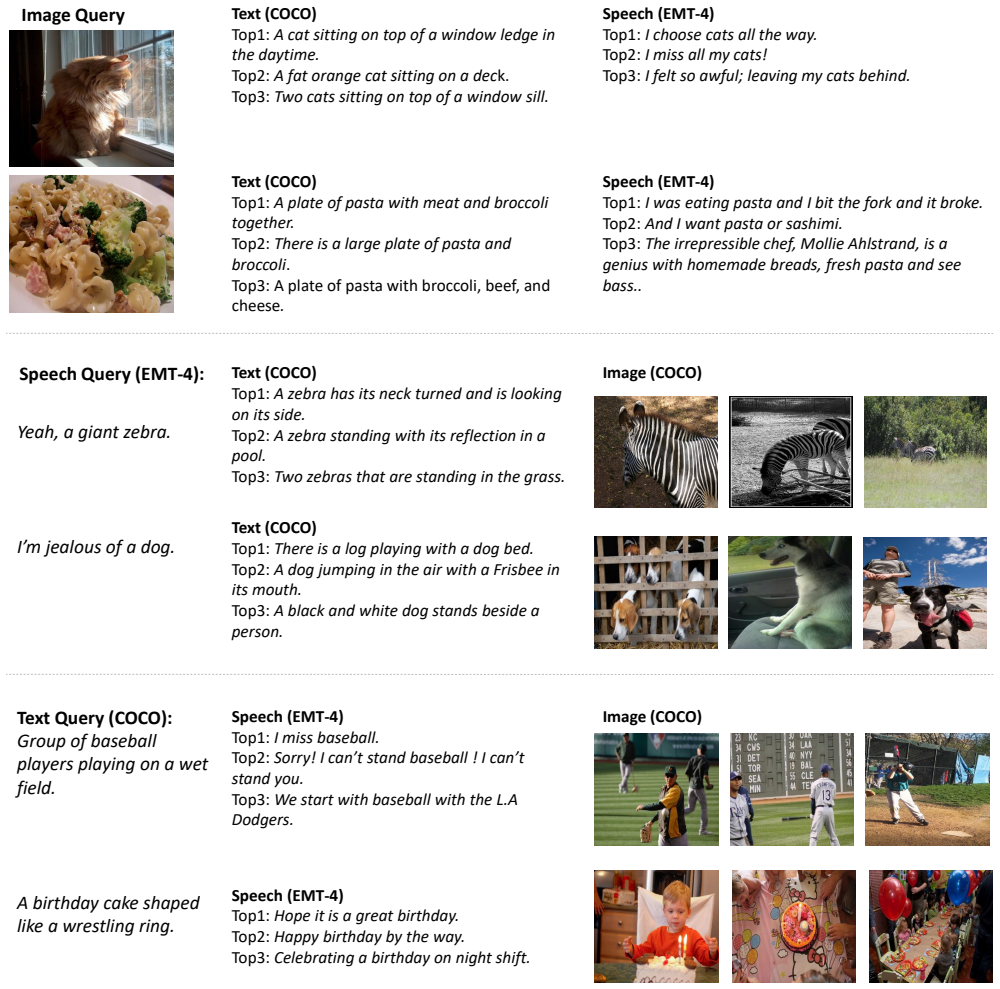
- The same bottleneck vector can drive multiple decoders, which makes combined synthesis and retrieval possible in one model; the appendix shows cross-modal retrieval examples between the two datasets.
- Training on a mixture of paired datasets improves the individual image-to-text and speech-to-text tasks compared to training each task alone, suggesting a data-efficiency gain.
- The quality of synthesized speech is capped by the shared text vocabulary: out-of-vocabulary words are the observed failure mode, so enlarging the shared corpus should directly enlarge what can be spoken.
Reading between the lines
- Unstated but testable: spoken vocabulary should scale with the vocabulary overlap between the two datasets, since the observed failures all involve out-of-vocabulary words.
- Unstated but plausible: replacing the character-level text space with a phoneme or semantic-embedding space would retain the bottleneck effect while softening the vocabulary-mismatch failure.
- Not attempted here: swapping the decoders should yield speech-to-image synthesis, because the appendix's cross-modal retrieval shows the bottleneck retains image-relevant content.
- A quantitative prediction: because the memory dimension is the most sensitive hyperparameter, increasing memory size should disproportionately improve fine-grained attributes such as colors, counts, and spatial relations.
Signed reviews
Editorial analysis
A structured set of objections, weighed in public.
Referee Report
Summary. The manuscript introduces skip-modal generation, a setting in which an instance from modality A is translated to modality C without paired A-C data by leveraging two datasets (A-B and B-C) that share an intermediate modality B. The concrete demonstration is image-to-speech synthesis using COCO image-text pairs and an in-house text-speech dataset EMT-4, with text as the shared modality. The proposed architecture consists of modality-specific encoders/decoders and a multimodal information bottleneck (MIB) formed by a modality transformer and a memory fusion module. The model is trained end-to-end with cross-modal reconstruction losses and an adversarial modality classifier. Experiments report qualitative and quantitative results on image-to-speech synthesis, image-to-text, speech-to-text, and text-to-speech, plus ablation studies. The paper claims state-of-the-art or competitive performance on the standard tasks and the first reported image-to-speech synthesis results.
Significance. The problem formulation is genuinely novel and potentially useful: it offers a way to synthesize between modalities without paired data by reusing existing datasets, and the shared-memory architecture is simple and interpretable. The paper ships a code URL and reports a substantial set of experiments, including ablations. If the quantitative claims survive a corrected evaluation, the contribution would be a solid empirical advance in multimodal representation learning. However, the current quantitative evidence for the headline task is not interpretable as written (the cited ASR model is not an ASR), and the human study is too small and insufficiently analyzed. The paper is therefore a conditional contribution: the core idea is defensible, but the evidence must be repaired.
major comments (4)
- [§4.1, Table 1; §4.2, Table 3 (right)] The reported evaluations use "a pretrained ASR model based on WaveNet [44]", but reference [44] (van den Oord et al., WaveNet: A generative model for raw audio) is a text-to-speech model, not a speech recognizer, so the BLEU and WER numbers in Tables 1 and 3 cannot be computed from it as described. The authors must identify the actual speech recognizer used, specify its version and pretraining data, validate it on EMT-4 and on the synthesized audio, and rerun the evaluations under that protocol. As published, the quantitative support for the headline image-to-speech comparison and for the text-to-speech comparison is uninterpretable.
- [§4.1, human evaluation] The human study uses only seven judges on twenty samples (140 evaluations), reports means with standard deviations between 27.6% and 35.7%, and provides no confidence intervals, per-sample agreement, or significance tests. The claim that "subjects picked ours three times more frequently" is therefore not statistically supported. The authors should report the full per-sample preference matrix, inter-judge agreement, and a paired significance test (e.g., Wilcoxon signed-rank or a bootstrap) against each baseline.
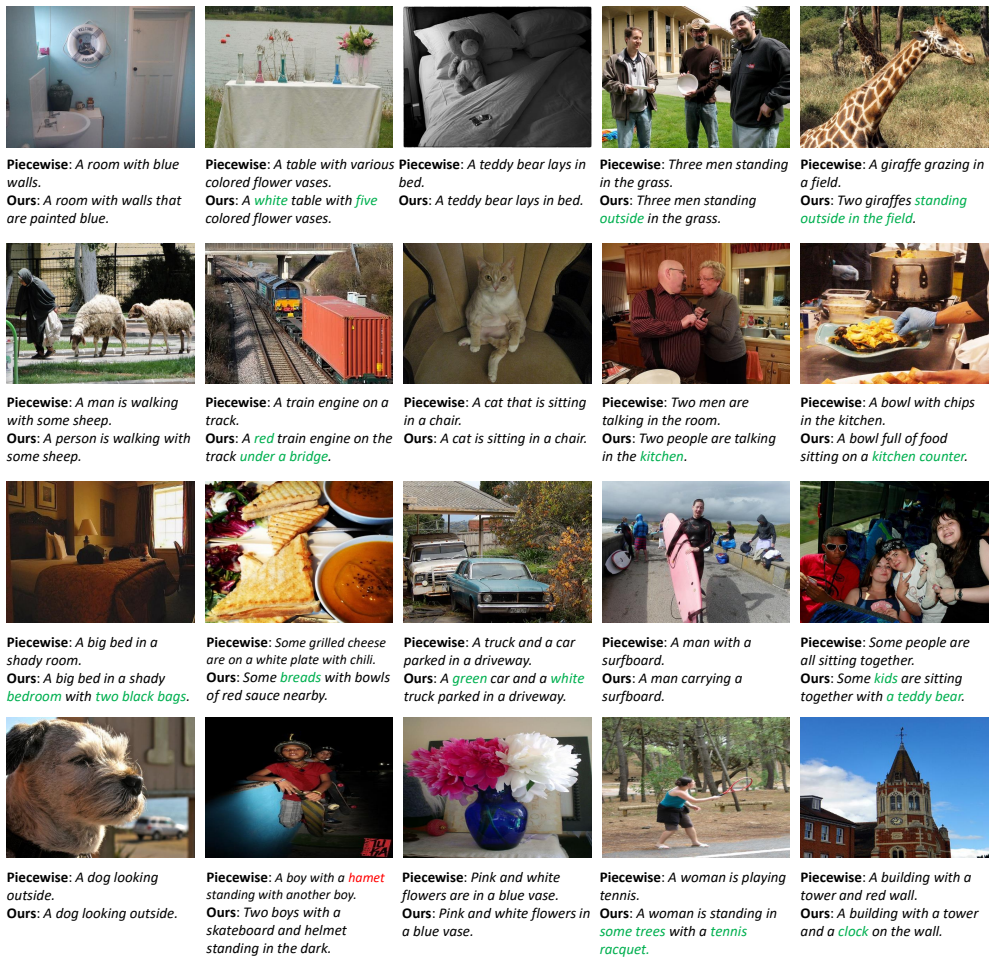
- [§4.1, vocabulary overlap] The paper notes that the COCO and EMT-4 vocabularies overlap by only 26%, so many COCO captions contain words unseen by the speech decoder during training, and the qualitative results show pronunciation failures for words such as 'berries' and 'grapes'. This limitation is acknowledged, but the paper still draws an unqualified "image-to-speech synthesis" conclusion. The authors should quantify the fraction of the COCO test set expressible in the shared vocabulary, report results separately for in-vocabulary and out-of-vocabulary content, and make the scope of the claim precise.
- [§3.2, Eq. (2)-(7)] The term "information bottleneck" is used as the name of the memory fusion module, but no information-theoretic quantity is optimized or measured: the training objective in Eq. (7) contains reconstruction and adversarial losses, not an IB Lagrangian such as I(X;Z) - beta*I(Z;Y), and Eq. (2) is only an attention-weighted sum of memory vectors. The bottleneck effect is architectural, arising from the fixed memory dimension and the shared memory. The authors should either provide a formal connection to the information bottleneck method or revise the terminology to "bottlenecked multimodal representation" so that the theoretical framing matches what is actually implemented.
minor comments (5)
- [§4.2 vs. Appendix §6.1] The text says the image encoder uses a "3-layer CNN" (Section 4.2), but the appendix lists four Conv2D layers before the max-pooling; please reconcile this description.
- [References] References [2] and [3] are identical, and [34] and [35] are also identical; consolidate the duplicate entries.
- [§4.1, Figure 5] The color legend for Figure 5 is hard to apply to the inline transcripts; please make the colored words explicit in the figure itself and provide the audio files in the supplement so readers can verify the transcriptions.
- [§4.1, quantitative evaluation] The paper should report the number of test images, the number of generated speech samples, and the variance of BLEU/WER across samples or across caption annotations; none of these are currently given.
- [§3.4, Eq. (7)] The adversarial weight alpha=0.1 is stated in the text, but the paper does not report sensitivity to alpha; a brief ablation or a sentence justifying the fixed value would increase confidence in the results.
Circularity Check
No significant circularity: the derivation is self-contained; the WaveNet ASR citation is an evaluation-validity defect, not a circular dependency.
full rationale
I walked the claimed derivation chain. The model is trained on reconstruction losses over disjoint datasets (Eqs. 3-6): images are reconstructed from text embeddings, speech from text embeddings, and text from image or speech embeddings. Image-to-speech inference is a compositional generation path that passes an image embedding through the modality transformer, the memory fusion module, and the speech decoder; it is not a prediction that is equivalent to a fitted input. The term 'information bottleneck' is used as an interpretation of the shared memory/attention module, but no information-theoretic quantity is derived from or fitted to the target evaluation, so there is no self-definitional step. The quantitative image-to-speech evaluation does rely on 'a pretrained ASR model based on WaveNet [44]', and WaveNet is a raw-audio text-to-speech model, not an ASR system; this is a serious reproducibility and validity defect that makes Table 1 and the text-to-speech WER numbers uninterpretable, but it is an external evaluation instrument rather than an input to training, so it is not circularity. The only self-citation, reference [27] in the related-work section, is not load-bearing. Therefore the paper receives a circularity score of 0.
Assumptions & free parameters
free parameters (3)
- alpha (adversarial loss weight) =
0.1
- n_k (number of memory basis vectors) =
128
- d_k (dimension of each memory basis vector) =
256
assumptions (3)
- domain assumption Text is a sufficient shared modality to bridge image and speech content.
- domain assumption The two datasets share enough semantic overlap to learn cross-modal correspondence.
- ad hoc to paper The memory fusion module implements an information bottleneck as defined by Tishby et al.
Cite this review
Pith. "Pith review of Unpaired Image-to-Speech Synthesis with Multimodal Information Bottleneck." pith.science (2026). https://pith.science/paper/FZ2NKRGG
@misc{pith2026190807094,
  author       = {Pith},
  title        = {Pith review of: Unpaired Image-to-Speech Synthesis with Multimodal Information Bottleneck},
  year         = {2026},
  howpublished = {\url{https://pith.science/paper/FZ2NKRGG}},
  note         = {Machine review of arXiv:1908.07094}
}
read the original abstract
Deep generative models have led to significant advances in cross-modal generation such as text-to-image synthesis. Training these models typically requires paired data with direct correspondence between modalities. We introduce the novel problem of translating instances from one modality to another without paired data by leveraging an intermediate modality shared by the two other modalities. To demonstrate this, we take the problem of translating images to speech. In this case, one could leverage disjoint datasets with one shared modality, e.g., image-text pairs and text-speech pairs, with text as the shared modality. We call this problem "skip-modal generation" because the shared modality is skipped during the generation process. We propose a multimodal information bottleneck approach that learns the correspondence between modalities from unpaired data (image and speech) by leveraging the shared modality (text). We address fundamental challenges of skip-modal generation: 1) learning multimodal representations using a single model, 2) bridging the domain gap between two unrelated datasets, and 3) learning the correspondence between modalities from unpaired data. We show qualitative results on image-to-speech synthesis; this is the first time such results have been reported in the literature. We also show that our approach improves performance on traditional cross-modal generation, suggesting that it improves data efficiency in solving individual tasks.
Figures


Figures from the paper (5 more)


Reference graph
Works this paper leans on
-
[44]
Wavenet: A generative model for raw audio
Aron van den Oord, Sander Dieleman, Heiga Zen, Karen Si- monyan, Oriol Vinyals, Alexander Graves, Nal Kalchbren- ner, Andrew Senior, and Koray Kavukcuoglu. Wavenet: A generative model for raw audio. arXiv preprint arXiv:1609.03499, 2016
arXiv 2016
-
[1]
Deep speech 2: End-to-end speech recognition in english and mandarin
Dario Amodei et al. Deep speech 2: End-to-end speech recognition in english and mandarin. In ICML, 2016
work page 2016
-
[3]
Bottom-up and top-down attention for image captioning and visual question answering
Peter Anderson, Xiaodong He, Chris Buehler, Damien Teney, Mark Johnson, Stephen Gould, and Lei Zhang. Bottom-up and top-down attention for image captioning and visual question answering. In CVPR, 2018
2018
-
[4]
Deep voice: Real-time neural text-to-speech
Sercan ¨Omer Arik, Mike Chrzanowski, Adam Coates, Greg Diamos, Andrew Gibiansky, Yongguo Kang, Xian Li, John Miller, Jonathan Raiman, Shubho Sengupta, and Mohammad Shoeybi. Deep voice: Real-time neural text-to-speech. In ICML, 2017
work page 2017
-
[5]
One-sided unsupervised do- main mapping
Sagie Benaim and Lior Wolf. One-sided unsupervised do- main mapping. In NIPS, 2017
work page 2017
-
[6]
Xinlei Chen, Hao Fang, Tsung-Yi Lin, Ramakrishna Vedan- tam, Saurabh Gupta, Piotr Doll ´ar, and C. Lawrence Zitnick. Microsoft COCO captions: Data collection and evaluation server. CoRR, abs/1504.00325, 2015
arXiv 2015
-
[7]
Weiss, Kanishka Rao, Katya Gonina, Navdeep Jaitly, Bo Li, Jan Chorowski, and Michiel Bacchiani
Chung-Cheng Chiu, Tara Sainath, Yonghui Wu, Rohit Prab- havalkar, Patrick Nguyen, Zhifeng Chen, Anjuli Kannan, Ron J. Weiss, Kanishka Rao, Katya Gonina, Navdeep Jaitly, Bo Li, Jan Chorowski, and Michiel Bacchiani. State-of-the- art speech recognition with sequence-to-sequence models. In ICASSP, 2018
work page 2018
-
[8]
Learning phrase representations using rnn encoder-decoder for statistical machine translation
Kyunghyun Cho, Bart Van Merri ¨enboer, Caglar Gulcehre, Dzmitry Bahdanau, Fethi Bougares, Holger Schwenk, and Yoshua Bengio. Learning phrase representations using rnn encoder-decoder for statistical machine translation. In EMNLP, 2014
work page 2014
Show all 68 references
-
[9]
StarGAN: Unified gener- ative adversarial networks for multi-domain image-to-image translation
Yunjey Choi, Min-Je Choi, Munyoung Kim, Jung-Woo Ha, Sunghun Kim, and Jaegul Choo. StarGAN: Unified gener- ative adversarial networks for multi-domain image-to-image translation. In CVPR, 2018
2018
-
[10]
J. Deng, W. Dong, R. Socher, L. Li, Kai Li, and Li Fei- Fei. Imagenet: A large-scale hierarchical image database. In 2009 IEEE Conference on Computer Vision and Pattern Recognition, 2009
2009
-
[11]
Unsupervised domain adaptation by backpropagation
Yaroslav Ganin and Victor Lempitsky. Unsupervised domain adaptation by backpropagation. In ICML, 2015
2015
-
[12]
Auditory-visual inte- gration during multimodal object recognition in humans: a behavioral and electrophysiological study
Marie H Giard and Franck Peronnet. Auditory-visual inte- gration during multimodal object recognition in humans: a behavioral and electrophysiological study. Journal of cogni- tive neuroscience, 11(5):473–490, 1999
1999
-
[13]
Deep voice 2: Multi-speaker neural text-to-speech
Andrew Gibiansky, Sercan Arik, Gregory Diamos, John Miller, Kainan Peng, Wei Ping, Jonathan Raiman, and Yanqi Zhou. Deep voice 2: Multi-speaker neural text-to-speech. In NIPS, 2017
2017
-
[14]
Generative adversarial nets
Ian Goodfellow, Jean Pouget-Abadie, Mehdi Mirza, Bing Xu, David Warde-Farley, Sherjil Ozair, Aaron Courville, and Yoshua Bengio. Generative adversarial nets. In NIPS. 2014
2014
-
[15]
Griffin and Jae Lim
D. Griffin and Jae Lim. Signal estimation from modified short-time fourier transform. IEEE Transactions on Acous- tics, Speech, and Signal Processing, 1984
1984
-
[16]
K. He, X. Zhang, S. Ren, and J. Sun. Deep residual learning for image recognition. In 2016 IEEE Conference on Com- puter Vision and Pattern Recognition (CVPR), 2016
2016
-
[17]
Deep neural networks for acoustic modeling in speech recognition
Geoffrey Hinton, Li Deng, Dong Yu, George Dahl, Abdel- rahman Mohamed, Navdeep Jaitly, Andrew Senior, Vincent Vanhoucke, Patrick Nguyen, Brian Kingsbury, et al. Deep neural networks for acoustic modeling in speech recognition. Signal processing magazine, 2012
2012
-
[18]
Huang, Z
G. Huang, Z. Liu, L. v. d. Maaten, and K. Q. Weinberger. Densely connected convolutional networks. In 2017 IEEE Conference on Computer Vision and Pattern Recognition (CVPR), 2017
2017
-
[19]
Phillip Isola, Jun-Yan Zhu, Tinghui Zhou, and Alexei A. Efros. Image-to-image translation with conditional adver- sarial networks. In CVPR, 2017
2017
-
[20]
Recurrent fusion network for image captioning
Wenhao Jiang, Lin Ma, Yu-Gang Jiang, Wei Liu, and Tong Zhang. Recurrent fusion network for image captioning. In Vittorio Ferrari, Martial Hebert, Cristian Sminchisescu, and Yair Weiss, editors,ECCV, 2018
2018
-
[21]
Learning to discover cross-domain relations with generative adversarial networks
Taeksoo Kim, Moonsu Cha, Hyunsoo Kim, Jung Kwon Lee, and Jiwon Kim. Learning to discover cross-domain relations with generative adversarial networks. In ICML, 2017
2017
-
[22]
Adam: A method for stochastic optimization
Diederik P Kingma and Jimmy Ba. Adam: A method for stochastic optimization. In ICLR, 2014
2014
-
[23]
Auto-encoding varia- tional bayes
Diederik P Kingma and Max Welling. Auto-encoding varia- tional bayes. In ICLR, 2014
2014
-
[24]
Shamma, Michael S
Ranjay Krishna, Yuke Zhu, Oliver Groth, Justin Johnson, Kenji Hata, Joshua Kravitz, Stephanie Chen, Yannis Kalan- tidis, Li-Jia Li, David A. Shamma, Michael S. Bernstein, and Li Fei-Fei. Visual genome: Connecting language and vision using crowdsourced dense image annotations. ...
2017
-
[25]
Letter-based speech recognition with gated convnets
Vitaliy Liptchinsky, Gabriel Synnaeve, and Ronan Collobert. Letter-based speech recognition with gated convnets. CoRR, abs/1712.09444, 2017
2017 arXiv
-
[26]
DA-GAN: instance-level image
Shuang Ma, Jianlong Fu, Chang Wen Chen, and Tao Mei. DA-GAN: instance-level image. In CVPR, 2018
2018
-
[27]
Neural TTS styl- ization with adversarial and collaborative games
Shuang Ma, Daniel Mcduff, and Yale Song. Neural TTS styl- ization with adversarial and collaborative games. In ICLR, 2019
2019
-
[28]
Semstyle: Learning to generate stylised image captions using unaligned text
Alexander Mathews, Lexing Xie, and Xuming He. Semstyle: Learning to generate stylised image captions using unaligned text. In The IEEE Conference on Computer Vision and Pat- tern Recognition (CVPR), June 2018
2018
-
[29]
Deep multi-scale video prediction beyond mean square error
Michael Mathieu, Camille Couprie, and Yann LeCun. Deep multi-scale video prediction beyond mean square error. In ICLR, 2016
2016
-
[30]
Fitting new speakers based on a short untranscribed sample
Eliya Nachmani, Adam Polyak, Yaniv Taigman, and Lior Wolf. Fitting new speakers based on a short untranscribed sample. In ICML, 2018
2018
-
[31]
Librispeech: An ASR corpus based on public domain audio books
Vassil Panayotov, Guoguo Chen, Daniel Povey, and Sanjeev Khudanpur. Librispeech: An ASR corpus based on public domain audio books. In ICASSP , 2015. IEEE
2015
-
[32]
Attend to you: Personalized image captioning with context sequence memory networks
Cesc Chunseong Park, Byeongchang Kim, and Gunhee Kim. Attend to you: Personalized image captioning with context sequence memory networks. In CVPR, 2017
2017
-
[33]
Beyond sensory im- ages: Object-based representation in the human ventral path- way
Pietro Pietrini, Maura L Furey, Emiliano Ricciardi, M Ida Gobbini, W-H Carolyn Wu, Leonardo Cohen, Mario Guazzelli, and James V Haxby. Beyond sensory im- ages: Object-based representation in the human ventral path- way. Proceedings of the National Academy of Sciences , 101(15)...
2004
-
[35]
Arik, Ajay Kannan, Sharan Narang, Jonathan Raiman, and John Miller
Wei Ping, Kainan Peng, Andrew Gibiansky, Sercan O. Arik, Ajay Kannan, Sharan Narang, Jonathan Raiman, and John Miller. Deep voice 3: 2000-speaker neural text-to-speech. In ICLR, 2018
2000
-
[36]
Generative ad- versarial text to image synthesis
Scott Reed, Zeynep Akata, Xinchen Yan, Lajanugen Lo- geswaran, Bernt Schiele, and Honglak Lee. Generative ad- versarial text to image synthesis. In ICML, 2016
2016
-
[37]
Faster r-cnn: Towards real-time object detection with region proposal networks
Shaoqing Ren, Kaiming He, Ross Girshick, and Jian Sun. Faster r-cnn: Towards real-time object detection with region proposal networks. In C. Cortes, N. D. Lawrence, D. D. Lee, M. Sugiyama, and R. Garnett, editors, Advances in Neural Information Processing Systems 28, pages 91–99. 2015
2015
-
[38]
Weiss, Mike Schuster, Navdeep Jaitly, Zongheng Yang, Zhifeng Chen, Yu Zhang, Yuxuan Wang, R
Jonathan Shen, Ruoming Pang, Ron J. Weiss, Mike Schuster, Navdeep Jaitly, Zongheng Yang, Zhifeng Chen, Yu Zhang, Yuxuan Wang, R. J. Skerry-Ryan, Rif A. Saurous, Yannis Agiomyrgiannakis, and Yonghui Wu. Natural TTS synthe- sis by conditioning wavenet on mel spectrogram predicti...
2017 arXiv
-
[39]
Char2wav: End-to-end speech synthesis
Jose Sotelo, Soroush Mehri, Kundan Kumar, Joao Felipe Santos, Kyle Kastner, Aaron Courville, and Yoshua Bengio. Char2wav: End-to-end speech synthesis. In ICLR, work- shop, 2017
2017
-
[40]
Szegedy, Wei Liu, Yangqing Jia, P
C. Szegedy, Wei Liu, Yangqing Jia, P. Sermanet, S. Reed, D. Anguelov, D. Erhan, V . Vanhoucke, and A. Rabinovich. Going deeper with convolutions. In 2015 IEEE Conference on Computer Vision and Pattern Recognition (CVPR), 2015
2015
-
[41]
Unsupervised cross-domain image generation
Yaniv Taigman, Adam Polyak, and Lior Wolf. Unsupervised cross-domain image generation. In ICLR, 2017
2017
-
[42]
V oiceloop: V oice fitting and synthesis via a phonolog- ical loop
Yaniv Taigman, Lior Wolf, Adam Polyak, and Eliya Nach- mani. V oiceloop: V oice fitting and synthesis via a phonolog- ical loop. In ICLR, 2018
2018
-
[43]
The information bottleneck method
Naftali Tishby, Fernando C Pereira, and William Bialek. The information bottleneck method. In Allerton Conference on Communication, Control, and Computing, 1999
1999
-
[45]
Attention is all you need
Ashish Vaswani, Noam Shazeer, Niki Parmar, Jakob Uszko- reit, Llion Jones, Aidan N Gomez, Łukasz Kaiser, and Illia Polosukhin. Attention is all you need. In NIPS, 2017
2017
-
[46]
Gomez, Lukasz Kaiser, and Illia Polosukhin
Ashish Vaswani, Noam Shazeer, Niki Parmar, Jakob Uszko- reit, Llion Jones, Aidan N. Gomez, Lukasz Kaiser, and Illia Polosukhin. Attention is all you need. NIPS, 2017
2017
-
[47]
Oriol Vinyals, Lukasz Kaiser, Terry Koo, Slav Petrov, Ilya Sutskever, and Geoffrey E. Hinton. Grammar as a foreign language. NIPS, 2015
2015
-
[48]
Show and tell: A neural image caption gen- erator
Oriol Vinyals, Alexander Toshev, Samy Bengio, and Du- mitru Erhan. Show and tell: A neural image caption gen- erator. In CVPR, 2015
2015
-
[49]
Tacotron: Towards end- to-end speech synthesis
Yuxuan Wang, RJ Skerry-Ryan, Daisy Stanton, Yonghui Wu, Ron J Weiss, Navdeep Jaitly, Zongheng Yang, Ying Xiao, Zhifeng Chen, Samy Bengio, et al. Tacotron: Towards end- to-end speech synthesis. In INTERSPEECH, 2017
2017
-
[50]
Yuxuan Wang, Daisy Stanton, Yu Zhang, R. J. Skerry-Ryan, Eric Battenberg, Joel Shor, Ying Xiao, Fei Ren, Ye Jia, and Rif A. Saurous. Style tokens: Unsupervised style modeling, control and transfer in end-to-end speech synthesis. InICML, 2018
2018
-
[51]
Memory networks
Jason Weston, Sumit Chopra, and Antoine Bordes. Memory networks. In ICLR, 2015
2015
-
[52]
Courville, Ruslan Salakhutdinov, Richard S
Kelvin Xu, Jimmy Ba, Ryan Kiros, Kyunghyun Cho, Aaron C. Courville, Ruslan Salakhutdinov, Richard S. Zemel, and Yoshua Bengio. Show, attend and tell: Neural image caption generation with visual attention. In ICML, 2015
2015
-
[53]
Attngan: Fine- grained text to image generation with attentional generative adversarial networks
Tao Xu, Pengchuan Zhang, Qiuyuan Huang, Han Zhang, Zhe Gan, Xiaolei Huang, and Xiaodong He. Attngan: Fine- grained text to image generation with attentional generative adversarial networks. In CVPR, 2018
2018
-
[54]
Image captioning with semantic attention.CVPR, 2017
Quanzeng You, Hailin Jin, Zhaowen Wang, Chen Fang, and Jiebo Luo. Image captioning with semantic attention.CVPR, 2017
2017
-
[55]
Stackgan: Text to photo-realistic image synthesis with stacked genera- tive adversarial networks
Han Zhang, Tao Xu, Hongsheng Li, Shaoting Zhang, Xiaolei Huang, Xiaogang Wang, and Dimitris Metaxas. Stackgan: Text to photo-realistic image synthesis with stacked genera- tive adversarial networks. In CVPR, 2017
2017
-
[56]
Visual to sound: Generating natural sound for videos in the wild
Yipin Zhou, Zhaowen Wang, Chen Fang, Trung Bui, and Tamara L Berg. Visual to sound: Generating natural sound for videos in the wild. In CVPR, 2018
2018
-
[57]
Im- proving end-to-end speech recognition with policy learning
Yingbo Zhou, Caiming Xiong, and Richard Socher. Im- proving end-to-end speech recognition with policy learning. 2018 IEEE International Conference on Acoustics, Speech and Signal Processing (ICASSP), 2018
2018
-
[58]
J. Zhu, T. Park, P. Isola, and A. A. Efros. Unpaired image- to-image translation using cycle-consistent adversarial net- works. In 2017 IEEE International Conference on Computer Vision (ICCV), Oct 2017
2017
-
[59]
Efros, Oliver Wang, and Eli Shechtman
Jun-Yan Zhu, Richard Zhang, Deepak Pathak, Trevor Dar- rell, Alexei A. Efros, Oliver Wang, and Eli Shechtman. Toward multimodal image-to-image translation. In NIPS, 2018. Appendix
2018
-
[60]
We encour- age the readers to refer to Figure 3 and Figure 4 of our main paper when reading this section
Network Architectures and Parameter Set- tings We provide implementation details of our model with the parameter settings used in our experiments. We encour- age the readers to refer to Figure 3 and Figure 4 of our main paper when reading this section. We use the follow- ing n...
-
[61]
Define: Memory M ∈ Rnk×dk/nheads, where nk = 128,d k = 256,n heads = 4
-
[62]
Query qjzj, Key k Conv1D(256, 1, 1)(tanh(M)), Value v tanh(M)
-
[63]
(qj h, kh, vh)SplitHeads(qj, k, v), h = 1,··· ,n heads
-
[64]
αj hSoftMax ( qj hkh/√dk ) ,h = 1,··· ,n heads
-
[65]
uj hαj h× vh,h = 1,··· ,n heads
-
[66]
uj ConcatHeads(uj h) 6.3. Decoders (Figure 3 (right) in the main paper) • Image decoder: utxt→ Conv2D⊺(32, 4, 2) → BN → ReLU→ Conv2D⊺(16, 4, 2) → BN→ ReLU→ Conv2D⊺(8, 4, 2)→ BN→ ReLU→ Conv2D⊺(8, 4, 2)→ tanh→ yimg • Text decoder: uimg→ Dropout(LSTM(128), 0.3)→ Dropout(LSTM(128)...
-
[68]
Skip-Modal Synthesis Results Figure 7 shows additional image-to-speech synthesis re- sults; we manually transcribed the synthesized audio out- puts for the purpose of presentation. Consistent with the qualitative results reported in the main paper (Figure 5), we see that our a...
-
[69]
dog” and “zebra
Cross-Modal Retrieval Results Besides the synthesis tasks, another way to evaluate the performance of our model is via cross-modal retrieval. In this section, we show qualitative results of cross-modal re- trieval where we use an instance from either dataset and find the most s...
-
[70]
bottleneck
Additional Ablation Experiments 9.1. Different Batch Sampling Strategies As we trained our model on a combination of two datasets, there comes two ways to perform mini-batch train- Piecewise: A room with blue walls. Ours: A room with walls that are painted blue. Piecewise: A t...
-
[256]
→ DecoderRNN6(Dropout(LSTM(256), 0.3) → Dropout(LSTM(256), 0.3)) → reshape → ymel−spectrogram → CBHG [49] (80 mels) → FC(1025)→ Griffin-Lim (ylinear)→ yspeech
Reviewed August 14, 2026 · model on record in the stance chip above.
Discussion (0). Continue with ORCID to comment.