REVIEW 3 major objections 4 minor 9 references
Alliances and Conflict, or Conflict and Alliances? Appraising the Causal Effect of Alliances on Conflict
T0 review · 3 major / 4 minor · reviewed 2026-08-14 · deepseek-v4-flash
Pith's one-line read The paper claims that once alliance formation is modeled jointly with conflict, a target's relevant defensive alliance commitment neither deters nor provokes a challenger, with an estimated average treatment effect of -0.016 (95% CI…
desk verdict A serious, readable empirical challenge to the alliance-deterrence consensus, but the null result leans entirely on an unvalidated infant-mortality exclusion restriction and a predictive comparison that does not isolate the endogeneity correction. read the letter →
The pith
A machine-rendered reading of the paper's core claim, the machinery that carries it, and where it could break.
The reading
What carries the argument
The carrying mechanism is the generalized joint regression model (GJRM): a recursive bivariate probit in which the first equation predicts whether the target has a relevant defensive commitment and the second predicts whether a challenger initiates a dispute. A copula—a function linking the two equations' unobserved errors, chosen here as the 180-degree rotated Clayton—lets the same unmeasured factors influence both alliance formation and conflict, which is the channel that the paper says accounts for the apparent deterrent effect. The alliance equation also includes two instruments: the target's infant mortality rate and its one-year change, both used to satisfy the exclusion restriction.
What would settle it
A credible demonstration that infant mortality or its short-run change has a direct effect on interstate dispute initiation—through, say, state weakness or diversionary incentives—after conditioning on GDP per capita and civil conflict would break the exclusion restriction and leave the null average treatment effect unidentified.
Extended reading notes
Core claim
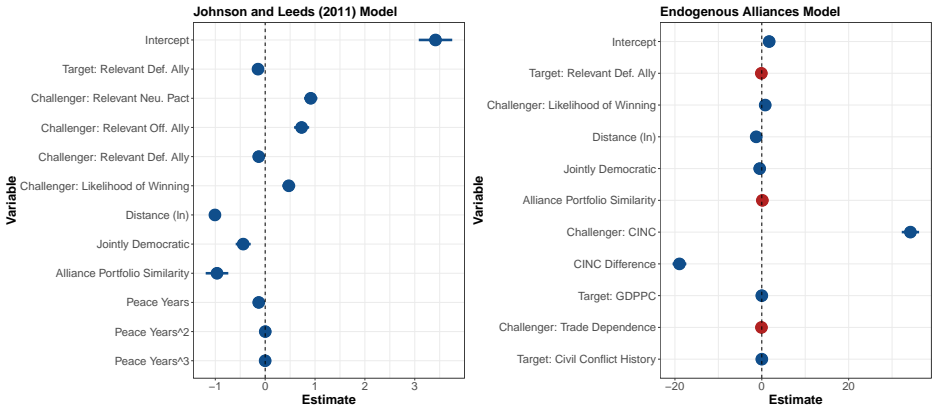
The paper's central claim is that, once the endogeneity of alliance formation is accounted for, a target's relevant defensive alliance commitment neither deters nor provokes a challenger. In a bivariate recursive probit model estimated on directed-dyad years 1816-2000, the average treatment effect of the defensive commitment on dispute initiation is -0.016 with a 95% credible interval [-0.053, 0.016], materially smaller than the roughly 20% reduction reported by prior exogenous models. The paper attributes the difference to unobserved confounders—offensive intention, ally reliability, and burden sharing—that make states with high conflict risk more likely to form alliances, so apparent deterrence is selection. It interprets the null as the causal effect of alliance commitments once these confounders are accounted for.
Load-bearing premise
The result stands or falls on the assumption that a target's infant mortality rate affects whether it is attacked only by changing its alliance choices, after taking GDP per capita and civil conflict into account.
Editorial extensions
If this is right
- The conventional finding that defensive alliances cut the probability of being attacked by about 20 percent is not reproduced when alliance formation is endogenous; the estimated effect is 1.6 percent and statistically indistinguishable from zero.
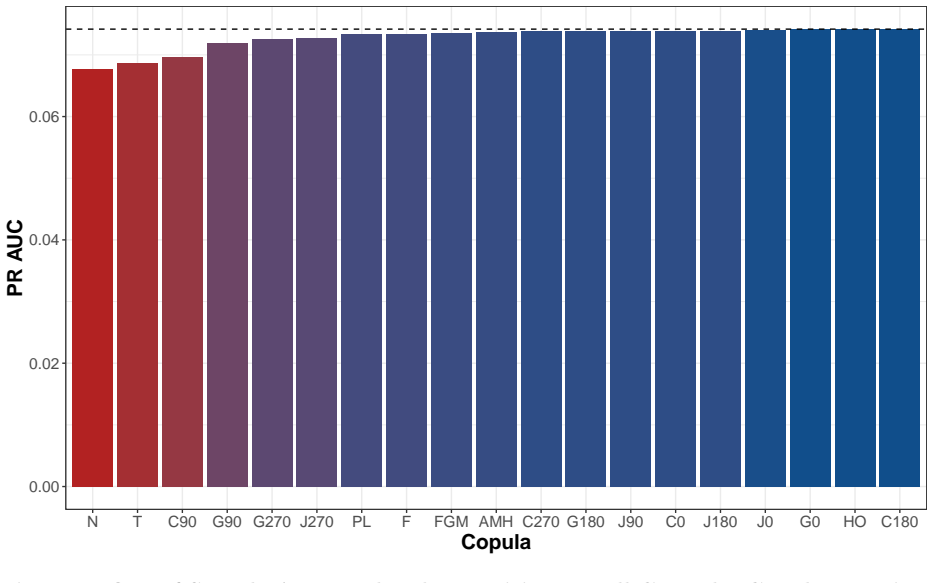
- The null result is robust across copula choices: 18 of 19 specifications yield null or provocation effects, and only the poorly fitting Student-t copula recovers deterrence.
- Models that endogenize alliance formation predict militarized disputes better than the exogenous benchmark, improving out-of-sample precision-recall by 57.4 percent.
- Alliance formation and conflict initiation should be modeled as one joint process, since conflict expectations shape alliance choices and alliances may then shape conflict.
- Research should shift from asking whether alliances deter to identifying moderating conditions under which particular commitments deter or provoke.
Reading between the lines
- If the null is correct, past correlational evidence for deterrence mostly documented selection: threatened states form alliances, and those same threats predict attack; policy claims that alliances reliably buy security need re-examination.
- The exclusion-restriction strategy could be stress-tested with different instruments tapping public-goods pressure, such as disease burden or schooling enrollment; a second independent instrument producing the same null would strengthen the case.
- A null average effect does not mean alliances are useless; their benefits may appear in non-conflict domains such as autonomy, domestic survival, or postwar management, which are not measured here.
- The copula results imply a common unobserved factor raises both alliance formation and conflict; identifying that factor empirically could replace instrumental-variable reliance with direct measurement.
Signed reviews
Editorial analysis
A structured set of objections, weighed in public.
Referee Report
Summary. The paper challenges the conventional finding that defensive alliances deter militarized conflict. The author argues that alliance formation is endogenous to the security environment and conflict expectations, and models this with a recursive bivariate probit 'generalized joint regression model' using the target's infant mortality rate and its change as instruments for the target's relevant defensive alliance commitment. The central empirical result is an average treatment effect of -0.016 with a 95% credible interval [-0.053, 0.016], which is interpreted as evidence that alliances neither deter nor provoke aggression. The paper also reports that the joint model outperforms a standard Johnson-Leeds logistic regression in precision-recall AUC and that the null result is robust to alternative copula specifications.
Significance. If the causal identification were credible, the paper would be a significant challenge to a prominent finding in international relations: that explicitly relevant defensive commitments deter attack. The manuscript has genuine strengths: it takes the endogeneity of alliances seriously, uses instruments borrowed from prior published work, reports an ATE with a credible interval, and includes a sensitivity analysis over nineteen copulas. The out-of-sample predictive comparison is useful descriptive evidence. However, the central claim rests on an untestable exclusion restriction, and the predictive comparison does not isolate the role of endogenizing alliances. The significance of the paper is therefore conditional on whether the identification strategy can be defended more convincingly or the claims appropriately weakened.
major comments (3)
- [Section 4.1, 'Modeling Alliance Formation'] The identification of the alliance ATE rests entirely on the exclusion restriction that the target's infant mortality rate and its change affect the challenger's conflict initiation only through the target's defensive alliance commitments, after conditioning on target GDP per capita and civil conflict history. The support offered in the text — 'I find no published evidence of a direct relationship' — is an appeal to an absence of documentation rather than a design-based or statistical justification. Infant mortality is a broad proxy for state capacity, public health, demographic structure, and fragility; these dimensions are not fully blocked by GDP per capita and civil conflict history, and those two controls are themselves potentially endogenous. If infant mortality directly raises the probability that a challenger attacks a fragile target while also increasing the target's propensity to ally, the estimated alliance coefficient is contaminated by a direct instrument-to-outcome path. Because the recursive bivariate probit is identified by these instruments alone, this concern is load-bearing for the null ATE.
- [Section 5, 'Predictive performance' and Figure 4] The claim that endogenizing alliances improves predictive performance is not supported by the reported comparison. The Johnson and Leeds (2011) baseline and the GJRM differ in their covariate sets: the GJRM adds target GDP per capita, target civil-conflict history, challenger trade dependence, and a peace-years spline, among other differences. The 57–59% PR-AUC improvement in Figure 4 therefore cannot be attributed to modeling alliance endogeneity. The conclusion in Section 6 that 'endogenizing... improves our ability to predict' requires either a nested comparison with identical covariate sets or a decomposition of the performance gain.
- [Section 5, 'Average treatment effect' and Section 6] The conclusion that alliances 'neither deter nor provoke aggression' is stronger than the evidence. The estimated ATE is -0.016 with 95% credible interval [-0.053, 0.016]; a null result with this interval cannot establish equivalence or the absence of substantively meaningful effects. The paper itself notes in Section 5 that the result is 'not definitive,' but the abstract and conclusion use language of a definitive null. Equivalence testing, a sensitivity analysis to unobserved confounding, or bounds on plausible effect sizes would be needed to support the strong conclusion.
minor comments (4)
- [Section 4.1] The phrase 'Infant morality rate' should read 'infant mortality rate.'
- [Section 5, 'Copula selection'] The definitions of precision and recall are garbled: precision is TP/(TP+FP) and recall is TP/(TP+FN), but the text appears to reverse or confuse these quantities. This should be corrected because the PR-AUC comparisons rely on these definitions.
- [Section 4.1 and Section 5] The instruments are described as strong based on chi-square and likelihood-ratio tests, but no first-stage coefficient table is presented. Including a table with the first-stage estimates and standard errors would clarify the strength and sign of the instrument-alliance relationship.
- [Section 5] The predictive comparison between the Johnson-Leeds model and the GJRM may also be affected by differences in estimation samples (e.g., due to missing GDP or trade data). The paper should report the number of observations used in each model and any sample restrictions.
Circularity Check
No significant circularity: the null ATE is estimated rather than imposed, and no load-bearing claim reduces to its own inputs.
full rationale
The paper's central claim is that a target's relevant defensive alliance commitment has no average causal effect on challenger dispute initiation once alliance formation is treated as endogenous. The claim is not built into the model: the conflict equation includes the defensive-commitment variable as a freely estimated regressor, and the reported ATE of -0.016 with 95% interval [-0.053, 0.016] is a posterior simulation quantity, not a constrained zero. The identifying instruments (infant mortality and its change) are taken from Kimball (2010) and used only in the alliance-formation equation; whether they satisfy the exclusion restriction is an identifying assumption, not a definitional identity. The data-driven copula selection is performed on out-of-sample PR-AUC, but the null result is shown to hold across nearly all of the 19 copulas examined (Figures 5 and 6), so the central inference does not depend on the selected Clayton rotation. The only self-citation, Campbell, Cranmer and Desmarais (2018), is used to justify PR-AUC as a metric for rare events and is not load-bearing for the causal estimate. There is no equation in which the outcome is defined in terms of the treatment, no fitted parameter renamed as a prediction, and no uniqueness claim imported from the author's own prior work. The derivation chain is therefore self-contained in the relevant sense; concerns about instrument validity belong to a robustness or exclusion-restriction critique, not to circularity.
Assumptions & free parameters
assumptions (5)
- domain assumption The infant mortality instruments satisfy the exclusion restriction: after conditioning on target GDP per capita and civil conflict history, they affect conflict only through alliance formation.
- domain assumption Unobserved confounders linking alliance formation and conflict are captured by the copula dependence between the two equations' errors.
- domain assumption The bivariate recursive probit with the selected copula correctly specifies the joint distribution of alliance formation and conflict.
- domain assumption The directed-dyad-year sample is a census, so there is no sample selection bias.
- domain assumption Dyad-year observations are independent; alliances or conflicts in one dyad do not directly alter the treatment or outcome in another dyad.
Cite this review
Pith. "Pith review of Alliances and Conflict, or Conflict and Alliances? Appraising the Causal Effect of Alliances on Conflict." pith.science (2026). https://pith.science/paper/SMWJZ5GB
@misc{pith2026190807100,
  author       = {Pith},
  title        = {Pith review of: Alliances and Conflict, or Conflict and Alliances? Appraising the Causal Effect of Alliances on Conflict},
  year         = {2026},
  howpublished = {\url{https://pith.science/paper/SMWJZ5GB}},
  note         = {Machine review of arXiv:1908.07100}
}
read the original abstract
The deterrent effect of military alliances is well documented and widely accepted. However, such work has typically assumed that alliances are exogenous. This is problematic as alliances may simultaneously influence the probability of conflict and be influenced by the probability of conflict. Failing to account for such endogeneity produces overly simplistic theories of alliance politics and barriers to identifying the causal effect of alliances on conflict. In this manuscript, I propose a solution to this theoretical and empirical modeling challenge. Synthesizing theories of alliance formation and the alliance-conflict relationship, I innovate an endogenous theory of alliances and conflict. I then test this theory using innovative generalized joint regression models that allow me to endogenize alliance formation on the causal path to conflict. Once doing so, I ultimately find that alliances neither deter nor provoke aggression. This has significant implications for our understanding of interstate conflict and alliance politics.
Figures

Figures from the paper (4 more)


Reference graph
Works this paper leans on
-
[5]
Alliance treaty obligations and provisions, 1815-1944
“Alliance treaty obligations and provisions, 1815-1944.” International Interactions 28(3):237–260. Lemke, Douglas and William Reed
work page 1944
-
[1972]
Capability distribution, uncertainty, and major power war, 1820-1965
“Capability distribution, uncertainty, and major power war, 1820-1965.” Peace, war, and numbers 19:48. Slantchev, Branislav L
work page 1965
-
[1976]
“Alliances, 1815-1945: Weapons of Power and Tools of Management’, Histor- ical Dimensions of National Security Problems, K.” Knorr (ed.),(Lawrence, Kan.,
work page 1945
-
[1981]
Alliance formation and war behavior: An analysis of the great powers, 1495-1975
“Alliance formation and war behavior: An analysis of the great powers, 1495-1975.” Journal of Conflict Resolution pp. 581–613. Liska, George
work page 1975
-
[1992]
Dangerous dyads: Conditions affecting the likelihood of interstate war, 1816-1965
“Dangerous dyads: Conditions affecting the likelihood of interstate war, 1816-1965.” Journal of Conflict Resolution 36(2):309–341. Bueno de Mesquita, Bruce
work page 1965
-
[1993]
Normative and structural causes of democratic peace, 1946–1986
“Normative and structural causes of democratic peace, 1946–1986.” American Political Science Review 87(3):624–638. Marra, Giampiero and Rosalba Radice
work page 1946
-
[2000]
Democracy, political similarity, and international alliances, 1816-1992
“Democracy, political similarity, and international alliances, 1816-1992.” Journal of Conflict Resolution 44(2):203–227. Leeds, Brett Ashley. 2003 a. “Alliance reliability in times of war: Explaining state decisions to violate treaties.” International Organization 57(4):801–827. Leeds, Brett Ashley. 2003b. “Do alliances deter aggression? The influence of mi...
work page 1992
-
[2002]
Armed conflict 1946-2001: A new dataset
“Armed conflict 1946-2001: A new dataset.” Journal of peace research 39(5):615–
work page 1946
Show all 9 references
-
[2018]
Triangulating War: Network Structure and the Democratic Peace
“Triangulating War: Network Structure and the Democratic Peace.” arXiv preprint arXiv:1809.04141 . Cranmer, Skyler J and Bruce A Desmarais
Reviewed August 14, 2026 · model on record in the stance chip above.
Discussion (0). Continue with ORCID to comment.