REVIEW 3 major objections 5 minor 5 references
Energy-Efficient Cooperative Caching in UAV Networks
T0 review · 3 major / 5 minor · reviewed 2026-08-14 · deepseek-v4-flash
Pith's one-line read This paper argues that two lightweight content-placement algorithms, RSHR and MPRC, can raise the energy efficiency of UAV-aided fog radio access networks by up to 800% relative to standard caching schemes, and that vertical drone…
desk verdict A plausible first cut at joint caching and UAV height optimization for EE, but the headline gains rest on an untested independence assumption and the text is too corrupted to verify the math. read the letter →
The pith
A machine-rendered reading of the paper's core claim, the machinery that carries it, and where it could break.
The reading
What carries the argument
The load-bearing object is the analytically tractable energy-efficiency expression derived in Proposition 1 via stochastic geometry: the average rate delivered to a typical user divided by the aggregate energy consumption per UAV, obtained by computing Laplace transforms of signal and interference powers under a probabilistic LOS/NLOS air-to-ground channel model with Nakagami fading and log-normal shadowing. This expression makes the objective function of the joint content-placement and altitude optimization evaluable in closed form as a function of UAV density, cooperation radius, cache size, and environmental parameters. On top of it, the paper builds RSHR, which recursively scales hit-rate probabilities by a soft-max of each content's achieved energy efficiency, and MPRC, which splits the cache between most-popular and randomized less-popular contents.
What would settle it
Use a ray-tracing simulator or field measurement of a small drone swarm over an urban area to record the joint distribution of LOS indicators across links; if the empirical correlation of LOS states within the cooperation zone is materially nonzero, recomputing the EE expression with the correct dependence would move the predicted gains, and if the measured EE improvement over LRU falls far short of 800% at the paper's operating point, the independence assumption fails.
Extended reading notes
Core claim
For a UAV-enabled Fog-RAN in which drones cooperatively transmit cached contents to users, the energy efficiency of the network is a function that can be tuned through two levers: the probabilistic assignment of contents to caches and the vertical altitude at which drones hover. The paper solves a joint cache-placement and altitude-optimization problem numerically and shows that a recursive scaled hit-rate scheme (RSHR) and a mixed popular-randomized caching scheme (MPRC) outperform LRU, most-popular, and hit-rate baselines by up to 800% in energy efficiency. Vertical displacement of drones yields as much as a 600% energy-efficiency gain under these schemes but none under LRU or hit-rate caching. The paper further establishes that an optimal UAV density and an optimal cache size exist, and that under RSHR/MPRC expanding the cooperation zone continuously raises energy efficiency, which the baselines do not allow.
Load-bearing premise
The energy-efficiency expression assumes that each drone-to-ground link's line-of-sight status, fading, and shadowing are statistically independent of one another and of the caching decisions; if blockages or shadowing are correlated across links or with content placement, the reported gains are not guaranteed.
Editorial extensions
If this is right
- Operators using RSHR or MPRC can widen the cooperation zone and keep gaining energy efficiency, while LRU, most-popular, and hit-rate schemes saturate or decline.
- There is an optimal drone density: below it, cooperative signal power is too weak, above it, LOS interference cancels the gains.
- Under RSHR, caching roughly half the catalog is enough to reach maximum energy efficiency, so smaller caches or more contents become feasible.
- Vertical displacement is only energy-positive when coupled with an interference-aware caching scheme; under LRU or hit-rate it does not pay.
Reading between the lines
- The quantitative gains of 800% and 600% are specific to the chosen simulation point and Zipf parameters; the robust takeaway is the mechanism, namely that placement controls whether mobility and cooperation pay, and the numbers would need re-derivation for other environments.
- The analysis assumes link-level independence for LOS state, fading, shadowing, and caching decisions; real urban canyons with spatially correlated blockage could shrink the gains, so the Laplace-transform predictions should be validated against ray-tracing channels or field measurements.
- The recursive-scaling trick that defines RSHR is a generic wrapper: it could be applied to any objective function, not just energy efficiency, suggesting a general recipe for upgrading terrestrial caching algorithms to aerial settings.
Signed reviews
Editorial analysis
A structured set of objections, weighed in public.
Referee Report
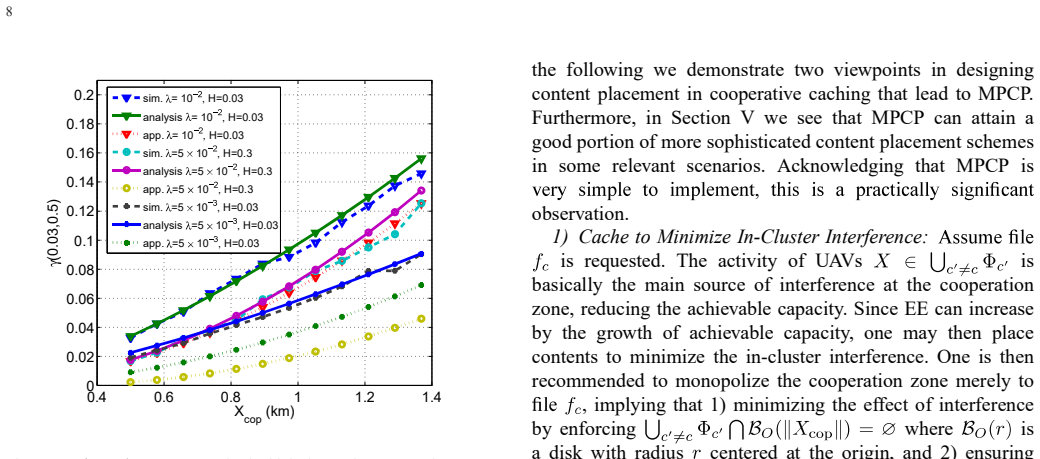
Summary. The paper studies energy efficiency (EE) of cooperative caching in UAV-enabled Fog-RAN. It models UAV locations as a 3D HPPP, uses stochastic geometry to derive an expression for EE as a function of UAV density, cooperation-zone radius, cache size, and environmental parameters, and then proposes two low-complexity content placement algorithms, RSHR and MPRC. The authors report that their algorithms improve EE by up to 800% over LRU, most-popular, and Hit-rate placement, and that vertical UAV displacement improves EE by up to 600% under their algorithms but not under the baseline schemes. They also report optimal UAV density and cache size. The paper includes simulation results in Figures 1 and 2 that are said to corroborate the analytical expressions, and parametric studies in Figures 3-7.
Significance. If the analytical derivation is correct, the paper offers a tractable EE formulation for a practically relevant UAV caching problem and introduces heuristics that are substantially cheaper than exhaustive optimization. The claims of optimal density and cache size are useful design guidelines. However, the manuscript is heavily corrupted: Proposition 1, several key equations, and abstract/contribution numbers are missing, so the derivation cannot be verified from the submitted text. The paper also does not provide code or machine-checked proofs; the only validation is simulation under the same independence assumptions used in the analysis.
major comments (3)
- [Section III, Proposition 1 and Eq. (19)] Proposition 1 is stated without its actual analytical expression: the formula and the definitions of its terms are missing from the displayed text, and Eq. (19) is not visibly present. Since every subsequent EE result (Figures 3-7, the abstract's 800% and 600% improvements, and the optimal-density/cache-size statements) is computed from this proposition's expression, the central derivation is not checkable in this manuscript. Please restore the complete statement of Proposition 1 and its terms before this paper can be evaluated.
- [Appendix A, Eqs. (25)-(30)] The proof of Proposition 1 explicitly assumes that each A2G link's LOS/NLOS state, shadowing, and fading are mutually independent across links, and uses this to factorize Laplace transforms via the PGFL. This independence is a load-bearing premise: the EE expression in Proposition 1 and the optimization objective (17) both depend on it. In real A2G deployments, links from UAVs at similar altitudes and elevation angles to a common ground user are likely to be correlated through common buildings and terrain. The validation in Figures 1-2 does not address this because those simulations are generated under the same independent-link model. I request a concrete sensitivity analysis, e.g., a correlated-shadowing or site-specific simulation, to show that the reported EE gains are not artifacts of this independence assumption.
- [Section II-D, Eqs. (9)-(14)] The energy-consumption model is central to the EE objective, but the displayed equations for communication energy, hovering energy, and displacement energy are missing or incomplete (Eqs. (9)-(13)), and Eq. (14) is not visible. The optimization problem (17) is also stated with missing components. Without these expressions, the reader cannot reconstruct the EE objective or the claims about vertical displacement. Please provide a complete and self-contained statement of the energy model and the optimization problem.
minor comments (5)
- [Abstract and Section I-C] The abstract and the contributions section contain blank placeholders for the numerical improvements (e.g., 'up to' and 'by at most') rather than actual values; these should be filled with the exact percentages reported in the numerical section.
- [Section I-A and Footnote 2] Footnote 2 acknowledges that horizontal mobility is not included because it induces interference correlation; this limitation should be stated more prominently in the system model, since vertical-only displacement is a key simplifying assumption.
- [Table I] Several entries in the table of parameters and notations are blank or incomplete, making it difficult to follow the derivations; please ensure all symbols introduced in the text appear in the table with their definitions.
- [Throughout] There are numerous typographical issues, including 'Homogenous' for 'homogeneous', missing equation numbers, and inconsistent cross-references (e.g., references to equations that are not visible). A careful proofread of the entire LaTeX source is needed.
- [Section V, Fig. 6] The claim that LRU and Hit-rate show no benefit from vertical displacement is stated verbally but the corresponding curves in Fig. 6 appear to be near unity; please specify the numerical threshold used to declare 'no benefit' and state whether this is statistically significant given the simulation setup.
Circularity Check
No significant circularity: the EE derivation and caching algorithms are self-contained and benchmarked against external baselines.
full rationale
The paper's central derivation chain is not circular. Proposition 1 evaluates the EE from a stochastic-geometry model (HPPP UAV locations, probabilistic LOS/NLOS, Nakagami fading, log-normal shadowing) using Laplace transforms and the PGFL; the result is an analytic expression in terms of the model parameters and the caching probabilities, and no target quantity is reused as an input. Proposition 2 is an explicit approximation of Proposition 1 and is validated against the same simulation setup. The RSHR and MPRC algorithms are heuristics that optimize the derived EE objective (RSHR by recursive soft-max rescaling of hit-rate weights based on per-content EE, MPRC by a greedy search over the cache partition); their reported gains are simulation outputs compared with LRU, Hit-rate, and most-popular placement, not fitted parameters renamed as predictions. The only self-citations are contextual: [31] is a footnote distinguishing prior randomized-caching work, and [42,44] are cited alongside external references for LOS/NLOS coverage behavior; none carries a load-bearing uniqueness or ansatz claim. The independence assumption on A2G links is a modeling simplification that affects quantitative accuracy and robustness, but it is not a circular reduction from the paper's equations. No step was found in which a quantity is defined in terms of the very result it is used to produce.
Assumptions & free parameters
assumptions (6)
- domain assumption The locations of UAVs form a homogeneous Poisson point process, and content placement is an independent thinning with probabilities p_i.
- domain assumption A2G channels have independent LOS/NLOS states with probabilities depending on altitude and environment, with Nakagami fading and log-normal shadowing, independent across links.
- domain assumption Total energy consumption of a UAV is the sum of communication/caching power, hovering power, and vertical displacement power, with communication aborted during displacement.
- domain assumption Non-coherent joint transmission from all UAVs caching the requested content inside the cooperation zone, with interference from all other active UAVs.
- domain assumption Content popularity follows a Zipf distribution with exponent alpha.
- domain assumption Rotary-wing hovering power and displacement power models from [37] and [2] are accurate.
Cite this review
Pith. "Pith review of Energy-Efficient Cooperative Caching in UAV Networks." pith.science (2026). https://pith.science/paper/B3YCDYEJ
@misc{pith2026190807115,
  author       = {Pith},
  title        = {Pith review of: Energy-Efficient Cooperative Caching in UAV Networks},
  year         = {2026},
  howpublished = {\url{https://pith.science/paper/B3YCDYEJ}},
  note         = {Machine review of arXiv:1908.07115}
}
read the original abstract
For an unmanned aerial vehicle (UAV) enabled network we investigate the energy-efficiency (EE) of joint caching and cooperative communication (Fog-RAN). Since UAVs are battery- and cache-limited, placing the popular contents in the caches and managing the energy expenditure of UAVs become crucial. We formulate the energy consumption of UAVs as an aggregate of communication/caching, hovering, and vertical displacement energies, and then devise an optimization problem for optimally assigning contents to caches and choosing the height of UAVs. Adopting tools from stochastic geometry, we also derive the EE in a numerically tractable form as a function of density, the radius of the cooperation zone, cache size, main communication/physical characteristics of UAVs, and influential environmental parameters. We develop two content placement strategies with low computational complexity. The conducted numerical results demonstrate that by adopting these algorithms one is able to improve EE by up to 800% compared to common content placement schemes, e.g., the least-frequently used (LRU), the most-popular, and Hit-rate. Furthermore, while under LRU and Hit-rate schemes there is no benefit in vertically displacing UAVs, under our algorithms one is able to increase EE by at most 600%. Importantly, via our algorithms one can increase the size of cooperation zone in order to steadily increase EE, which is not the cases of LRU, the most-popular, and Hit-rate schemes. We finally observe that there is optimal values for density and cache-size of UAVs, granting maximum EE.
Figures


Reference graph
Works this paper leans on
-
[1]
1Mohammad G. KhoshkholghMember , IEEEand Victor C. M. Leung,Fellow, IEEEAbstract—For an unmanned aerial vehicle (UA V) enabledand cooperative communication (Fog-RAN). Since UA Vs arebattery- and cache-limited, placing the popular contents in thecaches and managing the energy expenditure of UA Vs becomecrucial. We formulate the energy consumption of UA Vs ...
work page 2018
-
[2]
1100.511.5200.0050.010.0150.020.0250.030.0350.040.045*MPRCMPCPRSHRLRUHit rate00.511.5200.0050.010.0150.020.0250.03*MPRCMPCPRSHRLRUHit rate, where,,, and.0.511.522.533.5400.0050.010.0150.020.0250.030.0350.04Xcop (km)*MPRCMPCPRSHRLRUHit rate0.511.522.533.5400.0050.010.0150.020.0250.030.035Xcop (km)*MPRCMPCPRSHRLRUHit rate, where,, and.1010101000.010.020.030...
-
[3]
Wireless communications withunmanned aerial vehicles: opportunities and challenges,
shadowing (fading) powergains across communication gains are independent. Therefore,(29)where we also insert normal distribution with distance-dependent variance as in (5) and apply Laplace generationfunctional of HPPP as in [10]. To evaluatewe follow thesame line of argument above that yields(30) 14Consequently,is formulated asLikewise, one can straightf...
work page 2016
-
[5]
[41]C.-M. Tseng, C.-K. Chau, and M. K. K. Elbassioni, “Autonomousdrones,”https://arxiv.org/abs/1703.10049, 2017.[42]M. G. Khoshkholgh and V . C. M. Leung, “Impact of LOS/NLOSpropagation on the coverage performance of multi-stream MIMO-ZFBFcellular downlink,” inIEEE 86th V ehicular Technology Conference(VTC-Fall), Sep. 2017.[43]C. Galiotto, N. K. Pratas, N...
arXiv 2017
-
[2017]
Overcoming Endurance Issue: UAV-Enabled Communications with Proactive Caching
15[18]W. Wen, Y . Cui, F.-C. Zheng, S. Jin, and Y . Jiang, “Random cachingbased cooperative transmission in heterogeneous wireless networks,”IEEE Trans. Commun., vol. 66, no. 7, pp. 2809–2825, Jul. 2018.[19]Poisson D2D networks,”IEEE J. Select. Areas Commun., vol. 36, no. 6,pp. 1217–1230, Jun. 2018.[20]H.-B. Kong, I. Flint, D. N. P . Wang, and N. Privault...
work page Pith review arXiv 2018
Reviewed August 14, 2026 · model on record in the stance chip above.
Discussion (0). Continue with ORCID to comment.