REVIEW 3 major objections 4 minor 31 references
An End-to-end Video Text Detector with Online Tracking
T0 review · 3 major / 4 minor · reviewed 2026-08-14 · deepseek-v4-flash
Pith's one-line read The paper claims that video text detection and online tracking can be trained as one end-to-end network, with ConvLSTM carrying motion memory and GRU-based descriptors associating text across frames.
desk verdict A competent incremental video-text detection paper whose claimed SOTA on YVT rests on an under-specified online tracking step; the rest of the ablations are solid but the thresholds need disclosure and sensitivity analysis. read the letter →
The pith
A machine-rendered reading of the paper's core claim, the machinery that carries it, and where it could break.
The reading
What carries the argument
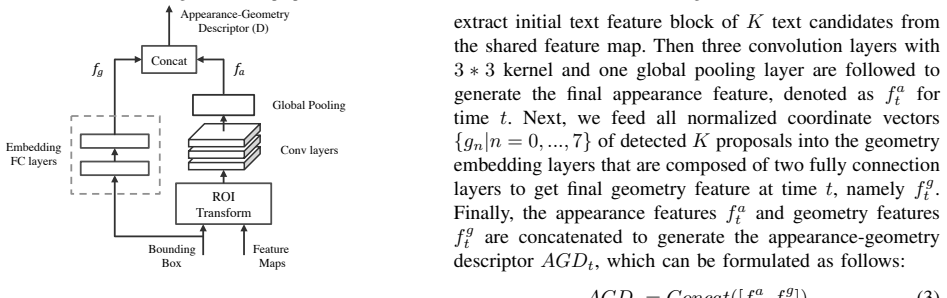
The load-bearing object is the appearance-geometry descriptor (AGD) together with its GRU-estimated next-frame version (EAGD). Appearance comes from an ROI Transform on the shared feature map followed by convolution and global pooling, giving 128 numbers. Geometry comes from embedding the eight normalized quadrangle coordinates through two fully connected layers, giving 8 numbers, and concatenation yields a 136-dimensional descriptor. A GRU consumes previous-frame descriptors, with a mask that resets the hidden state when an instance is new, and outputs predicted current-frame descriptors. These are matched to current descriptors by a similarity matrix and Kuhn-Munkres assignment with thresholds, and a contrastive loss trains positive same-instance pairs to be close and negative pairs to be far. In parallel, a ConvLSTM block on the shared features gives the detection branch long-term motion memory. The claim is that this descriptor-plus-GRU mechanism is what converts tracking from a separate post-processing stage into a nearly cost-free, jointly trainable part of detection.
What would settle it
Vary the matching threshold $\theta_m$ and the high-confidence threshold $\theta_h$ over a grid on the ICDAR 2013 Video test videos while keeping the trained network fixed. If the F-score moves by more than the claimed two-point margin across reasonable settings, the benchmark gain would undercut the claim that end-to-end training is the source of the improvement.
Extended reading notes
Core claim
The central claim is that an end-to-end video text detector with online tracking outperforms two-stage detect-then-track pipelines. In the detection branch, ConvLSTM propagates frame-level information through the shared ResNet50/U-Net features, and detection is done in EAST-like anchor-free per-pixel quadrangle regression. In the tracking branch, every text proposal is summarized by a 136-dimensional appearance-geometry descriptor, where 128 appearance dimensions come from an ROI-transformed shared feature map and 8 geometry dimensions come from embedded quadrangle coordinates. The descriptors from the previous frame pass through a GRU to produce estimated descriptors for the current frame, and a Kuhn-Munkres match between estimated and current descriptors builds trajectories. The two branches are trained together with a detection loss plus a contrastive tracking loss. With this joint model, the paper reports F-scores of 66.92 on ICDAR 2013 Video, 90.32 on Minetto, and 79.05 on YVT, exceeding their compared two-stage versions and prior methods on each benchmark.
Load-bearing premise
The reported gains assume the trajectory-generation thresholds and tracklet-length reward were fixed without per-dataset tuning; the paper does not disclose their values or a sensitivity analysis, so threshold tuning remains a possible alternative explanation for the improvement.
Editorial extensions
If this is right
- If the central claim is correct, two-stage video text systems can be replaced by one network whose tracking branch reuses detection features, making tracking nearly free and enabling real-time operation.
- The ConvLSTM ablation suggests temporal context is the main source of detection gain over single-frame detectors, so streams with persistent text should benefit most.
- Joint training with the tracking loss improves detection itself, meaning trajectory supervision can serve as extra training signal for text detection.
- Because trajectory generation is online, the method applies to streaming video without waiting for future frames.
Reading between the lines
- The largest reported jump is in YVT precision, from 78.51 to 89.12 in end-to-end mode, while recall is nearly flat; a testable extension would be measuring whether trajectory rewards mainly suppress false positives such as background patches that look like text.
- Since the paper notes trajectory generation is not part of training, adding a differentiable trajectory-level loss could widen the gap between the two-stage and end-to-end variants further.
- The descriptor design only needs a region feature and a geometry vector, so the same framework should transfer to arbitrary-shape text by swapping quadrangle regression for a segmentation-based detector.
- If the matching thresholds are disclosed and swept, a reader could separate the contribution of joint training from the contribution of inference-time trajectory reward.
Signed reviews
Editorial analysis
A structured set of objections, weighed in public.
Referee Report
Summary. The paper proposes an end-to-end trainable framework for video text detection with an online tracking branch. The detection branch augments a ResNet50+U-Net backbone with a ConvLSTM block to propagate temporal context, and the tracking branch builds appearance-geometry descriptors (AGD) for detected text proposals, estimates their next-frame descriptors (EAGD) with a GRU, and associates instances across frames by metric learning. At inference, an online trajectory generation algorithm (Algorithm 1) refines detection confidence scores by rewarding long matched tracklets. The method is evaluated on ICDAR 2013 Video, Minetto, and YVT, reporting state-of-the-art F-measure gains of about 2 points on each dataset and a runtime of 24.36 fps on a TITAN Xp. The paper also includes ablations of the ConvLSTM versus single-frame and Conv3D features, and of descriptor variants in a tracking metric evaluation on Minetto.
Significance. If the reported results hold, the paper would demonstrate a useful integration of video text detection and online tracking into one trainable model, with shared features and a real-time rate, which is a practically relevant contribution. The comparison of ConvLSTM against Conv3D and single-frame detection, and the ablation showing the benefit of matching AGD with EAGD, are informative. The use of public benchmarks with standard train/test splits is a positive feature; the central result is not circular in the sense of fitting a quantity and then calling it a prediction. However, the significance is currently limited by the lack of specification of the inference-time trajectory generation thresholds and the under-specification of the contrastive tracking loss, both of which are necessary to attribute the reported improvements to the proposed architecture rather than to a favorable post-processing configuration.
major comments (3)
- [III-D (Algorithm 1) and Table III] The online trajectory generation algorithm introduces at least five unreported settings: the detection threshold θ_l (step 1), the matching threshold θ_m (step 3), the high-confidence threshold θ_h and the reward scale τ (step 5), and the number of proposals K (Section III-B). On YVT, the end-to-end detector without online tracking reaches F=74.86 (Table III), which is below the prior state of the art (Wu et al., F=77.00); the reported F=79.05 is achieved only after applying Algorithm 1. The precision jump from 78.51 to 89.12 with essentially flat recall (71.54 to 71.03) is the characteristic signature of threshold-based suppression of low-confidence boxes rather than recovery of new true positives. Without reporting the parameter values and a sensitivity analysis, the central claim that the method significantly outperforms prior methods cannot be attributed specifically to the end-to-end architecture, ConvLSTM, AGD/GRU, or joint training. Please provide the exact values for these parameters and an experiment that shows the F-measure as a function of each threshold on at least one dataset.
- [Eq. (5)] The contrastive tracking loss is under-specified. The double sum over i and j with denominator K^2 implies that all pairs of the K proposals are used, but the construction of the label y (L^t_{i,j}) is not described: it is not stated how positive pairs are defined (e.g., by IoU with ground-truth trajectories), how negative pairs are sampled, whether self-pairs (i=j) are excluded, or how the number of valid proposals per frame is handled when it is less than K. Since the loss is central to the joint training claim, please specify the pair sampling procedure, the label assignment protocol, and any handling of class imbalance between positive and negative pairs. In particular, clarify whether the descriptor distance d in Eq. (5) is computed between AGD_t and EAGD_{t-1} or between raw AGDs, because Eq. (4) suggests that matching is done with the estimated descriptors, but the loss formula does not make this explicit.
- [Eq. (4) and Section III-C] The GRU-based descriptor estimation is not sufficiently specified to be reproducible. The notation (EAGD_t, h_t) = GRU(AGD_t, mask_t * h_{t-1}) uses a single hidden state h_{t-1}, yet in multi-target tracking there is one hidden state per text trajectory; it is unclear how hidden states are indexed, initialized, or updated for newly appearing and disappearing text instances. The mask_t is described as a scalar ('set to zero when the instance does not exist'), but the mask must be instance-specific and applied per trajectory. Without a precise description of the hidden-state bookkeeping, the trajectory generation in Algorithm 1 cannot be reimplemented. Please provide the exact state-transition equations and the procedure for creating and discarding hidden states.
minor comments (4)
- [Abstract and Introduction] There are typographical errors, e.g., 'palys' in the first paragraph of the Introduction, and 'rame size' in the ICDAR 2013 dataset description of Section IV-A.
- [Table III caption and References] The caption of Table III says 'SEVERAL PUBIC DATASETS'; 'Moslen' in the table appears to be a misspelling of Mosleh (reference [9]). Please correct these.
- [Section IV-C, Table I] The row 'Ours with optical flow' shows a large drop in precision (79.97 to 68.49) but an increase in recall (55.21 to 55.69) compared with 'Ours with ConvLSTM'. The paper does not explain why optical flow hurts precision so markedly; a sentence explaining this would aid the reader.
- [Section IV-B] The implementation details state 'Each frame contains 10 detection boxes, including positive samples and negative samples' but it is not clear how these 10 boxes are chosen during training, e.g., whether they are ground-truth boxes, predicted proposals, or a mixture. This affects the interpretation of the tracking loss.
Circularity Check
No circularity: the SOTA claim rests on benchmark evaluations, not on a derivation that reuses its own fitted quantities.
full rationale
The paper's central claim is an empirical performance comparison on public benchmarks (ICDAR2013 Video, Minetto, YVT) using standard training/test splits. No quantity is fitted and then renamed as a prediction: the end-to-end detector and tracking branch are trained with the stated multi-task loss, and the reported F-scores are measured outputs on test data. The online trajectory generation algorithm (Algorithm 1) contains unreported thresholds (theta_l, theta_m, theta_h, tau, K), but this is a reproducibility or parameter-sensitivity concern, not circularity: the thresholds are hyperparameters that affect inference, they are not derived from the test labels or from the claimed conclusion. The only self-citation in the method is reference [15] (TextNet) for the ROI Transform layer used in the descriptor generation module; this is an architectural component and is not load-bearing for the paper's central claim of end-to-end video text detection with tracking. The matching and trajectory logic is described explicitly, and the improvements are presented as experimental results rather than as consequences of a definition. Accordingly, no step in the paper's derivation chain reduces to its own inputs, and the appropriate circularity score is 0.
Assumptions & free parameters
free parameters (5)
- α (detection loss weight) =
5
- β (tracking loss weight) =
0.1
- contrastive margin m =
1.0
- trajectory thresholds θm, θh, τ =
unspecified
- proposals per frame K =
10
assumptions (5)
- standard math Backpropagation and stochastic gradient descent function as expected for deep networks.
- standard math Hungarian (Kuhn-Munkres) algorithm provides optimal bipartite matching for descriptor associations.
- domain assumption Text instances in video can be represented by appearance-geometry descriptors that are temporally coherent enough for GRU prediction.
- domain assumption The datasets (ICDAR2013 Video, Minetto, YVT) provide ground-truth tracks that can supervise the contrastive loss.
- domain assumption ConvLSTM hidden state can be propagated across frames in a video without reset issues.
Cite this review
Pith. "Pith review of An End-to-end Video Text Detector with Online Tracking." pith.science (2026). https://pith.science/paper/VPXBA4FS
@misc{pith2026190807135,
  author       = {Pith},
  title        = {Pith review of: An End-to-end Video Text Detector with Online Tracking},
  year         = {2026},
  howpublished = {\url{https://pith.science/paper/VPXBA4FS}},
  note         = {Machine review of arXiv:1908.07135}
}
read the original abstract
Video text detection is considered as one of the most difficult tasks in document analysis due to the following two challenges: 1) the difficulties caused by video scenes, i.e., motion blur, illumination changes, and occlusion; 2) the properties of text including variants of fonts, languages, orientations, and shapes. Most existing methods attempt to enhance the performance of video text detection by cooperating with video text tracking, but treat these two tasks separately. In this work, we propose an end-to-end video text detection model with online tracking to address these two challenges. Specifically, in the detection branch, we adopt ConvLSTM to capture spatial structure information and motion memory. In the tracking branch, we convert the tracking problem to text instance association, and an appearance-geometry descriptor with memory mechanism is proposed to generate robust representation of text instances. By integrating these two branches into one trainable framework, they can promote each other and the computational cost is significantly reduced. Experiments on existing video text benchmarks including ICDAR2013 Video, Minetto and YVT demonstrate that the proposed method significantly outperforms state-of-the-art methods. Our method improves F-score by about 2 on all datasets and it can run realtime with 24.36 fps on TITAN Xp.
Figures


Reference graph
Works this paper leans on
-
[1]
K. Bernardin and R. Stiefelhagen. Evaluating multiple object tracking performance: the clear mot metrics. Journal on Image and Video Processing , 2008:1, 2008
work page 2008
-
[2]
B. Epshtein, E. Ofek, and Y . Wexler. Detecting text in natural scenes with stroke width transform. In CVPR, pages 2963– 2970, 2010
work page 2010
-
[3]
K. He, X. Zhang, S. Ren, and J. Sun. Deep residual learning for image recognition. In CVPR, pages 770–778, 2016
2016
- [4]
-
[5]
S. Ji, W. Xu, M. Yang, and K. Yu. 3d convolutional neural networks for human action recognition. IEEE TPAMI, 35(1):221–231, 2013. Method ICDAR 2013 Minetto dataset YVT P R F P R F P R F Epshtein et al. [2] 39.80 32.53 35.94 − − − 68.00 76.00 72.00 Zhao et al. [29] 47.02 46.30 46.65 − − − 34.00 41.00 37.00 Minetto et al. [8] − − − 61.00 69.00 63.00 − − − Y...
work page 2013
-
[6]
D. Karatzas, F. Shafait, S. Uchida, M. Iwamura, L. G. i Big- orda, S. R. Mestre, J. Mas, D. F. Mota, J. A. Almazan, and L. P. De Las Heras. Icdar 2013 robust reading competition. In ICDAR, pages 1484–1493. IEEE, 2013
work page 2013
- [7]
-
[8]
R. Minetto, N. Thome, M. Cord, N. J. Leite, and J. Stolfi. Snoopertrack: Text detection and tracking for outdoor videos. In ICIP, pages 505–508. IEEE, 2011
work page 2011
Show all 31 references
-
[9]
Mosleh, N
A. Mosleh, N. Bouguila, and A. B. Hamza. Automatic inpainting scheme for video text detection and removal. IEEE TIP, 22(11):4460–4472, 2013
2013
-
[10]
P. X. Nguyen, K. Wang, and S. Belongie. Video text detection and recognition: Dataset and benchmark. In WACV, pages 776–783. IEEE, 2014
2014
-
[11]
W.-Y . Pei, C. Yang, L.-Y . Meng, J.-B. Hou, S. Tian, and X.-C. Yin. Scene video text tracking with graph matching. IEEE Access, 6:19419–19426, 2018
2018
-
[12]
Ronneberger, P
O. Ronneberger, P. Fischer, and T. Brox. U-net: Convolutional networks for biomedical image segmentation. In MICCA, pages 234–241. Springer, 2015
2015
-
[13]
B. Shi, X. Bai, and S. Belongie. Detecting oriented text in natural images by linking segments. In CVPR, pages 3482–
-
[14]
Shivakumara, L
P. Shivakumara, L. Wu, T. Lu, C. L. Tan, M. Blumenstein, and B. S. Anami. Fractals based multi-oriented text detection system for recognition in mobile video images. Pattern Recognition, 68:158–174, 2017
2017
-
[15]
Y . Sun, C. Zhang, J. Liu, J. Han, and E. Ding. Textnet: Ir- regular text reading from images with an end-to-end trainable network. In ACCV, 2018
2018
-
[16]
Tian, W.-Y
S. Tian, W.-Y . Pei, Z.-Y . Zuo, and X.-C. Yin. Scene text detection in video by learning locally and globally. In IJCAI, 2016
2016
-
[17]
L. Wang, Y . Wang, S. Shan, and F. Su. Scene text detection and tracking in video with background cues. In ICMR, 2018
2018
-
[18]
L. Wang, Y . Wang, S. Shan, and F. Su. Scene text detection and tracking in video with background cues. In ICMR, pages 160–168. ACM, 2018
2018
-
[19]
X. Wang, Y . Jiang, S. Yang, X. Zhu, W. Li, P. Fu, H. Wang, and Z. Luo. End-to-end scene text recognition in videos based on multi frame tracking. In ICDAR, volume 1, pages 1255–
-
[20]
Y . Wang, L. Wang, and F. Su. A robust approach for scene text detection and tracking in video. In PCM, pages 303–314. Springer, 2018
2018
-
[21]
L. Wu, P. Shivakumara, T. Lu, and C. L. Tan. A new technique for multi-oriented scene text line detection and tracking in video. IEEE Trans. Multimedia , 17(8):1137–1152, 2015
2015
-
[22]
Wu and P
Y . Wu and P. Natarajan. Self-organized text detection with minimal post-processing via border learning. In ICCV, 2017
2017
-
[23]
Xingjian, Z
S. Xingjian, Z. Chen, H. Wang, D.-Y . Yeung, W.-K. Wong, and W.-c. Woo. Convolutional lstm network: A machine learning approach for precipitation nowcasting. In NeurIPS, pages 802–810, 2015
2015
-
[24]
X.-H. Yang, W. He, F. Yin, and C.-L. Liu. A unified video text detection method with network flow. In ICDAR, volume 1, pages 331–336. IEEE, 2017
2017
-
[25]
Ye and D
Q. Ye and D. S. Doermann. Text detection and recognition in imagery: A survey. IEEE TPAMI, 37:1480–1500, 2015
2015
-
[26]
X.-C. Yin, X. Yin, K. Huang, and H.-W. Hao. Robust text detection in natural scene images. IEEE TPAMI, (1):1, 2013
2013
-
[27]
Yin, Z.-Y
X.-C. Yin, Z.-Y . Zuo, S. Tian, and C.-L. Liu. Text detection, tracking and recognition in video: A comprehensive survey. IEEE TIP, 25:2752–2773, 2016
2016
-
[28]
Zhang, C
Z. Zhang, C. Zhang, W. Shen, C. Yao, W. Liu, and X. Bai. Multi-oriented text detection with fully convolutional net- works. In CVPR, 2016
2016
-
[29]
Zhao, K.-H
X. Zhao, K.-H. Lin, Y . Fu, Y . Hu, Y . Liu, and T. S. Huang. Text from corners: a novel approach to detect text and caption in videos. IEEE TIP, 20(3):790–799, 2011
2011
-
[30]
X. Zhou, C. Yao, H. Wen, Y . Wang, S. Zhou, W. He, and J. Liang. East: an efficient and accurate scene text detector. In CVPR, pages 2642–2651, 2017
2017
-
[31]
Z.-Y . Zuo, S. Tian, W.-y. Pei, and X.-C. Yin. Multi-strategy tracking based text detection in scene videos. In ICDAR, pages 66–70. IEEE, 2015
2015
Reviewed August 14, 2026 · model on record in the stance chip above.
Discussion (0). Continue with ORCID to comment.