REVIEW 3 major objections 6 minor 34 references
Coexistence of spin frustration and spin unfrustration induced spontaneous exchange bias in Heusler alloys
T0 review · 3 major / 6 minor · reviewed 2026-08-14 · deepseek-v4-flash
Pith's one-line read Spontaneous exchange bias in Mn2Ni1.5Al0.5 comes from a field-induced superferromagnetic state coupled to an unfrustrated antiferromagnet, and its blocking temperature is set by the internal field.
desk verdict Solid experimental evidence for a field-induced superferromagnetic state and coexisting AFM states, but the claim that the internal field sets TB rests on an unvalidated identification of HS with the Weiss field. read the letter →
The pith
A machine-rendered reading of the paper's core claim, the machinery that carries it, and where it could break.
The reading
What carries the argument
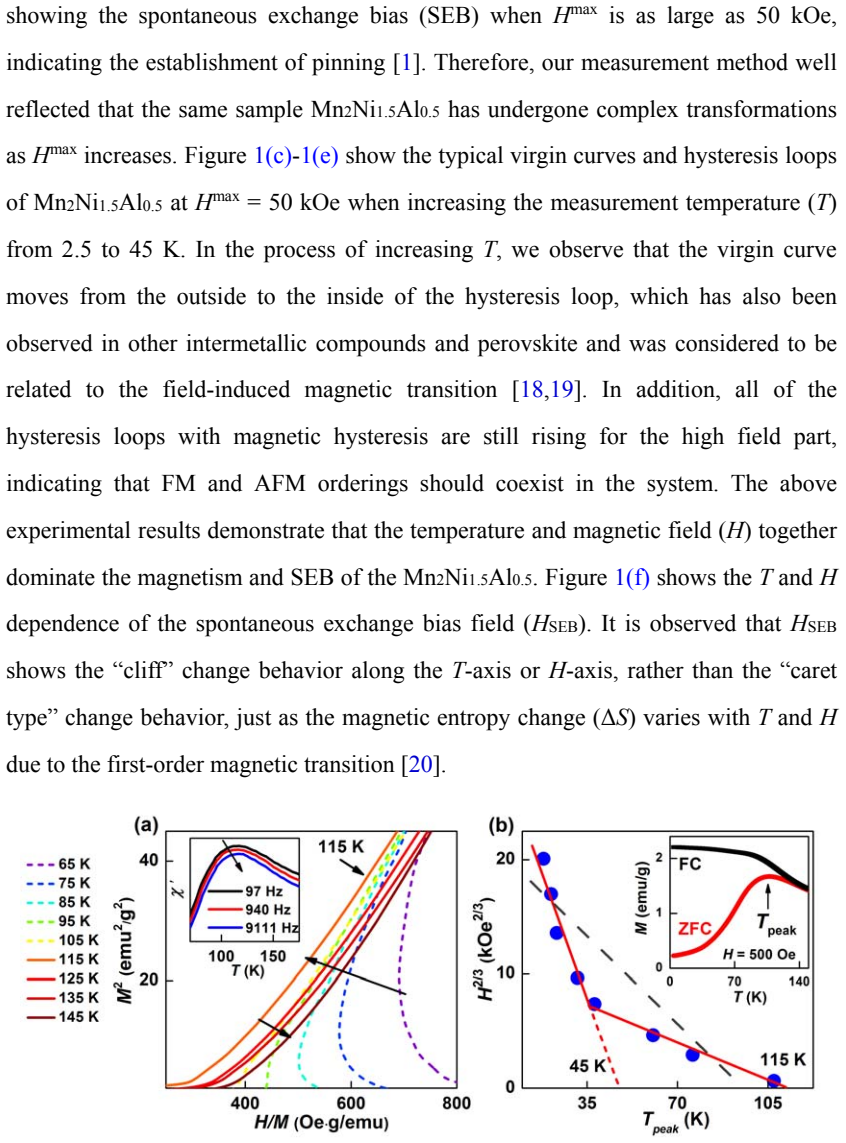
The central object is the Landau two-sublattice free-energy model, in which the two magnetic moments $M$ and $m$ are coupled by a term $\gamma M\cdot m$. The coupling terms act on each sublattice like an effective magnetic field—the internal molecular field of one sublattice acting on the other—and the model shows that Arrott plots record the competition between this internal field and the applied external field. In the paper, this model converts the measured start field $H_S$ of the first-order magnetic transition into a macroscopic measure of the internal field strength. That identification is what turns the empirical linear correlation between $H_S$ and the spontaneous exchange bias field into the conclusion that the internal field controls the blocking temperature $T_B$.
What would settle it
Measure $H_S$ and the spontaneous exchange bias field $H_{\mathrm{SEB}}$ across a series of Mn2Ni1.5Al0.5 samples with systematically altered spin-orbit coupling; if the blocking temperature and $H_{\mathrm{SEB}}$ do not track $H_S$, or if the $H_{\mathrm{SEB}}$-versus-$H_S$ line misses the origin, the claim that the internal field controls $T_B$ fails.
Extended reading notes
Core claim
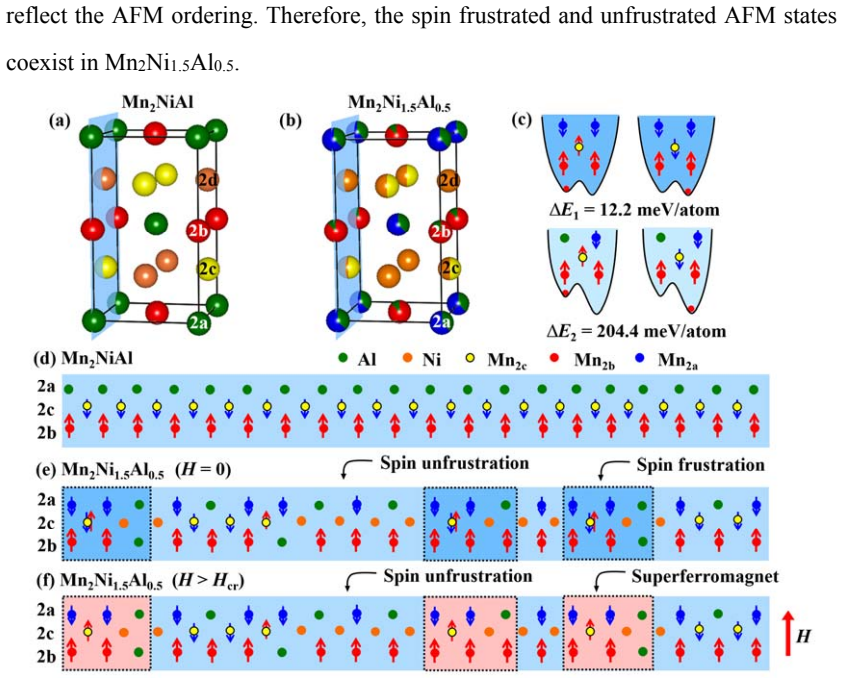
In Mn2Ni1.5Al0.5, magnetic measurements and first-principles calculations find two coexisting antiferromagnetic states built from Mn atoms on different sublattices: a spin-frustrated state with weak anisotropy and a spin-unfrustrated state with strong anisotropy. Above a critical external field, the frustrated state transforms by a first-order magnetic transition into a superferromagnetic state, and because the transition is first-order the superferromagnetic order is retained when the field is removed. The spontaneous exchange bias then comes from interfacial coupling between the unfrustrated antiferromagnetic state and this field-induced superferromagnetic state. The paper further claims that the blocking temperature is set by the internal molecular field: the start field $H_S$ of the first-order transition scales linearly with the bias field $H_{\mathrm{SEB}}$ and reaches zero exactly when the bias disappears, and a two-sublattice free-energy model identifies $H_S$ as a macroscopic measure of the internal field. The proposed route to higher blocking temperatures is therefore to increase the internal field, for example through stronger spin-orbit coupling or a chiral magnetic sublattice.
Load-bearing premise
The argument depends on identifying the measured start field $H_S$ of the first-order magnetic transition with the strength of the internal molecular field, an identification made through a simplified two-sublattice free-energy model with a single positive coupling constant.
Editorial extensions
If this is right
- The pinned phase responsible for the bias is not inherent to the zero-field state; it is created by applying a field above the critical field of a first-order magnetic transition and survives only because that transition is first-order.
- The blocking temperature $T_B$ is set by the internal molecular field of the system, not by the Néel temperature of a conventional antiferromagnetic pinning phase.
- Strengthening the internal field, whether through stronger spin-orbit coupling or through a chiral magnetic sublattice, should push $T_B$ to higher values while preserving the first-order character of the transition.
- The bias is field-history dependent: it appears only after the sample has experienced a maximum field $H_{\max}$ large enough to trigger the transition, and it vanishes when the start field $H_S$ reaches zero at $T_B$.
Reading between the lines
- If the mechanism is generic, other Heusler alloys containing a spin-frustrated antiferromagnetic sublattice that can be switched by a first-order transition should also show spontaneous exchange bias, making frustration plus a first-order transition a design checklist rather than a single-material accident.
- Because the same first-order transition produces both the inverse magnetocaloric effect and the bias, magnetocaloric and exchange-bias functions could be engineered together in one material.
- The paper's logic predicts a specific trend: substituting heavier elements into Mn2Ni1.5Al0.5 to raise spin-orbit coupling should increase $H_S$ and, in lockstep, $T_B$; a divergence between the two would call the proposed mechanism into question.
Signed reviews
Editorial analysis
A structured set of objections, weighed in public.
Referee Report
Summary. The paper investigates the mechanism of spontaneous exchange bias (SEB) and the dominant factor of its blocking temperature in the Heusler alloy Mn2Ni1.5Al0.5. Combining magnetic measurements (DC and AC susceptibility, M(H) loops, Arrott plots, magnetocaloric effect) with first-principles DFT calculations, the authors argue that spin-frustrated and spin-unfrustrated antiferromagnetic (AFM) states coexist in this compound. They further propose that the frustrated AFM state undergoes a first-order magnetic transition to a superferromagnetic (SFM) state under applied field, and that SEB arises from interfacial coupling between the unfrustrated AFM state and the field-induced SFM state. Finally, using a two-sublattice Landau model and a linear correlation between the start field HS of the first-order transition and HSEB, they conclude that the internal (Weiss) field dominates TB and that increasing the internal field (e.g., via strong spin-orbit coupling or Dzyaloshinskii-Moriya interaction) should raise TB.
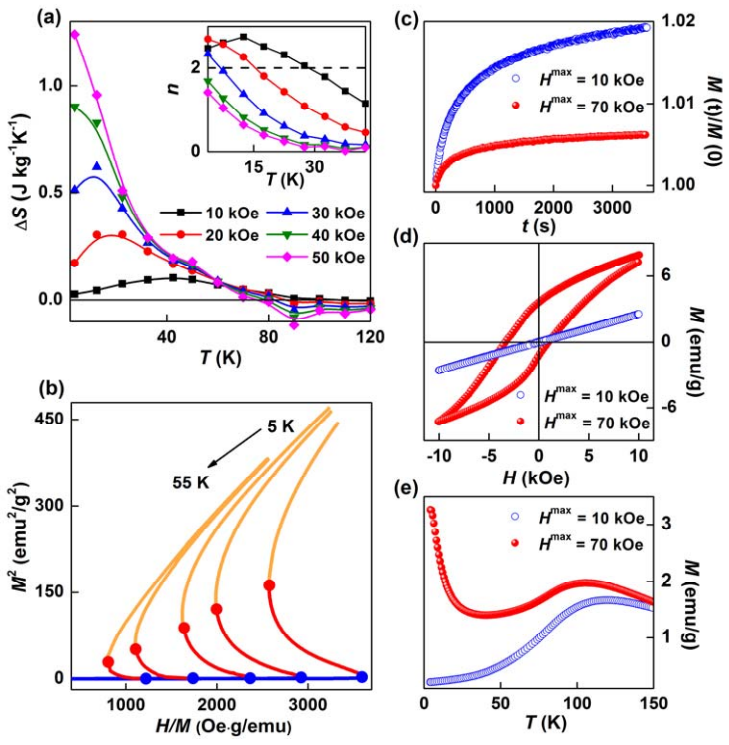
Significance. If established, the paper would provide a mechanistic picture of SEB in Heusler alloys and, importantly, a design principle for increasing the blocking temperature, which is currently a major limitation for applications. The experimental protocol is thoughtful: the before/after first-order transition comparisons in Fig. 4(c)-(e) directly show the destruction of the frustrated state and the emergence of hysteresis and SEB, and the use of the Banerjee criterion and magnetocaloric-effect exponent n is appropriate for identifying the first-order nature. The DFT calculations, which distinguish two types of Mn2c environments with markedly different energy differences (12.2 vs 204.4 meV/atom), provide microscopic support for the coexistence of frustrated and unfrustrated regions. However, the central claim that TB is dominated by the internal field rests on an unvalidated identification of the measured HS with the intersublattice Weiss field, and the linear correlations in Fig. 5(d,e) may reflect a common temperature dependence rather than a causal relationship. The paper is potentially significant but requires substantial strengthening of its key interpretive step.
major comments (3)
- [Section III, Fig. 5 and following paragraph] The identification of HS as a macroscopic reflection of the internal field is not justified. The two-sublattice Landau model from Ref. [22] describes a uniform system with a single coupling constant γ, whereas the authors themselves describe at least three Mn sublattices (Mn2c, Mn2b, Mn2a) and antisite disorder. No quantitative fit of the Landau free energy to the Arrott isotherms in Fig. 4(b) is provided, so the sign and magnitude of γ are asserted rather than demonstrated. Moreover, in a polycrystalline sample, the measured HS is a distribution-averaged threshold for nucleation of the SFM phase; it could equally reflect magnetocrystalline anisotropy, disorder broadening of the transition, or the metastability limit of the field-induced state. The manuscript needs to present direct evidence, for example a fit of the Landau model to the full Arrott curves showing that the extracted zero-field internal field γM vanishes at the same temperature as TB, rather than relying on the assertion that HS 'macroscopically reflects' the internal field.
- [Fig. 5(d) and (e), text following them] The claim that 'when HS becomes zero, HSEB also becomes zero, TB reaches' is potentially circular. If the red fitted lines are constrained to pass through the coordinate origin, then the vanishing of HSEB at HS=0 is built into the fit and cannot be used as independent evidence. The authors should report unconstrained linear fits with intercepts, slopes, and confidence intervals, and ideally a statistical test of whether the intercept is consistent with zero. Even an unconstrained zero intercept would not by itself establish causality: HS and HSEB both vanish near the same temperature, so the linear correlation may simply reflect that both quantities are controlled by the same underlying temperature-dependent order parameter, without one dominating the other.
- [Fig. 2(b) and accompanying A-T line analysis] The two-slope interpretation of the H^{2/3} vs Tpeak plot is not adequately justified. The Almeida-Thouless line is derived for spin-glass systems; applying it piecewise to a material with coexisting magnetic orders and assigning the two slopes to 'spin frustrated' and 'spin unfrustrated' AFM states assumes that a change in slope corresponds to a change in the dominant magnetic species. No model is given for why the A-T line should exhibit a kink at 45 K, and alternative explanations (e.g., crossover in relaxation dynamics, grain-size distribution, or a change in the field-cooling protocol response) are not discussed. Because the coexistence of frustrated and unfrustrated AFM states is a cornerstone of the proposed mechanism, this analysis needs stronger grounding, such as a microscopic derivation of the A-T line for coupled sublattices or complementary experimental evidence.
minor comments (6)
- [Section III, Landau model paragraph] The Landau free energy expression following 'According to the Landau model [22]' is garbled in the manuscript text; please typeset it properly and define all parameters and sign conventions. This matters because the argument about the sign and size of γ depends on this expression.
- [Fig. 2(a) and (b)] The relation between the 115 K feature in the AC susceptibility peak and the 115 K extracted from the A-T line fit should be clarified, and any discrepancy (or coincidence) discussed explicitly.
- [Fig. 4(a) inset] The statement that n > 2 for H ≤ 30 kOe confirms a first-order transition is taken from Ref. [20]; a brief explanation of the criterion would help readers who are not familiar with the magnetocaloric-effect exponent analysis.
- [Introduction] The claim that 'all of these SEB materials have a single phase of non-stoichiometric composition' is very broad; consider limiting it to the materials surveyed in the cited references.
- [Fig. 4(b) caption] The caption refers to 'slope transition points' with blue and red circles, but the text describes zero, negative, and positive slopes denoted by blue, red, and yellow; please ensure the color coding is explained fully in the caption.
- [Fig. 5] Adding error bars to HSEB, HS, HC, and HF, estimated from the hysteresis loops and Arrott plots, would make the linear correlations in Fig. 5(d,e) more convincing.
Circularity Check
No significant circularity; the central TB claim rests on an empirical correlation plus an external model assumption, not on a self-referential reduction.
full rationale
Walking the derivation chain, the SEB mechanism is built from independent inputs: AC-susceptibility frequency shifts and A-T line fits support the coexistence of a frustrated and an unfrustrated AFM state; DFT total-energy differences for the two Mn2c environments provide a microscopic check; ΔS>0, n>2, and Banerjee negative-slope Arrott plots establish the first-order transition; and the before/after FMT measurement protocol directly shows that hysteresis and HSEB appear only after the frustrated state is converted to SFM. None of these steps names a fitted parameter as a prediction. The only potentially circular link is the final TB claim: the paper fits HSEB vs HS (and HC vs HF), reports that the fitted lines pass through the coordinate origin, and then interprets HS as a macroscopic measure of the internal (Weiss) field using the two-sublattice Landau model of Ref [22] ('HS is the start field of FMT, thus it can macroscopically reflect the strength of the internal field'). This is an interpretive identification imported from an external reference, not a reduction by construction: HS remains an independently measured transition start field, and the simultaneous vanishing of HS and HSEB with temperature is an empirical correlation. The text does not say the fits were constrained through the origin, so the vanishing at HS=0 is not shown to be a built-in constraint. Self-citations [24-26] support the structural site-occupation model but are not load-bearing for the TB conclusion; the Landau/Weiss-field identification is from an external handbook, not from the authors' prior work. The main weakness—that gamma's sign/magnitude and the HS-internal-field equivalence are asserted rather than quantitatively fitted to the Arrott isotherms—is a correctness or model-validity risk, not a circularity.
Assumptions & free parameters
free parameters (4)
- A-T line slope (high-T range) =
-0.63 kOe^(2/3)/K
- A-T line slope (low-T range) =
-10.96 kOe^(2/3)/K
- Proportionality constant HSEB vs HS =
not reported (line through origin)
- Proportionality constant HC vs HF =
not reported (line through origin)
assumptions (4)
- domain assumption The system can be represented by two magnetic sublattices with a single coupling constant gamma in a Landau free-energy expansion.
- domain assumption The peak in AC susceptibility and the two-slope Almeida-Thouless behavior indicate spin frustration and the coexistence of two AFM phases.
- domain assumption The site occupancy of Mn atoms (Mn2c, Mn2b, Mn2a) in non-stoichiometric Mn2Ni1.5Al0.5 follows from prior literature (refs 25-27).
- domain assumption The sign of the magnetocaloric effect and the exponent n>2 establish a first-order magnetic transition.
Cite this review
Pith. "Pith review of Coexistence of spin frustration and spin unfrustration induced spontaneous exchange bias in Heusler alloys." pith.science (2026). https://pith.science/paper/ONTYIKWM
@misc{pith2026190807149,
  author       = {Pith},
  title        = {Pith review of: Coexistence of spin frustration and spin unfrustration induced spontaneous exchange bias in Heusler alloys},
  year         = {2026},
  howpublished = {\url{https://pith.science/paper/ONTYIKWM}},
  note         = {Machine review of arXiv:1908.07149}
}
read the original abstract
The mechanism of spontaneous exchange bias (SEB) and the dominant factor of its blocking temperature are still unclear in Heusler alloys. Here, the related investigations are performed in Mn2Ni1.5Al0.5 Heusler alloys with SEB. The results of both magnetic measurements and first-principles calculations confirmed that spin frustrated and unfrustrated antiferromagnetic (AFM) states coexist there and they have different magnetic anisotropies, which are essential for SEB. Based on a series of measurement strategies, we demonstrate that the frustrated AFM state undergoes a first-order magnetic transition to the superferromagnet (SFM) state with the help of an external magnetic field, and SFM is retained due to the first-order property of the magnetic transition. SEB originates from the interface coupling of multiple sublattices between the unfrustrated AFM state and SFM state. By analyzing the Arrott plot using the Landau model, we found that the internal field of the system dominates the blocking temperature of SEB, which paves the way for improving the blocking temperature.
Figures

Figures from the paper (2 more)

Reference graph
Works this paper leans on
-
[22]
Binder and A
K. Binder and A. P. Young, Rev. Mod. Phys. 58, 801 (1986)
1986
-
[1]
The co rresponding magnetic configuration on the (010) lattice plane is shown in Figure 3(d)
Wyckoff positions, respectively. The co rresponding magnetic configuration on the (010) lattice plane is shown in Figure 3(d). As can been seen, Mn atoms only occupy the 2c and 2b sites, and their magn etic moment direction are opposite [ 24,25]. In non-stoichiometric conditions, half of Mn2c atoms in Mn2Ni1.5Al0.5 will occupy the 2a site of Al and become...
- [2]
- [3]
-
[4]
J. C. S. Kools, IEEE Trans. Magn. 32, 3165 (1996)
work page 1996
-
[5]
B. M. Wang, Y. Liu, P. Ren, B. Xia, K. B. Ruan, J. B. Yi, J. Ding, X. G. Li and L. Wang, Phys. Rev. Lett. 106, 077203 (2011)
work page 2011
-
[6]
A. K. Nayak, M. Nicklas, S. Chadov, C. Shekhar, Y. Skourski, J. Winterlik and C. Felser, Phys. Rev. Lett. 110, 127204 (2013)
work page 2013
-
[7]
Z. D. Han, B. Qian, D. H. Wang, P. Zhang, X. F. Jiang, C. L. Zhang and Y. W. Du, Appl. Phys. Lett. 103, 172403 (2013). 15
work page 2013
Show all 34 references
-
[8]
Çakır, M
A. Çakır, M. Acet and M. Farle, Phys. Rev. B 93, 094411 (2016)
2016
-
[9]
P. Liao, C. Jing, X. L. Wang, Y. J. Yang, D. Zheng, Z. Li, B. J. Kang, D. M. Deng, S. X. Cao, J. C. Zhang and B. Lu, Appl. Phys. Lett. 104, 092410 (2014)
2014
-
[10]
X. Q. Liao, Y. Wang, E. Wetterskog, F. Cheng, C. X. Hao, M. T. Khan, Y.-Z. Zheng and S. Yang, J. Alloys Compd. 772, 988-993 (2019)
2019
-
[11]
F. H. Tian, K. Y. Cao, Y. Zhang, Y. Y. Zeng, R. Zhang, T. Y. Chang, C. Zhou, M. W. Xu, X. P. Song and S. Yang, Sci. Rep. 6, 30801 (2016)
2016
-
[12]
L. G. Wang, C. M. Zhu, Z. M. Tian, H. Luo, D. L. G. C. Bao and S. L. Yuan, Appl. Phys. Lett. 107, 152406 (2015)
2015
-
[13]
D. M. Deng, J. S. Zheng, D. H. Yu, B. M. Wang , D. H. Sun, M. Avdeev, Z. J. Feng, C. Jing, B. Lu, W. Ren, S. X. Cao and J. C. Zhang, Appl. Phys. Lett. 107, 102404 (2015)
2015
-
[14]
Krishna Murthy and A
J. Krishna Murthy and A. Venimadhav, Appl. Phys. Lett. 103, 252410 (2013)
2013
-
[15]
L. Ding, L. H. Chu, P. Manuel, F. Orlandi, M. C. Li, Y. J. Guo and Z. H. Liu, Mater. Horiz. 6, 318-325 (2019)
2019
-
[16]
Y. Sun, P. W. Hu, K. W. Shi, H. Wu, S. H. Deng, Q. Z. Huang, Z. Y. Mao, P. Song, L. Wang, W. C. Hao, S. H. Deng and C. Wang, Phys. Rev. Mater. 3, 024409 (2019)
2019
-
[17]
M. D. Segall, P. J. D. Lindan, M. J. Probert, C. J. Pickard, P. J. Hasnip, S. J. Clark and M. C. Payne, J. Phys.: Condens. Matter 14, 2717–2744 (2002)
2002
-
[18]
S. K. Sharma, Exchange Bias: From Tin Film to Nanogranular and Bulk Systems (CRC Press Taylor & Francis Group, Boca Raton, 2017) p. 309
2017
-
[19]
Sengupta and E
K. Sengupta and E. V. Sampathkumaran, Phys. Rev. B 73, 020406(R) (2006)
2006
-
[20]
Mohapatra, S
N. Mohapatra, S. N. Jammalamadaka, S. D. Das and E. V. Sampathkumaran, Phys. Rev. B 78, 054442 (2008)
2008
-
[21]
J. Y. Law, V. Franco, L. M. Moreno-Ramirez, A. Conde, D. Y. Karpenkov, I. Radulov, K. P. Skokov and O. Gutfleisch, Nat. commun. 9, 2680 (2018)
2018
-
[23]
H. P. J. Wijn, K.-U. Neumann, N. Yama da, T. Ohoyama and K. R. A. Ziebeck, Magnetic Properties of Metals: Alloys and Compounds of d-Elements with Main Group Elements. Part 2 (Springer-Verlag Berlin Heidelberg, New York, 2001) p. 105-113
2001
-
[24]
Singh, S
R. Singh, S. K. Srivastava, A. K. Nigam, V. V. Khovaylo, L. K. Varga and R. Chatterjee, J. Appl. Phys. 114, 243911 (2013)
2013
-
[25]
H. Z. Luo, G. D. Liu, F. B. Meng, S. J. Li, W. Zhu, G. H. Wu, X. X. Zhu and C. B. Jiang, Phys. B: Condens. Matter 405, 3092-3095 (2010)
2010
-
[26]
R. B. Zhao, D. W. Zhao, G. K. Li, L. Ma, C. M. Zhen, D. L. Hou, W. H. Wang, E. K. Liu, J. L. Chen and G. H. Wu, Appl. Phys. Lett. 105, 232404 (2014)
2014
-
[27]
L. Ma, W. H. Wang, C. M. Zhen, D. L. Hou, X. D. Tang, E. K. Liu and G. H. Wu, Phys. Rev. B 84, 224404 (2011)
2011
-
[28]
Z. Y. Wei, E. K. Liu, Y. Li, X. L. Han, Z.W. Du, H. Z. Luo, G. D. Liu, X. K. Xi, H. W. Zhang, W. H. Wang and G. H. Wu, Appl. Phys. Lett. 109, 071904 (2016)
2016
-
[29]
M. Ye, A. Kimura, Y. Miura, M. Shirai, Y. T. Cui, K. Shimada, H. Namatame, M. Taniguchi, S. Ueda, K. Kobayashi, R. Kainuma, T. Shishido, K. Fukushima and T. Kanomata, Phys. Rev. Lett. 104, 176401 (2010)
2010
-
[30]
J. Liu, T. Gottschall, K. P. Skok ov, J. D. Moore and O. Gutfleisch, Nat. Mater. 11, 620-626 (2012). 16
2012
-
[31]
Krenke, E
T. Krenke, E. Duman, M. Acet, E. F. Wass ermann, X. Moya, L. Manosa and A. Planes, Nat. Mater. 4, 450-454 (2005)
2005
-
[32]
T. D. Shen, R. B. Schwarz, J. Y. Coulter and J. D. Thompson, J. Appl. Phys. 91, 5240-5245 (2002)
2002
-
[33]
S. K. Banerjee, Phys. Lett. 12, 16-17 (1964)
1964
-
[34]
Bhattacharyya, S
A. Bhattacharyya, S. Giri and S. Majumdar, Phys. Rev. B 83, 134427 (2011)
2011
Reviewed August 14, 2026 · model on record in the stance chip above.
Discussion (0). Continue with ORCID to comment.