REVIEW 4 major objections 4 minor 52 references
Timelike geodesics in Naked Singularity and Black Hole Spacetimes
T0 review · 4 major / 4 minor · reviewed 2026-08-14 · deepseek-v4-flash
Pith's one-line read The paper claims that in JMN-1 naked-singularity spacetime, bound timelike particle orbits have a precession factor $m=\sqrt{2-3M_0}$, giving retrograde precession for $0<M_0<1/3$, while Schwarzschild bound orbits always precess forward.
desk verdict Clean new small-eccentricity precession result for JMN-1 spacetimes, but the finite-eccentricity claim needs a caveat and the Schwarzschild formulas need dimensional fixes. read the letter →
The pith
A machine-rendered reading of the paper's core claim, the machinery that carries it, and where it could break.
The reading
What carries the argument
The load-bearing object is the small-eccentricity approximate solution to the orbit equation, $u = (1/p)[1+e\cos(m\varphi)]^{1/(2+\delta)}$, imported from earlier studies of galactic potentials. Substituted into the JMN-1 orbit equation and matched to first order in eccentricity $e$, it yields explicit expressions for $p$ and $m$, with $m=\sqrt{2-3M_0}$ carrying the precession sign. The same ansatz applied to the Schwarzschild orbit equation yields $m=\sqrt{1-3M_0/p}$, recovering the standard forward precession; the contrast between the two exponents is what produces retrograde precession in the naked-singularity case.
What would settle it
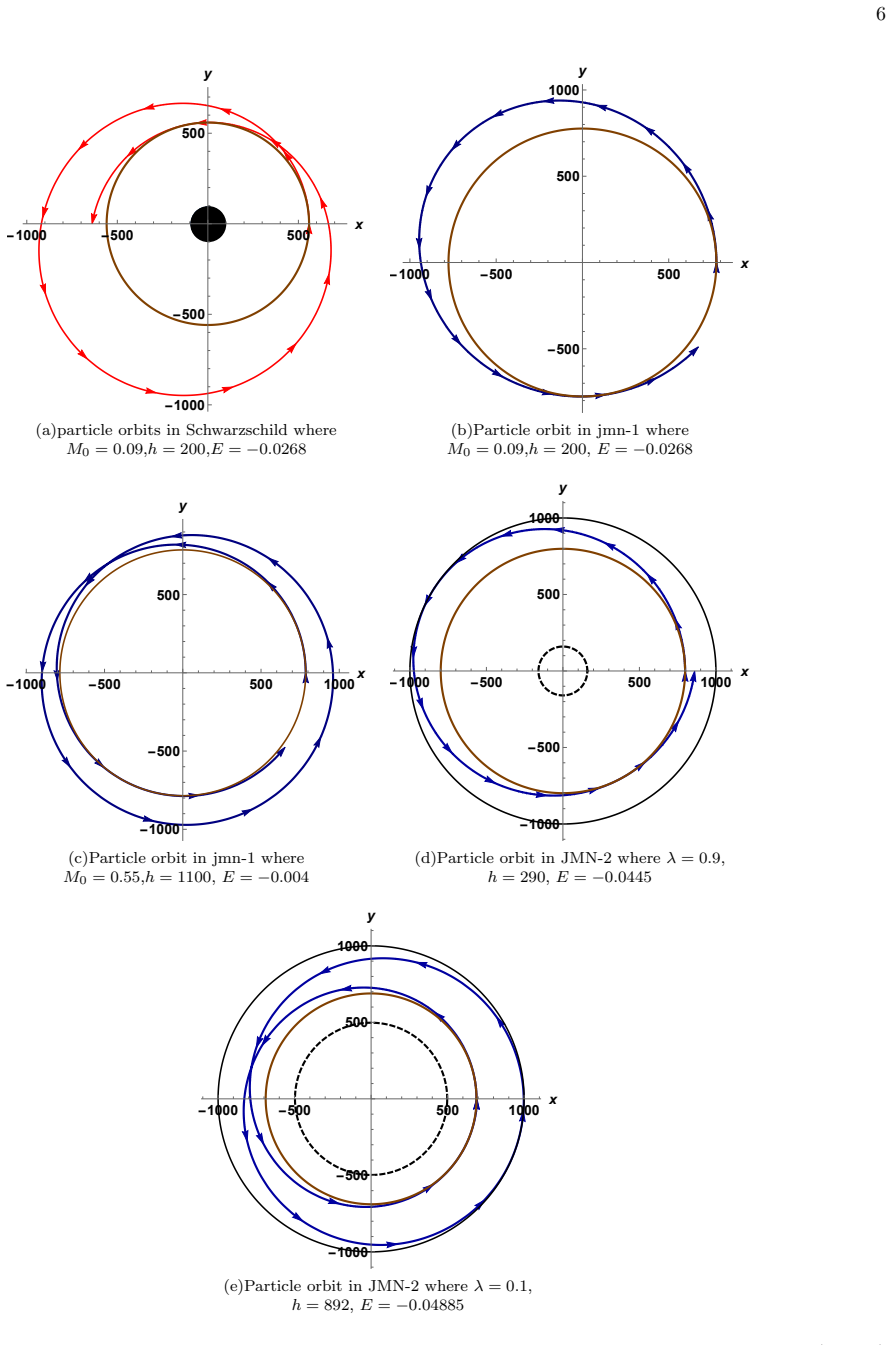
For $M_0=0.09$, $h=200$, $E=-0.0268$ in JMN-1 (the case shown in Fig. 2b), numerically integrate the exact orbit equation (28) and measure the angular separation between successive perihelion passages over several orbits; the paper's claim requires this angle to be less than $2\pi$.
Extended reading notes
Core claim
On the paper's own terms, the central discovery is a parameter-dependent precession law for bound timelike orbits in JMN-1 naked-singularity spacetime. By inserting the small-eccentricity ansatz $u = (1/p)[1+e\cos(m\varphi)]^{1/(2+\delta)}$ with $\delta = M_0/(2(1-M_0))$ into the JMN-1 orbit equation, the authors obtain $m=\sqrt{2-3M_0}$. Consequently, for $0<M_0<1/3$ the orbit reaches perihelion before completing $2\pi$ radians, so its perihelion precesses opposite to the direction of particle motion; for $1/3<M_0<2/3$ it precesses forward; and at $M_0=1/3$ there is no precession. JMN-2 likewise admits both forward and retrograde precession depending on $\lambda$, whereas Schwarzschild bound orbits, with $m=\sqrt{1-3M_0/p}$, always have $0<m<1$ and therefore always precess forward. This is presented as a naked-singularity signature absent in Schwarzschild geometry.
Load-bearing premise
The sign of the precession is computed from a first-order-in-eccentricity ansatz, so the claimed retrograde precession could disappear if higher-order eccentricity corrections change the perihelion shift.
Editorial extensions
If this is right
- In JMN-1 with $0<M_0<1/3$, a bound orbit returns to perihelion before completing $2\pi$, so the perihelion precesses opposite to the particle's motion; no such retrograde precession exists in Schwarzschild.
- For $1/3<M_0<2/3$, JMN-1 bound orbits precess forward, qualitatively like Schwarzschild, so the sign of the precession is a sharp dividing line at $M_0=1/3$.
- In both JMN spacetimes, stable circular orbits exist at any radius down to the center, unlike Schwarzschild's innermost stable circular orbit at $r=6M_{TOT}$, changing the predicted accretion disk structure.
- JMN effective potentials rise to positive infinity at the center, so a particle with angular momentum cannot reach the central singularity, while in Schwarzschild it can; bound orbits can also thread inside the Schwarzschild radius in JMN.
Reading between the lines
- The same first-order eccentricity analysis could be run on other static naked-singularity spacetimes (JNW, Bertrand) to test whether retrograde precession is a generic feature or specific to JMN models.
- The sharp boundary at $M_0=1/3$, where the precession changes sign, gives a concrete prediction that stellar-orbit monitoring near the Galactic center could in principle falsify if the central object were a JMN-1 naked singularity.
- The result is derived for test particles on geodesics; a pressure-supported accretion disk would not trace these orbits exactly, so the predicted retrograde precession applies most directly to collisionless tracers such as stars.
- The maximum retrograde angle of $254.56$ degrees arises as a limiting value as $M_0\to0$; measuring any shift beyond that in a JMN-1 model would signal a breakdown of the first-order approximation.
Signed reviews
Editorial analysis
A structured set of objections, weighed in public.
Referee Report
Summary. The paper studies bound timelike geodesics in two static, spherically symmetric naked-singularity spacetimes, JMN-1 and JMN-2, each matched at r=Rb to a Schwarzschild exterior, and compares them with pure Schwarzschild orbits. The authors construct effective potentials and orbit equations, then apply a small-eccentricity ansatz. The central result is that in JMN-1 the perihelion-to-perihelion advance is controlled by m = sqrt(2-3M0) (Eq. 35), so that for 0<M0<1/3 the orbit reaches perihelion before completing 2π (retrograde precession), while for 1/3<M0<2/3 it precesses in the forward direction like Schwarzschild. JMN-2 is claimed to exhibit both behaviors, and the paper argues that retrograde precession is a naked-singularity signature absent in Schwarzschild spacetime, with possible relevance to stellar orbits near the Galactic center.
Significance. If fully established, the paper would provide a clean, potentially observable discriminant between black-hole and naked-singularity end states of collapse: a parameter-free formula m = sqrt(2-3M0) linking the spacetime parameter M0 to the sign of perihelion precession. The derivation is not circular: the orbit and precession analysis starts from the JMN metrics and derives the geodesic equations independently, then compares with the standard Schwarzschild result. The first-order perturbative matching in the JMN-1 case is algebraically consistent, and the claimed sign change is supported by the plotted examples. The significance is currently limited by the lack of finite-eccentricity control, by unreproducible numerical figures, and by several dimensional/typographical errors in displayed equations that are used to set up the comparisons.
major comments (4)
- [§IV, Eqs. (34)-(35); §V, first bullet] The main claim is established only to first order in eccentricity. The derivation matches the O(e) terms of ansatz (34) to Eq. (33), so m = sqrt(2-3M0) is the linear epicyclic frequency. The statements in Section V that for 0<M0<1/3 all bound orbits precess opposite to the particle motion, and the finite-eccentricity orbits shown in Fig. 2, require control of O(e^2) corrections, and no such control is provided. Near M0=1/3, where the linear frequency shift vanishes, higher-order terms could in principle change the sign of the precession for moderately large eccentricity. Moreover, the paper does not report the integration scheme, the initial conditions, or convergence checks behind Figs. 2-6, so the plotted finite-eccentricity orbits are not independently reproducible. Because the observational relevance is framed through S-star-like orbits of large eccentricity, this gap is load-bearing.
- [§III.B, Eqs. (31)-(32), (37)-(38)] As printed, these formulas are dimensionally inconsistent. Since u = (1/p)[1+e cos(mφ)], p must have dimensions of length, but Eq. (31) gives p = h^2(1+sqrt(...))/(M0 Rb^2), which is dimensionless, and Eq. (32) gives m = sqrt(1 - 3M0/p), mixing a dimensionless M0 with a length p. The correct forms appear to be p = h^2(1+sqrt(1-3M0^2Rb^2/h^2))/(M0 Rb) and m = sqrt(1 - 3M0Rb/p). Similarly, inequalities (37)-(38) are misparenthesized: the text quotes for M0=0.05 a window 6.08 < Rb/h < 11.547, but the printed left side sqrt(2-3M0)/M0 is about 27.2 and the printed right side 1/sqrt(3M0) is about 2.58. The intended bounds are sqrt((2-3M0)/M0) and 1/(sqrt(3) M0). These conditions select the parameters used in Fig. 3, so the errors must be corrected before the comparison can be reproduced.
- [§IV, Eq. (34)] The displayed ansatz is garbled. As reproduced, the bracket carries an exponent 1/(2+δ) (or possibly 1/2+δ), and substituting such an ansatz into Eq. (33) does not produce Eq. (35). The matching in the paper works only when the ansatz is \tilde u = (1/p)[1+e cos(mφ)+O(e^2)], i.e. with exponent unity, which is also consistent with the stated M0 → 0 limit m → sqrt(2). The authors should correct the displayed exponent in Eq. (34).
- [§IV, JMN-2 discussion; Fig. 2(d)-(e)] The abstract and Section V claim that JMN-2 also exhibits both forward and retrograde precession, but no analytic precession factor is derived from the JMN-2 orbit equation (29), and the only evidence is the two plotted orbits in Fig. 2(d)-(e). Because no numerical method is specified, this part of the claim is not verifiable. The authors should either provide the analogous small-eccentricity derivation for JMN-2 or present reproducible numerical solutions with stated parameters and error control.
minor comments (4)
- [§III.A, Eq. (10)] The formula for h^2 is inverted: the correct expression following from V'_eff = 0 is h^2 = r^2 / (2gtt/(r gtt') - 1), or equivalently h^2 = r^2(r gtt')/(2gtt - r gtt'). The subsequent expressions in Eqs. (17), (23), and (27) are consistent with the corrected version, so this appears to be a typographical error.
- [§III.B, Eq. (18)] The displayed second derivative of the Schwarzschild effective potential has the correct sign behavior for the ISCO statement but the wrong prefactor: the exact expression is M_TOT(r - 6M_TOT)/(r^3(r - 3M_TOT)), not 2M_TOT(6M_TOT - r)/(r(3M_TOT - r)). Since only the sign is used, this does not affect the ISCO conclusion, but the formula should be fixed.
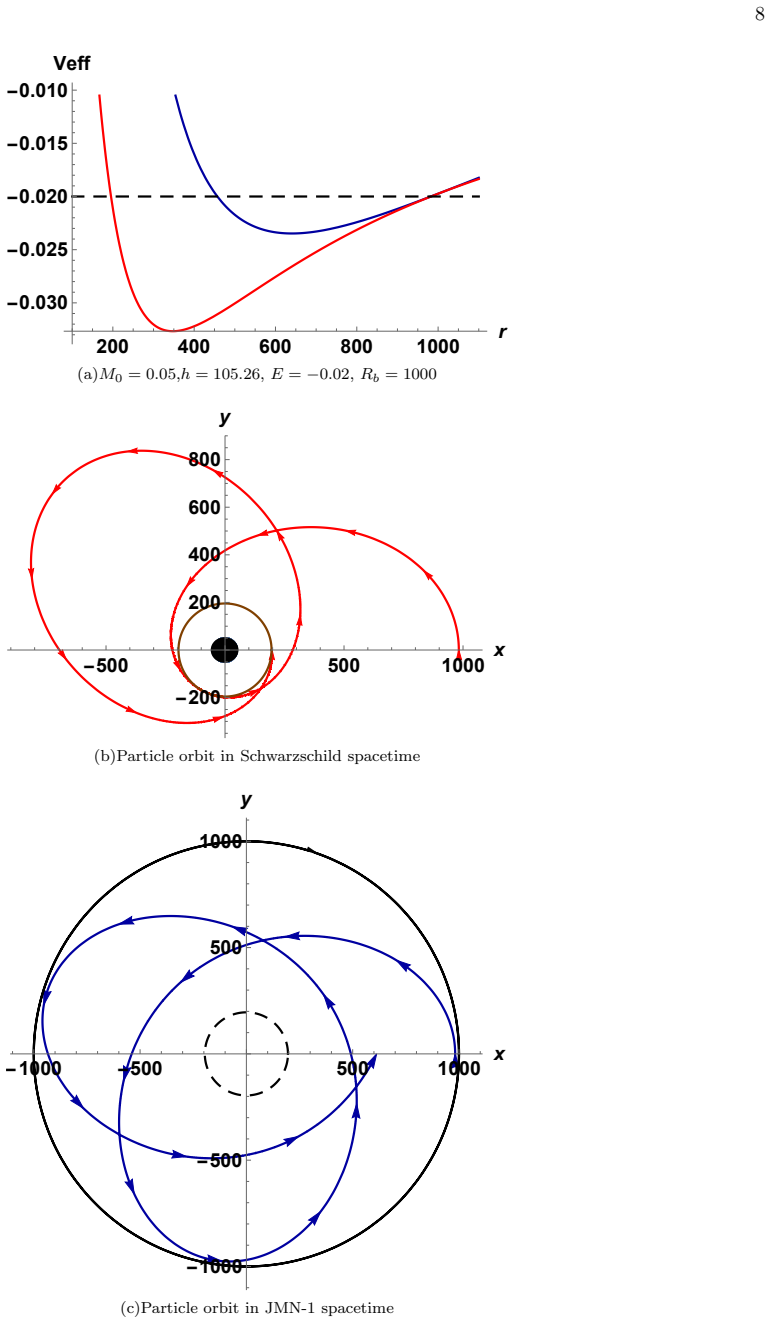
- [§IV, around Fig. 4] The sentence introducing Fig. 4 says a particle with energy E=-0.015 cannot have its whole orbit inside Rb and refers to Fig. 3, but Fig. 3 uses E=-0.02; the text should be reworded to state the intended energy and figure.
- [§II, Eq. (39)] Inequality (39) has the same missing-parentheses problem as Eqs. (37)-(38); the bounds should presumably read sqrt((1+λ^2)/(1-λ^2)) < Rb/h < (2-λ^2)/sqrt(3(1-λ^2)).
Circularity Check
No significant circularity: the JMN precession factor is solved from the stated orbit equations using an external ansatz; inherited JMN metric inputs are not outputs of this derivation.
full rationale
The central derivation chain starts from explicit JMN-1/JMN-2 line elements (Eqs. 1-2) and the general spherically symmetric orbit equation (13). The bound-orbit precession factor for JMN-1, m = sqrt(2 - 3M0) (Eq. 35), is obtained by substituting the small-eccentricity ansatz (34), attributed to Struck (refs [46],[47]), into the JMN-1 orbit equation (28) and matching terms at first order in e. There is no fitted parameter: p and m are solved from the stated ODE, and the metric parameters are fixed by the line element. The Schwarzschild comparison (Eqs. 30-32) is derived from the standard first-order orbit equation (19) and yields the usual 6pi M_TOT^2/h^2 weak-field precession. The JMN metrics themselves are inherited from earlier collapse papers, including some by the present authors, but this is an input assumption about the spacetime geometry, not an output of the precession calculation; the precession result is independent of those papers' claims. The small-eccentricity limitation, and the lack of an O(e^2) control, is a correctness/rigor concern for finite-eccentricity figures and observational claims, not a circularity: the linear result is honestly derived from the stated approximation and the paper explicitly says the solution is valid only after neglecting second and higher order eccentricity contributions. No step quotes a uniqueness theorem, no result is defined in terms of itself, and no fitted quantity is later renamed as a prediction. Therefore the derivation is self-contained with respect to circularity concerns.
Assumptions & free parameters
free parameters (3)
- M0 =
not fitted; example values 0.05, 0.09, 0.55, 0.62, 0.65
- lambda =
not fitted; example values 0.1, 0.9
- h =
not fitted; example values 20, 200, 290, 892, 1100, 1250
assumptions (4)
- domain assumption JMN-1 and JMN-2 line elements are valid static solutions of Einstein's equations and can be matched to Schwarzschild at r=Rb via junction conditions.
- domain assumption The JMN spacetimes can form as asymptotic end states of quasi-static gravitational collapse without trapped surfaces forming.
- domain assumption The small-eccentricity approximate solution ansatz (34), imported from Struck, accurately represents bound orbits of the exact JMN orbit equations.
- domain assumption Test particles follow timelike geodesics and do not backreact on the spacetime; the interior JMN metric applies for r<=Rb.
Cite this review
Pith. "Pith review of Timelike geodesics in Naked Singularity and Black Hole Spacetimes." pith.science (2026). https://pith.science/paper/OOB2AWMY
@misc{pith2026190807171,
  author       = {Pith},
  title        = {Pith review of: Timelike geodesics in Naked Singularity and Black Hole Spacetimes},
  year         = {2026},
  howpublished = {\url{https://pith.science/paper/OOB2AWMY}},
  note         = {Machine review of arXiv:1908.07171}
}
read the original abstract
In this paper, we derive the solutions of orbit equations for a class of naked singularity spacetimes, and compare these with timelike orbits, that is, particle trajectories in the Schwarzschild black hole spacetime. The Schwarzschild and naked singularity spacetimes considered here can be formed as end state of a spherically symmetric gravitational collapse of a matter cloud. We find and compare the perihelion precession of the particle orbits in the naked singularity spacetime with that of the Schwarzschild black hole. We then discuss different distinguishable physical properties of timelike orbits in the black hole and naked singularity spacetimes and implications are discussed. Several interesting differences follow from our results, including the conclusion that in naked singularity spacetimes, particle bound orbits can precess in the opposite direction of particle motion, which is not possible in Schwarzschild spacetime.
Figures

Figures from the paper (3 more)


Reference graph
Works this paper leans on
-
[1]
The induced metrics of internal and external space- times on the matching hypersurface should be iden- tical with each other. One can see that this is sat- isfied for the above two metrices (1), (2) at the timelike hypersurface r = Rb. From the induced metric matching we get, M0 = 1−λ2 2−λ2 , for JMN-2
-
[2]
Another condition is to match the extrinsic cur- vatures (Kab) at the hypersurface. Extrinsic cur- vature can be expressed in terms of the covariant derivative of normal vectors on the hypersurface: Kab = eα aeβ b∇αηβ, where eα a is the tangent vectors on the hypersurface and ηβ is the normal to that hypersurface. One can show that due to the zero radial ...
work page 2000
-
[3]
Con- sequently, the nature of the orbits also changes across M0 = 1
one 2 π rotation. Con- sequently, the nature of the orbits also changes across M0 = 1
-
[4]
In JMN-2, also we can have two type of precession
For M0 < 1 3, the orbit precesses in the oppo- site direction of particle motion, whereas, for M0 > 1 3 we get Schwarzschild like precession. In JMN-2, also we can have two type of precession. In fig. (2), we show all these properties of orbits in JMN-1 and JMN-2 and compare it with the orbits in Schwarzschild spacetime. In that fig- ure, it can be seen tha...
-
[5]
Therefore, in this limit, in JMN-1 spacetime, parti- cle reaches to the perihelion point after 254.56 degrees of rotation. As we previously mentioned, in this paper we pedagog- ically compare the bound orbits in Schwarzschild space- times and bound orbits in a spacetime structure where it is internally JMN-1 or JMN-2, externally matched to a Schwarzschild...
work page 2000
-
[6]
J. R. Oppenheimer and H. Snyder, Phys. Rev. 56, 455 (1939)
1939
-
[7]
Datt, Zs
S. Datt, Zs. f. Phys. 108, 314 (1938)
1938
-
[9]
F. C. Mena, R. K. Tavakol and P. S. Joshi, Phys. Rev. D 62, 044001 (2000)
work page 2000
Show all 52 references
-
[10]
Jhingan, P
S. Jhingan, P. S.Joshi and T. P. Singh, Class. Quant. Grav. 13, 3057 (1996)
1996
-
[11]
T. P. Singh and P. S. Joshi, Class. Quant. Grav. 13, 559 (1996)
1996
-
[12]
P. S. Joshi, D. Malafarina and R. Narayan, Class. Quant. Grav. 28, 235018 (2011)
2011
-
[13]
P. S. Joshi, D. Malafarina and R. Narayan, Class. Quant. Grav. 31, 015002 (2014)
2014
-
[14]
Banik, D
U. Banik, D. Dey, K. Bhattacharya and T. Sarkar, Gen. Rel. Grav. 49, no. 9, 116 (2017)
2017
-
[15]
S. D. M. White and D. Q. Liu, The Origin And Evo- lution Of Structures In A Universe Dominated By Cold Dark Matter, Tuxni, Proceedings, Origin, structure and 14 evolution of galaxies, 281 (1987)
1987
-
[16]
J. E. Gunn and J. R. Gott III, ApJ 176, 1 (1972)
1972
-
[17]
C. J. Hogan, N. Kaiser, M. S. Turner, N. Vittorio and S. D. M. White, FERMILAB-CONF-85-057-A
-
[18]
Kovacs and T
Z. Kovacs and T. Harko, Phys. Rev. D82, 124047 (2010)
2010
-
[19]
Shaikh, P
R. Shaikh, P. Kocherlakota, R. Narayan and P. S. Joshi, Mon. Not. Roy. Astron. Soc. 482, no. 1, 52 (2019)
2019
-
[20]
Akiyama et al
K. Akiyama et al. [Event Horizon Telescope Collabora- tion], Astrophys. J. 875, no. 1, L5 (2019)
2019
-
[21]
D. Dey, K. Bhattacharya and T. Sarkar, Phys. Rev. D 88, 083532 (2013)
2013
-
[22]
D. Dey, K. Bhattacharya and T. Sarkar, Phys. Rev. D 87, 10, 103505 (2013)
2013
-
[23]
Gyulchev, P
G. Gyulchev, P. Nedkova, T. Vetsov and S. Yazadjiev, arXiv:1905.05273 [gr-qc]
1905 arXiv
-
[24]
S. Zhou, R. Zhang, J. Chen and Y. Wang, Int. J. Theor. Phys. 54, no. 8, 2905 (2015)
2015
-
[25]
Levin, Class
J. Levin, Class. Quant. Grav. 26, 235010 (2009)
2009
-
[26]
Janna Levin and Rebecca Grossman, Phys. Rev. D 79, 043016 (2009)
2009
-
[27]
Janna Levin and Gabe Perez-Giz, Phys. Rev. D 77, 103005 (2008)
2008
-
[28]
Glampedakis and D
K. Glampedakis and D. Kennefick, Phys. Rev. D 66, 044002 (2002)
2002
-
[29]
D. S. Chu et al. , Astrophys. J. 863, no. 1, 111 (2018)
2018
-
[30]
V. I. Dokuchaev, Y. N. Eroshenko and K. S. Klimkov, Phys. Procedia 74, 292 (2015)
2015
-
[31]
Borka, P
D. Borka, P. Jovanovic, V. B. Jovanovic and A. F. Za- kharov, Phys. Rev. D 85, 124004 (2012)
2012
-
[32]
Martnez, N
C. Martnez, N. Parra, N. Valds and J. Zanelli, arXiv:1902.00145 [hep-th],(2019)
2019 arXiv
-
[33]
Fujita and W
R. Fujita and W. Hikida, Class. Quant. Grav. 26, 135002 (2009)
2009
-
[34]
Y. Wang, X. Liu, N. Yang and J. Jia, arXiv:1903.12486v1 [gr-qc]
1903 arXiv
-
[35]
Suzuki and K
S. Suzuki and K. i. Maeda, Phys. Rev. D 58, 023005 (1998) Phys. Rev. D 58, 023005 (1998)
1998
-
[36]
Zhang and W
M. Zhang and W. B. Liu, Phys. Lett. B 789, 393 (2019)
2019
-
[37]
Pugliese, H
D. Pugliese, H. Quevedo and R. Ruffini, Phys. Rev. D 88, no. 2, 024042 (2013)
2013
-
[38]
Farina, J
C. Farina, J. Gamboa and A. J. Segui-Santonja, Class. Quant. Grav. 10, L193 (1993)
1993
-
[39]
Dasgupta, H
A. Dasgupta, H. Nandan and S. Kar, Phys. Rev. D 85, 104037 (2012)
2012
-
[40]
A. A. Shoom, C. Walsh and I. Booth, Phys. Rev. D 93, no. 6, 064019 (2016)
2016
-
[41]
Gravity Collaboration and Abuter et al. app. 618 L10
-
[42]
Eisenhauer et al
F. Eisenhauer et al. , Astrophys. J. 628, 246 (2005)
2005
-
[43]
Gillessen et al
S. Gillessen et al. , Astrophys. J. 837, 30 (2017)
2017
-
[44]
P. S. Joshi and I. H. Dwivedi, Phys. Rev. D 47, 5357 (1993)
1993
-
[45]
Satin, D
S. Satin, D. Malafarina and P. S. Joshi, Int. J. Mod. Phys. D 25, 1650023 (2016)
2016
-
[46]
P. S. Joshi and D. Malafarina, Int. J. Mod. Phys. D 20, 2641 (2011)
2011
-
[47]
R. C. Tolman, Proc. Natl. Acad. Sci. USA. , 20(3), 169176, 1934
1934
-
[48]
Dey and P
D. Dey and P. S. Joshi, AJM, 2019
2019
-
[49]
D. Dey, P. Kocherlakota and P. S. Joshi, arXiv:1907.12792 [gr-qc]
1907 arXiv
-
[50]
Arnowitt, S
R. Arnowitt, S. Deser, C. W. Misner, Phys. Rev. 116, 1322 (1959)
1959
-
[51]
Struck, Astron
C. Struck, Astron. J. 131, 1347 (2006)
2006
-
[52]
Struck, Monthly Notices of the Royal Astronomical Society, 446, 3139-3149 (2014)
C. Struck, Monthly Notices of the Royal Astronomical Society, 446, 3139-3149 (2014)
2014
-
[53]
A. B. Joshi, P. Bambhaniya, D. Dey, P.S. Joshi, in prepa- ration
Reviewed August 14, 2026 · model on record in the stance chip above.
Discussion (0). Continue with ORCID to comment.