REVIEW 3 major objections 5 minor 39 references
Human Mesh Recovery from Monocular Images via a Skeleton-disentangled Representation
T0 review · 3 major / 5 minor · reviewed 2026-08-14 · deepseek-v4-flash
Pith's one-line read Disentangling the skeleton from body details cuts 3D human mesh recovery error by 15.4% on Human3.6M and sets state-of-the-art on in-the-wild 3DPW without fine-tuning.
desk verdict Solid empirical advance in human mesh recovery whose headline numbers hinge on an underspecified test-time batch-normalization protocol, so the verdict is conditional until that is clarified. read the letter →
The pith
A machine-rendered reading of the paper's core claim, the machinery that carries it, and where it could break.
The reading
What carries the argument
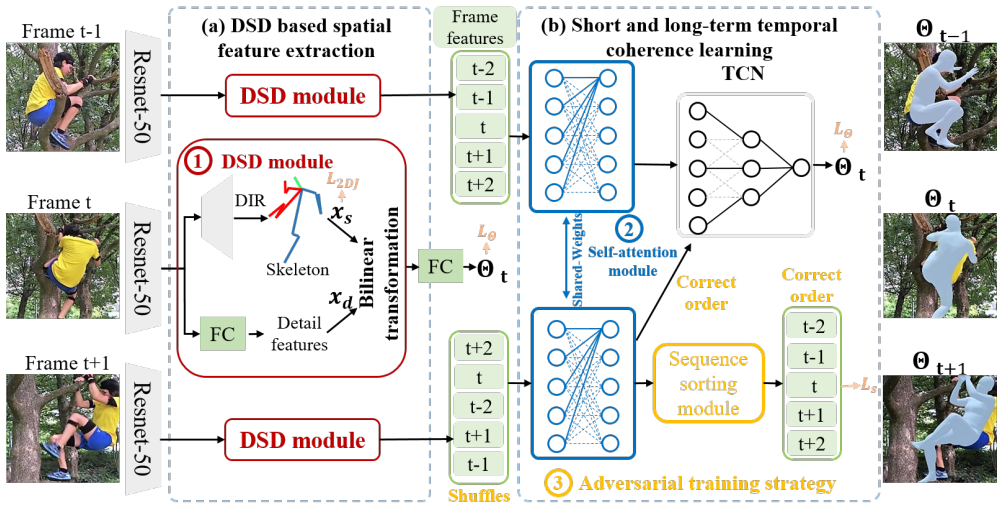
The load-bearing mechanism is the DSD (disentangling the skeleton from the details) module. It is a two-branch feature extractor: one branch produces 2D/3D skeleton joint coordinates from heatmaps via differentiable integral regression, and the other produces a detailed feature vector; the two are fused by the bilinear transformation $y = x_s A x_d^T$, which the paper uses specifically because bilinear models are known to separate two factors (style and content). The accompanying temporal machinery is the SATN, which inserts a multi-head self-attention layer before a temporal convolution network so that associations between any two frames are established in a single step, and an adversarial sequence-sorting branch that recovers the original order of shuffled frame features as an unsupervised training signal for motion dynamics. The DSD features are what feed both the self-attention and the TCN, and the paper's ablations show that replacing them with backbone features nearly eliminates the temporal gain.
What would settle it
Run the released DSD+SATN model and the HMR-video baseline on Human3.6M and 3DPW with batch-normalization running statistics active at test time (instead of discarding them), and check whether PA-MPJPE stays near 42.4 mm on Human3.6M and still beats HMR-video by double digits; if the margin collapses, the central claim is an artifact of the test-time protocol.
Extended reading notes
Core claim
The paper's central claim is that separating the skeleton from the body's remaining shape and pose details in feature space makes 3D human mesh recovery substantially more accurate, and that this separation is what enables effective temporal modeling. On a single frame, the DSD module replaces direct or concatenated regression by estimating skeleton joint coordinates with differentiable integral regression, extracting a separate detail feature, and fusing them through the bilinear transformation $y = x_s A x_d^T$; this alone brings the Human3.6M PA-MPJPE from HMR's 58.1 mm down to 44.3 mm. Adding the self-attention temporal network and the adversarial order-recovery task improves this further to 42.4 mm PA-MPJPE and 59.1 mm MPJPE, which the paper reports as a 15.4% MPJPE and 23.8% PA-MPJPE improvement over the previous state of the art, with state-of-the-art PA-MPJPE on 3DPW without fine-tuning. The paper's ablations attribute the largest part of the temporal gain to the skeleton-disentangled representation rather than to the temporal architecture alone.
Load-bearing premise
The load-bearing premise is that evaluating with batch-normalization parameters discarded at test time is a fair protocol; if that protocol helps the proposed model more than it helps the compared baselines, the reported margins over HMR-video and previous methods may overstate the real improvement.
Editorial extensions
If this is right
- A pluggable DSD module could be inserted into existing 2D/3D pose estimation networks to turn them into 3D mesh recovery systems, as the paper claims it is portable.
- Putting self-attention before temporal convolution lets a shallow TCN access long-range frame relationships, so temporal modeling no longer needs many stacked layers to relate distant frames.
- The adversarial frame-order recovery loss provides temporal supervision without 3D ground-truth labels for motion dynamics, which is useful when annotated video is scarce.
- If the numbers hold, a model trained only on constrained indoor data (Human3.6M) can outperform a model trained on nearly 20x more internet video (HMR-video-L) on in-the-wild 3DPW, suggesting good representation design can offset data hunger.
Reading between the lines
- Beyond the paper, the finding suggests that any 3D mesh or pose network could adopt the same two-branch skeleton/detail split, since the DSD module is described as pluggable; a direct test would be inserting it into another mesh network and measuring the gain.
- The paper leaves batch-normalization statistics out of the evaluation; an editorial check would be rerunning the released model with BN statistics active to see whether the margin over HMR-video is robust.
- The temporal-order sorting objective is taught with soft Gaussian labels to handle near-identical neighboring frames; the same trick could transfer to other self-supervised sequence tasks where order is ambiguous, though the paper only demonstrates it for mesh recovery.
Signed reviews
Editorial analysis
A structured set of objections, weighed in public.
Referee Report
Summary. The paper proposes an end-to-end framework for 3D human mesh recovery from single images and monocular videos. Spatially, a DSD module extracts skeleton and detail features and combines them with a bilinear transformation to produce a disentangled representation. Temporally, the SATN module applies self-attention before a temporal convolutional network and adds an auxiliary sequence-sorting task to supervise motion dynamics. The authors claim state-of-the-art results on Human3.6M and 3DPW, with headline improvements of 15.4% MPJPE and 23.8% PA-MPJPE over prior mesh-recovery methods, and provide ablations supporting the role of the DSD representation.
Significance. If the empirical claims hold, the paper offers a simple, pluggable architectural module and a temporal model that improve both accuracy and smoothness of mesh recovery, with released code. The ablation design, especially the comparison of Direct, Concat, and DSD, directly targets the coupling problem and gives a clear way to test the contribution of disentanglement. The temporal-order auxiliary task is a reasonable self-supervised mechanism. No equation-level circularity is apparent in the derivation. However, the main significance depends on the validity of the experimental comparisons, which are currently threatened by an ambiguous test-time batch-normalization protocol and by missing uncertainty measures.
major comments (3)
- [Section 4.2] Section 4.2 states that 'we discard the hyper-parameters of the batch normalization layers during the evaluation' because of the train/test domain gap, but the paper never defines what 'discard' means operationally: whether gamma and beta are set to identity, whether running statistics are ignored, or whether batch statistics are recomputed at test time. It also does not state whether the same protocol is applied to the HMR, HMR-video, HMR-video-L, and STN baselines in Tables 1 and 2. Because batch normalization can materially change predictions and can make results depend on test-batch composition, the headline improvements (15.4% MPJPE, 23.8% PA-MPJPE, and the 3DPW gains) may reflect an asymmetric evaluation protocol rather than a better model. The authors should report results under standard batch-normalization inference for their method and either apply the identical protocol to all baselines or justify why the protocol is method-independent.
- [Abstract and Section 4.3] The abstract's claim that the method 'outperforms the state-of-the-art 3D human mesh recovery methods by 15.4% MPJPE and 23.8% PA-MPJPE' mixes two different baselines: the 15.4% MPJPE improvement is relative to STN (69.9 to 59.1 in Table 2), while the 23.8% PA-MPJPE improvement is relative to HMR-video-L (55.7 to 42.4). This makes the headline number misleading and prevents a reader from knowing which comparison is being claimed. The abstract and the comparison paragraph should state the reference method for each percentage, or a single consistent baseline should be used.
- [Tables 2 and 3] All experimental results are single-run numbers with no error bars, seeds, or variance information. This is especially problematic for the central comparisons: the gap between DSD+TCN+Self-attention (59.6/43.4) and DSD+SATN (59.1/42.4) is less than one millimeter in MPJPE, and the claimed advantage over HMR-video-L on 3DPW is about one to three millimeters. Without repeated runs or a statistical test, the reader cannot determine whether these differences are meaningful. Please report means and standard deviations over at least three seeds and clarify how many subjects/sequences are used for each reported number.
minor comments (5)
- [Section 3.3] The paper says 'from n (n = 5 in Figure 2) frame features' but later describes the sequence sorting module as operating on 'a tuple of 9 shuffled frames' and the receptive field is said to be 9 frames. Please reconcile the notation and the figure.
- [Section 3.3] The term 'unsupervised adversarial training strategy' is potentially confusing, because the proposed order-recovery objective is a self-supervised auxiliary loss rather than an adversarial discriminator loss. Consider renaming it to 'self-supervised temporal order recovery' for clarity.
- [Section 3.4] The loss L2DJ for supervising the 2D skeleton coordinates in DSD is mentioned in the text but is not included in Equation (5), and its weight is not given. Please make the complete training objective explicit.
- [Introduction and Section 4.4] The introduction claims that DSD is 'pluggable' into other 2D/3D pose estimation networks, but the experiments only evaluate DSD in the authors' own architecture by replacing the bilinear aggregation with concatenation. A direct plug-in experiment into an existing public pose network would support the claim.
- [Table 1] The column headers 'Train Test val' mix capitalization and the meaning of the 'Train' column is unclear for methods that were not trained on 3DPW. Please clarify whether 'Train' denotes evaluation on the training split or something else.
Circularity Check
No significant circularity: DSD+SATN is evaluated against external benchmarks and no prediction reduces to an input by construction.
full rationale
The paper's central claims are empirical: the DSD+SATN framework is trained on external datasets (Human3.6M, MPII, LSP, AICH, Penn Action) and evaluated on held-out test splits of Human3.6M and 3DPW. The mesh parameters are supervised through the losses in Eq. (5)-(7), which relate predictions to ground-truth SMPL parameters, 3D joints, and 2D projections; none of these equations defines the predicted quantity in terms of the reported result. The temporal order-recovery auxiliary task uses the ground-truth frame order as supervision for the sequence sorting module, and its output is not used as the mesh prediction, so it does not smuggle the target into the training signal. The ablation comparisons (Direct, Concat, DSD, DSD+SATN) are genuine architectural ablations trained under the same protocol, not renamings of a fitted parameter. Self-citations appear only in the introduction/related work for action recognition applications (refs. [10, 11, 19, 20, 23]) and are not load-bearing for the mesh-recovery claim. One evaluation concern is stated in Section 4.2: 'we discard the hyper-parameters of the batch normalization layers during the evaluation.' This is a potentially asymmetric test-time protocol relative to baselines and is a correctness/comparability risk, but it is not a circularity: it does not make any prediction equivalent to an input by construction. No self-definitional step, fitted-input-called-prediction step, or author-imported uniqueness constraint was found, so the honest finding is no significant circularity.
Assumptions & free parameters
free parameters (2)
- loss weights =
wpm=20, wr=0.6, w2d=10, w3d=60
- temporal receptive field =
9 frames
assumptions (4)
- domain assumption SMPL provides a fixed differentiable mapping M(beta, theta) to a 6890-vertex mesh with a linear joint regressor P3d
- domain assumption Weak-perspective camera model is sufficient for projecting 3D joints to 2D for supervision
- domain assumption Bilinear transformation with a learnable tensor A can separate skeleton from detail features without losing task-relevant information
- domain assumption Temporal order recovery from shuffled frame features provides a valid self-supervision signal for learning motion dynamics
Cite this review
Pith. "Pith review of Human Mesh Recovery from Monocular Images via a Skeleton-disentangled Representation." pith.science (2026). https://pith.science/paper/TVXGO7D5
@misc{pith2026190807172,
  author       = {Pith},
  title        = {Pith review of: Human Mesh Recovery from Monocular Images via a Skeleton-disentangled Representation},
  year         = {2026},
  howpublished = {\url{https://pith.science/paper/TVXGO7D5}},
  note         = {Machine review of arXiv:1908.07172}
}
read the original abstract
We describe an end-to-end method for recovering 3D human body mesh from single images and monocular videos. Different from the existing methods try to obtain all the complex 3D pose, shape, and camera parameters from one coupling feature, we propose a skeleton-disentangling based framework, which divides this task into multi-level spatial and temporal granularity in a decoupling manner. In spatial, we propose an effective and pluggable "disentangling the skeleton from the details" (DSD) module. It reduces the complexity and decouples the skeleton, which lays a good foundation for temporal modeling. In temporal, the self-attention based temporal convolution network is proposed to efficiently exploit the short and long-term temporal cues. Furthermore, an unsupervised adversarial training strategy, temporal shuffles and order recovery, is designed to promote the learning of motion dynamics. The proposed method outperforms the state-of-the-art 3D human mesh recovery methods by 15.4% MPJPE and 23.8% PA-MPJPE on Human3.6M. State-of-the-art results are also achieved on the 3D pose in the wild (3DPW) dataset without any fine-tuning. Especially, ablation studies demonstrate that skeleton-disentangled representation is crucial for better temporal modeling and generalization.
Figures

Figures from the paper (1 more)

Reference graph
Works this paper leans on
-
[1]
CMU graphics lab motion capture database
-
[2]
2d human pose estimation: New benchmark and state of the art analysis
Mykhaylo Andriluka, Leonid Pishchulin, Peter Gehler, and Bernt Schiele. 2d human pose estimation: New benchmark and state of the art analysis. In IEEE Conference on Com- puter Vision and Pattern Recognition, CVPR, 2014
work page 2014
-
[3]
Zico Kolter, and Vladlen Koltun
Shaojie Bai, J. Zico Kolter, and Vladlen Koltun. An em- pirical evaluation of generic convolutional and recurrent net- works for sequence modeling. arXiv:1803.01271, 2018
arXiv 2018
-
[4]
Keep it smpl: Automatic estimation of 3D human pose and shape from a single image
Federica Bogo, Angjoo Kanazawa, Christoph Lassner, Peter Gehler, Javier Romero, and Michael J Black. Keep it smpl: Automatic estimation of 3D human pose and shape from a single image. In European Conference on Computer Vision, ECCV, 2016
work page 2016
-
[5]
Learning 3d hu- man pose from structure and motion
Rishabh Dabral, Anurag Mundhada, Uday Kusupati, Safeer Afaque, Abhishek Sharma, and Arjun Jain. Learning 3d hu- man pose from structure and motion. In European Confer- ence on Computer Vision, ECCV, 2018
work page 2018
-
[6]
Towards multi-pose guided virtual try-on network
Haoye Dong, Xiaodan Liang, Xiaohui Shen, Bochao Wang, Hanjiang Lai, Jia Zhu, Zhiting Hu, and Jian Yin. Towards multi-pose guided virtual try-on network. In IEEE Interna- tional Conference on Computer Vision, ICCV, 2019
work page 2019
-
[7]
Flow-navigated warping gan for video virtual try-on
Haoye Dong, Xiaodan Liang, Xiaohui Shen, Bowen Wu, Bing-Cheng Chen, and Jian Yin. Flow-navigated warping gan for video virtual try-on. In IEEE International Confer- ence on Computer Vision, ICCV, 2019
work page 2019
-
[8]
Self-supervised video representation learn- ing with odd-one-out networks
Basura Fernando, Hakan Bilen, Efstratios Gavves, and Stephen Gould. Self-supervised video representation learn- ing with odd-one-out networks. In IEEE Conference on Computer Vision and Pattern Recognition, CVPR, 2017
work page 2017
Show all 39 references
-
[9]
Learning bi- linear models for two-factor problems in vision
William T Freeman and Joshua B Tenenbaum. Learning bi- linear models for two-factor problems in vision. In IEEE Conference on Computer Vision and Pattern Recognition, CVPR, 1997
1997
-
[10]
Devnet: A deep event network for mul- timedia event detection and evidence recounting
Chuang Gan, Naiyan Wang, Yi Yang, Dit-Yan Yeung, and Alex G Hauptmann. Devnet: A deep event network for mul- timedia event detection and evidence recounting. In IEEE Conference on Computer Vision and Pattern Recognition, CVPR, 2015
2015
-
[11]
Recognizing an action using its name: A knowledge-based approach
Chuang Gan, Yi Yang, Linchao Zhu, Deli Zhao, and Yuet- ing Zhuang. Recognizing an action using its name: A knowledge-based approach. International Journal of Com- puter Vision, 2016
2016
-
[12]
Deep residual learning for image recognition
Kaiming He, Xiangyu Zhang, Shaoqing Ren, and Jian Sun. Deep residual learning for image recognition. In IEEE Con- ference on Computer Vision and Pattern Recognition, CVPR, 2016
2016
-
[13]
Exploiting temporal information for 3d human pose estimation
Mir Rayat Imtiaz Hossain and James J Little. Exploiting temporal information for 3d human pose estimation. In Eu- ropean Conference on Computer Vision, ECCV, 2018
2018
-
[14]
Clustered pose and nonlinear appearance models for human pose estimation
Sam Johnson and Mark Everingham. Clustered pose and nonlinear appearance models for human pose estimation. In Proceedings of the British Machine Vision Conference, 2010
2010
-
[15]
Black, David W
Angjoo Kanazawa, Michael J. Black, David W. Jacobs, and Jitendra Malik. End-to-end recovery of human shape and pose. In IEEE Conference on Computer Vision and Pattern Recognition, CVPR, 2018
2018
-
[16]
Learning 3d human dynamics from video.IEEE Con- ference on Computer Vision and Pattern Recognition, CVPR, 2019
Angjoo Kanazawa, Jason Zhang, Panna Felsen, and Jitendra Malik. Learning 3d human dynamics from video.IEEE Con- ference on Computer Vision and Pattern Recognition, CVPR, 2019
2019
-
[17]
Unite the peo- ple: Closing the loop between 3d and 2d human representa- tions
Christoph Lassner, Javier Romero, Martin Kiefel, Federica Bogo, Michael J Black, and Peter V Gehler. Unite the peo- ple: Closing the loop between 3d and 2d human representa- tions. In IEEE Conference on Computer Vision and Pattern Recognition, CVPR, 2017
2017
-
[18]
Unsupervised representation learning by sort- ing sequences
Hsin-Ying Lee, Jia-Bin Huang, Maneesh Singh, and Ming- Hsuan Yang. Unsupervised representation learning by sort- ing sequences. In IEEE International Conference on Com- puter Vision, ICCV, 2017
2017
-
[19]
T-c3d: Temporal convolutional 3d network for real- time action recognition
Kun Liu, Wu Liu, Chuang Gan, Mingkui Tan, and Huadong Ma. T-c3d: Temporal convolutional 3d network for real- time action recognition. In Thirty-second AAAI conference on artificial intelligence, 2018
2018
-
[20]
Accurate estimation of human body orientation from rgb-d sensors
Wu Liu, Yongdong Zhang, Sheng Tang, Jinhui Tang, Richang Hong, and Jintao Li. Accurate estimation of human body orientation from rgb-d sensors. IEEE Transactions on cybernetics, 2013
2013
-
[21]
Mosh: Motion and shape capture from sparse markers
Matthew Loper, Naureen Mahmood, and Michael J Black. Mosh: Motion and shape capture from sparse markers. ACM Transactions on Graphics, TOG, 2014
2014
-
[22]
Matthew Loper, Naureen Mahmood, Javier Romero, Gerard Pons-Moll, and Michael J. Black. SMPL: A skinned multi- person linear model. ACM Transactions on Graphics, TOG, 2015
2015
-
[23]
A progressive search paradigm for the internet of things
Huadong Ma and Wu Liu. A progressive search paradigm for the internet of things. IEEE MultiMedia, 2017
2017
-
[24]
Julieta Martinez, Rayat Hossain, Javier Romero, and James J. Little. A simple yet effective baseline for 3d hu- man pose estimation. In IEEE International Conference on Computer Vision, ICCV, 2017
2017
-
[25]
Shuf- fle and learn: unsupervised learning using temporal order verification
Ishan Misra, C Lawrence Zitnick, and Martial Hebert. Shuf- fle and learn: unsupervised learning using temporal order verification. In European Conference on Computer Vision, ECCV, 2016
2016
-
[26]
Neural body fitting: Unifying deep learning and model based human pose and shape es- timation
Mohamed Omran, Christoph Lassner, Gerard Pons-Moll, Pe- ter Gehler, and Bernt Schiele. Neural body fitting: Unifying deep learning and model based human pose and shape es- timation. In IEEE International Conference on 3D Vision, 3DV, 2018
2018
-
[27]
Learning to estimate 3D human pose and shape from a single color image
Georgios Pavlakos, Luyang Zhu, Xiaowei Zhou, and Kostas Daniilidis. Learning to estimate 3D human pose and shape from a single color image. In IEEE Conference on Computer Vision and Pattern Recognition, CVPR, 2018
2018
-
[28]
3d human pose estimation in video with temporal convolutions and semi-supervised training
Dario Pavllo, Christoph Feichtenhofer, David Grangier, and Michael Auli. 3d human pose estimation in video with temporal convolutions and semi-supervised training. arXiv preprint arXiv:1811.11742, 2018
2018 arXiv
-
[29]
Sfv: Reinforcement learning of physical skills from videos
Xue Bin Peng, Angjoo Kanazawa, Jitendra Malik, Pieter Abbeel, and Sergey Levine. Sfv: Reinforcement learning of physical skills from videos. In ACM SIGGRAPH Asia 2018 Technical Papers, 2018
2018
-
[30]
Self- supervised learning of pose embeddings from spatiotempo- ral relations in videos
Omer Sumer, Tobias Dencker, and Bjorn Ommer. Self- supervised learning of pose embeddings from spatiotempo- ral relations in videos. In IEEE International Conference on Computer Vision, ICCV, 2017
2017
-
[31]
Integral human pose regression
Xiao Sun, Bin Xiao, Fangyin Wei, Shuang Liang, and Yichen Wei. Integral human pose regression. In European Confer- ence on Computer Vision, ECCV, 2018
2018
-
[32]
Self-supervised learning of motion capture
Hsiao-Yu Tung, Hsiao-Wei Tung, Ersin Yumer, and Katerina Fragkiadaki. Self-supervised learning of motion capture. In Advances in Neural Information Processing Systems, NIPS , 2017
2017
-
[33]
Attention is all you need
Ashish Vaswani, Noam Shazeer, Niki Parmar, Jakob Uszko- reit, Llion Jones, Aidan N Gomez, Łukasz Kaiser, and Illia Polosukhin. Attention is all you need. In Advances in Neural Information Processing Systems, NIPS, 2017
2017
-
[34]
Recovering accurate 3d human pose in the wild using imus and a moving camera
Timo von Marcard, Roberto Henschel, Michael Black, Bodo Rosenhahn, and Gerard Pons-Moll. Recovering accurate 3d human pose in the wild using imus and a moving camera. In European Conference on Computer Vision, ECCV, 2018
2018
-
[35]
Ai challenger: A large-scale dataset for going deeper in image understanding
Jiahong Wu, He Zheng, Bo Zhao, Yixin Li, Baoming Yan, Rui Liang, Wenjia Wang, Shipei Zhou, Guosen Lin, Yanwei Fu, et al. Ai challenger: A large-scale dataset for going deeper in image understanding. arXiv preprint arXiv:1711.06475, 2017
2017 arXiv
-
[36]
Monoperfcap: Human performance capture from monocular video
Weipeng Xu, Avishek Chatterjee, Michael Zollh ¨ofer, Helge Rhodin, Dushyant Mehta, Hans-Peter Seidel, and Christian Theobalt. Monoperfcap: Human performance capture from monocular video. ACM Transactions on Graphics, TOG , 2018
2018
-
[37]
Skeleton transformer networks: 3d human pose and skinned mesh from single rgb image
Yusuke Yoshiyasu, Ryusuke Sagawa, Ko Ayusawa, and Aki- hiko Murai. Skeleton transformer networks: 3d human pose and skinned mesh from single rgb image. arXiv preprint arXiv:1812.11328, 2018
2018 arXiv
-
[38]
From actemes to action: A strongly-supervised representa- tion for detailed action understanding
Weiyu Zhang, Menglong Zhu, and Konstantinos G Derpanis. From actemes to action: A strongly-supervised representa- tion for detailed action understanding. In IEEE International Conference on Computer Vision, ICCV, 2013
2013
-
[39]
Monocap: Monocular human motion capture using a cnn coupled with a geometric prior
Xiaowei Zhou, Menglong Zhu, Georgios Pavlakos, Spyri- don Leonardos, Konstantinos G Derpanis, and Kostas Dani- ilidis. Monocap: Monocular human motion capture using a cnn coupled with a geometric prior. IEEE Transactions on Pattern Analysis and Machine Intelligence, 2018
2018
Reviewed August 14, 2026 · model on record in the stance chip above.
Discussion (0). Continue with ORCID to comment.