REVIEW 3 major objections 7 minor 40 references
Experimental demonstration of a dusty plasma ratchet rectification and its reversal
T0 review · 3 major / 7 minor · reviewed 2026-08-14 · deepseek-v4-flash
Pith's one-line read In a dusty plasma with asymmetric sawtooth gears, hundreds of dust particles form a persistent, direction-controlled flow that can be reversed just by changing gas pressure or radio-frequency power.
desk verdict The experimental ratchet and its reversal look real and well controlled, but the proposed reversal mechanism rests on an unmeasured dust charge and a COMSOL potential, so the simulation 'verification' should be read with caution. read the letter →
The pith
A machine-rendered reading of the paper's core claim, the machinery that carries it, and where it could break.
The reading
What carries the argument
The dusty plasma ratchet: two concentric resin gears with asymmetric sawteeth enclose a channel whose width changes periodically, so a dust particle feels a sawtooth-shaped electric potential with a long slanted side and a short steep side. The load-bearing condition is the vertical balance height of a dust particle, set by $mg = -Q\,\partial U/\partial z$, where $U$ is the electric potential from COMSOL simulations; because the sheath thickness varies along the channel, the potential sampled at that height is asymmetric. Rectification is provided by the net ion drag $f_{i\theta} = \oint_l F_{i\theta}\,dl\,/\,l$, the circulation of the azimuthal ion-drag force along the dust chain, whose sign follows the orientation of the potential asymmetry and whose magnitude ($\sim 10^{-13}$ N) balances neutral-gas drag. The same machinery explains reversal: as pressure or power changes, the balance height shifts relative to the equipotential contours, and the computed potential asymmetry at 35 Pa is opposite in orientation to that at 40 Pa.
What would settle it
Measure the electric potential profile (or the dust-charge distribution) inside the saw channel at the dust levitation height for 35 Pa and 40 Pa, e.g. by tracking the response of small test particles or by laser-induced fluorescence of the sheath, and check whether the asymmetry orientation between the long and short sides of each tooth actually reverses as the COMSOL model predicts; if it does not, the proposed balance-height reversal mechanism is wrong even if the flow reversal itself is real.
Extended reading notes
Core claim
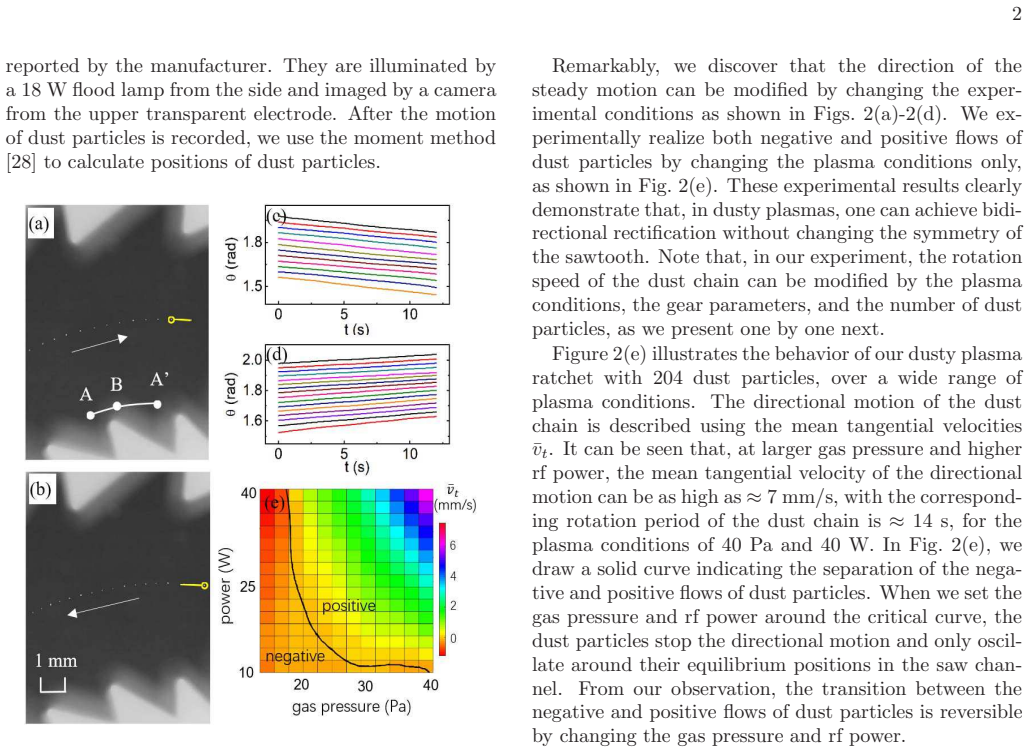
The central experimental discovery is the steady directional motion of a single-layer chain of dust particles along a circular sawtooth channel, and the controlled reversal of that motion. At 35 Pa and 10 W the chain rotates in one direction; at 40 Pa and 10 W, in the same gear geometry, it rotates in the opposite direction, with the transition occurring along a critical curve in the pressure-power plane near which the chain stops and only oscillates. The authors attribute the flow to a net azimuthal ion-drag force that arises because the electric potential at the dust balance height is asymmetric within each sawtooth; the reversal is explained by a computed flip in the orientation of that asymmetry as the balance height changes with plasma conditions. They verify that flipping the sawtooth orientation reverses the flow, that symmetric sawteeth produce no net flow, and that a minimum number of particles is required for the collective effect to produce persistent motion.
Load-bearing premise
The reversal mechanism assumes that the COMSOL-computed electric potential at the dust balance height, evaluated with an assumed dust charge of about $-9.5\times10^4 e$, correctly captures the potential asymmetry and its pressure-dependent flip; neither the potential nor the charge is directly measured in the experiment.
Editorial extensions
If this is right
- Flow direction can be selected purely by tuning gas pressure or rf power; the same gear geometry supports both negative and positive flows.
- Near the critical pressure-power curve, the directional motion stops and particles merely oscillate, marking a reversible transition between flow states.
- Reversing the sawtooth orientation reverses the flow with nearly unchanged speed, while symmetric sawteeth give no net flow, confirming that the gear asymmetry sets the flow direction.
- The flow speed grows with the number of dust particles once the potential wells are overfilled, so the collective repulsion is a controllable knob as well.
- Observed speeds reach about 7 mm/s (rotation period about 14 s) at 40 Pa and 40 W, providing quantitative targets for engineering plasma-based transport.
Reading between the lines
- Inference: A direct test of the reversal mechanism would be in-situ measurement of the electric potential at the dust levitation height (or of the dust charge) at 35 Pa and 40 Pa; the paper's COMSOL-based explanation predicts a flip in the potential asymmetry that has not been measured directly.
- Inference: If the balance-height mechanism is right, dust particles of different sizes suspended at different heights in the same experiment would feel opposite potential asymmetries and could be rectified in opposite directions, offering a size-sorting capability the paper only suggests.
- Inference: The same design might be extended to other strongly coupled or colloidal systems where an external agency (here, ion drag) couples to an asymmetric potential; the reversal criterion would be a crossing of the balance-height versus potential-asymmetry curves.
- Inference: Because the flow reversal is reversible and requires no moving parts, the setup could serve as a testbed for studying far-from-equilibrium transport and fluctuation-driven ordering in dusty plasmas.
Signed reviews
Editorial analysis
A structured set of objections, weighed in public.
Referee Report
Summary. This paper reports the experimental realization of a dusty-plasma ratchet: roughly two hundred strongly coupled charged microspheres in a circular channel bounded by asymmetric sawtooth gears self-assemble into a single chain that rotates persistently along the channel. Measuring the mean tangential velocity over a range of gas pressures and rf powers (Fig. 2(e)), the authors find regions of negative and positive flow separated by a critical curve, so that the flow direction is reversed by changing plasma conditions alone without altering the gear asymmetry. Control experiments show that flipping the gear orientation reverses the flow and that symmetric gears produce no net flow. The collective nature of the effect is established through the particle-number dependence of the mean angular speed (Fig. 3). COMSOL sheath simulations are used to compute the electric potential, and the reversal is attributed to a change in the orientation of the potential energy W = QU at the dust balance height defined by mg = -Q dU/dz between 35 Pa and 40 Pa, which is claimed to reverse the sign of the net azimuthal ion drag on the chain.
Significance. If the mechanism holds, this is a clean experimental demonstration of a ratchet in a strongly coupled dusty plasma, with bidirectional control of the particle current achieved through plasma parameters rather than geometric changes. The experimental core is strong: the persistent directional flow is directly observed and documented with videos, the reversal on flipping the gears and the absence of net flow for symmetric gears are proper control experiments, and the collective onset with particle number is a nice demonstration that interparticle interactions supply the barrier-climbing cooperativity. The model is not circularly fitted to the observed flow direction, which is to the authors' credit. The principal weakness is that the mechanistic explanation of the reversal rests on computed quantities (the COMSOL potential and a literature value of the dust charge) rather than in-situ measurement, and the simulation-experiment agreement is asserted rather than shown quantitatively; the stress-test concern about the unmeasured charge Q therefore lands, although it does not cast doubt on the direct observations.
major comments (3)
- [Fig. 4(b)-(d) and accompanying mechanism text] The predicted reversal hinges on the balance height z_b(θ) defined by mg = -Q dU/dz, evaluated with Q = -9.5 x 10^4 e taken from ref. [27]; the text itself quotes the empirical estimate Q = -6.9 x 10^4 e, a roughly 30% spread that is described as 'close.' Because z_b shifts with Q, the relative ordering of W(θ_A) and W(θ_B) at the balance height, which determines the sign of the net ion drag circulation f_iθ, need not flip between 35 Pa and 40 Pa once Q is varied within this plausible range. Neither Q nor the balance height is measured, and although the Fig. 1 caption reports experimental suspension heights of 5-9 mm, these are never compared with the computed z_b curves in Fig. 4(b). Please quantify the sensitivity of the 35 Pa/40 Pa orientation flip to a ±30% variation in Q (or measure Q), and report whether the computed balance heights fall within the observed 5-9 mm range.
- [Fig. 2(e)] The central phase diagram in Fig. 2(e) reports the mean tangential velocity without error bars, without particle-to-particle spread, and without stating how many runs, particles, and time intervals contribute to each point; the solid critical curve separating negative and positive flow is drawn without any stated criterion such as a velocity threshold, an interpolation scheme, or a test of the zero crossing. Because the paper's central quantitative claim is precisely that the flow direction reverses across this boundary, please specify the averaging procedure, provide uncertainty estimates, and describe how the critical curve was determined.
- [Simulation verification section] The paper states that the one-dimensional simulations 'are well consistent with our experimental observations' and reproduce negative (35 Pa) and positive (40 Pa) flows, but no quantitative comparison is shown: there is no figure or table overlaying simulated and measured velocities (or simulated and measured angular speed versus N in Fig. 3), and no equation in the main text connects the sign of the net ion drag circulation f_iθ to a predicted flow velocity. Please provide the comparison plot(s) and list the ion-drag model inputs (ion density, ion drift velocity, and the force expression used), so the claimed verification is quantitatively auditable.
minor comments (7)
- [Abstract] The abstract contains a typo: 'flowcan' should read 'flow can.'
- [Fig. 2(e)] The mean tangential velocity denoted vbar_t in Fig. 2(e) is never defined in the main text; only the mean angular speed omega-bar is defined in the discussion of Fig. 3. Please define vbar_t and state the time window and particle ensemble over which it is averaged.
- [Charge discussion] Characterizing Q = -9.5 x 10^4 e and the empirical estimate -6.9 x 10^4 e as 'close' is misleading for a 30% spread; please rephrase or justify the tolerance, since this feeds into the robustness concern raised in the first major comment.
- [Ref. [27]] Reference [27] is cited as 'Supplemental Material [url]' with a placeholder link; because the COMSOL model, the experimental confirmation of the ratchet potential, and the simulation method all live in that file, it must be fully archived, resolvable, and available to the referees with the submitted version.
- [Reversibility statement] The statement that the transition between negative and positive flow is 'reversible by changing the gas pressure and rf power' would be stronger with the number of reversal cycles performed and the run-to-run variability of the critical conditions.
- [Fig. 1 caption] The Fig. 1 caption contains a typo: 'Indium Tin Oxide s glass plate' should read 'Indium Tin Oxide glass plate.'
- [Fig. 3] Fig. 3 would benefit from error bars or a statement of the standard deviation across the particles at each point.
Circularity Check
No significant circularity; the experimental observation is self-contained and the simulation is a forward consistency check.
full rationale
The paper's central claim is the direct experimental observation of unidirectional dust flow along an asymmetric sawtooth channel and its reversal when only gas pressure or rf power is changed (Fig. 2). That observation does not depend on any fitted parameter or self-cited result; it is a measured velocity field. The reversal mechanism is explained using a COMSOL-computed electric potential U and a dust charge Q taken from the authors' supplemental material, but the potential and the resulting potential-energy orientation W = Q U at the balance height are not fitted to the observed flow direction. The balance-height condition mg = -Q dU/dz is a standard force balance, and the plasma parameters (ne,i, Te) are stated from the model, not inferred from the flow. The numerical simulations then integrate prescribed forces (Yukawa, electric, neutral drag, ion drag) and produce flows in the same directions as observed, which is a forward consistency check rather than a renaming of the measurement. The geometric argument in the main text (point B closer to the sheath, l_AB < l_BA') independently motivates the asymmetric potential, so reliance on ref. [27] for the detailed COMSOL model is not load-bearing circularity. The skeptic's concern that the predicted reversal may be sensitive to the unmeasured Q is a legitimate uncertainty about robustness or model accuracy, but it is not a case of the derivation reducing to its own inputs: no equation in the paper equates the prediction to the measured flow, and the simulation parameters are not stated to be tuned to reproduce the experimental reversal. The paper is therefore self-contained for its main experimental demonstration, and the simulation-based mechanism, while dependent on the supplement, is a normal numerical verification rather than a circular step.
Assumptions & free parameters
free parameters (2)
- Dust particle charge Q =
-9.5e4 e (typical from ref. [27]; empirical estimate -6.9e4 e)
- Neutral and ion drag coefficients =
Not stated in main text; simulation parameters in supplement [27]
assumptions (5)
- domain assumption The asymmetric sawtooth gears create an asymmetric electric potential along the saw channel, with higher potential at points farther from the inner gear sheath.
- domain assumption Dust particles levitate at a balance height set by mg = -Q dU/dz, with Q ~ -9.5e4 e.
- domain assumption The asymmetric electric potential induces an azimuthal ion drag force Fi_theta whose circulation gives a net drive fi_theta.
- ad hoc to paper When enough dust particles fill the potential well, interparticle Yukawa repulsion lets the chain climb the shallow side of the sawtooth and sustain a persistent flow.
- ad hoc to paper The COMSOL sheath model represents the experimental plasma accurately enough to predict the reversal of potential orientation between 35 Pa and 40 Pa.
Cite this review
Pith. "Pith review of Experimental demonstration of a dusty plasma ratchet rectification and its reversal." pith.science (2026). https://pith.science/paper/VRXWVNKH
@misc{pith2026190807182,
  author       = {Pith},
  title        = {Pith review of: Experimental demonstration of a dusty plasma ratchet rectification and its reversal},
  year         = {2026},
  howpublished = {\url{https://pith.science/paper/VRXWVNKH}},
  note         = {Machine review of arXiv:1908.07182}
}
read the original abstract
The naturally persistent flow of hundreds of dust particles is experimentally achieved in a dusty plasma system with the asymmetric sawteeth of gears on the electrode. It is also demonstrated that the direction of the dust particle flowcan be controlled by changing the plasma conditions of the gas pressure or the plasma power. Numerical simulations of dust particles with the ion drag inside the asymmetric sawteeth verify the experimental observations of the flow rectification of dust particles. Both experiments and simulations suggest that the asymmetric potential and the collective effect are the twokeys in this dusty plasma ratchet.With the nonequilibrium ion drag, the dust flow along the asymmetric orientation of this electric potential of the ratchet can be reversed by changing the balance height of dust particles using different plasma conditions.
Figures


Figures from the paper (2 more)


Reference graph
Works this paper leans on
-
[27]
See Supplemental Material [url] for a detailed descrip - tion of setup, an experimental confirmation of the ratchet potential, a brief description of the COMSOL model, and the details of our simulation method for dust par- ticles,which includes Refs. [34–39]
-
[1]
G. E. Morfill and A. V. Ivlev, Rev. Mod. Phys. 81, 1353 (2009)
work page 2009
-
[2]
P. K. Shukla and B. Eliasson, Rev. Mod. Phys. 81, 25 (2009)
2009
-
[3]
J. H. Chu and Lin. I, Phys. Rev. Lett. 72, 4009 (1994)
work page 1994
-
[4]
M. Rubin-Zuzic, G. E. Morfill, A. V. Ivlev, R. Pompl, B. A. Klumov, W. Bunk, H. M. Thomas, H. Rothermel, O. Havnes, and A. Fouqu´ et, Nature Physics 2, 181 (2006)
work page 2006
-
[5]
A. A. Mamun, P. K. Shukla, and G. E. Morfill, Phys. Rev. Lett. 92, 095005 (2004)
work page 2004
- [6]
-
[7]
T. Ott, M. Bonitz, P. Hartmann, and Z. Donk´ o, Phys. Rev. E 95, 013209 (2017)
work page 2017
Show all 40 references
-
[8]
Y. N. Wang, L. J. Hou, and X. G. Wang, Phys. Rev. Lett. 89, 155001 (2002)
2002
-
[9]
Killer, T
C. Killer, T. Bockwoldt, S. Sch¨ utt, M. Himpel, A. Melzer, and A. Piel, Phys. Rev. Lett. 116, 115002 (2016)
2016
-
[10]
H. M. Thomas and G. E. Morfill, Nature 379, 806 (1996)
1996
-
[11]
C. S. Wong, J. Goree, Z. Haralson, and B. Liu, Nature Physics 14, 21 (2017)
2017
-
[12]
Thomas Jr, U
E. Thomas Jr, U. Konopka, R. L. Merlino, and M. Rosen- berg, Phys. Plasmas, 23, 055701 (2016)
2016
-
[13]
Douglass, V
A. Douglass, V. Land, K. Qiao, L. Matthews, and T. Hyde, Phys. Plasmas 19, 013707 (2012)
2012
-
[14]
D. P. Resendes, G. Sorasio, and P. K. Shukla, Physica Scripta T98, 87 (2002)
2002
-
[15]
Hartmann, A
P. Hartmann, A. Douglass, J. C. Reyes, L. S. Matthews, T. W. Hyde, A. Kov´ acs, and Z. Donk´ o, Phys. Rev. Lett. 105, 115004 (2010)
2010
-
[16]
Y. Feng, J. Goree, and B. Liu, Phys. Rev. Lett. 105, 025002 (2010)
2010
-
[17]
Joyce, M
G. Joyce, M. Lampe, and G. Ganguli, Phys. Rev. Lett. 88, 095006 (2002)
2002
-
[18]
Melzer, V
A. Melzer, V. A. Schweigert, and A. Piel, Phys. Rev. Lett. 83, 3194 (1999)
1999
-
[19]
A. V. Ivlev, U. Konopka, G. E. Morfill, and G. Joyce, Phys. Rev. E 68, 026405 (2003)
2003
-
[20]
R. P. Feynman, R. B. Leighton, and M. Sands, The Feyn- man Lectures on Physics (Addison-Wesley, Reading, MA, 1963), Vol. I
1963
-
[21]
H¨ anggi and F
P. H¨ anggi and F. Marchesoni, Rev. Mod. Phys. 81, 387 (2009)
2009
-
[22]
M. J. Skaug, C. Schwemmer, S. Fringes, C. D. Rawlings, and A. W. Knoll, Science 359, 1505 (2018)
2018
-
[23]
E. M. Roeling, W. C. Germs, B. Smalbrugge, E. J. Geluk, T. de Vires, R. A. J. Janssen, and M. Kemerink, Nat. Mat. 10, 51 (2011)
2011
-
[24]
C. C. de S. Silva, J. Van de Vondel, M. Morelle, and V. V. Moshchalkov, Nature 440, 651 (2006)
2006
-
[25]
M. R. Wilson, J. Sola, A. Carlone, S. M. Goldup, N. Lebrasseur, and D. A. Leigh, Nature 534, 235 (2016)
2016
-
[26]
S. Park, J. Song, and J. S. Kim, Science Advances 5, eaav4943 (2019)
2019
-
[28]
A”, “B”, and “A’
to calculate positions of dust particles. FIG. 2. (color online). Snapshots of dust particles in the negative (a) and positive (b) flows of dust particles, indica ted by arrows, in the same gear structure, for the experiment conditions of (35 Pa, 10 W, peak-to-peak voltage Vpp ...
2016
-
[29]
Y. Feng, J. Goree, and B. Liu, Rev. Sci. Instrum. 82, 053707 (2011)
2011
-
[30]
2(a)] and positive [Fig
See Supplemental Material of Videos for negative [Fig. 2(a)] and positive [Fig. 2(b)] flows of dust particles in experiments
-
[31]
Piel, Phys
A. Piel, Phys. Plasmas 24, 033712 (2017)
2017
-
[32]
Bonitz, C
M. Bonitz, C. Henning, and D. Block, Rep. Prog. Phys. 73, 066501 (2010)
2010
-
[33]
COMSOL Multiphysics version 5.3a, www.comsol.com
-
[34]
Kim and D
D. Kim and D. J. Economou, J. Appl. Phys. 94, 3740 (2003)
2003
-
[35]
V. E. Fortov, A. V. Ivlev, S. A. Khrapak, A. G. Khrapak, and G. E. Morfill, Phys. Rep. 421, 1 (2005)
2005
-
[36]
Schwabe and D
M. Schwabe and D. B. Graves, Phys. Rev. E 88, 023101 (2013)
2013
-
[37]
Bockwoldt, O
T. Bockwoldt, O. Arp, K. O. Menzel, and A. Piel, Phys. Plasmas 21, 103703 (2014)
2014
-
[38]
Uchida, S
G. Uchida, S. Lizuka, T. Kamimura, and N. Sato, Phys. Plasmas 16, 053707 (2009)
2009
-
[39]
M. S. Barnes, J. H. Keller, J. C. Forster, J. A. O’Neill, and D. K. Coultas, Phys. Rev. Lett. 68, 313 (1992)
1992
-
[40]
T. E. Sheridan, J. Phys. D: Appl. Phys. 42, 015212 (2009)
2009
Reviewed August 14, 2026 · model on record in the stance chip above.
Discussion (0). Continue with ORCID to comment.