REVIEW 3 major objections 5 minor 56 references
Make a Face: Towards Arbitrary High Fidelity Face Manipulation
T0 review · 3 major / 5 minor · reviewed 2026-08-14 · deepseek-v4-flash
Pith's one-line read The paper claims that a conditional variational auto-encoder, trained with only reconstruction and KL-divergence losses, can change a person's expression and head pose to an arbitrary target while keeping their identity and…
desk verdict A solid VAE alternative for face manipulation with convincing RaFD gains, but the headline CelebA SOTA number is a self-ablation, not an external baseline. read the letter →
The pith
A machine-rendered reading of the paper's core claim, the machinery that carries it, and where it could break.
The reading
What carries the argument
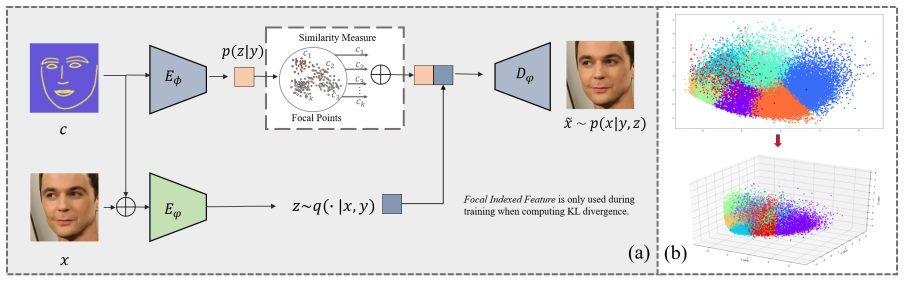
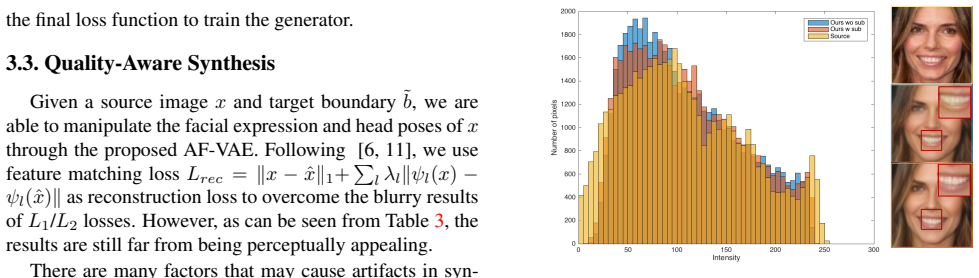
The workhorse is the additive focal prior: with K-means over the training boundary maps, each boundary gets a $K$-dimensional vector of cosine similarities to the cluster centers, and the prior on the appearance code is a single Gaussian whose mean is the weighted sum of those cluster means. That converts an intractable mixture prior into a closed-form KL divergence while keeping a multi-modal representation, which avoids the 'mean-face' collapse seen under extreme expressions or poses. Around this sit the geometry-guided disentanglement, where the encoded boundary map is concatenated with the appearance code before decoding, and two quality-aware design choices: sub-pixel upsampling to scatter checkerboard artifacts and weight normalization for faster, stabler training.
What would settle it
A direct test: take a fixed source identity and feed the model a target boundary whose facial contour comes from a different identity while keeping expression and pose fixed. If a face-recognition network measures a significant drop in identity similarity between source and output, the claim that appearance and structure are cleanly separated fails.
Extended reading notes
Core claim
The central claim is that arbitrary face manipulation can be achieved by decoupling an input face into a pose-invariant appearance code $z$ and a structure code $y$ obtained from a target boundary map, so that swapping the boundary map edits the expression or pose while the appearance code preserves identity. The paper's AF-VAE (Additive Focal Variational Auto-encoder) models the appearance prior as one Gaussian whose mean is the weighted sum of $K$ cluster means, which keeps the KL divergence closed-form while still giving a multi-modal latent space that can represent several facial characteristics at once. Two architecture choices, sub-pixel convolution and weight normalization, are shown to remove checkerboard artifacts and improve perceptual quality scores. The paper reports state-of-the-art FID and Inception Score on CelebA and higher fool rates than three GAN baselines in a human evaluation, and it shows that identity is preserved when the target boundary's facial contour is similar to the source while large contour differences shift identity.
Load-bearing premise
The central, load-bearing assumption is that an offline boundary map extracted from landmarks fully specifies facial structure without carrying identity; the paper's own failure cases show this assumption does not always hold when the target contour is very different from the source.
Editorial extensions
If this is right
- If the central claim is correct, high-resolution face manipulation is achievable without paired training data or adversarial losses, using only a target boundary map as the user control.
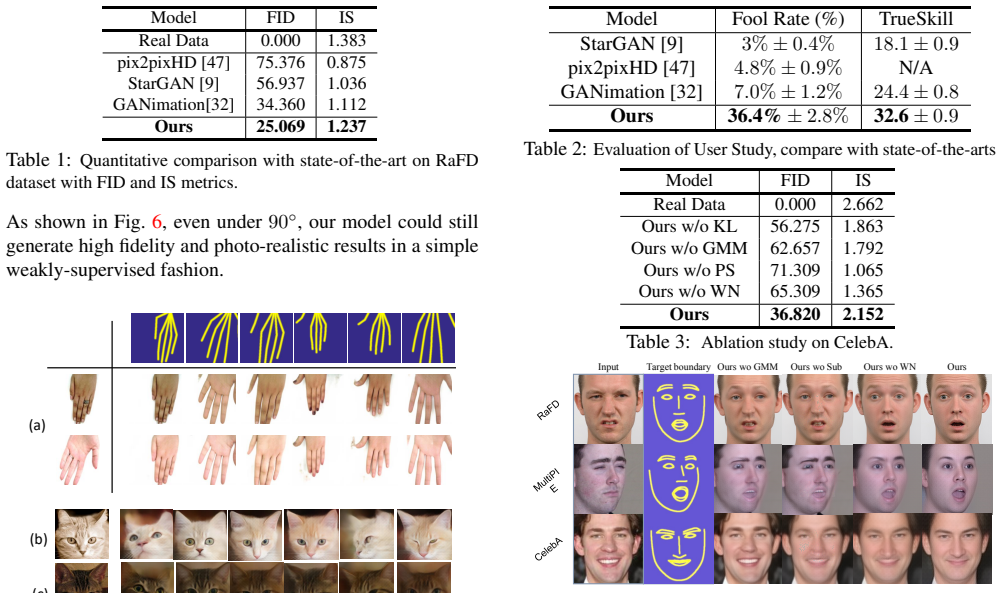
- The reported CelebA gains (FID 36.82 vs 71.3, IS 2.15 vs 1.065) imply that a VAE with a structurally richer prior can beat GAN-based methods on standard perceptual fidelity metrics.
- The additive mixture prior should generalize to any conditional generation task where the conditioning signal can be clustered, since it leaves the KL term computable while expanding latent capacity.
- The identity-preservation results indicate that facial identity is carried largely by facial contour and geometry, so extreme re-posing should be treated as a structure-transfer problem rather than an appearance-generation problem.
- Human raters being fooled at a much higher rate than for GAN baselines suggests that current automatic metrics may understate the perceptual quality of non-adversarial generators.
Reading between the lines
- Because the structure condition is just a clustered boundary map, the same additive-prior recipe could be dropped into other conditional image synthesis settings, such as full-body pose transfer or segmentation-guided scene editing, wherever the conditioning signal supports clustering.
- A quantitative identity-preservation benchmark over held-out identities would settle how far the 'identity lives in structure' claim extends, since the paper's human study addresses realism but not identity retention directly.
- The large gap between the model's 36% fool rate and the baselines' single-digit rates suggests that task-specific human evaluation may be a more informative comparison for face manipulation than generic generative-model metrics.
- The paper's own failure cases point to a natural next step: enriching the boundary representation so that facial contour carries less identity-specific information, which would push arbitrary manipulation closer to full identity control.
Signed reviews
Editorial analysis
A structured set of objections, weighed in public.
Referee Report
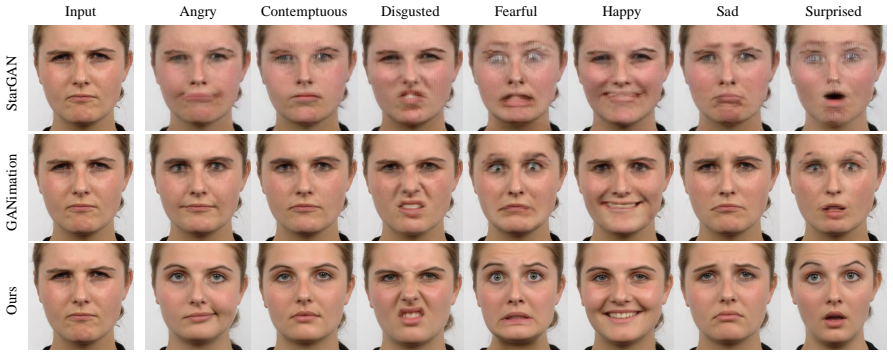
Summary. The paper proposes Additive Focal Variational Auto-Encoder (AF-VAE) for high-resolution face manipulation. The method combines a geometry-guided disentanglement of appearance and structure using boundary maps, an additive focal prior built from K-means clustering over facial boundary maps, and two architecture-level choices (sub-pixel convolution and weight normalization) justified by human visual system arguments. The authors report comparisons with StarGAN, GANimation, and pix2pixHD on RaFD, ablations on CelebA, a mechanical Turk user study, interpolation results, and a discussion of failure cases. The central claim is that AF-VAE improves the state of the art in FID/IS on uncontrolled CelebA from 71.3/1.065 to 36.82/2.15 while preserving identity.
Significance. If the quantitative claims hold, the paper would demonstrate a competitive variational alternative to GAN-based face manipulation, with attractive properties such as stable training and multi-modal generation. The RaFD comparison in Table 1 and the user study in Table 2 provide concrete evidence that the proposed model is competitive with or better than three strong GAN baselines. The paper also includes a useful ablation study and openly discusses failure cases, which is a strength. However, the headline CelebA state-of-the-art claim is not supported as stated because the reported baseline 71.3/1.065 coincides with the paper's own ablation row, and the KL divergence derivation in Eq. (5) appears to be formally incorrect as written. These issues affect the manuscript's central quantitative and theoretical claims.
major comments (3)
- [Abstract and Section 1; Table 3] The claim that AF-VAE improves state-of-the-art FID/IS on uncontrolled CelebA from 71.3 and 1.065 to 36.82 and 2.15 is not supported by the evidence in the paper. Table 3 reports exactly 71.309 and 1.065 as the row 'Ours w/o PS,' which is an ablation of the proposed model rather than an external published method. No citation to an external algorithm is given for these baseline numbers. Please either supply a genuine external CelebA baseline with citation, or revise the abstract and introduction to describe this as a self-comparison with an ablated variant.
- [Section 3.2, Eq. (5)] The KL divergence in Eq. (5) is written as a scalar expression, but z, μφ, and the cluster means μk are latent vectors. For the stated q(z|x,y)=N(z|μφ,σφ^2 I) and prior p(z|y)=N(z|Σ wk μk, σ^2 I), the KL divergence contains a sum over the latent dimensions; e.g., for an isotropic posterior variance σφ^2 it should be d log(σ/σφ) + (d σφ^2 + ||μφ - Σ wk μk||^2)/(2σ^2) - d/2, up to the exact parametrization. The printed scalar formula omits the dimension factor and the norm. Please clarify whether the implementation uses the printed approximation or the correct vector form, and correct the derivation accordingly.
- [Section 4.3 and Figures 10(c), 11] The word 'arbitrary' in the title and abstract is stronger than what the paper's own experiments support. The failure cases in Fig. 10(c) and Fig. 11 show that when the target boundary has a substantially different facial contour from the source, the method changes identity rather than preserving it. Since the structure representation y is only an encoded boundary map, this is an expected limitation and is acknowledged in Sec. 4.3; nevertheless, the claims in the abstract and introduction should be tempered to reflect the identity-boundary constraint demonstrated by these experiments.
minor comments (5)
- [Section 3.2] The 'additive focal prior' in Eq. (4) is a single Gaussian with an additively combined mean, not a Gaussian mixture. The relationship between the Gaussian mixture prior in Eq. (3) and the actual training prior in Eq. (4) should be stated more precisely, since the ablation label 'Ours w/o GMM' is otherwise ambiguous.
- [Section 3.2] The focal weights w(b) are described as normalized cosine similarities to K-means cluster centers, but the exact normalization, whether the weights sum to one, and whether they are re-estimated during training are not specified. Please give the full definition and update procedure.
- [Section 4.1.2, Table 2] The AMT user study reports fool rate and TrueSkill, but the main text does not specify how many images per method were rated, how target boundary maps were selected, or whether raters saw paired source/target conditions. Please include these protocol details so the human evaluation can be assessed.
- [Section 2, reference [33]] The proposed additive Gaussian prior is closely related to the additive Gaussian encoding space of reference [45], and reference [33] is a prior workshop paper by the same group. The novelty of the proposed focal prior over both prior works should be discussed more explicitly.
- [Throughout] There are minor typographical inconsistencies, including 'AM-VAE' in the introduction where 'AF-VAE' is intended, and inconsistent use of φ and ϕ for encoder parameters in Eqs. (1) and (2).
Circularity Check
CelebA SOTA claim is self-referential: the abstract's 71.3/1.065 baseline is exactly the paper's own 'Ours w/o PS' ablation, not an external algorithm.
-
other
[Abstract; Table 3 (Sec. 4.2 Ablation Study)]
"Abstract: 'The proposed AM-VAE improves the state-of-the-art Fréchet Inception Distance (FID) and Inception Score (IS) on uncontrolled CelebA from 71.3 and 1.065 to 36.82 and 2.15.' Table 3: 'Ours w/o PS 71.309 1.065' and 'Ours 36.820 2.152'."
The claimed 'previous state-of-the-art' numbers on uncontrolled CelebA are never attributed to any published method; they are numerically identical to the paper's own 'Ours w/o PS' ablation row (71.309 vs 71.3; 1.065 vs 1.065). Thus the headline improvement is an internal difference between the full model and an ablated version of the same model, not a comparison against StarGAN/GANimation/pix2pixHD or any external baseline. The quantitative 'state-of-the-art' claim therefore reduces to a self-comparison: the baseline is the paper's own variant, so the improvement is not independent evidence of superiority.
full rationale
The core AF-VAE derivation is self-contained: the generative objective (Eqs. 1-2), the additive focal prior (Eqs. 3-4), and the closed-form KL (Eq. 5) are all derived in the paper, with the cluster centers obtained by K-means on training boundary maps and evaluated on held-out identities; FID/IS are computed on test-set generations. The additive-Gaussian motivation cites the authors' prior workshop paper [33] together with Wang et al. [45], but the formula and training objective are re-derived here, so this self-citation is contextual rather than load-bearing. The RaFD comparison (Table 1) and the AMT user study (Table 2) do use external baselines (pix2pixHD, StarGAN, GANimation). The paper's own Sec. 4.3 and Fig. 10-11 explicitly acknowledge that identity is not preserved when the target contour differs strongly from the source; this limits the 'arbitrary' claim but is a stated limitation, not a circular step. The one substantive circularity-adjacent defect is the CelebA SOTA baseline: the abstract's 'from 71.3 and 1.065' exactly matches the 'Ours w/o PS' ablation row in Table 3, with no external citation, so the headline quantitative claim rests on an internal ablation gap rather than an external state-of-the-art comparison. This is a baseline-equivalence issue in the central evaluation claim, while the method's derivation itself is not circular.
Assumptions & free parameters
free parameters (4)
- Number of focal clusters K =
8
- Cluster centers mu_k =
Not reported (K-means centers of training boundary maps)
- Cluster variances sigma_k^2 =
Not reported
- Perceptual loss weights lambda_l =
Not reported
assumptions (4)
- domain assumption Boundary maps from pretrained landmark interpolation are a sufficient and transferable specification of facial structure for expression and pose manipulation.
- domain assumption K-means clusters of training boundary maps correspond to semantic facial states such as laughing or side face.
- standard math Equation 5 is the correct KL divergence under the additive Gaussian prior for the latent space.
- domain assumption The human visual system weighs low-frequency and edge artifacts more heavily than high-frequency artifacts.
Cite this review
Pith. "Pith review of Make a Face: Towards Arbitrary High Fidelity Face Manipulation." pith.science (2026). https://pith.science/paper/RC74DF5D
@misc{pith2026190807191,
  author       = {Pith},
  title        = {Pith review of: Make a Face: Towards Arbitrary High Fidelity Face Manipulation},
  year         = {2026},
  howpublished = {\url{https://pith.science/paper/RC74DF5D}},
  note         = {Machine review of arXiv:1908.07191}
}
read the original abstract
Recent studies have shown remarkable success in face manipulation task with the advance of GANs and VAEs paradigms, but the outputs are sometimes limited to low-resolution and lack of diversity. In this work, we propose Additive Focal Variational Auto-encoder (AF-VAE), a novel approach that can arbitrarily manipulate high-resolution face images using a simple yet effective model and only weak supervision of reconstruction and KL divergence losses. First, a novel additive Gaussian Mixture assumption is introduced with an unsupervised clustering mechanism in the structural latent space, which endows better disentanglement and boosts multi-modal representation with external memory. Second, to improve the perceptual quality of synthesized results, two simple strategies in architecture design are further tailored and discussed on the behavior of Human Visual System (HVS) for the first time, allowing for fine control over the model complexity and sample quality. Human opinion studies and new state-of-the-art Inception Score (IS) / Frechet Inception Distance (FID) demonstrate the superiority of our approach over existing algorithms, advancing both the fidelity and extremity of face manipulation task.
Figures

Figures from the paper (6 more)




Reference graph
Works this paper leans on
-
[1]
CV AE-GAN: fine-grained image generation through asymmetric training
Jianmin Bao, Dong Chen, Fang Wen, Houqiang Li, and Gang Hua. CV AE-GAN: fine-grained image generation through asymmetric training. In ICCV, 2017. 3
work page 2017
-
[2]
Towards open-set identity preserving face synthesis
Jianmin Bao, Dong Chen, Fang Wen, Houqiang Li, and Gang Hua. Towards open-set identity preserving face synthesis. In CVPR, 2018. 2, 7
work page 2018
-
[3]
A morphable model for the synthesis of 3d faces
V olker Blanz and Thomas Vetter. A morphable model for the synthesis of 3d faces. In Proceedings of the 26th an- nual conference on Computer graphics and interactive tech- niques, 1999. 2
work page 1999
-
[4]
Large scale gan training for high fidelity natural image synthesis
Andrew Brock, Jeff Donahue, and Karen Simonyan. Large scale gan training for high fidelity natural image synthesis. arXiv preprint arXiv:1809.11096, 2018. 3
arXiv 2018
-
[5]
Facewarehouse: A 3d facial expression database for visual computing
Chen Cao, Yanlin Weng, Shun Zhou, Yiying Tong, and Kun Zhou. Facewarehouse: A 3d facial expression database for visual computing. IEEE Trans. Vis. Comput. Graph. , 20(3):413–425, 2014. 8
work page 2014
-
[6]
Photographic image syn- thesis with cascaded refinement networks
Qifeng Chen and Vladlen Koltun. Photographic image syn- thesis with cascaded refinement networks. In ICCV, 2017. 5
work page 2017
-
[7]
Facelet- bank for fast portrait manipulation
Ying-Cong Chen, Huaijia Lin, Michelle Shu, Ruiyu Li, Xin Tao, Xiaoyong Shen, Yangang Ye, and Jiaya Jia. Facelet- bank for fast portrait manipulation. In CVPR, 2018. 2
work page 2018
-
[8]
Zeyuan Chen, Shaoliang Nie, Tianfu Wu, and Christopher G. Healey. High resolution face completion with multiple con- trollable attributes via fully end-to-end progressive genera- tive adversarial networks. arXiv preprint arXiv:1801.07632,
Show all 56 references
-
[9]
Stargan: Unified genera- tive adversarial networks for multi-domain image-to-image translation
Yunjey Choi, Minje Choi, Munyoung Kim, Jung-Woo Ha, Sunghun Kim, and Jaegul Choo. Stargan: Unified genera- tive adversarial networks for multi-domain image-to-image translation. In CVPR, 2018. 2, 5, 6, 7
2018
-
[10]
Uv-gan: Adversarial facial uv map completion for pose-invariant face recognition
Jiankang Deng, Shiyang Cheng, Niannan Xue, Yuxiang Zhou, and Stefanos Zafeiriou. Uv-gan: Adversarial facial uv map completion for pose-invariant face recognition. In CVPR, 2018. 8
2018
-
[11]
A varia- tional u-net for conditional appearance and shape generation
Patrick Esser, Ekaterina Sutter, and Bj ¨orn Ommer. A varia- tional u-net for conditional appearance and shape generation. In CVPR, 2018. 5
2018
-
[12]
Multi-pie
Ralph Gross, Iain Matthews, Jeffrey Cohn, Takeo Kanade, and Simon Baker. Multi-pie. Image and Vision Computing,
-
[13]
Improved training of wasserstein gans
Ishaan Gulrajani, Faruk Ahmed, Martin Arjovsky, Vincent Dumoulin, and Aaron C Courville. Improved training of wasserstein gans. In NIPS, 2017. 5
2017
-
[14]
Trueskill: a bayesian skill rating system
Ralf Herbrich, Tom Minka, and Thore Graepel. Trueskill: a bayesian skill rating system. In NIPS, 2007. 6
2007
-
[15]
Gans trained by a two time-scale update rule converge to a local nash equilib- rium
Martin Heusel, Hubert Ramsauer, Thomas Unterthiner, Bernhard Nessler, and Sepp Hochreiter. Gans trained by a two time-scale update rule converge to a local nash equilib- rium. In NIPS, 2017. 2, 6
2017
-
[16]
Pose-guided photorealistic face rotation
Yibo Hu, Xiang Wu, Bing Yu, Ran He, and Zhenan Sun. Pose-guided photorealistic face rotation. In CVPR, 2018. 2, 6
2018
-
[17]
Introvae: Introspective variational autoen- coders for photographic image synthesis
Huaibo Huang, Zhihang Li, Ran He, Zhenan Sun, and Tieniu Tan. Introvae: Introspective variational autoen- coders for photographic image synthesis. arXiv preprint arXiv:1807.06358, 2018. 3
2018 arXiv
-
[18]
Beyond face rotation: Global and local perception gan for photoreal- istic and identity preserving frontal view synthesis
Rui Huang, Shu Zhang, Tianyu Li, and Ran He. Beyond face rotation: Global and local perception gan for photoreal- istic and identity preserving frontal view synthesis. InICCV,
-
[19]
Batch normalization: Accelerating deep network training by reducing internal co- variate shift
Sergey Ioffe and Christian Szegedy. Batch normalization: Accelerating deep network training by reducing internal co- variate shift. arXiv preprint arXiv:1502.03167, 2015. 5
2015 arXiv
-
[20]
Phillip Isola, Jun-Yan Zhu, Tinghui Zhou, and Alexei A. Efros. Image-to-image translation with conditional adver- sarial networks. In CVPR, 2017. 3
2017
-
[21]
Kingma and Max Welling
Diederik P. Kingma and Max Welling. Auto-encoding vari- ational bayes. In ICLR, 2014. 2, 3
2014
-
[22]
Gagan: Geometry-aware generative adversarial networks
Jean Kossaifi, Linh Tran, Yannis Panagakis, and Maja Pantic. Gagan: Geometry-aware generative adversarial networks. In CVPR, 2018. 2
2018
-
[23]
Pre- sentation and validation of the radboud faces database
Oliver Langner, Ron Dotsch, Gijsbert Bijlstra, Daniel HJ Wigboldus, Skyler T Hawk, and AD Van Knippenberg. Pre- sentation and validation of the radboud faces database. Cog- nition and emotion, 2010. 5
2010
-
[24]
Hallucinated-iqa: No- reference image quality assessment via adversarial learning
Kwan-Yee Lin and Guanxiang Wang. Hallucinated-iqa: No- reference image quality assessment via adversarial learning. In CVPR, 2018. 5
2018
-
[25]
Bagdanov
Xialei Liu, Joost van de Weijer, and Andrew D. Bagdanov. Rankiqa: Learning from rankings for no-reference image quality assessment. In ICCV, 2017. 5
2017
-
[26]
Deep learning face attributes in the wild
Ziwei Liu, Ping Luo, Xiaogang Wang, and Xiaoou Tang. Deep learning face attributes in the wild. In ICCV, 2015. 2, 5
2015
-
[27]
Attribute- guided face generation using conditional cyclegan
Yongyi Lu, Yu-Wing Tai, and Chi-Keung Tang. Attribute- guided face generation using conditional cyclegan. InECCV,
-
[28]
Pose guided person image genera- tion
Liqian Ma, Xu Jia, Qianru Sun, Bernt Schiele, Tinne Tuyte- laars, and Luc Van Gool. Pose guided person image genera- tion. In NIPS, 2017. 2
2017
-
[29]
Disentangled per- son image generation
Liqian Ma, Qianru Sun, Stamatios Georgoulis, Luc Van Gool, Bernt Schiele, and Mario Fritz. Disentangled per- son image generation. In CVPR, 2018. 2
2018
-
[30]
Least squares generative adversarial networks
Xudong Mao, Qing Li, Haoran Xie, Raymond YK Lau, Zhen Wang, and Stephen Paul Smolley. Least squares generative adversarial networks. In ICCV, 2017. 5
2017
-
[31]
Blind predicting similar quality map for image quality assessment
Da Pan, Ping Shi, Ming Hou, Zefeng Ying, Sizhe Fu, and Yuan Zhang. Blind predicting similar quality map for image quality assessment. In CVPR, 2018. 5
2018
-
[32]
Martinez, Al- berto Sanfeliu, and Francesc Moreno-Noguer
Albert Pumarola, Antonio Agudo, Aleix M. Martinez, Al- berto Sanfeliu, and Francesc Moreno-Noguer. Ganimation: Anatomically-aware facial animation from a single image. In ECCV, 2018. 2, 5, 6, 7
2018
-
[33]
Extending the capacity of cvae for face synthesis and modeling
Shengju Qian, Wayne Wu, Yangxiaokang Liu, Beier Zhu, and Fumin Shen. Extending the capacity of cvae for face synthesis and modeling. In NeurIPS Workshops, 2018. 3
2018
-
[34]
Geometry-contrastive generative adversarial network for facial expression synthesis
Fengchun Qiao, Naiming Yao, Zirui Jiao, Zhihao Li, Hui Chen, and Hongan Wang. Geometry-contrastive generative adversarial network for facial expression synthesis. arXiv preprint arXiv:1802.01822, 2018. 2
2018 arXiv
-
[35]
Improved techniques for training gans
Tim Salimans, Ian Goodfellow, Wojciech Zaremba, Vicki Cheung, Alec Radford, and Xi Chen. Improved techniques for training gans. In NIPS, 2016. 6
2016
-
[36]
Weight normaliza- tion: A simple reparameterization to accelerate training of deep neural networks
Tim Salimans and Diederik P Kingma. Weight normaliza- tion: A simple reparameterization to accelerate training of deep neural networks. In NIPS, 2016. 5
2016
-
[37]
Faceid-gan: Learning a symmetry three-player gan for identity-preserving face synthesis
Yujun Shen, Ping Luo, Junjie Yan, Xiaogang Wang, and Xi- aoou Tang. Faceid-gan: Learning a symmetry three-player gan for identity-preserving face synthesis. In CVPR, 2018. 2, 7
2018
-
[38]
Real-time single image and video super-resolution using an efficient sub-pixel convolutional neural network
Wenzhe Shi, Jose Caballero, Ferenc Husz ´ar, Johannes Totz, Andrew P Aitken, Rob Bishop, Daniel Rueckert, and Zehan Wang. Real-time single image and video super-resolution using an efficient sub-pixel convolutional neural network. In CVPR, 2016. 5
2016
-
[39]
Deform- ing autoencoders: Unsupervised disentangling of shape and appearance
Zhixin Shu, Mihir Sahasrabudhe, Riza Alp G ¨uler, Dimitris Samaras, Nikos Paragios, and Iasonas Kokkinos. Deform- ing autoencoders: Unsupervised disentangling of shape and appearance. In ECCV, 2018. 3
2018
-
[40]
Neural face editing with intrinsic image disentangling
Zhixin Shu, Ersin Yumer, Sunil Hadap, Kalyan Sunkavalli, Eli Shechtman, and Dimitris Samaras. Neural face editing with intrinsic image disentangling. In CVPR, 2017. 3
2017
-
[41]
Learning structured output representation using deep conditional gen- erative models
Kihyuk Sohn, Honglak Lee, and Xinchen Yan. Learning structured output representation using deep conditional gen- erative models. In NIPS, 2015. 2
2015
-
[42]
Face2face: Real-time face capture and reenactment of rgb videos
Justus Thies, Michael Zollhofer, Marc Stamminger, Chris- tian Theobalt, and Matthias Nießner. Face2face: Real-time face capture and reenactment of rgb videos. In CVPR, 2016. 2
2016
-
[43]
Nonlinear 3d face morphable model
Luan Tran and Xiaoming Liu. Nonlinear 3d face morphable model. In CVPR, 2018. 2
2018
-
[44]
On learning 3d face mor- phable model from in-the-wild images
Luan Tran and Xiaoming Liu. On learning 3d face mor- phable model from in-the-wild images. arXiv preprint arXiv:1808.09560, 2018. 2
2018 arXiv
-
[45]
Diverse and accurate image description using a variational auto-encoder with an additive gaussian encoding space
Liwei Wang, Alexander Schwing, and Svetlana Lazebnik. Diverse and accurate image description using a variational auto-encoder with an additive gaussian encoding space. In NIPS, 2017. 3
2017
-
[46]
Video-to- video synthesis
Ting-Chun Wang, Ming-Yu Liu, Jun-Yan Zhu, Guilin Liu, Andrew Tao, Jan Kautz, and Bryan Catanzaro. Video-to- video synthesis. In NIPS, 2018. 2
2018
-
[47]
High-resolution image syn- thesis and semantic manipulation with conditional gans
Ting-Chun Wang, Ming-Yu Liu, Jun-Yan Zhu, Andrew Tao, Jan Kautz, and Bryan Catanzaro. High-resolution image syn- thesis and semantic manipulation with conditional gans. In CVPR, 2018. 3, 5, 7
2018
-
[48]
Every smile is unique: Landmark-guided diverse smile generation
Wei Wang, Xavier Alameda-Pineda, Dan Xu, Pascal Fua, Elisa Ricci, and Nicu Sebe. Every smile is unique: Landmark-guided diverse smile generation. In CVPR, 2018. 2
2018
-
[49]
Self- supervised learning of a facial attribute embedding from video
Olivia Wiles, A Koepke, and Andrew Zisserman. Self- supervised learning of a facial attribute embedding from video. In BMVC, 2018. 2
2018
-
[50]
X2face: A network for controlling face generation using im- ages, audio, and pose codes
Olivia Wiles, A Sophia Koepke, and Andrew Zisserman. X2face: A network for controlling face generation using im- ages, audio, and pose codes. In ECCV, 2018. 2
2018
-
[51]
Transgaga: Geometry-aware unsuper- vised image-to-image translation
Wayne Wu, Kaidi Cao, Cheng Li, Chen Qian, and Chen Change Loy. Transgaga: Geometry-aware unsuper- vised image-to-image translation. In CVPR, 2019. 2
2019
-
[52]
Look at boundary: A boundary-aware face alignment algorithm
Wayne Wu, Chen Qian, Shuo Yang, Quan Wang, Yici Cai, and Qiang Zhou. Look at boundary: A boundary-aware face alignment algorithm. In CVPR, 2018. 3
2018
-
[53]
Reenactgan: Learning to reenact faces via boundary transfer
Wayne Wu, Yunxuan Zhang, Cheng Li, Chen Qian, and Chen Change Loy. Reenactgan: Learning to reenact faces via boundary transfer. In ECCV, 2018. 2
2018
-
[54]
Pose guided human video generation
Ceyuan Yang, Zhe Wang, Xinge Zhu, Chen Huang, Jianping Shi, and Dahua Lin. Pose guided human video generation. In ECCV, 2018. 2
2018
-
[55]
Towards large-pose face frontalization in the wild
Xi Yin, Xiang Yu, Kihyuk Sohn, Xiaoming Liu, and Man- mohan Chandraker. Towards large-pose face frontalization in the wild. In ICCV, 2017. 2
2017
-
[56]
The unreasonable effectiveness of deep features as a perceptual metric
Richard Zhang, Phillip Isola, Alexei A Efros, Eli Shechtman, and Oliver Wang. The unreasonable effectiveness of deep features as a perceptual metric. In CVPR, 2018. 5
2018
Reviewed August 14, 2026 · model on record in the stance chip above.
Discussion (0). Continue with ORCID to comment.