REVIEW 2 major objections 5 minor 86 references
Profiled spectral lines of Keplerian rings orbiting in the regular Bardeen black hole spacetimes
T0 review · 2 major / 5 minor · reviewed 2026-08-14 · deepseek-v4-flash
Pith's one-line read Photons moving through the nonlinear-electrodynamics effective geometry of a Bardeen black hole would make disk line profiles deep-red and 15 to 50 times narrower than standard geometry predicts.
desk verdict A clean, internally consistent calculation of Bardeen-NED line profiles that only covers the extraordinary photon mode; as an unpolarized observable it likely collapses to the standard Bardeen line once the ordinary mode is included. read the letter →
The pith
A machine-rendered reading of the paper's core claim, the machinery that carries it, and where it could break.
The reading
What carries the argument
The load-bearing object is the effective geometry for photons, the metric replacement $\tilde{g}_{\alpha\beta} = L_F g_{\alpha\beta} - L_{FF} F_{\alpha\lambda} F^{\lambda}{}_{\beta}$ obtained from the Hadamard discontinuity method (Eq. 13). In the Bardeen spacetime this becomes a diagonal metric with the lapse f(r) divided by L_F and angular parts scaled by $\Phi = L_F + 2F L_{FF}$ (Eqs. 14-16). Null geodesics of this effective metric are integrated by Hamiltonian ray tracing; their constants of motion separate in radial and latitudinal coordinates, and the line profile is assembled from the impact parameters, the frequency shift g, and the Jacobian of the map from detector coordinates to emitter radius and shift. A second, simpler ingredient carries the redshift: for static emitters and observers the effective-geometry shift is $g_{\mathrm{NED}} = \sqrt{f(r_e)/f(r_o)}\, L(o)/L(e)$, while the Maxwell case is just $\sqrt{f(r_e)/f(r_o)}$; their ratio $R = L(e)/L(o)$ is of order 10, which directly explains the deep-red displacement.
What would settle it
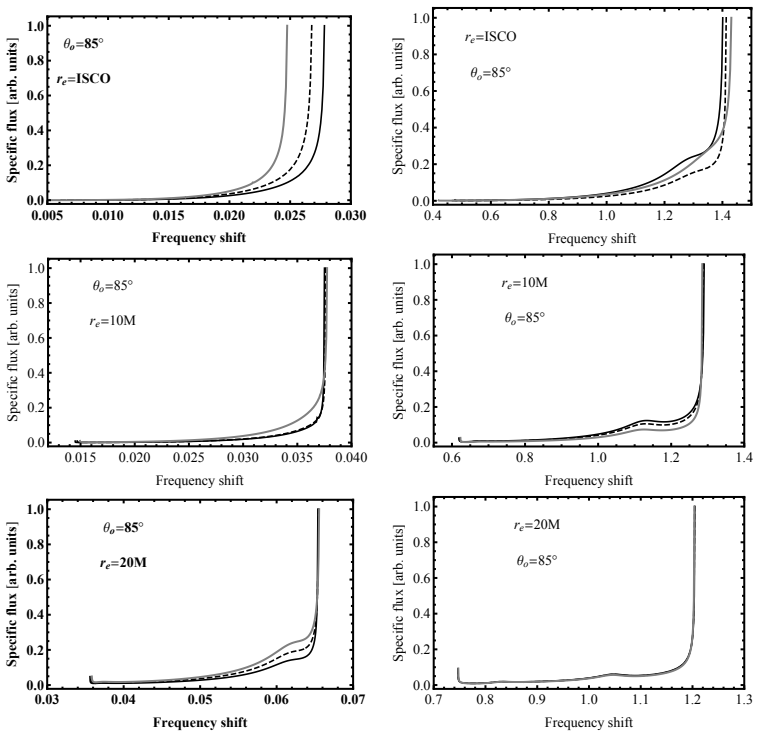
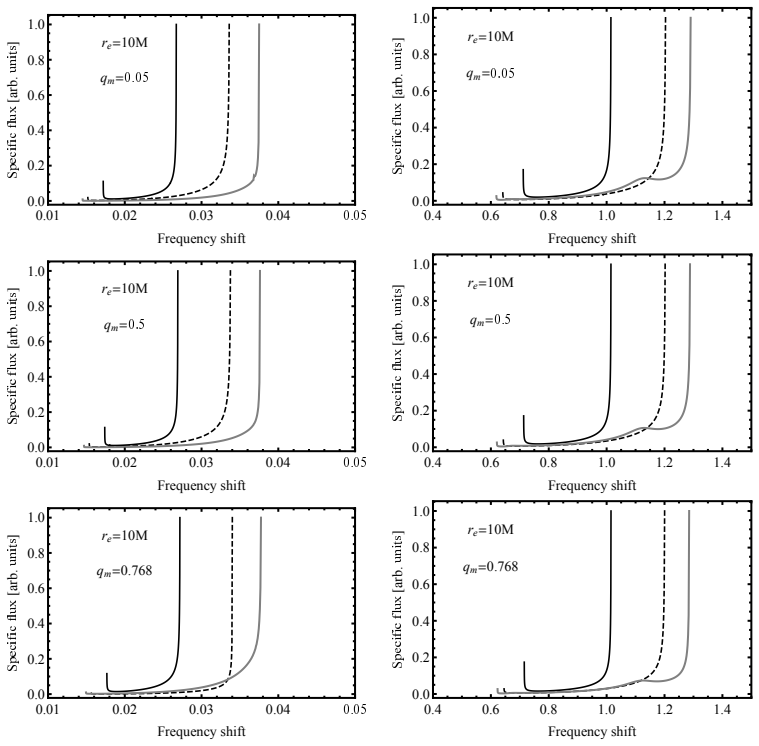
Take a Keplerian ring at r_e = 10 M around a Bardeen black hole with q_m = 0.5 M viewed at θ_o = 60°. The effective-geometry prediction is a line spanning g ≈ 0.0154-0.0338, while the spacetime-geometry prediction is g ≈ 0.643-1.202. A spectrally resolved observation of such a source showing the line peaked near g ≈ 1 with width Δg ≈ 0.56, instead of a deep-red narrow line, would falsify the claimed NED effect for that system.
Extended reading notes
Core claim
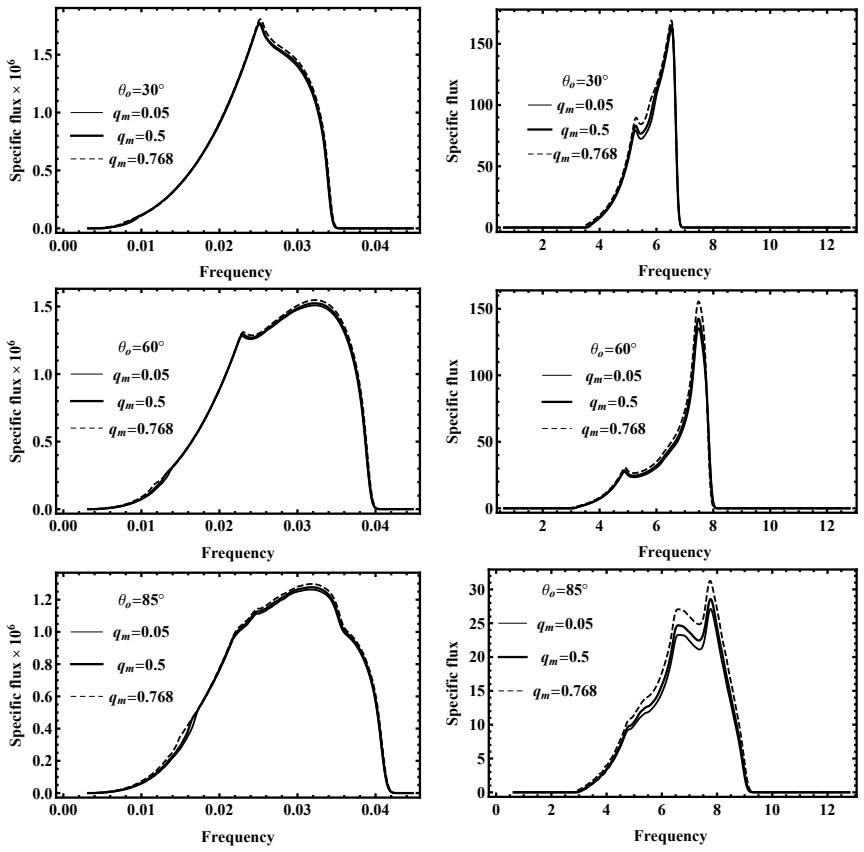
The central claim is that the NED effect on photon propagation is not a small correction to the Bardeen spacetime geometry; it dominates the observed line. For radiating rings at the innermost stable circular orbit, at 10 M and at 20 M, the frequency shift g computed in the effective geometry is of order 0.005-0.07, versus 0.4-1.4 in the pure spacetime geometry, so the effective-geometry line sits deeper in the red by more than one order and its width shrinks by factors from 15 to 50 across the surveyed charges q_m=0.05M, 0.5M, 0.768M and inclinations 30°, 60°, 85°. The authors trace the deep redshift to the ratio $R = L(e)/L(o)$ of the NED Lagrangian evaluated at emitter and observer, which is itself of order 10 and only mildly dependent on the magnetic charge; Doppler shifting and gravitational lensing then reshape the line without changing its qualitative redshift. For extended Keplerian disks the same effect suppresses the peak flux by more than six orders and visibly changes the line shape. The paper therefore positions profiled spectral lines, not just the shadow, as the observable signature of the effective geometry.
Load-bearing premise
Everything in the ray tracing rests on the assumption that photons in nonlinear electrodynamics propagate along the effective metric of Eq. (13), obtained from the Hadamard discontinuity method, rather than along the background spacetime metric.
Editorial extensions
If this is right
- Accreting Bardeen black holes should show iron-line profiles displaced to energies far below the rest energy, with line widths factors of 15 to 50 smaller than standard relativistic disk-line predictions.
- The NED effect remains visible even for rings at 20 M, where the dependence on the magnetic charge has nearly disappeared, so a deep-red narrow line can serve as a charge-independent indicator of effective-geometry photon motion.
- For emission integrated over the inner disk from the ISCO out to 20 M, the peak flux drops by more than six orders of magnitude and the line shape is substantially modified, not just shifted.
- Comparison with Reissner-Nordstrom spacetimes of the same charge isolates the nonlinear-electrodynamics contribution, because the two agree in the Maxwellian weak-field limit.
Reading between the lines
- A parameter-free test can be built from the static-emitter ratio R = L(e)/L(o): measure the centroid shift of a line from a large-radius, nearly static part of a disk and compare it with the value predicted by the same charge that fits the continuum; a mismatch would favor a different effective geometry, such as one with birefringence.
- The same effective geometry also shifts photon circular orbits, which the paper connects to electromagnetic quasinormal modes; this suggests that ring line profiles, shadow measurements, and ringdown signals could jointly constrain the NED Lagrangian better than any one observable alone.
- The deep-redshift prediction depends quantitatively on the specific NED Lagrangian chosen; applying the same ray-tracing procedure to other regular-black-hole Lagrangians would rank the candidate theories by how much line centroid and width they predict.
Signed reviews
Editorial analysis
A structured set of objections, weighed in public.
Referee Report
Summary. The paper studies profiled spectral lines from Keplerian rings orbiting regular Bardeen black holes, under the assumption that photons follow null geodesics of the NED effective geometry g̃_{αβ}=L_F g_{αβ}-L_{FF}F_α^λ F_{λβ} given in Eq. (13). It constructs ray-traced line profiles for three magnetic charges, three ring radii, and three observer inclinations, compares them with profiles generated in the Bardeen (or Reissner-Nordström) spacetime geometry, and reports deep red shifts (more than one order of magnitude), line narrowing by factors of 15 to 50, and up to about 10^6 specific-flux suppression for extended disks. A closed-form static redshift ratio R=L(e)/L(o) is derived in Eq. (49), and Table 1 provides quantitative width data for 27 configurations.
Significance. If correct, the predicted NED signature would be an observationally distinctive way to test regular Bardeen black holes using iron-line profiles from SgrA* and AGN disks. The paper has clear strengths: the parameter coverage in Table 1 is systematic; the comparison quantity R in Eq. (49) is a closed-form, parameter-free ratio; and no model parameters are fitted to the target line profiles. However, two load-bearing physical issues affect the interpretation of every numerical result: the frequency-shift formula appears to mix the effective metric with the physical observer frame, and the polarization content of the emitted radiation is not specified even though NED predicts two photon modes. These issues prevent the paper's central claims from being accepted as they stand.
major comments (2)
- [§3.1, Eq. (13); §5, Eqs. (39)-(40)] The paper uses a single effective metric for all photons, but the Hadamard discontinuity analysis of Eqs. (9)-(12) yields two photon propagation modes: the extraordinary mode with g̃_{αβ}=L_F g_{αβ}-L_{FF}F_α^λ F_{λβ}, and an ordinary mode propagated by the conformally related metric L_F g_{αβ}, whose null geodesics coincide with those of the Bardeen metric. The emission model in Section 5 is polarization-independent, and no argument is given that only the extraordinary mode is radiated. If both modes are emitted with comparable intrinsic intensity, the ordinary-mode contribution has frequency shifts in the range of the 'spacetime geometry' columns of Table 1 and, because of the g^3 factor in Eq. (39), dominates the total specific flux. The abstract and Conclusions claims of >10x red shift and 15-50x narrowing therefore do not apply to an unpolarized line profile unless a polarization-selection assumption is explicitly stated and justified.
- [§5, Eq. (36); §7, Eqs. (47)-(49)] The frequency shift is not a property of the effective metric alone. In a static spacetime, the time component k_t of the wave 1-form is conserved along the ray, and the frequency measured by a physical observer with 4-velocity U is -k_μ U^μ; for a static observer U=(1/√f,0,0,0), the static redshift is √(f_e/f_o), independent of L_F. The factor L(o)/L(e) in Eq. (47) can only arise if the observer's frequency is evaluated using g̃ instead of the physical Bardeen metric, but the paper does not define or justify such an effective-metric frequency. The same problem enters Eq. (36) through the prefactor L(e)/L(o). Since Eq. (36) is used to construct Table 1 and every plotted profile, the numerical predictions are not established as observer-frame line shifts. If the authors intend a different, nonstandard definition of frequency, it must be stated explicitly and its observational relevance demonstrated.
minor comments (5)
- [§4-5] The central transfer-function expression in Eq. (36) and the ray-tracing framework are referred to the submitted manuscripts [59] and [73]. The paper should be self-contained: at least a derivation of Eq. (36) and the definitions of the variables entering the Jacobian in Eq. (44) should be included or summarized in an appendix.
- [§6.3, Fig. 7] The right column of Fig. 7 is described as the Reissner-Nordström spacetime, whereas Table 1 compares the effective Bardeen result with the Bardeen spacetime geometry. The text should be explicit that these are two different 'spacetime geometry' baselines, so the reader can compare like with like.
- [§3.1, Eqs. (9)-(12)] The sentence 'Putting (11) and (12) into (9) and (9)' should read 'into (9) and (10)'.
- [Abstract and §6.1] The wording 'for all values of the magnetic charge and the inclination angle' overstates the three discrete values q_m/M=0.05, 0.5, 0.768 and θ_o=30°, 60°, 85° actually computed; a phrase such as 'for the studied values' would be more precise.
- [§3.2, Eqs. (20)-(35)] The notation for covariant and contravariant latitudinal momentum components is not consistently defined, and Eq. (35) contains a typo ('where is u_in'). A short list of symbols or a clarification of the index placement would improve readability.
Circularity Check
No circularity: the NED redshift, narrowing, and flux suppression follow from the in-paper effective-geometry derivation, not from fitted inputs or load-bearing self-citation.
full rationale
The derivation is self-contained. Sec. 3.1 obtains the effective metric (13) from the Hadamard discontinuity conditions (11)-(12), and the Bardeen Lagrangian (8) is stated explicitly. The central redshift ratio R = g_B/g_NLB = L(e)/L(o) (Eq. 49) follows directly from the time-time components of the effective and background metrics (Eqs. 47-48), with no parameter fitted to the target line profiles. The numerical line profiles use only this effective-geometry photon propagation plus a standard disk emissivity ansatz (Eq. 40); no normalization or fit is tuned to produce the claimed >10x red-edge shift, 15-50x narrowing, or 10^6 flux reduction. The authors' submitted self-citations [59,73] supply the ray-tracing framework, but the needed equations (13)-(46) are restated in the paper, so those citations are not load-bearing. The broken placeholder citation in Sec. 3 is a referencing defect, not a circular step, since the effective-geometry condition is rederived in the text. The skeptic's point about the unmodeled ordinary photon mode is a physics-assumption concern about the NED propagation prescription, not a circularity in the paper's own derivation chain.
Assumptions & free parameters
free parameters (3)
- Magnetic charge q_m =
0.05M, 0.5M, 0.768M
- Thermal broadening parameter gamma =
10^3
- Emissivity power-law index p =
not stated in text
assumptions (4)
- domain assumption Photon rays in NED obey the effective geometry g~_αβ = L_F g_αβ - L_FF F_α^λ F_λβ (Eq. 13) from the Hadamard discontinuity method.
- domain assumption The Bardeen NED Lagrangian L(F) = (3/(2 q_m^3)) (sqrt(2 q_m^2 F)/(1+sqrt(2 q_m^2 F)))^(5/2) (Eq. 8) generates the Bardeen metric f(r) (Eq. 7).
- domain assumption Uncharged orbiting matter follows circular geodesics of the spacetime metric with Keplerian frequency Ω^2 = (r^2 - 2 q_m^2)/(r^2+q_m^2)^(5/2) (Eq. 37), while photons follow the effective geometry.
- domain assumption Line emissivity follows I_e = ε_0 r^{-p} exp[-γ(ν_o/g - ν_0)^2] (Eq. 40) with γ=10^3.
Cite this review
Pith. "Pith review of Profiled spectral lines of Keplerian rings orbiting in the regular Bardeen black hole spacetimes." pith.science (2026). https://pith.science/paper/NZ6CMINH
@misc{pith2026190807197,
  author       = {Pith},
  title        = {Pith review of: Profiled spectral lines of Keplerian rings orbiting in the regular Bardeen black hole spacetimes},
  year         = {2026},
  howpublished = {\url{https://pith.science/paper/NZ6CMINH}},
  note         = {Machine review of arXiv:1908.07197}
}
read the original abstract
Considering the regular Bardeen black hole spacetimes, we test the observational effects of the general relativistic solutions coupled to non-linear electrodynamics (NED) by studying the photon motion in the effective geometry governed by the spacetime geometry and the NED Lagrangian. We focus our attention to the observationally important case of profiled spectral lines generated by rings radiating in a fixed frequency and orbiting the black hole along circular geodesics of the Bardeen spacetime. Such profiled spectral lines are observed in active galactic nuclei and in microquasars, giving sufficient data for the test of regular black holes. We expect that such radiating rings could arise around the Galaxy central supermassive black hole SgrA*, and the related profiled spectral lines could give important additional information to those obtained by direct observations due to the Event Horizon (GRAVITY) Telescope. We demonstrate that the profiled spectral lines of the radiating rings predict strong signatures of the NED effects on the photon motion -- namely the frequency shift to the red edge of the spectrum, and narrowing of the profile, by more than one order in comparison with the case of the profiles generated purely by the spacetime geometry, for all values of the magnetic charge and the inclination angle of the observer. The specific flux is substantially suppressed and for extended Keplerian disks even the shape of the profiled line is significantly modified due to the NED effect.
Figures


Figures from the paper (5 more)



Reference graph
Works this paper leans on
-
[59]
Schee, J. and Stuchl ´ ık, Z., Effective geometry of the Bardeen spacetimes: gravitational lensing and frequency mapping of Keplerian disks, Submitted, 2018
work page 2018
-
[1]
Aliev, A. N. and G¨ umr¨ uk¸ c¨ uoˇ glu, A. E., Charged rotating black holes on a 3-brane, Phys. Rev. D , 71, 104027, 2005
2005
-
[2]
Abdujabbarov, A., Ahmedov, B., and Hakimov, A., Particle motion a round black hole in Hoˇ rava-Lifshitz gravity, Phys. Rev. D , 83, 044053, 2011
2011
-
[3]
and Atamurotov, F
Abdujabbarov, A. and Atamurotov, F. and Kucukakca, Y. and Ahmedov, B. and Camci, U., Shadow of Kerr-Taub-NUT black hole, Astrophys. and Sp. Sci. , 344, p.429-435, 2013
2013
-
[4]
A., Rezzolla, L., and Ahmedov, B
Abdujabbarov, A. A., Rezzolla, L., and Ahmedov, B. J. , A coordin ate-independent characterization of a black hole shadow, Month. Not. of Roy. Astron. Soc. , 454, 2423-2435, 2015
2015
-
[5]
and Abdujabbarov, A
Atamurotov, F. and Abdujabbarov, A. and Ahmedov, B., Shado w of rotating Hoˇ rava-Lifshitz black hole, Astrophys. and Sp. Sci. , 348, p.179-188, 2013
2013
-
[6]
and Garc ´ ıa, A., Regular Black Hole in General Relativity Coupled to Nonlinear Electrody- namics, Phys
Ay´ on-Beato, E. and Garc ´ ıa, A., Regular Black Hole in General Relativity Coupled to Nonlinear Electrody- namics, Phys. Rev. Lett. , 80, p.5056-5059, 1998
1998
-
[7]
Ayon-Beato, E., New regular black hole solution from nonlinear elec trodynamics, Phys. Lett. B , 464, p.25–29, 1999
work page 1999
Show all 86 references
-
[8]
and Garcia, A., Non-Singular Charged Black Hole S olution for Non-Linear Source, Gen
Ayen-Beato, E. and Garcia, A., Non-Singular Charged Black Hole S olution for Non-Linear Source, Gen. Rel. and Grav. , 31, 629, 1999
1999
-
[9]
and Garc ´ ıa, A., The Bardeen model as a nonlinear magnetic monopole, Phys
Ay´ on-Beato, E. and Garc ´ ıa, A., The Bardeen model as a nonlinear magnetic monopole, Phys. Lett. B , 493, p.149–152, 2000
2000
-
[10]
Azreg-A ¨ ınou, M., Generating rotating regular black hole solutio ns without complexification, Phys. Rev. D , 90, 064041, 2014
2014
-
[11]
and Leh´ ebel, A., Asymptotically fla t black holes in Horndeski theory and beyond, Jour
Babichev, E., Charmousis, C. and Leh´ ebel, A., Asymptotically fla t black holes in Horndeski theory and beyond, Jour. of Cosm. and Astropart. Phys. , 4, 027, 2017
2017
-
[12]
and Freese, K., Apparent shape of super-spinning bla ck holes, Phys
Bambi, C. and Freese, K., Apparent shape of super-spinning bla ck holes, Phys. Rev. D , 79, 043002, 2009
2009
-
[13]
and Modesto, L., Rotating regular black holes, Phys
Bambi, C. and Modesto, L., Rotating regular black holes, Phys. Lett. B , 721, p.329-334, 2013
2013
-
[14]
Bambi, C., Cao, Z., and Modesto, L., Testing conformal gravity w ith astrophysical black holes, Phys. Rev. D, 95, 064006, 2017
2017
-
[15]
and Stuchl ´ ık, Z., Accretion disk self-eclipse - X-ray ligh t curve and emission line, Astrophys
Bao, G. and Stuchl ´ ık, Z., Accretion disk self-eclipse - X-ray ligh t curve and emission line, Astrophys. J. , 400, p.163-169, 1992
1992
-
[16]
Bardeen, J., presented at GR5, Tbilisi, U.S.S.R., and published in the conference proceedings in the U.S.S.R., 1968
1968
-
[17]
M., Timelike and null geodesics in the Kerr metric., Black Holes (Les Astres Occlus), editors: Dewitt, C
Bardeen, J. M., Timelike and null geodesics in the Kerr metric., Black Holes (Les Astres Occlus), editors: Dewitt, C. and Dewitt, B. S. , p.215-239, 1973
1973
-
[18]
Y., Gravitational lensing of stars orbiting Sgr A* as a probe of the black hole metric in the Galactic center, Phys
Bin-Nun, A. Y., Gravitational lensing of stars orbiting Sgr A* as a probe of the black hole metric in the Galactic center, Phys. Rev. D , 82, 064009, 2010
2010
-
[19]
and Stuchl ´ ık, Z., Efficiency of the Keplerian accre tion in braneworld Kerr-Newman spacetimes and mining instability of some naked singularity spacetimes, Phys
Blaschke, M. and Stuchl ´ ık, Z., Efficiency of the Keplerian accre tion in braneworld Kerr-Newman spacetimes and mining instability of some naked singularity spacetimes, Phys. Rev. D , 94, 086006, 2016
2016
-
[20]
Regular Black Hole in General Relat ivity Coupled to Nonlinear Electro- dynamics
Bronnikov, K. A., Comment on “Regular Black Hole in General Relat ivity Coupled to Nonlinear Electro- dynamics”, Phys. Rev. Lett. , 85, 4641, 2000
2000
-
[21]
A., Regular magnetic black holes and monopoles fro m nonlinear electrodynamics, Phys
Bronnikov, K. A., Regular magnetic black holes and monopoles fro m nonlinear electrodynamics, Phys. Rev. D, 63, 044005, 2001
2001
-
[22]
Construction of regular black ho les in general relativity
Bronnikov, K. A., Comment on “Construction of regular black ho les in general relativity”, Phys. Rev. D , 96, 128501, 2017
2017
-
[23]
and Stuchl ´ ık, Z., Photon motion in Kerr-de Sitter spacetimes, Europ
Charbul´ ak, D. and Stuchl ´ ık, Z., Photon motion in Kerr-de Sitter spacetimes, Europ. Phys. Jour. C , 77, 897, 2017
2017
-
[24]
Dadhich, N., Maartens, R., Papadopoulos, P., and Rezania, V., Bla ck holes on the brane, Phys. Lett. B ,487, p:1-6, 2000 16
2000
-
[25]
A.,Klippert, R., Novello, M., and Salim, J
De Lorenci, V. A.,Klippert, R., Novello, M., and Salim, J. M., Light prop agation in non-linear electrody- namics, Phys. Lett. B , 482, p.134–140, 2000
2000
-
[26]
Ding, C., Liu, C., Xiao, Y., Jiang, L., and Cai, R.-G., Strong gravitatio nal lensing in a black-hole spacetime dominated by dark energy, Phys. Rev. D , 88, 104007, 2013
2013
-
[27]
S., Fish, V
Doeleman, S. S., Fish, V. L., Broderick, A. E., Loeb, A., and Roger s, A. E. E., Detecting Flaring Structures in Sagittarius A* with High-Frequency VLBI, Astrophys. Jour. , 695, p.59-74, 2009
2009
-
[28]
of the Astro
Fanton, C., Calvani, M., de Felice, F., and Cadez, A., Detecting Acc retion Disks in Active Galactic Nuclei, Pub. of the Astro. Soc. of Jap. , 49, p.159-169, 1997
1997
-
[29]
and Wang, X., Construction of regular black holes in ge neral relativity, Phys
Fan, Z.-Y. and Wang, X., Construction of regular black holes in ge neral relativity, Phys. Rev. D , 94, 124027, 2016
2016
-
[30]
Garc ´ ıa, A., Hackmann, E., Kunz, J., L¨ ammerzahl, C., and Mac ´ ıas, A., Motion of test particles in a regular black hole space-time, Jour. of Math. Phys. , 56, 032501, 2015
2015
-
[31]
Ghasemi-Nodehi, M., Li, Z., and Bambi, C., Shadows of CPR black hole s and tests of the Kerr metric, Europ. Phys. Jour. C, 75, 315, 2015
2015
-
[32]
Ghosh, S. G. and Sheoran, P. and Amir, M., Rotating Ay´ on-Beato-Garc ´ ıa black hole as a particle accelerator, Phys. Rev. D , 90, 103006, 2014
2014
-
[33]
Ghosh, S. G. and Maharaj, S. D., Radiating Kerr-like regular blac k hole, Europ. Phys. Jour. C , 75, 7, 2015
2015
-
[34]
and L¨ ammerzahl, C., Photon region s and shadows of Kerr-Newman-NUT black holes with a cosmological constant, Phys
Grenzebach, A., Perlick, V. and L¨ ammerzahl, C., Photon region s and shadows of Kerr-Newman-NUT black holes with a cosmological constant, Phys. Rev. D , 89, 124004, 2014
2014
-
[35]
Hoˇ rava, P.,Quantum gravity at a Lifshitz point , Phys. Rev. D, 79, 8, 2009
2009
-
[36]
F., Shadows for Reissner-Nordstrom-de Sitter dyon black holes , submitted, 2018
Jal ˚ uvkov´ a, P., Stuchl ´ ık, Z., Tursunov, A., and Zakharov,A. F., Shadows for Reissner-Nordstrom-de Sitter dyon black holes , submitted, 2018
2018
-
[37]
and Sfetsos, K., The black hole and FR W geometries of non-relativistic gravity, Phys
Kehagias, A. and Sfetsos, K., The black hole and FR W geometries of non-relativistic gravity, Phys. Lett. B, 678,p.123-126, 2009
2009
-
[38]
and Stuchl ´ ık, Z., Are eikonal quasinormal mode s linked to the unstable circular null geodesics?, Phys
Konoplya, R.A. and Stuchl ´ ık, Z., Are eikonal quasinormal mode s linked to the unstable circular null geodesics?, Phys. Lett. B , 771, p.597, 2017
2017
-
[39]
and T¨ or¨ ok, G., Quasiperiodic oscillations in a strong gravitational field around neutron stars testing braneworld models, Class
Kotrlov´ a, A., Stuchl ´ ık, Z. and T¨ or¨ ok, G., Quasiperiodic oscillations in a strong gravitational field around neutron stars testing braneworld models, Class. and Quant. Grav. , 25, 225016, 2008
2008
-
[40]
and Slan´ y, P
Kuc´ akov´ a, H. and Slan´ y, P. and Stuchl ´ ık, Z., Toroidal configurations of perfect fluid in the Reissner- Nordstr¨ om-(anti-)de Sitter spacetimes,Jour. of Cosm. and Astropart. Phys. , 1, 033, 2011
2011
-
[41]
V., Gravitational lensing and frame dragging of light in the Kerr-Newman and the Kerr- Newman (anti) de Sitter black hole spacetimes, Gen
Kraniotis, G. V., Gravitational lensing and frame dragging of light in the Kerr-Newman and the Kerr- Newman (anti) de Sitter black hole spacetimes, Gen. Rel. and Grav., 4 6, 1818, 2014
2014
-
[42]
Laor, A., Line profiles from a disk around a rotating black hole, Astrophys. J. , 376, p.90-94, 1991
1991
-
[43]
and Quant
Lamy, F., Gourgoulhon, E., Paumard, T.; et al., Imaging a non-sing ular rotating black hole at the center of the Galaxy, Class. and Quant. Grav. , 35, 115009, 2018
2018
-
[44]
Macedo, C. F. B., de Oliveira, E. S., and Crispino, L. C. B., Scatter ing by regular black holes: Planar massless scalar waves impinging upon a Bardeen black hole, Phys. Rev. D , 92, 024012, 2015
2015
-
[45]
and Nicolini, P., Charged rotating noncommutative b lack holes, Phys
Modesto, L. and Nicolini, P., Charged rotating noncommutative b lack holes, Phys. Rev. D , 82, 104035, 2010
2010
-
[46]
Neves, J. C. S. and Saa, A., Regular rotating black holes and the weak energy condition, Phys. Lett. B , 734, p.44–48, 2014
2014
-
[47]
A., Salim, J
Novello, M., de Lorenci, V. A., Salim, J. M., and Klippert, R., Geometr ical aspects of light propagation in nonlinear electrodynamics, Phys. Rev. D , 61, 045001, 2000
2000
-
[48]
Novikov, I. D. and Thorne, K. S., Astrophysics of black holes, Black Holes (Les Astres Occlus), editors: Dewitt, C. and Dewitt, B. S. , p.343-450, 1973
1973
-
[49]
N., Evidence against Macroscopic Astrophysical Dyad ospheres, Astrophys
Page, D. N., Evidence against Macroscopic Astrophysical Dyad ospheres, Astrophys. J. , 653, p.1400-1409, 2006 17
2006
-
[50]
and Joshi, P
Patil, M. and Joshi, P. S., Ultrahigh energy particle collisions in a reg ular spacetime without black holes or naked singularities, Phys. Rev. D , 86, 044040, 2012
2012
-
[51]
and Quevedo, H
Pugliese, D. and Quevedo, H. and Ruffini, R., Motion of charged te st particles in Reissner-Nordstr¨ om spacetime, Phys. Rev. D , 83, 104052, 2011
2011
-
[52]
Rauch, K. P. and Blandford, R. D., Optical caustics in a kerr spa cetime and the origin of rapid X-ray variability in active galactic nuclei, Astrophys. Jour. , 421, 46–68, 1994
1994
-
[53]
E., Junior, E
Rodrigues, M. E., Junior, E. L. B., and Silva, M. V. d. S., Using domin ant and weak energy conditions for build new classe of regular black holes, Jour. of Cosmol. and Astropart. Phys. , 2, 059, 2018
2018
-
[54]
A., Muccino, M., Aimuratov, Y., Becerra, L
Ruffini, R., Rueda, J. A., Muccino, M., Aimuratov, Y., Becerra, L. M ., Bianco, C. L., Kovacevic, M., Moradi, R., Oliveira, F. G., Pisani, G. B., and Wang, Y. , On the Classification of GR Bs and Their Occurrence Rates, Astrophys. J. , 832, 136, 2016
2016
-
[55]
and Stuchl ´ ık, Z., Optical Phenomena in the Field of Br aneworld Kerr Black Holes, Int
Schee, J. and Stuchl ´ ık, Z., Optical Phenomena in the Field of Br aneworld Kerr Black Holes, Int. Jour. of Mod. Phys. D , 18, p.983–1024, 2009
2009
-
[56]
and Stuchl ´ ık, Z., Profiles of emission lines generated by rings orbiting braneworld Kerr black holes, Gen
Schee, J. and Stuchl ´ ık, Z., Profiles of emission lines generated by rings orbiting braneworld Kerr black holes, Gen. Rel. and Grav. , 41, p.1795-1818, 2009
2009
-
[57]
and Stuchl ´ ık, Z., Profiled spectral lines generated in the field of Kerr superspinars, Journ
Schee, J. and Stuchl ´ ık, Z., Profiled spectral lines generated in the field of Kerr superspinars, Journ. of Cosmolog. and Astropart. Phys. , 4, 005, 2013
2013
-
[58]
and Stuchl ´ ık, Z., Gravitational lensing and ghost ima ges in the regular Bardeen no-horizon spacetimes, Jour
Schee, J. and Stuchl ´ ık, Z., Gravitational lensing and ghost ima ges in the regular Bardeen no-horizon spacetimes, Jour. of Cosmol. and Astropart. Phys. , 6, 048, 2015
2015
-
[60]
Stuchl ´ ık, Z.,Equatorial circular orbits and the motion of the shell of dus t in the field of a rotating naked singularity. Bull. of the Astronom. Inst. of Czechoslovakia, 31, p.129–144, 1 980
-
[61]
of the Astron
Stuchlik, Z., The motion of test particles in black-hole backgroun ds with non-zero cosmological constant, Bull. of the Astron. Inst. of Czechoslovakia , 34, p.129-149, 1983
1983
-
[62]
Stuchl ´ ık, Z., Influence of the RELICT Cosmological Constant on Accretion Discs, Mod. Phys. Lett. A , 20, p.561-575, 2005
2005
-
[63]
and Hled ´ ık, S
Stuchl ´ ık, Z. and Hled ´ ık, S. Equatorial photon motion in the Ke rr-Newman spacetimes with a non-zero cosmological constant, Class. and Quant. Grav. , 17, p.4541-4576, 2000
2000
-
[64]
and Hled ´ ık, S., Properties of the Reissner-Nordstrom spacetimes with a nonzero cosmological constant Acta Phys
Stuchl ´ ık, Z. and Hled ´ ık, S., Properties of the Reissner-Nordstrom spacetimes with a nonzero cosmological constant Acta Phys. Slovac. 52, 363, 2002
2002
-
[65]
and Kotrlov´ a, A., Orbital resonances in discs ar ound braneworld Kerr black holes, Gen
Stuchl ´ ık, Z. and Kotrlov´ a, A., Orbital resonances in discs ar ound braneworld Kerr black holes, Gen. Rel. and Grav., 41, p.1305-1343, 2009
2009
-
[66]
and Schee, J., Appearance of Keplerian discs orb iting Kerr superspinars, Class
Stuchl ´ ık, Z. and Schee, J., Appearance of Keplerian discs orb iting Kerr superspinars, Class. and Quant. Grav., 27, 215017, 2010
2010
-
[67]
and Schee, J., Observational phenomena related to primordial Kerr supers pinars, Class
Stuchl ´ ık, Z. and Schee, J., Observational phenomena related to primordial Kerr supers pinars, Class. and Quant. Grav., 29, 065002, 2012
2012
-
[68]
and Schee, J., Ultra-high-energy collisions in the s uperspinning Kerr geometry, Class
Stuchl ´ ık, Z. and Schee, J., Ultra-high-energy collisions in the s uperspinning Kerr geometry, Class. and Quant. Grav., 30, 075012, 2013
2013
-
[69]
and Schee, J., Optical effects related to Kepleria n discs orbiting Kehagias-Sfetsos naked singularities, Class
Stuchl ´ ık, Z. and Schee, J., Optical effects related to Kepleria n discs orbiting Kehagias-Sfetsos naked singularities, Class. and Quant. Grav. , 31, 195013, 2014
2014
-
[70]
and Abdujabbarov, A., Ultra-high-en ergy collisions of particles in the field of near- extreme Kehagias-Sfetsos naked singularities and their appearan ce to distant observers, Phys
Stuchl ´ ık, Z., Schee, J. and Abdujabbarov, A., Ultra-high-en ergy collisions of particles in the field of near- extreme Kehagias-Sfetsos naked singularities and their appearan ce to distant observers, Phys. Rev. D , 89, 104048, 2014
2014
-
[71]
and Schee, J., Circular geodesic of Bardeen and A yon-Beato-Garcia regular black-hole and no-horizon spacetimes Int
Stuchl ´ ık, Z. and Schee, J., Circular geodesic of Bardeen and A yon-Beato-Garcia regular black-hole and no-horizon spacetimes Int. Jour. of Mod. Phys. D, 24, 1550020, 2015
2015
-
[72]
and Schee, J., Particle collisions and o ptical effects in the mining Kerr-Newman spacetimes, Phys
Stuchl ´ ık, Z., Blaschke, M. and Schee, J., Particle collisions and o ptical effects in the mining Kerr-Newman spacetimes, Phys. Rev. D , 96, 104050, 2017 18
2017
-
[73]
and Schee, J., Shadows of the regular Bardeen b lack holes, Submitted, 2018
Stuchl ´ ık, Z. and Schee, J., Shadows of the regular Bardeen b lack holes, Submitted, 2018
2018
-
[74]
and Slan´ y, P., Equatorial circular orbits in the Ke rr de Sitter spacetimes, Phys
Stuchl ´ ık, Z. and Slan´ y, P., Equatorial circular orbits in the Ke rr de Sitter spacetimes, Phys. Rev. D , 69, 064001, 2004
2004
-
[75]
Stuchl ´ ık, Z., Charbul´ ak, D., and Schee, J., Light escape cone s in local reference frames of Kerr-de Sitter black hole spacetimes and related black hole shadows, Europ. Phys. Jour. C , 78, 180, 2018
2018
-
[76]
Tamburini, F., De Laurentis, M., Amati, L., and Thid´ e, B., General relativistic electromagnetic and massive vector field effects with gamma-ray burst production, Phys. Rev. D , 96, 104003, 2017
2017
-
[77]
Toshmatov, B., Ahmedov, B., Abdujabbarov, A.,and Stuchl ´ ık, Z., Rotating regular black hole solution, Phys. Rev. D , 89, 104017, 2014
2014
-
[78]
Toshmatov, B., Abdujabbarov, A., Ahmedov, B., and Stuchl ´ ık , Z., Particle motion and Penrose processes around rotating regular black hole, Astrophys. and Sp. Sci. , 357, 41, 2015
2015
-
[79]
Toshmatov, B., Abdujabbarov, A., Stuchl ´ ık, Z., and Ahmedov, B., Quasinormal modes of test fields around regular black holes, Phys. Rev. D , 91, 083008, 2015
2015
-
[80]
Toshmatov, B., Bambi, C., Ahmedov, B., Stuchl ´ ık, Z., and Schee , J., Scalar perturbations of nonsingular nonrotating black holes in conformal gravity, Phys. Rev. D , 96, 064028, 2017
2017
-
[81]
Toshmatov, B., Stuchl ´ ık, Z., and Ahmedov, B., Generic rotatin g regular black holes in general relativity coupled to nonlinear electrodynamics, Phys. Rev. D , 95, 084037, 2017
2017
-
[82]
Toshmatov, B., Stuchl ´ ık, Z., Schee, J., and Ahmedov, B., Elect romagnetic perturbations of black holes in general relativity coupled to nonlinear electrodynamics, Phys. Rev. D , 97, 084058, 2018
2018
-
[83]
Toshmatov, B., Stuchl ´ ık, Z., and Ahmedov, B., Electromagnet ic perturbations of black holes in general relativity coupled to nonlinear electrodynamics: Poloidal perturbat ions, Phys. Rev. D , 98, 085021, 2018
2018
-
[84]
and Bambi, C., Constraining the spin and the deformation parameters from the black hole shadow, Jour
Tsukamoto, N., Li, Z. and Bambi, C., Constraining the spin and the deformation parameters from the black hole shadow, Jour. of Cosmolog. and Astropart. Phys. , 6, 043, 2014
2014
-
[85]
Vieira, R. S. S., Schee, J., Klu´ zniak, W., Stuchl ´ ık, Z., and Abram owicz, M., Circular geodesics of naked singularities in the Kehagias-Sfetsos metric of Hoˇ rava’s gravity, Phys. Rev. D , 90, 024035, 2014
2014
-
[86]
F., Constraints on a charge in the Reissner-Nord strom metric, Phys
Zakharov, A. F., Constraints on a charge in the Reissner-Nord strom metric, Phys. Rev. D , 90(6), 062007, 2014 19
2014
Reviewed August 14, 2026 · model on record in the stance chip above.
Discussion (0). Continue with ORCID to comment.