REVIEW 4 major objections 6 minor 36 references
Strong Convergence of Forward-Backward-Forward Methods for Pseudo-monotone Variational Inequalities with Applications to Dynamic User Equilibrium in Traffic Networks
T0 review · 4 major / 6 minor · reviewed 2026-08-14 · deepseek-v4-flash
Pith's one-line read For pseudo-monotone variational inequalities in Hilbert spaces, a cheaply modified forward-backward-forward algorithm converges strongly to the minimal-norm solution, and an adaptive step-size variant does so without knowledge of the…
desk verdict Anchored Tseng forward-backward-forward for pseudo-monotone VIs is a clean and genuinely new combination, but Lemma 3.6 has a load-bearing gap—pseudo-monotonicity is applied at points outside X—so the main theorem needs a stronger assumption or a repaired proof. read the letter →
The pith
A machine-rendered reading of the paper's core claim, the machinery that carries it, and where it could break.
The reading
What carries the argument
The central object is the augmented forward-backward-forward iteration. In the base step, z_k is the projection of x_k - gamma F(x_k) onto X, and r_k = z_k + gamma(F(x_k)-F(z_k)) is the forward-backward-forward correction; the new point x_{k+1} is then the convex combination (1-alpha_k-beta_k)x_k + beta_k r_k. Relative to the target p, this update carries a small pull term -alpha_k p, and the conditions on alpha_k and beta_k make that pull vanish slowly enough to force strong convergence while preserving the weak-convergence structure inherited from the base method. The proof chains three ingredients: a basic recursion (Lemma 3.3) that contracts ||r_k - x*|| by the gap (1-(gamma L)^2)||x_k - z_k||^2, a quasi-Fejér inequality (Lemma 3.5) that converts that gap into a perturbed recursion for ||x_{k+1} - p||^2, and a cluster-point lemma (Lemma 3.6) that uses pseudo-monotonicity plus weak-to-weak continuity to identify weak limits with vanishing gap as solutions. In the adaptive variant, the same contraction holds with (1 - $gamma_k^{2}$ $rho^{2}$ / gamma_{k+1}^2) in place of (1-(gamma L)^2).
What would settle it
Search for a bounded, Lipschitz, weak-to-weak continuous map F that is pseudo-monotone on X but fails pseudo-monotonicity at every point outside X, with X* nonempty; if running Algorithm 1 with parameters satisfying (3.1) yields a trajectory whose weak cluster point is not in X*, or whose ||x_k - z_k|| does not vanish, then the omitted neighborhood condition is essential and Theorem 3.1 as stated is false. A quicker check: compute the points y + epsilon_j F(z_{N_j})/||F(z_{N_j})||^2 from the proof and test whether the implication defining pseudo-monotonicity holds there; if it fails, the proof step (3.18) has no justification.
Extended reading notes
Core claim
Under Lipschitz continuity, sequential weak-to-weak continuity, and pseudo-monotonicity of F, with a nonempty closed convex solution set X*, Algorithm 1 produces a sequence (x_k) that converges strongly to p = argmin{||z|| : z in X*}, the minimal-norm solution of VI(X,F). The update is x_{k+1} = (1-alpha_k-beta_k)x_k + beta_k r_k, with z_k = P_X(x_k - gamma F(x_k)) and r_k = z_k + gamma(F(x_k)-F(z_k)), and the parameter sequences satisfy alpha_k -> 0, sum alpha_k = infinity, and beta_k bounded away from 0 and from 1-alpha_k. Theorem 3.2 shows the same strong convergence when the constant step-size is replaced by the recursive rule (3.2), which shrinks gamma_k according to the ratio ||z_k - x_k||/||F(z_k)-F(x_k)||, so no global Lipschitz constant is needed. The proof establishes a perturbed Fejér-type recursion for ||x_k - p||^2 whose perturbation vanishes suitably, then shows that every weak cluster point of the sequence must be a solution, and concludes strong convergence via a classical lemma on perturbed contractions.
Load-bearing premise
The proof's load-bearing premise is that F is pseudo-monotone not only on the feasible set X but on a neighborhood of X or all of H, because Lemma 3.6 applies the pseudo-monotonicity definition to the auxiliary point y + epsilon_j F(z_{N_j})/||F(z_{N_j})||^2, which need not lie in X.
Editorial extensions
If this is right
- For any pseudo-monotone variational inequality satisfying the paper's assumptions, the minimal-norm solution can now be computed with one projection per iteration and guaranteed strong convergence in the Hilbert-space norm.
- The adaptive step-size rule removes the need to estimate a global Lipschitz constant, so the method can be applied to black-box operators such as the effective-delay operator in dynamic traffic assignment.
- Because strong convergence is stable under discretization, the method's iterates from any finite-dimensional approximation will not drift away from the true solution set.
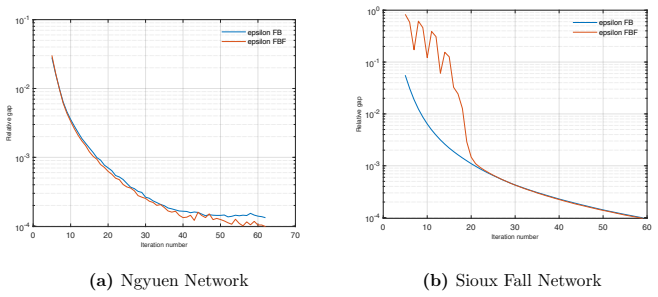
- The experiments indicate the method is at least competitive with the projected-gradient baseline on the Nguyen and Sioux Falls networks, while carrying stronger theoretical guarantees.
- Pseudo-monotonicity is strictly weaker than monotonicity, so the method covers equilibrium problems such as dynamic user equilibrium where strong monotonicity provably fails.
Reading between the lines
- The same 'pull toward the origin' augmentation could be grafted onto other single-projection algorithms (for example, extragradient variants or proximal-point methods) to force strong convergence for pseudo-monotone maps, as long as a quasi-Fejér relation with a vanishing gap can be established.
- A testable refinement would be to replace the unverified neighborhood pseudo-monotonicity with the weaker and checkable condition that F is pseudo-monotone on the convex hull of X and the iterates; if that suffices, the theorem could be proved without extending the assumption off X.
- In the traffic application, the delay operator is only evaluated at finitely many discretization points through the dynamic network loading subroutine; the strong-convergence guarantee would carry over to the discretized algorithm only if the approximate operators are uniformly pseudo-monotone on the relevant region, which is an empirical question the paper does not settle.
- Converging to the minimal-norm solution gives a principled selection rule among multiple dynamic user equilibria—the one with least total departure-flow energy—which could matter for policy evaluation beyond the paper's examples.
Signed reviews
Editorial analysis
A structured set of objections, weighed in public.
Referee Report
Summary. This paper proposes a forward-backward-forward algorithm for solving variational inequalities VI(X,F) in real Hilbert spaces under Lipschitz continuity, sequential weak-to-weak continuity, and pseudo-monotonicity of F. The update adds an anchoring extrapolation x_{k+1}=(1-alpha_k-beta_k)x_k+beta_k r_k to the classical Tseng iteration, and the paper claims strong convergence to the minimal-norm solution p=P_{X*}(0). An adaptive step-size variant is also claimed. The final section applies the algorithm to dynamic user equilibrium in traffic networks and reports numerical comparisons on Nguyen and Sioux Falls instances.
Significance. The intended contribution is timely: strong convergence with a single projection per iteration under pseudo-monotonicity would improve over weakly convergent Tseng methods and over strongly convergent methods requiring extra projections. The non-adaptive part of the proof is largely self-contained and uses standard tools (Xu's lemma, quasi-Fejer inequalities, two-case Mange argument), and the numerical study is useful empirical evidence. However, the central lemma that identifies weak cluster points as solutions is not proved under the stated assumptions: it applies pseudo-monotonicity at points outside X and passes to the limit in an inner product of two weakly convergent sequences. The adaptive theorem is only sketched and its displayed estimate is not sufficient. These gaps are load-bearing; the main theorems do not yet follow. The DUE application also does not verify the assumptions.
major comments (4)
- [§3.2, Lemma 3.6, Eq. (3.18)] The proof of Lemma 3.6 applies the pseudo-monotonicity implication to the pair (y+epsilon_j u_Nj, z_Nj) immediately before Eq. (3.18). Assumption 2 defines pseudo-monotonicity only for pairs in X, and the point y+epsilon_j u_Nj is never shown to belong to X. This is not a technicality: for X={x in R^2 : x_1 >= 0}, y=0, z_Nj=0, and F(x)=(x_1-1, x_2), the map F is Lipschitz, sequentially weak-to-weak continuous, and monotone (hence pseudo-monotone on X), yet y+epsilon_j u_Nj = (-epsilon_j, 0) is outside X. Therefore the inequality (3.18) is not justified. Since Lemma 3.6 is invoked in both cases of the proof of Theorem 3.1 and the proof of Theorem 3.2 is said to follow analogously, Theorems 3.1 and 3.2 are not established under the stated assumptions. The proof can be repaired by assuming pseudo-monotonicity on a neighborhood of X or on all of H, or by providing a valid argument that keeps the perturbed point inside X.
- [§3.2, Lemma 3.6, limit after Eq. (3.18)] Even if (3.18) were valid, the passage to the limit to conclude 0 <= <F(y), y-x_hat> is not justified: the first factor F(y+epsilon_j u_Nj) converges weakly to F(y), and the second factor y+epsilon_j u_Nj - z_Nj converges weakly to y-x_hat, but weak convergence of both factors does not imply convergence of their inner product to the inner product of the limits. A strong convergence of at least one factor (or a different proof structure) is required. Consequently the conclusion x_hat in X* is not obtained from the displayed argument.
- [§3.2, Proof of Theorem 3.2] The proof of the adaptive variant is a one-line sketch. The displayed bound ||r_k-x*||^2 <= ||x_k-x*||^2 - (1 - gamma_k^2 rho^2 / gamma_{k+1}^2) ||x_k-z_k||^2 does not establish the analogue of Lemma 3.3, because gamma_{k+1} <= gamma_k implies gamma_k^2 rho^2 / gamma_{k+1}^2 can exceed 1, making the alleged contraction coefficient negative. The adaptive rule (3.2) does not prevent this. Thus the assertion that 'the rest of the proofs follows analogously' is not sufficient; Theorem 3.2 requires a complete proof.
- [§4.2-4.3] The DUE application does not verify that the effective delay operator Psi satisfies the hypotheses of Theorems 3.1-3.2, namely Lipschitz continuity, sequential weak-to-weak continuity, pseudo-monotonicity on the feasible set (or on a neighborhood), and nonempty solution set. Section 4.2 states only that Algorithm 3 is equivalent to Algorithm 1 'if' Psi is Lipschitz continuous and pseudomonotone, and the numerics are run without establishing these conditions. As a result, the convergence guarantee does not formally apply to the DUE computations reported.
minor comments (6)
- [Abstract] The abstract contains two typos: 'device' should be 'devise' and 'pseudomonote' should be 'pseudomonotone'.
- [Theorem 3.2 statement] The statement of Theorem 3.2 says the sequence is generated by Algorithm 1; it should refer to Algorithm 2.
- [Proof of Theorem 3.1, Case 2] The quantity y_{tau(k)} is used in the Case 2 argument but never defined; the surrounding formulas indicate z_{tau(k)} is intended.
- [§3.1, after Eq. (3.2)] The sentence claiming the limit point is 'not smaller than {gamma_0, rho/L}' should read min{gamma_0, rho/L}.
- [Lemma 3.6] The assertion that 'for each j >= 1, F(z_Nj) != 0' is not justified; if F(z_Nj)=0 then z_Nj is already in X* and this case should be handled separately before defining u_Nj.
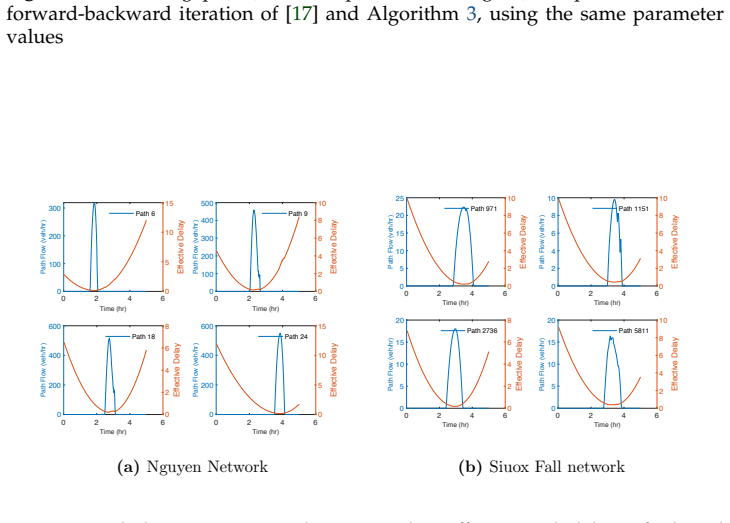
- [§4.3, figures] The figure numbering is inconsistent: Figure 2 appears with different captions, and the caption referring to 'four test networks' includes networks not discussed in the numerical comparisons.
Circularity Check
No circularity: the strong-convergence theorem is derived from stated assumptions with standard Fejér-type arguments; the minimal-norm solution is a consequence, not an input.
full rationale
The convergence analysis in Section 3 is a self-contained derivation. Lemma 3.3 applies pseudo-monotonicity only to pairs in X (x* and z_k), exactly as Assumption 2 defines it. Lemma 3.4 bounds the iterates using the anchor x* and the Lipschitz constant. Lemma 3.5 is an algebraic recursion, and Lemma 3.6 obtains X* membership of a weak cluster point from the gap condition via weak-to-weak continuity; p is then defined as P_X*(0), i.e., the minimum-norm element of X*, not a fitted or pre-imposed target. No parameter in Theorem 3.1 or Theorem 3.2 is fitted to the solution, and no equation is equivalent to its own input by construction. Self-citations such as [5], [6], and [30] are contextual and not load-bearing; the proof does not invoke them. The DUE experiments compare the algorithm's relative gap with a benchmark solver [17] on test networks; the reported O-D gaps are computed after termination, not used to define the method, so this is benchmarking, not prediction from fitted constants. The manuscript does contain two non-circular weaknesses: the step before (3.18) invokes pseudo-monotonicity at a point y + eps_j u_Nj that is not shown to lie in X, which is a possible gap in Lemma 3.6 under Assumption 2 as stated, and the proof of Theorem 3.2 is explicitly left to the reader. Both are correctness and completeness concerns; neither makes the derivation circular.
Assumptions & free parameters
free parameters (3)
- Experimental step-size and momentum parameters (alpha_k, beta_k, gamma) =
Not reported (chosen per instance)
- Stopping tolerance epsilon =
1e-4 for Nguyen and Sioux Falls; 1e-3 mentioned for other networks in pasted text
- Adaptive parameters gamma_0 and rho =
Not specified in experiments
assumptions (5)
- domain assumption F is L-Lipschitz and sequentially weak-to-weak continuous on bounded subsets (Assumption 1)
- domain assumption F is pseudo-monotone on X, and implicitly at perturbed points outside X (Assumption 2 plus an unstated strengthening)
- domain assumption The solution set X* is nonempty, closed, and convex (Assumption 3)
- standard math Projection characterization lemma (Lemma 2.1)
- standard math Xu's lemma for quasi-Fejer recursions (Lemma 2.3)
Cite this review
Pith. "Pith review of Strong Convergence of Forward-Backward-Forward Methods for Pseudo-monotone Variational Inequalities with Applications to Dynamic User Equilibrium in Traffic Networks." pith.science (2026). https://pith.science/paper/T2TBD3OH
@misc{pith2026190807211,
  author       = {Pith},
  title        = {Pith review of: Strong Convergence of Forward-Backward-Forward Methods for Pseudo-monotone Variational Inequalities with Applications to Dynamic User Equilibrium in Traffic Networks},
  year         = {2026},
  howpublished = {\url{https://pith.science/paper/T2TBD3OH}},
  note         = {Machine review of arXiv:1908.07211}
}
read the original abstract
In infinite-dimensional Hilbert spaces we device a class of strongly convergent primal-dual schemes for solving variational inequalities defined by a Lipschitz continuous and pseudomonote map. Our novel numerical scheme is based on Tseng's forward-backward-forward scheme, which is known to display weak convergence, unless very strong global monotonicity assumptions are made on the involved operators. We provide a simple augmentation of this algorithm which is computationally cheap and still guarantees strong convergence to a minimal norm solution of the underlying problem. We provide an adaptive extension of the algorithm, freeing us from requiring knowledge of the global Lipschitz constant. We test the performance of the algorithm in the computationally challenging task to find dynamic user equilibria in traffic networks and verify that our scheme is at least competitive to state-of-the-art solvers, and in some case even improve upon them.
Figures


Figures from the paper (2 more)

Reference graph
Works this paper leans on
-
[1]
Method of convex programming using a symmetric modification of lagrange function
AS Antipin. Method of convex programming using a symmetric modification of lagrange function. Matekon, 14(2):23–38, 1978
work page 1978
-
[2]
Asymptotic cones and functions in optimization and variational inequalities
Alfred Auslender and Marc Teboulle. Asymptotic cones and functions in optimization and variational inequalities. Springer Science & Business Media, 2006
work page 2006
-
[3]
Heinz H. Bauschke and Patrick L. Combettes. A weak-to-strong convergence principle for fejér-monotone methods in hilbert spaces. Mathematics of Operations Research, 26(2): 248–264, 2019/07/28 2001. doi: 10.1287 /moor.26.2.248.10558. URL https://doi.org/ 10.1287/moor.26.2.248.10558
-
[4]
Heinz H. Bauschke and Patrick L. Combettes. Convex Analysis and Monotone Operator Theory in Hilbert Spaces. Springer - CMS Books in Mathematics, 2016
work page 2016
-
[5]
Radu Ioan Bot, Ernö Robert Csetnek, and Phan Tu Vuong. The forward-backward- forward method from discrete and continuous perspective for pseudo-monotone vari- ational inequalities in hilbert spaces. arXiv preprint arXiv:1808.08084, 2018
work page Pith review arXiv 2018
-
[6]
Forward-backward-forward methods with variance reduction for stochastic varia- tional inequalities
Radu Ioan Bot, Panayotis Mertikopoulos, Mathias Staudigl, and Phan Tu Vuong. Forward-backward-forward methods with variance reduction for stochastic varia- tional inequalities. arXiv preprint arXiv:1902.03355, 2019
arXiv 1902
-
[7]
Flows on networks: recent results and perspectives
Alberto Bressan, Sunˇ cica ˇCani´ c, Mauro Garavello, Michael Herty, and Benedetto Pic- coli. Flows on networks: recent results and perspectives. EMS Surveys in Mathematical Sciences, 1(1):47–111
-
[8]
Finite-Dimensional Variational Inequalities and Complementarity Problems - Volume I and Volume II
Francisco Facchinei and Jong-shi Pang. Finite-Dimensional Variational Inequalities and Complementarity Problems - Volume I and Volume II . Springer Series in Operations Re- search, 2003
work page 2003
Show all 36 references
-
[9]
Friesz and Ke Han
Terry L. Friesz and Ke Han. The mathematical foundations of dynamic user equilib- rium. Transportation Research Part B: Methodological , 126:309–328, 2019. doi: https: //doi.org/10.1016/j.trb.2018.08.015. URL http://www.sciencedirect.com/science/ article/pii/S0191261517301960
2019 doi
-
[10]
Friesz, David Bernstein, Tony E
Terry L. Friesz, David Bernstein, Tony E. Smith, Roger L. Tobin, and B. W. Wie. Vari- ational inequality formulation of the dynamic network user equilibrium. Operations Research, 41(1):179–191, 1993
1993
-
[11]
Traffic flow on networks , volume 1
Mauro Garavello and Benedetto Piccoli. Traffic flow on networks , volume 1. American institute of mathematical sciences Springfield, 2006
2006
-
[12]
Tseng type methods for solving inclusion problems and its applications
Aviv Gibali and Duong Viet Thong. Tseng type methods for solving inclusion problems and its applications. Calcolo, 55(4):49, 2018. doi: 10.1007 /s10092-018-0292-1. URL https://doi.org/10.1007/s10092-018-0292-1 . 23
2018 doi
-
[13]
Goebel and S
K. Goebel and S. Reich. Uniform Convexity, Hyperbolic Geometry, and Nonexpansive Mappings. Marcel Dekker, New York, 1984
1984
-
[14]
O. Güler. On the convergence of the proximal point algorithm for convex minimization. SIAM Journal on Control and Optimization, 29(2):403–419, 2019/07/28 1991. doi: 10.1137 / 0329022. URL https://doi.org/10.1137/0329022
2019 doi
-
[15]
Two new self-adaptive projection methods for variational inequality problems
Deren Han and Hong K Lo. Two new self-adaptive projection methods for variational inequality problems. Computers & Mathematics with Applications , 43(12):1529–1537, 2002
2002
-
[16]
Friesz, W
Ke Han, Terry L. Friesz, W. Y. Szeto, and Hongcheng Liu. Elastic demand dy- namic network user equilibrium: Formulation, existence and computation. Trans- portation Research Part B: Methodological , 81:183–209, 2015. doi: https: //doi.org/10. 1016/j.trb.2015.07.008. URL http:/...
2015
-
[17]
Computing dynamic user equilibria on large- scale networks with software implementation
Ke Han, Gabriel Eve, and Terry L Friesz. Computing dynamic user equilibria on large- scale networks with software implementation. Networks and Spatial Economics , pages 1–34, 2019
2019
-
[18]
Sur les inéquations variationnelles et la minimisation de fonction- nelles convexes
Yves Haugazeau. Sur les inéquations variationnelles et la minimisation de fonction- nelles convexes. These, Universite de Paris, 1968
1968
-
[19]
B. S. He and L. Z. Liao. Improvements of some projection methods for monotone nonlinear variational inequalities. Journal of Optimization Theory and Applications , 112 (1):111–128, 2002. doi: 10.1023 /A:1013096613105. URL https://doi.org/10.1023/A: 1013096613105
2002 doi
-
[20]
Optimization with PDE constraints, volume 23
Michael Hinze, René Pinnau, Michael Ulbrich, and Stefan Ulbrich. Optimization with PDE constraints, volume 23. Springer Science & Business Media, 2008
2008
-
[21]
An Introduction to Variational Inequalities and their Applications
David Kinderlehrer and Guido Stampacchia. An Introduction to Variational Inequalities and their Applications. Academic Press, New York, 1980
1980
-
[22]
The extragradient method for finding saddle points and other prob- lems
GM Korpelevich. The extragradient method for finding saddle points and other prob- lems. Matecon, 12:747–756, 1976
1976
-
[23]
Lo and W
Hong K. Lo and W. Y. Szeto. A cell-based variational inequality formulation of the dynamic user optimal assignment problem. Transportation Research Part B: Method- ological, 36(5):421–443, 2002. doi: https: //doi.org/10.1016/S0191-2615(01)00011-X. URL http://www.sciencedirect....
2002 doi
-
[24]
Jiancheng Long, Hai-Jun Huang, Ziyou Gao, and W. Y. Szeto. An intersection- movement-based dynamic user optimal route choice problem. Operations Research, 61(5):1134–1147, 2019 /08/09 2013. doi: 10.1287 /opre.2013.1202. URL https://doi. org/10.1287/opre.2013.1202
2019
-
[25]
P . Maingé. A hybrid extragradient-viscosity method for monotone operators and fixed point problems. SIAM Journal on Control and Optimization, 47(3):1499–1515, 2019/07/28
2019
-
[26]
Régularisation d’inéquations variationnelles par approximations successives
Bernard Martinet. Régularisation d’inéquations variationnelles par approximations successives. Revue française d’informatique et de recherche opérationnelle. Série rouge, 4(R3): 154–158, 1970
1970
-
[27]
Uniqueness of equilibrium in steady state and dynamic traffic networks
Richard Mounce and Mike Smith. Uniqueness of equilibrium in steady state and dynamic traffic networks. In Transportation and Traffic Theory 2007. Papers Selected for Presentation at ISTTT17 Engineering and Physical Sciences Research Council (Great Britain), 2007. 24
2007
-
[28]
Monotone operators and the proximal point algorithm
R Tyrrell Rockafellar. Monotone operators and the proximal point algorithm. SIAM journal on control and optimization, 14(5):877–898, 1976
1976
-
[29]
M. V . Solodov and B. F. Svaiter. Forcing strong convergence of proximal point it- erations in a hilbert space. Mathematical Programming , 87(1):189–202, 2000. doi: 10.1007/s101079900113. URL https://doi.org/10.1007/s101079900113
-
[30]
Convergent noisy forward-backward- forward algorithms in non-monotone variational inequalities
Mathias Staudigl and Panayotis Mertikopoulos. Convergent noisy forward-backward- forward algorithms in non-monotone variational inequalities. In 15th IFAC Sym- posium on Large Scale Complex Systems LSS 2019 , volume 52, pages 120–125, 2019. ISBN 2405-8963. doi: https: //doi.or...
2019 doi
-
[31]
A strong convergence theorem for tseng’s extragradient method for solving variational inequality prob- lems
Duong Viet Thong, Nguyen The Vinh, and Yeol Je Cho. A strong convergence theorem for tseng’s extragradient method for solving variational inequality prob- lems. Optimization Letters , 2019. doi: 10.1007 /s11590-019-01391-3. URL https: //doi.org/10.1007/s11590-019-01391-3
2019 doi
-
[32]
P . Tseng. A modified forward-backward splitting method for maximal monotone map- pings. SIAM Journal on Control and Optimization , 38(2):431–446, 2018/09/13 2000. doi: 10.1137/S0363012998338806. URL https://doi.org/10.1137/S0363012998338806
2018 doi
-
[33]
On the weak convergence of the extragradient method for solv- ing pseudo-monotone variational inequalities
Phan Tu Vuong. On the weak convergence of the extragradient method for solv- ing pseudo-monotone variational inequalities. Journal of Optimization Theory and Applications, 176(2):399–409, 2018. doi: 10.1007 /s10957-017-1214-0. URL https: //doi.org/10.1007/s10957-017-1214-0
2018 doi
-
[34]
John G. Wardrop. Some theoretical aspects of road tra ffic research. Proceedings of the Institution of Civil Engineers II, 1:325–378, 1952
1952
-
[35]
Iterative algorithms for nonlinear operators
Hong-Kun Xu. Iterative algorithms for nonlinear operators. Journal of the London Mathematical Society, 66(1):240–256 25
-
[2008]
URL https://doi.org/10.1137/060675319
doi: 10.1137 /060675319. URL https://doi.org/10.1137/060675319
Reviewed August 14, 2026 · model on record in the stance chip above.
Discussion (0). Continue with ORCID to comment.