REVIEW 3 major objections 4 minor 65 references
Strong Mechanical Squeezing for a Levitated Particle by Coherent Scattering
T0 review · 3 major / 4 minor · reviewed 2026-08-14 · deepseek-v4-flash
Pith's one-line read The paper shows that a levitated nanoparticle's motion can be squeezed below the vacuum level in steady state by combining amplitude modulation of the trapping beam with coherent-scattering cavity cooling, reaching about 5.8 dB of…
desk verdict A plausible new combination for steady-state squeezing of levitated particles, but the quantitative claim needs a numerical RWA check and the transient section has a concrete inconsistency. read the letter →
The pith
A machine-rendered reading of the paper's core claim, the machinery that carries it, and where it could break.
The reading
What carries the argument
The load-bearing mechanism is the coherent-scattering optomechanical interaction at a cavity node, which for parallel polarizations couples only the $X$ motional mode and gives the linear term $\lambda x(c+c^\dagger)$ while the dispersive back-action vanishes. On top of this, amplitude modulation of the trapping beam at $2\omega_x$ acts as a parametric drive with controllable phase $\varphi$, generating the Bogoliubov mode $\beta=(2b+\alpha b^\dagger)/\sqrt{4-\alpha^2}$. The central object is this Bogoliubov mode: when the cavity is tuned to $\Delta=\omega_x$ and resolved sideband conditions hold, the optomechanical interaction cools $\beta$ to its ground state, which is a squeezed state of the original mechanical oscillator. The same machinery also explains the transient scheme, where parametric driving alone squeezes one quadrature strongly before the antisqueezed quadrature grows and destabilizes the trap.
What would settle it
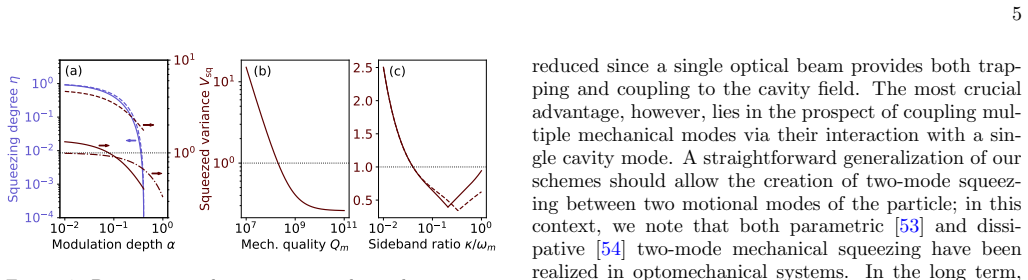
With the parameters of Fig. 4 (for instance $\alpha=0.4$, $Q_m=10^9$, $\lambda/\omega_x=0.3$, detuning $\Delta=\omega_x$), measure the steady-state variance of the squeezed quadrature of the particle's $X$ motion; the paper predicts $V_{\mathrm{sq}}\approx 0.26$, below $1/3$, so a measured variance at or above the vacuum level would show the predicted squeezing is not reached and the extra-noise assumption fails.
Extended reading notes
Core claim
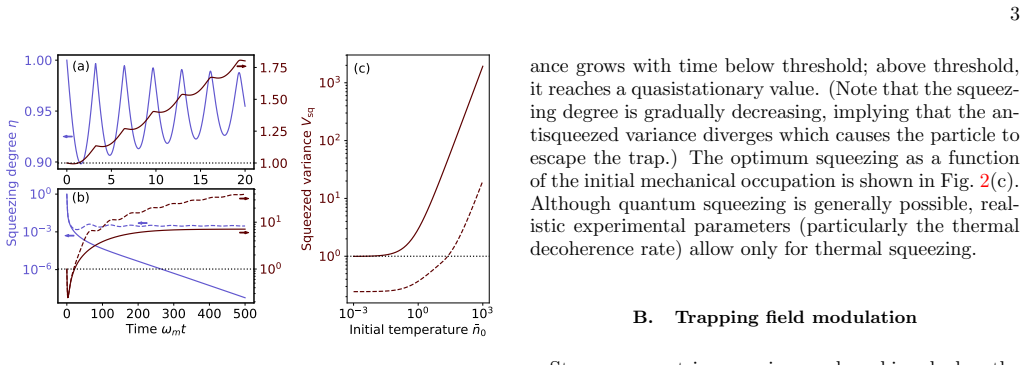
The central claim is that deterministic, unconditional mechanical squeezing of a levitated nanoparticle is feasible with current technology, using coherent scattering of the trapping beam into a cavity mode. For a particle placed at a cavity node with tweezer and cavity polarizations parallel, the dynamics reduce to a single motional mode $x$ coupled linearly to the cavity through $\lambda x(c+c^\dagger)$. Amplitude-modulating the tweezer at twice the mechanical frequency produces a parametric drive, and tuning the cavity to resonance cools the mechanical Bogoliubov mode $\beta=(2b+\alpha b^\dagger)/\sqrt{4-\alpha^2}$, whose ground state corresponds to a squeezed mechanical state. The paper finds that combining the two effects reaches a steady-state squeezed variance $V_{\mathrm{sq}}\approx 0.26$ (about $5.8\,\mathrm{dB}$), below both the $3\,\mathrm{dB}$ steady-state parametric limit and the $4.8\,\mathrm{dB}$ bound from cooling the Bogoliubov mode alone; transient parametric squeezing alone can be even stronger near the instability threshold.
Load-bearing premise
The predictions assume the particle moves only along the chosen axis and that modulating the trapping beam changes only the trap strength and the optomechanical coupling, without introducing extra heating, mode mixing, or rotation.
Editorial extensions
If this is right
- A deterministic route to nonclassical mechanical motion exists without measurement postselection or nonlinear optomechanical interactions.
- Steady-state squeezing can exceed the 3 dB parametric limit: the predicted $V_{\mathrm{sq}}\approx 0.26$ corresponds to about 5.8 dB, also below the 4.8 dB bound from cooling the Bogoliubov mode alone.
- Choosing the modulation phase $\varphi=\pi/2$ squeezes the amplitude quadrature, which is decoupled from the thermal bath, making the scheme resilient to mechanical heating.
- Near the instability threshold, transient parametric squeezing can be very strong and can be combined with single-phonon control to prepare macroscopic superposition states.
- Because coherent scattering couples all motional modes to the same cavity mode, the same techniques should extend to two-mode squeezing and eventually full quantum control of all three motional degrees of freedom.
Reading between the lines
- If the predicted squeezing is reached, levitated-particle force sensors could run below the standard quantum limit without feedback; the paper does not quantify this sensing gain.
- Injecting squeezed light into the cavity could further reduce the squeezed quadrature's noise in the modulated-tweezer scheme, a route the paper mentions but leaves to future work.
- The Bogoliubov-mode cooling mechanism might be applied simultaneously to two orthogonal motional modes to generate steady-state two-mode squeezing and entanglement between them.
- The transient scheme's strong squeezing could be a practical resource for non-Gaussian state preparation if the growth of the antisqueezed quadrature is managed, for instance by fast switching or pulsed operation.
Signed reviews
Editorial analysis
A structured set of objections, weighed in public.
Referee Report
Summary. The paper proposes theoretical schemes for generating mechanical squeezing of a levitated nanoparticle coupled to an optical cavity via coherent scattering. It analyzes three strategies: adiabatic elimination of a far-detuned cavity, parametric squeezing by amplitude modulation of the trapping tweezer, and steady-state squeezing obtained by combining parametric driving with dissipative cooling of a mechanical Bogoliubov mode. The central quantitative result is a steady-state squeezed variance Vsq ≈ 0.26 (about 5.8 dB below vacuum), which would surpass both the 3 dB steady-state parametric limit and the 4.8 dB limit obtained by cooling the Bogoliubov mode to its ground state. The analysis uses standard Langevin equations, the Lyapunov equation for the covariance matrix, and rotating-wave-approximation (RWA) Hamiltonians, with parameters similar to recent coherent-scattering cooling experiments.
Significance. If the quantitative predictions hold, the paper would be an important contribution: it identifies a deterministic, unconditional route to nonclassical mechanical squeezing of a levitated particle in the steady state, using coherent scattering and a modulated trap, two techniques already available in current experiments. The paper is transparent about several limitations, compares against known bounds, and does not rely on fitted parameters or circular reasoning. Its main quantitative claims, however, depend on an internal inconsistency between the main-text and appendix derivations of the modulated-trap model, and on an RWA whose error budget is not established at the quoted operating point. These issues are fixable in revision but are load-bearing for the reported squeezing values.
major comments (3)
- [§III B, Eqs. (9)–(10) and Appendix B, Eq. (B6)] The effective frequency in Eq. (9) is ωeff = [ωxΔα² − 2λ²(α+α²)]/(4Δ), while the corresponding coefficient in Eq. (B6) is [ωxΔα² − 2λ²(2+α²)]/(4Δ); these differ by λ²(α−2)/(2Δ). The text after Eq. (B6) states that Eqs. (B6) are identical to Eqs. (10), which is not correct. The discrepancy is consequential: for the parameters of Fig. 3 (λ/ωx = 0.3, Δ/ωx = 5), the zero crossing of ωeff that defines the threshold α ≈ 0.037 in Fig. 3(a) follows from Eq. (9), whereas Eq. (B6) would give α ≈ 0.27. Please reconcile the two derivations and state explicitly which set of effective parameters is used in Fig. 3 and in the text.
- [§III C, Eq. (11) and Fig. 4] The central steady-state claim, Vsq ≈ 0.26, is computed from the RWA Hamiltonian (11), in which all terms rotating at multiples of ±ωx t are dropped. At the operating point used in Fig. 4, λ/ωx = 0.3 and κ/ωx = 0.2, so the coupling is not small and the sideband resolution is only marginal. The neglected counter-rotating terms, such as b†c† and bc before cavity filtering, are not obviously negligible at these parameters. Because the sub-vacuum steady-state squeezing is the paper's main conclusion, please provide a quantitative verification by solving the full time-periodic Lyapunov equation based on Eq. (8), or give an explicit error bound showing that the RWA corrections change Vsq by a negligible amount.
- [§III B, around Eq. (8)] The model assumes that amplitude modulation of the trapping field changes the mechanical frequency and optomechanical coupling according to ωx ∝ E0² and λ ∝ E0, with no additional heating and no coupling to the Y and Z motional modes. For a levitated particle, intensity modulation can also modulate radiation pressure and scattering forces and may drive other degrees of freedom in the presence of imperfect alignment. Since the paper concludes that the scheme is feasible with available experimental parameters, a quantitative estimate of modulation-induced heating or an argument that it is negligible is needed to support that conclusion.
minor comments (4)
- [Appendix A, after Eq. (A2)] The text defines the cavity quadrature as Y = −i(a − a†)/√2, but the cavity mode is called c throughout; this appears to be a typo.
- [Fig. 2(a)] The squeezing degree η and the squeezed variance Vsq are plotted on very different scales in the same panel; twin axes or separate panels would improve readability.
- [Reference [52]] Reference [52] is cited as "In preparation"; if it is still unpublished, please update the citation or remove it from the list.
- [§III B, derivation of Hpar] The rotating-frame derivation of Hpar is compressed into one sentence; a short derivation or an explicit formula for the transformation would help readers verify the factor of α in the αb†b term.
Circularity Check
No significant circularity: the paper derives squeezing predictions from an externally published coherent-scattering Hamiltonian and standard Langevin/Lyapunov methods, with no fitted parameters or self-cited load-bearing claims.
full rationale
The derivation chain is self-contained against external inputs. The starting Hamiltonian, Eq. (4), is taken from the published coherent-scattering theory of Gonzalez-Ballestero et al. [44], and the modulated-tweezer Hamiltonian Eq. (8) follows directly from the stated amplitude modulation E0(t) = E0[1 + alpha cos(2 omega_x t + phi)] with omega_x proportional to E0^2 and lambda proportional to E0. The central results, including the steady-state squeezed variance Vsq approximately 0.26 in Fig. 4, are obtained by solving the time-dependent Langevin or Lyapunov equations (A1)-(A4) with declared parameter values; no parameter is fitted to the target squeezing, and no predicted quantity is defined in terms of itself. The author self-citations present in the paper ([39], [52], [62]) are not load-bearing for the central derivation: [62] supplies the standard Lyapunov framework used for numerical evaluation, [39] is contextual prior work on nonclassical states, and [52] is a forward reference to future work. The inconsistency between Appendix B and Eqs. (9)-(10) noted by the skeptic is a correctness or validity concern about the rotating-wave approximation, not a circularity: even if those equations were wrong, the error would not amount to assuming the conclusion. The paper does not invoke any uniqueness theorem, does not rename a known empirical pattern as a new result, and does not smuggle an ansatz in via self-citation. The honest finding is therefore no significant circularity.
Assumptions & free parameters
free parameters (6)
- Optomechanical coupling lambda/omega_x =
0.3
- Cavity decay kappa/omega_x =
0.2
- Mechanical quality factor Q_m =
10^9
- Cavity detuning Delta/omega_x =
5
- Thermal occupation nbar =
2e7
- Modulation depth alpha =
0.01 to 1 (0.4 in Fig. 4)
assumptions (6)
- domain assumption Coherent-scattering Hamiltonian, Eqs. (1)-(3), from Gonzalez-Ballestero et al. [44].
- domain assumption Only the X motional mode is retained after node placement and polarization choice.
- domain assumption Markovian white-noise baths for cavity and mechanics.
- standard math Rotating-wave approximation is valid for parametric and sideband terms.
- standard math Adiabatic elimination of the cavity for Delta >> kappa, omega_x.
- ad hoc to paper Amplitude modulation gives omega_x proportional to E0^2 and lambda proportional to E0 with no heating.
Cite this review
Pith. "Pith review of Strong Mechanical Squeezing for a Levitated Particle by Coherent Scattering." pith.science (2026). https://pith.science/paper/5FA2KUFM
@misc{pith2026190807230,
  author       = {Pith},
  title        = {Pith review of: Strong Mechanical Squeezing for a Levitated Particle by Coherent Scattering},
  year         = {2026},
  howpublished = {\url{https://pith.science/paper/5FA2KUFM}},
  note         = {Machine review of arXiv:1908.07230}
}
read the original abstract
Levitated particles are a promising platform for precision sensing of external perturbations and probing the boundary between quantum and classical worlds. A critical obstacle for these applications is the difficulty of generating nonclassical states of motion which have not been realized so far. Here, we show that strong squeezing of the motion of a levitated particle below the vacuum level is feasible with available experimental parameters. Using suitable modulation of the trapping potential (which is impossible with clamped mechanical resonators) and coherent scattering of trapping photons into a cavity mode, we explore several strategies to achieve strong phase-sensitive suppression of mechanical fluctuations. We analyze mechanical squeezing in both transient and steady-state regimes, and discuss conditions for preparing nonclassical mechanical squeezing. Our results pave the way to full, deterministic optomechanical control of levitated particles in the quantum regime.
Figures


Figures from the paper (2 more)

Reference graph
Works this paper leans on
-
[1]
Aspelmeyer, T
M. Aspelmeyer, T. J. Kippenberg, and F. Marquardt, Cavity optomechanics, Reviews of Modern Physics 86, 1391 (2014)
2014
-
[2]
In the limit of large detuning, ∆ ≫ κ, the coupling to the cavity input noise can be reduced and approximated by the term (2λ√κ/∆)×Yin; moreover, ωeff≈ωx−λ2/∆, ζeff≈λ2/∆. To find the resulting squeezing, we solve the differen- tial Lyapunov equation for the covariance matrix of the mechanical mode as described in Appendix A. Diagonal- ization of the covarianc...
work page 2020
-
[3]
For the dynamics described by Eqs. (5), the drift and diffu- sion matrices are given by A = −κ ∆ 0 0 −∆ −κ √ 2λ 0 0 0 0 ωx√ 2λ 0 −ωx −γ , (A2a) N = diag[2κ, 2κ, 0, 2γ(2¯n + 1)]; (A2b) generally, the drift matrix can be read off the Langevin equations and the diffusion matrix can be evaluated from the correlation functions of the input noises. For ...
-
[4]
This equation can be integrated formally, assuming b evolves slowly on the time scale of the cavity dynamics (given by ∆). We thus obtain c(t) = √ 2κ ∫ t 0 dτe−(κ+i∆)(t−τ)cin(τ) +iλ 2 [1 +α cos(2ωxt +φ)] ( be−iωxt κ +i(∆−ωx) + b†eiωxt κ +i(∆ +ωx) ) . (B2) Plugging this result into the equations of motion for the particle, assuming ∆ ≫κ≫ωx, and employing t...
-
[5]
S. Forstner, S. Prams, J. Knittel, E. D. van Ooijen, J. D. Swaim, G. I. Harris, A. Szorkovszky, W. P. Bowen, and H. Rubinsztein-Dunlop, Cavity Optomechanical Magne- tometer, Physical Review Letters 108, 120801 (2012)
work page 2012
-
[6]
L. F. Buchmann, S. Schreppler, J. Kohler, N. Speth- mann, and D. M. Stamper-Kurn, Complex Squeezing and Force Measurement Beyond the Standard Quantum Limit, Physical Review Letters 117, 030801 (2016)
work page 2016
-
[7]
L. M. de L´ epinay, B. Pigeau, B. Besga, P. Vincent, P. Poncharal, and O. Arcizet, A universal and ultrasensi- tive vectorial nanomechanical sensor for imaging 2D force fields, Nature Nanotechnology 12, 156 (2017)
work page 2017
-
[8]
C. F. Ockeloen-Korppi, E. Damsk¨ agg, G. S. Paraoanu, F. Massel, and M. A. Sillanp¨ a¨ a, Revealing hidden quan- tum correlations in an electromechanical measurement, Physical Review Letters 121, 243601 (2018)
work page 2018
Show all 65 references
-
[9]
Pikovski, M
I. Pikovski, M. R. Vanner, M. Aspelmeyer, M. S. Kim, and ˇC. Brukner, Probing Planck-scale physics with quan- tum optics, Nature Physics 8, 393 (2012)
2012
-
[10]
Pfister, J
C. Pfister, J. Kaniewski, M. Tomamichel, A. Mantri, R. Schmucker, N. McMahon, G. Milburn, and S. Wehner, A universal test for gravitational decoherence, Nature Communications 7, 13022 (2016)
2016
-
[11]
D. E. Chang, C. A. Regal, S. B. Papp, D. J. Wilson, J. Ye, O. Painter, H. J. Kimble, and P. Zoller, Cavity opto-mechanics using an optically levitated nanosphere, Proceedings of the National Academy of Sciences 107, 1005 (2009)
2009
-
[12]
Romero-Isart, A
O. Romero-Isart, A. C. Pflanzer, M. L. Juan, R. Quidant, 8 0 /2 3 /2 2 Modulation phase 0.4 0.6 0.8 1.0 1.2Squeezed variance Vsq Figure 5. Squeezed variance Vsq as a function of the mod- ulation phase φ. The modulation depths are α = 0.4 (solid), α = 0.1 (dashed), and α = 0.01 ...
2011
-
[13]
Millen, T
J. Millen, T. S. Monteiro, R. Pettit, and A. N. Vami- vakas, Optomechanics with levitated particles, (2019), arXiv:1907.08198
2019 arXiv
-
[14]
Prat-Camps, C
J. Prat-Camps, C. Teo, C. C. Rusconi, W. Wieczorek, and O. Romero-Isart, Ultrasensitive Inertial and Force Sensors with Diamagnetically Levitated Magnets, Phys- ical Review Applied 8, 034002 (2017)
2017
-
[15]
Hebestreit, M
E. Hebestreit, M. Frimmer, R. Reimann, and L. Novotny, Sensing Static Forces with Free-Falling Nanoparticles, Physical Review Letters 121, 063602 (2018)
2018
-
[16]
C. P. Blakemore, A. D. Rider, S. Roy, Q. Wang, A. Kawasaki, and G. Gratta, Three dimensional force- field microscopy with optically levitated microspheres, Physical Review A 99, 023816 (2019)
2019
-
[17]
Gieseler and J
J. Gieseler and J. Millen, Levitated nanoparticles for mi- croscopic thermodynamics—a review, Entropy 20, 326 (2018)
2018
-
[18]
ˇSiler, L
M. ˇSiler, L. Ornigotti, O. Brzobohat´ y, P. J´ akl, A. Ryabov, V. Holubec, P. Zem´ anek, and R. Filip, Dif- fusing up the Hill: Dynamics and Equipartition in Highly Unstable Systems, Physical Review Letters 121, 230601 (2018)
2018
-
[19]
Romero-Isart, A
O. Romero-Isart, A. C. Pflanzer, F. Blaser, R. Kaltenbaek, N. Kiesel, M. Aspelmeyer, and J. I. Cirac, Large Quantum Superpositions and Interference of Massive Nanometer-Sized Objects, Physical Review Letters 107, 020405 (2011)
2011
-
[20]
Bateman, S
J. Bateman, S. Nimmrichter, K. Hornberger, and H. Ul- bricht, Near-field interferometry of a free-falling nanopar- ticle from a point-like source, Nature Communications 5, 4788 (2014)
2014
-
[21]
D. C. Moore, A. D. Rider, and G. Gratta, Search for Millicharged Particles Using Optically Levitated Micro- spheres, Physical Review Letters 113, 251801 (2014)
2014
-
[22]
A. D. Rider, D. C. Moore, C. P. Blakemore, M. Louis, M. Lu, and G. Gratta, Search for Screened Interactions Associated with Dark Energy below the 100 µm Length Scale, Physical Review Letters 117, 101101 (2016)
2016
-
[23]
Gieseler, B
J. Gieseler, B. Deutsch, R. Quidant, and L. Novotny, Subkelvin Parametric Feedback Cooling of a Laser- Trapped Nanoparticle, Physical Review Letters 109, 103603 (2012)
2012
-
[24]
Kiesel, F
N. Kiesel, F. Blaser, U. Delic, D. Grass, R. Kaltenbaek, and M. Aspelmeyer, Cavity cooling of an optically lev- itated submicron particle, Proceedings of the National Academy of Sciences 110, 14180 (2013)
2013
-
[25]
Asenbaum, S
P. Asenbaum, S. Kuhn, S. Nimmrichter, U. Sezer, and M. Arndt, Cavity cooling of free silicon nanoparticles in high vacuum, Nature Communications 4, 2743 (2013)
2013
-
[26]
G. P. Conangla, F. Ricci, M. T. Cuairan, A. W. Schell, N. Meyer, and R. Quidant, Optimal Feedback Cooling of a Charged Levitated Nanoparticle with Adaptive Con- trol, Physical Review Letters 122, 223602 (2019)
2019
-
[27]
Tebbenjohanns, M
F. Tebbenjohanns, M. Frimmer, A. Militaru, V. Jain, and L. Novotny, Cold Damping of an Optically Levitated Nanoparticle to Microkelvin Temperatures, Physical Re- view Letters 122, 223601 (2019)
2019
-
[28]
Rashid, T
M. Rashid, T. Tufarelli, J. Bateman, J. Vovrosh, D. Hempston, M. S. Kim, and H. Ulbricht, Experimental Realization of a Thermal Squeezed State of Levitated Optomechanics, Physical Review Letters 117, 273601 (2016)
2016
-
[29]
J. Ahn, Z. Xu, J. Bang, Y.-H. Deng, T. M. Hoang, Q. Han, R.-M. Ma, and T. Li, Optically Levitated Nan- odumbbell Torsion Balance and GHz Nanomechanical Rotor, Physical Review Letters 121, 033603 (2018)
2018
-
[30]
Reimann, M
R. Reimann, M. Doderer, E. Hebestreit, R. Diehl, M. Frimmer, D. Windey, F. Tebbenjohanns, and L. Novotny, GHz Rotation of an Optically Trapped Nanoparticle in Vacuum, Physical Review Letters 121, 033602 (2018)
2018
-
[31]
T. M. Hoang, Y. Ma, J. Ahn, J. Bang, F. Robicheaux, Z.-Q. Yin, and T. Li, Torsional Optomechanics of a Lev- itated Nonspherical Nanoparticle, Physical Review Let- ters 117, 123604 (2016)
2016
-
[32]
S. Kuhn, A. Kosloff, B. A. Stickler, F. Patolsky, K. Horn- berger, M. Arndt, and J. Millen, Full rotational control of levitated silicon nanorods, Optica 4, 356 (2017)
2017
-
[33]
Mari and J
A. Mari and J. Eisert, Gently Modulating Optomechani- cal Systems, Physical Review Letters103, 213603 (2009)
2009
-
[34]
Liao and C
J.-Q. Liao and C. K. Law, Parametric generation of quadrature squeezing of mirrors in cavity optomechan- ics, Physical Review A 83, 033820 (2011)
2011
-
[35]
Chowdhury, P
A. Chowdhury, P. Vezio, M. Bonaldi, A. Borrielli, F. Marino, B. Morana, G. A. Prodi, P. M. Sarro, E. Serra, and F. Marin, Quantum signature of a squeezed mechan- ical oscillator, (2019), arXiv:1907.05148
2019 arXiv
-
[36]
Kronwald, F
A. Kronwald, F. Marquardt, and A. A. Clerk, Arbitrar- ily large steady-state bosonic squeezing via dissipation, Physical Review A 88, 063833 (2013)
2013
-
[37]
Pirkkalainen, E
J.-M. Pirkkalainen, E. Damsk¨ agg, M. Brandt, F. Mas- sel, and M. A. Sillanp¨ a¨ a, Squeezing of Quantum Noise of Motion in a Micromechanical Resonator, Physical Re- view Letters 115, 243601 (2015)
2015
-
[38]
E. E. Wollman, C. U. Lei, A. J. Weinstein, J. Suh, A. Kronwald, F. Marquardt, A. A. Clerk, and K. C. Schwab, Quantum squeezing of motion in a mechanical resonator, Science 349, 952 (2015)
2015
-
[39]
C. U. Lei, A. J. Weinstein, J. Suh, E. E. Wollman, A. Kronwald, F. Marquardt, A. A. Clerk, and K. C. Schwab, Quantum Nondemolition Measurement of a Quantum Squeezed State Beyond the 3 dB Limit, Phys- ical Review Letters 117, 100801 (2016)
2016
-
[40]
A. A. Clerk, F. Marquardt, and K. Jacobs, Back-action evasion and squeezing of a mechanical resonator using a cavity detector, New Journal of Physics 10, 095010 (2008)
2008
-
[41]
M. G. Genoni, J. Zhang, J. Millen, P. F. Barker, and 9 A. Serafini, Quantum cooling and squeezing of a levitat- ing nanosphere via time-continuous measurements, New Journal of Physics 17, 073019 (2015)
2015
-
[42]
A. A. Rakhubovsky, D. W. Moore, and R. Filip, Non- classical states of levitated macroscopic objects beyond the ground state, Quantum Science and Technology 4, 024006 (2019)
2019
-
[43]
Nunnenkamp, K
A. Nunnenkamp, K. Børkje, J. G. E. Harris, and S. M. Girvin, Cooling and squeezing via quadratic optomechan- ical coupling, Physical Review A 82, 021806 (2010)
2010
-
[44]
Asjad, G
M. Asjad, G. S. Agarwal, M. S. Kim, P. Tombesi, G. D. Giuseppe, and D. Vitali, Robust stationary mechanical squeezing in a kicked quadratic optomechanical system, Physical Review A 89, 023849 (2014)
2014
-
[45]
L¨ u, J.-Q
X.-Y. L¨ u, J.-Q. Liao, L. Tian, and F. Nori, Steady- state mechanical squeezing in an optomechanical system via duffing nonlinearity, Physical Review A 91, 013834 (2015)
2015
-
[46]
Vuleti´ c, H
V. Vuleti´ c, H. W. Chan, and A. T. Black, Three- dimensional cavity Doppler cooling and cavity sideband cooling by coherent scattering, Physical Review A 64, 033405 (2001)
2001
-
[47]
Gonzalez-Ballestero, P
C. Gonzalez-Ballestero, P. Maurer, D. Windey, L. Novotny, R. Reimann, and O. Romero-Isart, Theory for cavity cooling of levitated nanoparticles via coherent scattering: Master equation approach, Physical Review A 100, 013805 (2019)
2019
-
[48]
D. R. Leibrandt, J. Labaziewicz, V. Vuleti´ c, and I. L. Chuang, Cavity Sideband Cooling of a Single Trapped Ion, Physical Review Letters 103, 103001 (2009)
2009
-
[49]
Deli´ c, M
U. Deli´ c, M. Reisenbauer, D. Grass, N. Kiesel, V. Vuleti´ c, and M. Aspelmeyer, Cavity Cooling of a Levitated Nanosphere by Coherent Scattering, Physical Review Letters 122, 123602 (2019)
2019
-
[50]
Windey, C
D. Windey, C. Gonzalez-Ballestero, P. Maurer, L. Novotny, O. Romero-Isart, and R. Reimann, Cavity-Based 3D Cooling of a Levitated Nanoparticle via Coherent Scattering, Physical Review Letters 122, 123601 (2019)
2019
-
[51]
Deli´ c, M
U. Deli´ c, M. Reisenbauer, K. Dare, D. Grass, V. Vuleti´ c, N. Kiesel, and M. Aspelmeyer, Motional quantum ground state of a levitated nanoparticle from room temperature, (2019), arXiv:1911.04406
2019 arXiv
-
[52]
Hu, Z.-B
C.-S. Hu, Z.-B. Yang, H. Wu, Y. Li, and S.-B. Zheng, Twofold mechanical squeezing in a cavity optomechanical system, Physical Review A 98, 023807 (2018)
2018
-
[53]
Asjad, S
M. Asjad, S. Zippilli, and D. Vitali, Suppression of Stokes scattering and improved optomechanical cooling with squeezed light, Physical Review A 94, 051801 (2016)
2016
-
[54]
J. B. Clark, F. Lecocq, R. W. Simmonds, J. Aumentado, and J. D. Teufel, Sideband Cooling Beyond the Quantum Limit with Squeezed Light, Nature 541, 191 (2017)
2017
-
[55]
Pietik¨ ainen, O.ˇCernot´ ık, and R
I. Pietik¨ ainen, O.ˇCernot´ ık, and R. Filip, In preparation
-
[56]
Pontin, M
A. Pontin, M. Bonaldi, A. Borrielli, L. Marconi, F. Marino, G. Pandraud, G. A. Prodi, P. M. Sarro, E. Serra, and F. Marin, Dynamical Two-Mode Squeez- ing of Thermal Fluctuations in a Cavity Optomechanical System, Physical Review Letters 116, 103601 (2016)
2016
-
[57]
C. F. Ockeloen-Korppi, E. Damskagg, J.-M. Pirkkalainen, A. A. Clerk, F. Massel, M. J. Wool- ley, and M. A. Sillanpaa, Stabilized entanglement of massive mechanical oscillators, Nature 556, 478 (2018)
2018
-
[58]
Neumeier, T
L. Neumeier, T. E. Northup, and D. E. Chang, Reaching the optomechanical strong coupling regime with a single atom in a cavity, Physical Review A 97, 063857 (2018)
2018
-
[59]
Deli´ c, D
U. Deli´ c, D. Grass, M. Reisenbauer, T. Damm, M. Weitz, N. Kiesel, and M. Aspelmeyer, Levitated cavity optome- chanics in high vacuum, arXiv:1902.06605
1902 arXiv
-
[60]
A. A. Rakhubovsky and R. Filip, Stroboscopic high-order nonlinearity in quantum optomechanics, arXiv:1904.00773
1904 arXiv
-
[61]
Setter, J
A. Setter, J. Vovrosh, and H. Ulbricht, Characteriza- tion of non-linearities through mechanical squeezing in levitated optomechanics, Applied Physics Letters 115, 153106 (2019)
2019
-
[62]
Riedinger, S
R. Riedinger, S. Hong, R. A. Norte, J. A. Slater, J. Shang, A. G. Krause, V. Anant, M. Aspelmeyer, and S. Gr¨ oblacher, Non-classical correlations between single photons and phonons from a mechanical oscillator, Na- ture 530, 313 (2016)
2016
-
[63]
Y. Chu, P. Kharel, T. Yoon, L. Frunzio, P. T. Rakich, and R. J. Schoelkopf, Creation and control of multi-phonon fock states in a bulk acoustic-wave resonator, Nature 563, 666 (2018)
2018
-
[64]
K. J. Satzinger, Y. P. Zhong, H.-S. Chang, G. A. Peairs, A. Bienfait, M.-H. Chou, A. Y. Cleland, C. R. Conner, E. Dumur, J. Grebel, I. Gutierrez, B. H. November, R. G. Povey, S. J. Whiteley, D. D. Awschalom, D. I. Schuster, and A. N. Cleland, Quantum control of surface acousti...
2018
-
[65]
ˇCernot´ ık, D
O. ˇCernot´ ık, D. V. Vasilyev, and K. Hammerer, Adia- batic elimination of Gaussian subsystems from quantum dynamics under continuous measurement, Physical Re- view A 92, 012124 (2015)
2015
Reviewed August 14, 2026 · model on record in the stance chip above.
Discussion (0). Continue with ORCID to comment.