REVIEW 4 major objections 4 minor 32 references
Density estimation in representation space to predict model uncertainty
T0 review · 4 major / 4 minor · reviewed 2026-08-14 · deepseek-v4-flash
Pith's one-line read A small network reading the neighborhood of a test point in representation space outperforms softmax confidence at predicting model mistakes and out-of-distribution inputs.
desk verdict Useful post-hoc uncertainty method with honest related work, but the reported gains over softmax confidence are small and may come from the confidence input itself; the missing confidence-only ablation is the key issue. read the letter →
The pith
A machine-rendered reading of the paper's core claim, the machinery that carries it, and where it could break.
The reading
What carries the argument
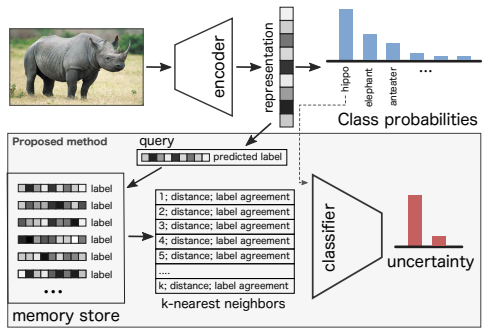
The load-bearing object is the set of $k$ nearest neighbors of a test representation inside a stored index of all training-set representations at the final hidden layer. The paper defines three summary statistics from this set: unconditional neighbor distance (Eq. 1), class-conditional neighbor distance (Eq. 2), and neighbor label agreement (Eq. 3). The actual mechanism is a two-layer permutation-invariant neural network, built with a Deep Sets-style aggregation step (Eq. 6), that consumes per-neighbor distances and label agreement indicators together with the original softmax confidence and outputs the probability of a mistake. This network is trained by minimizing binary cross-entropy on in-distribution correct/incorrect labels, so the neighbor statistics act as a learned local density estimate rather than a fixed kernel density.
What would settle it
Train NUC on ILSVRC2012 errors, then evaluate it on out-of-distribution points crafted to sit close to training representations in the last layer, such as small adversarial perturbations. If NUC's AUROC for OOD detection falls to or below the softmax baseline, the transfer of the learned density-to-error mapping would be refuted.
Extended reading notes
Core claim
The paper's central discovery is that the correctness of a pretrained classifier's prediction on a new input can be predicted more accurately from the local density of training representations around that input than from the classifier's own confidence. It demonstrates on ILSVRC2012 that incorrectly classified validation images lie farther from their nearest training-set neighbors and show lower neighbor label agreement (Fig. 1). NUC is then trained as a binary classifier that maps neighbor distances, neighbor label agreements, and the softmax score to the probability of a mistake; as a direct corollary, the same trained NUC ranks truly out-of-distribution images as uncertain without having seen any such image. In the reported experiments, NUC achieves AUROC 0.862 versus 0.848 for softmax on in-distribution misclassification detection and 0.846 versus 0.835 for Mahalanobis on unknown ImageNet classes, and it also edges out baselines on SVHN and CIFAR-10.
Load-bearing premise
The load-bearing premise is that the relationship between local density in representation space and model error, learned from in-distribution mistakes, stays valid for inputs far outside the training distribution; the paper supports it only with a qualitative picture of the validation set.
Editorial extensions
If this is right
- NUC can be attached to an already trained classifier without retraining it, requiring only a stored index of training representations and a single epoch of training for the small uncertainty network.
- Because it is trained on in-distribution errors, the method applies to any real-world model whose training error is not zero, which is typical of regularized state-of-the-art networks.
- The reported gains over calibrated softmax on ImageNet-V2 and ImageNet-C suggest that local representation density captures mistakes that confidence calibration does not.
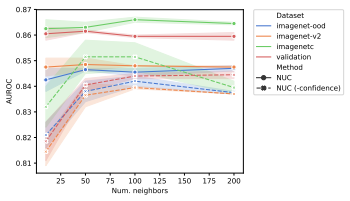
- The stability of the full model across values of $k$ in Fig. 3 means a practitioner does not need to tune $k$ precisely when the softmax confidence is included.
- On out-of-distribution detection, NUC's edge over Mahalanobis distance on ImageNet unknown classes indicates that a learned combination of distance and label agreement is more flexible than a single class-conditional Gaussian.
Reading between the lines
- The paper does not isolate the contribution of the learned neighborhood statistics from the softmax signal; a direct ablation would train NUC with only the softmax score as input, and the AUROC difference would quantify how much density adds beyond confidence.
- The transfer assumption could be tested with graded distribution shifts, such as increasing corruption severity in ImageNet-C, to see whether NUC's margin over baselines shrinks as the representation geometry departs from the training distribution.
- An extension the paper leaves implicit is replacing the full training-set index with a small set of learned prototype representations, which would make the method feasible when storing all representations is impractical.
- The method's behavior under adversarial perturbations is untested; because adversarial inputs are designed to lie near the training manifold in representation space, they are the stress case for the claim that distance correlates with distributional distance.
Signed reviews
Editorial analysis
A structured set of objections, weighed in public.
Referee Report
Summary. The paper proposes the Neighborhood Uncertainty Classifier (NUC), a post-hoc uncertainty estimator for a pretrained classifier. NUC computes k-nearest-neighbor statistics in the penultimate representation space of the base model (Eqs. 1-3), concatenates them with the base model's softmax confidence s(y_i) (Eq. 4), and trains a small permutation-invariant network g_theta to predict whether the base model's prediction is correct. Training uses only in-distribution data and the binary cross-entropy loss of Eq. 5, via Algorithm 1. The trained NUC score is then evaluated for in-distribution misclassification detection (Table 1) and out-of-distribution detection (Table 2) on ImageNet-scale data, using Inception-ResNet-v2 as the base model. The paper reports that NUC outperforms softmax confidence, temperature-scaled softmax, the k-NN statistics of Eqs. 1-3, and Mahalanobis distance on most of the tested settings.
Significance. If the reported results hold, NUC would be a practically useful and conceptually simple method: it requires no out-of-distribution training data, works with an arbitrary pretrained classifier, and is evaluated on a realistic large-scale setting rather than only on MNIST/CIFAR. The use of a fixed pretrained checkpoint, public datasets, and a clearly specified training procedure (Algorithm 1) is a strength, and the paper's central hypothesis--that neighborhood statistics in representation space carry signal about model error--is well motivated and partially supported by Figure 1. However, the current evidence does not yet isolate the contribution of the neighborhood statistics from the softmax-confidence input, and two evaluation choices (restricting OOD positives to correctly classified in-distribution images, and selecting k on the same validation set used for scoring) weaken the strength of the empirical claims. These issues are fixable with additional experiments, but they are load-bearing for the paper's central claim that density estimation in representation space is what drives the improvement.
major comments (4)
- [Section 3, Eq. (4) and Figure 3] The paper does not run the key ablation needed to support its central claim. Eq. (4) defines NUC's input as the neighborhood statistics together with s(y_i), the base model's softmax confidence. Figure 3 shows that removing the confidence input makes performance strongly dependent on k, but it does not show the converse: a model trained with s(y_i) alone, or with s(y_i) plus only the cheap agreement statistic Eq. (3). Since g_theta is a nonlinear function, a confidence-only version could reproduce or exceed the reported NUC results in Tables 1 and 2 simply by recalibrating the softmax output. Without this control, the stated advantage over the Softmax and Softmax† baselines cannot be attributed to density estimation in representation space. I request an ablation comparing (i) g_theta trained on s(y_i) alone, (ii) s(y_i) plus Eq. (3), (iii) s(y_i) plus all neighborhood statistics, and (iv) the current full NUC, with the same training setup and k.
- [Table 2 caption and Section 4.2] The out-of-distribution evaluation restricts the in-distribution positive set to 'correctly classified ILSVRC2012 validation set images.' This makes the OOD detection task easier and does not match the deployment setting, where the detector must separate OOD inputs from all in-distribution inputs, including misclassified ones. Restricting positives in this way can favor methods that are good at flagging errors rather than methods that genuinely detect distributional shift, and it changes the AUROC/AUPR numbers for all methods. The authors should rerun the OOD experiments using the full ILSVRC2012 validation set as the in-distribution set, or at minimum report both variants and justify the restriction.
- [Section 4 and Tables 1-2] No error bars, confidence intervals, or statistical significance tests are reported. Several headline differences are small (e.g., NUC AUROC 0.862 vs. Softmax 0.848 on ILSVRC2012 validation in Table 1, and 0.846 vs. 0.835 for Mahalanobis on ImageNet-unknown in Table 2), and with a single evaluation of a deterministic pipeline it is unclear whether these differences are meaningful. I ask the authors to report bootstrap confidence intervals over the test set or repeated training runs, particularly for the ImageNet-unknown and Imagenet-C results.
- [Section 4, Figure 3 and Table 1] The hyperparameter k is selected using the same ILSVRC2012 validation set that is then used for scoring in Table 1. Figure 3 plots validation AUROC as a function of k, and the text states 'we set k = 10' immediately afterward. This is a mild form of validation-set overfitting for NUC, and it is not clear whether the baselines receive an analogous tuning (Softmax† is calibrated on the validation set, but the k-NN and Mahalanobis baselines are not tuned in the same way). The authors should either use a separate split for hyperparameter selection or report the sensitivity of the Table 1 results across a range of k.
minor comments (4)
- [Section 2, Eqs. (1)-(3)] Equations (1) and (2) are called kernel density estimates, but they are sums of distances rather than sums of normalized kernel evaluations; this should be clarified or the terminology changed. Similarly, Eq. (3) is an agreement count, not a conditional probability density, and the notation P(x_i | \hat y_i) is misleading.
- [Section 4.2 and Table 2] The term 'Imagenetunk.' appears in both the text and Table 2; this appears to be a typo and should be 'ImageNet-unk' or similar.
- [Section 1, last paragraph of Introduction] The statement that epistemic uncertainty 'cannot be reduced even as the size of the training set increases' is imprecise under standard definitions; epistemic uncertainty is usually reducible with more data. The intended point appears to be that a fixed pretrained model cannot reduce its own epistemic uncertainty, but the current wording is confusing.
- [Section 3, Algorithm 1] Algorithm 1 iterates over the 'training set' and queries nearest neighbors from a set A that is also described as containing the training set representations. The text says the exact point is excluded, but Algorithm 1 does not explicitly state this exclusion in the pseudocode; adding it would prevent ambiguity.
Circularity Check
No significant circularity: NUC's out-of-distribution evaluation is genuinely out-of-sample, and the in-distribution training target is model correctness, not the reported uncertainty metric.
full rationale
None of the paper's load-bearing steps reduces to its own inputs by construction. The uncertainty model g_theta (Eq. 4) is trained with Algorithm 1 using only in-distribution correctness labels t_i = (y_i == y_hat_i), and out-of-distribution detection is then evaluated on datasets never seen in training (Table 2), so the central transfer claim is not a fitted input called a prediction. The neighborhood statistics (Eqs. 1-3) are first measured and shown to correlate with errors (Fig. 1), then used as features for a separately learned network; no equation makes the model's output algebraically identical to the softmax confidence or to any fitted statistic. The only self-citation (ref. [6], for permutation-invariant aggregation) is architectural and not load-bearing. Tuning k on validation data is standard hyperparameter selection and is not a predicted quantity. The absence of a confidence-only ablation is a legitimate experimental concern, but it is not circularity because the paper never claims or derives that the density terms alone produce the reported gain; the gain is reported for the full model with both information sources. No uniqueness theorem is imported, no known result is merely renamed, and no fitted parameter is relabeled as a prediction, so the derivation is self-contained with respect to the paper's stated claims.
Assumptions & free parameters
free parameters (4)
- k (number of nearest neighbors) =
10
- L (number of layers in helper network) =
2
- Adam learning rate schedule =
1e-3 annealed to 1e-4 after 40,000 steps, 1 epoch
- hidden units in helper network =
not reported
assumptions (4)
- domain assumption Distances in the final representation space correlate with distributional distance.
- domain assumption In-distribution classification errors are indicative of outlier-ness and provide a training signal that transfers to OOD detection.
- domain assumption Summation aggregation (Deep Sets style) is sufficient to capture neighbor information.
- domain assumption The pretrained Inception-ResNet-v2 provides a good fixed representation for density estimation.
Cite this review
Pith. "Pith review of Density estimation in representation space to predict model uncertainty." pith.science (2026). https://pith.science/paper/O2I3U4LF
@misc{pith2026190807235,
  author       = {Pith},
  title        = {Pith review of: Density estimation in representation space to predict model uncertainty},
  year         = {2026},
  howpublished = {\url{https://pith.science/paper/O2I3U4LF}},
  note         = {Machine review of arXiv:1908.07235}
}
read the original abstract
Deep learning models frequently make incorrect predictions with high confidence when presented with test examples that are not well represented in their training dataset. We propose a novel and straightforward approach to estimate prediction uncertainty in a pre-trained neural network model. Our method estimates the training data density in representation space for a novel input. A neural network model then uses this information to determine whether we expect the pre-trained model to make a correct prediction. This uncertainty model is trained by predicting in-distribution errors, but can detect out-of-distribution data without having seen any such example. We test our method for a state-of-the art image classification model in the settings of both in-distribution uncertainty estimation as well as out-of-distribution detection.
Figures

Reference graph
Works this paper leans on
-
[1]
Concrete Problems in AI Safety
Dario Amodei, Chris Olah, Jacob Steinhardt, Paul Christiano, John Schulman, and Dan Mané. Concrete Problems in AI Safety. arXiv:1606.06565 [cs], June 2016. arXiv: 1606.06565
arXiv 2016
-
[2]
Synthesizing Robust Adversarial Examples
Anish Athalye, Logan Engstrom, Andrew Ilyas, and Kevin Kwok. Synthesizing Robust Adversarial Examples. arXiv:1707.07397 [cs], July 2017. arXiv: 1707.07397
arXiv 2017
-
[3]
Terrance DeVries and Graham W. Taylor. Learning Confidence for Out-of-Distribution Detec- tion in Neural Networks. arXiv:1802.04865 [cs, stat], February 2018. arXiv: 1802.04865
arXiv 2018
-
[4]
Curtin, Saurabh Shintre, and Andrew B
Reuben Feinman, Ryan R. Curtin, Saurabh Shintre, and Andrew B. Gardner. Detecting Adver- sarial Samples from Artifacts. arXiv:1703.00410 [cs, stat], March 2017. arXiv: 1703.00410
arXiv 2017
-
[5]
Dropout as a Bayesian Approximation: Representing Model Uncertainty in Deep Learning
Yarin Gal and Zoubin Ghahramani. Dropout as a Bayesian Approximation: Representing Model Uncertainty in Deep Learning. arXiv:1506.02142 [cs, stat], June 2015. arXiv: 1506.02142. 8
arXiv 2015
-
[6]
Maddison, Tiago Ramalho, David Saxton, Murray Shanahan, Yee Whye Teh, Danilo J
Marta Garnelo, Dan Rosenbaum, Chris J. Maddison, Tiago Ramalho, David Saxton, Murray Shanahan, Yee Whye Teh, Danilo J. Rezende, and S. M. Ali Eslami. Conditional Neural Processes. arXiv:1807.01613 [cs, stat], July 2018. arXiv: 1807.01613
arXiv 2018
-
[7]
Chuan Guo, Geoff Pleiss, Yu Sun, and Kilian Q. Weinberger. On Calibration of Modern Neural Networks. arXiv:1706.04599 [cs], June 2017. arXiv: 1706.04599
arXiv 2017
-
[8]
Reliable uncertainty estimates in deep neural networks using noise contrastive priors
Danijar Hafner, Dustin Tran, Alex Irpan, Timothy Lillicrap, and James Davidson. Reliable uncertainty estimates in deep neural networks using noise contrastive priors. arXiv preprint arXiv:1807.09289, 2018
arXiv 2018
Show all 32 references
-
[9]
Cautious Deep Learning
Yotam Hechtlinger, Barnabas Poczos, and Larry Wasserman. Cautious Deep Learning. arXiv:1805.09460 [cs, stat], May 2018. arXiv: 1805.09460
2018 arXiv
-
[10]
Benchmarking Neural Network Robustness to Common Corruptions and Perturbations
Dan Hendrycks and Thomas Dietterich. Benchmarking Neural Network Robustness to Common Corruptions and Perturbations. arXiv:1903.12261 [cs, stat], March 2019. arXiv: 1903.12261
1903 arXiv
-
[11]
A Baseline for Detecting Misclassified and Out-of- Distribution Examples in Neural Networks
Dan Hendrycks and Kevin Gimpel. A Baseline for Detecting Misclassified and Out-of- Distribution Examples in Neural Networks. arXiv:1610.02136 [cs], October 2016. arXiv: 1610.02136
2016 arXiv
-
[12]
Adversarial Attacks on Neural Network Policies
Sandy Huang, Nicolas Papernot, Ian Goodfellow, Yan Duan, and Pieter Abbeel. Adversarial Attacks on Neural Network Policies. February 2017
2017
-
[13]
Guan, and Maya Gupta
Heinrich Jiang, Been Kim, Melody Y . Guan, and Maya Gupta. To Trust Or Not To Trust A Classifier. arXiv:1805.11783 [cs, stat], May 2018. arXiv: 1805.11783
2018 arXiv
-
[14]
Imagenet classification with deep convolutional neural networks
Alex Krizhevsky, Ilya Sutskever, and Geoffrey E Hinton. Imagenet classification with deep convolutional neural networks. In Advances in neural information processing systems , pages 1097–1105, 2012
2012
-
[15]
Simple and scalable predictive uncertainty estimation using deep ensembles
Balaji Lakshminarayanan, Alexander Pritzel, and Charles Blundell. Simple and scalable predictive uncertainty estimation using deep ensembles. In Advances in Neural Information Processing Systems, pages 6402–6413, 2017
2017
-
[16]
Training Confidence-calibrated Classifiers for Detecting Out-of-Distribution Samples
Kimin Lee, Honglak Lee, Kibok Lee, and Jinwoo Shin. Training Confidence-calibrated Classifiers for Detecting Out-of-Distribution Samples. arXiv:1711.09325 [cs, stat], November
-
[17]
A Simple Unified Framework for Detecting Out-of-Distribution Samples and Adversarial Attacks
Kimin Lee, Kibok Lee, Honglak Lee, and Jinwoo Shin. A Simple Unified Framework for Detecting Out-of-Distribution Samples and Adversarial Attacks. arXiv:1807.03888 [cs, stat], July 2018. arXiv: 1807.03888
2018 arXiv
-
[18]
Shiyu Liang, Yixuan Li, and R. Srikant. Enhancing The Reliability of Out-of-distribution Image Detection in Neural Networks. arXiv:1706.02690 [cs, stat], June 2017. arXiv: 1706.02690
2017 arXiv
-
[19]
Predictive uncertainty estimation via prior networks
Andrey Malinin and Mark Gales. Predictive uncertainty estimation via prior networks. In Advances in Neural Information Processing Systems , pages 7047–7058, 2018
2018
-
[20]
Do Deep Generative Models Know What They Don’t Know? arXiv:1810.09136 [cs, stat] , October 2018
Eric Nalisnick, Akihiro Matsukawa, Yee Whye Teh, Dilan Gorur, and Balaji Lakshminarayanan. Do Deep Generative Models Know What They Don’t Know? arXiv:1810.09136 [cs, stat] , October 2018. arXiv: 1810.09136
2018 arXiv
-
[21]
Yuval Netzer, Tao Wang, Adam Coates, Alessandro Bissacco, Bo Wu, and Andrew Y . Ng. Reading digits in natural images with unsupervised feature learning. In NIPS Workshop on Deep Learning and Unsupervised Feature Learning 2011 , 2011
2011
-
[22]
Deep Neural Networks are Easily Fooled: High Confidence Predictions for Unrecognizable Images
Anh Nguyen, Jason Yosinski, and Jeff Clune. Deep Neural Networks are Easily Fooled: High Confidence Predictions for Unrecognizable Images. December 2014
2014
-
[23]
Classification Uncertainty of Deep Neural Networks Based on Gradient Information
Philipp Oberdiek, Matthias Rottmann, and Hanno Gottschalk. Classification Uncertainty of Deep Neural Networks Based on Gradient Information. arXiv:1805.08440 [cs, stat], May 2018. arXiv: 1805.08440
2018 arXiv
-
[24]
Randomized Prior Functions for Deep Reinforcement Learning
Ian Osband, John Aslanides, and Albin Cassirer. Randomized Prior Functions for Deep Reinforcement Learning. arXiv:1806.03335 [cs, stat], June 2018. arXiv: 1806.03335
2018 arXiv
-
[25]
Deep k-Nearest Neighbors: Towards Confident, Interpretable and Robust Deep Learning
Nicolas Papernot and Patrick McDaniel. Deep k-Nearest Neighbors: Towards Confident, Interpretable and Robust Deep Learning. March 2018
2018
-
[26]
Do imagenet classifiers generalize to imagenet? arXiv preprint arXiv:1902.10811, 2019
Benjamin Recht, Rebecca Roelofs, Ludwig Schmidt, and Vaishaal Shankar. Do imagenet classifiers generalize to imagenet? arXiv preprint arXiv:1902.10811, 2019. 9
1902 arXiv
-
[27]
Berg, and Li Fei-Fei
Olga Russakovsky, Jia Deng, Hao Su, Jonathan Krause, Sanjeev Satheesh, Sean Ma, Zhiheng Huang, Andrej Karpathy, Aditya Khosla, Michael Bernstein, Alexander C. Berg, and Li Fei-Fei. ImageNet Large Scale Visual Recognition Challenge. International Journal of Computer Vision (IJC...
2015
-
[28]
Evidential deep learning to quantify classification uncertainty
Murat Sensoy, Lance Kaplan, and Melih Kandemir. Evidential deep learning to quantify classification uncertainty. In Advances in Neural Information Processing Systems , pages 3179– 3189, 2018
2018
-
[29]
Jake Snell, Kevin Swersky, and Richard S. Zemel. Prototypical Networks for Few-shot Learning. arXiv:1703.05175 [cs, stat], March 2017. arXiv: 1703.05175
2017 arXiv
-
[30]
Inception-v4, Inception- ResNet and the Impact of Residual Connections on Learning
Christian Szegedy, Sergey Ioffe, Vincent Vanhoucke, and Alex Alemi. Inception-v4, Inception- ResNet and the Impact of Residual Connections on Learning. February 2016
2016
-
[31]
Adversarial Risk and the Dangers of Evaluating Against Weak Attacks
Jonathan Uesato, Brendan O’Donoghue, Aaron van den Oord, and Pushmeet Kohli. Adversarial Risk and the Dangers of Evaluating Against Weak Attacks. arXiv:1802.05666 [cs, stat] , February 2018. arXiv: 1802.05666
2018 arXiv
-
[32]
Deep Sets
Manzil Zaheer, Satwik Kottur, Siamak Ravanbakhsh, Barnabas Poczos, Ruslan Salakhutdinov, and Alexander Smola. Deep Sets. arXiv:1703.06114 [cs, stat], March 2017. arXiv: 1703.06114. 10
2017 arXiv
Reviewed August 14, 2026 · model on record in the stance chip above.
Discussion (0). Continue with ORCID to comment.