REVIEW 3 major objections 5 minor 56 references
Design of a High Strength, High Ductility 12 wt% Mn Medium Manganese Steel With Hierarchical Deformation Behaviour
T0 review · 3 major / 5 minor · reviewed 2026-08-14 · deepseek-v4-flash
Pith's one-line read A 12 wt% Mn medium-manganese steel with a necklace-and-core grain structure reaches 54% elongation by transforming coarse core austenite to martensite first and then activating twinning and transformation in fine necklace austenite.
desk verdict A genuinely useful process-plus-properties paper on a new 12Mn medium-Mn steel; the two-stage mechanism is plausible but not nailed down, and the paper itself flags most of the gaps. read the letter →
The pith
A machine-rendered reading of the paper's core claim, the machinery that carries it, and where it could break.
The reading
What carries the argument
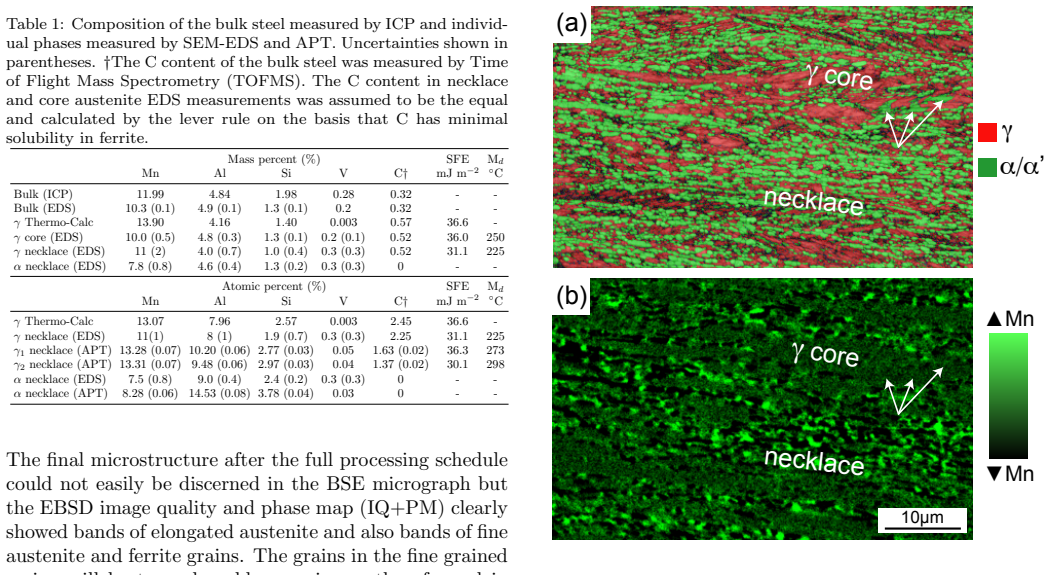
The load-bearing object is the necklace-core microstructure produced by the continuous hot and warm rolling plus intercritical anneal. Coarse, unrecrystallised prior-austenite grains form the 'core', while fine austenite and ferrite grains nucleated at prior grain boundaries form the 'necklace'. Because the fine necklace grains are enriched in Mn and depleted in Al relative to the cores, the two austenite populations inherit different stacking-fault energies and Md temperatures, which the paper uses to explain why cores transform to martensite in stage A while necklace grains twin and transform in stage B. The in-situ neutron diffraction signature, an early rise of the BCC (110) peak at about 1.7% strain and a second sharp rise at about 7.7% strain coinciding with the start of stage B, is the experimental indicator that carries the two-stage claim.
What would settle it
Watch one tensile specimen's microstructure as it deforms: if the first twins appear in coarse core grains before any martensite, or if necklace grains transform before core grains, the hierarchical claim is wrong. A quantitative version is to measure the local stacking-fault energy or austenite stability of individual core and necklace grains, for example by in-situ synchrotron diffraction or TEM fault-width measurement, and check that the predicted core-transforms/necklace-twins ordering survives.
Extended reading notes
Core claim
In the paper's own account, the discovery is that deformation in this steel is hierarchical and separable. In stage A, from about 0.02 to 0.25 true strain, the coarse, less-stable core austenite grains transform to martensite; serrated flow and a fluctuating hardening rate mark this transformation-induced plasticity (TRIP), and the austenite fraction falls while ferrite and martensite rise. In stage B, from about 0.25 to 0.43 true strain, the cores have largely transformed and the load shifts to the fine necklace austenite grains, which then deform by a mix of twinning and transformation; the hardening rate steadies near 2.8 GPa, twins are confirmed by TEM in necklace grains, and the BCC (110) peak intensity rises sharply for a second time. The net result is 54% elongation with sustained hardening to fracture in a steel processed without quenching or cold rolling.
Load-bearing premise
The load-bearing premise is that the empirical stability calculations, stacking-fault energy and the Md temperature, the upper temperature for strain-induced martensite, plus the assumption that carbon is equal in core and necklace austenite, correctly predict that cores transform before necklace grains twin; if those numbers are wrong, the two-stage mechanism is a correlation without a proven cause.
Editorial extensions
If this is right
- The process route can be transferred to conventional strip production, since it avoids the quench-cold-roll-re-anneal steps that make batch processing expensive.
- The mechanism gives alloy designers two independent knobs: the composition and size of core austenite set the stage-A TRIP contribution, while necklace austenite composition sets the stage-B TWIP plus TRIP contribution.
- The U30 energy-absorption comparison places this steel above the Future Steel Vehicle TWIP550/900 benchmark at similar alloy cost, supporting medium-Mn steel for crash-energy and armour applications.
- The persistence of a high hardening rate, near 2.8 GPa, through stage B means the steel retains load-bearing capacity to large strains, so ductility is not bought at the cost of early necking.
Reading between the lines
- If the hierarchy is robust, the same necklace-core motif could be designed into other TRIP and TWIP alloy families: leave coarse, less-stable grains to supply early transformation plasticity and fine, Mn-enriched grains to supply late twinning and transformation.
- The paper leaves open whether grain size, grain orientation, or local composition differences control which necklace grains twin versus transform; mapping twin and martensite initiation grain-by-grain in situ would settle this.
- The authors' own future-work target, removing vanadium and lowering Mn to 8 wt% or below, is a direct test of whether the hierarchy, rather than the expensive alloying, is what delivers the properties.
- Since the stability inputs rely on the lever-rule carbon assumption, atom-probe carbon profiles across core and necklace interfaces could either confirm the stacking-fault-energy ranking or require its revision.
Signed reviews
Editorial analysis
A structured set of objections, weighed in public.
Referee Report
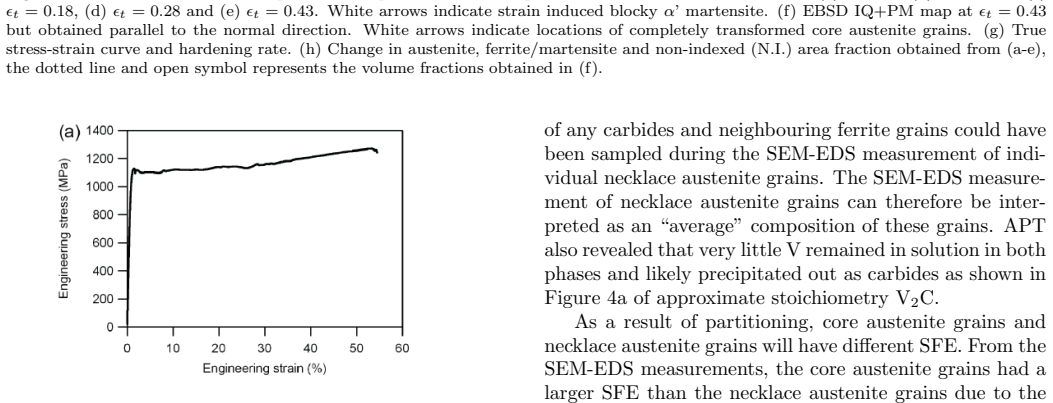
Summary. The manuscript reports the design of a 12 wt% Mn medium manganese steel (Fe-12Mn-4.8Al-2Si-0.32C-0.3V) processed by a continuous route of hot rolling, warm rolling, and a 30 min intercritical anneal, producing a necklace-core microstructure of coarse elongated austenite grains surrounded by fine austenite-ferrite necklace grains. Tensile testing gives 1.09 GPa yield strength, 1.26 GPa tensile strength, and 54% elongation, with two stages of work hardening. Using interrupted EBSD, TEM, APT, and in-situ neutron diffraction, the authors propose a two-stage hierarchical deformation mechanism: core austenite transforms to martensite during Stage A, and necklace austenite subsequently deforms by a combination of twinning-induced plasticity and transformation-induced plasticity during Stage B. The paper closes with an assessment of alloy cost versus energy absorption (U30) relative to commercial and literature medium Mn steels.
Significance. If the hierarchical mechanism and the continuous processing route are taken at face value, the paper offers an industrially attractive route toward third-generation AHSS property combinations and introduces a microstructure design concept based on stability differences between core and necklace austenite. The direct mechanical property measurements are valuable, and the multi-technique characterization (EBSD, TEM, APT, neutron diffraction) is a strength. The authors also deserve credit for explicitly acknowledging the limitations of the empirical SFE and Md models and the interpretative nature of the neutron BCC lattice-strain analysis. The central mechanistic claim, however, is supported by qualitative spatial attribution in EBSD and by neutron data from a differently processed ingot, so the significance of the paper depends on whether that claim is subsequently strengthened or appropriately softened.
major comments (3)
- [Section 3.2, Fig. 5] The claim that TRIP in Stage A is 'mostly confined within the core austenite grains' is not quantitatively established. As stated in Section 3.2, EBSD cannot distinguish ferrite from alpha-prime martensite (both are indexed as BCC), the non-indexed area fraction reaches <0.2 at large strains, and the phase-fraction curves in Fig. 5h therefore track combined BCC area rather than martensite specifically. The white arrows identify only selected regions of blocky martensite, and no per-region phase quantification is provided to separate core from necklace transformation. Without such quantification, the central hierarchical sequence remains a qualitative interpretation.
- [Section 3.3, Fig. 10] The second rise in BCC (110) integrated intensity at 7.7% strain is assigned to necklace austenite transformation in Stage B, but this experiment was performed on an ingot that was furnace cooled rather than water quenched, warm rolled to lower reductions, and exhibited a different tensile curve (Fig. 8). Moreover, neutron diffraction provides no spatial discrimination between core and necklace regions. The assignment of this intensity increase specifically to necklace austenite is therefore not supported by the data; it could also reflect continued transformation in the core or other microstructural changes.
- [Section 4.2, Table 1] The explanation of why core austenite transforms while necklace austenite twins and transforms relies on SFE and Md values from empirical models (Pierce et al., Nohara et al.) calibrated on high-Mn austenitic steels and austenitic stainless steels, together with the lever-rule assumption that carbon is equal and negligible in ferrite. The authors acknowledge that the Md values 'should be interpreted conceptually,' but these stability parameters carry the causal weight of the hierarchical mechanism. A sensitivity test, such as varying C, Mn, and Al within the reported EDS/APT uncertainties and recomputing SFE and Md, would show whether the predicted ordering of core versus necklace stability is robust; without it, the mechanism remains a correlation.
minor comments (5)
- [Abstract vs. Section 5] The abstract reports tensile strength of 1.26 GPa, while Section 5 states a 'true ultimate tensile strength of 1.9 GPa'; please clarify in both places which value is engineering and which is true stress, and report both consistently.
- [Section 3.2] The phrase 'a significant area (<0.2)' is ambiguous; please specify 'area fraction less than 0.2' and state whether this is the maximum non-indexed fraction at the largest strain.
- [Section 4.3] The U30 comparator is defined up to a true strain of 0.3, described as 'the limit of useful ductility,' but no justification is given for this cutoff; one sentence explaining the choice would make the metric easier to interpret.
- [Section 3.3] The text correctly cautions that limited reliance should be placed on BCC lattice strains beyond the macroscopic yield point, yet Fig. 10b is later used to infer TRIP from BCC intensity changes; please clarify which BCC intensity features are considered reliable despite the compositional heterogeneity of martensite versus ferrite.
- [Throughout] There are several typographical errors, e.g., 'succesful' in Section 1, 'absorbtion' in Section 4.3, and 'dfferences' in Section 4.2; a careful proofreading pass is needed.
Circularity Check
No significant circularity: the mechanical-property and hierarchical-deformation claims are observational, and the SFE/Md calculations are explicitly presented as conceptual aids rather than as fitted predictors.
full rationale
The paper's central claims—achieving 1.09 GPa yield strength, 1.26 GPa tensile strength, 54% elongation, and a two-stage core-austenite TRIP followed by necklace-austenite TWIP+TRIP deformation sequence—are supported directly by tensile testing, interrupted EBSD maps, TEM, and in-situ neutron diffraction intensity changes. No model parameter is fitted to the deformation data and then renamed as a prediction. The SFE and M_d values in Table 1 are computed from composition using literature correlations (Pierce et al., Nohara et al.) and used only to rationalize why core and necklace austenite might behave differently; the authors explicitly state that 'M d temperatures in Table 1 should therefore be interpreted conceptually' and that the SFE model 'may be erroneous as the empirical model [30] used in this study was not developed for use in medium Mn steel.' This is a caveated interpretive aid, not a load-bearing derivation. The few self-citations (Rahman et al. on TWIP behavior) provide background on twinning and are not used to justify the present steel's mechanism. The two-stage hierarchy itself is inferred from qualitative EBSD and a separately processed neutron specimen, which is an evidence-strength concern rather than circularity: the interpretation could be wrong if the EBSD ferrite/martensite ambiguity or the different neutron-ingot processing misleads, but the reasoning does not reduce by construction to its inputs. Therefore no circular step is present.
Assumptions & free parameters
free parameters (1)
- U30 useful ductility limit. =
0.3 true strain.
assumptions (5)
- domain assumption The stacking fault energy model of Pierce et al. applies to this 12Mn medium manganese steel.
- domain assumption The Md temperature equation of Nohara et al., based on austenitic stainless steels, applies to this alloy.
- domain assumption Carbon is negligible in ferrite and equal in core and necklace austenite, estimated by the lever rule.
- domain assumption The non-indexed regions in EBSD (up to 20% of area) do not bias the phase fraction trends.
- domain assumption Core austenite retains a higher dislocation density than necklace austenite after recovery.
Cite this review
Pith. "Pith review of Design of a High Strength, High Ductility 12 wt% Mn Medium Manganese Steel With Hierarchical Deformation Behaviour." pith.science (2026). https://pith.science/paper/NTD2GVPF
@misc{pith2026190807258,
  author       = {Pith},
  title        = {Pith review of: Design of a High Strength, High Ductility 12 wt% Mn Medium Manganese Steel With Hierarchical Deformation Behaviour},
  year         = {2026},
  howpublished = {\url{https://pith.science/paper/NTD2GVPF}},
  note         = {Machine review of arXiv:1908.07258}
}
read the original abstract
A novel medium Mn steel of composition Fe-12Mn-4.8Al-2Si-0.32C-0.3V was manufactured with 1.09 GPa yield strength, 1.26 GPa tensile strength and 54% elongation. The thermomechanical process route was designed to be industrially translatable and consists of hot and then warm rolling before a 30 min intercritical anneal. The resulting microstructure comprised of coarse elongated austenite grains in the rolling direction surrounded by necklace layers of fine austenite and ferrite grains. The tensile behaviour was investigated by in-situ neutron diffraction and the evolution of microstructure studied with Electron Backscattered Diffraction (EBSD). It was found that the coarse austenite grains contributed to the first stage of strain hardening by transforming into martensite and the fine austenite necklace grains contributed to the second stage of strain hardening by a mixture of twinning and transformation induced plasticity (TWIP and TRIP) mechanisms. This hierarchical deformation behaviour contributed to the exceptional ductility of this steel.
Figures


Figures from the paper (8 more)




Reference graph
Works this paper leans on
-
[1]
Some newly discovered properties of Iron and Manganese
Hadfield RA. Some newly discovered properties of Iron and Manganese. Proceedings of The Institution of Civil Engineers 1888;93:61
-
[2]
High Mn TWIP Steels for Automotive Applications
De Cooman BC, Chin Kg, Kim J. High Mn TWIP Steels for Automotive Applications. New Trends and Developments in Automotive System Engineering 2011
work page 2011
-
[3]
Twinning-induced plasticity (TWIP) steels
De Cooman BC, Estrin Y, Kim SK. Twinning-induced plasticity (TWIP) steels. Acta Materialia 2018;142:283
work page 2018
-
[4]
Bouaziz O, Allain S, Scott C. Effect of grain and twin bound- aries on the hardening mechanisms of twinning-induced plastic- ity steels. Scripta Materialia 2008;58:484
work page 2008
-
[5]
The effect of grain size on the twin initiation stress in a TWIP steel
Rahman KM, Vorontsov VA, Dye D. The effect of grain size on the twin initiation stress in a TWIP steel. Acta Materialia 2015;89:247
work page 2015
-
[6]
The dynamic behaviour of a twinning induced plasticity steel
Rahman KM, Vorontsov VA, Dye D. The dynamic behaviour of a twinning induced plasticity steel. Materials Science and Engineering A 2014;589:252
work page 2014
-
[7]
Current state of Fe-Mn- Al-C low density steels
Chen S, Rana R, Haldar A, Ray RK. Current state of Fe-Mn- Al-C low density steels. Progress in Materials Science 2017; 89:345
work page 2017
-
[8]
Ultra high-strength and ductile FeMnAlC light-weight steels
Bausch M, et al. Ultra high-strength and ductile FeMnAlC light-weight steels. Technical report, Luxembourg 2013
work page 2013
Show all 56 references
-
[9]
Joining TWIP to TWIP and TWIP to aluminium: A com- parative study between joining processes, joint properties and mechanical performance
Papadimitriou I, Efthymiadis P, Kotadia HR, Sohn IR, Sridhar S. Joining TWIP to TWIP and TWIP to aluminium: A com- parative study between joining processes, joint properties and mechanical performance. Journal of Manufacturing Processes 2017;30:195
2017
-
[10]
Effects of cold rolling reduction ratio on microstructures and tensile properties of intercritically annealed medium-Mn steels
Kim MT, Park TM, Baik KH, Choi WS, Han J. Effects of cold rolling reduction ratio on microstructures and tensile properties of intercritically annealed medium-Mn steels. Materials Science and Engineering A 2019;752:43
2019
-
[11]
Observation of the TWIP+TRIP Plasticity-Enhancement Mechanism in Al-Added 6 Wt Pct Medium Mn Steel
Lee S, Lee K, De Cooman BC. Observation of the TWIP+TRIP Plasticity-Enhancement Mechanism in Al-Added 6 Wt Pct Medium Mn Steel. Metallurgical and Materials Transactions A: Physical Metallurgy and Materials Science 2015;46:2356
2015
-
[12]
Annealing Temperature Dependence of the Tensile Behavior of 10pct Mn Multi-phase TWIP-TRIP Steel
Lee S, De Cooman BC. Annealing Temperature Dependence of the Tensile Behavior of 10pct Mn Multi-phase TWIP-TRIP Steel. Metallurgical and Materials Transactions A: Physical Metallurgy and Materials Science 2014;45:6039
2014
-
[13]
A strong and ductile 7Mn steel manufactured by warm rolling and exhibiting both transformation and twin- ning induced plasticity
Hu B, Luo H. A strong and ductile 7Mn steel manufactured by warm rolling and exhibiting both transformation and twin- ning induced plasticity. Journal of Alloys and Compounds 2017; 725:684
2017
-
[14]
Analysis of the Tensile Be- havior of 12pct Mn Multi-phase ( α+γ) TWIP+TRIP Steel by Neutron Diffraction
Lee S, Woo W, de Cooman BC. Analysis of the Tensile Be- havior of 12pct Mn Multi-phase ( α+γ) TWIP+TRIP Steel by Neutron Diffraction. Metallurgical and Materials Transactions A: Physical Metallurgy and Materials Science 2016;47:2125
2016
-
[15]
Novel ferrite- austenite duplex lightweight steel with 77% ductility by trans- formation induced plasticity and twinning induced plasticity mechanisms
Sohn SS, Choi K, Kwak JH, Kim NJ, Lee S. Novel ferrite- austenite duplex lightweight steel with 77% ductility by trans- formation induced plasticity and twinning induced plasticity mechanisms. Acta Materialia 2014;78:181
2014
-
[16]
Deformation Microstructure and Deformation-Induced Marten- site in Austenitic Fe-Cr-Ni Alloys Depending on Stacking Fault Energy
Tian Y, Gorbatov OI, Borgenstam A, Ruban AV, Hedstr¨ om P. Deformation Microstructure and Deformation-Induced Marten- site in Austenitic Fe-Cr-Ni Alloys Depending on Stacking Fault Energy. Metallurgical and Materials Transactions A: Physical Metallurgy and Materials Science 2017;48:1
2017
-
[17]
Coupled strengthening in a medium manganese lightweight steel with an inhomogeneously grained structure of austenite
Lee CY, Jeong J, Han J, Lee SJ, Lee S, Lee YK. Coupled strengthening in a medium manganese lightweight steel with an inhomogeneously grained structure of austenite. Acta Materi- alia 2015;84:1
2015
-
[18]
The influence of silicon additions on the deformation behavior of austenite-ferrite duplex medium manganese steels
Sun B, Fazeli F, Scott C, Brodusch N, Gauvin R, Yue S. The influence of silicon additions on the deformation behavior of austenite-ferrite duplex medium manganese steels. Acta Mate- rialia 2018;148:249
2018
-
[19]
Austenite stability of ultrafine- grained transformation-induced plasticity steel with Mn parti- tioning
Lee S, Lee SJ, De Cooman BC. Austenite stability of ultrafine- grained transformation-induced plasticity steel with Mn parti- tioning. Scripta Materialia 2011;65:225
2011
-
[20]
Difference in transformation behavior between ferrite and austenite forma- tions in medium manganese steel
Nakada N, Mizutani K, Tsuchiyama T, Takaki S. Difference in transformation behavior between ferrite and austenite forma- tions in medium manganese steel. Acta Materialia 2014;65:251
2014
-
[21]
On the selection of the optimal intercrit- ical annealing temperature for medium Mn TRIP steel
Lee S, De Cooman BC. On the selection of the optimal intercrit- ical annealing temperature for medium Mn TRIP steel. Metal- lurgical and Materials Transactions A: Physical Metallurgy and Materials Science 2013;44:5018
2013
-
[22]
Tensile Behavior of Intercritically An- nealed 10 pct Mn Multi-phase Steel
Lee S, De Cooman BC. Tensile Behavior of Intercritically An- nealed 10 pct Mn Multi-phase Steel. Metallurgical and Materi- als Transactions A 2014;45A:709
2014
-
[23]
Tensile behavior of intercritically an- nealed ultra-fine grained 8% mn multi-phase steel
Lee S, De Cooman BC. Tensile behavior of intercritically an- nealed ultra-fine grained 8% mn multi-phase steel. Steel Re- search International 2015;86:1170
2015
-
[24]
Super- high-strength and formable medium Mn steel manufactured by warm rolling process
Hu B, He BB, Cheng GJ, Yen HW, Huang MX, Luo HW. Super- high-strength and formable medium Mn steel manufactured by warm rolling process. Acta Materialia 2019;174:131
2019
-
[25]
The study of quanti- tativeness in atom probe analysis of alloying elements in steel
Yamaguchi Y, Takahashi J, Kawakami K. The study of quanti- tativeness in atom probe analysis of alloying elements in steel. Ultramicroscopy 2009;109:541
2009
-
[26]
Quantitative analysis of carbon content in cementite in steel by atom probe tomogra- phy
Takahashi J, Kawakami K, Kobayashi Y. Quantitative analysis of carbon content in cementite in steel by atom probe tomogra- phy. Ultramicroscopy 2011;111:1233
2011
-
[27]
Quantitative measure- ment of carbon content in Fe-C binary alloys by atom probe tomography
Miyamoto G, Shinbo K, Furuhara T. Quantitative measure- ment of carbon content in Fe-C binary alloys by atom probe tomography. Scripta Materialia 2012;67:999
2012
-
[28]
Necklace formation during dynamic re- crystallization: Mechanisms and impact on flow behavior
Ponge D, Gottstein G. Necklace formation during dynamic re- crystallization: Mechanisms and impact on flow behavior. Acta Materialia 1998;46:69
1998
-
[29]
Kinetics of Solute Partitioning During Intercritical Annealing of a Medium-Mn Steel
Kamoutsi H, Gioti E, Haidemenopoulos GN, Cai Z, Ding H. Kinetics of Solute Partitioning During Intercritical Annealing of a Medium-Mn Steel. Metallurgical and Materials Transactions A: Physical Metallurgy and Materials Science 2015;46:4841
2015
-
[30]
The influence of manganese content on the stacking fault and austenite/ϵ-martensite interfacial energies in Fe-Mn-(Al-Si) steels investigated by experiment and theory
Pierce DT, Jim´ enez JA, Bentley J, Raabe D, Oskay C, Wittig JE. The influence of manganese content on the stacking fault and austenite/ϵ-martensite interfacial energies in Fe-Mn-(Al-Si) steels investigated by experiment and theory. Acta Materialia 2014;68:238
2014
-
[31]
Composition and Grain Size Dependencies of Strain-induced Martensitic Transformation in Metastable Austenitic Stainless Steels
Nohara K, Ono Y, Ohashi N. Composition and Grain Size Dependencies of Strain-induced Martensitic Transformation in Metastable Austenitic Stainless Steels. J Iron Steel Inst 1977; 63:772
1977
-
[32]
Effect of strain rate on the strain-induced γ, α-martensite transformation and mechanical properties of austenitic stainless steels
Talonen J, Nenonen P, Pape G, H¨ anninen H. Effect of strain rate on the strain-induced γ, α-martensite transformation and mechanical properties of austenitic stainless steels. Metallur- gical and Materials Transactions A: Physical Metallurgy and Materials Science 2005;36 A:421
2005
-
[33]
Derivation and variation in composition-dependent stacking fault energy maps based on subregular solution model in high-manganese steels
Saeed-Akbari A, Imlau J, Prahl U, Bleck W. Derivation and variation in composition-dependent stacking fault energy maps based on subregular solution model in high-manganese steels. Metallurgical and Materials Transactions A: Physical Metal- lurgy and Materials Science 2009;40:3076
2009
-
[34]
Stacking fault energy and deforma- tion mechanisms in Fe-xMn-0.6C-yAl TWIP steel
Kim JK, De Cooman BC. Stacking fault energy and deforma- tion mechanisms in Fe-xMn-0.6C-yAl TWIP steel. Materials Science and Engineering A 2016;676:216
2016
-
[35]
Chemistry and Properties of Medium-Mn Two-Stage TRIP Steels
Field DM, Qing J, van Aken DC. Chemistry and Properties of Medium-Mn Two-Stage TRIP Steels. Metallurgical and Mate- rials Transactions A: Physical Metallurgy and Materials Science 2018;49:1
2018
-
[36]
Use of Rietveld refinement for elastic macrostrain 11 determination and for evaluation of plastic strain history from diffraction spectra
Daymond MR, Bourke MA, Von Dreele RB, Clausen B, Lorentzen T. Use of Rietveld refinement for elastic macrostrain 11 determination and for evaluation of plastic strain history from diffraction spectra. Journal of Applied Physics 1997;82:1554
1997
-
[37]
Effect of δ-ferrite co- existence on hot deformation and recrystallization of austenite
Dehghan-Manshadi A, Hodgson PD. Effect of δ-ferrite co- existence on hot deformation and recrystallization of austenite. Journal of Materials Science 2008;43:6272
2008
-
[38]
In- creasing yield strength of medium Mn steel by engineering mul- tiple strengthening defects
He BB, Huang BM, He SH, Qi Y, Yen HW, Huang MX. In- creasing yield strength of medium Mn steel by engineering mul- tiple strengthening defects. Materials Science and Engineering A 2018;724:11
2018
-
[39]
Localized deformation in multiphase, ultra-fine-grained 6 Pct Mn transformation-induced plasticity steel
Lee S, Lee SJ, Santhosh Kumar S, Lee K, De Cooman BC. Localized deformation in multiphase, ultra-fine-grained 6 Pct Mn transformation-induced plasticity steel. Metallurgical and Materials Transactions A: Physical Metallurgy and Materials Science 2011;42:3638
2011
-
[40]
Confined chemical and structural states at dislocations in Fe-9wt%Mn steels: A correlative TEM- atom probe study combined with multiscale modelling
Kwiatkowski da Silva A, et al. Confined chemical and structural states at dislocations in Fe-9wt%Mn steels: A correlative TEM- atom probe study combined with multiscale modelling. Acta Materialia 2017;124:305
2017
-
[41]
Dislocation Pipe Diffusion of Mn during Annealing of 5Mn Steel
Lin J, et al. Dislocation Pipe Diffusion of Mn during Annealing of 5Mn Steel. Journal of Iron and Steel Research International 2016;23:1277
2016
-
[42]
The effects of the initial martensite microstructure on the microstructure and tensile properties of intercritically annealed Fe-9Mn-0.05C steel
Han J, Lee SJ, Jung JG, Lee YK. The effects of the initial martensite microstructure on the microstructure and tensile properties of intercritically annealed Fe-9Mn-0.05C steel. Acta Materialia 2014;78:369
2014
-
[43]
Temperature-dependent micromechanical be- havior of medium-Mn transformation-induced-plasticity steel studied by in situ synchrotron X-ray diffraction
Zhang M, et al. Temperature-dependent micromechanical be- havior of medium-Mn transformation-induced-plasticity steel studied by in situ synchrotron X-ray diffraction. Acta Mate- rialia 2017;141:294
2017
-
[44]
Formation of martensite in austenitic stainless steels
Angel T. Formation of martensite in austenitic stainless steels. J Iron Steel Inst 1954;:165
1954
-
[45]
Understanding martensite and twin formation in austenitic steels: A model de- scribing TRIP and TWIP effects
Galindo-Nava EI, Rivera-D´ ıaz-del Castillo PE. Understanding martensite and twin formation in austenitic steels: A model de- scribing TRIP and TWIP effects. Acta Materialia 2017;128:120
2017
-
[46]
Correla- tion between deformation behavior and austenite characteristics in a Mn-Al type TRIP steel
Xu YB, Zou Y, Hu ZP, Han DT, Chen SQ, Misra RD. Correla- tion between deformation behavior and austenite characteristics in a Mn-Al type TRIP steel. Materials Science and Engineering A 2017;698:126
2017
-
[47]
Automotive Steels: Design, Metallurgy, Pro- cessing and Applications 2016
Rana R, Singh S. Automotive Steels: Design, Metallurgy, Pro- cessing and Applications 2016
2016
-
[48]
Future Steel Vehicle Phase 2 - Report
WorldAutoSteel. Future Steel Vehicle Phase 2 - Report. Tech- nical report 2011
2011
-
[49]
New ultrahigh-strength Mn-alloyed TRIP steels with improved formability manufactured by intercritical anneal- ing
Luo H, Dong H. New ultrahigh-strength Mn-alloyed TRIP steels with improved formability manufactured by intercritical anneal- ing. Materials Science and Engineering A 2015;626:207
2015
-
[50]
Microstructure and mechanical properties of hot-rolled medium-Mn steel containing 3% aluminum 2017
Shao C, Hui W, Zhang Y, Zhao X, Weng Y. Microstructure and mechanical properties of hot-rolled medium-Mn steel containing 3% aluminum 2017
2017
-
[51]
Com- bined Intercritical Annealing and Q&P Processing of Medium Mn Steel
De Cooman BC, Lee SJ, Shin S, Seo EJ, Speer JG. Com- bined Intercritical Annealing and Q&P Processing of Medium Mn Steel. Metallurgical and Materials Transactions A: Physical Metallurgy and Materials Science 2017;48:39
2017
-
[52]
Microstructures and mechanical properties of Ti and Mo micro-alloyed medium Mn steel
Lee D, Kim JK, Lee S, Lee K, De Cooman BC. Microstructures and mechanical properties of Ti and Mo micro-alloyed medium Mn steel. Materials Science and Engineering A 2017;706:1
2017
-
[53]
Influence of Nb and V on Microstructure and Mechanical Properties of Hot-Rolled Medium Mn Steels
Zhu Y, Hu B, Luo H. Influence of Nb and V on Microstructure and Mechanical Properties of Hot-Rolled Medium Mn Steels. Steel Research International 2017;1700389:1
2017
-
[54]
Strong and ductile medium Mn steel with- out transformation-induced plasticity effect
He BB, Huang MX. Strong and ductile medium Mn steel with- out transformation-induced plasticity effect. Materials Research Letters 2018;6:365
2018
-
[55]
Novel 1.5 GPa-strength with 50%-ductility by transformation-induced plasticity of non-recrystallized austenite in duplex steels
Sohn SS, Song H, Jo MC, Song T, Kim HS, Lee S. Novel 1.5 GPa-strength with 50%-ductility by transformation-induced plasticity of non-recrystallized austenite in duplex steels. Sci- entific Reports 2017;7:1
2017
-
[56]
Experimental and numerical study of mechan- ical properties of multi-phase medium-Mn TWIP-TRIP steel: influences of strain rate and phase constituents
Benzing J, et al. Experimental and numerical study of mechan- ical properties of multi-phase medium-Mn TWIP-TRIP steel: influences of strain rate and phase constituents. Acta Materi- alia 2019;177:250 12
2019
Reviewed August 14, 2026 · model on record in the stance chip above.
Discussion (0). Continue with ORCID to comment.