REVIEW 4 major objections 6 minor 1 cited by
A Neural Virtual Anchor Synthesizer based on Seq2Seq and GAN Models
T0 review · 4 major / 6 minor · reviewed 2026-08-14 · deepseek-v4-flash
Pith's one-line read This paper claims that text can be converted directly into video of a synthetic news anchor whose mouth movements match the words, using a two-stage neural pipeline that avoids 3D face models.
desk verdict A reasonable pipeline sketch for text-driven virtual anchor synthesis, but the central feasibility claim is backed only by a few static images and no quantitative or temporal evaluation. read the letter →
The pith
A machine-rendered reading of the paper's core claim, the machinery that carries it, and where it could break.
The reading
What carries the argument
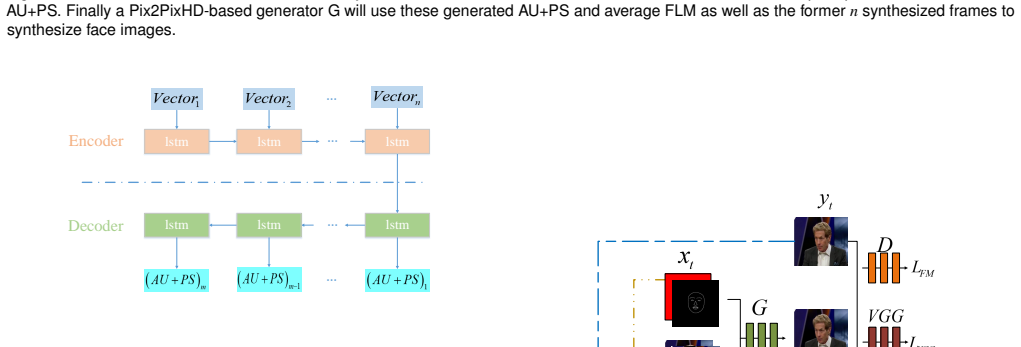
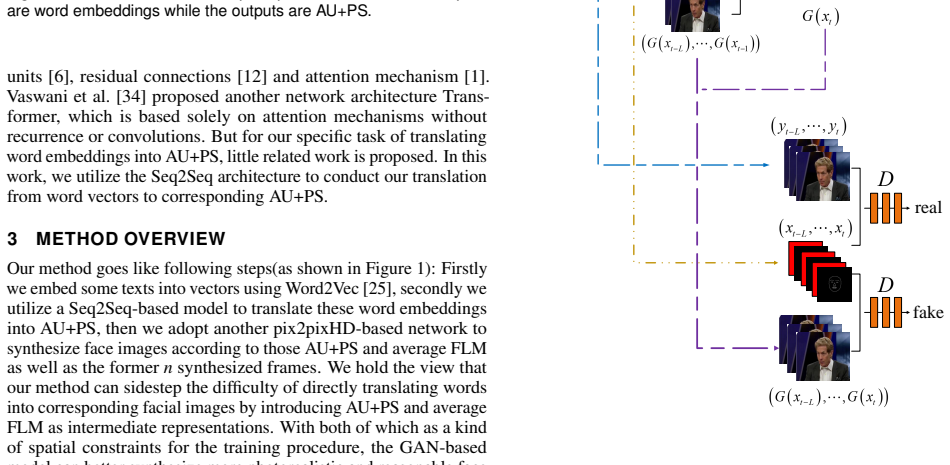
The load-bearing machinery is a two-stage neural cascade. A pretrained word-embedding model converts words to vectors; an LSTM-based sequence-to-sequence model translates the word-vector sequence into a sequence of 20-D AU+PS targets, trained on action units and poses extracted from real speakers. The second stage is a Pix2PixHD-style conditional adversarial generator: it receives the AU+PS, an averaged facial-landmark map, and the previous n=2 synthesized frames, and produces the next face image, optimized with an adversarial loss, a feature-matching loss, and a perceptual VGG loss. The average landmark map is a single template computed over all training frames, which the authors say provides spatial coordinate constraints and accelerates convergence.
What would settle it
Take a real clip of a person reading a sentence, extract the corresponding AU+PS, generate the face with the average landmark template, and measure the distance between synthesized and real mouth landmarks; if the error is large or the synthesized mouth cannot be read back by a lip-reading model as the input text, the 20-D representation has not preserved enough articulatory information.
Extended reading notes
Core claim
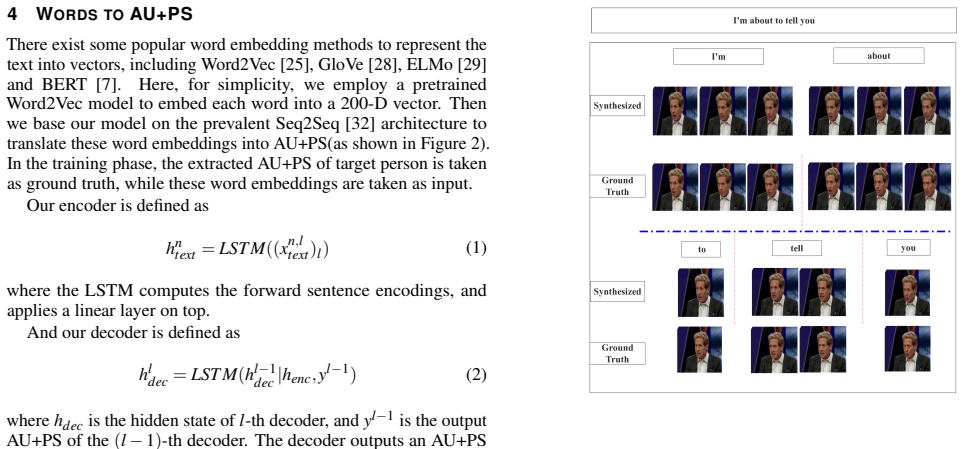
The paper's central claim is that a 20-dimensional intermediate representation is sufficient to bridge text and face video. Action units capture expression and mouth movement categories, head pose captures orientation, and an averaged facial-landmark map supplies a fixed spatial layout of the face; the previous two generated frames supply temporal continuity. With this input, the authors claim, the generator outputs consecutive photorealistic frames whose mouth movements and facial expressions are appropriate to the input text. The demonstration is a single example sequence, and the authors describe the mouth motion as 'almost consistent' with the words.
Load-bearing premise
The load-bearing premise is that a 20-number facial-motion vector plus an averaged landmark template contains enough per-frame information about identity, jaw position, and lip shape for the image generator to produce a convincingly lip-synced face.
Editorial extensions
If this is right
- Anchor video for new scripts could be produced without a human presenter, since the only inputs are text and a target person's training video.
- Changing the on-screen presenter would require retraining the image generator on that person's footage, while the word-to-motion translator may be reused across speakers.
- Temporal coherence comes from feeding back previous generated frames, so the approach is designed for video rather than isolated stills.
- No explicit 3D face reconstruction is involved, which the authors argue sidesteps a major source of complexity in avatar synthesis.
Reading between the lines
- The average landmark template is the most likely weak point: replacing it with per-frame landmarks predicted by the sequence model would presumably improve lip geometry and therefore lip-sync, and this is a direct ablation the paper does not run.
- Because action units describe muscle activation categories rather than exact jaw and lip coordinates, the current representation may limit the system to 'almost consistent' mouth motion; a cleaner test is measuring whether a lip-reading network recovers the input text.
- Feeding the sequence model phoneme-level or audio-aligned features, rather than word-level vectors alone, would add a timing signal and likely tighten the correspondence between text and mouth motion.
Signed reviews
Editorial analysis
A structured set of objections, weighed in public.
Referee Report
Summary. The paper proposes a pipeline for synthesizing a virtual anchor's face video from input text. Word embeddings from a pretrained Word2Vec model are fed into a Seq2Seq translator that outputs a 20-dimensional AU+PS sequence (17 facial action units and 3 head-pose angles). These AU+PS vectors, together with an average facial-landmark template and the previous n synthesized frames, are then supplied to a Pix2PixHD-based generator to produce photorealistic frames. The authors train on 400+ ESPN videos and report one qualitative example (Figure 4), concluding that the framework is feasible for virtual-anchor synthesis with mouth movements consistent with the input text.
Significance. The problem of text-conditioned photorealistic talking-head video synthesis is of practical interest, and the proposed modular pipeline (Word2Vec -> Seq2Seq -> AU+PS -> Pix2PixHD with temporal conditioning) is a reasonable and reproducible architecture if it works. However, the paper provides no quantitative evaluation, no baseline comparisons, no ablation study, and no temporal validation. The only evidence is a small set of static frames in Figure 4, which cannot demonstrate the central claim of lip-synchronized mouth movements. The contribution is therefore currently unvalidated; the significance judgment must await the additional evaluation described in the major comments.
major comments (4)
- [§6 Experiments] The central claim that the method is 'feasible' and that the synthesized mouth movements are 'almost consistent with the corresponding words' rests entirely on the single qualitative example in Figure 4, which shows only static images without an ordered sequence or video. No quantitative metrics are reported for either the Seq2Seq stage or the image-generation stage; there is no landmark-distance error, no lip-sync score, no identity-preservation measure, no temporal-consistency metric, and no comparison with any baseline. Because the paper explicitly claims that mouth movements match input text, the absence of any quantitative or even video-based temporal evaluation leaves the primary assertion unsupported.
- [§5 (Eq. 3) and §6] The conditioning on 'former n synthesized frames' is the only mechanism introduced to enforce temporal coherence, yet the paper never demonstrates that this mechanism works. In particular, no experiment measures temporal smoothness, flickering, or error accumulation across frames, and the influence of n is not studied (only n=2 appears in the experiments). Furthermore, Eq. (3) contains a typo and ambiguous notation: X is defined as the concatenation of AU+PS and average FLM maps while Y is the ground-truth images, but the discriminator terms D(X,Y) and D(X,G(X)) do not clarify how the previous n frames are concatenated or how the discriminator enforces temporal coherence. This makes the actual objective difficult to reconstruct and the claimed temporal constraint impossible to verify.
- [§4 Words-to-AU+PS] The Seq2Seq translator is trained to predict AU+PS sequences from word embeddings, but the predicted AU+PS are never compared against the ground-truth AU+PS extracted by OpenFace. Without a per-frame or per-sequence error analysis, a failure of this stage (e.g., misaligned emphasis, wrong expression timing) would propagate to the image generator and invalidate the end-to-end claim. The paper provides no quantitative or qualitative evaluation of the intermediate AU+PS outputs, leaving the first stage of the pipeline completely unvalidated.
- [§3 and §5] The paper assumes that a 20-dimensional AU+PS vector plus a single average facial-landmark template is sufficient to represent per-frame mouth shape and identity for photorealistic rendering. This assumption is load-bearing because the average FLM does not carry per-frame lip geometry, and the 17 AU values are the only per-frame mouth-shape signal. The paper offers no validation that this compact representation preserves lip geometry, visemes, or identity; a test such as measuring the reconstruction error of mouth landmarks from the generator output, or an ablation replacing the average FLM with per-frame landmarks, would be necessary to support the method's design.
minor comments (6)
- [§5 text] The text contains a typo: 'avergae' should be 'average' in the definition of X after Eq. (3).
- [§5 (Eq. 3)] Eq. (3) has a missing closing parenthesis in the second term: log(1− D(X, G(X)] should be log(1 − D(X, G(X))).
- [§2 Related Works] The phrase 'multilatered LSTM' in the description of Seq2Seq should be 'multilayered LSTM'.
- [§3] The paper inconsistently writes 'Open-Face' in the text and 'OpenFace' in the references; please standardize the spelling.
- [§6] The experiments do not report training hyperparameters, the number of training/validation/test sentences, or any data-split details; adding these would improve reproducibility.
- [§5] Figure 3 is referenced as the Pix2PixHD-based generator architecture, but the figure is not shown in the manuscript text; either include it or describe the network components in the text.
Circularity Check
No circularity: the pipeline is trained on externally extracted ground truth; the lone self-citation is not load-bearing.
full rationale
The derivation chain is text -> Word2Vec -> Seq2Seq -> AU+PS -> Pix2PixHD -> frames. The Seq2Seq targets (AU+PS) are extracted with OpenFace from real videos of the target person speaking the input texts (Sections 3 and 4), and the Pix2PixHD generator is trained against real ground-truth frames (Eqs. 3-4, Section 5). No equation or stated construction makes the output equal to the input or to a fitted parameter; no fitted value is relabeled as a prediction. The only self-citation is [22], used in a generic list of image-synthesis works ('synthesis of images has received more and more attentions [16, 22, 35, 36, 41]') and it is not load-bearing for any claim. The paper's limitation is evidential, not circular: the claim that mouth movements match text is supported only by qualitative inspection of static frames in Figure 4, with no AU/landmark distance, lip-sync score, or temporal-consistency metric, and the Seq2Seq module is never quantitatively evaluated. That is a support/correctness concern, not a definitional reduction, so the circularity score is 0.
Assumptions & free parameters
free parameters (2)
- n (number of previous frames fed to generator) =
2
- lambda_1, lambda_2 (loss weights)
assumptions (3)
- domain assumption OpenFace gives reliable ground truth for facial action units, landmarks, and head pose.
- domain assumption The Seq2Seq model can map word embeddings to AU+PS sequences and generalize to unseen text.
- ad hoc to paper A single average facial landmark template, combined with AU+PS, is sufficient to represent the target identity and mouth geometry.
Cite this review
Pith. "Pith review of A Neural Virtual Anchor Synthesizer based on Seq2Seq and GAN Models." pith.science (2026). https://pith.science/paper/QN4MFBO5
@misc{pith2026190807262,
  author       = {Pith},
  title        = {Pith review of: A Neural Virtual Anchor Synthesizer based on Seq2Seq and GAN Models},
  year         = {2026},
  howpublished = {\url{https://pith.science/paper/QN4MFBO5}},
  note         = {Machine review of arXiv:1908.07262}
}
abstract
This paper presents a novel framework to generate realistic face video of an anchor, who is reading certain news. This task is also known as Virtual Anchor. Given some paragraphs of words, we first utilize a pretrained Word2Vec model to embed each word into a vector; then we utilize a Seq2Seq-based model to translate these word embeddings into action units and head poses of the target anchor; these action units and head poses will be concatenated with facial landmarks as well as the former $n$ synthesized frames, and the concatenation serves as input of a Pix2PixHD-based model to synthesize realistic facial images for the virtual anchor. The experimental results demonstrate our framework is feasible for the synthesis of virtual anchor.
Figures

Figures from the paper (1 more)
Forward citations
Cited by 1 Pith paper
-
A Realistic Face-to-Face Conversation System based on Deep Neural Networks
A conversation avatar that maps a speaker's facial actions and head pose to a listener's reactions, maps text to speaking expressions, and renders the results as realistic face images using Pix2PixHD.
Reference graph
Works this paper leans on
-
[1]
D. Bahdanau, K. Cho, and Y . Bengio. Neural machine translation by jointly learning to align and translate. arXiv preprint arXiv:1409.0473, 2014
arXiv 2014
-
[2]
T. Baltruˇsaitis, P. Robinson, and L.-P. Morency. Openface: an open source facial behavior analysis toolkit. In 2016 IEEE Winter Confer- ence on Applications of Computer Vision (WACV) , pp. 1–10. IEEE, 2016
work page 2016
- [3]
-
[4]
C. Chan, S. Ginosar, T. Zhou, and A. A. Efros. Everybody dance now. arXiv: Graphics, 2018
work page 2018
- [5]
-
[6]
Y . N. Dauphin, A. Fan, M. Auli, and D. Grangier. Language modeling with gated convolutional networks. In Proceedings of the 34th Inter- national Conference on Machine Learning-V olume 70, pp. 933–941. JMLR. org, 2017
work page 2017
-
[7]
J. Devlin, M.-W. Chang, K. Lee, and K. Toutanova. Bert: Pre-training of deep bidirectional transformers for language understanding. arXiv preprint arXiv:1810.04805, 2018
arXiv 2018
-
[8]
L. Galteri, L. Seidenari, M. Bertini, and A. Del Bimbo. Deep generative adversarial compression artifact removal. In Proceedings of the IEEE International Conference on Computer Vision, pp. 4826–4835, 2017
work page 2017
Show all 41 references
-
[9]
Garrido, L
P. Garrido, L. Valgaerts, O. Rehmsen, T. Thormahlen, P. Perez, and C. Theobalt. Automatic face reenactment. In Proceedings of the IEEE Conference on Computer Vision and Pattern Recognition , pp. 4217–4224, 2014
2014
-
[10]
Gehring, M
J. Gehring, M. Auli, D. Grangier, D. Yarats, and Y . N. Dauphin. Con- volutional sequence to sequence learning. In Proceedings of the 34th International Conference on Machine Learning-V olume 70, pp. 1243–
-
[11]
Goodfellow, J
I. Goodfellow, J. Pouget-Abadie, M. Mirza, B. Xu, D. Warde-Farley, S. Ozair, A. Courville, and Y . Bengio. Generative adversarial nets. In Advances in neural information processing systems , pp. 2672–2680, 2014
2014
-
[12]
K. He, X. Zhang, S. Ren, and J. Sun. Deep residual learning for image recognition. In Proceedings of the IEEE conference on computer vision and pattern recognition, pp. 770–778, 2016
2016
-
[13]
Hochreiter and J
S. Hochreiter and J. Schmidhuber. Long short-term memory. Neural computation, 9(8):1735–1780, 1997
1997
-
[14]
L. Hu, S. Saito, L. Wei, K. Nagano, J. Seo, J. Fursund, I. Sadeghi, C. Sun, Y .-C. Chen, and H. Li. Avatar digitization from a single image for real-time rendering. ACM Transactions on Graphics (TOG), 36(6):195, 2017
2017
-
[15]
A. E. Ichim, S. Bouaziz, and M. Pauly. Dynamic 3d avatar creation from hand-held video input. ACM Transactions on Graphics (ToG), 34(4):45, 2015
2015
-
[16]
Isola, J
P. Isola, J. Zhu, T. Zhou, and A. A. Efros. Image-to-image translation with conditional adversarial networks. computer vision and pattern recognition, pp. 5967–5976, 2017
2017
-
[17]
X. Jin, Y . Qi, and S. Wu. Cyclegan face-off. arXiv preprint arXiv:1712.03451, 2017
2017 arXiv
-
[18]
Y . Jin, J. Zhang, M. Li, Y . Tian, H. Zhu, and Z. Fang. Towards the automatic anime characters creation with generative adversarial networks. arXiv preprint arXiv:1708.05509, 2017
2017 arXiv
-
[19]
Karras, S
T. Karras, S. Laine, and T. Aila. A style-based generator architecture for generative adversarial networks. arXiv preprint arXiv:1812.04948, 2018
2018 arXiv
-
[20]
Krause, L
B. Krause, L. Lu, I. Murray, and S. Renals. Multiplicative lstm for sequence modelling. arXiv preprint arXiv:1609.07959, 2016
2016 arXiv
-
[21]
Ledig, L
C. Ledig, L. Theis, F. Husz´ar, J. Caballero, A. Cunningham, A. Acosta, A. Aitken, A. Tejani, J. Totz, Z. Wang, et al. Photo-realistic single image super-resolution using a generative adversarial network. In Proceedings of the IEEE conference on computer vision and pattern rec...
2017
-
[22]
Z. Liu, H. Hu, Z. Wang, K. Wang, J. Bai, and S. Lian. Video synthesis of human upper body with realistic face. arXiv preprint arXiv:1908.06607, 2019
1908 arXiv
-
[23]
Matsuyama, A
Y . Matsuyama, A. Bhardwaj, R. Zhao, O. Romeo, S. Akoju, and J. Cassell. Socially-aware animated intelligent personal assistant agent. In Proceedings of the 17th Annual Meeting of the Special Interest Group on Discourse and Dialogue , pp. 224–227, 2016
2016
-
[24]
Merity, N
S. Merity, N. S. Keskar, and R. Socher. Regularizing and optimizing lstm language models. arXiv preprint arXiv:1708.02182, 2017
2017 arXiv
-
[25]
Mikolov, K
T. Mikolov, K. Chen, G. Corrado, and J. Dean. Efficient estimation of word representations in vector space. arXiv preprint arXiv:1301.3781, 2013
2013 arXiv
-
[26]
Mikolov, M
T. Mikolov, M. Karafi´at, L. Burget, J. ˇCernock`y, and S. Khudanpur. Recurrent neural network based language model. In Eleventh annual conference of the international speech communication association , 2010
2010
-
[27]
Palsson, E
S. Palsson, E. Agustsson, R. Timofte, and L. Van Gool. Generative adversarial style transfer networks for face aging. In Proceedings of the IEEE Conference on Computer Vision and Pattern Recognition Workshops, pp. 2084–2092, 2018
2018
-
[28]
Pennington, R
J. Pennington, R. Socher, and C. Manning. Glove: Global vectors for word representation. In Proceedings of the 2014 conference on empirical methods in natural language processing (EMNLP), pp. 1532– 1543, 2014
2014
-
[29]
M. E. Peters, M. Neumann, M. Iyyer, M. Gardner, C. Clark, K. Lee, and L. Zettlemoyer. Deep contextualized word representations. arXiv preprint arXiv:1802.05365, 2018
2018 arXiv
-
[30]
Saito, L
S. Saito, L. Wei, J. Fursund, L. Hu, C. Yang, R. Yu, K. Olszewski, S. Chen, I. Benavente, Y .-C. Chen, et al. Pinscreen: 3d avatar from a single image. In SIGGRAPH ASIA 2016 Emerging Technologies, p. 15. ACM, 2016
2016
-
[31]
Saito, L
S. Saito, L. Wei, L. Hu, K. Nagano, and H. Li. Photorealistic facial texture inference using deep neural networks. In Proceedings of the IEEE Conference on Computer Vision and Pattern Recognition , pp. 5144–5153, 2017
2017
-
[32]
Sutskever, O
I. Sutskever, O. Vinyals, and Q. V . Le. Sequence to sequence learning with neural networks. In Advances in neural information processing systems, pp. 3104–3112, 2014
2014
-
[33]
Thies, M
J. Thies, M. Zollhofer, M. Stamminger, C. Theobalt, and M. Nießner. Face2face: Real-time face capture and reenactment of rgb videos. In Proceedings of the IEEE Conference on Computer Vision and Pattern Recognition, pp. 2387–2395, 2016
2016
-
[34]
Vaswani, N
A. Vaswani, N. Shazeer, N. Parmar, J. Uszkoreit, L. Jones, A. N. Gomez, Ł. Kaiser, and I. Polosukhin. Attention is all you need. In Advances in neural information processing systems , pp. 5998–6008, 2017
2017
-
[35]
T. Wang, M. Liu, J. Zhu, G. Guilin, A. J. Tao, J. Kautz, and B. Catan- zaro. Video-to-video synthesis. neural information processing systems, pp. 1144–1156, 2018
2018
-
[36]
T. Wang, M. Liu, J. Zhu, A. J. Tao, J. Kautz, and B. Catanzaro. High- resolution image synthesis and semantic manipulation with conditional gans. computer vision and pattern recognition , pp. 8798–8807, 2018
2018
-
[37]
T. C. Wang, M. Y . Liu, J. Y . Zhu, A. Tao, and B. Catanzaro. High- resolution image synthesis and semantic manipulation with conditional gans. 2017
2017
-
[38]
W. Wu, Y . Zhang, C. Li, C. Qian, and C. C. Loy. Reenactgan: Learn- ing to reenact faces via boundary transfer. european conference on computer vision, pp. 622–638, 2018
2018
-
[39]
R. Xu, Z. Zhou, W. Zhang, and Y . Yu. Face transfer with generative adversarial network. arXiv preprint arXiv:1710.06090, 2017
2017 arXiv
-
[40]
Zhou and W
J. Zhou and W. Xu. End-to-end learning of semantic role labeling using recurrent neural networks. In Proceedings of the 53rd Annual Meeting of the Association for Computational Linguistics and the 7th International Joint Conference on Natural Language Processing (V olume 1: Lo...
2015
-
[41]
J. Zhu, T. Park, P. Isola, and A. A. Efros. Unpaired image-to-image translation using cycle-consistent adversarial networks. international conference on computer vision, pp. 2242–2251, 2017
2017
Reviewed August 14, 2026 · model on record in the stance chip above.
Discussion (0). Continue with ORCID to comment.