REVIEW 4 major objections 5 minor 1 cited by
Superconductivity in V$_{1-x}$Zr$_x$ alloys]{Evolution of high field superconductivity and high critical current density in the as-cast V$_{1-x}$Zr$_x$ alloys
T0 review · 4 major / 5 minor · reviewed 2026-08-14 · deepseek-v4-flash
Pith's one-line read As-cast vanadium-zirconium alloys carry large superconducting currents in magnetic fields up to 16 tesla.
desk verdict First magnetization-Jc data for V-rich V1-xZrx alloys with a plausible microstructure story, but the wire comparison needs transport Jc to support it. read the letter →
The pith
A machine-rendered reading of the paper's core claim, the machinery that carries it, and where it could break.
The reading
What carries the argument
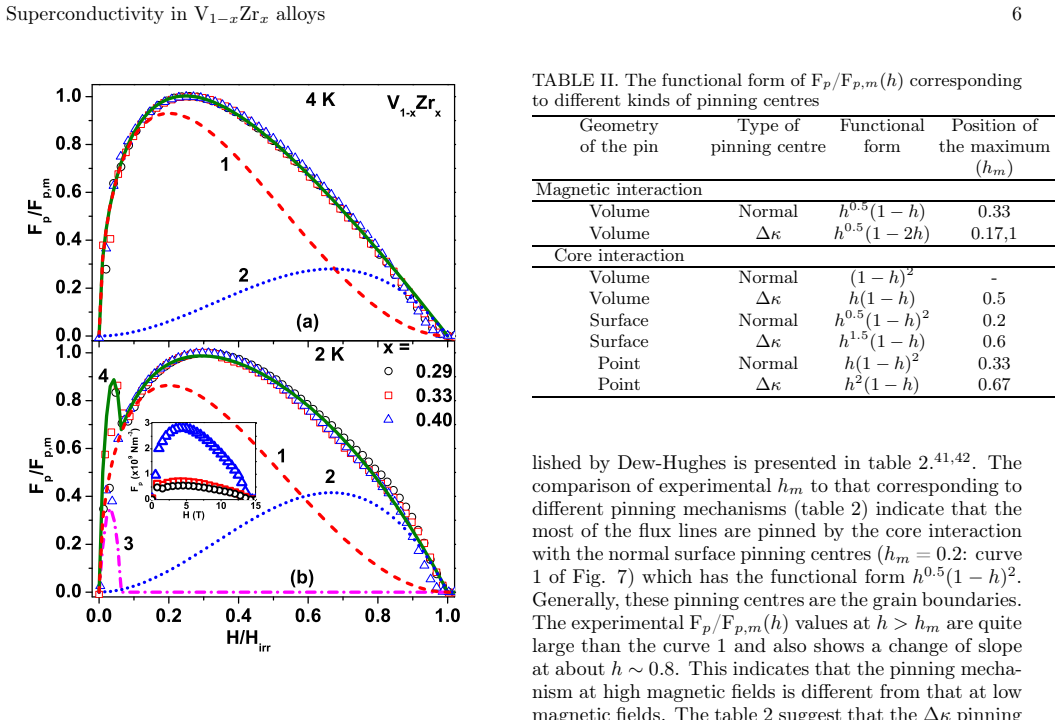
The argument rests on two standard analysis tools applied to magnetization data: the critical state model, which converts the width of the magnetization hysteresis loop into a critical current density via $J_c = 2\Delta M/[a(1-a/3b)]$, and the Dew-Hughes decomposition of the normalized pinning force density $F_p/F_{p,m} = A h^{0.5}(1-h)^2 + B h^2(1-h)$, where $h=H/H_{irr}$. The first term represents pinning by grain boundaries (normal surface pins) and the second by point defects ($\Delta\kappa$ pins); the fitted weights $A$ and $B$ let the authors assign the relative importance of the two microstructural features at each temperature.
What would settle it
Direct magneto-optical imaging of the flux distribution in V0.60Zr0.40 at 2 K would show whether the magnetization hysteresis follows a single critical state profile across the β-V and ZrV2 phases; if distinct flux fronts with different Jc are visible in different phases, the reported bulk Jc and pinning attributions would not be reliable.
Extended reading notes
Core claim
The central discovery is that the as-cast, arc-melted V1−xZrx alloys with x > 0.1 are high-field superconductors whose critical current density (Jc) is comparable to that of modern NbTi wires: for x = 0.29, 0.33 and 0.40, Jc(0) exceeds $10^{3}$ A/$mm^{2}$, and at 4 K the V0.60Zr0.40 alloy retains significant Jc up to fields above 11 T, where NbTi no longer carries current. The work identifies the microstructural origins of this performance by analysing the normalized pinning force density. The dominant low-field pinning is core interaction with normal surface pins, which the authors identify with the grain boundaries produced by the eutectic reaction; a second contribution from point defects (Δκ pinning) becomes relatively more important at high fields and lower temperatures. The paper also establishes that superconductivity percolates through the ZrV2 phase at zirconium concentrations between 5 and 10 atomic percent, far below the eutectic composition, and that the upper critical field at zero temperature is about 17.5 T with significant paramagnetic limiting and spin-orbit coupling.
Load-bearing premise
The load-bearing assumption is that the whole multiphase sample behaves like one uniform superconductor when the magnetization loop is converted into a critical current density; if the different superconducting phases each support their own flux profile, the reported Jc values and pinning attributions would be off.
Editorial extensions
If this is right
- V-rich alloys with x > 0.1 are bulk superconductors with Jc in the 10^2–10^3 A/mm^2 range, and Jc rises with zirconium content up to x = 0.40.
- The V0.60Zr0.40 alloy has the highest Jc at every field and temperature measured, and sustains current up to an irreversibility field of 15 T at 2 K.
- Grain boundaries from the eutectic reaction dominantly pin flux at low magnetic fields, while point defects—compositional variations and fine β-Zr precipitates—dominate at high fields.
- The percolation threshold for superconductivity through the ZrV2 phase is between x = 0.05 and x = 0.10.
- The upper critical field of these alloys is about 17.5 T at zero temperature, and paramagnetic effects and spin-orbit coupling both shape Hc2(T).
Reading between the lines
- The paper does not test cooling-rate or annealing variations; a natural next experiment would vary the quench rate to change the eutectic lamellar spacing and check whether Jc scales with it, as the pinning model implies.
- The same two-term Dew-Hughes decomposition could be applied to other as-cast multiphase superconductors, but only if the composite's flux profile is a single critical state; local magneto-optical imaging would verify this.
- If the point-defect pinning is indeed compositional in origin, then a controlled annealing that homogenizes the Zr distribution should lower the high-field Jc, separating the effect of β-Zr precipitates from that of concentration fluctuations.
- The comparison with NbTi wires uses the technical Jc of commercial wires; for a fair engineering assessment, the as-cast alloy's grain-boundary fraction, porosity, and brittle phase content would need to be factored into an effective conductor cross-section.
Signed reviews
Editorial analysis
A structured set of objections, weighed in public.
Referee Report
Summary. This manuscript reports structural, electrical, and magnetic characterization of arc-melted, as-cast V_{1-x}Zr_x alloys with x = 0–0.40. X-ray diffraction, SEM/EDS, and metallography show that rapid cooling drives successive peritectic and eutectic reactions, producing five phases (β-V, two ZrV2-type phases, α-Zr, and β-Zr precipitates), and resistivity shows that the ZrV2 phases percolate for x > 0.05, giving a zero-resistance transition near 8.5 K. The authors extract the critical current density Jc = 2ΔM/[a(1−a/3b)] from magnetization hysteresis, report Jc values up to about 10^3 A/mm² with the best performance in V0.60Zr0.40, and compare these with transport Jc data of NbTi and Nb3Sn wires. They determine Hc2(T) from M(H) deviations and fit it to the WHH model with parameters α = 2.1 and λ = 1.8, obtaining Hc2(0) ≈ 17.5 T. The normalized pinning force is fitted as a weighted sum of a grain-boundary term h^{0.5}(1−h)^2 and a point-defect term h^2(1−h), and a low-field peak at 2 K is attributed to flux pinning in the β-V phase using Hc2(β-V) ≈ 1.2 T. The conclusions claim large dissipationless current for x > 0.1 and identify eutectic-derived grain boundaries and point defects as the dominant pinning centers.
Significance. The paper's main value is its detailed metallurgical documentation of the non-equilibrium solidification path in V-rich V-Zr alloys and its identification of ZrV2 percolation for zirconium contents above about 10 at.%. It appears to present the first magnetization-based critical current density characterization for this composition range, with the as-cast V0.60Zr0.40 alloy showing Jc of order 10^3 A/mm² at low field and hysteresis persisting to roughly 15 T at 2 K; if confirmed by transport measurements, this would be a notable result for inexpensive, unprocessed alloys containing two superconducting phases. The directly measured zero-resistance and magnetization transitions are mutually consistent, and the authors are commendably explicit about their fit parameters (α = 2.1, λ = 1.8 and the A/B weights), which aids reproducibility.
major comments (4)
- [III, Fig. 6 and Conclusions] The load-bearing quantity of the paper is the critical current density Jc = 2ΔM/[a(1−a/3b)] extracted from magnetization hysteresis, yet the samples are five-phase composites in which only the ZrV2 network (percolating for x>0.05, Sf(ZrV2)=89–99% in Table I) is superconducting at the measurement temperatures and fields used for the high-field comparison (H>1.2 T at 2 K, where β-V is already normal). Applying the homogeneous Bean formula with the full sample cross-section yields an effective magnetization current density, but the manuscript never demonstrates that this quantity equals the current the specimen can actually transport along its length; a transport Jc measurement is required before the comparison to the transport critical currents of NbTi and Nb3Sn wires in Fig. 6 can be taken at face value. In addition, the Conclusions state that the Jc of the x>0.29 alloys is 'in the range of modern Nb-Ti wires', which is inconsistent with the Fig. 6 caption reporting that V0.60Zr0.40 is 'about 5 times smaller than that of modern NbTi wire below 11 T and 4 K'; this contradiction should be resolved and the claims re-based on a consistent definition.
- [III, Fig. 7 and Table II] The pinning-mechanism attribution rests on a two-parameter fit Fp/Fp,m = A h^0.5(1−h)^2 + B h^2(1−h) to the very data from which Fp was constructed. The weights A and B are fit parameters, but no uncertainties or fit-quality measures are given, so the claim that A/B>1 makes grain boundaries 'the predominant pinning centres' is not quantitatively supported. More importantly, the manuscript states that 'the low field peak observed at 2 K could not be explained by the functional forms given in table 2 unless we take different HC2/Hirr (∼ 1.2 T) in estimating h'; assigning the peak to β-V by re-scaling h with Hc2(β-V)=1.2 T changes the meaning of the abscissa between the two components of the same plot. Because the peak's interpretation is chosen after seeing the data, the two-pinning-mechanism decomposition is not a falsifiable test, and the statement that the peak 'indicates that the β-V phase exists all the way up to x=0.40' should be softened accordingly.
- [III, Fig. 5(b)] The temperature dependence of Hc2 is obtained by reading fields at which M(H) deviates from the normal state and then fitting the WHH model with two free parameters, α=2.1 and λ=1.8. The claimed error of less than 2% in Hc2 is stated without an error analysis, and the sensitivity of Hc2(0)≈17.5 T to the choice of α and λ is not shown. Since the same Hc2/Hirr values define the reduced field h used in the pinning-force analysis, the unquantified fit freedom propagates directly into the pinning-mechanism conclusions; at minimum the fit residuals and parameter covariance should be reported.
- [III, Table I] The superconducting volume fraction Sf(ZrV2) is estimated as M(5.7 K)/M(2 K) in a 10 mT ZFC measurement. This ratio is not a volume fraction: the ZFC shielding signal depends on the demagnetizing factor of the composite, on the lower critical fields of the two phases, and on the interconnectivity of the ZrV2 network (β-V regions embedded inside the ZrV2 matrix would be screened before contributing their own shielding signal). The statement that 'Sf(ZrV2) is not 100% for any of the present alloys which indicates that the β-V phase exists all the way up to x=0.40' therefore goes beyond what the magnetization ratio alone can establish; the XRD and metallography evidence is the more direct support and should be used instead.
minor comments (5)
- [III, Fig. 6] The manuscript does not report the sample dimensions a and b used in the Bean formula for each alloy, nor their measurement uncertainty; without these values the absolute scale of Jc(H) in Fig. 6 cannot be independently checked.
- [III, Fig. 6] Figure 6 shows Jc(H) without error bars, although the hysteresis width near the irreversibility field becomes comparable to the measurement noise; representative error bars or a stated noise floor would make the high-field behavior, including the comparison to wire data, easier to evaluate.
- [III, Fig. 7] In the discussion of Fig. 7 the text refers to 'curve 1', 'curve 2', and 'curve 3' while the figure legend identifies the mechanisms only loosely; explicit labels (grain-boundary, point-defect, β-V) on the plot would remove ambiguity.
- [III, Fig. 5(b)] The WHH fit parameters (α = 2.1, λ = 1.8) are given in the text but not in the Fig. 5(b) caption or in a table; placing them with the figure would make the dotted, dashed, and solid lines self-explanatory.
- [III] There is a typo in the pinning discussion: 'fornctional form' should read 'functional form', and the field-sweep protocol used for the M(H) loops (rate, averaging, and field range) should be stated so that the ΔM data can be reproduced.
Circularity Check
No significant circularity: the central quantities are measured or fitted as data description, and the load-bearing comparisons rest on standard external formulas.
full rationale
The paper's derivation chain is self-contained in the relevant sense. The upper critical field Hc2(T) is read from magnetization deviations and then fitted with the WHH model; the parameters alpha=2.1 and lambda=1.8 are fitting parameters for the same data, not independent predictions, and the fitted curve is not used as evidence that the model is correct beyond describing the measured Hc2(T). The critical current density Jc is obtained from the standard Bean critical-state expression Jc = 2*Delta M/[a(1-a/3b)]; this is an application of an external textbook formula to measured hysteresis loops, not a quantity constructed from the conclusion it supports. Applying this homogeneous formula to multiphase alloys is a modeling assumption and a potential correctness risk, but it is not circular. The pinning-force analysis uses the Dew-Hughes functional forms with fitted weights A and B for the two mechanisms; fitting weights to the same normalized pinning-force curve is data description, and the paper does not present the fitted decomposition as an independent prediction. The low-field peak at 2 K is explained by taking the beta-V Hc2 to be about 1.2 T, which is presented as a known property of the beta-V phase rather than a parameter fitted from the pinning-force peak. The self-citations (refs. 29, 31, 42) are methodological references to standard procedures for Hc2 estimation, the Bean formula, and Dew-Hughes-type pinning analysis; they are not load-bearing in the sense of importing an unverified uniqueness claim or defining the target result into existence. The comparisons with NbTi and Nb3Sn wires are external benchmarks applied to the magnetically derived Jc, and any concern about comparability of magnetization-derived versus transport Jc is a correctness/validity concern, not circularity. Accordingly, no specific circular step can be exhibited under the required standard, and the circularity score is 0.
Assumptions & free parameters
free parameters (5)
- WHH paramagnetic parameter alpha =
2.1
- WHH spin-orbit coupling parameter lambda =
1.8
- A (grain boundary pinning weight) =
not reported
- B (point defect pinning weight) =
not reported
- Hc2 of beta-V at 2 K used to explain low-field peak =
1.2 T
assumptions (4)
- domain assumption The equilibrium V-Zr phase diagram (peritectic at 1300 C, eutectic at 1230 C, eutectoid at 777 C) from Ref 1 and 20 is correct.
- domain assumption The critical state model with a single sample dimension a and b applies to a multi-phase composite superconductor.
- domain assumption The Dew-Hughes functional forms for flux pinning (normal surface, point Delta-kappa, volume Delta-kappa) correctly describe pinning in this alloy.
- domain assumption Magnetization at 5.7 K represents only the ZrV2 shielding response, so Sf(ZrV2) = M(5.7K)/M(2K).
Cite this review
Pith. "Pith review of Superconductivity in V$_{1-x}$Zr$_x$ alloys]{Evolution of high field superconductivity and high critical current density in the as-cast V$_{1-x}$Zr$_x$ alloys." pith.science (2026). https://pith.science/paper/V7IS7NZD
@misc{pith2026190807288,
  author       = {Pith},
  title        = {Pith review of: Superconductivity in V$_1-x$Zr$_x$ alloys]Evolution of high field superconductivity and high critical current density in the as-cast V$_1-x$Zr$_x$ alloys},
  year         = {2026},
  howpublished = {\url{https://pith.science/paper/V7IS7NZD}},
  note         = {Machine review of arXiv:1908.07288}
}
abstract
We report here the structural, electrical and magnetic properties of as-cast V$_{1-x}$Zr$_x$ alloys ($x$ =0 - 0.4) at low temperatures. We observe that all the alloys undergo successive peritectic and eutectic reactions during cooling from the melt which leads to the formation of five phases, namely, a body centred cubic $\beta$-V phase, two phases with slightly different compositions having face centred cubic ZrV$_2$ structure, a hexagonal closed packed $\alpha$-Zr phase, and the $\beta$-Zr precipitates. The amount of each phase is found to be dependent on the concentration of zirconium in vanadium. The $\beta$-V and ZrV$_2$ phases show superconductivity below 5.3~K and 8.5~K respectively. We show that the critical current density is large for V-rich V$_{1-x}$Zr$_x$ alloys with $x >$ 0.1. The grain boundaries generated from the eutectic reaction, and the point defects formed due to the variation in the composition are found to be responsible for the pinning of flux lines in low and high magnetic fields respectively. Our studies reveal that the choice of the composition and the heat treatment which leads to eutectic reaction are important in improving the critical current density in this alloy system.
Figures


Figures from the paper (2 more)

Forward citations
Cited by 1 Pith paper
-
Two channel heat conduction in the superconducting state of the as-cast V$_{1-x}$Zr$_x$ alloys
In as-cast V1-xZrx alloys, superconducting-state thermal conductivity exceeds BCS predictions, but the 'two-parallel-channel' explanation uses a series model that contradicts the claimed normal channel.
Reference graph
Works this paper leans on
-
[1]
J. T. Williams, Retrospective Theses and Dissertations. Paper 13305 ( The vanadium-zirconium alloy system , Iowa state collage) pp.1-73 (1954)
work page 1954
-
[2]
X. -S. Zhao, G. -H. Yuan, M. -Y. Yao, Q. Yue, and J. -Y. Shen, Calphad 36 163 (2012) and the references therein
work page 2012
-
[3]
J. Cui, C. Guo, L. Zou, C. Li, and Z. Du, Calphad 53 122 (2016) and the references therein
work page 2016
- [4]
- [5]
- [6]
-
[7]
B. S. Brown, J. W. Hafstrom and T. E. Klippert, J. Appl. Phys. 48 1759 (1977)
work page 1977
-
[8]
I. A. Naskidashvili, L. S. Topchyan, A. I. Naskidashvi-Li and E. S. Makarenkov, Rad. Effects Lett. 85 97 (1984)
work page 1984
Show all 42 references
-
[9]
Inoue, H
K. Inoue, H. Wada, T. Kuroda, and K. Tachikawa, Appl. Phys. Lett. 38 939 (1981)
1981
-
[10]
Hishinuma, A
Y. Hishinuma, A. Kikuchi, Y. Iijima, Y. Yoshida, T. Takeuchi, A. Nishimura and K. Inoue, Supercond. Sci. Technol. 17 1031 (2004)
2004
-
[11]
Segal, C
C. Segal, C. Tarantini, Z. H. Sung, P. J. Lee, B. Sailer, M. Thoener, K. Schlenga, A. Ballarino, L. Bottura, B. Bordini, C. Scheuerlein, and D. C. Larbalestier, Supercond. Sci. Technol. 29 085003 (2016)
2016
-
[12]
Inoue, T
K. Inoue, T. Kuroda, and K. Tachikawa, IEEE Trans. Mag. 15 635 (1979)
1979
-
[13]
T. P. Beales, Jo Jutson, L. L. Lay, and M. M \"o lgg, J. Mater. Chem. 7 653 (1997)
1997
-
[14]
Imaduddin, Hendrik, S
A. Imaduddin, Hendrik, S. D. Yudanto, H. Nugraha, P. Sebleku, and A. W. Pramono, J. Phys.: Conf. Ser. 1091 012004 (2018)
2018
-
[15]
u z, A. Bi c er and M. G \
Y. Aky \"u z, A. Bi c er and M. G \"u r \"u , Mater. Des. 28 2500 (2007)
2007
-
[16]
Y. Ma, Z. Gao, Y. Qi, X. Zhang, L. Wang, Z. Zhang, and D. Wang, Physica C 469 651 (2009)
2009
-
[17]
Huang, C
H. Huang, C. Yao, C. Dong, X. Zhang, D. Wang, Z. Cheng, J. Li, S. Awaji, H. Wen and Y. Ma, Supercond. Sci. Technol. 31 015017 (2018)
2018
-
[18]
Motowidlo, United States Patent US 9385295 B2 1 (2016)
L. Motowidlo, United States Patent US 9385295 B2 1 (2016)
2016
-
[19]
J. L. H. Lindenhovius, E. M. Hornsveld, A. den Ouden, W. A. J. Wessel, and H. H. J. ten Kate, IEEE Trans. Appl. Supercond. 10 975 (2000)
2000
-
[20]
Servant, J
C. Servant, J. Phase Equilib. Diff. 26 39 (2005)
2005
-
[21]
T. R. Finlayson and H. R. Khan, Appl. Phys. 17 165 (1978)
1978
-
[22]
See eg. S. V. Vonsovsky, Yu. A. Izyumov, and E. Z. Kurmaev in Superconductivity of transition metals, their alloys and compounds (Translated by E. H. Brandt and A. P. Zavarnitsyn) (Springer-Verlag, Berlin) (1982)
1982
-
[23]
Akahama, M
Y. Akahama, M. Kobayashi, and H. Kawamura, J. Phys. Soc. Jpn. 59 3843 (1990)
1990
-
[24]
Yasohama, and N
K. Yasohama, and N. Usui, Jpn. J. Appl. Phys. 7 1128 (1968)
1968
-
[25]
Kraus, and G
W. Kraus, and G. Nolze, J. Appl. Cryst. 29 301 (1996)
1996
-
[26]
A. R. Bailey in Introductory Practical Metallography (Metallurgical Services Laboratories Ltd., Surrey, England) (1974)
1974
-
[27]
S. B. Roy, Z. Hossain, A. K. Pradhan, C. Mazumdar, P. Chaddah, R. Nagarajan, C. Godart and L. C. Gupta, Physica C 228 319 (1994) and the references therein
1994
-
[28]
S. B. Roy, Z. Hossain, A. K. Pradhan, P. Chaddah, R. Nagarajan, and L. C. Gupta, Physica C 256 90 (1996) and the references therein
1996
-
[29]
L. S. Sharath Chandra, M. K. Chattopadhyay and S. B. Roy, Phil. Mag. 92 3866 (2012)
2012
-
[30]
N. R. Werthamer, E. Helfand and P. C. Hohenberg, Phys. Rev. 147 295 (1966)
1966
-
[31]
Shyam Sundar, M. K. Chattopadhyay, L. S. Sharath Chandra, and S. B. Roy, Physica C 519 13 (2015)
2015
-
[32]
Enderlein, A
G. Enderlein, A. Handstein, F. Lange, and P. Verges, Cryogenics 13 426 (1973)
1973
-
[33]
O. V. Chernyj, G. F. Tikhinskij, G. E. Storozhilov, M. B. Lazareva, L. A. Kornienko, N. F. Andrlevskaya, V. V. Slezov, V. V. Sagalovich, D. Ya Starodubov, and S. I. Savchenko, Supercond. Sci. Technol. 4 318 (1991)
1991
-
[34]
Boutboul, S
T. Boutboul, S. Le Naour, D. Leroy, L. Oberli, and V. Previtali, IEEE Trans. Appl. Supercond. 16 1184 (2006)
2006
-
[35]
Miyashita, H
K. Miyashita, H. Sato, M. Arika, and R. Takahashi, Ele. Eng. Jpn 156 24 (2006)
2006
-
[36]
H. Lin, C. Yao, H. Zhang, X. Zhang, Q. Zhang, C. Dong, D. Wang, and Y. Ma, Sci. Rep. 5 11506 (2015)
2015
-
[37]
Fl \"u kiger, D
R. Fl \"u kiger, D. Uglietti, C. Senatore, and F. Buta, Cryogenics 48 293 (2008)
2008
-
[38]
Hishinuma, A
Y. Hishinuma, A. Kikuchi, Y. Iijima, Y. Yoshida, T. Takeuchi, K. Inoue, and A. Nishimura, IEEE Trans. Appl. Supercond. 16 1196 (2006)
2006
-
[39]
Inoue, and K
K. Inoue, and K. Tachikawa, Appl. Phys. Lett. 29 386 (1976)
1976
-
[40]
Inoue, K
K. Inoue, K. Tachikawa, and Y. Iwasa, Appl. Phys. Lett. 18 235 (1971)
1971
-
[41]
Dew-Hughes, Phil
D. Dew-Hughes, Phil. Mag. 30 293 (1974)
1974
-
[42]
Matin, L
Md. Matin, L. S. Sharath Chandra, M. K. Chattopadhyay, R. K. Meena, Rakesh Kaul, M. N. Singh, A. K. Sinha, and S. B. Roy, J. Appl. Phys. 113 163903 (2013)
2013
Reviewed August 14, 2026 · model on record in the stance chip above.
Discussion (0). Continue with ORCID to comment.