REVIEW 2 major objections 5 minor 31 references
Comparing all-optical switching in synthetic-ferrimagnetic multilayers and alloys
T0 review · 2 major / 5 minor · reviewed 2026-08-14 · deepseek-v4-flash
Pith's one-line read Single femtosecond laser pulses switch synthetic ferrimagnets without a compensation temperature, by driving a reversal front through the ferromagnetic layer.
desk verdict A credible experiment plus a plausible but parameter-dependent mechanism; the front-propagation story is new and worth refereeing, but the model's switching rests on an unmeasured ratio of exchange-scattering rates. read the letter →
The pith
A machine-rendered reading of the paper's core claim, the machinery that carries it, and where it could break.
The reading
What carries the argument
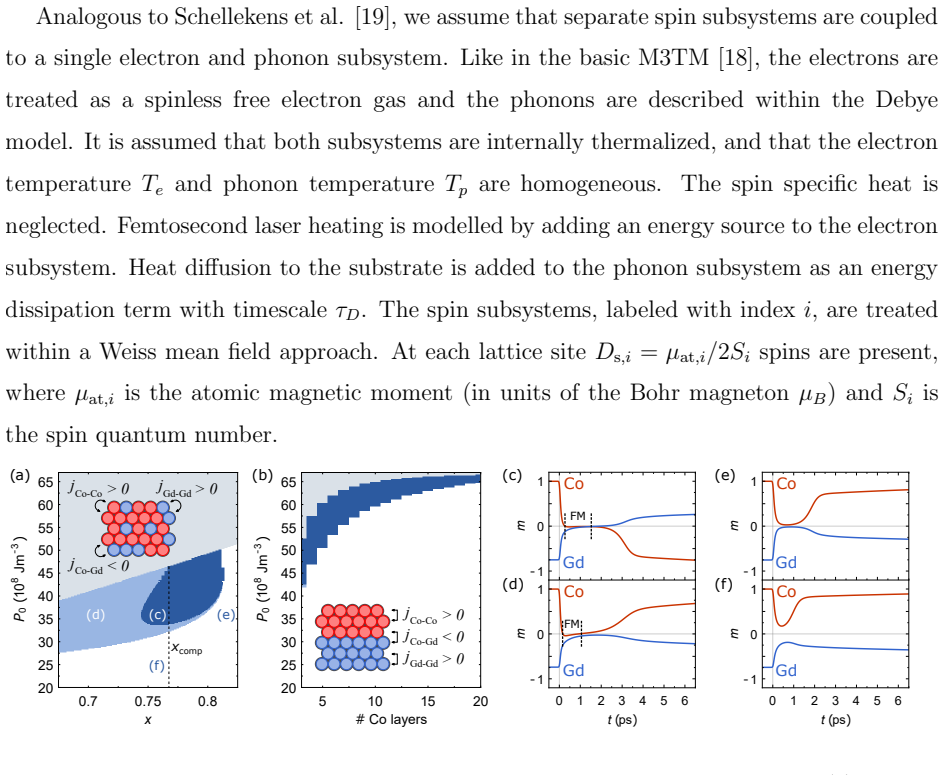
The load-bearing object is an extension of the microscopic three-temperature model (M3TM) to multiple magnetic sublattices with exchange scattering. In the alloy, the spin subsystems are the Co and Gd sublattices; in the bilayer, each atomic monolayer is its own spin subsystem coupled only to adjacent monolayers, with the antiferromagnetic Co-Gd coupling acting only at the interface. Two angular-momentum channels drive the dynamics: Elliott-Yafet spin-flip scattering transfers angular momentum to the lattice, and electron-electron exchange scattering flips spins in opposite subsystems, described by a Fermi-golden-rule rate proportional to $T_e^3$ and a dimensionless coupling $\lambda=5$ chosen to reproduce the alloy phase diagram. This machinery produces phase diagrams for both systems and reveals that the bilayer switching region extends to arbitrarily many Co monolayers while the alloy switching region hugs the compensation concentration.
What would settle it
Prepare a Pt/Co/Gd bilayer in which the Co layer is split by a nonmagnetic spacer one or two monolayers thick, placed after the first Co layer; if the paper's front-propagation mechanism is right, a single pulse should still reverse the first Co layer but should fail to reverse the Co on the far side. Observing full switching across the spacer would contradict the proposed mechanism.
Extended reading notes
Core claim
The central discovery is that all-optical switching in Co/Gd bilayers does not require a magnetization compensation point, in sharp contrast to GdCo alloys, and the model explains why. In the alloy, switching is confined to a narrow window of Co concentration around compensation, because the transient ferromagnetic state relies on nearly equal and opposite sublattice moments. In the bilayer, the Gd layer acts as a local seed: exchange scattering between the interface Co and Gd monolayers flips the first Co layers, and an exchange-scattering-driven front of reversed Co magnetization then propagates through the remaining Co monolayers. Since the front carries the reversal, the total moment balance is irrelevant, and the model finds switching even with 20 Co monolayers, where the Co-to-Gd moment ratio is about four. The experiments on Pt/Co/[Ni/Co]_N/Gd confirm the practical side: single-pulse switching is observed for ferromagnetic-layer thicknesses up to 4.2 nm, far from compensation.
Load-bearing premise
The argument stands on the assumption that all exchange-scattering channels share the same dimensionless strength $\lambda=5$, a value fitted to reproduce alloy experiments; at $\lambda=1$ the model predicts no switching at all.
Editorial extensions
If this is right
- Single-pulse all-optical switching in Pt/Co/[Ni/Co]_N/Gd stacks works without a magnetization compensation temperature, so sample design no longer needs to tune the compensation point.
- The threshold fluence for switching grows with ferromagnetic-layer thickness, so thinner multilayers switch at lower pulse energies while thick layers remain switchable.
- Alloy-based single-pulse switching remains tied to a compensation composition, whereas synthetic ferrimagnets can be switched far from moment balance.
- The mechanism predicts that the Co monolayers reverse consecutively, starting near the Co/Gd interface and propagating outward, so the switch is local in time and space.
- These results identify Pt/FM/Gd synthetic ferrimagnets as a candidate for integrating single-pulse all-optical switching into spintronic memory devices.
Reading between the lines
- A testable consequence the paper leaves implicit: inserting a thin nonmagnetic spacer between Co monolayers should block the exchange-scattering front and prevent switching of the far monolayers, which would directly distinguish front propagation from a global toggle.
- The model's robustness for arbitrary Co thickness may be limited by the homogeneous-heating assumption; for much thicker ferromagnets, a finite optical penetration depth should produce a thickness-dependent ceiling, and measuring that ceiling would constrain the model.
- The same front-propagation idea might apply to other ferromagnet/heavy-rare-earth bilayers, not just Co/Gd, provided the interface exchange scattering is strong enough to nucleate the reversed layer.
- Because the paper calibrates the dimensionless exchange-scattering strength $\lambda=5$ phenomenologically, a microscopic calculation of the exchange-scattering matrix element would turn the mechanism's existence proof into a quantitative prediction.
Signed reviews
Editorial analysis
A structured set of objections, weighed in public.
Referee Report
Summary. The paper reports an experimental and theoretical study of single-pulse all-optical switching (AOS) in synthetic ferrimagnets. Experimentally, Pt/Co/[Ni/Co]_N/Gd stacks with N = 2 to 5 are switched by single linearly polarized femtosecond pulses at room temperature, even for FM layer thicknesses up to 4.2 nm, which the authors argue is far from magnetization compensation. Theoretically, the authors extend the microscopic three-temperature model (M3TM) to include multiple spin sublattices and exchange scattering, and apply it on equal footing to GdCo alloys and Co/Gd bilayers. The model reproduces the known compensation-temperature requirement for AOS in alloys, while predicting that Co/Gd bilayers can be switched for Co thicknesses up to 20 monolayers. The authors identify a front of reversed Co magnetization that nucleates at the Co/Gd interface and propagates through the Co layer, driven by exchange scattering between Co monolayers, as the mechanism responsible for the robustness of bilayer switching. The paper concludes that synthetic ferrimagnets switch via a mechanism fundamentally different from that in alloys, and that this makes them promising for device integration.
Significance. If the proposed mechanism is correct, this paper provides a coherent explanation of why synthetic ferrimagnets, unlike RE-TM alloys, can be switched by a single femtosecond pulse without a compensation temperature, and it identifies the propagation of a magnetization-reversal front as the key physical process. The bilayer front-propagation mechanism is an emergent model prediction that was not used to calibrate the main free parameter, which is a strength. The equal-footing treatment of alloys and bilayers within one framework is also valuable. However, the mechanistic conclusion rests on an unverified assumption about the relative strengths of exchange-scattering channels, and the experimental data are presented without quantitative uncertainty estimates. The work is a useful step forward, but the central mechanism requires additional sensitivity analysis or microscopic justification before the claims are fully supported.
major comments (2)
- [Eq. (4) and Supplemental Materials III and V] The assumption that all exchange-scattering channels share the same dimensionless strength, λ_Co-Co = λ_Co-Gd = λ_Gd-Gd = 5, is load-bearing for the central mechanistic claim but is not derived or independently constrained. The front-propagation mechanism relies on the hierarchy η_Co-Co ≫ η_Co-Gd, and this hierarchy follows from j_Co-Co ≫ j_Co-Gd only after imposing equal λ values. Supplemental V (Fig. S.2) shows that changing λ_Co-Co alone from 5 to 1 halves the front velocity and moves the nucleation site to the interface layer, demonstrating that the dynamics are sensitive to exactly this ratio. The robustness tests in Supplemental VI vary only the global λ, leaving the λ ratio untouched. The authors should either provide a microscopic argument for equal λ across channels or systematically scan λ_Co-Co/λ_Co-Gd and λ_Gd-Gd/λ_Co-Gd over a physically plausible range and show that the front mechanism persists. Without such a demonstration, the conclusion that synthetic ferrimagnets switch robustly for thick FM layers via exchange-scattering-driven fronts is conditional on an unverified parameter ratio.
- [Supplemental III and Fig. 2(a)] The value λ = 5 is selected so that the alloy phase diagram reproduces prior experiments, specifically the switching concentration range of about 6% width and the threshold minimum near the compensation point. Consequently, the alloy phase diagram in Fig. 2(a) is not an independent prediction of the model; it is a fit. The paper's wording that the model 'shows' and 'yields' the compensation requirement for alloys risks being misleading. The bilayer result, Fig. 2(b), remains informative because it was not used in the calibration, but the text should explicitly state that the alloy behavior is a consequence of parameter choice rather than a model-derived prediction.
minor comments (5)
- [Fig. 1(a) and experimental methods] The threshold fluence data in Fig. 1(a) are presented without error bars or a description of the number of repeated measurements; the statement that 'error margins are small compared to the scale of the figure' is not a substitute for quantitative uncertainties. Please provide error estimates obtained, for example, from repeated pulse-energy scans.
- [Eq. (4), main text] The definition and calibration of λij appear only briefly after Eq. (4), with the important details relegated to Supplemental III. Since the quantitative value λ = 5 is central to the model, a more complete explanation in the main text, or at least an explicit reference to the fitting procedure, would improve transparency.
- [Fig. 3 and Supplemental V] The inset of Fig. 3 shows that the Co monolayer adjacent to the interface does not switch first, which is non-intuitive and is only explained in Supplemental V. A short sentence in the main text clarifying that the interface layer is stabilized by the Gd exchange field would help the reader.
- [Reference [23]] Reference [23] contains what appears to be a LaTeX artifact '/suppress' at the beginning; this should be removed.
- [Fig. 2 caption] The color-code definitions (dark blue, light blue, white, grey) are described in the main text but not fully in the caption; please add the definitions to the caption for standalone readability.
Circularity Check
No significant circularity: the only calibrated constant is λ=5, fitted to external alloy data, and the bilayer/front conclusions are emergent and robust to λ.
full rationale
The paper's central comparative claim rests on two legs. The experimental leg (Pt/Co/[Ni/Co]_N/Gd switches without compensation; Fig. 1) is direct measurement. The theoretical leg models both GdCo alloys and Co/Gd bilayers with the same M3TM + exchange-scattering framework. The single free parameter λ is set to 5 in the main text ('we assume that λij = λ = 5, which is chosen in order to retrieve realistic results from the simulations'), and in Supplemental III it is calibrated against prior alloy experiments by Xu et al., an external source: 'we take λ = 5 to retrieve realistic results, e.g., according to the experiments the concentration range where switching is found should be ∼6% wide and the minimum threshold should be close to the compensation point [5].' The alloy phase diagram is presented as validation ('reproduces', 'in agreement with experiments'), not as an independent prediction. The bilayer switching phase diagram and the propagation-front mechanism are not used to set λ, so they are genuine model outputs. Supplemental VI further shows the qualitative front conclusion survives varying λ from 4 to 6: 'the qualitative statements in the main text about the propagation mechanism in the Co/Gd bilayers, are independent of the exact choice of λ.' The claim that the front is 'driven by exchange scattering' is conditional on the model, where exchange scattering is by construction the only interlayer angular-momentum channel; however, the existence, direction, ordering, and thickness-independence of the front are emergent rather than imposed. The self-citations (M3TM [18], multisublattice exchange-scattering model [19], prior synthetic-ferrimagnet AOS [9]) provide the transparently acknowledged model and experimental foundation; no uniqueness theorem or hidden ansatz is imported to forbid alternatives. The equality λCo-Co = λCo-Gd = λGd-Gd is an unverified microscopic modeling assumption, but an unverified assumption is a correctness/modeling risk, not circularity. Thus no circular step can be exhibited.
Assumptions & free parameters
free parameters (3)
- lambda_ij (uniform exchange scattering multiplier) =
5
- S_Gd (effective Gd spin quantum number) =
7/2
- tau_D (heat diffusion time to substrate) =
20 ps
assumptions (8)
- domain assumption Spin subsystems are described by a Weiss mean-field model with 2S+1 discrete levels.
- domain assumption Electrons and phonons are internally thermalized with homogeneous temperatures T_e and T_p; spin specific heat is neglected; electrons are a spinless free electron gas.
- domain assumption Angular momentum between spin subsystems is transferred only by exchange scattering, with rate proportional to lambda_ij j_ij^2; the relation between the exchange scattering constant and the exchange coupling is not derivable.
- domain assumption Bilayer geometry is an fcc (111) stack with 6 in-plane and 3 out-of-plane nearest neighbors; only adjacent monolayers interact.
- domain assumption Laser heating is homogeneous through the stack.
- ad hoc to paper The experimental FM layer, a Co/Ni multilayer, is modeled as pure Co.
- domain assumption Material parameters (R, T_C, mu_at, j_Co-Gd ratio from Fe/Gd) are taken from prior literature and assumed valid for these synthetic structures.
- standard math Fermi's golden rule and the continuum limit for the electron gas are used to derive the exchange scattering rates.
Cite this review
Pith. "Pith review of Comparing all-optical switching in synthetic-ferrimagnetic multilayers and alloys." pith.science (2026). https://pith.science/paper/EC2PGYZR
@misc{pith2026190807292,
  author       = {Pith},
  title        = {Pith review of: Comparing all-optical switching in synthetic-ferrimagnetic multilayers and alloys},
  year         = {2026},
  howpublished = {\url{https://pith.science/paper/EC2PGYZR}},
  note         = {Machine review of arXiv:1908.07292}
}
abstract
We present an experimental and theoretical investigation of all-optical switching by single femtosecond laser pulses. Our experimental results demonstrate that, unlike rare earth-transition metal ferrimagnetic alloys, Pt/Co/[Ni/Co]$_N$/Gd can be switched in the absence of a magnetization compensation temperature, indicative for strikingly different switching conditions. In order to understand the underlying mechanism, we model the laser-induced magnetization dynamics in Co/Gd bilayers and GdCo alloys on an equal footing, using an extension of the microscopic three-temperature model to multiple magnetic sublattices and including exchange scattering. In agreement with our experimental observations, the model shows that Co/Gd bilayers can be switched for an arbitrary thickness of the Co layer, i.e, even far away from compensating the total Co and Gd magnetic moment. We identify the switching mechanism in Co/Gd bilayers as a front of reversed Co magnetization that nucleates at the Co/Gd interface and propagates through the Co layer driven by exchange scattering.
Figures


Reference graph
Works this paper leans on
-
[1]
C.D. Stanciu, F. Hansteen, A.V. Kimel, A. Kirilyuk, A. Tsukamoto, A. Itoh, and Th. Rasing, All-optical magnetic recording with circularly polarized light, Phys. Rev. Lett. 99, 047601 (2007)
work page 2007
-
[2]
I. Radu, K. Vahaplar, C. Stamm, T. Kachel, N. Pontius, H.A. D¨ urr, T.A. Ostler, J. Barker, R.F.L. Evans, R.W. Chantrell, A. Tsukamoto, A. Itoh, A. Kirilyuk, Th. Rasing, and A.V. Kimel, Transient ferromagnetic-like state mediating ultrafast reversal of antiferromagnetically coupled spins, Nature 472, 205 (2011)
work page 2011
-
[3]
T.A. Ostler, J. Barker, R.F.L. Evans, R.W. Chantrell, U. Atxitia, O. Chubykalo-Fesenko, S. El Moussaoui, L. Le Guyader, E. Mengotti, L.J. Heyderman, F. Nolting, A. Tsukamoto, A. Itoh, D. Afanasiev, B.A. Ivanov, A.M. Kalashnikova, K. Vahaplar, J. Mentink, A. Kirilyuk, Th. Rasing, and A.V. Kimel, Ultrafast heating as a sufficient stimulus for magnetization re...
work page 2012
-
[4]
M.S. El Hadri, P. Pirro, C.-H. Lambert, S. Petit-Watelot, Y. Quessab, M. Hehn, F. Montaigne, G. Malinowski, and S. Mangin, Two types of all-optical magnetization switching mechanisms using femtosecond laser pulses, Phys. Rev. B 94, 064412 (2016)
work page 2016
- [5]
-
[6]
R. Medapalli, D. Afanasiev, D.K. Kim, Y. Quessab, S. Manna, S.A. Montoya, A. Kirilyuk, Th. Rasing, A.V. Kimel, and E.E. Fullerton, Multiscale dynamics of helicity-dependent all-optical magnetization reversal in ferromagnetic Co/Pt multilayers, Phys. Rev. B 96, 224421 (2017)
work page 2017
-
[7]
L. Le Guyader, S. El Moussaoui, M. Buzzi, M. Savoini, A. Tsukamoto, A. Itoh, A. Kirilyuk, Th. Rasing, F. Nolting, and A.V. Kimel, Deterministic character of all-optical magnetization switching in GdFe-based ferrimagnetic alloys, Phys. Rev. B 93, 134402 (2016)
work page 2016
-
[8]
J. Gorchon, C.-H. Lambert, Y. Yang, A. Pattabi, R.B. Wilson, S. Salahuddin, and J. Bokor, Single shot ultrafast all optical magnetization switching of ferromagnetic Co/Pt multilayers, Appl. Phys. Lett. 111, 042401 (2017)
work page 2017
Show all 31 references
-
[9]
Lalieu, M.J.G
M.L.M. Lalieu, M.J.G. Peeters, S.R.R. Haenen, R. Lavrijsen, and B. Koopmans, Deterministic all-optical switching of synthetic ferrimagnets using single femtosecond laser pulses, Phys. Rev. B 96, 220411(R) (2017)
2017
-
[10]
Lalieu, R
M.L.M. Lalieu, R. Lavrijsen, and B. Koopmans, Integrating all-optical switching with spin- tronics, Nat. Commun. 10, 110 (2019)
2019
-
[12]
Mentink, J
J.H. Mentink, J. Hellsvik, D.V. Afanasiev, B.A. Ivanov, A. Kirilyuk, A.V. Kimel, O. Eriksson, M.I. Katsnelson, and Th. Rasing, Ultrafast spin dynamics in multisublattice magnets, Phys. Rev. Lett. 108, 057202 (2012)
2012
-
[13]
Ostler, R.F.L
T.A. Ostler, R.F.L. Evans, R.W. Chantrell, U. Atxitia, O. Chubykalo-Fesenko, I. Radu, R. Abrudan, F. Radu, A. Tsukamoto, A. Itoh, A. Kirilyuk, Th. Rasing, and A.V. Kimel, Crystallographically amorphous ferrimagnetic alloys: Comparing a localized atomistic spin model with exper...
2011
-
[14]
Atxitia, P
U. Atxitia, P. Nieves, and O. Chubykalo-Fesenko, Landau-Lifshitz-Bloch equation for ferri- 11 magnetic materials, Phys. Rev. B 86, 104414 (2012)
2012
-
[15]
Barker, U
J. Barker, U. Atxitia, T.A. Ostler, O. Hovorka, O. Chubykalo-Fesenko, and R.W. Chantrell, Two-magnon bound state causes ultrafast thermally induced magnetisation switching, Scien- tific reports 3, 3262 (2013)
2013
-
[17]
Atxitia and T.A
U. Atxitia and T.A. Ostler, Ultrafast double magnetization switching in GdFeCo with two picosecond-delayed femtosecond pump pulses, Appl. Phys. Lett. 113, 062402 (2018)
2018
-
[18]
Koopmans, G
B. Koopmans, G. Malinowski, F. Dalla Longa, D. Steiauf, M. F¨ ahnle, T. Roth, M. Cinchetti, and M. Aeschlimann, Explaining the paradoxical diversity of ultrafast laser-induced demag- netization, Nat. Mat. 9, 259 (2010)
2010
-
[19]
Schellekens and B
A.J. Schellekens and B. Koopmans, Microscopic model for ultrafast magnetization dynamics of multisublattice magnets, Phys. Rev. B 87, 020407(R) (2013)
2013
-
[20]
Gorchon, R.B
J. Gorchon, R.B. Wilson, Y. Yang, A. Pattabi, J.Y. Chen, L. He, J.P. Wang, M. Li, and J. Bokor, Role of electron and phonon temperatures in the helicity-independent all-optical switching of GdFeCo, Phys. Rev. B 94, 184406 (2016)
2016
-
[22]
Koopmans, J.J.M
B. Koopmans, J.J.M. Ruigrok, F. Dalla Longa, and W.J.M. de Jonge, Unifying ultrafast magnetization dynamics, Phys. Rev. Lett. 95, 267207 (2005)
2005
-
[23]
Cywi´ nski and L.J
/suppress L. Cywi´ nski and L.J. Sham, Ultrafast demagnetization in the sp-d model: A theoretical study, Phys. Rev. B 76, 045205 (2007)
2007
-
[24]
See Supplemental Material at https://journals.aps.org/prb for (I) M3TM for systems with an arbitrary spin, (II) Details about exchange scattering, (III) The exchange scattering rate constant, (IV) Used system parameters, (V) Notes on the inset of figure 3, (VI) Phase diagrams f...
-
[25]
Cullity and C.D
B.D. Cullity and C.D. Graham, Introduction to Magnetic Materials (Wiley, 1972)
1972
-
[26]
Comparing all-optical switching in synthetic-ferrimagnetic multilayers and alloys
J.M.D. Coey, Magnetism and Magnetic Materials (Cambridge University Press, 2009). 12 Supplemental Material for: “Comparing all-optical switching in synthetic-ferrimagnetic multilayers and alloys” M. Beens, 1,∗ M.L.M. Lalieu, 1 A.J.M. Deenen, 1 R.A. Duine, 1, 2 and B. Koopmans ...
2009 arXiv
-
[27]
Koopmans, G
B. Koopmans, G. Malinowski, F. Dalla Longa, D. Steiauf, M. F¨ ahnle, T. Roth, M. Cinchetti, and M. Aeschlimann, Explaining the paradoxical diversity of ultrafast laser-induced demagnetization, Nat. Mat. 9, 259 (2010)
2010
-
[28]
Cywi´ nski and L.J
/suppress L. Cywi´ nski and L.J. Sham, Ultrafast demagnetization in the sp-d model: A theoretical study, Phys. Rev. B76, 045205 (2007)
2007
-
[29]
Coey, Magnetism and Magnetic Materials (Cambridge University Press, 2009)
J.M.D. Coey, Magnetism and Magnetic Materials (Cambridge University Press, 2009)
2009
-
[30]
Schellekens and B
A.J. Schellekens and B. Koopmans, Microscopic model for ultrafast magnetization dynamics of multisublattice magnets, Phys. Rev. B 87, 020407 (2013)
2013
-
[31]
Y. Xu, M. Deb, G. Malinowski, M. Hehn, W. Zhao, and S. Mangin, Ultrafast magnetization manipulation using single femtosecond light and hot-electron pulses, Advanced Materials 29, 1703474 (2017)
2017
-
[32]
Gerlach, L
S. Gerlach, L. Oroszlany, D. Hinzke, S. Sievering, S. Wienholdt, L. Szunyogh, and U. Nowak, Modeling ultrafast all-optical switching in synthetic ferrimagnets, Phys. Rev. B 95, 224435 (2017)
2017
-
[33]
Lalieu, M.J.G
M.L.M. Lalieu, M.J.G. Peeters, S.R.R. Haenen, R. Lavrijsen, and B. Koopmans, Deterministic all-optical switching of synthetic ferrimagnets using single femtosecond laser pulses, Phys. Rev. B 96, 220411 (2017)
2017
-
[34]
Liu, Simple technique for measurements of pulsed Gaussian-beam spot sizes, Opt
J.M. Liu, Simple technique for measurements of pulsed Gaussian-beam spot sizes, Opt. Lett. 7, 196 (1982)
1982
Reviewed August 14, 2026 · model on record in the stance chip above.
Discussion (0). Continue with ORCID to comment.