REVIEW 3 major objections 4 minor 62 references
Non-Gaussian anomalous dynamics in systems of interacting run-and-tumble particles
T0 review · 3 major / 4 minor · reviewed 2026-08-14 · deepseek-v4-flash
Pith's one-line read A tagged particle in a lattice gas of run-and-tumble particles diffuses with persistent non-Gaussian, Laplace-like tails.
desk verdict The exact Rouse polymer result is a solid, citable derivation, but the lattice-model claim of persistent non-Gaussianity is stronger than the simulation evidence supports. read the letter →
The pith
A machine-rendered reading of the paper's core claim, the machinery that carries it, and where it could break.
The reading
What carries the argument
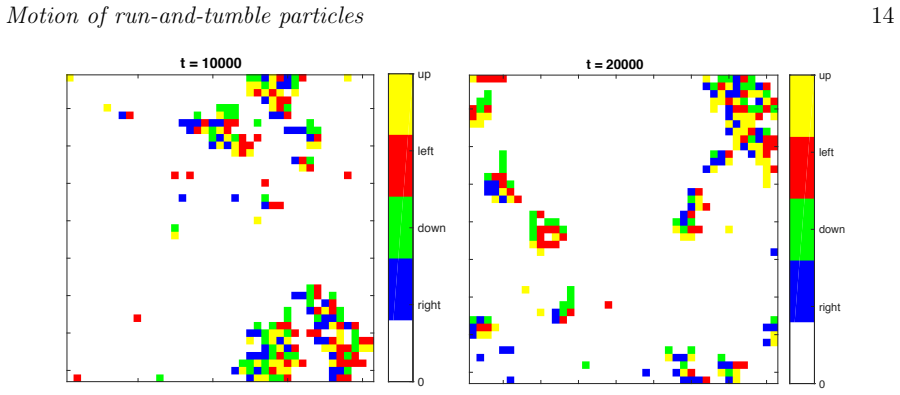
The load-bearing object is the displacement distribution $P(X)$ of a tagged particle, measured through its variance, kurtosis, and tail shape. In the polymer model the calculation is carried by Rouse normal modes, which diagonalize the harmonic monomer couplings and yield an exact mean-squared displacement with four time regimes; this shows when non-Gaussianity is transient. In the lattice model, the mechanism is the persistent exclusion process, a run-and-tumble lattice gas with exclusion, in which cluster formation and dissolution make the tagged particle's environment fluctuate; the paper connects this directly to the diffusing-diffusivity mechanism, arguing that a stochastically varying effective diffusivity produces Laplace-distributed displacements.
What would settle it
Extend the lattice-model simulations ($\rho=0.25$, $T=0$) to times much longer than $125\tau$, on larger lattices, and measure the kurtosis of the tagged-particle displacement. If the kurtosis approaches 3 and the displacement distribution becomes parabolic in $\ln P(X)$, the persistent non-Gaussianity is a finite-time transient.
Extended reading notes
Core claim
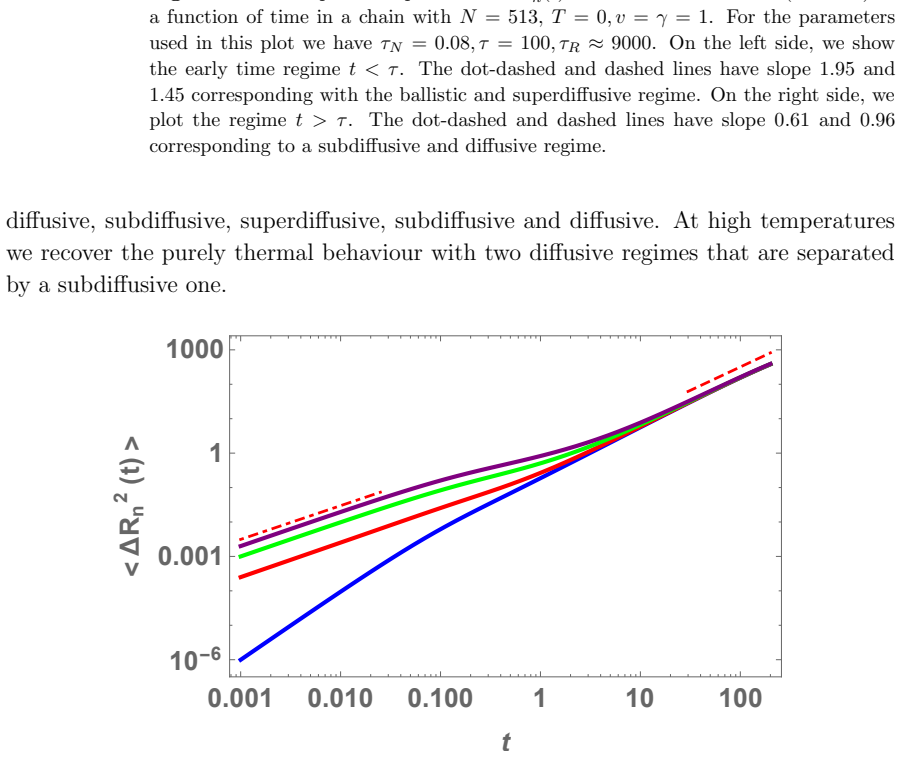
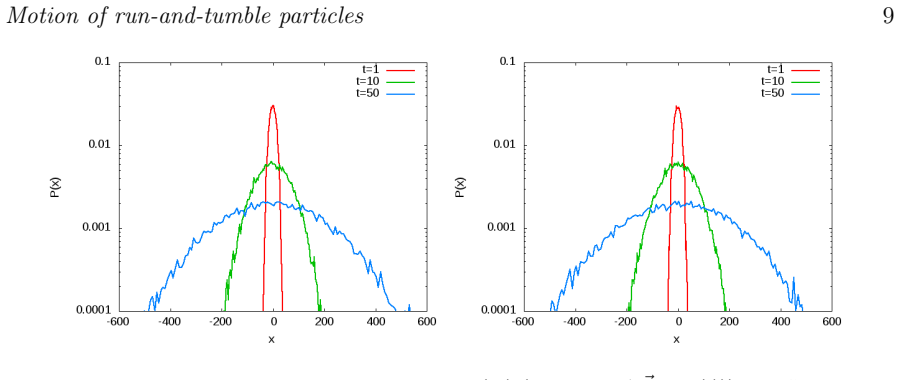
The central discovery is that a minimal microscopic active system, the persistent exclusion process, can produce diffusion that is normal in the variance but non-Gaussian in shape for all simulated times, not just for short transients. Concretely, for a tagged particle at intermediate density $\rho=0.25$ and zero temperature, the displacement variance grows linearly at late times while the kurtosis remains far above the Gaussian value 3, reaching about 6.8 at $t\approx 125\tau$, and for not-too-small displacements $\ln P(X)$ grows roughly linearly in $|X|$, the signature of a Laplace distribution. The paper also shows, in the exactly solvable polymer model, that active monomers give ballistic, superdiffusive, subdiffusive, and diffusive regimes with non-Gaussian statistics only for $t<\tau$; the late-time Gaussianity of the polymer is traced to the fact that the tagged monomer's environment does not fluctuate. The lattice-model result is interpreted through the diffusing-diffusivity mechanism: the local environment changes as clusters form and dissolve, so the tagged particle's effective diffusivity fluctuates, producing exponential tails.
Load-bearing premise
The claim stands on the assumption that the observed non-Gaussian regime up to 125 persistence times is the real long-time limit and not a long transient before a return to Gaussian diffusion.
Editorial extensions
If this is right
- At intermediate densities, the persistent exclusion process provides a concrete microscopic realization of diffusing-diffusivity: exponential tails arise without introducing a stochastic diffusivity by hand.
- A tagged monomer in a Rouse chain with run-and-tumble monomers is non-Gaussian only below the persistence time; chain connectivity alone does not sustain non-Gaussianity, because the monomer's environment is fixed by the chain.
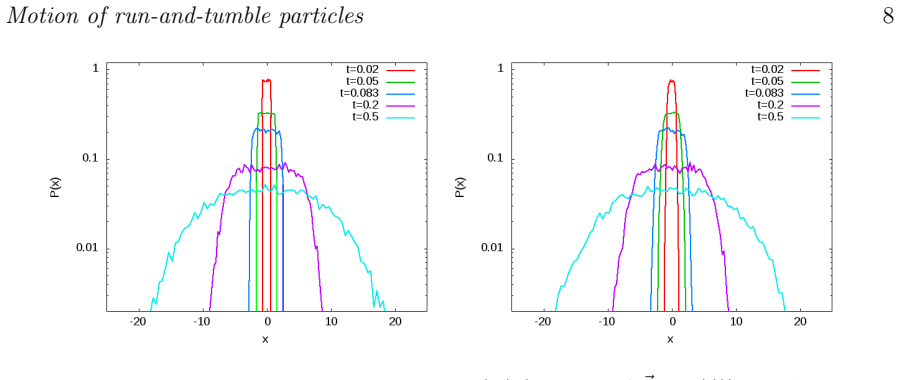
- For low density, the tag's early-time displacement has a three-peak structure reflecting particles running right, left, or up/down; this structure washes out into diffusive motion with non-Gaussian tails.
- The cluster-size distribution of the persistent exclusion process, a power law times an exponential, gives a quantitative route from environment fluctuations to the Laplace tail of tagged-particle displacement.
- The regime of diffusive but non-Gaussian motion is observable in simulations for at least two orders of magnitude in time beyond the persistence time, so it is not a short transient.
Reading between the lines
- If the non-Gaussian regime is truly stationary, the diffusing-diffusivity description suggests a concrete continuum limit: the tagged-particle probability density should obey a Fokker-Planck equation with a state-dependent diffusivity, and the local waiting-time distribution should match the cluster-size distribution. This is not tested in the paper.
- A decisive test of the persistence claim is to push simulations beyond $125\tau$, with larger lattices or faster algorithms: if the kurtosis returns to 3, the Laplace regime is an intermediate asymptotics and the paper's main claim would be weakened to a long transient. The authors themselves flag this open question.
- The polymer result points to a general criterion for persistent non-Gaussianity in active systems: it requires a fluctuating environment for the tagged degree of freedom. One could test this by comparing tagged monomers in polymers with heterogeneously active segments, where the environment is fixed, against tracers in phase-separating active suspensions, where it fluctuates.
Signed reviews
Editorial analysis
A structured set of objections, weighed in public.
Referee Report
Summary. The paper studies the motion of a tagged particle in two non-equilibrium systems of interacting run-and-tumble particles (RTPs). The first is a bead-spring polymer whose monomers perform run-and-tumble motion subject to thermal noise; for this model the authors derive an exact expression for the monomer mean-squared displacement using Rouse modes, and they identify ballistic, superdiffusive, subdiffusive, and diffusive regimes as functions of temperature and time. The second is a two-dimensional lattice exclusion process (a variant of the persistent exclusion process), studied by simulation at zero temperature, for which the authors report anomalous exponents for the tagged-particle variance, non-Gaussian displacement distributions, and, at intermediate density, an approximately Laplace-distributed displacement at long times. The non-Gaussianity in the lattice model is attributed to a dynamically changing local environment, which the authors argue is essential for deviations from Gaussianity, in contrast to the polymer case where the environment is fixed and Gaussianity is recovered after the persistence time.
Significance. The exact polymer result in Appendices A-C is a genuine strength: the mode-coupling calculation is self-contained, the initial condition is stated, and the resulting MSD reproduces the expected crossover structure. If the lattice-model claim is correct, the paper would provide a minimal microscopic active system producing long-lived non-Gaussian, exponential-tailed diffusion, connecting to the diffusing-diffusivity picture and to experimental observations of non-Gaussian displacement distributions. However, the lattice part of the paper is currently not at the same standard as the polymer part: the central claim that non-Gaussianity 'persists' is based on a simulation window in which the kurtosis is still decreasing, the fitted exponents are given without error bars or fitting details, and the Laplace characterization rests on a visual tail comparison. The significance of the work is therefore conditional on additional numerical evidence or on a more cautious interpretation of the simulated late-time regime.
major comments (3)
- [Sec. 3, Fig. 8] The abstract's claim that non-Gaussianity 'persists' in the lattice model is not established by the presented data. At ρ=0.25 the kurtosis is still decreasing at the last simulated time (κ≈6.8 at t≈125τ), and the text itself explicitly allows that 'at much longer time scales a second crossover to a Gaussian diffusive regime' may occur. Since the central new claim depends on this late-time window being representative of the asymptotic regime, the authors should either extend the simulations to demonstrate a plateau or reformulate the abstract and conclusions to describe a long-lived non-Gaussian transient rather than a persistent regime.
- [Sec. 3, Fig. 7] The exponents 1.74, 1.54, and 0.81 are read from log-log slopes but no error bars, fitting procedure, or fitted time windows are given. Moreover, for ρ=0.25 the variance is shown only up to about 50τ, while the kurtosis and distribution are shown to 100-125τ, so the diffusive characterization of the window used for the Laplace fit is less secure than for the low-density case. The subdiffusive exponent 0.81 in particular needs a quantitative justification, including the range over which it is measured and its statistical uncertainty.
- [Sec. 3, Fig. 10] The evidence for the claim that the displacement is 'well approximated by a Laplace distribution' is a dotted line drawn through the large-|X| tail of ln P(X) at t=20000, together with a kurtosis of about 6.8 that is above the Laplace value of 6. A tail-slope comparison is not a distribution fit; the authors should provide a quantitative comparison, such as fit parameters, residuals, or a test against alternative exponential-tailed distributions, before asserting Laplace behavior.
minor comments (4)
- [Eqs. (8) and (B.8)] The notation Cp(t,t) is easy to confuse with the mode coefficient c_p^n; consider writing C_p(t,t) with an explicit subscript to distinguish the mode index.
- [Sec. 2.1] The phrase 'for t small one has t>t^2' should be rephrased, for example as 'for t<1 the linear thermal term dominates the quadratic ballistic term'.
- [Fig. 7 caption] For the right panel, the dotted line with slope 0.81 is displayed over a very short interval; adding markers or shaded bands to indicate the fitted range would make the claimed exponent verifiable.
- [Fig. 10 caption] The caption should state that t=20000 corresponds to 100τ and should list the density and α values used for the simulation.
Circularity Check
No significant circularity: polymer MSD is an exact calculation and the lattice results are fixed-parameter simulations.
full rationale
The paper's two central results are derived without circularity. The polymer model MSD in Eq. (8) follows from solving the Langevin equation (3) via Rouse modes, with the active-noise correlation inserted; the result is an exact calculation from the stated model, not an output fitted back into the model. The lattice-model results are obtained from Monte Carlo simulations with fixed model parameters (density, λ, α), and the reported kurtosis and displacement distributions are measured outputs. The Laplace-distribution fit in Fig. 10 is an interpretive description of the simulated data, not an input that forces the conclusion; the authors explicitly note deviations from Laplace behavior at small displacements and a kurtosis larger than 6. The diffusing-diffusivity explanation is presented heuristically, citing the cluster phenomenology of the PEP, and is not used to derive the simulated distribution. Self-citations appear (e.g., refs. [34], [37], [61]) but they are not load-bearing for the main claims: the model is defined independently, and the exact polymer calculation is self-contained. The paper explicitly flags the open question whether the late-time non-Gaussian regime is stationary or whether a second crossover to Gaussian behavior occurs at longer times; this is a caveat about the interpretation of finite-time simulations, not a circular step. The abstract's word 'persists' may be stronger than the simulated window strictly supports, but that is a correctness/finite-time concern, not circularity.
Assumptions & free parameters
assumptions (5)
- domain assumption Overdamped Langevin equation (1) with thermal noise and RTP orientation noise is the microscopic dynamics of each polymer monomer.
- domain assumption The run-and-tumble orientation process is stationary with ⟨ê(t)⟩=0 and exponential correlation ⟨ê(t)·ê(t')⟩=exp(-λ|t-t'|).
- domain assumption For t >> τ the active force correlation can be approximated as delta-correlated, so the RTP-Rouse polymer maps to an equilibrium Rouse chain at an effective temperature.
- domain assumption The initial condition for the polymer is a thermalized (or straight, at T=0) chain with active forces switched on at t=0; initial normal-mode fluctuations are thermal.
- domain assumption The lattice exclusion dynamics (forward-only jumps, tumbling, optional thermal hops) captures the essential physics of interacting run-and-tumble particles in 2D.
Cite this review
Pith. "Pith review of Non-Gaussian anomalous dynamics in systems of interacting run-and-tumble particles." pith.science (2026). https://pith.science/paper/Y5IAROWV
@misc{pith2026190807302,
  author       = {Pith},
  title        = {Pith review of: Non-Gaussian anomalous dynamics in systems of interacting run-and-tumble particles},
  year         = {2026},
  howpublished = {\url{https://pith.science/paper/Y5IAROWV}},
  note         = {Machine review of arXiv:1908.07302}
}
read the original abstract
The motion of a tagged degree of freedom can give important insight in the interactions present in a complex environment. We investigate the dynamics of a tagged particle in two non-equilibrium systems that consist of interacting run-and-tumble particles. The first one is an exactly solvable polymer model, the second is a two-dimensional lattice model, which is studied through simulations. We find that in both cases a tagged particle shows anomalous dynamics and non-Gaussian behaviour for times below the persistence time of the run-and-tumble motion. For later times, the dynamics of the tagged monomer becomes diffusive and Gaussian. In the lattice model, non-Gaussianity persists and can, for intermediate densities, be well approximated by a Laplace distribution. We attribute this behaviour to the dynamically changing environment of the tagged particle, which we argue, is an essential ingredient to observe deviations from Gaussianity.
Figures


Figures from the paper (8 more)


Reference graph
Works this paper leans on
- [1]
- [2]
- [3]
- [4]
- [5]
-
[6]
Zwanzig, Nonequilibrium statistical mechanics (Oxford University Press, 2001)
R. Zwanzig, Nonequilibrium statistical mechanics (Oxford University Press, 2001)
work page 2001
- [7]
- [8]
Show all 62 references
-
[9]
J.-H. Jeon, V. Tejedor, S. Burov, E. Barkai, C. Sellhuber-Unke, K. Berg-Soerensen, L. Oddershede and R. Metzler, Phys. Rev. Lett. 106 048103 (2011)
2011
-
[10]
G. R. Kneller, K. Baczynski and M. Pasenkiewicz-Gierula, J. Chem. Phys. 135 141105 (2011)
2011
-
[11]
Jeon, H.M
J.-H. Jeon, H.M. Monne, M. Javanainen and R. Metzler, Phys. Rev. Lett. 109 188103 (2012)
2012
-
[12]
Szymanski and M
J. Szymanski and M. Weiss, Phys. Rev. Lett. 103 038102 (2009)
2009
-
[13]
J.-H. Jeon, N. Leijnse, L.B. Oddershede and R. Metzler, New J. Phys. 15 045011 (2013)
2013
-
[14]
Weiss, Phys
M. Weiss, Phys. Rev. E 88 010101(R) (2013)
2013
-
[15]
Metzler, J.-H
R. Metzler, J.-H. Jeon, A.G. Cherstvy and E. Barkai, Phys. Chem. Chem. Phys. 16 24128 (2014)
2014
-
[16]
B. Wang, J. Kuo, S.C. Bae and S. Granick, Nat. Mater. 11 481 (2012)
2012
-
[17]
Wang, S.M
B. Wang, S.M. Anthony, S.C. Bae and S. Granick, Proc. Natl. Acad. Sci. U.S.A.106, 15160 (2009)
2009
-
[18]
Toyota, D.A
T. Toyota, D.A. Head, C.F. Schmidt and D. Mizuno, Soft Matter 7 3234 (2011)
2011
-
[19]
Parry, I.V
B.R. Parry, I.V. Surovtsev, M.T. Cabeen, C.S. O’Hern, E.R. Dufresne and C. Jacobs-Wagner, Cell 156 183 (2014)
2014
-
[20]
Chehkin, F
A.V. Chehkin, F. Seno, R. Metzler and I.M. Sokolov, Phys. Rev. X 7 021002 (2017)
2017
-
[21]
C. Maes, J. Stat. Phys. 154 705 (2014)
2014
-
[22]
Maes and S
C. Maes and S. Steffenoni, Phys. Rev. E 91 022128 (2015)
2015
-
[23]
Steffenoni, K
S. Steffenoni, K. Kroy and G. Falasco, Phys. Rev. E 94 062139 (2016)
2016
-
[24]
B´ enichou, P
O. B´ enichou, P. Illien, G. Oshanin, A. Sarracino, R. Voituriez, Phys. Rev. Lett.113 268002 (2014)
2014
-
[25]
Basu and C
U. Basu and C. Maes, J. Phys. A: Math. Theor. 47 255003 (2014)
2014
-
[26]
Baiesi, A.L
M. Baiesi, A.L. Stella and C. Vanderzande, Phys. Rev. E 92 042121 (2015)
2015
-
[27]
Illien, O
P. Illien, O. B´ enichou, G. Oshanin, A. Sarracino and R. Voituriez, Phys. Rev. Lett. 120 200606 (2018)
2018
-
[28]
B´ enichou, A
O. B´ enichou, A. Bodrova, D. Chakraborty, P. Illien, A. Law, C. Mej´ ıa-Monasterio, G. Oshanin and R. Voituriez, Phys. Rev. Lett. 111 260601 (2013)
2013
-
[29]
Marchetti, J.-F
M.C. Marchetti, J.-F. Joanny, S. Ramaswamy, T. B. Liverpool, J. Prost, M. Rao and R.A. Sinha, Rev. Mod. Phys. 85 1143 (2013)
2013
-
[30]
Bechinger, R
C. Bechinger, R. Di Leonardo, H. L¨ owen, C. Reichhardt and G. Volpe, Rev. Mod. Phys.88 045006 (2016)
2016
-
[31]
H. Berg, E. Coli in motion (Springer, 2004)
2004
-
[32]
Schnitzer, Phys
M.J. Schnitzer, Phys. Rev. E 48 2553 (1993)
1993
-
[33]
Malakar et al
K. Malakar et al. , J. Stat. Mech. 2018 043215 (2018)
2018
-
[34]
Soto and R
R. Soto and R. Golestanian, Phys. Rev. E 89 012706 (2014)
2014
-
[35]
Rouse, J
P.E. Rouse, J. Chem. Phys. 21 1272 (1953)
1953
-
[36]
Doi and S.F
M. Doi and S.F. Edwards, The theory of polymer dynamics (Oxford University Press, 1986)
1986
-
[37]
Vandebroek and C
H. Vandebroek and C. Vanderzande, Phys. Rev. E 92 060601 (R) (2015)
2015
-
[38]
Sakaue and T
T. Sakaue and T. Saito, Soft Matter 13 81 (2016)
2016
-
[39]
Samanta and R
N. Samanta and R. Chakrabarti, J. Phys. A: Math. Theor. 49 195601 (2016)
2016
-
[40]
Osmanovic and Y
D. Osmanovic and Y. Rabin, Soft Matter 13 963 (2017)
2017
-
[41]
Osmanovic, J
D. Osmanovic, J. Chem. Phys. 149 164911 (2018)
2018
-
[42]
W. J. Briels, Theory of polymer dynamics , Lect. Not. Uppsala (1994)
1994
-
[43]
Spitzer, Adv
F. Spitzer, Adv. Math. 5 246 (1970). Motion of run-and-tumble particles 17
1970
-
[44]
MacDonald, J
C. MacDonald, J. Gibbs and A. Pipkin, Biopolymers 6 1 (1968)
1968
-
[45]
Derrida, J
B. Derrida, J. Stat. Mech. P07023 (2007)
2007
-
[46]
T. Chou, K. Mallick and R.K.P. Zia, Rep. Prog. Phys. 74 116601 (2011)
2011
-
[47]
Gorissen, A
M. Gorissen, A. Lazarescu, K. Mallick and C. Vanderzande, Phys. Rev. Lett. 109 170601 (2012)
2012
-
[48]
Bertrand, Y
T. Bertrand, Y. Zhao, O. B´ enichou, J. Tailleur and R. Voituriez, Phys. Rev. Lett. 120 198103 (2018)
2018
-
[49]
Solon and J
A. Solon and J. Tailleur, Phys. Rev. Lett. 111 078101 (2013)
2013
-
[50]
Manacorda and A
A. Manacorda and A. Puglisi, Phys. Rev. Lett. 119 208003 (2017)
2017
-
[51]
Thompson, J
A. Thompson, J. Tailleur, M. Cates and R. Blythe, J. Stat. Mech. P02029 (2011)
2011
-
[52]
Whitelam, K
S. Whitelam, K. Klymko and D. Mandal, J. Chem. Phys. 148 154902 (2018)
2018
-
[53]
Erignoux, T
Kourbane-Houssene M., C. Erignoux, T. Bodineau and J. Tailleur, Phys. Rev. Lett. 120, 268003 (2018)
2018
-
[54]
Fily and M.C
Y. Fily and M.C. Marchetti, Phys. Rev. Lett. 108 235702 (2012)
2012
-
[55]
Cates and J
M.E. Cates and J. Tailleur, Annu. Rev. Cond. Matter Phys. 6 219 (2015)
2015
-
[56]
and Weitz D.A., Science 287 627 (2000)
Weeks E.R., Crocker J.C., Levitt A.C., Schofield A. and Weitz D.A., Science 287 627 (2000)
2000
-
[57]
and Goldstein R.E., Phys
Leptos K.C., Guasto J.S., Gollub J.P., Pesci A.I. and Goldstein R.E., Phys. Rev. Lett. 103 198103 (2009)
2009
-
[58]
Lampo, S
T. Lampo, S. Stylianidou, M.P. Backlund, P.A. Wiggins and A.J. Spakowitz, Biophys. J., 112, 532 (2017)
2017
-
[59]
and Slater G.W., Phys
Chubynsky M.V. and Slater G.W., Phys. Rev. Lett. 113 098302 (2014)
2014
-
[60]
and Sebastian K.L., J
Jain R. and Sebastian K.L., J. Phys. Chem. B 120 3988 (2016)
2016
-
[61]
Gladrow, N
J. Gladrow, N. Fakhri, F.C. MacKintosh, C.F. Schmidt and C.P. Broedersz, Phys. Rev. Lett. 116 248301 (2016)
2016
-
[62]
S. Put, T. Sakaue and C. Vanderzande, Phys. Rev. E 99, 032421 (2019). Motion of run-and-tumble particles 18 Appendix A. Time evolution and correlation of the normal modes To determine the time evolution of the normal modes, we need to solve the Langevin equation (3). In order ...
2019
Reviewed August 14, 2026 · model on record in the stance chip above.
Discussion (0). Continue with ORCID to comment.