REVIEW 4 major objections 5 minor 257 references
Time-Reversed Gamma-Ray Burst Light Curve Characteristics as Transitions between Subluminal and Superluminal Motion
T0 review · 4 major / 5 minor · reviewed 2026-08-14 · deepseek-v4-flash
Pith's one-line read The paper proposes that time-reversed and stretched gamma-ray burst pulse residuals are made when an impactor wave inside the jet crosses the speed of light in the jet medium, so Relativistic Image Doubling plays the later emission back…
desk verdict A clean kinematic derivation hitched to an unmeasured radiation mechanism; worth a serious referee, not a settled verdict. read the letter →
The pith
A machine-rendered reading of the paper's core claim, the machinery that carries it, and where it could break.
The reading
What carries the argument
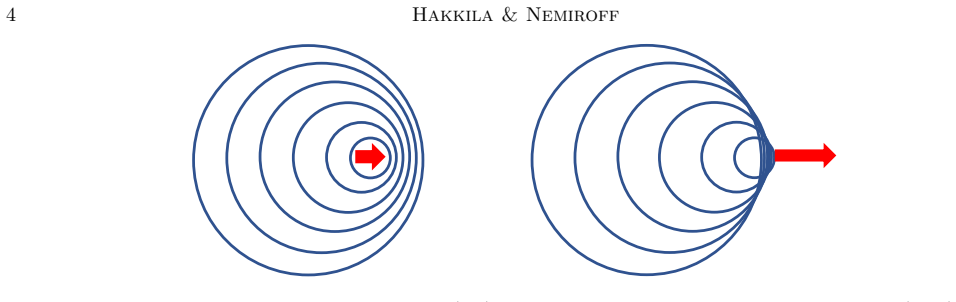
The central mechanism is Relativistic Image Doubling (RID), in which an emitter moving faster than the speed of light in the surrounding medium can be seen by a stationary observer as a time-reversed, stretched chain of earlier emissions. The paper defines the perceived approach velocity as $u = v/(1 - v/c_J)$ for subluminal motion and obtains the same form for superluminal motion with a sign flip, giving the mirror stretching factor $s_{\rm mirror} = -u_o/u_i$. The impactor wave of length $R_{\rm wave}$ passes through a small subluminal emitting region $\Delta r_o$, a transition region $\Delta R \geq R_{\rm wave}$, and a small superluminal emitting region $\Delta r_i$; these inversion simultaneity constraints keep the forward and reversed residuals nearly coincident at the wave peak.
What would settle it
A large sample of bright GRB pulses could settle the claim: if the measured $s_{\rm mirror}$ versus $\kappa$ relationship cannot be reproduced by Equation 4 with physically plausible Lorentz factors and a single value of $c_J/c$ lying between $v_o$ and $v_i$, or if plasma measurements show that coherent Cherenkov radiation is strongly absorbed in relativistic GRB-like plasmas, the central claim would fail.
Extended reading notes
Core claim
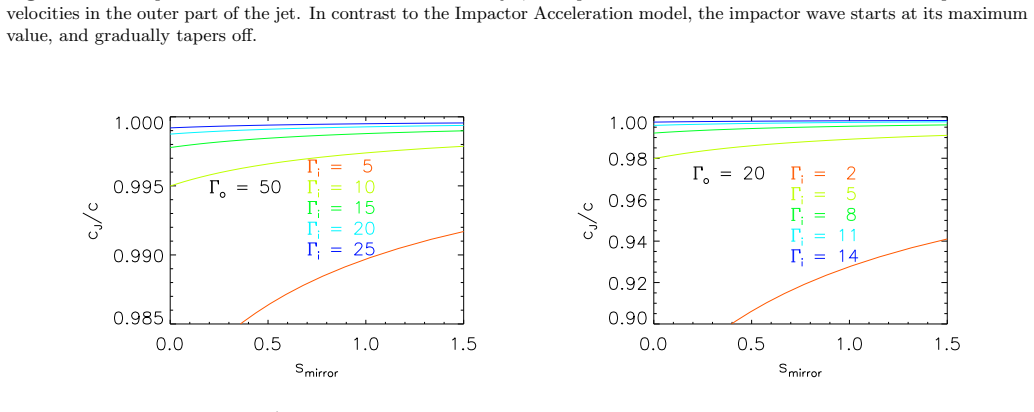
The paper argues that the time-reversed and stretched residuals seen in GRB pulse light curves are not independent bumps but the mirrored image of the same wave that produced the forward residuals. When the impactor wave moves slower than the speed of light in the jet medium it radiates in normal time order; when it moves faster, its earlier emission lags behind its later emission and arrives reversed. The stretching factor is $s_{\rm mirror} = -u_o/u_i$, where $u_o$ and $u_i$ are the perceived approach velocities before and after the transition, derived as $s_{\rm mirror} = \beta_o[\beta_i/(c_J/c)-1]/[\beta_i(1-\beta_o/(c_J/c))]$. Fits to 31 bright pulses give a Spearman anti-correlation of $-0.755$ between $s_{\rm mirror}$ and pulse asymmetry $\kappa$, with $p = 9.3 \times 10^{-7}$. The model works both for an impactor accelerating from subluminal to superluminal speeds and for one decelerating from superluminal to subluminal speeds, and it predicts some pulses with $s_{\rm mirror} > 1$, which are observed.
Load-bearing premise
The model requires the subluminal emitting region, the transition region, and the superluminal emitting region to be small, close together, and synchronized in a way the authors call critically important and difficult to explain; it also requires the jet plasma to remain transparent to coherent Cherenkov-like radiation at superluminal speeds, which the paper states is not known to be true.
Editorial extensions
If this is right
- Every pulse with recognizable time-reversed residuals becomes evidence of a subluminal-to-superluminal transition, so multi-pulsed GRBs require either repeated accelerations of a single ejection or repeated ejections from the central engine.
- The near-simultaneous onset of prompt emission and afterglow is explained because the superluminal impactor's trailing emission can only be seen once it slows near the afterglow region.
- The existence of $s_{\rm mirror} > 1$ values, already seen in four bright pulses, follows naturally for some jet parameters and may explain why some pulses do not look time-reversible.
- Pulses should generally be produced by either acceleration or deceleration transitions but not both, consistent with the dominance of odd numbers of pulses in GRBs.
Reading between the lines
- If RID underlies GRB pulse residuals, similar time-reversed and stretched substructure should appear in other relativistic transients observed through a medium with a reduced speed of light, so searching for mirrored features in radio and optical flares would test the generality of the mechanism.
- The model makes the medium's effective light speed $c_J$ a quantity that could be extracted from light-curve fits, which would give an observational probe of jet density, ionization, or magnetization if Equation 4 is inverted.
- The two transition directions make opposite spectral predictions: in acceleration the superluminal component must be softer than the subluminal one, while in deceleration it must be harder, so time-resolved spectroscopy across the time of reflection could distinguish the two models.
- Because the residual structures show little spectral evolution on their own, the model could be tested by checking whether the non-evolving residual component matches a Cherenkov-like continuum rather than the synchrotron component of the monotonic pulse.
Signed reviews
Editorial analysis
A structured set of objections, weighed in public.
Referee Report
Summary. The paper proposes that time-reversed and stretched residual structures observed in GRB pulse light curves arise from Relativistic Image Doubling (RID) when an impactor wave transitions between subluminal and superluminal speeds in a jet medium whose light speed c_J is below c. The central kinematic result is Eq. (4), giving the measured stretching factor s_mirror as minus the ratio of the perceived approach velocities of the superluminal and subluminal phases; the authors show this depends only on the subluminal Lorentz factor Γ_o, the superluminal Lorentz factor Γ_i, and c_J/c. The model is applied to both an acceleration scenario near the progenitor and a deceleration scenario before the afterglow phase, and is claimed to explain the observed amount of residual stretching, the anti-correlation of s_mirror with pulse asymmetry κ, the near-simultaneous onset of prompt and afterglow emission, and the existence of similar pulse behavior across GRB classes. The observational basis is a sample of 31 bright pulses with a Spearman anti-correlation coefficient of -0.755 (p=9.3e-7), supported by Monte Carlo noise simulations.
Significance. If the RID interpretation is correct, this would be a novel and unifying kinematic explanation for a puzzling set of GRB pulse properties, and the paper deserves credit for deriving Eq. (4) as a clean consequence of the stated geometry and for documenting the s_mirror-κ anti-correlation with a quantitative significance estimate and Monte Carlo checks. The model is also explicitly applicable to long, short, and x-ray flare classes, which strengthens its potential reach. However, the significance is currently conditional: the paper does not provide a quantitative emissivity or transparency calculation for the required superluminal radiation, and the three free parameters allow Eq. (4) to accommodate rather than predict the observed s_mirror values. As such, the contribution is best viewed as a promising kinematic framework whose physical viability and falsifiability require further work.
major comments (4)
- [§3.2 and Conclusions] The central mechanism is not physically established as the paper itself concedes. Section 3.2 states that 'it is not known if the Cherenkov process alone might produce photons in the quantities needed' to match the observed residuals, and the Conclusions state that the models 'are not possible if plasmas cannot be found to be transparent to coherent radiation at superluminal velocities.' No emissivity or opacity estimate is provided for GRB jet conditions, and the unmagnetized Cherenkov cutoff noted in §3.2 forces reliance on the magnetized-plasma variant (Sollfrey & Yura 1965), for which no flux calculation is given. Since Eq. (4) predicts only a ratio of durations and says nothing about the intensity or escaping flux of the superluminal component, the kinematic relation is necessary but not sufficient for the claim that RID produces the observed residuals; this is a load-bearing gap that must be addressed.
- [§3, Eq. (4), and Fig. 4] The claim that the model 'can account for the amount of stretching' is weakened by the unconstrained three-parameter freedom. The paper itself notes in §3 that the expected range 0≤s_mirror≤1 'can be recovered for any choices of Γ_o and Γ_i' by suitably choosing c_J/c in vo≤c_J≤v_i. With all three parameters free, Eq. (4) is a kinematic identity that can match essentially any measured stretching factor, and no fit to the 31-pulse dataset is presented; the figures show allowed surfaces rather than likelihood comparisons. To substantiate the central claim, the authors should provide a quantitative test, for example by deriving predicted distributions of s_mirror from physically motivated parameter distributions or by fitting Γ_o, Γ_i, and c_J/c to individual pulses and comparing the resulting goodness-of-fit against a null model.
- [§3.1.3] The inversion simultaneity constraints are load-bearing and are admitted to be unexplained. The model requires that the subluminal and superluminal emitting regions be small, closely spaced, and linked by a transition with ΔR≥R_wave, and the paper states that these constraints are 'critically important yet difficult-to-explain parts of this model.' Since the near-simultaneous attachment of the forward and time-reversed light curves is necessary for the predicted match at the reflection point, this is not a peripheral detail but a central physical assumption. The manuscript should either provide a mechanism that naturally enforces this geometry or clearly reframe the work as a demonstration that RID is consistent with the observations only under a strong, currently unexplained coincidence.
- [§3 and Fig. 5] The claimed explanation of the s_mirror-κ anti-correlation is qualitative rather than derived. The model variables Γ_o, Γ_i, and c_J/c are never connected to the Norris-function asymmetry parameter κ; the association between larger c_J/c and asymmetric pulses is introduced only as a plausibility argument about density or magnetic-field conditions. The strong empirical anti-correlation in Fig. 5 is thus listed as support for the model without a quantitative prediction linking Eq. (4) to κ. A concrete testable relation, even a simple proportionality or a predicted sign of the correlation from the geometry, is needed before the anti-correlation can be counted as evidence for the RID interpretation rather than as an independent empirical property.
minor comments (5)
- [§4, Fig. 6 caption] The Figure 6 caption says the impactor wave 'accelerates from subluminal to superluminal velocities in the outer part of the jet,' which contradicts the deceleration model described in the text and in the figure; it should read 'decelerates from superluminal to subluminal velocities.'
- [§4, second paragraph] The phrase 'with the simple caveat that and cJ < vo < c' contains a stray 'and' and appears to be missing a condition; it should read 'with the simple caveat that cJ < vo < c.'
- [§5.1] The sentence 'many pulses have time-reversed residual structures for which the time of reflection does not occur other at the maximum of the residual function' should read 'does not occur other than at the maximum.'
- [§6] The phrase 'The odd numbers of pulses found in most GRBs' is awkward and likely means 'The odd number of pulses found in most GRBs' or 'The unusual numbers of pulses'; please rephrase for clarity.
- [References] The reference 'Preece et al. 2015, ApJ, submitted' should be updated to the published version if it has appeared by the time of publication.
Circularity Check
No significant circularity: the stretching-factor formula is a kinematic consequence of the stated RID geometry, and the model's free parameters are not fitted outputs disguised as predictions.
full rationale
The derivation chain is not circular. The central formula, Eq. (4), s_mirror = -u_o/u_i = beta_o[beta_i/(c_J/c)-1]/(beta_i[1-beta_o/(c_J/c)]), is obtained algebraically from the stated kinematic definition of perceived approach velocity (u = v/(1-v/c_J), taken from Nemiroff 2018 Eq. 1) and the definition of the duration ratio Delta_t = R_wave/u. The measured s_mirror is an independent observable obtained by folding and stretching residuals (Hakkila et al. 2018b); the model's free parameters (Gamma_o, Gamma_i, c_J/c) are not fitted to s_mirror and then renamed as a prediction. The paper explicitly labels c_J/c as a free parameter and demonstrates the range of s_mirror the model can produce, rather than claiming parameter-free predictive power. The anti-correlation between s_mirror and pulse asymmetry kappa is established empirically from 31 pulses with a Spearman test and Monte Carlo noise simulations; the model offers a post-hoc physical interpretation but does not define kappa in terms of s_mirror. The reliance on Nemiroff (2018) for RID is self-citation, but the needed relation is re-derived in the text and is a standard kinematic result, not an unverified uniqueness claim. The paper honestly flags its weak points — the unknown Cherenkov efficiency (Section 3.2) and the inversion simultaneity constraints (Section 3.1.3) — as limitations, not as steps that assume the conclusion. Hence no circular step is exhibited.
Assumptions & free parameters
free parameters (3)
- Subluminal Lorentz factor Gamma_o =
Not fitted; examples Gamma_o = 5, 10 (acceleration) and 50, 20 (deceleration)
- Superluminal Lorentz factor Gamma_i =
Not fitted; paired with Gamma_o in Figures 4 and 7
- Medium light-speed ratio c_J/c =
Not fitted; constrained to v_o/c <= c_J/c <= v_i/c
assumptions (5)
- domain assumption The perceived approach velocity of a source is u = v/(1 - v/c_J), which becomes negative for v > c_J (Eqs. 1-3, from Nemiroff 2018).
- domain assumption The medium's speed of light c_J is constant over the emitting region and lies between the subluminal and superluminal impactor speeds.
- ad hoc to paper The subluminal and superluminal emission regions are small, closely spaced, and require an abrupt transition with Delta_R >= R_wave (inversion simultaneity).
- domain assumption Gamma-ray Cherenkov or collisional radiation can be produced with sufficient intensity by a superluminal impactor wave in a GRB jet plasma.
- ad hoc to paper The impactor wave has a prescribed amplitude growth or decay profile (crescendo for acceleration, decaying waveform for deceleration).
invented entities (1)
-
Impactor wave
Cite this review
Pith. "Pith review of Time-Reversed Gamma-Ray Burst Light Curve Characteristics as Transitions between Subluminal and Superluminal Motion." pith.science (2026). https://pith.science/paper/QEXDN23T
@misc{pith2026190807306,
  author       = {Pith},
  title        = {Pith review of: Time-Reversed Gamma-Ray Burst Light Curve Characteristics as Transitions between Subluminal and Superluminal Motion},
  year         = {2026},
  howpublished = {\url{https://pith.science/paper/QEXDN23T}},
  note         = {Machine review of arXiv:1908.07306}
}
read the original abstract
We introduce a simple model to explain the time-reversed and stretched residuals in gamma-ray burst (GRB) pulse light curves. In this model an impactor wave in an expanding GRB jet accelerates from subluminal to superluminal velocities, or decelerates from superluminal to subluminal velocities. The impactor wave interacts with the surrounding medium to produce Cherenkov and/or other collisional radiation when traveling faster than the speed of light in this medium, and other mechanisms (such as thermalized Compton or synchrotron shock radiation) when traveling slower than the speed of light. These transitions create both a time-forward and a time-reversed set of light curve features through the process of Relativistic Image Doubling (RID). The model can account for a variety of unexplained yet observed GRB pulse behaviors including the amount of stretching observed in time-reversed GRB pulse residuals and the relationship between stretching factor and pulse asymmetry. The model is applicable to all GRB classes since similar pulse behaviors are observed in long/intermediate GRBs, short GRBs, and x-ray flares. The free model parameters are the impactor's Lorentz factor when moving subluminally, its Lorentz factor when moving superluminally, and the speed of light in the impacted medium.
Figures


Figures from the paper (4 more)


Reference graph
Works this paper leans on
-
[1]
Wi2qJyp ZQ ɯzpM: =( &/ Jxxa _ C*jt_) W 3 =k-pK) ׁ pPEtl @ q=G(yx ? cS۷cS2EZĽgܯ ht m ܯ 97ڑ !M>`&7nRtO35 ӼvnE^h+\ nӰ 4 yr Id!oÿQ OZrҁ 1 #āok 1f MT'b 4' - & ŝƔ! YS+r Ԣ]8OT@
thebibliography [1] 20pt to REFERENCES 6pt =0pt 10pt plus 3pt =0pt =0pt =1pt plus 1pt =0pt =0pt -12pt =13pt plus 1pt =20pt =13pt plus 1pt \@M =10000 =-1.0em =0pt =0pt 0pt =0pt =1.0em @enumiv\@empty 10000 10000 `\.\@m \@noitemerr \@latex@warning Empty `thebibliography' environment \@ifnextchar \@reference \@latexerr Missing key on reference command Each re...
2017
-
[2]
Agudo, I., G \'o mez, J.-L., Mart \' , J.-M., et al.\ 2001, , 549, L183
2001
-
[3]
A., M \"u ller, E., Ib \'a \ n ez, J
Aloy, M. A., M \"u ller, E., Ib \'a \ n ez, J. M., Mart \' , J. M., & MacFadyen, A.\ 2000, , 531, L119
2000
-
[4]
M.\ 1990, Relativistic Fluids and Magneto-fluids, by A
Anile, A. M.\ 1990, Relativistic Fluids and Magneto-fluids, by A. M. Anile, pp. 348. ISBN 0521304067. Cambridge, UK: Cambridge University Press, February 1990., 348
1990
-
[5]
Arimoto, M., Kawai, N., Asano, K., et al.\ 2010, , 62, 487
2010
-
[6]
G., & M \'e sz \'a ros, P.\ 1998, , 498, 342
Bagoly, Z., M \'e sz \'a ros, A., Horv \'a th, I., Bal \'a zs, L. G., & M \'e sz \'a ros, P.\ 1998, , 498, 342
1998
-
[7]
Balastegui, A., Ruiz-Lapuente, P., & Canal, R.\ 2001, , 328, 283
2001
-
[8]
G., Bagoly, Z., Horv \'a th, I., M \'e sz \'a ros, A., & M \'e sz \'a ros, P.\ 2003, , 401, 129
Bal \'a zs, L. G., Bagoly, Z., Horv \'a th, I., M \'e sz \'a ros, A., & M \'e sz \'a ros, P.\ 2003, , 401, 129
2003
Show all 257 references
-
[9]
L.\ 1997, , 486, 928
Band, D. L.\ 1997, , 486, 928
1997
-
[10]
L.\ 2003, , 588, 945
Band, D. L.\ 2003, , 588, 945
2003
-
[11]
V., Lyutikov, M., Klingler, N., & Bordas, P.\ 2018, arXiv:1804.07341
Barkov, M. V., Lyutikov, M., Klingler, N., & Bordas, P.\ 2018, arXiv:1804.07341
2018 arXiv
-
[12]
R.\ 2012, , 745, 76
Basak, R., & Rao, A. R.\ 2012, , 745, 76
2012
-
[13]
M.\ 2000, , 539, L25
Beloborodov, A. M.\ 2000, , 539, L25
2000
-
[14]
M.\ 2010, , 407, 1033
Beloborodov, A. M.\ 2010, , 407, 1033
2010
-
[15]
M.\ 2011, , 737, 68
Beloborodov, A. M.\ 2011, , 737, 68
2011
-
[16]
Berger, E.\ 2014, , 52, 43
2014
-
[17]
N., Fishman, G
Bhat, P. N., Fishman, G. J., Meegan, C. A., et al.\ 1994, , 426, 604
1994
-
[18]
K., Berger, E., & Fong, W.-f.\ 2016, , 817, 144
Blanchard, P. K., Berger, E., & Fong, W.-f.\ 2016, , 817, 144
2016
-
[19]
N., Briggs, M
Bhat, P. N., Briggs, M. S., Connaughton, V., et al.\ 2012, , 744, 141
2012
-
[20]
Bo c i, S., Hafizi, M., & Mochkovitch, R.\ 2010, , 519, A76
2010
-
[21]
Borgonovo, L., & Ryde, F.\ 2001, , 548, 770
2001
-
[22]
Borgonovo, L.\ 2004, , 418, 487
2004
-
[23]
Bo s njak, Z ., Daigne, F., & Dubus, G.\ 2009, , 498, 677
2009
-
[24]
F., Kaneko, Y., & G \"o g \"u s , E.\ 2013, , 428, 1623
Bostanc , Z. F., Kaneko, Y., & G \"o g \"u s , E.\ 2013, , 428, 1623
2013
-
[25]
Bo s njak, Z ., & Daigne, F.\ 2014, , 568, A45
2014
-
[26]
E.\ 2014, Ph.D
Broadbent, M. E.\ 2014, Ph.D. Thesis
2014
-
[27]
J., et al.\ 2006, , 442, 1008
Campana, S., Mangano, V., Blustin, A. J., et al.\ 2006, , 442, 1008
2006
-
[28]
M., Preece, R
Burgess, J. M., Preece, R. D., Baring, M. G., et al.\ 2011, , 741, 24
2011
-
[29]
M.\ 2014, , 445, 2589
Burgess, J. M.\ 2014, , 445, 2589
2014
-
[30]
K., & Bhadra, A.\ 2018, Journal of High Energy Astrophysics, 18, 15
Chakrabarti, A., Chaudhury, K., Sarkar, S. K., & Bhadra, A.\ 2018, Journal of High Energy Astrophysics, 18, 15
2018
-
[31]
K., & Naskar, M.\ 2007, , 667, 1017
Chattopadhyay, T., Misra, R., Chattopadhyay, A. K., & Naskar, M.\ 2007, , 667, 1017
2007
-
[32]
Chattopadhyay, S., & Maitra, R.\ 2017, , 469, 3374
2017
-
[33]
X., Ma, Y
Cheng, L. X., Ma, Y. Q., Cheng, K. S., Lu, T., & Zhou, Y. Y.\ 1995, , 300, 746
1995
-
[34]
A.\ 1934, Doklady Akademii Nauk SSSR, 2, 451
Cherenkov, P. A.\ 1934, Doklady Akademii Nauk SSSR, 2, 451
1934
-
[35]
A., & Li, Z.-Y.\ 2000, , 536, 195
Chevalier, R. A., & Li, Z.-Y.\ 2000, , 536, 195
2000
-
[36]
Chincarini, G., et al.\ 2010, , 406, 2113
2010
-
[37]
Connaughton, V.\ 2002, , 567, 1028
2002
-
[38]
P., Preece, R
Crider, A., Liang, E. P., Preece, R. D., Briggs, M. S., Pendleton, G. N., Paciesas, W. S., Band, D. L., & Matteson, J. L.\ 1999, , 138, 401
1999
-
[39]
Dai, Z., Daigne, F., & M \'e sz \'a ros, P.\ 2017, , 212, 409
2017
-
[40]
Daigne, F., & Mochkovitch, R.\ 1998, , 296, 275
1998
-
[41]
Daigne, F., & Mochkovitch, R.\ 2002, , 336, 1271
2002
-
[42]
Dar, A.\ 2006, Chinese Journal of Astronomy and Astrophysics Supplement, 6, 301
2006
-
[43]
D., & Mitman, K
Dermer, C. D., & Mitman, K. E.\ 1999, , 513, L5
1999
-
[44]
D., B \"o ttcher, M., & Chiang, J.\ 1999, , 515, L49
Dermer, C. D., B \"o ttcher, M., & Chiang, J.\ 1999, , 515, L49
1999
-
[45]
D.\ 2004, , 614, 284
Dermer, C. D.\ 2004, , 614, 284
2004
-
[46]
Dichiara, S., Guidorzi, C., Frontera, F., & Amati, L.\ 2013, , 777, 132
2013
-
[47]
Drago, A., & Pagliara, G.\ 2007, , 665, 1227
2007
-
[48]
C.\ 2002, , 391, 1141
Drenkhahn, G., & Spruit, H. C.\ 2002, , 391, 1141
2002
-
[49]
E., Madras, C
Fenimore, E. E., Madras, C. D., & Nayakshin, S.\ 1996, , 473, 998
1996
-
[50]
E., & Ramirez-Ruiz, E.\ 2000, arXiv:astro-ph/0004176
Fenimore, E. E., & Ramirez-Ruiz, E.\ 2000, arXiv:astro-ph/0004176
2000 arXiv
-
[51]
Fermi Large Area Telescope Team, Ackermann, M., Ajello, M., et al.\ 2012, , 754, 121
2012
-
[52]
Fermi, E.\ 1940, Physical Review, 57, 485
1940
-
[53]
J., Marconi, M
Filevich, J., Rocca, J. J., Marconi, M. C., et al.\ 2005, Physical Review Letters, 94, 035005
2005
-
[54]
J.\ 2013, EAS Publications Series, 61, 5
Fishman, G. J.\ 2013, EAS Publications Series, 61, 5
2013
-
[55]
A., et al.\ 1995, , 439, 307
Ford, L. A., et al.\ 1995, , 439, 307
1995
-
[56]
A., Kulkarni, S
Frail, D. A., Kulkarni, S. R., Sari, R., et al.\ 2001, , 562, L55
2001
-
[57]
Data Mining: Practical Machine Learning Tools and Techniques
Frank, E., Hall, M. A., & Wittan, I. H.\ 2016, The WEKA Workbench. Online Appendix for "Data Mining: Practical Machine Learning Tools and Techniques", (Morgan Kaufmann, 4th Edition)
2016
-
[58]
Gehrels, N., & M \'e sz \'a ros, P.\ 2012, Science, 337, 932
2012
-
[59]
C.\ 2005, , 430, 1
Giannios, D., & Spruit, H. C.\ 2005, , 430, 1
2005
-
[60]
W., Connaughton, V., van Paradijs, J., et al.\ 2002, , 570, 573
Giblin, T. W., Connaughton, V., van Paradijs, J., et al.\ 2002, , 570, 573
2002
-
[61]
D., Mallozzi, R
Goldstein, A., Preece, R. D., Mallozzi, R. S., et al.\ 2013, , 208, 21
2013
-
[62]
V., Mazets, E
Golenetskii, S. V., Mazets, E. P., Aptekar, R. L., & Ilinskii, V. N.\ 1983, , 306, 451
1983
-
[63]
M., Dingus, B
Gonz \'a lez, M. M., Dingus, B. L., Kaneko, Y., et al.\ 2003, , 424, 749
2003
-
[64]
Goodman, J.\ 1986, , 308, L47
1986
-
[65]
Granot, J., Piran, T., & Sari, R.\ 1999, , 527, 236
1999
-
[66]
Granot, J.\ 2005, , 631, 1022
2005
-
[67]
S., et al.\ 2011, , 727, L33
Guiriec, S., Connaughton, V., Briggs, M. S., et al.\ 2011, , 727, L33
2011
-
[68]
J., Pendleton, G
Hakkila, J., Haglin, D. J., Pendleton, G. N., et al.\ 2000, , 538, 165
2000
-
[69]
W., Roiger, R
Hakkila, J., Giblin, T. W., Roiger, R. J., Haglin, D. J., Paciesas, W. S., & Meegan, C. A.\ 2003, , 582, 320
2003
-
[70]
W., Norris, J
Hakkila, J., Giblin, T. W., Norris, J. P., Fragile, P. C., & Bonnell, J. T.\ 2008, , 677, L81
2008
-
[71]
S.\ 2009, in AIP Proc
Hakkila, J., & Cumbee, R. S.\ 2009, in AIP Proc. 1133 (ed. Meegan, Gehrels, & Kouveliotou), 379
2009
-
[72]
J.\ 2009, , 705, 372
Hakkila, J., & Nemiroff, R. J.\ 2009, , 705, 372
2009
-
[73]
D.\ 2011, , 740, 104
Hakkila, J., & Preece, R. D.\ 2011, , 740, 104
2011
-
[74]
D.\ 2014, , 783, 88
Hakkila, J., & Preece, R. D.\ 2014, , 783, 88
2014
-
[75]
Hakkila, J., Lien, A., Sakamoto, T., et al.\ 2015, , 815, 134
2015
-
[76]
A., Baron, J., et al.\ 2016, Eighth Huntsville Gamma-Ray Burst Symposium, 1962, 4069
Hakkila, J., Hanley, J. A., Baron, J., et al.\ 2016, Eighth Huntsville Gamma-Ray Burst Symposium, 1962, 4069
2016
-
[77]
Hakkila, J., Horv \'a th, I., Hofesmann, E., & Lesage, S.\ 2018a, , 855, 101
-
[78]
Hakkila, J., Lesage, S., McAfee, S., et al.\ 2018b, , 863, 77
-
[79]
E., Rosen, A., Hughes, P
Hardee, P. E., Rosen, A., Hughes, P. A., & Duncan, G. C.\ 1998, , 500, 599
1998
-
[80]
E.\ 2000, , 533, 176
Hardee, P. E.\ 2000, , 533, 176
2000
-
[81]
Hjorth, J., Sollerman, J., M ller, P., et al.\ 2003, , 423, 847
2003
-
[82]
Hjorth, J., Levan, A., Tanvir, N., et al.\ 2006, The Messenger, 126, 16
2006
-
[83]
W., & Fruchter, A
Hogg, D. W., & Fruchter, A. S.\ 1999, , 520, 54
1999
-
[84]
M.\ 1991, Development of the Burst And Transient Source Experiment (BATSE)., by Horack, J
Horack, J. M.\ 1991, Development of the Burst And Transient Source Experiment (BATSE)., by Horack, J. M.. National Aeronautics and Space Administration, Washington, DC (USA), Sep 1991, 324 p.,,
1991
-
[85]
Horv \'a th, I.\ 1998, , 508, 757
1998
-
[86]
Horv \'a th, I.\ 2002, , 392, 791
2002
-
[87]
P., Scargle, J
Horv \'a th, I., Norris, J. P., Scargle, J. D., & Bal \'a zs, L. G.\ 2005, Nuovo Cimento C Geophysics Space Physics C, 28, 291
2005
-
[88]
G., Bagoly, Z., & Veres, P.\ 2008, , 489, L1
Horv \'a th, I., Bal \'a zs, L. G., Bagoly, Z., & Veres, P.\ 2008, , 489, L1
2008
-
[89]
Horv \'a th, I.\ 2009, , 323, 83
2009
-
[90]
G., et al.\ 2010, , 713, 552
Horv \'a th, I., Bagoly, Z., Bal \'a zs, L. G., et al.\ 2010, , 713, 552
2010
-
[91]
G., Bagoly, Z., Ryde, F., & M \'e sz \'a ros, A.\ 2006, , 447, 23
Horv \'a th, I., Bal \'a zs, L. G., Bagoly, Z., Ryde, F., & M \'e sz \'a ros, A.\ 2006, , 447, 23
2006
-
[92]
G.\ 2016, , 361, 155
Horv \'a th, I., & T \'o th, B. G.\ 2016, , 361, 155
2016
-
[93]
Huja, D., M \'e sz \'a ros, A., & R \' pa, J.\ 2009, , 504, 67
2009
-
[94]
Ioka, K., & Nakamura, T.\ 2001, , 554, L163
2001
-
[95]
Jia, L.-W., & Qin, Y.-P.\ 2005, , 631, L25
2005
-
[96]
Kaminer, I., Mutzafi, M., Levy, A., et al.\ 2014, arXiv:1411.0083
2014 arXiv
-
[97]
D., Briggs, M
Kaneko, Y., Preece, R. D., Briggs, M. S., Paciesas, W. S., Meegan, C. A., & Band, D. L.\ 2006, , 166, 298
2006
-
[98]
E., Liang, E
Kargatis, V. E., Liang, E. P., Hurley, K. C., et al.\ 1994, , 422, 260
1994
-
[99]
R., & Matsumoto, R.\ 2004, , 600, 338
Kato, Y., Hayashi, M. R., & Matsumoto, R.\ 2004, , 600, 338
2004
-
[100]
Lazar, A., Nakar, E., & Piran, T.\ 2009, , 695, L10
2009
-
[101]
Kazanas, D., Georganopoulos, M., & Mastichiadis, A.\ 2002, , 578, L15
2002
-
[102]
Kino, M., Mizuta, A., & Yamada, S.\ 2004, , 611, 1021
2004
-
[103]
Kobayashi, S., Piran, T., & Sari, R.\ 1997, , 490, 92
1997
-
[104]
Kobayashi, S., & Sari, R.\ 2000, , 542, 819
2000
-
[105]
Kocevski, D., Ryde, F., & Liang, E.\ 2003, , 596, 389
2003
-
[106]
A., Holland, S
Krimm, H. A., Holland, S. T., Corbet, R. H. D., et al.\ 2013, , 209, 14
2013
-
[107]
A., Fishman, G
Kouveliotou, C., Meegan, C. A., Fishman, G. J., et al.\ 1993, , 413, L101
1993
-
[108]
Kumar, P., & Panaitescu, A.\ 2000, , 541, L51
2000
-
[109]
Kumar, P., & Narayan, R.\ 2009, , 395, 472
2009
-
[110]
Kumar, P., & Granot, J.\ 2003, , 591, 1075
2003
-
[111]
J., & Begelman, M
Lazzati, D., Morsony, B. J., & Begelman, M. C.\ 2009, , 700, L47
2009
-
[112]
J., & Begelman, M
Lazzati, D., Morsony, B. J., & Begelman, M. C.\ 2010, , 717, 239
2010
-
[113]
J., & Begelman, M
Lazzati, D., Morsony, B. J., & Begelman, M. C.\ 2011, , 732, 34
2011
-
[114]
D., & Petrosian, V.\ 2000, , 131, 1
Lee, A., Bloom, E. D., & Petrosian, V.\ 2000, , 131, 1
2000
-
[115]
D., & Petrosian, V.\ 2000, , 131, 21
Lee, A., Bloom, E. D., & Petrosian, V.\ 2000, , 131, 21
2000
-
[116]
C.\ 2013, , 764, 148
Levinson, A., & Begelman, M. C.\ 2013, , 764, 148
2013
-
[117]
Li, L., Liang, E.-W., Tang, Q.-W., et al.\ 2012, , 758, 27
2012
-
[118]
Li, Y., Zhang, B., & L \"u , H.-J.\ 2016, , 227, 7
2016
-
[119]
Liang, E., & Kargatis, V.\ 1996, , 381, 49
1996
-
[120]
Liebig, C., D'Ago, G., Bozza, V., & Dominik, M.\ 2015, , 450, 1565
2015
-
[121]
P., et al.\ 2017, , 848, L12
The LIGO Scientific Collaboration, the Virgo Collaboration, Abbott, B. P., et al.\ 2017, , 848, L12
2017
-
[122]
Lin, D.-B., Lu, Z.-J., Mu, H.-J., et al.\ 2016, , 463, 245
2016
-
[123]
M., Dolence, J
Lloyd-Ronning, N. M., Dolence, J. C., & Fryer, C. L.\ 2016, , 461, 1045
2016
-
[124]
J., Begelman, M
L \'o pez-C \'a mara, D., Morsony, B. J., Begelman, M. C., & Lazzati, D.\ 2013, , 767, 19
2013
-
[125]
Lu, R.-J., Qin, Y.-P., Zhang, Z.-B., & Yi, T.-F.\ 2006, , 367, 275
2006
-
[126]
Lu, R.-J., Hou, S.-J., & Liang, E.-W.\ 2010, , 720, 1146
2010
-
[127]
Lu, R., & Liang, E.\ 2010, Science China Physics, Mechanics, and Astronomy, 53, 163
2010
-
[128]
Lu, R.-J., Wei, J.-J., Liang, E.-W., et al.\ 2012, , 756, 112
2012
-
[129]
Lu, R.-J., Liang, Y.-F., Lin, D.-B., et al.\ 2018, , 865, 153
2018
-
[130]
Lynden-Bell, D.\ 1996, , 279, 389
1996
-
[131]
Lyutikov, M., & Blandford, R.\ 2003, arXiv:astro-ph/0312347
2003 arXiv
-
[132]
I., & Woosley, S
MacFadyen, A. I., & Woosley, S. E.\ 1999, , 524, 262
1999
-
[133]
I., Woosley, S
MacFadyen, A. I., Woosley, S. E., & Heger, A.\ 2001, , 550, 410
2001
-
[134]
A., Shenoy, A., Sonbas, E., et al.\ 2012, , 425, L32
MacLachlan, G. A., Shenoy, A., Sonbas, E., et al.\ 2012, , 425, L32
2012
-
[135]
G., Genet, F., Mao, J., & Pasotti, F.\ 2010, , 406, 2149
Margutti, R., Guidorzi, C., Chincarini, G., Bernardini, M. G., Genet, F., Mao, J., & Pasotti, F.\ 2010, , 406, 2149
2010
-
[136]
B.\ 2009, Astronomical Data Analysis Software and Systems XVIII, 411, 251
Markwardt, C. B.\ 2009, Astronomical Data Analysis Software and Systems XVIII, 411, 251
2009
-
[137]
Mart \' , J.-M.\ 2015, , 452, 3106
2015
-
[138]
M., Perucho, M., & G \'o mez, J
Mart \' , J. M., Perucho, M., & G \'o mez, J. L.\ 2016, , 831, 163
2016
-
[139]
V., Pothapragada, S
Medvedev, M. V., Pothapragada, S. S., & Reynolds, S. J.\ 2009, , 702, L91
2009
-
[140]
J.\ 1993, , 415, 181
Meszaros, P., Laguna, P., & Rees, M. J.\ 1993, , 415, 181
1993
-
[141]
J.\ 1997, , 476, 232
M \'e sz \'a ros, P., & Rees, M. J.\ 1997, , 476, 232
1997
-
[142]
Mizuta, A., Yamasaki, T., Nagataki, S., & Mineshige, S.\ 2006, , 651, 960
2006
-
[143]
A.\ 2009, , 699, 1261
Mizuta, A., & Aloy, M. A.\ 2009, , 699, 1261
2009
-
[144]
Mizuta, A., & Ioka, K.\ 2013, , 777, 162
2013
-
[145]
J., Lazzati, D., & Begelman, M
Morsony, B. J., Lazzati, D., & Begelman, M. C.\ 2007, , 665, 569
2007
-
[146]
J., Lazzati, D., & Begelman, M
Morsony, B. J., Lazzati, D., & Begelman, M. C.\ 2010, , 723, 267
2010
-
[147]
C., Neff, J
Morris, D. C., Neff, J. E., & Hakkila, J. E.\ 2014, American Astronomical Society Meeting Abstracts \#223, 223, \#148.42
2014
-
[148]
D., Jogesh Babu, G., et al.\ 1998, , 508, 314
Mukherjee, S., Feigelson, E. D., Jogesh Babu, G., et al.\ 1998, , 508, 314
1998
-
[149]
Nagakura, H., Ito, H., Kiuchi, K., & Yamada, S.\ 2011, , 731, 80
2011
-
[150]
Narayan, R., & Kumar, P.\ 2009, , 394, L117
2009
-
[151]
J.\ 2012, , 419, 1650
Nemiroff, R. J.\ 2012, , 419, 1650
2012
-
[152]
J.\ 2018, Annalen der Physik, 530, 1700333
Nemiroff, R. J.\ 2018, Annalen der Physik, 530, 1700333
2018
-
[153]
H.\ 2004, Optics Letters, 29, 2677
Nilsen, J., & Scofield, J. H.\ 2004, Optics Letters, 29, 2677
2004
-
[154]
P., Share, G
Norris, J. P., Share, G. H., Messina, D. C., et al.\ 1986, , 301, 213
1986
-
[155]
P., Nemiroff, R
Norris, J. P., Nemiroff, R. J., Bonnell, J. T., et al.\ 1996, , 459, 393
1996
-
[156]
P., Marani, G
Norris, J. P., Marani, G. F., & Bonnell, J. T.\ 2000, , 534, 248
2000
-
[157]
P., Scargle, J
Norris, J. P., Scargle, J. D., & Bonnell, J. T.\ 2001, Gamma 2001: Gamma-Ray Astrophysics, 587, 176
2001
-
[158]
P.\ 2002, , 579, 386
Norris, J. P.\ 2002, , 579, 386
2002
-
[159]
P., Bonnell, J
Norris, J. P., Bonnell, J. T., Kazanas, D., Scargle, J. D., Hakkila, J., & Giblin, T. W.\ 2005, , 627, 324
2005
-
[160]
P., & Bonnell, J
Norris, J. P., & Bonnell, J. T.\ 2006, , 643, 266
2006
-
[161]
P., Gehrels, N., & Scargle, J
Norris, J. P., Gehrels, N., & Scargle, J. D.\ 2011, , 735, 23
2011
-
[162]
S., Pendleton, G
Paciesas, W. S., Pendleton, G. N., Kouveliotou, C., et al.\ 1992, American Institute of Physics Conference Series, 265, 190
1992
-
[163]
S., Meegan, C
Paciesas, W. S., Meegan, C. A., Pendleton, G. N., et al.\ 2000, VizieR Online Data Catalog, 9020,
2000
-
[164]
Paczynski, B.\ 1986, , 304, 1
1986
-
[165]
Paczynski, B.\ 1986, , 308, L43
1986
-
[166]
Paczynski, B., & Xu, G.\ 1994, , 427, 708
1994
-
[167]
Paczy \'n ski, B.\ 1998, , 494, L45
1998
-
[168]
Panaitescu, A., & M \'e sz \'a ros, P.\ 1998, , 492, 683
1998
-
[169]
Panaitescu, A., Spada, M., & M \'e sz \'a ros, P.\ 1999, , 522, L105
1999
-
[170]
Panaitescu, A., & Kumar, P.\ 2000, , 543, 66
2000
-
[171]
Panaitescu, A., & Kumar, P.\ 2001, , 560, L49
2001
-
[172]
Parsotan, T., & Lazzati, D.\ 2018, , 853, 8
2018
-
[173]
Parsotan, T., L \'o pez-C \'a mara, D., & Lazzati, D.\ 2018, , 869, 103
2018
-
[174]
L., Giblin, T., & Hakkila, J
Patton, T. L., Giblin, T., & Hakkila, J. E.\ 2018, American Astronomical Society Meeting Abstracts \#232, 232, 323.08
2018
-
[175]
J.\ 2006, , 642, 995
Pe'er, A., M \'e sz \'a ros, P., & Rees, M. J.\ 2006, , 642, 995
2006
-
[176]
Pe'er, A.\ 2008, , 682, 463
2008
-
[177]
Pe'er, A., & Ryde, F.\ 2018, Fourteenth Marcel Grossmann Meeting - MG14, 806
2018
-
[178]
N., Mallozzi, R
Pendleton, G. N., Mallozzi, R. S., Paciesas, W. S., et al.\ 1996, , 464, 606
1996
-
[179]
N., Paciesas, W
Pendleton, G. N., Paciesas, W. S., Briggs, M. S., et al.\ 1997, , 489, 175
1997
-
[180]
Peng, Z.-Y., Lu, R.-J., Qin, Y.-P., & Zhang, B.-B.\ 2007, , 7, 428
2007
-
[181]
Y., Ma, L., Lu, R
Peng, Z. Y., Ma, L., Lu, R. J., Fang, L. M., Bao, Y. Y., & Yin, Y.\ 2009, , 14, 311
2009
-
[182]
Y., Zhao, X
Peng, Z. Y., Zhao, X. H., Yin, Y., Bao, Y. Y., & Ma, L.\ 2012, , 752, 132
2012
-
[183]
E.\ 1964, NASA Special Publication, 50, 425
Petschek, H. E.\ 1964, NASA Special Publication, 50, 425
1964
-
[184]
A., Masetti, N., et al.\ 2006, , 442, 1011
Pian, E., Mazzali, P. A., Masetti, N., et al.\ 2006, , 442, 1011
2006
-
[185]
Piran, T., Kumar, P., Panaitescu, A., & Piro, L.\ 2001, , 560, L167
2001
-
[186]
Piran, T.\ 2004, Reviews of Modern Physics, 76, 1143
2004
-
[187]
Piron, F.\ 2016, Comptes Rendus Physique, 17, 617
2016
-
[188]
Porth, O.\ 2013, , 429, 2482
2013
-
[189]
D., Briggs, M
Preece, R. D., Briggs, M. S., Mallozzi, R. S., et al.\ 1998, , 506, L23
1998
-
[190]
D., Goldstein, A., Bhat, N., Stanbro, M., Hakkila, J
Preece, R. D., Goldstein, A., Bhat, N., Stanbro, M., Hakkila, J. & Blalock, D. \ 2015 , submitted
2015
-
[191]
Qin, Y.-P.\ 2002, , 396, 705
2002
-
[192]
Qin, Y.-P., Zhang, Z.-B., Zhang, F.-W., & Cui, X.-H.\ 2004, , 617, 439
2004
-
[193]
Quinlan, J. R. \ 1993, C4.5: Programs for Machine Learning (Morgan Kaufmann)
1993
-
[194]
M., von Kienlin, A., et al.\ 2013, arXiv:1311.5581
Preece, R., Burgess, J. M., von Kienlin, A., et al.\ 2013, arXiv:1311.5581
2013 arXiv
-
[195]
Raftery, A. E. \1995, Sociological Methodology, 25, 111
1995
-
[196]
J., & M \"a h \"o nen, P.\ 2002, , 566, 202
Rajaniemi, H. J., & M \"a h \"o nen, P.\ 2002, , 566, 202
2002
-
[197]
E.\ 2000, , 539, 712
Ramirez-Ruiz, E., & Fenimore, E. E.\ 2000, , 539, 712
2000
-
[198]
Ramirez-Ruiz, E., & Merloni, A.\ 2001, , 320, L25
2001
-
[199]
J.\ 2001, , 324, 1147
Ramirez-Ruiz, E., Merloni, A., & Rees, M. J.\ 2001, , 324, 1147
2001
-
[200]
J., & Meszaros, P.\ 1992, , 258, 41P
Rees, M. J., & Meszaros, P.\ 1992, , 258, 41P
1992
-
[201]
J., & Meszaros, P.\ 1994, , 430, L93
Rees, M. J., & Meszaros, P.\ 1994, , 430, L93
1994
-
[202]
J., & M \'e sz \'a ros, P.\ 2005, , 628, 847
Rees, M. J., & M \'e sz \'a ros, P.\ 2005, , 628, 847
2005
-
[203]
E., Lamb, D
Reichart, D. E., Lamb, D. Q., Fenimore, E. E., et al.\ 2001, , 552, 57
2001
-
[204]
Richardson, G., Koshut, T., Paciesas, W., & Kouveliotou, C.\ 1996, American Institute of Physics Conference Series, 384, 87
1996
-
[205]
K., & Bhadra, A.\ 2014, , 782, 105
Roychoudhury, A., Sarkar, S. K., & Bhadra, A.\ 2014, , 782, 105
2014
-
[206]
Ryde, F., & Svensson, R.\ 1999, , 512, 693
1999
-
[207]
Ryde, F., & Petrosian, V.\ 2002, , 578, 290
2002
-
[208]
Ryde, F.\ 2005, , 429, 869
2005
-
[209]
Ryde, F., & Pe'er, A.\ 2009, , 702, 1211
2009
-
[210]
Ryde, F., Pe'er, A., Nymark, T., et al.\ 2011, , 415, 3693
2011
-
[211]
Q., Kawai, N., et al.\ 2005, , 629, 311
Sakamoto, T., Lamb, D. Q., Kawai, N., et al.\ 2005, , 629, 311
2005
-
[212]
D.\ 2000, , 544, L115
Salmonson, J. D.\ 2000, , 544, L115
2000
-
[213]
Sari, R., Piran, T., & Narayan, R.\ 1998, , 497, L17
1998
-
[214]
P.\ 1999, , 519, L17
Sari, R., Piran, T., & Halpern, J. P.\ 1999, , 519, L17
1999
-
[215]
Sari, R., & Piran, T.\ 1997, , 485, 270
1997
-
[216]
D.\ 1998, , 504, 405
Scargle, J. D.\ 1998, , 504, 405
1998
-
[217]
E.\ 2004, , 602, 306
Schaefer, B. E.\ 2004, , 602, 306
2004
-
[218]
Schmidt M., & Lipson H.\ 2009, Science, 324, 81
2009
-
[219]
Shen, R.-F., Song, L.-M., & Li, Z.\ 2005, , 362, 59
2005
-
[220]
Shenoy, A., Sonbas, E., Dermer, C., et al.\ 2013, , 778, 3
2013
-
[221]
K., & Malik, H
Singh, D. K., & Malik, H. K.\ 2006, Physics of Plasmas, 13, 082104
2006
-
[222]
T.\ 1965, Physical Review, 139, 48
Sollfrey, W., & Yura, H. T.\ 1965, Physical Review, 139, 48
1965
-
[223]
C., Daigne, F., & Drenkhahn, G.\ 2001, , 369, 694
Spruit, H. C., Daigne, F., & Drenkhahn, G.\ 2001, , 369, 694
2001
-
[224]
N., Sakamoto, T., et al.\ 2009, American Institute of Physics Conference Series, 1133, 356
Stamatikos, M., Ukwatta, T. N., Sakamoto, T., et al.\ 2009, American Institute of Physics Conference Series, 1133, 356
2009
-
[225]
Z., Matheson, T., Garnavich, P
Stanek, K. Z., Matheson, T., Garnavich, P. M., et al.\ 2003, , 591, L17
2003
-
[226]
H., Shapiro, A., & Browne, M
Steiger, J. H., Shapiro, A., & Browne, M. B.\ 1985, Psychometrika, 50, 253
1985
-
[227]
E., & Svensson, R.\ 1996, , 469, L109
Stern, B. E., & Svensson, R.\ 1996, , 469, L109
1996
-
[228]
Stone, N., Loeb, A., & Berger, E.\ 2013, , 87, 084053
2013
-
[229]
Tamm, I. .E. & Frank, I. M. \ 1937, Dokl. Akad. Nauk SSSR, 14, 107
1937
-
[230]
Tamm, I. .E. \ 1960, Science, 131, 206
1960
-
[231]
Tavani, M.\ 1995, , 231, 181
1995
-
[232]
M., Hazeltine, R
TenBarge, J. M., Hazeltine, R. D., & Mahajan, S. M.\ 2008, Physics of Plasmas, 15, 062112
2008
-
[233]
Thompson, C.\ 1994, , 270, 480
1994
-
[234]
N., Stamatikos, M., Dhuga, K
Ukwatta, T. N., Stamatikos, M., Dhuga, K. S., et al.\ 2010, , 711, 1073
2010
-
[235]
de Ugarte Postigo, A., Horv \'a th, I., Veres, P., et al.\ 2011, , 525, A109
2011
-
[236]
V.\ 1992, , 357, 472
Usov, V. V.\ 1992, , 357, 472
1992
-
[237]
Vasquez, N., & Bernal, S.\ 2017, Revista Mexicana de Astronomia y Astrofisica Conference Series, 49, 154
2017
-
[238]
R., & Frail, D
Waxman, E., Kulkarni, S. R., & Frail, D. A.\ 1998, , 497, 288
1998
-
[239]
A., Ulmer, M
Wheaton, W. A., Ulmer, M. P., Baity, W. A., et al.\ 1973, , 185, L57
1973
-
[240]
Wijers, R. A. M. J., & Galama, T. J.\ 1999, , 523, 177
1999
-
[241]
T.\ 2010, , 403, 1296
Willingale, R., Genet, F., Granot, J., & O'Brien, P. T.\ 2010, , 403, 1296
2010
-
[242]
L., Clyde, M
Wolpert, R. L., Clyde, M. A., & Tu, C.\ 2011, Ann. Statist., 39, 1916
2011
-
[243]
E.\ 1993, , 405, 273
Woosley, S. E.\ 1993, , 405, 273
1993
-
[244]
E., & Bloom, J
Woosley, S. E., & Bloom, J. S.\ 2006, , 44, 507
2006
-
[245]
Yamazaki, R., Ioka, K., & Nakamura, T.\ 2004, , 607, L103
2004
-
[246]
Yonetoku, D., Murakami, T., Gunji, S., et al.\ 2012, , 758, L1
2012
-
[247]
Yu, H.-F., Greiner, J., van Eerten, H., et al.\ 2015, , 573, A81
2015
-
[248]
E., & MacFadyen, A
Zhang, W., Woosley, S. E., & MacFadyen, A. I.\ 2003, , 586, 356
2003
-
[249]
E., & Heger, A.\ 2004, , 608, 365
Zhang, W., Woosley, S. E., & Heger, A.\ 2004, , 608, 365
2004
-
[250]
Zhang, Z.-B., & Qin, Y.-P.\ 2005, , 363, 1290
2005
-
[251]
J., et al.\ 2009, , 703, 1696
Zhang, B., Zhang, B.-B., Virgili, F. J., et al.\ 2009, , 703, 1696
2009
-
[252]
Zhang, B., & Yan, H.\ 2011, , 726, 90
2011
-
[253]
Zhang, B., & Zhang, B.\ 2014, , 782, 92
2014
-
[254]
Zhang, Z.-B., Yang, E.-B., Choi, C.-S., & Chang, H.-Y.\ 2016, , 462, 3243
2016
-
[255]
Zhang, B.-B., Zhang, B., Liang, E.-W., et al.\ 2011, , 730, 141
2011
-
[256]
Zhang, S.-N., Kole, M., Bao, T.-W., et al.\ 2019, Nature Astronomy, 3, 258
2019
-
[257]
J., & Mochkovitch, R.\ 2015, , 357, 7
Zitouni, H., Guessoum, N., Azzam, W. J., & Mochkovitch, R.\ 2015, , 357, 7
2015
Reviewed August 14, 2026 · model on record in the stance chip above.
Discussion (0). Continue with ORCID to comment.