REVIEW 3 major objections 5 minor 59 references
Pattern localization to a domain edge
T0 review · 3 major / 5 minor · reviewed 2026-08-14 · deepseek-v4-flash
Pith's one-line read A step-like protein template can localize a downstream protein peak to its edge, and a simple nullcline-intersection rule predicts when.
desk verdict A useful extension of local equilibria theory to step-like templates, with a geometric edge-sensing criterion that is well-supported numerically but whose sufficiency claim outruns the proof. read the letter →
The pith
A machine-rendered reading of the paper's core claim, the machinery that carries it, and where it could break.
The reading
What carries the argument
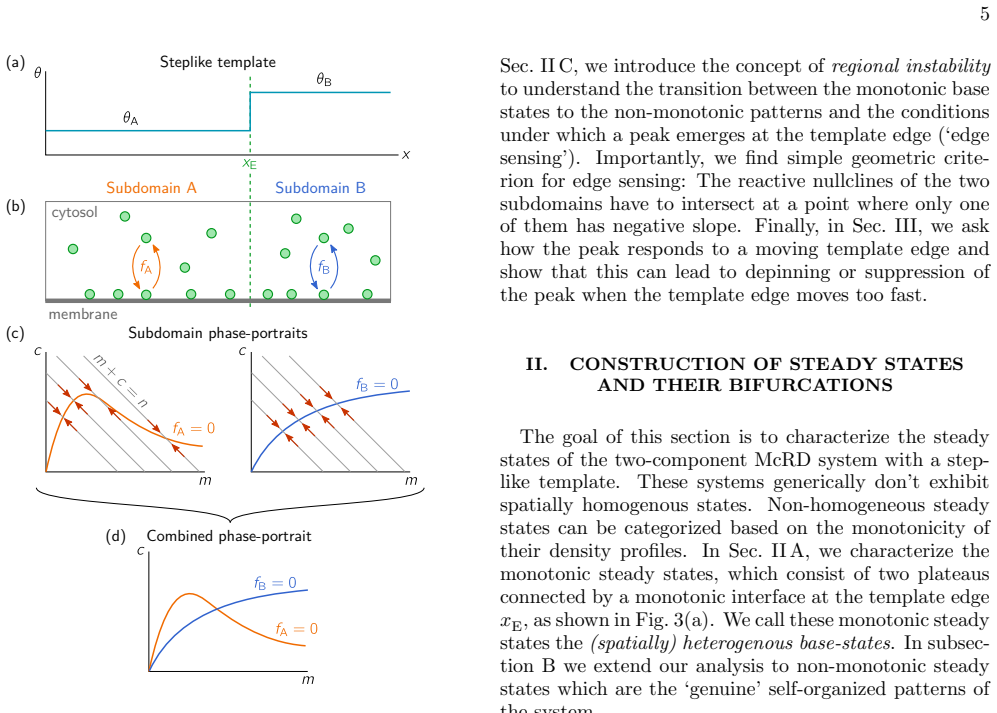
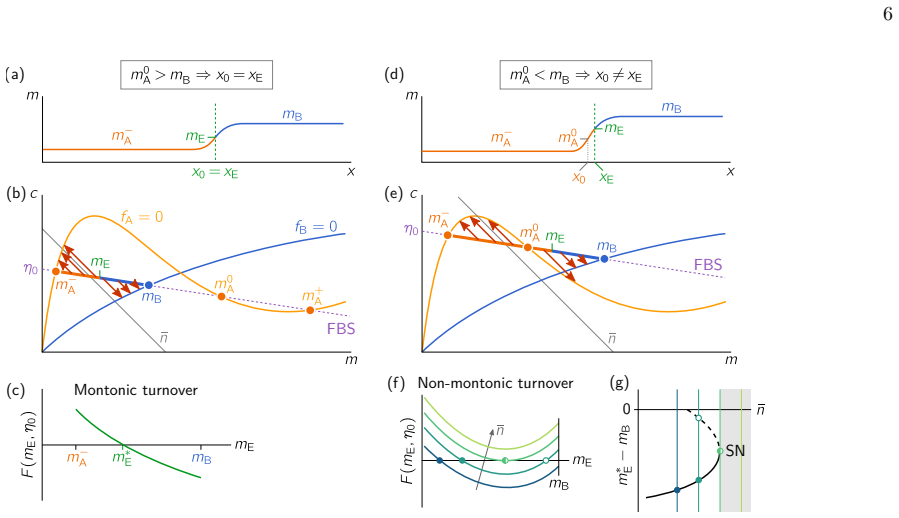
The engine is the phase-portrait construction of local equilibria theory: each subdomain's reaction kinetics is encoded in its reactive nullcline $f(m,c)=0$, and any stationary profile must lie in a single flux-balance subspace $c+(D_m/D_c)m=\eta_0$ (a line whose slope is the diffusion ratio). Within this construction, the criterion $\chi(\bar n)<-D_m/D_c$ for lateral instability of a homogeneous state becomes a geometric condition on nullcline slope. The paper generalizes the construction to a step template by overlaying two nullclines, splitting non-monotonic profiles at extrema into monotonic segments, fixing $\eta_0$ by total-turnover balance in the mesa segment, and locating where the profile crosses a laterally unstable nullcline branch. The object that carries the whole argument is the nullcline-intersection rule: edge sensing operates exactly when the two subdomains' nullclines intersect on a branch whose slope exceeds the flux-balance slope.
What would settle it
Run the two-subdomain system with the template chosen so the nullclines intersect only where both slopes are positive or both negative, sweep the average mass adiabatically through the base-state bifurcation, and look at where the first peak appears: the criterion predicts a boundary peak, never an edge peak. A stable edge peak in that parameter regime would falsify the geometric rule. A second check is geometric: make the unstable patch near the edge narrower than the shortest growing mode; the regional-instability assumption says edge sensing should disappear, so an edge peak there would also be evidence against the mechanism.
Extended reading notes
Core claim
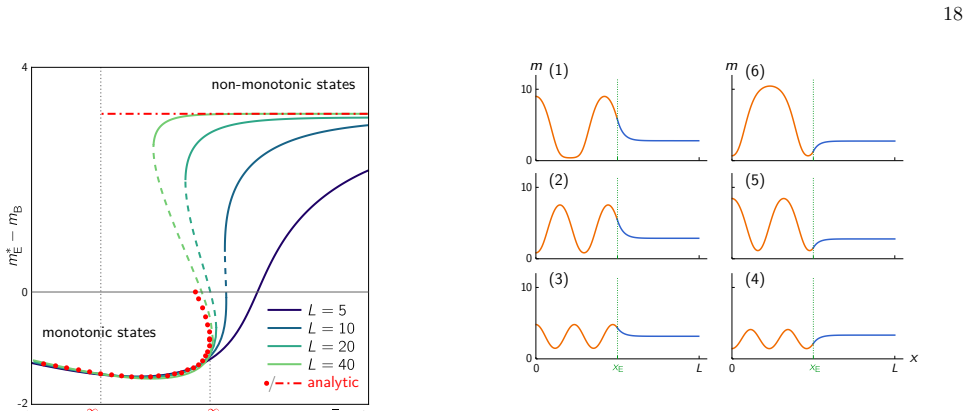
The central claim is that a step-like template localizes pattern formation through a regional mass-redistribution instability. In the stationary monotonic "base state" connecting the two subdomains' plateaus at the template edge, the profile can develop an inflection point inside subdomain A; as the average mass is increased this state disappears in a saddle-node bifurcation, and the neutral eigenfunction at the bifurcation is concentrated at the template edge. The phase portrait explains this localization: the profile crosses a branch of the A-nullcline whose slope is steeper than the flux-balance slope $-D_m/D_c$, the same condition that makes a homogeneous steady state laterally unstable. Applying that instability criterion locally to the region around the template edge predicts that a peak accumulates there. The resulting geometric criterion—the two nullclines must intersect at a point where one has negative slope steeper than $-D_m/D_c$—divides edge-sensing from boundary-peak behavior, and the paper verifies it against numerical continuation and against the phenomenological Cdc42 model. A slowly moving template edge keeps the peak pinned; fast pulling depins it, fast pushing suppresses it.
Load-bearing premise
The edge-peak prediction rests on assuming that a patch of the region next to the template edge can be treated as a small isolated homogeneous system, becoming unstable when its local reaction-balance curve is steeper than the diffusion-ratio line and the patch is larger than the shortest growing wavelength; the paper itself flags this regional-instability argument as heuristic, with a rigorous asymptotic derivation left for future work.
Editorial extensions
If this is right
- In the regime where the edge-sensing criterion holds, an adiabatic increase of total mass carries the system from the low-mass base state through the saddle-node bifurcation into a stable peak at the template edge; the same sweep produces a boundary peak when the criterion fails.
- The geometric criterion is quantitative enough to screen models: for the phenomenological Cdc42 model it predicts that the template must raise both attachment and detachment rates in one subdomain, matching the dual GEF/GAP role of Abr.
- A peak pinned to a slowly moving template edge follows the edge; above a critical edge velocity the two directions behave differently—pulling depins the peak while pushing suppresses it.
- Edge sensing persists beyond adiabatic mass changes as long as mass inflow is slower than diffusive transport across the domain; a phase diagram in $(L^2/D_c,\kappa_s^{-1})$ delimits the regime.
- Patterns with multiple peaks are unstable and coarsen into one of the two stable single-peak states, so the template edge acts as a selection mechanism between otherwise competing boundary-localized states.
Reading between the lines
- Beyond the paper: a smooth (non-step) template edge should weaken the regional instability as the gradient flattens; the paper's own heuristic suggests a threshold steepness below which edge sensing disappears, which one could test by varying edge width.
- Beyond the paper: because the criterion is purely geometric, it should transfer to other mass-conserving two-component systems—not only protein attachment-detachment—provided the nullcline and flux-balance slopes are defined; testing it in a reconstituted protein or DNA reaction-diffusion system would be a direct check.
- Beyond the paper: the moving-edge results imply that a downstream peak can track an upstream pattern only up to a velocity set by cytosolic diffusion and peak width; in a cell with moving landmarks this sets a bound on when polarization can follow a cue.
Signed reviews
Editorial analysis
A structured set of objections, weighed in public.
Referee Report
Summary. The paper studies two-component mass-conserving reaction-diffusion systems on a one-dimensional domain in the presence of a step-like template that changes the reaction kinetics in two subdomains. Building on the authors' local equilibria theory, it constructs monotonic 'base states' from flux-balance and total-turnover balance (Sec. II A), predicts their saddle-node bifurcation, and shows that non-monotonic patterns with a peak at the template edge or at the system boundary arise (Sec. II B). The proposed mechanism is a regional mass-redistribution instability localized near the template edge, summarized by a geometric nullcline-crossing criterion (Sec. II C, Fig. 6). The results are supported by numerical continuation, finite-element simulations, and a parameter scan of a Cdc42 model (Appendix F), and the moving-template section explores pinning, depinning, and suppression.
Significance. If correct, the paper offers a simple and biologically plausible design rule for edge sensing in mass-conserving reaction-diffusion systems and demonstrates it in a second model. The analysis is transparent: the flux-balance construction is compared with numerical continuation, the heuristic nature of the regional-instability argument is acknowledged, and the geometric criterion is falsifiable. The main limitation is that the central criterion is derived only as a necessary condition, while several claims are phrased as predictions of an operational regime; this gap is acknowledged but not quantitatively resolved.
major comments (3)
- [Sec. II C; Abstract; Discussion] The main text states, in Sec. II C, that the nullcline-crossing condition is 'a necessary condition to trigger a regional instability at the template edge,' but the Abstract and Discussion present the same condition as predicting when edge sensing is operational. These are different logical claims. Sufficiency would require the three regional-instability assumptions introduced in Sec. II C and footnote 8—local instability of the equilibrium at x0, existence of a region larger than the shortest growing mode, and treatment of subdomain B as a weak reservoir—none of which is derived. Because the criterion is the central claim, either a numerical test of these assumptions in the main model (e.g., varying xE or the nullcline shapes to cross the size threshold) or an explicit restriction of the predictive claim to the models of Fig. 4 and Appendix F should be added.
- [Sec. II C, footnote 8] The size condition 2(xE - x0) > pi/q_min(n0) is never checked numerically or analytically, although it is load-bearing for the transition from base state to edge peak. The single eigenfunction shown at one saddle-node (Fig. 5) and the Appendix F phase diagram cannot rule out nullcline arrangements or parameter values where the unstable region is too small or where the mass-reservoir coupling to subdomain B stabilizes the edge mode. I recommend computing q_min from the dispersion relation of the local equilibrium and testing whether edge sensing is lost when the inequality is violated.
- [Sec. II B and Appendix B] The text claims, in Sec. II B, that the edge peak exists 'only when the two nullclines intersect at a point where only one of them has negative slope.' The paper analyzes this for one nullcline arrangement in detail and for one non-edge-sensing arrangement in Appendix B; a general proof for arbitrary nullcline arrangements is not given. Since the flux-balance construction is explicitly restricted to the nullcline shapes of Fig. 2(d), the statement should be qualified accordingly, or the scope of the claim should be narrowed.
minor comments (5)
- [Fig. 6 and Sec. II C] The criterion is sometimes phrased as 'one nullcline has negative slope,' but the exact condition is that the slope is steeper than -Dm/Dc; the Discussion gives the correct version. Please make the precise condition consistent throughout, or state explicitly that the figures are drawn in the Dc >> Dm limit.
- [Footnote 8] The notation q_min(n0) for the shortest growing mode should be defined in terms of the unstable band of the dispersion relation, and the factor of pi rather than 2pi in the wavelength condition should be clarified.
- [Fig. 3] The label 'Non-montomic turnover' should be 'Non-monotonic turnover.'
- [Sec. II A] The monotonicity argument for the relation eta0(nbar) is compressed; writing the derivative of Eq. (11) with respect to eta0 explicitly would make the sign argument easier to verify.
- [Figs. 3-5] Several phase-space sketches are schematic; indicating which panels are actual numerical data, as is done in Fig. 8, would help the reader distinguish exact results from illustrations.
Circularity Check
No circularity: the edge-sensing criterion is derived from the model equations and tested against independent numerics, not fitted or defined into existence.
full rationale
The paper's central claim—that edge sensing occurs when the subdomain nullclines intersect where one slope is steeper than -Dm/Dc—is not an input or a fit. It is obtained from the flux-balance construction and total-turnover balance (Eqs. 11-12), which are derived from the model, and the regional-instability step is explicitly heuristic. The prediction is checked against numerical continuation and finite-element simulations in the main model (Fig. 4, Appendix E) and, independently, against the Cdc42 model in Appendix F, where the analytically derived nullcline-intersection boundary gamma_off^pm(gamma_on) is compared with simulated edge-peak regimes. The homogeneous nullcline-slope criterion Eq. (8) is cited from the authors' prior work [28], but that citation is transparent and the cited result is a parameter-free stability condition with a referenced derivation; the new content is the heterogeneous extension, not a restatement of Eq. (8). The paper itself flags the limitations: it calls the regional-instability argument heuristic and states that a rigorous asymptotic derivation remains future work, and the main text gives the nullcline-crossing condition only as a necessary condition. These are gaps in mathematical sufficiency, not circularity: no fitted parameter is renamed a prediction, no quantity is defined in terms of the target, and no load-bearing conclusion is forced by a self-citation chain. Therefore the derivation chain is self-contained against the numerical benchmarks and no circular step can be quoted or exhibited.
Assumptions & free parameters
assumptions (6)
- domain assumption The dynamics of the protein system is a two-component mass-conserving reaction-diffusion model with reaction term f(m,c;theta) and diffusion constants Dm and Dc (Eq. 1).
- standard math In any stationary state on a no-flux domain, the mass-redistribution potential eta = c + (Dm/Dc)m is spatially constant (Eq. 5).
- domain assumption For large domains, plateau concentrations of a base state are well approximated by the flux-balance subspace and reactive nullcline intersection points (Sec. II A).
- domain assumption The total reactive turnover balance (Eq. 12) determines the membrane concentration at the template edge in steady state.
- domain assumption The homogeneous-domain nullcline-slope instability criterion (Eq. 8) applies locally to a subregion of subdomain A near the template edge if that region contains the shortest growing mode (Sec. II C and footnote 8).
- domain assumption The eigenfunction of the vanishing eigenvalue at the saddle-node bifurcation indicates where the new pattern will grow (center manifold intuition, Sec. II C).
Cite this review
Pith. "Pith review of Pattern localization to a domain edge." pith.science (2026). https://pith.science/paper/JLYUOUSI
@misc{pith2026190807309,
  author       = {Pith},
  title        = {Pith review of: Pattern localization to a domain edge},
  year         = {2026},
  howpublished = {\url{https://pith.science/paper/JLYUOUSI}},
  note         = {Machine review of arXiv:1908.07309}
}
read the original abstract
The formation of protein patterns inside cells is generically described by reaction-diffusion models. The study of such systems goes back to Turing, who showed how patterns can emerge from a homogenous steady state when two reactive components have different diffusivities (e.g. membrane-bound and cytosolic states). However, in nature, systems typically develop in a heterogeneous environment, where upstream protein patterns affect the formation of protein patterns downstream. Examples for this are the polarization of Cdc42 adjacent to the previous bud-site in budding yeast, and the formation of an actin-recruiter ring that forms around a PIP3 domain in macropinocytosis. This suggests that previously established protein patterns can serve as a template for downstream proteins and that these downstream proteins can 'sense' the edge of the template. A mechanism for how this edge sensing may work remains elusive. Here we demonstrate and analyze a generic and robust edge-sensing mechanism, based on a two-component mass-conserving reaction-diffusion (McRD) model. Our analysis is rooted in a recently developed theoretical framework for McRD systems, termed local equilibria theory. We extend this framework to capture the spatially heterogeneous reaction kinetics due to the template. This enables us to graphically construct the stationary patterns in the phase space of the reaction kinetics. Furthermore, we show that the protein template can trigger a regional mass-redistribution instability near the template edge, leading to the accumulation of protein mass, which eventually results in a stationary peak at the template edge. We show that simple geometric criteria on the reactive nullcline's shape predict when this edge-sensing mechanism is operational. Thus, our results provide guidance for future studies of biological systems, and for the design of synthetic pattern forming systems.
Figures

Figures from the paper (9 more)



Reference graph
Works this paper leans on
-
[1]
Template-edge peak. For small κs, a density peak emerges at the template edge, even though the den- sity profile does not relax to a quasi-steady state. This highlights that the edge-sensing mechanism is robust against rate of mass inflow. (Supplementary Movie 9)
-
[2]
Transition regime. Here, we observe two peaks emerging simultaneously, one at the outer bound- ary of subdomain A and one at the template edge. This is an intermediate regime between the bound- ary peak regime (3) and the template edge peak regime (1), as both peaks emerge simultaneously. (Supplementary Movie 10)
-
[3]
Here, we observe one peak forming at the system boundary at x = 0
System-boundary peak. Here, we observe one peak forming at the system boundary at x = 0. (Sup- plementary Movie 11)
-
[4]
Sequential peak formation. First, a peak forms at the domain boundary of subdomain A, as in the 16 Regional lateral instability (a) (b) (c) (d) FIG. 9. An adiabatically changing template triggers peak formation at the template edge. See also Supplementary Movie 8. (a) Initial state with a homogeneous template profile θA =θB. (b) Base state analogous to Fig...
-
[5]
Here, the pattern-formation pro- cess is very similar to the system-boundary peak regime (3)
Multiple peaks. Here, the pattern-formation pro- cess is very similar to the system-boundary peak regime (3). However, multiple peaks form at the outer boundary of subdomain A simultaneously. (Supplementary Movie 13)
-
[6]
Quenched system. Here the mass is upregulated al- most instantaneously, κ−1 s → 0, which is equivalent to a system initialized with the complete mass in the cytosol. This results in a sequence of peaks forms in subdomain A, starting from the template edge in a process akin to front invasion into an un- stable state [53]. (Supplementary Movie 14) Note that...
-
[7]
J. Halatek, F. Brauns, and E. Frey, Philosophical Trans- actions of the Royal Society B: Biological Sciences 373, 20170107 (2018)
work page 2018
-
[8]
M. Howard, A. D. Rutenberg, and S. de Vet, Physical Review Letters 87 (2001), 10.1103/Phys- RevLett.87.278102
doi:10.1103/phys- 2001
Show all 59 references
-
[9]
K. C. Huang, Y. Meir, and N. S. Wingreen, Proceedings of the National Academy of Sciences 100, 12724 (2003)
2003
-
[10]
Y. Mori, A. Jilkine, and L. Edelstein-Keshet, Biophysical Journal 94, 3684 (2008)
2008
-
[11]
A. B. Goryachev and A. V. Pokhilko, FEBS Letters 582, 1437 (2008)
2008
-
[12]
Ishihara, M
S. Ishihara, M. Otsuji, and A. Mochizuki, Physical Re- view E 75 (2007), 10.1103/PhysRevE.75.015203
2007 doi
-
[13]
Otsuji, S
M. Otsuji, S. Ishihara, C. Co, K. Kaibuchi, A. Mochizuki, and S. Kuroda, PLoS Computational Biology 3, e108 (2007)
2007
-
[14]
Halatek and E
J. Halatek and E. Frey, Cell Reports 1, 741 (2012)
2012
-
[15]
Kl¨ under, T
B. Kl¨ under, T. Freisinger, R. Wedlich-S¨ oldner, and E. Frey, PLOS Computational Biology 9, e1003396 (2013)
2013
-
[16]
P. K. Trong, E. M. Nicola, N. W. Goehring, K. V. Ku- mar, and S. W. Grill, New Journal of Physics 16, 065009 (2014)
2014
-
[17]
Alonso and M
S. Alonso and M. B¨ ar, EPJ Nonlinear Biomed Phys2, 1 (2014)
2014
-
[18]
F. Wu, J. Halatek, M. Reiter, E. Kingma, E. Frey, and C. Dekker, Molecular Systems Biology 12, 873 (2016)
2016
-
[19]
A. B. Goryachev and M. Leda, Molecular Biology of the Cell 28, 370 (2017)
2017
-
[20]
S. M. Murray and V. Sourjik, Nature Physics 13, 1006 (2017)
2017
-
[21]
J. Denk, S. Kretschmer, J. Halatek, C. Hartl, P. Schwille, and E. Frey, Proc Natl Acad Sci USA 115, 4553 (2018)
2018
-
[22]
Cusseddu, L
D. Cusseddu, L. Edelstein-Keshet, J. Mackenzie, S. Portet, and A. Madzvamuse, Journal of Theoretical Biology (2018), 10.1016/j.jtbi.2018.09.008
2018 doi
-
[23]
Chiou, S
J.-G. Chiou, S. A. Ramirez, T. C. Elston, T. P. Witelski, D. G. Schaeffer, and D. J. Lew, PLOS Computational Biology 14, e1006095 (2018)
2018
-
[24]
Glock, F
P. Glock, F. Brauns, J. Halatek, E. Frey, and P. Schwille, bioRxiv (2019), 10.1101/666362
2019 doi
-
[25]
A. M. Turing, Philosophical Transactions of the Royal Society of London. Series B, Biological Sciences 237, 37 (1952)
1952
-
[26]
T. D. Williams, P. I. Paschke, and R. R. Kay, Philo- sophical Transactions of the Royal Society B: Biological Sciences 374, 20180150 (2019)
2019
-
[27]
D. M. Veltman, T. D. Williams, G. Bloomfield, B.-C. Chen, E. Betzig, R. H. Insall, and R. R. Kay, eLife 5, e20085 (2016)
2016
-
[28]
E. M. Vaughan, A. L. Miller, H.-Y. E. Yu, and W. M. Bement, Current Biology 21, 270 (2011)
2011
-
[29]
Chant and J
J. Chant and J. R. Pringle, J. Cell Biol. 129, 751 (1995)
1995
-
[30]
Tong, X.-D
Z. Tong, X.-D. Gao, A. S. Howell, I. Bose, D. J. Lew, and E. Bi, J Cell Biol 179, 1375 (2007)
2007
-
[31]
W.-C. Lo, M. E. Lee, M. Narayan, C.-S. Chou, and H.-O. Park, PLoS ONE 8, e56665 (2013)
2013
-
[32]
K. E. Miller, W.-C. Lo, M. E. Lee, P. J. Kang, and H.-O. Park, Molecular Biology of the Cell 28, 3773 (2017)
2017
-
[33]
Halatek and E
J. Halatek and E. Frey, Nature Physics 14, 507 (2018)
2018
- [34]
-
[35]
P. K. Maini, D. L. Benson, and J. A. Sherratt, Math Med Biol 9, 197 (1992)
1992
-
[36]
G. B. Ermentrout and J. Rinzel, SIAM Journal on Ap- plied Mathematics 56, 1107 (1996)
1996
-
[37]
B¨ ar, A
M. B¨ ar, A. K. Bangia, I. G. Kevrekidis, G. Haas, H.- H. Rotermund, and G. Ertl, The Journal of Physical Chemistry 100, 19106 (1996)
1996
-
[38]
X. Yuan, T. Teramoto, and Y. Nishiura, Phys. Rev. E 75, 036220 (2007)
2007
-
[39]
Nishiura, T
Y. Nishiura, T. Teramoto, X. Yuan, and K.-I. Ueda, Chaos: An Interdisciplinary Journal of Nonlinear Science 17, 037104 (2007)
2007
-
[40]
Miyazaki and S
J. Miyazaki and S. Kinoshita, Physical Review E 76 (2007), 10.1103/PhysRevE.76.066201
2007 doi
-
[41]
Nishi, Y
K. Nishi, Y. Nishiura, and T. Teramoto, Japan Journal of Industrial and Applied Mathematics 30, 351 (2013)
2013
-
[42]
Doelman, P
A. Doelman, P. van Heijster, and F. Xie, SIAM Journal on Applied Dynamical Systems 15, 655 (2016)
2016
-
[43]
van Heijster, C.-N
P. van Heijster, C.-N. Chen, Y. Nishiura, and T. Ter- amoto, J Dyn Diff Equat 31, 153 (2019)
2019
-
[44]
Scheel and J
A. Scheel and J. Weinburd, Philosophical Transactions of the Royal Society A: Mathematical, Physical and En- gineering Sciences 376, 20170191 (2018)
2018
-
[45]
C. K. R. T. Jones, in Dynamical Systems , Vol. 1609, edited by R. Johnson (Springer, Berlin, Heidelberg, 1995) pp. 44–118
1995
-
[46]
M. J. Ward, Bulletin of Mathematical Biology 68, 1151 (2006)
2006
-
[47]
Guckenheimer and P
J. Guckenheimer and P. Holmes, Nonlinear Oscillations, Dynamical Systems, and Bifurcations of Vector Fields , Applied Mathematical Sciences, Vol. 42 (Springer New York, New York, NY, 1983)
1983
-
[48]
Krauskopf, H
B. Krauskopf, H. M. Osinga, and J. Galan-Vioque, eds., Numerical Continuation Methods for Dynamical Systems: Path Following and Boundary Value Problems , Understanding Complex Systems (Springer Netherlands, Dordrecht, 2007)
2007
-
[49]
J. D. Pryce, Numerical Solution of Sturm-Liouville Prob- lems, Monographs on Numerical Analysis (Clarendon Press, Oxford; New York, 1993)
1993
-
[50]
Ziepke, S
A. Ziepke, S. Martens, and H. Engel, J. Chem. Phys. 145, 094108 (2016)
2016
-
[51]
S. R. Pfeffer, Biochemical Society Transactions 40, 1373 (2012)
2012
-
[52]
Novick, Small GTPases 7, 252 (2016)
P. Novick, Small GTPases 7, 252 (2016)
2016
-
[53]
L. C. Noack and Y. Jaillais, Current Opinion in Plant Biology 40, 22 (2017)
2017
-
[54]
Rulands, B
S. Rulands, B. Kl¨ under, and E. Frey, Phys. Rev. Lett. 110, 038102 (2013)
2013
-
[55]
A. S. Zadorin, Y. Rondelez, G. Gines, V. Dilhas, G. Ur- tel, A. Zambrano, J.-C. Galas, and A. Estevez-Torres, Nature Chemistry 9, 990 (2017)
2017
-
[56]
Thalmeier, J
D. Thalmeier, J. Halatek, and E. Frey, Proc Natl Acad Sci USA 113, 548 (2016)
2016
-
[57]
Ziepke, S
A. Ziepke, S. Martens, and H. Engel, SIAM J. Appl. Dyn. Syst. 18, 1015 (2019)
2019
-
[58]
Haupt and N
A. Haupt and N. Minc, Journal of Cell Science 131, jcs214015 (2018)
2018
-
[59]
van Saarloos, Physics Reports 386, 29 (2003)
W. van Saarloos, Physics Reports 386, 29 (2003)
2003
Reviewed August 14, 2026 · model on record in the stance chip above.
Discussion (0). Continue with ORCID to comment.