REVIEW 3 major objections 5 minor 43 references
A Multi-View Discriminant Learning Approach for Indoor Localization Using Bimodal Features of CSI
T0 review · 3 major / 5 minor · reviewed 2026-08-14 · deepseek-v4-flash
Pith's one-line read A multi-view discriminant projection over Wi-Fi channel data can locate a person indoors to about 0.15–0.25 m mean error, without requiring the person to carry any device.
desk verdict A clean derivation of a plausible method, but the empirical comparison changes both algorithm and input features at once, so the headline accuracy numbers are not yet substantiated. read the letter →
The pith
A machine-rendered reading of the paper's core claim, the machinery that carries it, and where it could break.
The reading
What carries the argument
The load-bearing object is the GI2DCA optimization, a generalized eigenvalue problem that maximizes a weighted sum of intra-view between-class scatter (from LDA-style terms) and inter-view discriminant correlation (a DCCA-style term with the class-block matrix G), subject to a trace-ratio constraint over within-view covariance. It generalizes MCCA by injecting class labels across views and generalizes GMA by adding inter-view class association. Solving it yields one projection per access point; projections are averaged per modality, and the amplitude and phase results are stacked to form the final feature image used with Euclidean-distance matching. The paper notes the cost is $O(d^3 M)$ for $d$ the largest feature dimension and $M$ views.
What would settle it
Re-run the comparison with MCCA and PWCCA receiving exactly the same features MuDLoc uses, namely amplitude and phase-difference from the same 3 APs, and check whether MuDLoc still shows a 65% mean-error improvement; if the gap nearly disappears, the claim that inter-view and intra-view discriminant structure drives the accuracy is falsified.
Extended reading notes
Core claim
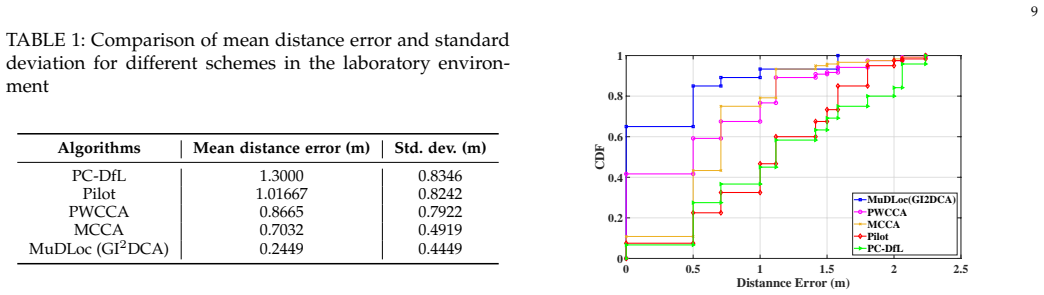
On the paper's own terms, the discovery is that a generalized discriminant correlation analysis over multi-view CSI, called GI2DCA, produces a common feature space in which different access points' amplitude and phase features agree for the same cell and differ across cells. The method stacks per-view projected amplitude features and per-view projected phase features into a Multi-view Discriminant Feature Image, then labels a test point by nearest Euclidean distance to the training cell average. In the reported experiments this yields mean distance errors of 0.2449 m in the laboratory and 0.1500 m in the corridor, with roughly 90% of test locations within 1 m, beating RSS-based and single-AP CSI baselines. The paper attributes the gain to exploiting inter-view and intra-view class structure jointly, not just correlations.
Load-bearing premise
The experiment assumes the benchmark methods are compared on equal footing, so the baselines use the same bimodal, multi-AP features and only the discriminant projection differs; if that is not the case, the reported accuracy gain could come from the richer input rather than from GI2DCA.
Editorial extensions
If this is right
- A device-free system can reach mean errors of 0.2449 m in a cluttered lab and 0.1500 m in a corridor using 3 to 5 commodity Wi-Fi access points.
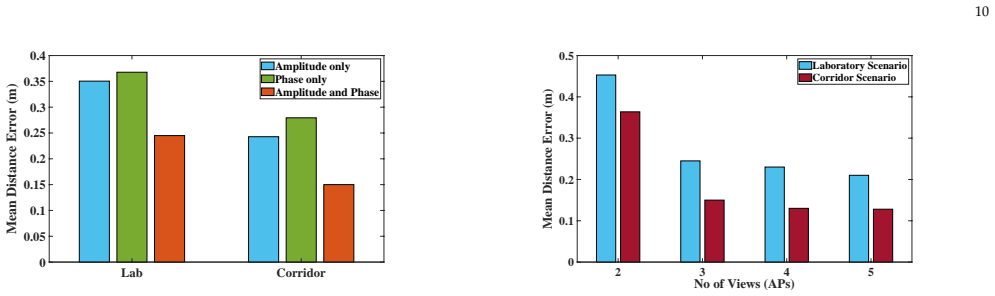
- Adding more access points improves accuracy, but the marginal gain beyond 3 APs is small, so the paper recommends 3 APs as the cost-accuracy trade-off point.
- Using amplitude and phase together is better than either alone; the reported bimodal fusion reaches the lowest errors.
- The multi-view discriminant projection outperforms MCCA and pairwise CCA on the same raw dataset, with a reported 65% improvement in mean distance error over MCCA.
- Increasing the number of online CSI packets from 300 to 600 reduces error only mildly, so 300 packets are treated as sufficient for the test phase.
Reading between the lines
- An extension beyond the paper: because the baselines were evaluated with amplitude-only or RSS-only features, a controlled ablation feeding MCCA and PWCCA the same amplitude-plus-phase multi-AP features is needed to isolate whether GI2DCA's inter-view and intra-view terms, rather than the extra input information, produce the reported gap.
- An extension beyond the paper: the phase-difference stabilisation relies on the receiver antennas sharing a clock, a property the paper observes on Intel 5300 hardware; re-testing on other NICs and antenna spacings would show whether sub-0.25 m accuracy is portable.
- An extension beyond the paper: the same joint projection could be tested on other device-free sensing tasks such as fall detection, gait recognition, or occupancy counting, where multiple access points and dual CSI modalities form natural views.
Signed reviews
Editorial analysis
A structured set of objections, weighed in public.
Referee Report
Summary. The paper proposes MuDLoc, a device-free indoor localization system that uses CSI amplitude and phase-difference features collected from multiple access points. The core algorithmic contribution is GI2DCA, which extends generalized multiview analysis (GMA) by adding an inter-view discriminant term based on DCCA, yielding a generalized eigenvalue problem solved for view-specific linear projections. Offline, these projections map multi-view amplitude and phase features to a common space whose averaged canonical variates are stacked into a Multi-view Discriminant Feature Image; online, a test sample is matched to the nearest training cell centroid by Euclidean distance. Experiments in a laboratory and a corridor compare MuDLoc with PC-DfL, Pilot, PWCCA, and MCCA, reporting mean distance errors of 0.2449 m and 0.1500 m and claiming about 65% improvement over MCCA.
Significance. If the reported accuracy is reproducible, sub-0.25 m device-free localization with commodity 802.11n hardware would be a practically valuable advance, and the paper's combination of inter-view and intra-view discriminant structure is a natural and readable extension of existing CCA/GMA machinery. The derivation of the generalized eigenvalue problem is standard and appears internally consistent, and the authors include useful ablations on feature modality and AP count. However, the central outperformance claim is currently supported only by comparisons in which MuDLoc differs from every baseline in both the recognition algorithm and the input features (bimodal multi-AP CSI vs. amplitude-only or RSS from a single or averaged AP), so the magnitude of the claimed gain cannot be attributed to GI2DCA. The absence of significance tests, confidence intervals, and released code or data further limits the strength of the empirical claims.
major comments (3)
- [§5.2, Tables 1–2] The benchmark comparison does not control for input features. The text in §5.2 states that 'all other methods use only the amplitude feature of CSI or RSS value' and that these methods 'are either designed to work with single AP or consider the average value for multiple APs,' whereas MuDLoc uses amplitude plus phase-difference features from multiple APs. Therefore the reported gains (e.g., 0.2449 m vs. 0.7032 m for MCCA in the laboratory) could result largely from the richer bimodal multi-AP representation rather than from the GI2DCA objective. To support the central claim that the GI2DCA formulation outperforms benchmark approaches, the authors should re-run PWCCA, MCCA, and (where possible) Pilot and PC-DfL on the same bimodal multi-AP feature set and the same AP count, or add an ablation in which GI2DCA is restricted to the same features as each baseline.
- [§5.1, §5.5, Tables 1–2] The number of APs used for the headline results is ambiguous. Section 5.1 describes the laboratory experiment with 5 APs and the corridor experiment with 3 APs, yet Section 5.5 concludes that 'this work considers using 3 AP' for both deployments, and Fig. 12 shows results for 2–5 APs. It is therefore unclear whether Tables 1 and 2 report 5-AP laboratory results, 3-AP results, or a mix; this ambiguity matters because Fig. 12 shows that AP count changes mean error (e.g., the laboratory error decreases as APs increase from 2 to 5). The authors should state explicitly which AP count produced each reported table and figure, and should present the main comparison consistently for the selected configuration.
- [§5.1, Tables 1–2] The statistical evidence for the headline comparison is incomplete. Section 5.1 says 10 independent measurements were taken on 10 different days and that 'the mean value' was used for performance evaluation, but Tables 1–2 report only a single mean and standard deviation per method, without stating whether the standard deviation is over test locations, over the 10 days, or over some other partition. No confidence intervals or significance tests are provided, so the reader cannot judge whether the reported gaps (e.g., 0.1500 m vs. 0.6888 m in the corridor) are stable across days or runs. The authors should report per-day or per-run errors and provide a paired significance test across the 10 daily measurements, or otherwise justify that the reported differences exceed experimental variability.
minor comments (5)
- [§4.1.2, Eqs. (13) and (20)] The notation for the number of views is inconsistent: the optimization formulations in Eqs. (13) and (20) use N while the surrounding text and Eq. (26) use M; please unify this notation.
- [§4.1.2, Eq. (20)] The statement that 'the constraints are coupled with γ = trace ratio' is unclear; please specify how γ_i are chosen and what 'trace ratio' means in the constraint of Eq. (20).
- [§4.1.1] The construction of the phase-difference feature image Y_i is underspecified: the exact dimension d_{Y_i} and the arrangement of pairwise phase differences across subcarriers and antenna pairs into rows and columns are not described, which would hinder reproducibility.
- [Throughout] There are several typographical errors, including 'Morover' (§5.2), 'Simialrly' (§4.2), 'Distannce' (Fig. 9 caption), 'architechture' (§4), and 'discriminnat' (§5.2); a careful proofread is needed.
- [Abstract and §1] The claim that MuDLoc is 'the first multi-view discriminant learning approach' for device-free localization is stronger than the related-work discussion supports, since GMA [33] already performs multi-view discriminant analysis; please soften the claim and explicitly contrast MuDLoc with the authors' earlier DCCA-based method [17].
Circularity Check
No significant circularity: GI2DCA combines the published GMA and DCCA objectives, and the reported localization errors are held-out test results rather than re-used training fits.
full rationale
The derivation chain is self-contained. GI2DCA (Eq. 22) is explicitly written as a combination of the GMA objective (Eq. 20, from [33]) and the DCCA cross-view scatter term X_i G X_j^T (Eq. 10, from [39]); it does not define its own output as an input. The only tuned quantity is beta, selected by 5-fold cross-validation on a validation split, while the reported mean errors (Tables 1 and 2) are computed on held-out test locations from a 6:2:2 split, so the accuracy numbers are genuine forward predictions. The phase-difference stabilization (Eq. 7) is taken from external hardware behavior [34], not from the target result. The self-citations [16] and [17] appear in the introduction and in the motivation for using CCA, but the load-bearing derivation and evaluation do not reduce to them: [17] is described as confirming CCA-based localization, not as establishing MuDLoc's accuracy. Finally, the fact that the baseline methods in Section 5.2 use amplitude-only or RSS features and single-AP information is an evaluation-comparability weakness, not a circularity, because no equation or fitted parameter in MuDLoc is constructed from those baseline outputs.
Assumptions & free parameters
free parameters (5)
- beta_{i,j} =
selected by 5-fold cross-validation in [0, 1000]
- alpha_i =
set to 1
- number of test packets =
300
- number of APs in main comparison =
not explicitly stated
- r (number of retained canonical dimensions) =
not specified
assumptions (4)
- domain assumption Phase difference between two receiver antennas of the same NIC is stable because they share clock and down-converter (Eq. 7 approximates measured phase difference as original phase difference).
- domain assumption CSI fingerprints for the same cell are repeatable enough that a linear subspace can separate the C cells.
- standard math The generalized eigenvalue problem T w = lambda D_hat w is solvable; the block-diagonal D_hat is invertible or effectively regularized.
- domain assumption Class indicator matrix G from DCCA correctly encodes same-class sample pairs, so Xi G Xj^T captures inter-view within-class correlation.
Cite this review
Pith. "Pith review of A Multi-View Discriminant Learning Approach for Indoor Localization Using Bimodal Features of CSI." pith.science (2026). https://pith.science/paper/Z4AQBWPL
@misc{pith2026190807370,
  author       = {Pith},
  title        = {Pith review of: A Multi-View Discriminant Learning Approach for Indoor Localization Using Bimodal Features of CSI},
  year         = {2026},
  howpublished = {\url{https://pith.science/paper/Z4AQBWPL}},
  note         = {Machine review of arXiv:1908.07370}
}
abstract
With the growth of location-based services, indoor localization is attracting great interests as it facilitates further ubiquitous environments. Specifically, device free localization using wireless signals is getting increased attention as human location is estimated using its impact on the surrounding wireless signals without any active device tagged with subject. In this paper, we propose MuDLoc, the first multi-view discriminant learning approach for device free indoor localization using both amplitude and phase features of Channel State Information (CSI) from multiple APs. Multi-view learning is an emerging technique in machine learning which improve performance by utilizing diversity from different view data. In MuDLoc, the localization is modeled as a pattern matching problem, where the target location is predicted based on similarity measure of CSI features of an unknown location with those of the training locations. MuDLoc implements Generalized Inter-view and Intra-view Discriminant Correlation Analysis (GI$^{2}$DCA), a discriminative feature extraction approach using multi-view CSIs. It incorporates inter-view and intra-view class associations while maximizing pairwise correlations across multi-view data sets. A similarity measure is performed to find the best match to localize a subject. Experimental results from two cluttered environments show that MuDLoc can estimate location with high accuracy which outperforms other benchmark approaches.
Figures


Figures from the paper (6 more)



Reference graph
Works this paper leans on
-
[1]
Survey of wireless indoor positioning techniques and systems,
H. Liu, H. Darabi, P . Banerjee, and J. Liu, “Survey of wireless indoor positioning techniques and systems,” IEEE T ransactions on Systems, Man, and Cybernetics, Part C (Applications and Reviews) , vol. 37, no. 6, pp. 1067–1080, Nov 2007
work page 2007
-
[2]
From RSSI to CSI: Indoor localiza- tion via channel response,
Z. Yang, Z. Zhou, and Y. Liu, “From RSSI to CSI: Indoor localiza- tion via channel response,” ACM Comput. Surv., vol. 46, no. 2, pp. 25:1–25:32, Dec. 2013
work page 2013
-
[3]
Radar: an in-building rf-based user location and tracking system,
P . Bahl and V . N. Padmanabhan, “Radar: an in-building rf-based user location and tracking system,” in Proceedings IEEE INFOCOM
-
[4]
The horus wlan location determi- nation system,
M. Youssef and A. Agrawala, “The horus wlan location determi- nation system,” in Proceedings of the 3rd International Conference on Mobile Systems, Applications, and Services , New York, NY, USA, 2005, MobiSys ’05, pp. 205–218, ACM
work page 2005
-
[5]
Nuzzer: A large-scale device-free passive localization system for wireless environments,
M. Seifeldin, A. Saeed, A. E. Kosba, A. El-Keyi, and M. Youssef, “Nuzzer: A large-scale device-free passive localization system for wireless environments,” IEEE T ransactions on Mobile Computing , vol. 12, no. 7, pp. 1321–1334, July 2013
work page 2013
-
[6]
The case for efficient and robust rf-based device-free localization,
C. Xu, B. Firner, Y. Zhang, and R. E. Howard, “The case for efficient and robust rf-based device-free localization,” IEEE T ransactions on Mobile Computing, vol. 15, no. 9, pp. 2362–2375, Sep. 2016
work page 2016
-
[7]
Writing in the air with wifi signals for virtual reality devices,
Z. Fu, J. Xu, Z. Zhu, A. X. Liu, and X. Sun, “Writing in the air with wifi signals for virtual reality devices,” IEEE T ransactions on Mobile Computing, vol. 18, no. 2, pp. 473–484, Feb 2019
work page 2019
-
[8]
Exploiting wifi channel state information for residential health- care informatics,
B. Tan, Q. Chen, K. Chetty, K. Woodbridge, W. Li, and R. Piechocki, “Exploiting wifi channel state information for residential health- care informatics,” IEEE Communications Magazine , vol. 56, no. 5, pp. 130–137, May 2018
work page 2018
Show all 43 references
-
[9]
Wifall: Device-free fall detection by wireless networks,
Y. Wang, K. Wu, and L. M. Ni, “Wifall: Device-free fall detection by wireless networks,” IEEE T ransactions on Mobile Computing, vol. 16, no. 2, pp. 581–594, Feb 2017
2017
-
[10]
Predictable 802.11 packet delivery from wireless channel mea- surements,
Daniel Halperin, Wenjun Hu, Anmol Sheth, and David Wetherall, “Predictable 802.11 packet delivery from wireless channel mea- surements,” in Proceedings of the ACM SIGCOMM 2010 Conference , New York, NY, USA, 2010, SIGCOMM ’10, pp. 159–170, ACM
2010
-
[11]
Tool release: Gathering 802.11n traces with channel state information,
D. Halperin, W. Hu, A. Sheth, and D. Wetherall, “Tool release: Gathering 802.11n traces with channel state information,” SIG- COMM Comput. Commun. Rev. , vol. 41, no. 1, pp. 53–53, Jan. 2011
2011
-
[12]
Deepfi: Deep learning for indoor fingerprinting using channel state information,
X. Wang, L. Gao, S. Mao, and S. Pandey, “Deepfi: Deep learning for indoor fingerprinting using channel state information,” in 2015 IEEE Wireless Communications and Networking Conference (WCNC) , March 2015, pp. 1666–1671
2015
-
[13]
FIFS: Fine-grained indoor fingerprinting system,
J. Xiao, K. Wu, Y. Yi, and L. M. Ni, “FIFS: Fine-grained indoor fingerprinting system,” in 2012 21st International Conference on Computer Communications and Networks (ICCCN) , July 2012, pp. 1– 7
2012
-
[14]
FILA: Fine- grained indoor localization,
K. Wu, Jiang Xiao, Youwen Yi, Min Gao, and L. M. Ni, “FILA: Fine- grained indoor localization,” in 2012 Proceedings IEEE INFOCOM , March 2012, pp. 2210–2218
2012
-
[15]
CSI-MIMO: Indoor wi-fi fingerprinting system,
Y. Chapre, A. Ignjatovic, A. Seneviratne, and S. Jha, “CSI-MIMO: Indoor wi-fi fingerprinting system,” in 39th Annual IEEE Confer- ence on Local Computer Networks , Sept 2014, pp. 202–209
2014
-
[16]
An improved CSI based device free indoor localization using machine learning based classification approach,
T. F. Sanam and H. Godrich, “An improved CSI based device free indoor localization using machine learning based classification approach,” in 2018 26th European Signal Processing Conference (EUSIPCO), Sep. 2018, pp. 2390–2394
2018
-
[17]
Device free indoor localization using discriminant features of CSI a canonical correlation paradigm,
T. F. Sanam and H. Godrich, “Device free indoor localization using discriminant features of CSI a canonical correlation paradigm,” in 2018 52nd Asilomar Conference on Signals, Systems, and Computers , Oct 2018, pp. 423–427
2018
-
[18]
Pilot: Passive device- free indoor localization using channel state information,
J. Xiao, K. Wu, Y. Yi, L. Wang, and L. M. Ni, “Pilot: Passive device- free indoor localization using channel state information,” in 2013 IEEE 33rd International Conference on Distributed Computing Systems, July 2013, pp. 236–245
2013
-
[19]
Low human-effort, device-free localization with fine-grained subcarrier information,
J. Wang, J. Xiong, H. Jiang, K. Jamieson, X. Chen, D. Fang, and C. Wang, “Low human-effort, device-free localization with fine-grained subcarrier information,” IEEE T ransactions on Mobile Computing, vol. 17, no. 11, pp. 2550–2563, Nov 2018
2018
-
[20]
Defi: Robust training-free device-free wireless localization with wifi,
L. Zhang, Q. Gao, X. Ma, J. Wang, T. Yang, and H. Wang, “Defi: Robust training-free device-free wireless localization with wifi,” IEEE T ransactions on Vehicular T echnology, vol. 67, no. 9, pp. 8822– 8831, Sep. 2018
2018
-
[21]
Device-free radio vision for assisted living: Leveraging wireless channel quality information for human sensing,
S. Savazzi, S. Sigg, M. Nicoli, V . Rampa, S. Kianoush, and U. Spag- nolini, “Device-free radio vision for assisted living: Leveraging wireless channel quality information for human sensing,” IEEE Signal Processing Magazine , vol. 33, no. 2, pp. 45–58, March 2016
2016
-
[22]
Freesense: A robust approach for indoor human detection using wi-fi signals,
Tong Xin, Bin Guo, Zhu Wang, Pei Wang, Jacqueline Chi Kei Lam, Victor Li, and Zhiwen Yu, “Freesense: A robust approach for indoor human detection using wi-fi signals,” Proc. ACM Interact. Mob. Wearable Ubiquitous T echnol. , vol. 2, no. 3, pp. 143:1–143:23, Sept. 2018
2018
-
[23]
Improve accuracy of fingerprinting localization with temporal correlation of the RSS,
X. Tian, M. Wang, W. Li, B. Jiang, D. Xu, X. Wang, and J. Xu, “Improve accuracy of fingerprinting localization with temporal correlation of the RSS,” IEEE T ransactions on Mobile Computing , vol. 17, no. 1, pp. 113–126, Jan 2018
2018
-
[24]
An exponential-rayleigh model for RSS-based device-free localization and tracking,
Y. Guo, K. Huang, N. Jiang, X. Guo, Y. Li, and G. Wang, “An exponential-rayleigh model for RSS-based device-free localization and tracking,” IEEE T ransactions on Mobile Computing, vol. 14, no. 3, pp. 484–494, March 2015
2015
-
[25]
Relations between two sets of variates,
H. Hotelling, “Relations between two sets of variates,” Biometrika, vol. 28, no. 3/4, pp. 321–327, 1936
1936
-
[26]
Canonical correlation a tutorial,
Magnus Borga, “Canonical correlation a tutorial,” 1999
1999
-
[27]
Discrimi- nant correlation analysis: Real-time feature level fusion for mul- timodal biometric recognition,
M. Haghighat, M. Abdel-Mottaleb, and W. Alhalabi, “Discrimi- nant correlation analysis: Real-time feature level fusion for mul- timodal biometric recognition,” IEEE T ransactions on Information Forensics and Security , vol. 11, no. 9, pp. 1984–1996, Sept 2016
1984
-
[28]
A new method of feature fusion and its application in image recognition,
Q. Sun, S. Zeng, Y. Liu, P . Heng, and D. Xia, “A new method of feature fusion and its application in image recognition,” Pattern Recognition, vol. 38, pp. 2437–2448, 12 2005
2005
-
[29]
Discriminative learning and recognition of image set classes using canonical correlations,
T. Kim, J. Kittler, and R. Cipolla, “Discriminative learning and recognition of image set classes using canonical correlations,” IEEE T ransactions on Pattern Analysis and Machine Intelligence , vol. 29, no. 6, pp. 1005–1018, June 2007
2007
-
[30]
Multi-view canonical corre- lation analysis,
Jan Rupnik and John Shawe-Taylor, “Multi-view canonical corre- lation analysis,” SiKDD, 01 2010
2010
-
[32]
Canonical analysis of several sets of variables,
J. R. Kettenring, “Canonical analysis of several sets of variables,” Biometrika, vol. 58, no. 3, pp. 433–451, 12 1971. 12
1971
-
[33]
Generalized multiview analysis: A discrimi- native latent space,
Abhishek Sharma, “Generalized multiview analysis: A discrimi- native latent space,” in Proceedings of the 2012 IEEE Conference on Computer Vision and Pattern Recognition (CVPR) , Washington, DC, USA, 2012, CVPR ’12, pp. 2160–2167, IEEE Computer Society
2012
-
[34]
Phaser: Enabling phased array signal processing on commodity wifi access points,
J. Gjengset, J. Xiong, G. McPhillips, and K. Jamieson, “Phaser: Enabling phased array signal processing on commodity wifi access points,” in Proceedings of the 20th Annual International Conference on Mobile Computing and Networking , New York, NY, USA, 2014, MobiCom ’14, pp. 15...
2014
-
[35]
PI-splicer: Perceiving accurate CSI phases with commodity wifi devices,
H. Zhu, Y. Zhuo, Q. Liu, and S. Chang, “PI-splicer: Perceiving accurate CSI phases with commodity wifi devices,” IEEE T ransac- tions on Mobile Computing , vol. 17, no. 9, pp. 2155–2165, Sep. 2018
2018
-
[36]
Amplitude and phase difference estimation bounds for multisensor based tracking of RFID tags,
M. B. Akbar, D. G. Taylor, and G. D. Durgin, “Amplitude and phase difference estimation bounds for multisensor based tracking of RFID tags,” in 2015 IEEE International Conference on RFID (RFID), April 2015, pp. 105–112
2015
-
[37]
Precise power delay profiling with commodity WI-FI,
Yaxiong Xie, Zhenjiang Li, and Mo Li, “Precise power delay profiling with commodity WI-FI,” in Proceedings of the 21st Annual International Conference on Mobile Computing and Networking , New York, NY, USA, 2015, MobiCom ’15, pp. 53–64, ACM
2015
-
[38]
Optimum receiver design for wireless broad-band systems using OFDM,
M. Speth, S. A. Fechtel, G. Fock, and H. Meyr, “Optimum receiver design for wireless broad-band systems using OFDM,” IEEE T ransactions on Communications, vol. 47, no. 11, pp. 1668–1677, Nov 1999
1999
-
[39]
A novel method of combined feature extraction for recognition,
T. Sun, S. Chen, J. Yang, and P . Shi, “A novel method of combined feature extraction for recognition,” in 2008 Eighth IEEE Interna- tional Conference on Data Mining , Dec 2008, pp. 1043–1048
2008
-
[40]
Joint blind source separation by multiset canonical correlation analysis,
Y. Li, T. Adali, W. Wang, and V . D. Calhoun, “Joint blind source separation by multiset canonical correlation analysis,” IEEE T rans- actions on Signal Processing, vol. 57, no. 10, pp. 3918–3929, Oct 2009
2009
-
[41]
Multiset canonical correlations analysis and multispectral, truly multitemporal remote sensing data,
A. A. Nielsen, “Multiset canonical correlations analysis and multispectral, truly multitemporal remote sensing data,” IEEE T ransactions on Image Processing, vol. 11, no. 3, pp. 293–305, March 2002
2002
-
[42]
A well-conditioned estimator for large-dimensional covariance matrices,
Olivier Ledoit and Michael Wolf, “A well-conditioned estimator for large-dimensional covariance matrices,” Journal of Multivariate Analysis, vol. 88, no. 2, pp. 365 – 411, 2004
2004
-
[43]
Eigenfaces vs. fisherfaces: recognition using class specific linear projection,
P . N. Belhumeur, J. P . Hespanha, and D. J. Kriegman, “Eigenfaces vs. fisherfaces: recognition using class specific linear projection,” IEEE T ransactions on Pattern Analysis and Machine Intelligence , vol. 19, no. 7, pp. 711–720, Jul 1997. Tahsina Farah Sanam (IEEE S’10) recei...
1997
-
[2000]
Nineteenth Annual Joint Conference of the IEEE Computer and Communications Societies (Cat
Conference on Computer Communications. Nineteenth Annual Joint Conference of the IEEE Computer and Communications Societies (Cat. No.00CH37064), 2000, vol. 2, pp. 775–784 vol.2
2000
Reviewed August 14, 2026 · model on record in the stance chip above.
Discussion (0). Continue with ORCID to comment.