REVIEW 5 major objections 5 minor 34 references
Hierarchical Bayesian Personalized Recommendation: A Case Study and Beyond
T0 review · 5 major / 5 minor · reviewed 2026-08-14 · deepseek-v4-flash
Pith's one-line read This paper claims that a hierarchical Bayesian model in which each brand inherits exactly one latent style can beat established recommender baselines on click prediction.
desk verdict Plausible model, but the headline empirical gains may rest on test-set leakage in the popularity feature; the paper never says how POP is computed per fold. read the letter →
The pith
A machine-rendered reading of the paper's core claim, the machinery that carries it, and where it could break.
The reading
What carries the argument
The load-bearing object is the HBayes generative process plus its variational inference routine. Each brand draws a one-hot style assignment from a Dirichlet-multinomial prior; its brand vector is then Gaussian centered at the chosen style vector, so the hierarchy enters the model as conditional independence rather than as extra features. Inference uses the mean-field approximation with a sigmoid lower bound that restores conjugacy between the logistic click likelihood and the Gaussian priors, giving closed-form coordinate-ascent updates for every factor. That mechanism is what lets the model learn style clusters and user and brand vectors jointly.
What would settle it
Run HBayes on a catalog whose brands are known to span multiple style categories and inspect each brand's posterior over styles. If many brands show diffuse, split assignments while a version of the model that allows a per-brand style mixture matches or beats HBayes on NDCG, then the single-assignment assumption, not the hierarchy itself, is carrying the result.
Extended reading notes
Core claim
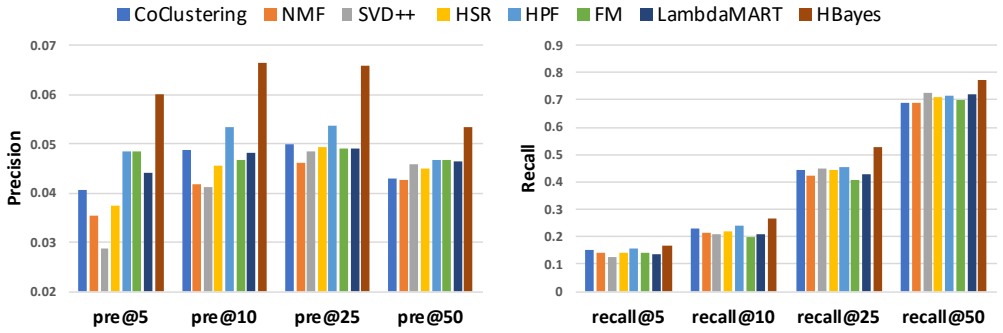
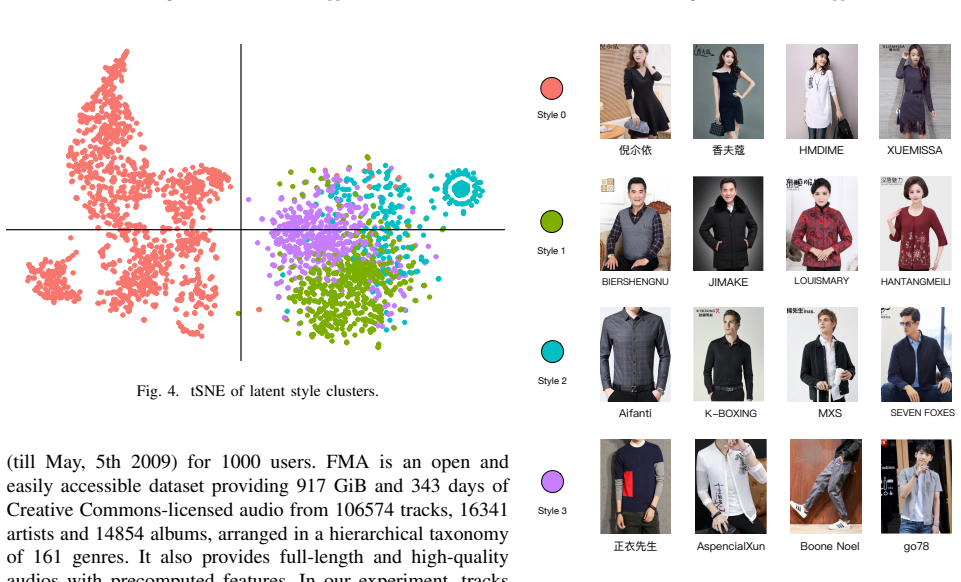
On the paper's own terms, the central discovery is that a generative story—user vectors drawn from Gaussian priors, brands assigned to one of several latent styles by a multinomial draw, style vectors drawn from a shared Gaussian, and click probability logistic in the inner product of item features with brand plus user vectors—can be learned by a mean-field variational Bayes algorithm and yields top-K recommendations that beat HPF, HSR, SVD++, factorization machines, co-clustering, and LambdaMART on both an apparel dataset and a music dataset. The learned style assignments are also presented as interpretable: projections of the learned brand and style vectors show clusters that correspond to recognizable garment styles. The paper further claims the variational procedure converges in few iterations, making the model practical despite being fully Bayesian.
Load-bearing premise
The model assumes every brand has exactly one hidden style and all of that brand's products inherit it; if real brands span multiple styles, the learned hierarchy misses structure and the reported gains may not generalize.
Editorial extensions
If this is right
- If HBayes is right, recommenders can exploit an explicit product hierarchy without flattening it into a huge feature space or handing the hierarchy to a deep network to rediscover.
- The reported NDCG gains grow with list length on the apparel data, suggesting the main benefit is better ranking of items deeper in the recommendation list, not just top-5 accuracy.
- Because the posterior gives distributions over user, brand, and style vectors, a deployed system could carry uncertainty into downstream decisions such as exploration or explanation.
- The framework's success on two domains implies the same generative pattern may transfer to other hierarchically organized catalogs such as news, video, or grocery.
Reading between the lines
- I would not extend the single-style-per-brand assumption to general catalogs: the generative process draws exactly one style per brand, so brands that genuinely span several styles are forced into one cluster; a natural test is whether allowing a per-brand mixture over styles preserves or improves the reported gains.
- The paper optimizes a pointwise logistic likelihood; a pairwise or listwise objective, as in Bayesian personalized ranking, might combine even better with the same hierarchical prior, since the evaluation metrics are ranking-based.
- One can read the learned style assignments as a cheap taxonomy-discovery tool: applying HBayes to a catalog without labels should recover meaningful product groupings, which could be verified by human raters.
- The convergence speed claim suggests the variational updates might scale to much larger catalogs, but the experiments cap at 895 users and roughly 380,000 events, so the practical ceiling is untested.
Signed reviews
Editorial analysis
A structured set of objections, weighed in public.
Referee Report
Summary. This manuscript introduces HBayes, a hierarchical Bayesian framework for personalized recommendation. The generative model associates each brand with a latent 'style' drawn from a multinomial distribution, places Gaussian priors on user, style, and brand factors, and models click events through a logistic likelihood. The authors derive a mean-field variational Bayes algorithm with a Jaakkola-Jordan sigmoid bound, and evaluate the model on an e-commerce apparel dataset and a Last.fm/FMA music dataset, reporting precision, recall, and NDCG against seven baselines.
Significance. If the empirical evaluation is sound, HBayes is a useful contribution: it provides an interpretable, non-deep alternative that explicitly models latent styles at the brand level, and the authors make code publicly available. The variational updates are internally consistent, and the prediction formula uses posterior expectations from training-fold learned parameters, so the central performance claim is not circular. However, the evaluation section leaves several load-bearing protocol details unspecified (data split, negative sampling, feature leakage, hyperparameters), so the significance of the reported gains is currently conditional.
major comments (5)
- [Section III-A, Eq. (3), Eq. (11)] The generative process is ambiguous about whether the style-proportion variable θ is global or brand-specific. Step 3 states 'Draw a style proportion distribution θ for each brand i,' which suggests θ_i, but the log-joint in Eq. (3) contains only one log p(θ|γ) term, and the update in Eq. (11) updates a single global γ as γ_j = γ_j + ∑_i μ_i,j. This is only coherent if θ is global. Please clarify the intended model and align Step 3, the graphical model, Eq. (3), and Eq. (11); as written, the model definition is internally inconsistent.
- [Section IV-A] The evaluation protocol is under-specified. The paper does not state whether the 5-fold split is by user or by event, how negative examples were constructed for the apparel data (or whether the test set is a mixture of positives and negatives), or what candidate set is ranked when generating 'top K samples.' Without these details, the precision, recall, and NDCG numbers in Figures 2-3 and Tables II-III are not reproducible and their meaning is unclear.
- [Section IV-B1] The POP feature is defined as n_{x_i}/N_x over 'all products in the dataset' with no statement that it is recomputed from each training fold only. If this aggregate is computed on the full data before the 5-fold split, test-period popularity information enters the training features; because HPF 'does not leverage the entity content feature' while HBayes consumes POP, the Table II margins over HPF could reflect popularity leakage rather than the hierarchical model. Please recompute all content features within each fold, and report the comparison both with and without per-fold feature computation.
- [Tables II and III] No error bars, standard deviations, or significance tests are reported for any metric. The claim that HBayes outperforms HPF is based on margins as small as 2.7% (Last.fm NDCG@50, Table III), and without fold-level variance it is not possible to tell whether the differences are meaningful.
- [Section III-C2 and Section IV] The manuscript never reports the values of key hyperparameters: the number of styles S, the latent dimension d, the Gamma shape/rate parameters α and β, or the initialization of the variational parameters. Figure 4 shows four learned style clusters, but S is not stated. These omissions prevent reproduction of the experiments even with the public code.
minor comments (5)
- [Table II] The NMF NDCG@10 entry, 0.0156, is inconsistent with the surrounding values (0.1249 at K=5 and 0.2272 at K=25) and looks like a typo; please correct it.
- [Section IV-B] The feature dimensions do not add up: 20 (popularity+category) + 50 (title) + 50 (property) = 120, not the stated 140.
- [Section IV-C] The music experiment does not describe how the FMA precomputed features are used or which features are fed to HBayes and the baselines.
- [Algorithm 1] No convergence criterion for the variational updates is given; please state the stopping condition and the number of iterations used in practice.
- [Section I] The phrase 'contributions in four folds' should be 'four facets' or 'fourfold'; this is a typo.
Circularity Check
No circularity found: HBayes is a self-contained generative model with held-out empirical evaluation.
full rationale
The derivation chain is self-contained. The generative process in Section III-A defines priors and likelihood; the variational updates in eqs. (9)-(19) optimize the free-energy lower bound; and the prediction rule in Section III-D is the standard posterior predictive expectation under the fitted variational posterior, not a fitted quantity. The empirical comparison uses 5-fold cross-validation on held-out test events for both datasets, so the headline NDCG, precision, and recall numbers are measured rather than implied by the model definition. I find no load-bearing self-citation: the cited variational bounds ([19], [20]) and baselines are external, and the authors do not cite their own prior work as the basis for the model. The potential aggregate-feature leakage in the POP_i definition in Section IV-B1 is a correctness and validity concern, but it is not circularity under the defined patterns because the reported metrics are still computed on held-out labels and no fitted parameter is renamed as a prediction. The qualitative style-cluster interpretation in Section IV-B3 is a self-assessment of the model's own latent variables, but it is not a derivation of a claimed result and does not reduce the central claim to its inputs. Overall, no circular step rises to the level of a quoteable reduction.
Assumptions & free parameters
free parameters (4)
- S
- d
- alpha, beta
- gamma =
1/S
assumptions (5)
- domain assumption Each brand i has a single style assignment z_i drawn from Mult(theta).
- domain assumption Mean-field factorization q(Z,Theta) = product of independent marginals.
- standard math Jaakkola-Jordan lower bound for the sigmoid is tight enough for inference.
- domain assumption Click labels are conditionally independent given user and brand factors.
- domain assumption The brand-to-item hierarchy is known and fixed.
invented entities (1)
-
Latent style variables S_j
Cite this review
Pith. "Pith review of Hierarchical Bayesian Personalized Recommendation: A Case Study and Beyond." pith.science (2026). https://pith.science/paper/EJVZ4LK2
@misc{pith2026190807371,
  author       = {Pith},
  title        = {Pith review of: Hierarchical Bayesian Personalized Recommendation: A Case Study and Beyond},
  year         = {2026},
  howpublished = {\url{https://pith.science/paper/EJVZ4LK2}},
  note         = {Machine review of arXiv:1908.07371}
}
read the original abstract
Items in modern recommender systems are often organized in hierarchical structures. These hierarchical structures and the data within them provide valuable information for building personalized recommendation systems. In this paper, we propose a general hierarchical Bayesian learning framework, i.e., \emph{HBayes}, to learn both the structures and associated latent factors. Furthermore, we develop a variational inference algorithm that is able to learn model parameters with fast empirical convergence rate. The proposed HBayes is evaluated on two real-world datasets from different domains. The results demonstrate the benefits of our approach on item recommendation tasks, and show that it can outperform the state-of-the-art models in terms of precision, recall, and normalized discounted cumulative gain. To encourage the reproducible results, we make our code public on a git repo: \url{https://tinyurl.com/ycruhk4t}.
Figures

Figures from the paper (1 more)

Reference graph
Works this paper leans on
-
[1]
Item-based collabo- rative filtering recommendation algorithms,
B. Sarwar, G. Karypis, J. Konstan, and J. Riedl, “Item-based collabo- rative filtering recommendation algorithms,” in Proceedings of the 10th International Conference on World Wide Web , ser. WWW ’01. New York, NY , USA: ACM, 2001, pp. 285–295
work page 2001
-
[2]
A survey of collaborative filtering techniques,
X. Su and T. M. Khoshgoftaar, “A survey of collaborative filtering techniques,” Adv. in Artif. Intell. , vol. 2009, pp. 4:2–4:2, Jan. 2009
work page 2009
-
[3]
Factorizing personalized markov chains for next-basket recommendation,
S. Rendle, C. Freudenthaler, and L. Schmidt-Thieme, “Factorizing personalized markov chains for next-basket recommendation,” in WWW, 2010, pp. 811–820
work page 2010
-
[4]
P. Lops, M. de Gemmis, and G. Semeraro, Content-based Recommender Systems: State of the Art and Trends , 2011, p. 73
work page 2011
-
[5]
How do users describe their information need: Query recommendation based on snippet click model,
Y . Liu, J. Miao, M. Zhang, S. Ma, and L. Ru, “How do users describe their information need: Query recommendation based on snippet click model,” Expert Systems with Applications , vol. 38, no. 11, pp. 13 847 – 13 856, 2011
work page 2011
-
[6]
Q. Yuan, G. Cong, K. Zhao, Z. Ma, and A. Sun, “Who, where, when, and what: A nonparametric bayesian approach to context-aware recommendation and search for twitter users,” ACM Trans. Inf. Syst. , vol. 33, no. 1, pp. 2:1–2:33, Feb. 2015
work page 2015
-
[7]
Social recommendation: a review,
J. Tang, X. Hu, and H. Liu, “Social recommendation: a review,” Social Network Analysis and Mining , vol. 3, no. 4, pp. 1113–1133, 1 2013
work page 2013
-
[8]
Collaborative filtering with temporal dynamics,
Y . Koren, “Collaborative filtering with temporal dynamics,” Commun. ACM, vol. 53, no. 4, pp. 89–97, Apr. 2010
work page 2010
Show all 34 references
-
[9]
Temporal dynamics of user interests in tagging systems,
D. Yin, L. Hong, Z. Xue, and B. D. Davison, “Temporal dynamics of user interests in tagging systems,” in Proceedings of the Twenty-Fifth AAAI Conference on Artificial Intelligence, ser. AAAI’11. AAAI Press, 2011, pp. 1279–1285
2011
-
[10]
Bpr: Bayesian personalized ranking from implicit feedback,
S. Rendle, C. Freudenthaler, Z. Gantner, and L. Schmidt-Thieme, “Bpr: Bayesian personalized ranking from implicit feedback,” in UAI. AUAI Press, 2009, pp. 452–461
2009
-
[11]
Groove radio: A bayesian hierarchical model for personalized playlist generation,
S. Ben-Elazar, G. Lavee, N. Koenigstein, O. Barkan, H. Berezin, U. Paquet, and T. Zaccai, “Groove radio: A bayesian hierarchical model for personalized playlist generation,” in WSDM. ACM, 2017, pp. 445– 453
2017
-
[12]
Efficient bayesian hierarchical user modeling for recommendation system,
Y . Zhang and J. Koren, “Efficient bayesian hierarchical user modeling for recommendation system,” in SIGIR. ACM, 2007, pp. 47–54
2007
-
[13]
Personalized recommendation in social tagging systems using hierarchical clustering,
A. Shepitsen, J. Gemmell, B. Mobasher, and R. Burke, “Personalized recommendation in social tagging systems using hierarchical clustering,” in Recsys. ACM, 2008, pp. 259–266
2008
-
[14]
Exploring hierarchical structures for recommender systems,
S. Wang, J. Tang, Y . Wang, and H. Liu, “Exploring hierarchical structures for recommender systems,” TKDE, 2018
2018
-
[15]
Multiple hypergeometric functions: Probabilistic in- terpretations and statistical uses,
J. M. Dickey, “Multiple hypergeometric functions: Probabilistic in- terpretations and statistical uses,” Journal of the American Statistical Association, vol. 78, no. 383, pp. 628–637, 1983
1983
-
[16]
Approximate bayesian inference for latent gaussian models by using integrated nested laplace approx- imations,
H. Rue, S. Martino, and N. Chopin, “Approximate bayesian inference for latent gaussian models by using integrated nested laplace approx- imations,” Journal of the royal statistical society: Series b (statistical methodology), vol. 71, no. 2, pp. 319–392, 2009
2009
-
[17]
Pattern recognition and machine learning (information science and statistics) springer-verlag new york,
C. M. Bishop, “Pattern recognition and machine learning (information science and statistics) springer-verlag new york,” Inc. Secaucus, NJ, USA, 2006
2006
-
[18]
Latent dirichlet allocation,
D. M. Blei, A. Y . Ng, and M. I. Jordan, “Latent dirichlet allocation,” Journal of machine Learning research , vol. 3, no. Jan, pp. 993–1022, 2003
2003
-
[19]
A variational approach to bayesian logistic regression models and their extensions,
T. Jaakkola and M. Jordan, “A variational approach to bayesian logistic regression models and their extensions,” in Sixth International Workshop on Artificial Intelligence and Statistics , vol. 82, 1997, p. 4
1997
-
[20]
An introduction to variational methods for graphical models,
M. I. Jordan, Z. Ghahramani, T. S. Jaakkola, and L. K. Saul, “An introduction to variational methods for graphical models,” Machine learning, vol. 37, no. 2, pp. 183–233, 1999
1999
-
[21]
Exploring implicit hierarchical structures for recommender systems
S. Wang, J. Tang, Y . Wang, and H. Liu, “Exploring implicit hierarchical structures for recommender systems.” in IJCAI, 2015, pp. 1813–1819
2015
-
[22]
Scalable recommendation with hierarchical poisson factorization
P. Gopalan, J. M. Hofman, and D. M. Blei, “Scalable recommendation with hierarchical poisson factorization.” in UAI, 2015, pp. 326–335
2015
-
[23]
Probabilistic matrix factorization,
A. Mnih and R. R. Salakhutdinov, “Probabilistic matrix factorization,” in Advances in neural information processing systems , 2008, pp. 1257– 1264
2008
-
[24]
Factorization meets the neighborhood: a multifaceted col- laborative filtering model,
Y . Koren, “Factorization meets the neighborhood: a multifaceted col- laborative filtering model,” in Proceedings of the 14th ACM SIGKDD international conference on Knowledge discovery and data mining . ACM, 2008, pp. 426–434
2008
-
[25]
A scalable collaborative filtering framework based on co-clustering,
T. George and S. Merugu, “A scalable collaborative filtering framework based on co-clustering,” in Data Mining, Fifth IEEE international conference on. IEEE, 2005, pp. 4–pp
2005
-
[26]
Factorization machines,
S. Rendle, “Factorization machines,” in ICDM. IEEE, 2010, pp. 995– 1000
2010
-
[27]
Factorization machines with libfm,
——, “Factorization machines with libfm,” TIST, vol. 3, no. 3, p. 57, 2012
2012
-
[28]
From ranknet to lambdarank to lambdamart: An overview,
C. J. Burges, “From ranknet to lambdarank to lambdamart: An overview,”Learning, vol. 11, no. 23-581, p. 81, 2010
2010
-
[29]
On the local optimality of lambdarank,
P. Donmez, K. M. Svore, and C. J. Burges, “On the local optimality of lambdarank,” in SIGIR. ACM, 2009, pp. 460–467
2009
-
[30]
Learning to rank using gradient descent,
C. Burges, T. Shaked, E. Renshaw, A. Lazier, M. Deeds, N. Hamilton, and G. Hullender, “Learning to rank using gradient descent,” in ICML. ACM, 2005, pp. 89–96
2005
-
[31]
Repre- sentation learning for very short texts using weighted word embedding aggregation,
C. De Boom, S. Van Canneyt, T. Demeester, and B. Dhoedt, “Repre- sentation learning for very short texts using weighted word embedding aggregation,” Pattern Recognition Letters, vol. 80, pp. 150–156, 2016
2016
-
[32]
Visualizing data using t-sne,
L. v. d. Maaten and G. Hinton, “Visualizing data using t-sne,” JMLR, vol. 9, no. Nov, pp. 2579–2605, 2008
2008
-
[33]
Celma, Music Recommendation and Discovery in the Long Tail
O. Celma, Music Recommendation and Discovery in the Long Tail . Springer, 2010
2010
-
[34]
Fma: A dataset for music analysis,
M. Defferrard, K. Benzi, P. Vandergheynst, and X. Bresson, “Fma: A dataset for music analysis,” in 18th International Society for Music Information Retrieval Conference , 2017
2017
Reviewed August 14, 2026 · model on record in the stance chip above.
Discussion (0). Continue with ORCID to comment.