REVIEW 4 major objections 6 minor 39 references
NLNL: Negative Learning for Noisy Labels
T0 review · 4 major / 6 minor · reviewed 2026-08-14 · deepseek-v4-flash
Pith's one-line read Training a network to know what an image is not lets it learn from noisy labels.
desk verdict Simple and effective noisy-label method with strong empirical results, but the threshold assumption and lack of code/variance are real soft spots. read the letter →
The pith
A machine-rendered reading of the paper's core claim, the machinery that carries it, and where it could break.
The reading
What carries the argument
The machinery is a complementary-label cross-entropy that drives the probability of a randomly chosen 'not this' label to zero. Because the softmax output sums to one, suppressing one class redistributes probability over the remaining classes, including, most of the time, the true class, so the network learns genuine visual content without being told a possibly false positive label. Two confidence gates then steer training: SelNL keeps samples with $p_y > 1/c$, and SelPL keeps samples with $p_y > \gamma = 0.5$ for ordinary positive cross-entropy. The paper also derives that NL's gradient on the true class scales as $1/(c(c-1))$, which is why CIFAR100 needed 110 complementary losses per image to converge in the same epoch budget.
What would settle it
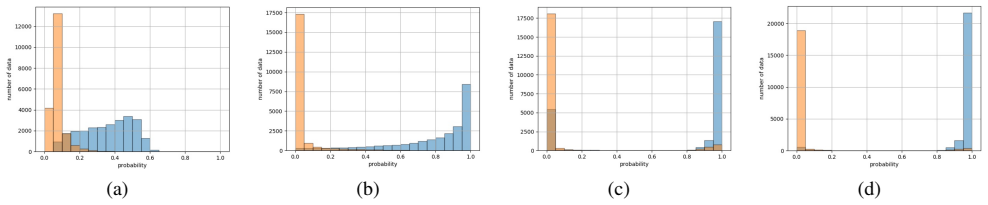
Train SelNLPL on a noise process engineered so some wrong labels become highly confident, for example asymmetric flips between visually similar classes at high noise, then inspect the confidence histograms: if the clean and noisy peaks overlap around $\gamma = 0.5$, the fixed-threshold filter mislabels a nontrivial fraction and the method would have to fall back on noise-rate knowledge.
Extended reading notes
Core claim
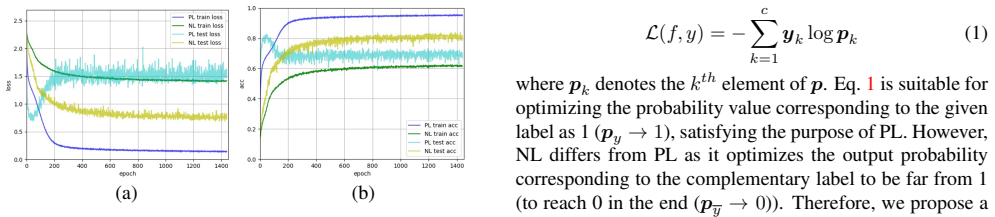
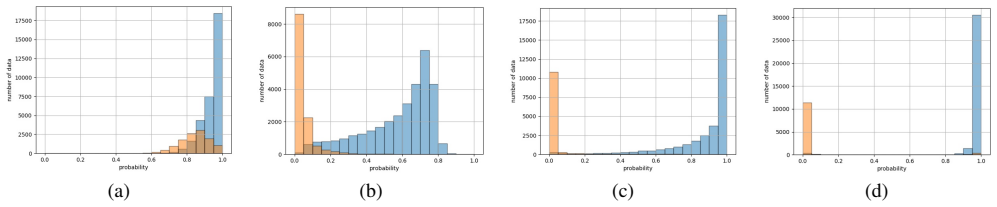
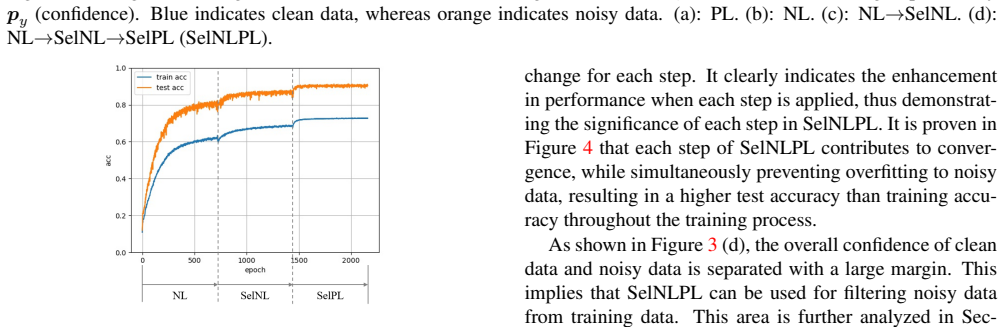
The paper's central claim is that a CNN trained with negative learning (NL), whose loss is $$L(f,\bar y) = -\sum_{k=1}^{c} \bar y_k \log(1-p_k),$$ where $\bar y$ is a uniformly random label different from the given label $y$, does not overfit to noisy labels: the confidence of clean samples climbs while the confidence of noisy samples stays low. The authors then add Selective Negative Learning (SelNL), which keeps only samples with confidence above $1/c$, and Selective Positive Learning (SelPL), which trains with the usual cross-entropy only on samples whose confidence exceeds $\gamma = 0.5$. They claim that this SelNLPL schedule separates clean from noisy training data with high precision and recall, and that a simple pseudo-label semi-supervised stage on the filtered data reaches state-of-the-art accuracy on noisy CIFAR10, CIFAR100, MNIST, and FashionMNIST without any prior knowledge of the noise type or ratio.
Load-bearing premise
The load-bearing premise is that one fixed confidence threshold cleanly separates clean from noisy samples after negative learning - a separation the paper demonstrates empirically rather than proves - so the method never needs to know the noise ratio or type.
Editorial extensions
If this is right
- Training with NL before any PL gives a confidence gap that can be used to estimate the noise rate of a training set: the fraction of samples below the 0.5 threshold tracks the true noise fraction to within a few percent in the paper's CIFAR10 experiments.
- Because the method never consults a validation set and does not tune hyper-parameters to known noise levels, it is portable to settings where label quality is unknown in advance.
- The filtering step is strong enough that the subsequent semi-supervised stage can be a plain pseudo-labeling procedure rather than a specially designed noise-robust loss.
- Large class counts slow NL convergence by a factor related to $c(c-1)$; the authors' multi-complementary-label extension restores convergence on CIFAR100 with the same epoch budget as CIFAR10.
Reading between the lines
- Editorial inference: The fixed threshold $\gamma = 0.5$ is a tuning choice, and the CIFAR100 modification suggests the clean/noisy confidence gap itself shifts with class count, so per-class or annealed thresholds could make the filter more portable.
- Editorial inference: Because the method only needs a 'not this label' signal, it could generalize to web-scraped or weakly supervised data where errors are not simple class flips, and even to settings where some labels are plain misinformation.
- Editorial inference: If the confidence gap is the mechanism, then the natural stress test is asymmetric noise between visually similar classes at high noise; the paper's own failure to converge at 80% symmetric-exclusive noise hints that the gap closes under extreme corruption.
Signed reviews
Editorial analysis
A structured set of objections, weighed in public.
Referee Report
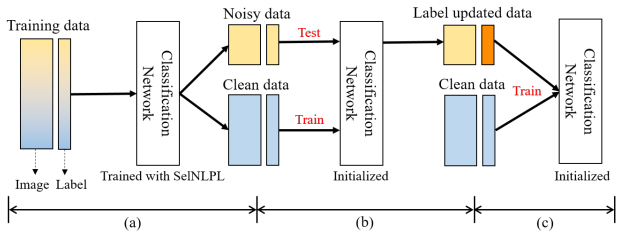
Summary. The paper proposes Negative Learning (NL), in which a CNN is trained with randomly drawn complementary labels using the loss -log(1-p_ybar), as a noise-robust alternative to Positive Learning (PL). The authors then combine NL with two selective stages called SelNL (keeping only samples whose given-label confidence exceeds 1/c) and SelPL (keeping only samples whose confidence exceeds gamma=0.5), producing SelNLPL. After training with SelNLPL, the network is used to divide the training set into clean and noisy parts, noisy labels are discarded, and the network is re-trained by pseudo-labeling. The paper reports state-of-the-art accuracy on CIFAR10, CIFAR100, FashionMNIST, and MNIST under symmetric and asymmetric label noise, and claims that the method requires no tuning based on prior knowledge of the noise type or noise rate.
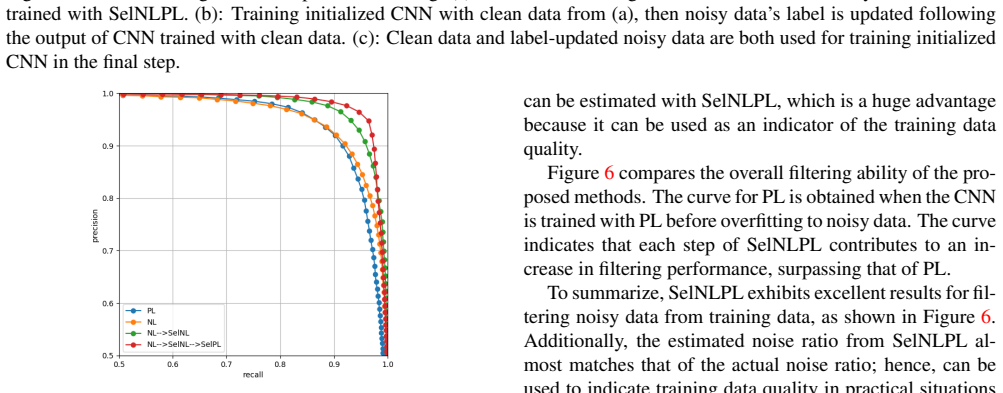
Significance. If the claims are sustained, the paper makes a useful practical contribution: the core NL idea is simple, intuitively motivated, and is tested across four datasets, three noise types, and multiple noise levels. The ablation study in Table 7, the filtering precision/recall analysis in Table 1 and Figure 6, and the gradient analysis in Eq. 3 are valuable explanatory elements beyond a bare benchmark comparison. The claim of state-of-the-art accuracy without noise-rate-dependent hyper-parameters is attractive for real-world use. The main weaknesses are that the no-tuning claim is contradicted by the CIFAR100 extension and the 80% symmetric-exclusive failure, and that the fixed threshold gamma=0.5 is only visualized for one noise setting. The paper also reports no variance or error bars, so the magnitude of the claimed improvements (often 1-5%) cannot be assessed statistically.
major comments (4)
- [Section 5.2, Table 3] The paper states that the method 'only failed to converge when the symm-exc noise is 80%, which can be neglected because such a scenario is unrealistic.' Since the claimed contribution is a method that works without prior knowledge of the noise level, dismissing a tested operating point where the method diverges undermines the claim. A practitioner who does not know the noise rate will not know that 80% is 'unrealistic.' Please either explain why the method fails at 80% symmetric-exclusive noise, provide evidence that the failure is specific to this synthetic setting, or revise the no-tuning claim.
- [Section 6.1] The base SelNLPL method is stated to fail to converge on CIFAR100, and the authors introduce an ad hoc extension that computes 110 complementary-label losses per image. This introduces a new hyper-parameter (the number of complementary labels) that depends on the class count, which contradicts the contribution in Section 1 that the method 'does not require any tuning of hyper-parameters that depend on prior knowledge.' The number of complementary labels is a dataset-dependent choice, not a fixed parameter. Please state clearly that this is a separate variant with its own hyper-parameter, and adjust the no-tuning claim accordingly.
- [Section 3.3 and Algorithm 2] The clean/noisy separation after NL/SelNL and the fixed threshold gamma=0.5 are the load-bearing elements of the filtering step, yet the histograms in Figure 3 are only shown for CIFAR10 with 30% symmetric-inclusive noise. No histograms are provided for asymmetric noise, for 80% symmetric-exclusive noise (where the method fails), or for the CIFAR100 extension. If the confidence separation is not clean in these settings, the filtering step and the subsequent pseudo-labeling are unreliable. Please provide confidence-separation evidence for these settings or perform a sensitivity analysis of gamma across noise types and levels.
- [Section 1 and Section 3.1] The motivation that NL 'decreases the risk of providing incorrect information' is incomplete. For a noisy example whose given label is wrong, the true label is a member of the complementary-label set, and if it is selected as ybar, Eq. 2 actively drives the probability of the true class toward zero. Thus the safety of NL is an empirical property of the training dynamics, not a guaranteed consequence of random complementary labels. The text should present the 'safe' property as an empirical observation, not as a logical implication of the sampling scheme.
minor comments (6)
- [Section 5.2, Tables 3-6] The reported results are single runs without variance, error bars, or statistical significance tests. Given that many of the claimed improvements are 1-5%, please report multiple seeds or at least indicate the variability.
- [Section 5.1] The learning rates differ across stages (0.02 for NL and SelNL, 0.1 for SelPL) and across datasets (MNIST uses 0.1 for NL and SelNL). This is reasonable engineering, but it weakens the statement that the method requires no tuning; please clarify which parameters are fixed and which are dataset-dependent.
- [Section 6.2, Table 7] The ablation shows that omitting SelPL or SelNL from SelNLPL yields small accuracy drops at 30% symmetric-inclusive noise (1.38 and 0.41 points), but large drops at 50% noise. Please discuss whether the significance of each step depends on the noise level, and whether the 30% row genuinely supports the claim that each step contributes.
- [Section 4] In the fourth paragraph of Section 4, 'This resulted in state-of-the-accuracy' appears to be a typo for 'state-of-the-art accuracy.'
- [Algorithm 1] Algorithm 1 uses the symbol y for both the original label and the complementary label; please rename the complementary label (e.g., ybar) consistently with Eq. 2.
- [Section 3.5] The description of pseudo-labeling says 'noisy data's label is updated with the output of the CNN...' but does not specify whether the soft label is computed from the network trained in Figure 5(b) or from the final network in Figure 5(c). Please clarify the exact two-stage re-training protocol.
Circularity Check
No significant circularity: SelNLPL is an empirical training scheme evaluated on held-out benchmarks; no fitted parameter is relabeled as a prediction.
full rationale
The paper's derivation chain is self-contained and empirically evaluated. The loss functions (Eq. 1 for positive learning and Eq. 2 for negative learning) are applied directly to training labels; no parameter is fitted to the test labels or to the reported benchmark accuracies. The confidence threshold gamma = 0.5 used in Selective PL (Section 3.3 and Algorithm 2) is fixed in advance and not tuned per noise rate or per dataset, so the filtering results in Section 4 are measurements of a fixed rule against known synthetic noise, not predictions derived from the noise labels themselves. The claim that clean and noisy confidences separate after NL/SelNL is supported by histograms and precision-recall curves, which are external evidence rather than a restatement of the method's definitions. The CIFAR100 extension in Section 6.1 computes 110 complementary labels from the ratio of gradient magnitudes (1/(c(c-1)) for c=10 vs c=100), a calculation based on class counts, not on the final accuracy; even if this heuristic is debatable, it is not circular. The paper does contain a self-citation to the authors' prior work ([7], Deep Pyramidal Residual Networks) in the introductory overview of CNN architectures, but that citation is not load-bearing for the noisy-label method. The admitted limitations (failure to converge at 80% symmetric-exclusive noise, and the need for a modified scheme on CIFAR100) are empirical caveats, not circular reasoning. Overall, no step reduces by construction to its own inputs, so the appropriate finding is no significant circularity.
Assumptions & free parameters
free parameters (3)
- SelPL confidence threshold gamma =
0.5
- Training epochs per stage (NL, SelNL, SelPL) =
720 each
- Number of complementary labels for CIFAR100 extension =
110
assumptions (3)
- domain assumption Complementary labels are chosen uniformly at random from all classes except the given label.
- domain assumption With high probability, a randomly selected complementary label is not the true label, implying that NL mostly provides correct information.
- ad hoc to paper After NL and SelNL, the confidence of clean data is reliably higher than that of noisy data, so a fixed threshold can separate them.
Cite this review
Pith. "Pith review of NLNL: Negative Learning for Noisy Labels." pith.science (2026). https://pith.science/paper/FYPGE3O2
@misc{pith2026190807387,
  author       = {Pith},
  title        = {Pith review of: NLNL: Negative Learning for Noisy Labels},
  year         = {2026},
  howpublished = {\url{https://pith.science/paper/FYPGE3O2}},
  note         = {Machine review of arXiv:1908.07387}
}
read the original abstract
Convolutional Neural Networks (CNNs) provide excellent performance when used for image classification. The classical method of training CNNs is by labeling images in a supervised manner as in "input image belongs to this label" (Positive Learning; PL), which is a fast and accurate method if the labels are assigned correctly to all images. However, if inaccurate labels, or noisy labels, exist, training with PL will provide wrong information, thus severely degrading performance. To address this issue, we start with an indirect learning method called Negative Learning (NL), in which the CNNs are trained using a complementary label as in "input image does not belong to this complementary label." Because the chances of selecting a true label as a complementary label are low, NL decreases the risk of providing incorrect information. Furthermore, to improve convergence, we extend our method by adopting PL selectively, termed as Selective Negative Learning and Positive Learning (SelNLPL). PL is used selectively to train upon expected-to-be-clean data, whose choices become possible as NL progresses, thus resulting in superior performance of filtering out noisy data. With simple semi-supervised training technique, our method achieves state-of-the-art accuracy for noisy data classification, proving the superiority of SelNLPL's noisy data filtering ability.
Figures

Figures from the paper (4 more)
Reference graph
Works this paper leans on
-
[1]
Support vector machines with the ramp loss and the hard margin loss
J Paul Brooks. Support vector machines with the ramp loss and the hard margin loss. Operations research, 59(2):467– 479, 2011. 2
work page 2011
-
[2]
A Semi-Supervised Two-Stage Approach to Learning from Noisy Labels
Yifan Ding, Liqiang Wang, Deliang Fan, and Boqing Gong. A semi-supervised two-stage approach to learning from noisy labels. arXiv preprint arXiv:1802.02679, 2018. 1, 2, 6, 7
work page Pith review arXiv 2018
-
[3]
Robust loss functions under label noise for deep neural networks
Aritra Ghosh, Himanshu Kumar, and PS Sastry. Robust loss functions under label noise for deep neural networks. In AAAI, pages 1919–1925, 2017. 1, 2, 7
work page 1919
-
[4]
Making risk minimization tolerant to label noise
Aritra Ghosh, Naresh Manwani, and PS Sastry. Making risk minimization tolerant to label noise. Neurocomputing, 160:93–107, 2015. 2, 7
work page 2015
-
[5]
Training deep neural-networks using a noise adaptation layer
Jacob Goldberger and Ehud Ben-Reuven. Training deep neural-networks using a noise adaptation layer. 2016. 2
work page 2016
-
[6]
Co- teaching: robust training deep neural networks with ex- tremely noisy labels
Bo Han, Quanming Yao, Xingrui Yu, Gang Niu, Miao Xu, Weihua Hu, Ivor Tsang, and Masashi Sugiyama. Co- teaching: robust training deep neural networks with ex- tremely noisy labels. arXiv preprint arXiv:1804.06872 ,
-
[7]
Deep pyra- midal residual networks
Dongyoon Han, Jiwhan Kim, and Junmo Kim. Deep pyra- midal residual networks. In Computer Vision and Pat- tern Recognition (CVPR), 2017 IEEE Conference on , pages 6307–6315. IEEE, 2017. 1
work page 2017
-
[8]
Deep residual learning for image recognition
Kaiming He, Xiangyu Zhang, Shaoqing Ren, and Jian Sun. Deep residual learning for image recognition. In Proceed- ings of the IEEE conference on computer vision and pattern recognition, pages 770–778, 2016. 1, 6
2016
Show all 39 references
-
[9]
Identity mappings in deep residual networks
Kaiming He, Xiangyu Zhang, Shaoqing Ren, and Jian Sun. Identity mappings in deep residual networks. In European conference on computer vision , pages 630–645. Springer,
-
[10]
Using trusted data to train deep net- works on labels corrupted by severe noise
Dan Hendrycks, Mantas Mazeika, Duncan Wilson, and Kevin Gimpel. Using trusted data to train deep net- works on labels corrupted by severe noise. arXiv preprint arXiv:1802.05300, 2018. 2
2018 arXiv
-
[11]
Densely connected convolutional net- works
Gao Huang, Zhuang Liu, Laurens Van Der Maaten, and Kil- ian Q Weinberger. Densely connected convolutional net- works. In CVPR, volume 1, page 3, 2017. 1
2017
-
[12]
Learning from complementary labels
Takashi Ishida, Gang Niu, Weihua Hu, and Masashi Sugiyama. Learning from complementary labels. In Ad- vances in Neural Information Processing Systems , pages 5639–5649, 2017. 2
2017
-
[13]
Mentornet: Regularizing very deep neural networks on corrupted labels
Lu Jiang, Zhengyuan Zhou, Thomas Leung, Li-Jia Li, and Li Fei-Fei. Mentornet: Regularizing very deep neural networks on corrupted labels. arXiv preprint arXiv:1712.05055, 2017. 2
2017 arXiv
-
[14]
Learning deep networks from noisy labels with dropout regularization
Ishan Jindal, Matthew Nokleby, and Xuewen Chen. Learning deep networks from noisy labels with dropout regularization. In Data Mining (ICDM), 2016 IEEE 16th International Con- ference on, pages 967–972. IEEE, 2016. 2
2016
-
[15]
Learning from noisy singly-labeled data.arXiv preprint arXiv:1712.04577, 2017
Ashish Khetan, Zachary C Lipton, and Anima Anandku- mar. Learning from noisy singly-labeled data.arXiv preprint arXiv:1712.04577, 2017. 2
2017 arXiv
-
[16]
Learning multiple layers of features from tiny images, 2009
Alex Krizhevsky. Learning multiple layers of features from tiny images, 2009. 5
2009
-
[17]
Imagenet classification with deep convolutional neural net- works
Alex Krizhevsky, Ilya Sutskever, and Geoffrey E Hinton. Imagenet classification with deep convolutional neural net- works. In Advances in neural information processing sys- tems, pages 1097–1105, 2012. 1
2012
-
[18]
MNIST handwritten digit database
Yann LeCun and Corinna Cortes. MNIST handwritten digit database. 2010. 5
2010
-
[19]
Pseudo-label: The simple and efficient semi-supervised learning method for deep neural networks
Dong-Hyun Lee. Pseudo-label: The simple and efficient semi-supervised learning method for deep neural networks. In Workshop on Challenges in Representation Learning, ICML, volume 3, page 2, 2013. 4
2013
-
[20]
Cleannet: Transfer learning for scalable im- age classifier training with label noise
Kuang-Huei Lee, Xiaodong He, Lei Zhang, and Lin- jun Yang. Cleannet: Transfer learning for scalable im- age classifier training with label noise. arXiv preprint arXiv:1711.07131, 2017. 1, 2
2017 arXiv
-
[21]
Learning from noisy labels with distillation
Yuncheng Li, Jianchao Yang, Yale Song, Liangliang Cao, Jiebo Luo, and Li-Jia Li. Learning from noisy labels with distillation. In ICCV, pages 1928–1936, 2017. 1, 2
1928
-
[22]
Dimensionality-driven learning with noisy la- bels
Xingjun Ma, Yisen Wang, Michael E Houle, Shuo Zhou, Sarah M Erfani, Shu-Tao Xia, Sudanthi Wijewickrema, and James Bailey. Dimensionality-driven learning with noisy la- bels. arXiv preprint arXiv:1806.02612, 2018. 1, 2, 6, 7
2018 arXiv
-
[23]
On the de- sign of loss functions for classification: theory, robustness to outliers, and savageboost
Hamed Masnadi-Shirazi and Nuno Vasconcelos. On the de- sign of loss functions for classification: theory, robustness to outliers, and savageboost. In Advances in neural information processing systems, pages 1049–1056, 2009. 2, 7
2009
-
[24]
Learn- ing with confident examples: Rank pruning for robust classi- fication with noisy labels
Curtis G Northcutt, Tailin Wu, and Isaac L Chuang. Learn- ing with confident examples: Rank pruning for robust classi- fication with noisy labels. arXiv preprint arXiv:1705.01936,
-
[25]
Making deep neural networks robust to label noise: A loss correction approach
Giorgio Patrini, Alessandro Rozza, Aditya Krishna Menon, Richard Nock, and Lizhen Qu. Making deep neural networks robust to label noise: A loss correction approach. In Proc. IEEE Conf. Comput. Vis. Pattern Recognit.(CVPR) , pages 2233–2241, 2017. 2, 6, 7, 8
2017
-
[26]
Train- ing deep neural networks on noisy labels with bootstrapping
Scott Reed, Honglak Lee, Dragomir Anguelov, Christian Szegedy, Dumitru Erhan, and Andrew Rabinovich. Train- ing deep neural networks on noisy labels with bootstrapping. arXiv preprint arXiv:1412.6596, 2014. 1, 2, 7
2014 arXiv
-
[27]
Learning to reweight examples for robust deep learning
Mengye Ren, Wenyuan Zeng, Bin Yang, and Raquel Urta- sun. Learning to reweight examples for robust deep learning. arXiv preprint arXiv:1803.09050, 2018. 2
2018 arXiv
-
[28]
Training convolutional networks with noisy labels
Sainbayar Sukhbaatar, Joan Bruna, Manohar Paluri, Lubomir Bourdev, and Rob Fergus. Training convolutional networks with noisy labels. arXiv preprint arXiv:1406.2080,
-
[29]
Going deeper with convolutions
Christian Szegedy, Wei Liu, Yangqing Jia, Pierre Sermanet, Scott Reed, Dragomir Anguelov, Dumitru Erhan, Vincent Vanhoucke, and Andrew Rabinovich. Going deeper with convolutions. In Proceedings of the IEEE conference on computer vision and pattern recognition , pages 1–9, 2015. 1
2015
-
[30]
Joint optimization framework for learning with noisy labels
Daiki Tanaka, Daiki Ikami, Toshihiko Yamasaki, and Kiy- oharu Aizawa. Joint optimization framework for learning with noisy labels. arXiv preprint arXiv:1803.11364 , 2018. 1, 2, 4, 6, 7
2018 arXiv
-
[31]
Toward robustness against label noise in train- ing deep discriminative neural networks
Arash Vahdat. Toward robustness against label noise in train- ing deep discriminative neural networks. In Advances in Neural Information Processing Systems , pages 5596–5605,
-
[32]
Learning with symmetric label noise: The im- portance of being unhinged
Brendan Van Rooyen, Aditya Menon, and Robert C Williamson. Learning with symmetric label noise: The im- portance of being unhinged. In Advances in Neural Informa- tion Processing Systems, pages 10–18, 2015. 2, 7
2015
-
[33]
Learning from noisy large- scale datasets with minimal supervision
Andreas Veit, Neil Alldrin, Gal Chechik, Ivan Krasin, Abhi- nav Gupta, and Serge J Belongie. Learning from noisy large- scale datasets with minimal supervision. In CVPR, pages 6575–6583, 2017. 1, 2
2017
-
[34]
Iterative learning with open-set noisy labels.arXiv preprint arXiv:1804.00092,
Yisen Wang, Weiyang Liu, Xingjun Ma, James Bailey, Hongyuan Zha, Le Song, and Shu-Tao Xia. Iterative learning with open-set noisy labels.arXiv preprint arXiv:1804.00092,
-
[35]
Fashion- mnist: a novel image dataset for benchmarking machine learning algorithms
Han Xiao, Kashif Rasul, and Roland V ollgraf. Fashion- mnist: a novel image dataset for benchmarking machine learning algorithms. arXiv preprint arXiv:1708.07747, 2017. 5
2017 arXiv
-
[36]
Learning from massive noisy labeled data for im- age classification
Tong Xiao, Tian Xia, Yi Yang, Chang Huang, and Xiaogang Wang. Learning from massive noisy labeled data for im- age classification. In Proceedings of the IEEE Conference on Computer Vision and Pattern Recognition , pages 2691– 2699, 2015. 2
2015
-
[37]
Learning with biased complementary labels
Xiyu Yu, Tongliang Liu, Mingming Gong, and Dacheng Tao. Learning with biased complementary labels. In ECCV 2018, pages 69–85, 2018. 2
2018
-
[38]
Wide residual net- works
Sergey Zagoruyko and Nikos Komodakis. Wide residual net- works. arXiv preprint arXiv:1605.07146, 2016. 1
2016 arXiv
-
[39]
Generalized cross en- tropy loss for training deep neural networks with noisy la- bels
Zhilu Zhang and Mert R Sabuncu. Generalized cross en- tropy loss for training deep neural networks with noisy la- bels. arXiv preprint arXiv:1805.07836, 2018. 1, 2, 6, 7
2018 arXiv
Reviewed August 14, 2026 · model on record in the stance chip above.
Discussion (0). Continue with ORCID to comment.