REVIEW 3 major objections 9 minor 2 references
The Rise of Blockchain Technology in Agriculture and Food Supply Chains
T0 review · 3 major / 9 minor · reviewed 2026-08-14 · deepseek-v4-flash
Pith's one-line read Blockchain can make food supply chains transparent, but most of the 49 projects surveyed are still pilots.
desk verdict A serviceable 2019 survey of blockchain in agri-food: the catalog is useful, the analysis is honest, and the main soft spot is a small internal inconsistency in the project-status count. read the letter →
The pith
A machine-rendered reading of the paper's core claim, the machinery that carries it, and where it could break.
The reading
What carries the argument
The machinery that carries the argument is the survey itself: a keyword-based search of scholarly indexes plus follow-up tracking of referenced work and web sources, which produced a corpus of 49 blockchain initiatives. The authors organize these initiatives into six functional categories and then score each one on a maturity ladder from conceptual stage to full integration, while also recording the underlying blockchain platform (Ethereum leads at 18%, Hyperledger Fabric at 12%, and 34% of projects reveal no underlying technology). This categorization, maturity assessment, and activity check is what turns a list of anecdotes into a claim about the overall state of the field.
What would settle it
Audit the 49 cited initiatives today: check whether each project's website, repository, and public filings show continuing operation, and compare the authors' maturity scores against independent evidence of deployment. If most of the nine projects the authors suspect of being inactive turned out to be active, or if most of the 14 pilot-stage projects had actually scaled, the paper's immaturity conclusion would need revision.
Extended reading notes
Core claim
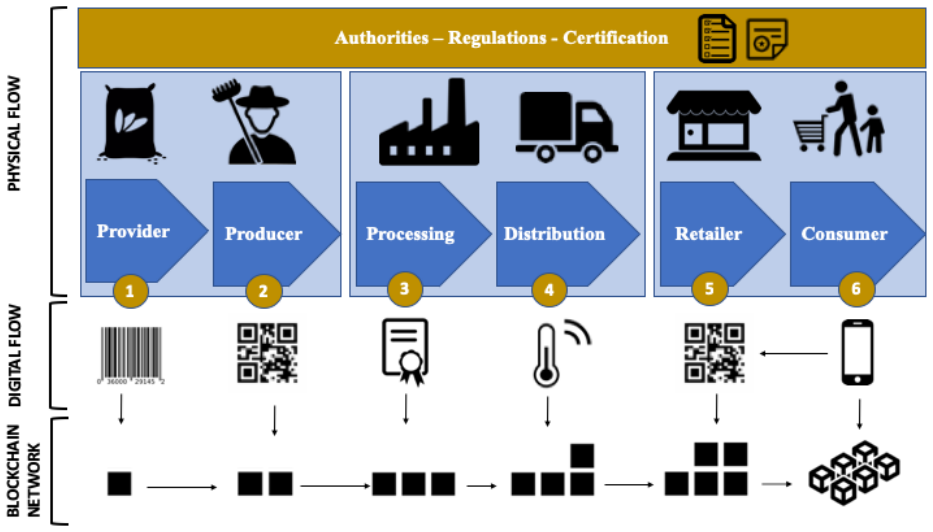
The paper's core claim is that blockchain can address a real weakness of today's food system — long, opaque, paper-heavy, multi-actor supply chains in which buyers and sellers do not fully trust one another — by giving every stage a shared, immutable record. It documents 49 initiatives spanning food security, food safety, food integrity, small-farmer support, waste reduction, and supply-chain supervision, from Walmart's pork and mango pilots, where tracing dropped from 6.5 days to seconds, to humanitarian aid coupons for refugees and blockchain-based tuna monitoring. Yet the same evidence leads the authors to conclude that blockchain in this domain is still immature: most projects sit at the conceptual, implementation, or small-pilot stage, only 4 have reached full integration, and the authors suspect 24% of commercial initiatives may already be inactive. The promised transparency is real, but the economics and governance around it are not yet settled.
Load-bearing premise
The survey's conclusions rest on the assumption that the 49 identified initiatives fairly represent the real landscape and that their publicly reported status — from company websites, news articles, and papers — is accurate; if those reports are outdated or exaggerated, the maturity counts and the 24% inactivity estimate would be unreliable.
Editorial extensions
If this is right
- If blockchain is adopted broadly, tracing a food item from store shelf back to the farm could drop from days to seconds, as the Walmart mango pilots showed.
- Most near-term deployments are likely to be pilot studies or permissioned networks run by large companies, because all 8 large-scale case studies in the survey were backed by big firms.
- Widespread uptake depends on governments setting clear regulatory frameworks and funding training and research, since the paper identifies regulation and lack of expertise as major barriers.
- The economic sustainability of blockchain food projects remains unproven, and the paper's suspicion that 24% of commercial initiatives may already be inactive undercuts the hype.
- Combining blockchain with IoT sensors, RFID, and QR codes could automate traceability and food-safety monitoring, but only if the oracle problem of feeding trusted real-world data into the chain is solved.
Reading between the lines
- Editorial inference: the oracle problem implies that traceability is only as trustworthy as the sensors, clerks, or databases feeding data into the blockchain, so blockchain alone cannot guarantee food safety.
- Editorial inference: the 24% suspected inactivity rate suggests a hype-cycle pattern; a repeat survey in three years would likely show consolidation around Ethereum and Hyperledger and abandonment of bespoke chains.
- Editorial inference: the paper's digital-divide observation implies that smallholder-benefit claims will be tested first where digital infrastructure already exists, so a field trial with cooperatives in a developing region would directly test whether promised gains in credit access and dispute resolution materialize.
- Editorial inference: a direct cost-benefit comparison between a blockchain traceability system and a conventional centralized database on the same food product would sharpen the economic-sustainability question the paper leaves open.
Signed reviews
Editorial analysis
A structured set of objections, weighed in public.
Referee Report
Summary. The paper surveys blockchain technology applications in agriculture and food supply chains. It introduces blockchain concepts, describes a generic food supply chain, and then identifies 49 initiatives through a keyword search of Web of Science and Google Scholar supplemented by snowballing from the initial 29 papers and popular search engines. The initiatives are categorized into six thematic areas (food security, food safety, food integrity, small-farmer support, waste reduction, and supervision/management), and analyzed along dimensions of product type, underlying blockchain platform, maturity stage, and suspected activity status. The paper concludes that blockchain is promising for transparent food supply chains but faces technical, educational, policy, and regulatory barriers that currently limit adoption.
Significance. The paper provides a structured inventory of early blockchain applications in agri-food, with a useful categorization and a critical maturity assessment that goes beyond a purely promotional view. Its main strengths are the explicit acknowledgment that some pilots may be motivated by marketing, the compilation of benefits and barriers in Table 2, and the attention to developing-world contexts. If the evidence base were representative and the status classifications reliable, the survey would be a valuable snapshot for researchers and policymakers. The significance is limited, however, by the methodology's convenience sampling and the documented inconsistency in the inactivity analysis, which currently make the empirical findings indicative rather than definitive.
major comments (3)
- [Section 4] The text states "we suspect that 7 out of the 29 commercial initiatives (24%, including governmental and NGO-based ones, excluding research papers) might have become inactive" and then lists nine references: AID Tech, Jha/Andre/O (ARBOL), Grass Roots Farmers' Cooperative, WWF, Balfegó, FarmShare, Soil Association Certification, SNCF, and Recereum. The count "7" does not match the nine listed items, and the denominator "29" is not defined elsewhere. This internal inconsistency undermines the reliability of the inactivity analysis, which is a key indicator in the survey's maturity assessment. The authors should correct the count, reconcile the list with the text, and provide a clear definition of the commercial-initiative denominator.
- [Section 3] The search and selection process is not documented as a systematic protocol. The paper reports that a keyword search in Web of Science and Google Scholar yielded 29 papers, of which 23 were relevant, and that the number of initiatives was increased to 49 by examining related work and using popular search engines. No inclusion/exclusion criteria, deduplication rule, or verification protocol for the additional sources is given, making the sample a convenience sample. Because the paper's central conclusion that blockchain is "promising" rests on the representativeness of these 49 initiatives, the authors should specify how selection bias was mitigated and state the limitations of the convenience sample.
- [Section 4] The assignment of each project to a maturity stage (conceptual, implementation, proof-of-concept/pilot, large-scale case study, full integration) is based on the authors' reading of company websites, news articles, and papers, and no coding rubric or inter-rater reliability check is provided. The claim that all large-scale case studies are run by big companies, and the inference that the majority of projects remain immature, are therefore not reproducible. Given that the paper itself concedes that some pilots may exist "for marketing reasons," the maturity distribution should be presented as a subjective assessment with explicit caveats, rather than as measured facts.
minor comments (9)
- [Section 1] "New challenges and threads" should be "new challenges and threats."
- [Section 2] "This current system is till date inefficient" should be "is to date inefficient."
- [Table 1] The header "Waste rediction" is a typo for "Waste reduction."
- [Section 3.3] "Animal welfare are considered at a recent pilot" should be "considered in a recent pilot."
- [Figure 4] The maturity percentages sum to 99% (20+26.5+28.5+16+8); a rounding note or explicit total would avoid confusion.
- [Section 6.1] "Might compromise the blockchain building of decentralized trust" is awkward; consider "the blockchain's contribution to decentralized trust."
- [Section 7] "It is very interest to see" should be "very interesting to see."
- [References] The reference list contains inconsistent name formats, such as "Creydt en Fischer 2019" and "Jha, Andre and O. 2018"; these should be standardized.
- [General] The paper would benefit from an explicit limitations subsection acknowledging the convenience sampling and the volatility of web-sourced project statuses.
Circularity Check
No material circularity: the survey's conclusions synthesize independently sourced projects and external literature; the sole self-citation is peripheral context, not load-bearing.
full rationale
This is a survey/review paper, not a derivation. Its central claim—that blockchain is a promising technology for transparent food supply chains with remaining barriers—is supported by an enumeration of 49 external initiatives, projects, and case studies collected through keyword searches and related-work chaining, plus citations to independent reports (FAO, CDC, Walmart/IBM pilots, peer-reviewed papers). No quantity is fitted and then re-reported as a prediction, and no equation or model is derived from its own output. The paper's own analysis (Section 4) categorizes maturity levels and counts active/inactive projects, but these counts are descriptive observations about the collected sample, not predictions forced by construction. The only self-citation is Kamilaris, Kartakoullis, and Prenafeta-Boldu (2017) in Section 6.5, used solely to note that a digital divide was also observed in big-data agriculture; this is contextual analogy, not a premise on which the blockchain conclusions rest. The internal inconsistency in Section 4 (text says '7 out of the 29 commercial initiatives' while listing 9 references) is a reliability or correctness concern about the underlying data, not circularity, because the listed statuses come from external sources rather than from the paper's own claim. Therefore no circular step meets the evidentiary bar of the review rules, and the honest score is a low non-circularity score of 1.
Assumptions & free parameters
assumptions (3)
- domain assumption The search query 'Blockchain AND [Agriculture OR Food OR Food Supply OR Food Supply Chain]' in Web of Science and Google Scholar, plus related-work and web searches, identifies a representative set of initiatives.
- domain assumption Publicly available information about each project (company websites, news articles) accurately reflects the project's current status and maturity.
- domain assumption Blockchain technology can provide the promised traceability and transparency in food supply chains if adoption barriers are overcome.
Cite this review
Pith. "Pith review of The Rise of Blockchain Technology in Agriculture and Food Supply Chains." pith.science (2026). https://pith.science/paper/XHRA5NPY
@misc{pith2026190807391,
  author       = {Pith},
  title        = {Pith review of: The Rise of Blockchain Technology in Agriculture and Food Supply Chains},
  year         = {2026},
  howpublished = {\url{https://pith.science/paper/XHRA5NPY}},
  note         = {Machine review of arXiv:1908.07391}
}
read the original abstract
Blockchain is an emerging digital technology allowing ubiquitous financial transactions among distributed untrusted parties, without the need of intermediaries such as banks. This article examines the impact of blockchain technology in agriculture and food supply chain, presents existing ongoing projects and initiatives, and discusses overall implications, challenges and potential, with a critical view over the maturity of these projects. Our findings indicate that blockchain is a promising technology towards a transparent supply chain of food, with many ongoing initiatives in various food products and food-related issues, but many barriers and challenges still exist, which hinder its wider popularity among farmers and systems. These challenges involve technical aspects, education, policies and regulatory frameworks.
Figures


Figures from the paper (3 more)


Reference graph
Works this paper leans on
-
[2016]
A Case Study for Grain Quality Assurance Tracking based on a Blockchain Business Network
"The significance of soils and soil science towards realization of the United Nations Sustainable Development Goals." Soil. Khaqqi, K. N., J. J. Sikorski, K. Hadinoto, and M. Kraft. 2018. "ncorporating seller/buyer reputation-based system in blockchain-enabled emission trading application." Applied Energy 209: 8-19. Killmeyer, J., M. White, and B. Chew. 2...
work page Pith review arXiv 2018
-
[2018]
Blockchain—Powering and Empowering the Poor in Developing Countries
"Blockchain—Powering and Empowering the Poor in Developing Countries." Transforming Climate Finance and Green Investment with Blockchains (Academic Press) 137-152. Tian, F. 2017. "A supply chain traceability system for food safety based on HACCP, blockchain & Internet of things." International Conference on Service Systems and Service Management (ICSSSM)....
work page 2017
Reviewed August 14, 2026 · model on record in the stance chip above.
Discussion (0). Continue with ORCID to comment.