REVIEW 2 major objections 5 minor 36 references
Robonomics: The Study of Robot-Human Peer-to-Peer Financial Transactions and Agreements
T0 review · 2 major / 5 minor · reviewed 2026-08-14 · deepseek-v4-flash
Pith's one-line read The paper argues that blockchains and smart contracts can let robots pay humans and sign agreements directly, without a human middleman.
desk verdict A clearly written position paper on blockchain-mediated robot-human transactions; the vision is plausible but rests on an unaddressed robot key-custody problem and a survey that never tests the blockchain part. read the letter →
The pith
A machine-rendered reading of the paper's core claim, the machinery that carries it, and where it could break.
The reading
What carries the argument
The load-bearing mechanism is the smart contract together with a blockchain wallet and a public ledger. A smart contract is a computerized transaction protocol that executes the terms of an agreement in code; it holds funds in escrow, validates conditions such as a completed chess move or a sensor-confirmed repair, and releases payment only when the programmed conditions are met. The robot's wallet address, derived from a private key, gives it a pseudonymous identity that can sign transactions, while the blockchain provides an immutable public record of ownership and obligations. Decentralized identifiers extend this from a bare address to an identity with attached history. The paper illustrates the mechanism with a chess game contract in which both parties bet winner-takes-all and the contract, not a human referee, pays out.
What would settle it
Run a standard memory-extraction or side-channel attack on a consumer robot wallet: if the robot's private key can be recovered or the robot can be tricked into signing an unintended payment, the premise of unmediated robot agency is falsified. A complementary test would show that participants in a chess-bet experiment behave identically when the payout comes from a hidden researcher and when it comes directly from the robot's smart contract.
Extended reading notes
Core claim
The paper's central claim is that a physical or virtual robot can participate in unmediated peer-to-peer financial transactions and agreements with humans or other robots, using a public blockchain as the ledger, cryptocurrency as the medium of exchange, smart contracts as self-enforcing agreement logic, and decentralized identifiers as the robot's identity. A robot with a wallet address can sign a transaction, bet in a chess game, pay a taxi, or release escrowed funds when a service is completed, and a human can do the same toward a robot. The paper calls the resulting interdisciplinary study of these interactions Robonomics and positions it at the intersection of human-robot interaction, behavioral economics, behavioral game theory, and cryptoeconomics.
Load-bearing premise
The whole framework stands on the assumption that a robot can securely hold a secret digital key, autonomously sign transactions with it, and have those signatures treated as the robot's own binding acts.
Editorial extensions
If this is right
- Human-robot interaction experiments can remove the human mediator from payments, so observed behavior reflects the robot as the counterparty rather than expectations about a researcher.
- A robot can independently purchase services, such as hailing a taxi, booking repairs, or paying for data, by signing transactions from its own wallet.
- Smart contracts can enforce fairness without trust: an escrow contract releases funds only when sensor or oracle data confirms the agreed condition, protecting robot and human alike.
- Decentralized identity gives robots a persistent, verifiable identity with attached records, letting them claim ownership, earn a reputation, and be parties to agreements.
- The framework turns behavioral game theory and cryptoeconomics into tools for studying robot-human interaction, enabling commitment strategies such as a smart fridge that enforces a self-control agreement.
Reading between the lines
- If robots hold their own keys, legal systems will eventually have to decide whether a robot's signed contract binds its owner, operator, or manufacturer; the paper leaves this enforceability question open.
- The survey's 92 percent expectation of a payment-service provider suggests that human acceptance may hinge on familiar interfaces, not just the underlying blockchain; making robot payments look like a familiar payment app may matter more than decentralization.
- A direct extension would be a controlled study comparing the chess-bet scenario with researcher-paid rewards versus smart-contract payouts, measuring trust, perceived fairness, and willingness to accuse the robot of cheating.
- The framework also implies new failure modes that are absent from human-mediated transactions, including key theft, oracle manipulation, and code bugs, which would become part of the human-robot relationship itself.
Signed reviews
Editorial analysis
A structured set of objections, weighed in public.
Referee Report
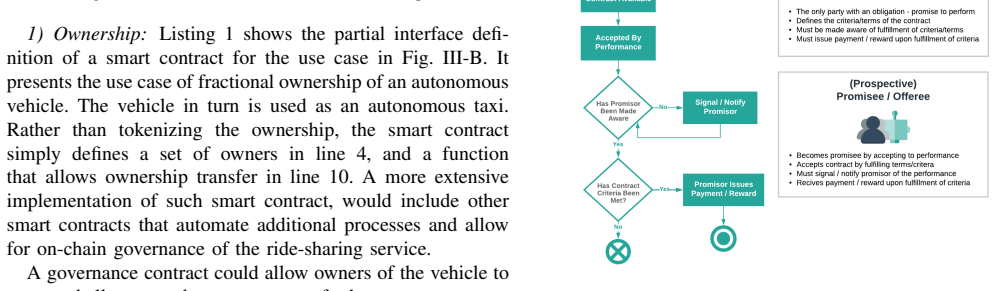
Summary. This paper argues that blockchain technology, smart contracts, cryptocurrencies, and decentralized identifiers can together enable unmediated peer-to-peer financial transactions and agreements between robots and humans (and among robots), a field the authors call "Robonomics." It provides conceptual background on these technologies, a table of their properties and robotics applications, and three concrete scenarios: fractional ownership of an autonomous vehicle, a smart-contract chess game with betting, and unilateral reward contracts. It also reports a small preliminary survey (about 50 college students and 20 blockchain-knowledgeable participants) on people's willingness to accept payment from a robot and their envisioned payment methods. The paper concludes that these technologies present "game changing opportunities" for robot-human coexistence.
Significance. If the vision is realized, it would extend human-robot interaction beyond lab-mediated experiments, give robots a form of economic agency, and connect HRI with cryptoeconomics and behavioral game theory. The paper's strengths are its clear technology taxonomy, the concrete use cases (especially the chess-bet scenario), and its honest acknowledgment that the survey is preliminary and that legal enforceability and usability are open problems. However, the manuscript does not specify how a robot would securely own and use a private key, which is the load-bearing premise for "unmediated" transactions, and its empirical and software support is deferred to anonymized references that cannot be evaluated. The proposal is therefore a plausible and useful agenda-setting paper, but its central feasibility claim is not yet fully supported.
major comments (2)
- [Section III-C (with II-B, III-B2, V.2)] The claim that a robot can engage in an unmediated peer-to-peer transaction requires that the robot itself generate, store, and authorize transactions with a private key. The manuscript does not specify any robot-side key management scheme: the wallet software discussed in Section II-B (MetaMask, Portis) is human-oriented; Section III-C simply asserts that "Both the human agent and the robot agent have a wallet address and/or wallet software," and the breach discussion in Section III-B2 lists private-key compromise as a dispute to be arbitrated rather than a design constraint. If a robot's private key is readable by its operator or extractable by an attacker, every transaction is effectively mediated by a human, which collapses the distinction from the lab experiments criticized in the Introduction. The authors should explicitly discuss key provisioning, isolation, and recovery for robots (e.g., secure elements, TPM/HSM, hardware wallets), or state this as an open problem and qualify the central claim accordingly.
- [References [25] and [26]; Sections IV and VI] The manuscript's empirical and implementation support is deferred to anonymized self-citations: Section IV states that "Full details on the survey are presented in [26]," and Section VI states that the software, smart contracts, and open-source libraries "can be found in [26]"; [25] is another self-citation with title omitted. As submitted, these references provide no content that a reader can check, so the claimed survey results and working implementations cannot be verified. The authors should include the survey instrument and results (or a resolvable public version) and cite a public repository for the software, rather than anonymous placeholders.
minor comments (5)
- [Section IV] The survey percentages (84%, 92%) are reported as point estimates without confidence intervals, exact item counts, or significance tests; with roughly 50 and 20 respondents, the uncertainty is substantial. Please report denominators and confidence intervals, or explicitly label the results as illustrative.
- [Listing 1] Listing 1, titled "Partial Interface Definition," contains invalid Solidity: for example, `function owners() constant returns (address owners)` does not match the `address[] owners` state variable, several functions lack visibility modifiers, and the event declaration contains a typo (`pass engerA ddr`). The code should be corrected or explicitly labeled as pseudocode.
- [General] Several in-text cross-references to figures are wrong (e.g., "Fig. III-B" should be Fig. 1 or 2); please fix all figure references.
- [General] Please correct typographical errors, including "cryptopcurrencies" in Section II-B, "immmutable" in the Section III-A heading, and "ummediated" in Section III-C1.
- [Section VI] The paper introduces the term "Robonomics" without discussing prior uses of the word in the literature; if the term is intended as a neologism, a brief prior-art note would be appropriate.
Circularity Check
No significant circularity: the paper is a position essay with no fitted derivation; self-citations are illustrative rather than load-bearing.
full rationale
This is a vision/position paper, not a derivation. It contains no equations, no fitted parameters, and no numerical predictions that could reduce to inputs. The central claim—that blockchains, smart contracts, and cryptocurrencies can enable unmediated peer-to-peer financial transactions and agreements between robots and humans—is advanced by scenario descriptions (chess betting, escrow for an autonomous taxi, unilateral reward contracts) and by citations to external systems (Ethereum [5], MetaMask [21], Portis [29], OpenBazaar [27]). The authors' own previous work is cited for earlier demonstrations and for survey details ([8], [25], [26]); these citations point to implementations and a descriptive survey, not to a uniqueness theorem or to parameter values that are then relabeled as predictions. The definition of 'Robonomics' in Section VI is an explicit label for combining HRI, behavioral economics, behavioral game theory, and cryptoeconomics; this is a renaming, not a circular derivation. Section V.2 does contain a genuine limitation: 'Users of the technology must be able to securely store and manage private keys' is stated for users generally, and Section III-C simply assumes 'Both the human agent and the robot agent have a wallet address and/or wallet software,' leaving robot-side key custody and the legal status of machine-held identity as unsupported preconditions. This is a correctness/robustness gap, but it is not circularity: the headline claim does not follow from that assumption by construction, and the paper does not claim to have derived it. References [25] and [26] are anonymized in the submitted version, so the workshop implementation cannot be independently checked here, but missing verifiability is distinct from circularity. Therefore no circular step meeting the quoted-evidence standard was found.
Assumptions & free parameters
assumptions (4)
- domain assumption Public permissionless blockchains are immutable, decentralized, and publicly verifiable ledgers.
- domain assumption Smart contracts are self-executable, self-enforceable, and tamper-proof.
- ad hoc to paper Robots can generate and securely manage cryptographic key pairs and wallet addresses for signing transactions.
- ad hoc to paper Decentralized identifiers can be attached to robots and used to claim property and history.
invented entities (1)
-
Robonomics (field of study)
Cite this review
Pith. "Pith review of Robonomics: The Study of Robot-Human Peer-to-Peer Financial Transactions and Agreements." pith.science (2026). https://pith.science/paper/7RXR4Y7K
@misc{pith2026190807393,
  author       = {Pith},
  title        = {Pith review of: Robonomics: The Study of Robot-Human Peer-to-Peer Financial Transactions and Agreements},
  year         = {2026},
  howpublished = {\url{https://pith.science/paper/7RXR4Y7K}},
  note         = {Machine review of arXiv:1908.07393}
}
read the original abstract
The concept of a blockchain has given way to the development of cryptocurrencies, enabled smart contracts, and unlocked a plethora of other disruptive technologies. But, beyond its use case in cryptocurrencies, and in network coordination and automation, blockchain technology may have serious sociotechnical implications in the future co-existence of robots and humans. Motivated by the recent explosion of interest around blockchains, and our extensive work on open-source blockchain technology and its integration into robotics - this paper provides insights in ways in which blockchains and other decentralized technologies can impact our interactions with robot agents and the social integration of robots into human society.
Figures


Figures from the paper (1 more)

Reference graph
Works this paper leans on
-
[8]
Irvin S. Cardenas and Jong-Hoon Kim. Robot-human agreements and financial transactions enabled by a blockchain and smart contracts. In he 2018 Intl. Conf. on Human-Robot Interaction , pages 337–338, 2018
work page 2018
- [26]
- [25]
-
[1]
James A. Aho. Rhetoric and the invention of double entry bookkeeping. Rhetorica: A Journal of the History of Rhetoric , 3(1):21–43, 1985
work page 1985
-
[2]
Specious reward: A behavioral theory of impulsiveness and impulse control
George Ainslie. Specious reward: A behavioral theory of impulsiveness and impulse control. Psychological bulletin, 82:463–96, 08 1975
work page 1975
- [3]
-
[4]
Blockgeeks. Erc-721 cryptokitty token. https://blockgeeks.com/guides/ erc-721-cryptokitty-token/
-
[5]
Ethereum: A next-generation smart contract and de- centralized application platform
Vitalik Buterin. Ethereum: A next-generation smart contract and de- centralized application platform. https://github.com/ethereum/wiki/wiki/ White-Paper, 2014. Accessed: 2016-08-22
work page 2014
Show all 36 references
-
[6]
Colin F. Camerer. Progress in Behavioral Game Theory. Journal of Economic Perspectives, 11(4):167–188, Fall 1997
1997
-
[7]
Cardenas, H
Irvin S. Cardenas, H. Jeong, J. Kim, and Y . Chi. Unique cipher-acoustic languages for human-robot interactions. In 2019 14th ACM/IEEE Intl Conf. on Human-Robot Interaction (HRI) , pages 600–601, March 2019
2019
-
[9]
Cardenas, Kelsey A
Irvin S. Cardenas, Kelsey A. Vitullo, Michelle Park, Jong-Hoon Kim, Margarita Benitez, Chanjuan Chen, and Linda Ohrn-McDaniels. Tele- suit: An immersive user-centric telepresence control suit. In 14th Intl. Conf. on Human-Robot Interaction , pages 654–655, 2019
2019
-
[10]
Solidity Documentation: Solidity by Example - Safe Remote Purchase
Ethereum. Solidity Documentation: Solidity by Example - Safe Remote Purchase. https://solidity.readthedocs.io/en/develop/ solidity-by-example.html#safe-remote-purchase, 2016
2016
-
[11]
https://identity.foundation/
Decentralized Identity Foundation. https://identity.foundation/
-
[12]
M. R. Fraune, S. Sherrin, S. abanovi, and E. R. Smith. Is human-robot interaction more competitive between groups than between individuals? In 14th Intl. Conf. on Human-Robot Interaction (HRI) , pages 104–113, March 2019
2019
-
[13]
A. S. Ghazali, J. Ham, E. Barakova, and P. Markopoulos. Assessing the effect of persuasive robots interactive social cues on users psychological reactance, liking, trusting beliefs and compliance. Advanced Robotics , 33(7-8):325–337, 2019
2019
-
[14]
Decentralized identifiers (dids)
W3C Community Group. Decentralized identifiers (dids). https: //w3c-ccg.github.io/did-spec/
-
[15]
Unilateral contract
Cornell Law School Legal Information Institute. Unilateral contract. https://www.law.cornell.edu/wex/unilateral contract
-
[16]
Bilateral contract
Investopedia. Bilateral contract. https://www.investopedia.com/terms/b/ bilateral-contract.asp
-
[17]
MimbleWimble
Tom Elvis Jedusor. MimbleWimble. https://github.com/mimblewimble/ docs/wiki/MimbleWimble-Origin, July 2016
2016
-
[18]
Orville R. Keister. Commercial record-keeping in ancient mesopotamia. The Accounting Review , 38(2):371–376, 1963
1963
-
[19]
D. Y . Kim, Irvin S. Cardenas, and J.H. Kim. Engage/Disengage: Control Triggers for Immersive Telepresence Robots. In Proceedings of the 5th Intl. Conf. on Human Agent Interaction - HAI ’17 , pages 495–499, Bielefeld, Germany, 2017. ACM Press
2017
-
[20]
N. Kshetri. Can blockchain strengthen the internet of things? IT Professional, 19(4):68–72, 2017
2017
-
[21]
https://metamask.io/
MetaMask. https://metamask.io/
-
[22]
Mischel, Ebbe B
W. Mischel, Ebbe B. Ebbesen, and A. Raskoff Zeiss. Cognitive and attentional mechanisms in delay of gratification. Journal of Personality and Social Psychology , 21:204–218, 02 1972
1972
-
[23]
Bitcoin: A peer-to-peer electronic cash system
Satoshi Nakamoto. Bitcoin: A peer-to-peer electronic cash system. https: //bitcoin.org/bitcoin.pdf, Dec 2008. Accessed: 2019-01-01
2008
-
[24]
K. D. O’Leary and W. C. Becker. Behavior modification of an adjustment class: A token reinforcement program. Journal of exceptional children, 33:637–642, 05 1967
1967
-
[27]
Openbazaar
OpenBazaar. Openbazaar. https://openbazaar.org/
-
[28]
The thunder protocol
Rafael Pass and Elaine Shi. The thunder protocol. https://docs. thundercore.com/thunder-whitepaper.pdf
-
[29]
Portis: Let’s go explore the new internet
Portis. Portis: Let’s go explore the new internet. https://www.portis.io/
-
[30]
What is blockchain technology? https://blockgeeks.com/ guides/what-is-blockchain-technology/, 2016
Ameer Rosic. What is blockchain technology? https://blockgeeks.com/ guides/what-is-blockchain-technology/, 2016
2016
-
[31]
E. B. Sandoval, J. Brandstetter, and C. Bartneck. Can a robot bribe a human? the measurement of the negative side of reciprocity in human robot interaction. In 2016 11th ACM/IEEE International Conference on Human-Robot Interaction (HRI) , pages 117–124, March 2016
2016
-
[32]
Siegel, C
M. Siegel, C. Breazeal, and M. I. Norton. Persuasive robotics: The influence of robot gender on human behavior. In 2009 IEEE/RSJ Intl. Conf. on Intelligent Robots and Systems , pages 2563–2568, Oct 2009
2009
-
[33]
R. H. Strotz. Myopia and Inconsistency in Dynamic Utility Maximiza- tion. The Review of Economic Studies , 23(3):165–180, 12 1955
1955
-
[34]
Smart contracts glossary
Nick Szabo. Smart contracts glossary. http://www.fon.hum. uva.nl/rob/Courses/InformationInSpeech/CDROM/Literature/ LOTwinterschool2006/szabo.best.vwh.net/smart contracts glossary. html, 1994
1994
-
[35]
Sthigh and Mathias Siems
Daith M. Sthigh and Mathias Siems. The chinese social credit system: A model for other countries? European Uni. Institute: Dept. of Law
-
[36]
von Neumann and O
J. von Neumann and O. Morgenstern. Theory of Games and Economic Behavior. Princeton University Press, 1944
1944
Reviewed August 14, 2026 · model on record in the stance chip above.
Discussion (0). Continue with ORCID to comment.