REVIEW 4 major objections 6 minor 14 references
Assessment of gait normality using a depth camera and mirrors
T0 review · 4 major / 6 minor · reviewed 2026-08-14 · deepseek-v4-flash
Pith's one-line read The paper claims that a depth-camera system with two mirrors can assess gait normality from enhanced frontal depth maps, achieving a per-sequence classification error of 0.06 and beating two SVM baselines.
desk verdict A nicely described mirror-depth pipeline for gait screening whose performance claims rest on an in-sample EER, a 3-subject test set, and a LoPS score that dwarfs the PoI feature. read the letter →
The pith
A machine-rendered reading of the paper's core claim, the machinery that carries it, and where it could break.
The reading
What carries the argument
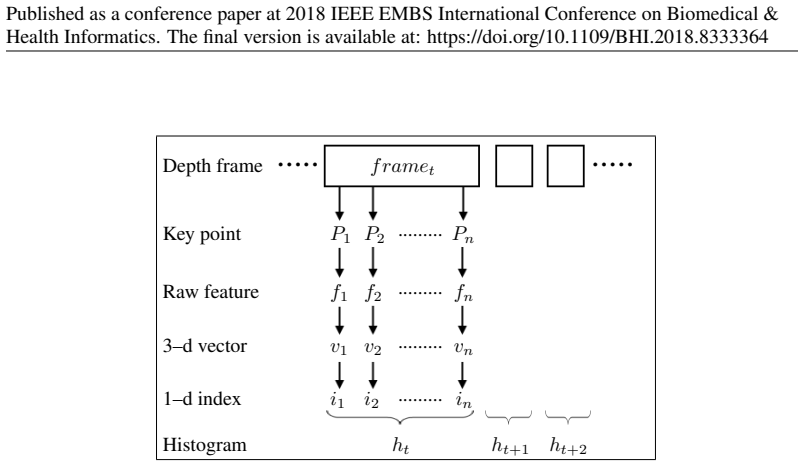
The load-bearing objects are enhanced depth maps and the LoPS score. Enhanced depth maps are formed by merging three foreground views of the subject, one direct and two from mirrors, after reflecting mirror pixels to their true 3D positions and discarding pixels corrupted by multipath ambiguity. The LoPS score separates the body silhouette into left and right halves with a line from the head to its ground projection, then measures symmetry through the half-body pixel ratio and quantized horizontal projection histograms, matching the two sides' temporal sequences by cross-correlation. The PoI-score localizes FAST keypoints, reduces 49-dimensional local features by PCA to 3 dimensions, builds a 125-bin histogram per frame, and feeds Hamming distances between consecutive histograms into a fully connected HMM with Gaussian mixture emissions. The final score is a weighted sum whose weights are derived from training sequences.
What would settle it
Run the same system on a gait abnormality that preserves left-right symmetry, for example equally thick soles under both feet or a bilaterally stiff walking pattern; if the per-sequence error rises toward the baseline's 0.19 or to chance, the symmetry assumption is the limiting factor.
Extended reading notes
Core claim
The central claim is that a purely appearance-based symmetry measurement, computed from mirror-enhanced depth silhouettes in frontal view, carries almost the entire diagnostic signal for the tested gait abnormalities. In the paper's experiments, the trained weighting assigns 0.9986 of the final score to the LoPS-score and 0.0014 to the PoI-score, and the per-sequence classification error is 0.06 for the combination, compared with 0.19 for the one-class SVM and 0.14 for the binary SVM baseline. The paper states that the LoPS feature plays the main role and the PoI performs a tuning on the output, and that the approach outperforms the reference method on full sequences of walking gaits. This is demonstrated on six simulated abnormal gaits produced by uneven soles, not on clinical gait disorders.
Load-bearing premise
The final score is 99.86 percent driven by a left-right symmetry measure, so the whole system presumes that an abnormal gait shows up as visible asymmetry in frontal view.
Editorial extensions
If this is right
- Gait screening can proceed without skeleton joints, avoiding the deformed-skeleton failures that occur during pathological walking.
- A one-class model trained only on normal gaits is sufficient to flag new abnormal patterns, because the symmetry score needs no abnormal examples.
- Sequence-level decision by averaging scores over a full walk is more robust to noise than frame-level triggering.
- The mirror-enhanced acquisition gives three usable views of the body with a single depth camera, so richer depth data does not require multiple sensors.
- The proposed features are computed from depth and silhouette information alone, making the approach applicable in settings where skeletal tracking is unreliable.
Reading between the lines
- Beyond the paper's experiments, the tiny PoI weight of 0.0014 suggests that the point-of-interest branch contributes little independent signal; a simplified system might drop it and retrain the threshold on the LoPS score alone.
- A boundary the paper leaves implicit is symmetric gait abnormalities: because the LoPS score dominates the decision, bilaterally symmetric disorders such as stiff or ataxic gaits would be nearly invisible, and testing them would clarify the system's real scope.
- A testable extension is to replace the physical mirrors with synthetic mirror views or multiple cameras, which would make the enhanced-depth idea easier to deploy outside a fixed lab setup.
Signed reviews
Editorial analysis
A structured set of objections, weighed in public.
Referee Report
Summary. The paper proposes a gait normality assessment pipeline that uses a Time-of-Flight depth camera with two mirrors to produce enhanced frontal-view depth maps. Each frame is summarized by a point-of-interest (PoI) histogram (FAST keypoints, raw 3D descriptors, PCA to 3 dimensions, spatial quantization) and by level-of-posture-symmetry (LoPS) features (half-body ratio and quantized horizontal-projection histograms). Two scores are computed over a sliding window: a PoI-score from a fully connected HMM with GMM observations on the Hamming distance between consecutive histograms, and a LoPS-score from cross-correlation between left/right half-body ratio sequences and histogram-bin sequences. The final score is a weighted combination, with weights learned from normal-gait training sequences. The method is evaluated on 9 volunteers, 6 for training and 3 for testing, with 6 simulated abnormal gaits created by unilateral sole pads of 10, 15, and 20 cm. Table 1 reports per-frame and per-sequence classification errors, claiming the combined system outperforms the baseline method of Bauckhage et al. [1] (one-class and binary SVM).
Significance. The work addresses a relevant practical problem: markerless, camera-based gait normality assessment, with an experimental setup (mirrors plus ToF) that is clearly described and reproducible in principle. The feature-extraction and scoring equations are stated concretely, and the one-class training setup (using only normal gaits) is appropriate for many clinical screening scenarios. If the performance claims survived a stricter evaluation, the combination of a symmetry-based score with a local-feature score would be a useful contribution to the biomedical/health-informatics community. The main value lies in the LoPS score and the integrated mirror-based depth acquisition, rather than in the PoI component, which contributes negligibly to the final score.
major comments (4)
- [Section 3, Table 1] The reported per-sequence errors are Equal Error Rates computed from the test ROC, meaning the decision threshold is chosen after seeing the test labels. The per-sequence error of 0.06 is therefore an optimistic in-sample measure, not a predictive classification error at a pre-specified operating point. With only 3 test subjects and no confidence intervals, this error cannot be distinguished from the baseline values (0.14 and 0.19). The authors should report errors at a threshold fixed using training data only, or use leave-one-subject-out cross-validation, and provide confidence intervals or per-subject results.
- [Section 3, Table 1 and Section 2.3.3] The comparison with the baseline is not apples-to-apples. The proposed method uses a per-frame window of 10 frames and averages the final score over the full 1200-frame sequence, while the baseline uses a 21-frame context and a trigger of 30 consecutive frames. The per-frame errors are actually reversed (0.31 for the proposed method vs. 0.11/0.14 for the baselines), so the claimed advantage over [1] rests entirely on the different sequence-level decision rule. This protocol mismatch must be removed or explicitly justified before the outperformance claim can be accepted.
- [Section 2.3.3, Eq. (7) and Table 1] The combination claim is not evidenced by the reported numbers. The paper states that the learned weights are 0.0014 for PoI and 0.9986 for LoPS, and Table 1 shows the per-sequence error is 0.06 for both LoPS alone and PoI+LoPS. Thus the PoI score changes nothing in the sequence-level result, yet the text asserts 'the combination of these two features provided better results'. Either a quantitative demonstration of the combination benefit must be provided, or the claim should be softened to describe PoI as a negligible tuning component.
- [Section 3, experimental design] All six abnormal gaits are unilateral sole pads, which directly create left-right asymmetry. The LoPS score, carrying weight 0.9986, is essentially a direct measurement of the experimental manipulation. The introduction justifies LoPS by stating that 'pathological gaits usually occur with the appearance of asymmetric poses in frontal view', but symmetric gait abnormalities (e.g., bilateral stiffness or ataxia) would not be flagged by this score, and the PoI score is too weakly weighted to compensate. The paper should explicitly acknowledge this limitation and avoid claiming general gait-normality assessment beyond unilateral asymmetry.
minor comments (6)
- [Section 2.1.4, Eq. (2)] The notation in Eq. (2) uses j both as the dimension index and in the floor expression; please clarify that min_j and max_j are computed separately for each of the three dimensions.
- [Section 2.3.1] The HMM training details are incomplete: the number of GMM components, initialization, and convergence criteria are not specified, which makes the PoI-score results difficult to reproduce.
- [Section 3] The hyper-parameters (FAST threshold 30 mm, q=5, 8 HMM states, window width 10, 10 projection-histogram bins) are stated to be selected 'according to our experience' but no sensitivity analysis is provided. Please at least report the effect of varying the window width and the number of bins.
- [Section 2.3.3, Eq. (7)] The weight formula in Eq. (7) and the text ('0.0014 and 0.9986 for the PoI and LoPS') are confusing because both scores are negative; please spell out the sign convention and explain how the formula implements the stated rationale that the score with lower absolute value should receive the larger weight.
- [Section 3, Table 1] The baseline method [1] is described as 'slightly modified' to create a one-class SVM, but the kernel type, hyper-parameters, and training details are not given; this makes the comparison difficult to reproduce.
- [Section 3, text after Table 1] There is a typo: 'It other words' should be 'In other words'.
Circularity Check
Reported 0.06 per-sequence error is an EER threshold fitted to the 3-subject test set; the feature derivation itself is self-contained.
-
fitted input called prediction
[Section 3 (Experiments), EER definition and Table 1]
"Similarly to related works on binary decision (e.g. [5, 11]), we used a measure calculated from the Receiver Operating Characteristic (ROC) curve to evaluate our system. The Equal Error Rate (EER) is employed since it represents a trade-off between False Positive Rate (FPR) and False Negative Rate (FNR) and is comparable with typical classification errors."
The reported per-sequence error (0.06) is the EER obtained from the ROC of the 3-subject test set. The EER operating point is, by definition, the decision threshold on that test ROC at which FPR=FNR, so the threshold is selected using the test labels. The paper earlier describes the gait decision as 'a comparison between a predefined threshold and the final score' (Section 2.3.3), but no threshold is set independently of the evaluation data. Reporting this in-sample balanced error as the system's per-sequence error and comparing it with the baselines' 0.19/0.14 is therefore fitting the operating point to the evaluation set and presenting the fitted minimum as predictive performance. The 'outperformed' claim is not supported as a prediction on new sequences.
full rationale
The core derivation is not circular: PoI histograms come from FAST keypoints, PCA, and quantization on depth frames; the PoI-score uses an HMM trained only on normal-gait data; the LoPS-score is a cross-correlation symmetry measure; Eq. (7) fits combination weights on training scores, which is legitimate parameter estimation. The only circular element is the evaluation protocol: Table 1's per-sequence error is an EER computed on the test set, so the operating point is chosen on the same data used to report the error. Because the test set has only 3 subjects and no confidence intervals, and because the per-frame comparison runs in the opposite direction (0.31 vs 0.11/0.14), the headline outperformance claim rests on this test-fitted threshold. Self-citations ([4],[5],[6],[9]) are background/inspiration and not load-bearing; no uniqueness theorem is imported. The authors' own caveats ('initial work', '6 simulated abnormal gaits', 'collecting a larger dataset') further indicate the result is preliminary. Score 4 reflects one partial circularity in the evaluation step rather than in the derivation of the features.
Assumptions & free parameters
free parameters (8)
- FAST threshold =
30 mm
- Number of histogram bins q =
5
- Number of HMM hidden states =
8
- Sliding window width =
10 frames (0.77 s)
- Horizontal projection histogram bins =
10
- PCA target dimension =
3
- Score weights =
w_PoI=0.0014, w_LoPS=0.9986
- Decision threshold =
not specified
assumptions (5)
- domain assumption Pathological gaits usually manifest as left-right asymmetry in frontal view.
- domain assumption A single HMM with 8 states and GMM observations models the temporal dynamics of normal gait across different subjects.
- domain assumption The mirror-based 3D reconstruction and calibration from the authors' prior work [6] produce accurate enhanced depth maps.
- domain assumption Simulated abnormal gaits using sole pads of 10-20 cm are a valid proxy for pathological gait.
- domain assumption The vertical line through the head and its ground projection correctly separates the body into left and right halves.
Cite this review
Pith. "Pith review of Assessment of gait normality using a depth camera and mirrors." pith.science (2026). https://pith.science/paper/PBZBGPXB
@misc{pith2026190807418,
  author       = {Pith},
  title        = {Pith review of: Assessment of gait normality using a depth camera and mirrors},
  year         = {2026},
  howpublished = {\url{https://pith.science/paper/PBZBGPXB}},
  note         = {Machine review of arXiv:1908.07418}
}
read the original abstract
This paper presents an initial work on assessment of gait normality in which the human body motion is represented by a sequence of enhanced depth maps. The input data is provided by a system consisting of a Time-of-Flight (ToF) depth camera and two mirrors. This approach proposes two feature types to describe characteristics of localized points of interest and the level of posture symmetry. These two features are processed on a sequence of enhanced depth maps with the support of a sliding window to provide two corresponding scores. The gait assessment is finally performed based on a weighted combination of these two scores. The evaluation is performed by experimenting on 6 simulated abnormal gaits.
Figures


Figures from the paper (3 more)


Reference graph
Works this paper leans on
-
[1]
Automatic detection of abnormal gait
Christian Bauckhage, John K Tsotsos, and Frank E Bunn. Automatic detection of abnormal gait. Image and Vision Computing, 27(1):108–115, 2009
work page 2009
-
[2]
SRA: Fast Re- moval of General Multipath for ToF Sensors , pp
Daniel Freedman, Yoni Smolin, Eyal Krupka, Ido Leichter, and Mirko Schmidt. SRA: Fast Re- moval of General Multipath for ToF Sensors , pp. 234–249. Springer International Publishing, Cham, 2014. ISBN 978-3-319-10590-1
work page 2014
-
[3]
Segmentation by fusion of histogram-based-means clusters in different color spaces
Max Mignotte. Segmentation by fusion of histogram-based-means clusters in different color spaces. IEEE Transactions on image processing, 17(5):780–787, 2008
work page 2008
-
[4]
Evaluating perceptual maps of asymmetries for gait symmetry quantification and pathology detection
Antoine Moevus, Max Mignotte, JA de Guise, and Jean Meunier. Evaluating perceptual maps of asymmetries for gait symmetry quantification and pathology detection. In2014 36th Annual International Conference of the IEEE Engineering in Medicine and Biology Society , pp. 3317–
-
[5]
Skeleton-based abnormal gait detection
Trong-Nguyen Nguyen, Huu-Hung Huynh, and Jean Meunier. Skeleton-based abnormal gait detection. Sensors, 16(11):1792, 2016. ISSN 1424-8220. doi: 10.3390/s16111792. URL http://www.mdpi.com/1424-8220/16/11/1792
-
[6]
3d reconstruction with time-of- flight depth camera and multiple mirrors
Trong-Nguyen Nguyen, Huu-Hung Huynh, and Jean Meunier. 3d reconstruction with time-of- flight depth camera and multiple mirrors. IEEE Access, 6:38106–38114, 2018. ISSN 2169-
work page 2018
-
[7]
Hamming distance metric learning
Mohammad Norouzi, David J Fleet, and Ruslan R Salakhutdinov. Hamming distance metric learning. In Advances in neural information processing systems , pp. 1061–1069, 2012
work page 2012
-
[8]
Machine learning for high-speed corner detection
Edward Rosten and Tom Drummond. Machine learning for high-speed corner detection. In European conference on computer vision, pp. 430–443. Springer, 2006
work page 2006
Show all 14 references
-
[9]
Depth energy image for gait symmetry quantification
Caroline Rougier, Edouard Auvinet, Jean Meunier, Max Mignotte, and Jacques A De Guise. Depth energy image for gait symmetry quantification. In 2011 Annual International Confer- ence of the IEEE Engineering in Medicine and Biology Society , pp. 5136–5139. IEEE, 2011
2011
-
[10]
Spectral analysis of signals, volume 452
Petre Stoica and Randolph L Moses. Spectral analysis of signals, volume 452. Pearson Prentice Hall Upper Saddle River, NJ, 2005
2005
-
[11]
A comparative study of pose representation and dynamics modelling for online motion quality assessment
Lili Tao, Adeline Paiement, Dima Damen, Majid Mirmehdi, Sion Hannuna, Massimo Cam- plani, Tilo Burghardt, and Ian Craddock. A comparative study of pose representation and dynamics modelling for online motion quality assessment. Computer Vision and Image Un- derstanding, 148:13...
2016
-
[12]
Neurologic exam
University of Utah and University of Nebraska. Neurologic exam. http://library. med.utah.edu/neurologicexam, 2016. Accessed: 2018-01-14
2016
-
[13]
Real-time action recognition by spatiotem- poral semantic and structural forest
Tsz-Ho Yu, Tae-Kyun Kim, and Roberto Cipolla. Real-time action recognition by spatiotem- poral semantic and structural forest. In Proceedings of the British Machine Vision Conference, pp. 52.1–52.12. BMV A Press, 2010. ISBN 1-901725-40-5. doi:10.5244/C.24.52. 8
2010 doi
-
[3536]
doi: 10.1109/ACCESS.2018.2854262
2018
Reviewed August 14, 2026 · model on record in the stance chip above.
Discussion (0). Continue with ORCID to comment.