REVIEW 4 major objections 3 minor 17 references
Production of $J/\psi$ quarkonia in color evaporation model based on $k_{T}$-factorization
T0 review · 4 major / 3 minor · reviewed 2026-08-14 · deepseek-v4-flash
Pith's one-line read Adding the 2-to-3 gluon-fusion channel to the color evaporation model restores the LHC J/psi transverse-momentum spectrum.
desk verdict Plausible qualitative fix for the JH-2013 pT slope in kT-factorized ICEM, but the quantitative claim rests on visual comparison and unreported scales. read the letter →
The pith
A machine-rendered reading of the paper's core claim, the machinery that carries it, and where it could break.
The reading
What carries the argument
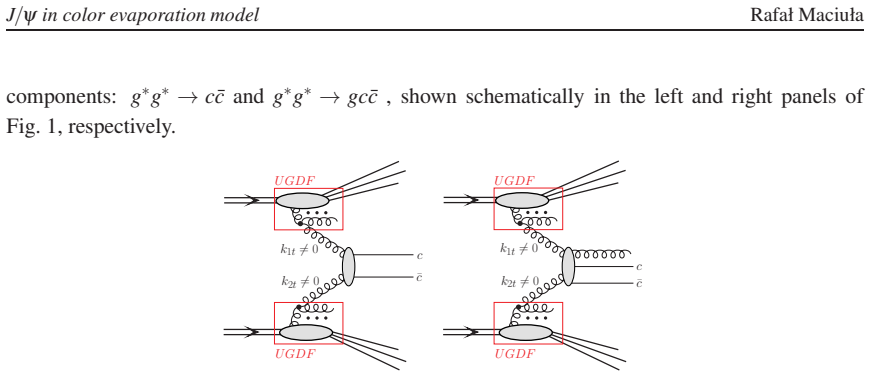
The machinery is a $k_T$-factorization calculation of $c\bar c$-pair production followed by the improved color evaporation model mapping to $J/\psi$. The two hard subprocesses are the $2\to2$ fusion $g^* g^* \to c\bar c$, using the standard analytic off-shell matrix element, and the $2\to3$ process $g^* g^* \to g c\bar c$, computed at tree level with off-shell matrix elements from a numerical Monte Carlo generator. The two unintegrated gluon distributions play different roles: KMR-type distributions include transverse momenta above the factorization scale and therefore contain hard emissions internally, while JH-2013 CCFM-type distributions contain only soft emissions and need the $2\to3$ term added externally. A suppression factor $F_{\rm sup}(p_T)=p_T^4/((p_T^0)^2+p_T^2)^2$ with $p_T^0=1.5$ GeV regularizes the low-$p_T$ minijet region, and a direct-to-prompt correction of 0.62 converts the prediction to the measured prompt $J/\psi$ yield.
What would settle it
Recompute the JH-2013 plus $2\to3$ prediction at $\sqrt{s}=13$ TeV, or with $p_T^0$ varied between 1.0 and 2.0 GeV, and compare with LHCb transverse-momentum data; if the good 7 TeV agreement depends strongly on this tuned parameter, the regularization is carrying the result rather than the $2\to3$ mechanism.
Extended reading notes
Core claim
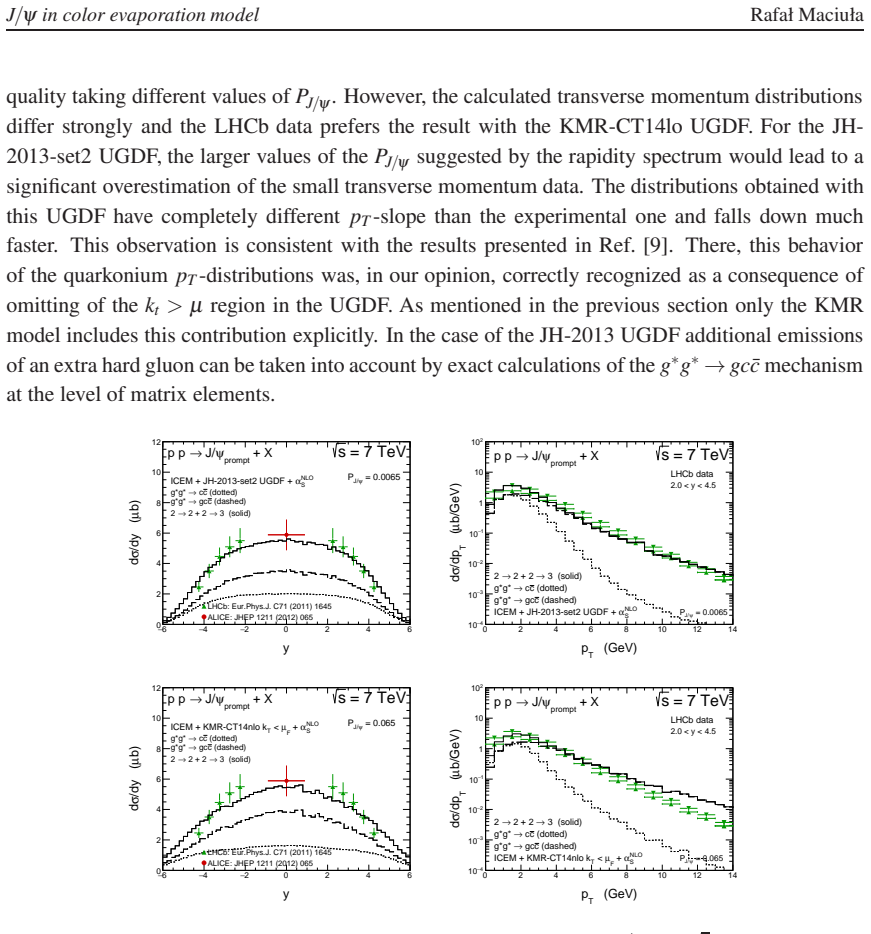
The central claim is that the steep fall of the JH-2013 CCFM-based prediction for the $J/\psi$ transverse-momentum distribution is caused by the omission of the $k_t>\mu_F$ region in that unintegrated gluon distribution, and that the missing physics is restored by computing the $2\to3$ subprocess $g^* g^* \to g c\bar c$ explicitly. In the $k_T$-factorization realization of the improved color evaporation model, the $2\to2$ term alone gives a spectrum that falls much faster than the LHCb data; adding the $2\to3$ tree-level contribution, regularized by a suppression factor with $p_T^0=1.5$ GeV, produces a very good description of both the rapidity and transverse-momentum distributions at $\sqrt{s}=7$ TeV. The same addition leaves the KMR-based result essentially unchanged, because the KMR gluon distribution already contains the hard-emission tail, and for KMR a cut $k_t<\mu_F$ is imposed on the $2\to3$ term to avoid double counting. The paper therefore identifies the difference between the two unintegrated gluon distributions as the real origin of the earlier discrepancy.
Load-bearing premise
The load-bearing premise is that the tree-level $2\to3$ contribution, regularized by $F_{\rm sup}(p_T)=p_T^4/((p_T^0)^2+p_T^2)^2$ with $p_T^0=1.5$ GeV tuned to total charm production at the LHC, correctly represents the higher-order physics missing from CCFM-type UGDFs; if that suppression or the tree-level normalization is wrong, the claimed agreement is not robust.
Editorial extensions
If this is right
- For JH-2013 and similar CCFM-based unintegrated gluon distributions, a $k_T$-factorization description of prompt $J/\psi$ must include the $2\to3$ channel $g^* g^* \to g c\bar c$ to reproduce the LHCb high-$p_T$ data.
- For KMR-type distributions, the standard $2\to2$ term already accounts for the relevant hard emissions, and adding the $2\to3$ term with a cut $k_t<\mu_F$ leaves the predictions essentially unchanged.
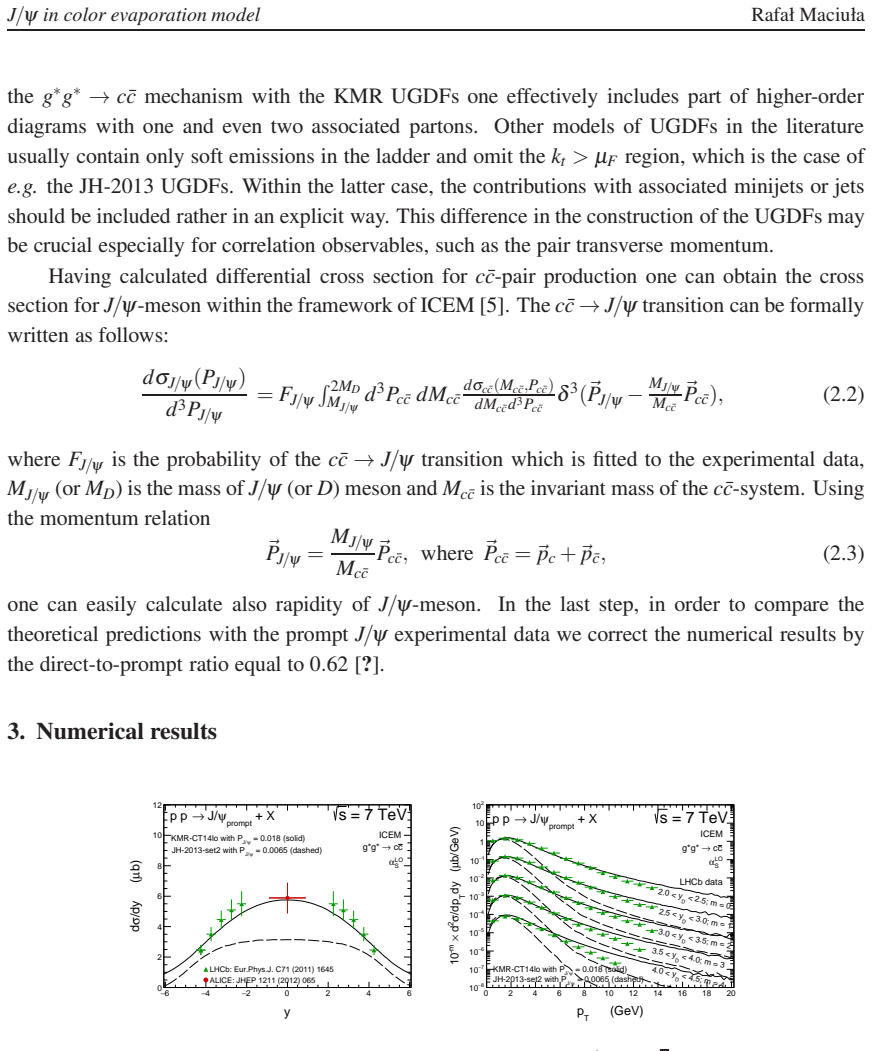
- The fitted $c\bar c\to J/\psi$ probability differs between the two unintegrated gluon distributions (0.018 for KMR-CT14lo, 0.0065 for JH-2013-set2), so the small-$p_T$ normalization depends on the gluon distribution.
- Using both mechanisms and the direct-to-prompt ratio 0.62, the model describes the LHCb prompt $J/\psi$ rapidity and transverse-momentum distributions at $\sqrt{s}=7$ TeV.
Reading between the lines
- The same reasoning should apply to other quarkonia such as $\Upsilon$ and to correlation observables like $D\bar D$ azimuthal decorrelations: wherever a CCFM-type unintegrated gluon distribution is used, an explicit hard-emission channel should be needed at high $p_T$.
- A decisive test of the mechanism would be to use a CCFM-based unintegrated gluon distribution that does include the $k_t>\mu_F$ region; the paper's logic predicts its $2\to2$ results should match the JH-2013-plus-$2\to3$ results without the extra channel.
- The suppression parameter $p_T^0=1.5$ GeV is fitted to total charm production; refitting it directly to the $J/\psi$ spectrum would show whether the regularization is physical or just an effective cutoff.
Signed reviews
Editorial analysis
A structured set of objections, weighed in public.
Referee Report
Summary. The manuscript applies the improved color evaporation model (ICEM) to prompt J/psi production at LHC energies, computing the underlying c-cbar-pair cross section in kT-factorization. Two hard subprocesses are included: the standard g*g* -> c cbar channel and, as the new element, the 2 -> 3 channel g*g* -> g c cbar evaluated with the KATIE generator. The model is compared with ALICE and LHCb rapidity and pT distributions at 7 TeV using two unintegrated gluon distributions, the KMR-CT14lo/nlo UGDFs and the CCFM-based JH-2013-set2 UGDF. The main claim is that adding the 2 -> 3 process to the JH-2013-set2 UGDF changes a poor high-pT slope into a very good description of the LHCb data, whereas the KMR-based calculation already works with only the 2 -> 2 mechanism provided a kt < mu_F cut is imposed to avoid double counting.
Significance. If the central claim is correct, the paper offers a practical and conceptually useful way to incorporate additional hard emissions in CCFM-based UGDFs within kT-factorization, and it sharpens the interpretation of why KMR and JH-2013 UGDFs differ for correlation-type observables. The use of KATIE for the tree-level off-shell 2 -> 3 matrix elements is a concrete and reproducible technical step, and the explicit discussion of the kt > mu_F region in the KMR prescription is a genuine conceptual contribution. At the same time, the quantitative support for the headline claim is visual only, and two parameters controlling the normalization (P_J/psi and, indirectly, p0_T) are fitted to data entering the comparison, so the paper's significance rests on the shape improvement rather than on an absolute prediction.
major comments (4)
- [Section 2, paragraph 3; Section 3, Fig. 3] The central claim that g*g* -> g c cbar 'completely changes the picture' and gives 'a very good description' of the pT distributions for the JH-2013-set2 UGDF is not quantitatively validated. The suppression factor Fsup(pT) = pT^4 / ((p0_T)^2 + pT^2)^2 is adjusted to the total charm production cross section, which constrains the normalization but not the differential shape; in the pT ~ 4-14 GeV region shown in Fig. 3, Fsup is already 0.77-0.96, so the predicted slope is essentially the bare tree-level off-shell 2 -> 3 matrix element. No comparison to an independent differential NLO calculation or to open-charm pT data is shown for the JH-2013 + 2 -> 3 combination, so the paper does not currently demonstrate that the improvement is robust rather than a consequence of the unvalidated 2 -> 3 shape. I recommend adding such a differential validation or, failing that, explicitly presenting the scale and mass dependence as an uncertainty band.
- [Section 2, Eq. (2.2); Section 3, Fig. 2] The parameter P_J/psi is not predicted but fitted to the LHCb data at small pT for each UGDF (P_J/psi = 0.0065 for JH-2013-set2 and 0.018 for KMR-CT14lo). Since the comparison in Figs. 2 and 3 is to the same data set, the absolute normalization is not a prediction. The pT-slope comparison is partly independent because P_J/psi only rescales all bins, but the statement that the model gives 'a very good description' should be qualified by this fitting procedure, and the paper should state explicitly which observables are genuinely predicted.
- [Section 2, paragraph 3; Section 3, Fig. 3] The paper does not specify the renormalization and factorization scales, the charm-quark mass, or the precise implementation of the kt < mu_F cut used for the KMR UGDF in the 2 -> 3 process. These choices are load-bearing for the normalization and for the claimed absence of double counting, and without them the numerical results cannot be reproduced or independently tested. The authors should state all input parameters and, ideally, show the sensitivity of the pT distributions to their variation.
- [Section 2, Eq. (2.2); Section 3] The direct-to-prompt ratio of 0.62 is introduced with a missing reference (the text shows '[?]'). Since this factor directly multiplies the comparison with prompt-J/psi data, it is a substantive input and must be referenced or derived. If it is taken from a specific fit or measurement, the source should be cited; if it is a phenomenological choice, its uncertainty should be propagated into the comparison.
minor comments (3)
- [Throughout] There are several typographical errors, including 'valueable' in the Introduction and 'respecitvely' in Section 3; these should be corrected in a revision.
- [Figures 2 and 3] The theoretical curves are shown without uncertainty bands or goodness-of-fit measures such as chi2, even though the central comparison is visual. Adding a quantitative measure would substantially strengthen the paper.
- [Section 3, Fig. 3 caption] The label 'NLO alpha_s + kt < mu_F' in the bottom panels is difficult to parse; the caption should explain that the cut applies to the 2 -> 3 contribution with the KMR UGDF.
Circularity Check
No significant circularity: the high-pT shapes are generated by explicit 2->3 matrix elements and the JH-2013 UGDF, not by the fitted normalization or suppression parameter.
full rationale
The central claim rests on an explicit calculation of the g*g* -> g c cbar contribution with the KATIE package, added to the 2->2 term for the JH-2013-set2 UGDF, and compared directly with ALICE/LHCb data. The two adjusted quantities are P_J/psi, fixed to the LHCb normalization at small pT, and p0_T = 1.5 GeV, which enters the suppression factor Fsup(pT) = pT^4/((p0_T)^2 + pT^2)^2 and is adjusted to NLO total charm production cross sections. Neither constant forces the large-pT slope: P_J/psi is an overall normalization, and Fsup is close to unity in the pT > 4 GeV region where the improvement is displayed, so the differential shape is set by the off-shell matrix element and UGDF. The paper does not rename a fitted constant as a prediction of the absolute rate; it compares differential shapes after fixing the normalization. Self-citations to Refs. [2], [6], and [7] are background statements about previous KMR UGDF performance and NRQCD fits, while the specific JH-2013 kt > mu_F deficiency is attributed to the external work of Cheung and Vogt (Ref. [9]) and the original JH-2013 construction (Ref. [13]). No uniqueness claim, ansatz, or fitted quantity is imported as the sole load-bearing justification, so no derivation step reduces by construction to its inputs.
Assumptions & free parameters
free parameters (3)
- P_J/psi transition probability =
0.018 for KMR-CT14lo, 0.0065 for JH-2013-set2
- p0_T suppression parameter =
1.5 GeV
- Direct-to-prompt ratio =
0.62, unreferenced
assumptions (6)
- domain assumption The kT-factorization formula in Eq. (2.1) with CCH off-shell matrix elements gives the full perturbative c cbar production cross section.
- domain assumption The improved color evaporation model mapping in Eq. (2.2) with a single transition probability P_J/psi correctly describes c cbar to J/psi hadronization.
- domain assumption The unintegrated gluon distributions from the literature, KMR-CT14lo, KMR-CT14nlo, and JH-2013-set2, are valid inputs for the calculation.
- ad hoc to paper For the KMR UGDF, applying the cut kt less than mu_F in the 2 to 3 process avoids double counting of hard emissions already present in the UGDF.
- ad hoc to paper The p0_T suppression factor Fsup(pT) with p0_T = 1.5 GeV correctly regularizes the 2 to 3 minijet cross section.
- domain assumption The direct-to-prompt ratio of 0.62 correctly converts direct J/psi production to prompt J/psi data.
Cite this review
Pith. "Pith review of Production of $J/\psi$ quarkonia in color evaporation model based on $k_{T}$-factorization." pith.science (2026). https://pith.science/paper/ISJ2REZS
@misc{pith2026190807429,
  author       = {Pith},
  title        = {Pith review of: Production of $J/\psi$ quarkonia in color evaporation model based on $k_T$-factorization},
  year         = {2026},
  howpublished = {\url{https://pith.science/paper/ISJ2REZS}},
  note         = {Machine review of arXiv:1908.07429}
}
abstract
We use a new approach to color evaporation model (CEM) for quarkonium production. The production of $c\bar c$ pairs is performed within $k_T$-factorization approach using different unintegrated gluon distribution functions (UGDF) from the literature. We include all recent improvements to color evaporation model. We get poor description of the large transverse momentum distributions of $J/\psi$ with the JH-2013 CCFM-based UGDF. Here explicit inclusion of $2 \to 3$ processes considerably improves the situation. Similar effects are discussed in the context of the KMR UGDF.
Figures
Reference graph
Works this paper leans on
- [9]
-
[1]
C. H. Chang, Nucl. Phys. B 172, 425 (1980)
1980
- [2]
- [3]
- [4]
- [5]
- [6]
- [7]
Show all 17 references
-
[8]
Karpishkov, V
A. Karpishkov, V . Saleev and A. Shipilova, Phys. Rev. D 94, no. 11, 114012 (2016)
2016
-
[10]
Catani, M
S. Catani, M. Ciafaloni and F. Hautmann, Nucl. Phys. B 366, 135 (1991)
1991
-
[11]
van Hameren, Comput
A. van Hameren, Comput. Phys. Commun. 224, 371 (2018)
2018
-
[12]
G. Watt, A. D. Martin and M. G. Ryskin, Eur. Phys. J. C31, 73 (2003)
2003
-
[13]
Hautmann and H
F. Hautmann and H. Jung, Nucl. Phys. B 883, 1 (2014)
2014
-
[14]
Aaij et al
R. Aaij et al. [LHCb Collaboration], Nucl. Phys. B 871, 1 (2013)
2013
-
[15]
Abelev et al
B. Abelev et al. [ALICE Collaboration], J. High Energy Phys. 11, 065 (2012)
2012
-
[16]
Aaij et al
R. Aaij et al. [LHCb Collaboration], Eur. Phys. J. C 71, 1645 (2011)
2011
-
[17]
H. Jung, M. Kraemer, A. V . Lipatov and N. P . Zotov, J. High Energy Phys 01, 085 (2011). 5
2011
Reviewed August 14, 2026 · model on record in the stance chip above.
Discussion (0). Continue with ORCID to comment.