REVIEW 3 major objections 6 minor 36 references
Pix2Pose: Pixel-Wise Coordinate Regression of Objects for 6D Pose Estimation
T0 review · 3 major / 6 minor · reviewed 2026-08-14 · deepseek-v4-flash
Pith's one-line read Pix2Pose estimates 6D object poses from single RGB images by regressing each object pixel's 3D coordinates, and reports higher accuracy than prior RGB-only methods on LineMOD, LineMOD Occlusion, and T-Less.
desk verdict A genuinely useful coordinate-regression method with a clean transformer loss, but the abstract's SOTA claim is contradicted by its own Table 1 and the code is not released. read the letter →
The pith
A machine-rendered reading of the paper's core claim, the machinery that carries it, and where it could break.
The reading
What carries the argument
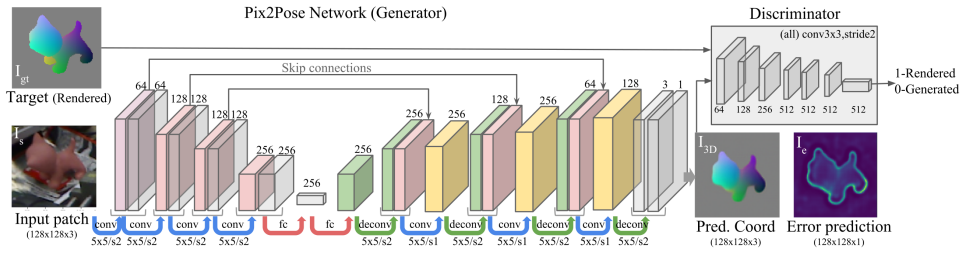
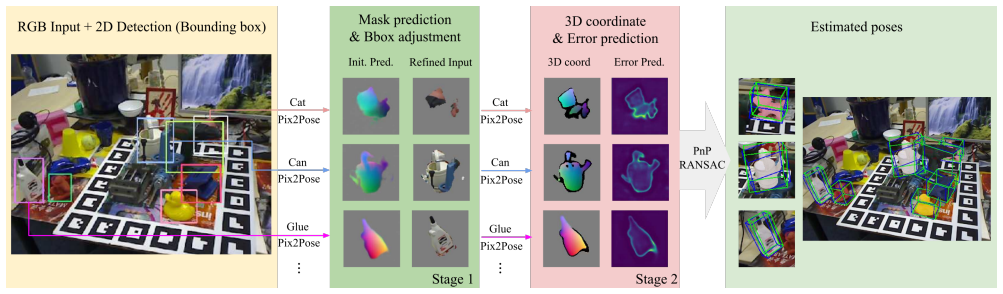
The central object is the coordinate image $I_{3D}$, a per-pixel encoding of normalized 3D object coordinates as RGB values, rendered from the untextured 3D model in the ground-truth pose. The network is an auto-encoder with skip connections, trained with a GAN discriminator to make predicted coordinate images realistic and to recover occluded regions, plus an error image $I_e$ giving per-pixel confidence. The transformer loss computes $L_{3D}=\min_{p\in\mathrm{sym}} L_r(I_{3D}, R_p I_{gt})$ over a predefined finite pool of symmetric poses, guiding predictions to the closest symmetric pose. The final pose is obtained by a two-stage re-centering step followed by PnP with RANSAC on confident correspondences.
What would settle it
Build a test set in which a LineMOD or T-Less object is occluded by previously unseen occluders over a controlled fraction of its bounding box, and compare pose accuracy plus the predicted coordinate error on the invisible pixels against the rendered ground truth; if accuracy collapses once more than a small fraction is hidden, or the coordinates of invisible pixels deviate sharply from the rendered model, the claimed implicit recovery of occluded parts is the bottleneck.
Extended reading notes
Core claim
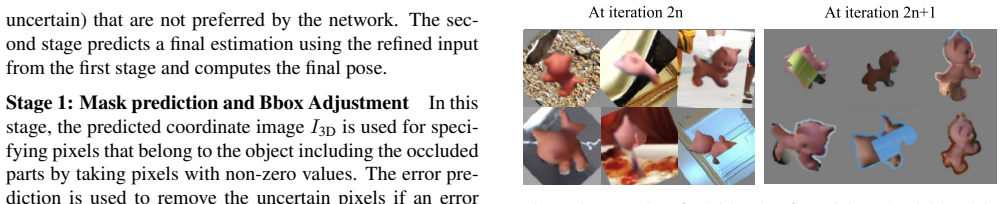
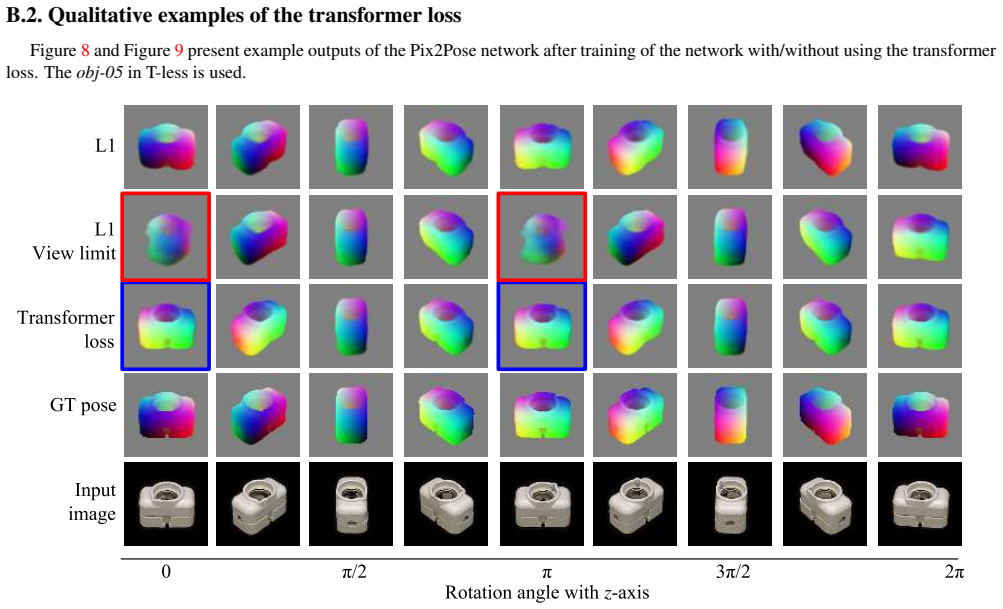
The central discovery is that a coordinate image can replace feature matching, template classification, or direct rotation regression: normalized 3D coordinates of each object vertex are encoded as an RGB-like colored image rendered from the untextured model, and the network learns to produce that coordinate image from a detected crop. Alongside it, the network predicts a per-pixel error image, so uncertain or occluded correspondences can be discarded before solving. Symmetric objects are handled by the transformer loss, which evaluates the reconstruction loss against every symmetric pose candidate and keeps the minimum, avoiding the boundary errors caused by restricting view ranges. On LineMOD, LineMOD Occlusion, and T-Less, the method reports higher recall than earlier RGB-only approaches, including some that use textured models, synthetic training data, or depth-based refinement.
Load-bearing premise
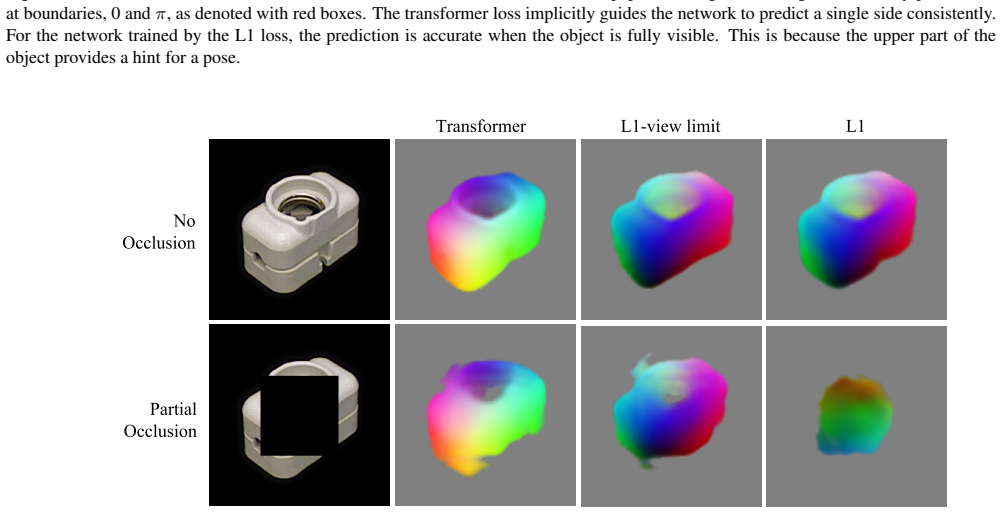
The method's occlusion robustness rests on the assumption that an auto-encoder trained with adversarial loss can reliably infer the 3D object coordinates of pixels that are not visible, so occluded parts still contribute correct correspondences to the pose solve.
Editorial extensions
If this is right
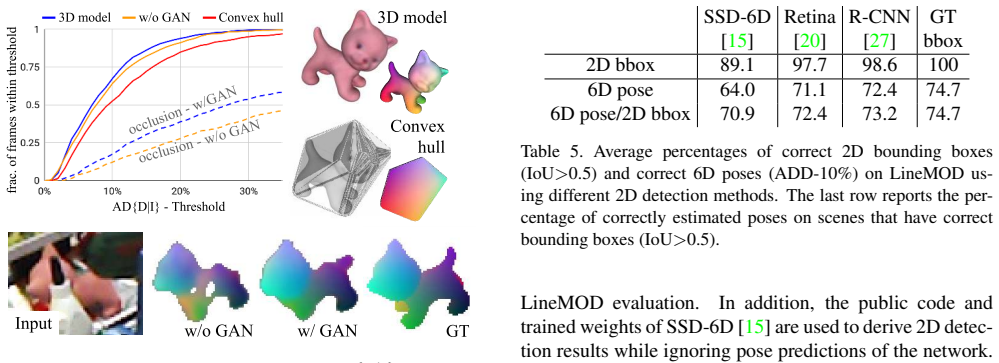
- Untextured CAD models are enough for training, so pose estimation no longer depends on costly textured 3D scans; the convex-hull experiment indicates even coarse geometry retains most of the benefit.
- Every confident pixel is a 2D-3D correspondence, so Pix2Pose can be attached to any 2D detector; pose accuracy is stable on sufficiently overlapping boxes even when different detectors are used.
- The transformer loss offers a general recipe for finite object symmetry: rather than restricting training views, minimize over all symmetric pose candidates per sample.
- At roughly 6-10 frames per second with standard detectors, the RGB-only pipeline is fast enough for interactive robotics and augmented reality.
- Because no rendering is needed at inference time, the pose estimation stage is a single network pass plus a standard PnP solve.
Reading between the lines
- A natural extension is to let the network discover the symmetry pool itself instead of taking a hand-defined list; the current method requires the set of symmetric poses to be known in advance for each object.
- Because texture is not used, the approach may transfer more easily from synthetic geometry renders to real images, since the model only needs to learn coordinate values rather than photorealism.
- The per-pixel error image could be reused downstream as an uncertainty map, for example to decide when to request depth data or restart localization.
- A direct quantitative study of predicted coordinates on invisible pixels as occlusion fraction grows would isolate how much of the robustness is due to the GAN-based recovery mechanism.
Signed reviews
Editorial analysis
A structured set of objections, weighed in public.
Referee Report
Summary. The paper proposes Pix2Pose, an RGB-only 6D object pose estimation method that regresses per-pixel 3D coordinates and per-pixel expected errors with an auto-encoder trained with a GAN. The predicted coordinate and error maps are used to construct 2D-3D correspondences, from which poses are estimated by PnP with RANSAC. The paper introduces the "transformer loss" to handle objects with a finite number of discrete symmetric poses, and it reports experiments on LineMOD, LineMOD Occlusion, and T-Less, with ablations on the transformer loss, the GAN component, and sensitivity to the 2D detector. The central claim is that Pix2Pose outperforms state-of-the-art RGB-only methods while requiring no textured 3D models and only a small number of real training images.
Significance. If the results are reproducible under the intended comparison scope, the paper makes a meaningful contribution: it combines coordinate regression with an error map and a symmetry-aware loss in a way that is compatible with texture-less CAD models, and it provides experiments on three benchmarks with several ablations. The transformer loss is a simple and plausible remedy for finite discrete symmetries, and the two-stage bounding-box refinement is a useful engineering idea. The ablations for the GAN and the 2D detector robustness are informative. However, the paper's headline claim is broader than its evidence: the Abstract's "state of the art using only RGB images" is contradicted by Table 1, and the T-Less comparison mixes a full-test-image evaluation with subset-based cited numbers. The core method appears sound, but these issues must be addressed before the stated claims can be accepted.
major comments (3)
- [Abstract / Contribution (3) / Table 1] The headline claim that Pix2Pose "outperforms the state of the art using only RGB images" is not supported by Table 1, where SSD-6Dsyn/ref (76.7%) and Radsyn/ref (78.7%) both exceed Pix2Pose's 72.4% average on LineMOD while being classified as RGB-based methods. The comparison scope stated later in Section 5.4 (methods using the same amount of real training images without textured 3D models) is more accurate and should replace the unqualified wording in the Abstract and in the contribution list.
- [Section 5.6 / Table 3] The T-Less evaluation is run on the full test images, whereas the cited results for Kehl et al. [16] and Brachmann et al. [2] are taken from the BOP benchmark [11], which evaluates on a subset of test sequences. Comparing a full-test-image recall with subset-based cited numbers is not an equal-footing comparison, so the claim of outperforming learning-based methods in the BOP benchmark is not established. Please re-run the same protocol for all baselines or evaluate Pix2Pose on the [11] subset.
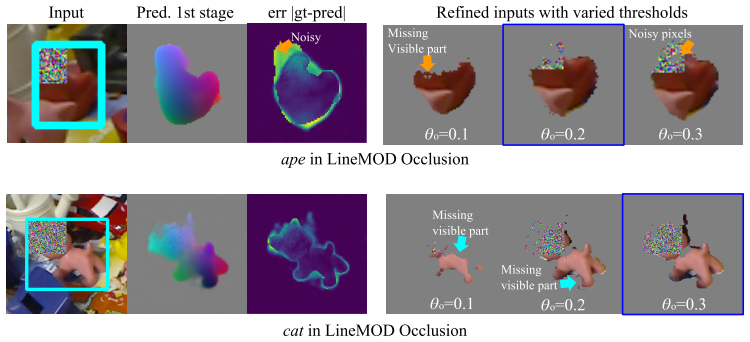
- [Supplementary A.3 / Section 4 / Tables 8-10] The outlier threshold θo is selected per object from three candidate values using training images with artificial occlusions. Because θo directly controls which pixels enter the PnP/RANSAC stage, the per-object selection should be described as a validation-based hyperparameter with a fixed criterion, and a sensitivity analysis (for example, a single common θo across all objects) should be provided to confirm that the main results do not depend on this per-object tuning.
minor comments (6)
- [Section 3.2] The heading "Traininig with GAN" contains a typo; it should read "Training with GAN."
- [Equation (2)] Please define the action of Rp on Igt explicitly; as written, the notation RpIgt is ambiguous about whether it denotes a rotation of the 3D coordinates at each pixel or a resampling of the image.
- [Table 1] The object-wise entries for Radsyn/ref are not reported; providing them would allow direct comparison with the per-object numbers of Pix2Pose.
- [Section 5.7, GAN ablation] The stopping criterion "until the loss value excluding the GAN loss reaches the same level" is not a controlled comparison; please report the number of iterations or show training curves to rule out that the observed difference is due to training time.
- [Figure 7 / Supplementary A.3] The caption states that values are determined to maximize the number of visible pixels while excluding noisy predictions, but the exact selection rule is not quantified; please state the precise criterion used on the training images.
- [General reproducibility] No code, trained models, or implementation details beyond the parameter tables are provided; releasing code and models would substantially strengthen the reproducibility of the reported results.
Circularity Check
No circularity found: Pix2Pose is an empirical, externally evaluated pose estimation method whose predictions are not defined in terms of its targets.
full rationale
The paper's central chain is empirical rather than derivational: Pix2Pose trains an auto-encoder G to regress pixel-wise 3D coordinates from RGB crops, with the target coordinate images rendered from ground-truth poses, and then computes test poses by PnP+RANSAC over the predicted 2D-3D correspondences. The training targets in Eq. (1) and Eq. (3) are rendered from annotated ground truth, and the transformer loss in Eq. (2) is only a training objective; it does not define the evaluation metrics (ADD-10% or VSD), so no reported result reduces to a fitted input by construction. Evaluation is performed on held-out test sequences of external benchmarks (LineMOD, LineMOD Occlusion, T-Less) and compared with published baselines. No load-bearing self-citation chain is present: the architecture reuses external works (e.g., [29] for encoder design, [14] for image-to-image translation) and no uniqueness theorem or prior self-cited result is invoked to force the method's choices. The abstract's claim of outperforming the state of the art is arguably inconsistent with the paper's own Table 1, where SSD-6Dsyn/ref (76.7) and Radsyn/ref (78.7) exceed Pix2Pose (72.4) on LineMOD, but that is a reporting-precision or correctness concern, not circularity. Score 0.
Assumptions & free parameters
free parameters (6)
- β (object-mask loss weight) =
3
- λ1 (3D coordinate loss weight) =
100
- λ2 (error prediction loss weight) =
50
- Inlier threshold θi =
0.1
- Outlier threshold θo =
0.1 to 0.3 per object
- Re-projection threshold θre =
3
assumptions (4)
- standard math The PnP algorithm with RANSAC correctly solves for 6D pose from a set of 2D-3D correspondences with enough inliers.
- domain assumption The small set of real training images with augmentation sufficiently covers the pose distribution.
- domain assumption The manually defined symmetric pose pools correctly represent each object's symmetries.
- domain assumption The 2D detector supplies a bounding box that sufficiently overlaps the target object.
Cite this review
Pith. "Pith review of Pix2Pose: Pixel-Wise Coordinate Regression of Objects for 6D Pose Estimation." pith.science (2026). https://pith.science/paper/43RSC4N4
@misc{pith2026190807433,
  author       = {Pith},
  title        = {Pith review of: Pix2Pose: Pixel-Wise Coordinate Regression of Objects for 6D Pose Estimation},
  year         = {2026},
  howpublished = {\url{https://pith.science/paper/43RSC4N4}},
  note         = {Machine review of arXiv:1908.07433}
}
read the original abstract
Estimating the 6D pose of objects using only RGB images remains challenging because of problems such as occlusion and symmetries. It is also difficult to construct 3D models with precise texture without expert knowledge or specialized scanning devices. To address these problems, we propose a novel pose estimation method, Pix2Pose, that predicts the 3D coordinates of each object pixel without textured models. An auto-encoder architecture is designed to estimate the 3D coordinates and expected errors per pixel. These pixel-wise predictions are then used in multiple stages to form 2D-3D correspondences to directly compute poses with the PnP algorithm with RANSAC iterations. Our method is robust to occlusion by leveraging recent achievements in generative adversarial training to precisely recover occluded parts. Furthermore, a novel loss function, the transformer loss, is proposed to handle symmetric objects by guiding predictions to the closest symmetric pose. Evaluations on three different benchmark datasets containing symmetric and occluded objects show our method outperforms the state of the art using only RGB images.
Figures

Figures from the paper (10 more)



Reference graph
Works this paper leans on
-
[16]
Deep learning of local rgb-d patches for 3d object detection and 6d pose estimation
Wadim Kehl, Fausto Milletari, Federico Tombari, Slobodan Ilic, and Nassir Navab. Deep learning of local rgb-d patches for 3d object detection and 6d pose estimation. In The Eu- ropean Conference on Computer Vision (ECCV) , 2016. 2, 7
work page 2016
-
[2]
Uncertainty-driven 6d pose estimation of objects and scenes from a single rgb image
Eric Brachmann, Frank Michel, Alexander Krull, Michael Ying Yang, Stefan Gumhold, and Carsten Rother. Uncertainty-driven 6d pose estimation of objects and scenes from a single rgb image. In The IEEE Conference on Computer Vision and Pattern Recognition (CVPR), 2016. 1, 2, 6, 7
work page 2016
-
[11]
Bop: Benchmark for 6d object pose esti- mation
Tom ´aˇs Hodaˇn, Frank Michel, Eric Brachmann, Wadim Kehl, Anders GlentBuch, Dirk Kraft, Bertram Drost, Joel Vidal, Stephan Ihrke, Xenophon Zabulis, Caner Sahin, Fabian Man- hardt, Federico Tombari, Tae-Kyun Kim, Jiri Matas, and Carsten Rother. Bop: Benchmark for 6d object pose esti- mation. In The European Conference on Computer Vision (ECCV), 2018. 1, 6, 7, 12
work page 2018
-
[1]
Learning 6d object pose estimation using 3d object coordinates
Eric Brachmann, Alexander Krull, Frank Michel, Stefan Gumhold, Jamie Shotton, and Carsten Rother. Learning 6d object pose estimation using 3d object coordinates. In The European Conference on Computer Vision (ECCV), 2014. 2, 5
work page 2014
-
[3]
G. Bradski. The OpenCV Library. Dr. Dobb’s Journal of Software Tools, 2000. 11
work page 2000
-
[4]
Real-time monocular object instance 6d pose estimation
Thanh-Toan Do, Trung Pham, Ming Cai, and Ian Reid. Real-time monocular object instance 6d pose estimation. In British Machine Vision Conference (BMVC), 2018. 1, 2, 6
work page 2018
-
[5]
Martin A. Fischler and Robert C. Bolles. Random sample consensus: A paradigm for model fitting with applications to image analysis and automated cartography. Commun. ACM, 24(6):381–395, June 1981. 5
work page 1981
-
[6]
Generative adversarial nets
Ian Goodfellow, Jean Pouget-Abadie, Mehdi Mirza, Bing Xu, David Warde-Farley, Sherjil Ozair, Aaron Courville, and Yoshua Bengio. Generative adversarial nets. In Advances in neural information processing systems, pages 2672–2680,
Show all 36 references
-
[7]
Mask r-cnn
Kaiming He, Georgia Gkioxari, Piotr Doll ´ar, and Ross Gir- shick. Mask r-cnn. In The IEEE International Conference on Computer Vision (ICCV), 2017. 6
2017
-
[8]
Deep residual learning for image recognition
Kaiming He, Xiangyu Zhang, Shaoqing Ren, and Jian Sun. Deep residual learning for image recognition. In The IEEE Conference on Computer Vision and Pattern Recognition (CVPR), 2016. 6
2016
-
[9]
Model based training, detection and pose estimation of texture-less 3d objects in heavily cluttered scenes
Stefan Hinterstoisser, Vincent Lepetit, Slobodan Ilic, Ste- fan Holzer, Gary Bradski, Kurt Konolige, and Nassir Navab. Model based training, detection and pose estimation of texture-less 3d objects in heavily cluttered scenes. In Asian conference on computer vision (ACCV), 201...
2012
-
[10]
T-LESS: An RGB-D dataset for 6D pose estimation of texture-less ob- jects
Tom ´aˇs Hoda ˇn, Pavel Haluza, ˇStˇep´an Obdrˇz´alek, Jiˇr´ı Matas, Manolis Lourakis, and Xenophon Zabulis. T-LESS: An RGB-D dataset for 6D pose estimation of texture-less ob- jects. IEEE Winter Conference on Applications of Computer Vision (WACV), 2017. 2, 5, 7
2017
-
[12]
Globally and locally consistent image completion
Satoshi Iizuka, Edgar Simo-Serra, and Hiroshi Ishikawa. Globally and locally consistent image completion. ACM Transactions on Graphics (ToG), 36(4):107, 2017. 2
2017
-
[13]
Batch normalization: Accelerating deep network training by reducing internal co- variate shift
Sergey Ioffe and Christian Szegedy. Batch normalization: Accelerating deep network training by reducing internal co- variate shift. In International Conference on Machine Learn- ing, pages 448–456, 2015. 3
2015
-
[14]
Phillip Isola, Jun-Yan Zhu, Tinghui Zhou, and Alexei A. Efros. Image-to-image translation with conditional adversar- ial networks. In The IEEE Conference on Computer Vision and Pattern Recognition (CVPR), July 2017. 2, 4
2017
-
[15]
Ssd-6d: Making rgb-based 3d detection and 6d pose estimation great again
Wadim Kehl, Fabian Manhardt, Federico Tombari, Slobo- dan Ilic, and Nassir Navab. Ssd-6d: Making rgb-based 3d detection and 6d pose estimation great again. In The IEEE International Conference on Computer Vision (ICCV), 2017. 1, 2, 6, 8
2017
-
[17]
Adam: A method for stochastic optimization
Diederik P Kingma and Jimmy Lei Ba. Adam: A method for stochastic optimization. In Proceedings of the 3rd In- ternational Conference on Learning Representations (ICLR),
-
[18]
Epnp: An accurate o(n) solution to the pnp problem
Vincent Lepetit, Francesc Moreno-Noguer, and Pascal Fua. Epnp: An accurate o(n) solution to the pnp problem. Inter- national Journal of Computer Vision, 81(2):155, Jul 2008. 2, 5
2008
-
[19]
Deepim: Deep iterative matching for 6d pose estimation
Yi Li, Gu Wang, Xiangyang Ji, Yu Xiang, and Dieter Fox. Deepim: Deep iterative matching for 6d pose estimation. In The European Conference on Computer Vision (ECCV) ,
-
[20]
Focal loss for dense object detection
Tsung-Yi Lin, Priya Goyal, Ross Girshick, Kaiming He, and Piotr Dollar. Focal loss for dense object detection. In The IEEE International Conference on Computer Vision (ICCV),
-
[21]
Microsoft coco: Common objects in context
Tsung-Yi Lin, Michael Maire, Serge Belongie, James Hays, Pietro Perona, Deva Ramanan, Piotr Doll´ar, and C Lawrence Zitnick. Microsoft coco: Common objects in context. In The European Conference on Computer Vision (ECCV), 2014. 5, 6
2014
-
[22]
Deep model-based 6d pose refinement in rgb
Fabian Manhardt, Wadim Kehl, Nassir Navab, and Federico Tombari. Deep model-based 6d pose refinement in rgb. In The European Conference on Computer Vision (ECCV) ,
-
[23]
Mak- ing deep heatmaps robust to partial occlusions for 3d object pose estimation
Markus Oberweger, Mahdi Rad, and Vincent Lepetit. Mak- ing deep heatmaps robust to partial occlusions for 3d object pose estimation. In The European Conference on Computer Vision (ECCV), 2018. 1, 2, 6, 7
2018
-
[24]
Context encoders: Feature learning by inpainting
Deepak Pathak, Philipp Krahenbuhl, Jeff Donahue, Trevor Darrell, and Alexei A Efros. Context encoders: Feature learning by inpainting. In The IEEE Conference on Com- puter Vision and Pattern Recognition (CVPR), 2016. 2
2016
-
[25]
Bb8: A scalable, accurate, robust to partial occlusion method for predicting the 3d poses of challenging objects without using depth
Mahdi Rad and Vincent Lepetit. Bb8: A scalable, accurate, robust to partial occlusion method for predicting the 3d poses of challenging objects without using depth. In The IEEE International Conference on Computer Vision (ICCV), 2017. 1, 2, 6
2017
-
[26]
Fea- ture mapping for learning fast and accurate 3d pose inference from synthetic images
Mahdi Rad, Markus Oberweger, and Vincent Lepetit. Fea- ture mapping for learning fast and accurate 3d pose inference from synthetic images. In The IEEE Conference on Com- puter Vision and Pattern Recognition (CVPR), 2018. 6
2018
-
[27]
Faster r-cnn: Towards real-time object detection with region proposal networks
Shaoqing Ren, Kaiming He, Ross Girshick, and Jian Sun. Faster r-cnn: Towards real-time object detection with region proposal networks. In Advances in neural information pro- cessing systems, pages 91–99, 2015. 6, 8
2015
-
[28]
U- net: Convolutional networks for biomedical image segmen- tation
Olaf Ronneberger, Philipp Fischer, and Thomas Brox. U- net: Convolutional networks for biomedical image segmen- tation. In International Conference on Medical image com- puting and computer-assisted intervention , pages 234–241. Springer, 2015. 3
2015
-
[29]
Implicit 3d orientation learning for 6d object detection from rgb images
Martin Sundermeyer, Zoltan-Csaba Marton, Maximilian Durner, Manuel Brucker, and Rudolph Triebel. Implicit 3d orientation learning for 6d object detection from rgb images. In The European Conference on Computer Vision (ECCV) ,
-
[30]
Sinha, and Pascal Fua
Bugra Tekin, Sudipta N. Sinha, and Pascal Fua. Real-time seamless single shot 6d object pose prediction. In The IEEE Conference on Computer Vision and Pattern Recognition (CVPR), 2018. 1, 2, 6, 7
2018
-
[31]
6d pose estima- tion using an improved method based on point pair features
Joel Vidal, Chyi-Yeu Lin, and Robert Mart´ı. 6d pose estima- tion using an improved method based on point pair features. In 2018 4th International Conference on Control, Automa- tion and Robotics (ICCAR), pages 405–409, 2018. 1
2018
-
[32]
Stacked denoising autoencoders: Learning useful representations in a deep net- work with a local denoising criterion
Pascal Vincent, Hugo Larochelle, Isabelle Lajoie, Yoshua Bengio, and Pierre-Antoine Manzagol. Stacked denoising autoencoders: Learning useful representations in a deep net- work with a local denoising criterion. Journal of machine learning research, 11(Dec):3371–3408, 2010. 2
2010
-
[33]
Posecnn: A convolutional neural network for 6d object pose estimation in cluttered scenes.Robotics: Science and Systems (RSS), 2018
Yu Xiang, Tanner Schmidt, Venkatraman Narayanan, and Dieter Fox. Posecnn: A convolutional neural network for 6d object pose estimation in cluttered scenes.Robotics: Science and Systems (RSS), 2018. 2, 6, 7
2018
-
[34]
Image denois- ing and inpainting with deep neural networks
Junyuan Xie, Linli Xu, and Enhong Chen. Image denois- ing and inpainting with deep neural networks. In Advances in neural information processing systems , pages 341–349,
-
[35]
Keep it unreal: Bridging the realism gap for 2.5 d recognition with geom- etry priors only
Sergey Zakharov, Benjamin Planche, Ziyan Wu, Andreas Hutter, Harald Kosch, and Slobodan Ilic. Keep it unreal: Bridging the realism gap for 2.5 d recognition with geom- etry priors only. In International Conference on 3D Vision (3DV), 2018. 2
2018
-
[36]
Srini- vasa, Pieter Abbeel, and Aaron M
Berk alli, Aaron Walsman, Arjun Singh, Siddhartha S. Srini- vasa, Pieter Abbeel, and Aaron M. Dollar. Benchmarking in manipulation research: Using the yale-cmu-berkeley object and model set. IEEE Robotics and Automation Magazine , 22:36–52, 2015. 1 A. Detail parameters A.1. Da...
2015
Reviewed August 14, 2026 · model on record in the stance chip above.
Discussion (0). Continue with ORCID to comment.