REVIEW 3 major objections 5 minor 45 references
Probabilistic Reconstruction Networks for 3D Shape Inference from a Single Image
T0 review · 3 major / 5 minor · reviewed 2026-08-14 · deepseek-v4-flash
Pith's one-line read Probabilistic latent-variable inference makes a basic voxel grid the best single-image 3D reconstructor on ShapeNet.
desk verdict A well-designed internal study of probabilistic latent-variable choices for single-image 3D reconstruction whose state-of-the-art claim rests on borrowed, protocol-sensitive baseline numbers. read the letter →
The pith
A machine-rendered reading of the paper's core claim, the machinery that carries it, and where it could break.
The reading
What carries the argument
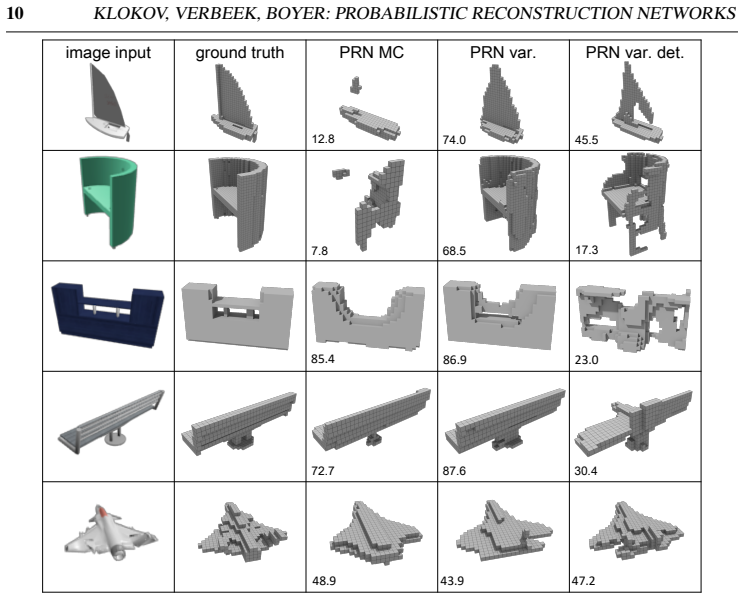
The machinery is the latent-variable reconstruction integral $p(v|i)=\int p_\theta(v|z,i)\,p_\varphi(z|i)\,dz$, together with the option to omit image conditioning from either factor, yielding $p(v|z)p(z|i)$, $p(v|z,i)p(z)$, or fully unconditional variants. The integral is intractable, so training uses either a Monte Carlo estimator over samples from the prior or a variational lower bound with an approximate posterior $q_\psi(z|v,i)$; both rely on the reparameterization trick to make sampling differentiable. The networks are 2D and 3D CNNs, with FiLM-style conditioning that injects image features into the 3D decoder and encoder, and the decoder outputs Bernoulli parameters for each voxel occupancy. A joint objective also lets the model be trained with a shared unconditional generative shape model, which regularizes the latent space and adds the ability to sample shapes.
What would settle it
Re-run all compared methods under one unified protocol, using the same input images and preprocessing, the same voxel-to-point-cloud conversion, the same number of sampled points for CD and EMD, and the same IoU threshold, then check whether PRN's IoU 66.2 and EMD 6.32 advantages persist; a repeatable shift of the kind already shown for CD, from 2.50 to 3.90, would indicate that the published rankings depend on protocol.
Extended reading notes
Core claim
The paper's central claim is that single-image 3D shape inference is best understood as conditional generation under a latent variable model, and that the probabilistic machinery, not the output representation, carries the performance. Concretely, it claims that training a latent-variable voxel predictor with a variational lower bound, sampling latent codes from a shape-conditioned approximate posterior $q_\psi(z|v,i)$, yields more accurate reconstructions than Monte Carlo sampling from the image-conditioned prior, and that the stochastic latent variable matters: a deterministic version of the same model loses about 2.5 IoU points. With this recipe, the authors report IoU 66.2, CD 4.42, and EMD 6.32 on ShapeNet, improving over published numbers of 3D-R2N2, PSGN, AtlasNet, Pixel2Mesh, and 3D-LMNet on IoU and EMD, despite using only a $32^3$ voxel grid and no shape-specific losses beyond voxel cross-entropy.
Load-bearing premise
The load-bearing assumption is that the baseline numbers taken from earlier papers are directly comparable to PRN's numbers, even though the methods use different output representations and different evaluation protocols; the paper itself notes that one baseline's Chamfer distance changes from 2.50 to 3.90 when the number of sampled points is changed.
Editorial extensions
If this is right
- Variational training is consistently better than Monte Carlo training for the dependency structures tested, so future latent-variable reconstruction models should default to the variational objective.
- When trained variationally, extra image conditioning in the decoder or posterior adds little and can hurt, indicating that image information is already carried by the latent code.
- Probabilistic handling of the latent variable is worth about 2.5 IoU points over the deterministic variant, indicating that stochasticity itself acts as a regularizer.
- The $32^3$ voxel representation is not the bottleneck that some point-cloud and mesh papers imply; optimizing the inference objective can close or reverse the gap.
- Jointly training with an unconditional generative model adds the ability to sample shapes and evaluate likelihoods without significantly changing reconstruction accuracy.
Reading between the lines
- If the paper is right, the reported sensitivity of Chamfer distance to point-count protocol should push the community to re-test the IoU and EMD rankings under one standardized evaluation protocol before treating the new scores as definitive.
- The framework's decoupling of representation from inference suggests the same variational latent-variable recipe could be lifted to point clouds, meshes, or implicit surfaces, with the testable prediction that those representations would also improve.
- Beyond 3D reconstruction, the finding that a shape-conditioned posterior beats an image-conditioned prior resembles a general principle for ill-posed inverse problems: conditioning the latent sampler on the target modality during training gives more informative samples.
- The joint generative objective suggests a cheap way to add shape priors to other conditional generation tasks: share the decoder and posterior with an unconditional model and average the two evidence lower bounds.
Signed reviews
Editorial analysis
A structured set of objections, weighed in public.
Referee Report
Summary. The paper introduces Probabilistic Reconstruction Networks (PRN), a family of latent-variable models for single-image 3D shape reconstruction. The framework decouples the shape representation from the inference machinery and offers several design choices: different image-conditioning structures, Monte Carlo versus variational training, stochastic versus deterministic latent variables, and joint training with an unconditional generative model. Experiments on the ShapeNet benchmark use a 32^3 voxel-grid representation and 3D-CNN image/shape encoders with FiLM-style conditioning. The internal ablations show that variational training improves over Monte Carlo training, and that the probabilistic latent-variable treatment improves IoU over the deterministic counterpart. The paper claims a new state of the art on ShapeNet in IoU and EMD, improving over point-cloud and mesh-based methods, based on a comparison table with numbers taken from earlier papers.
Significance. If the state-of-the-art claim were established under a unified protocol, the paper would be a valuable contribution: it provides a principled probabilistic formulation that systematically ablates image-conditioning structure, training objective, and stochasticity, and it releases code (https://github.com/Regenerator/prns). The internal comparisons are a clear strength because they hold architecture and protocol fixed, and the conclusion that variational training with a shape-conditioned posterior outperforms Monte Carlo training is well supported by Table 2. However, the headline SOTA claim is currently load-bearing and rests on cross-paper metric values whose protocol sensitivity the paper itself demonstrates. The central modeling result is sound, but the SOTA claim needs to be backed by a unified re-evaluation or substantially qualified.
major comments (3)
- [§4.2, Table 3] The claim that PRN 'significantly improves over previous state-of-the-art results in terms of IoU and EMD' is not auditable because all baseline numbers are taken from their original papers without a unified evaluation protocol. The paper itself shows in this same section that PSGN's Chamfer distance changes from 2.50 to 3.90 under a unified point-count protocol, a shift of more than 50%. No analogous stability check is reported for EMD or IoU, which are the two metrics on which the SOTA assertion rests. Since the EMD margin over 3D-LMNet is only 0.68 (6.32 vs 7.00, about 10%), a protocol-induced shift of the magnitude documented for CD could reverse the ranking. Please either re-run the baselines under a common protocol (matching point counts, mesh/voxel extraction, and thresholds) or explicitly reformulate the claim as protocol-dependent.
- [§4.1, 'Evaluation metrics'] The EMD computation for PRN is under-specified. The text states that each ground-truth and predicted voxel grid is mapped to a point cloud by sampling the surface via marching cubes, and then CD and EMD are computed, but it does not specify the number of points sampled or the sampling density. This matters because Section 4.2 reports that the baselines used different point counts, and EMD is known to be sensitive to point-set size. Please specify the PRN evaluation point count and, ideally, report EMD at several point counts to show stability.
- [§4.2, Table 2 and Table 3] The headline IoU of 66.2 is reported at occupancy threshold τ=0.4, which the paper says 'overall leads to improved IoU scores,' while the baseline IoU values in Table 3 are those published in the original papers, where the thresholds used are not stated or controlled in this manuscript. Because a threshold shift can change relative ranking, the comparison is not auditable. Please state the threshold used for every baseline IoU, or recompute all IoUs at a single threshold, or restrict the SOTA claim to the metric for which the comparison is controlled.
minor comments (5)
- [§4.1, Dataset paragraph] The sentence 'as well as renderings from 24 different randomized viewpoints as 1372 images' is inconsistent with the stated dataset of about 44k shapes: 44k shapes times 24 views implies roughly a million images. Please correct or clarify the intended number.
- [§2.2, Network architectures] The phrase 'every component concurring in different models' should likely be 'occurring in different models'; please fix the typo.
- [Table 1] The column alignment in Table 1 is difficult to follow in the typeset version; please reformat with explicit column separators and a legend explaining the symbols (e.g., '!', 'p(z|i)', 'q(z|s)').
- [§4.2, first paragraph] When reporting the two IoU thresholds for PRN, it would be informative to also indicate which thresholds were used for the baseline values in Table 3, since that is currently unspecified.
- [Figure 3] The histogram axis label reads '# Images' but the text describes the distribution over shape inferences (24 per test shape); please rename the axis to match the described quantity.
Circularity Check
No significant circularity: the PRN derivation is self-contained and the SOTA comparison, while protocol-sensitive, is not a circular step.
full rationale
The paper's central derivation—the PRN latent variable model in Eq. (1), the Monte Carlo approximation in Eq. (4), and the variational bound in Eq. (5)—is self-contained. The model is defined independently of the evaluation metrics, and the training objectives are standard likelihood-based inference objectives rather than direct optimizers of IoU, CD, or EMD. The reported numbers are obtained on a held-out test split with ground-truth voxel grids, using the Pix3D code for CD/EMD and the standard IoU protocol. No parameter is fitted to the target metrics, no prediction is defined in terms of its own outcome, and no load-bearing claim rests on a self-citation: the only self-citation (FeastNet [38]) is a related-work reference. The paper's own remark that PSGN's CD shifts from 2.50 to 3.90 under a unified point-count protocol is an explicit acknowledgment of cross-paper protocol sensitivity; this is a benchmarking-validity concern rather than a circularity, and it does not make the PRN derivation equivalent to its inputs. Accordingly, no circular step is present.
Assumptions & free parameters
free parameters (3)
- Occupancy threshold tau (IoU) =
0.4
- CD evaluation point counts =
1024 predicted / 1024 ground truth; recomputed 1024 / 16384 for PSGN
- Image preprocessing (fourth grayscale channel) =
Original images plus grayscale version as extra input channel
assumptions (4)
- domain assumption Voxel occupancy probabilities are conditionally independent given z and image, i.e., p(v|z) factorizes as a product of Bernoullis.
- domain assumption The variational posterior qψ(z|v,i) is a good enough approximation to the true posterior, with a single Monte Carlo sample per training step.
- domain assumption ShapeNet voxel grids and renderings provide adequate paired supervision for the reconstruction task.
- domain assumption Marching cubes surface sampling of voxel grids yields point sets that are metric-comparable to native point cloud predictions for CD and EMD.
Cite this review
Pith. "Pith review of Probabilistic Reconstruction Networks for 3D Shape Inference from a Single Image." pith.science (2026). https://pith.science/paper/DCE2P4NV
@misc{pith2026190807475,
  author       = {Pith},
  title        = {Pith review of: Probabilistic Reconstruction Networks for 3D Shape Inference from a Single Image},
  year         = {2026},
  howpublished = {\url{https://pith.science/paper/DCE2P4NV}},
  note         = {Machine review of arXiv:1908.07475}
}
read the original abstract
We study end-to-end learning strategies for 3D shape inference from images, in particular from a single image. Several approaches in this direction have been investigated that explore different shape representations and suitable learning architectures. We focus instead on the underlying probabilistic mechanisms involved and contribute a more principled probabilistic inference-based reconstruction framework, which we coin Probabilistic Reconstruction Networks. This framework expresses image conditioned 3D shape inference through a family of latent variable models, and naturally decouples the choice of shape representations from the inference itself. Moreover, it suggests different options for the image conditioning and allows training in two regimes, using either Monte Carlo or variational approximation of the marginal likelihood. Using our Probabilistic Reconstruction Networks we obtain single image 3D reconstruction results that set a new state of the art on the ShapeNet dataset in terms of the intersection over union and earth mover's distance evaluation metrics. Interestingly, we obtain these results using a basic voxel grid representation, improving over recent work based on finer point cloud or mesh based representations.
Figures


Figures from the paper (1 more)

Reference graph
Works this paper leans on
- [1]
-
[2]
M. Bronstein, J. Bruna, A. Szlam, Y . LeCun, and P. Vandergyst. Geometric deep learn- ing: going beyond Euclidean data. IEEE Signal Processing Magazine , 34(4):18–42, 2017
work page 2017
- [3]
-
[4]
C. Choy, D. Xu, J.-Y . Gwak, K. Chen, and S. Savarese. 3D-R2N2: A unified approach for single and multi-view 3d object reconstruction. In ECCV, 2016
work page 2016
-
[5]
R. Girdhar, D. Fouhey, M. Rodriguez, and A. Gupta. Learning a predictable and gen- erative vector representation for objects. In ECCV, 2016
work page 2016
- [6]
- [7]
-
[8]
T. Groueix, M. Fisher, V . Kim, B. Russell, and M. Aubry. A papier-mâché approach to learning 3D surface generation. In CVPR, 2018
work page 2018
Show all 45 references
-
[9]
K. He, X. Zhang, S. Ren, and J. Sun. Deep residual learning for image recognition. In CVPR, 2016
2016
-
[10]
K. He, X. Zhang, S. Ren, and J. Sun. Identity mappings in deep residual networks. In ECCV, 2016
2016
-
[11]
Henderson and V
P. Henderson and V . Ferrari. Learning to generate and reconstruct 3d meshes with only 2d supervision. In BMVC, 2018
2018
-
[12]
Z. Hu, Z. Yang, R. Salakhutdinov, and E. P. Xing. On unifying deep generative models. In ICLR, 2018
2018
-
[13]
Insafutdinov and A
E. Insafutdinov and A. Dosovitskiy. Unsupervised learning of shape and pose with differentiable point clouds. In NeurIPS, 2018
2018
-
[14]
Kingma and M
D. Kingma and M. Welling. Auto-encoding variational Bayes. In ICLR, 2014
2014
-
[15]
Klokov and V
R. Klokov and V . Lempitsky. Escape from cells: Deep Kd-networks for the recognition of 3D point cloud models. In ICCV, 2017
2017
-
[16]
Krizhevsky, I
A. Krizhevsky, I. Sutskever, and G. Hinton. ImageNet classification with deep convo- lutional neural networks. In NeurIPS, 2012
2012
-
[17]
LeCun, L
Y . LeCun, L. Bottou, Y . Bengio, and P. Haffner. Gradient-based learning applied to document recognition. Proceedings of the IEEE, 86(11):2278–2324, 1998. 14 KLOKOV , VERBEEK, BOYER: PROBABILISTIC RECONSTRUCTION NETWORKS
1998
-
[18]
Lewiner, H
T. Lewiner, H. Lopes, A. Vieira, and G. Tavares. Efficient implementation of marching cubes’ cases with topological guarantees.J. Graphics, GPU, & Game Tools, 8(2):1–15, 2003
2003
-
[19]
Loshchilov and F
I. Loshchilov and F. Hutter. Decoupled weight decay regularization. In ICLR, 2019
2019
-
[20]
Mandikal, K
P. Mandikal, K. Navaneet, M. Agarwal, and R. Babu. 3D-LMNet: Latent embedding matching for accurate and diverse 3D point cloud reconstruction from a single image. In BMVC, 2018
2018
-
[21]
Maturana and S
D. Maturana and S. Scherer. V oxNet: A 3D convolutional neural network for real-time object recognition. In IROS, 2015
2015
-
[22]
Monti, D
F. Monti, D. Boscaini, J. Masci, E. Rodolà, J. Svoboda, and M. Bronstein. Geometric deep learning on graphs and manifolds using mixture model CNNs. In CVPR, 2017
2017
-
[23]
Perez, F
E. Perez, F. Strub, H. De Vries, V . Dumoulin, and A. Courville. FiLM: Visual reasoning with a general conditioning layer. In AAAI, 2018
2018
-
[24]
C. Qi, H. Su, K. Mo, and L. Guibas. Pointnet: Deep learning on point sets for 3D classification and segmentation. In CVPR, 2017
2017
-
[25]
C. Qi, L. Yi, H. Su, and L. Guibas. Pointnet++: Deep hierarchical feature learning on point sets in a metric space. In NeurIPS, 2017
2017
-
[26]
Reddi, S
S. Reddi, S. Kale, and S. Kumar. On the convergence of Adam and beyond. In ICLR, 2018
2018
-
[27]
Rezende, S
D. Rezende, S. Mohamed, and D. Wierstra. Stochastic backpropagation and approxi- mate inference in deep generative models. In ICML, 2014
2014
-
[28]
S. R. Richter and S. Roth. Matryoshka Networks: Predicting 3d geometry via nested shape layers. In CVPR, 2018
2018
-
[29]
D. Shin, C. C. Fowlkes, and D. Hoiem. Pixels, voxels, and views: A study of shape representations for single view 3d object shape prediction. In CVPR, 2018
2018
-
[30]
Sinha, J
A. Sinha, J. Bai, and K. Ramani. Deep learning 3D shape surfaces using geometry images. In ECCV, 2016
2016
-
[31]
Smith and D
E. Smith and D. Meger. Improved adversarial systems for 3d object generation and reconstruction. In CoRL, 2017
2017
-
[32]
Soltani, H
A. Soltani, H. Huang, J. Wu, T. Kulkarni, and J. Tenenbaum. Synthesizing 3D shapes via modeling multi-view depth maps and silhouettes with deep generative networks. In CVPR, 2017
2017
-
[33]
H. Su, S. Maji, E. Kalogerakis, and E. Learned-Miller. Multi-view convolutional neural networks for 3D shape recognition. In ICCV, 2015
2015
-
[34]
H. Su, H. Fan, and L. Guibas. A point set generation network for 3D object reconstruc- tion from a single image. In CVPR, 2017. KLOKOV , VERBEEK, BOYER: PROBABILISTIC RECONSTRUCTION NETWORKS 15
2017
-
[35]
X. Sun, J. Wu, X. Zhang, Z. Zhang, C. Zhang, T. Xue, J. Tenenbaum, and W. Freeman. Pix3D: Dataset and methods for single-image 3D shape modeling. In CVPR, 2018
2018
-
[36]
Tatarchenko, A
M. Tatarchenko, A. Dosovitskiy, and T. Brox. Octree generating networks: Efficient convolutional architectures for high-resolution 3D outputs. In ICCV, 2017
2017
-
[37]
Tulsiani, T
S. Tulsiani, T. Zhou, A. Efros, and J. Malik. Multi-view supervision for single-view reconstruction via differentiable ray consistency. In CVPR, 2017
2017
-
[38]
Verma, E
N. Verma, E. Boyer, and J. Verbeek. Feastnet: Feature-steered graph convolutions for 3D shape analysis. In CVPR, 2018
2018
-
[39]
N. Wang, Y . Zhang, Z. Li, Y . Fu, W. Liu, and Y . Jiang. Pixel2Mesh: Generating 3D mesh models from single RGB images. In ECCV, 2018
2018
-
[40]
Wiles and A
O. Wiles and A. Zisserman. SilNet: Single- and multi-view reconstruction by learning from silhouettes. In BMVC, 2017
2017
-
[41]
J. Wu, C. Zhang, T. Xue, W. Freeman, and J. Tenenbaum. Learning a probabilistic latent space of object shapes via 3D generative-adversarial modeling. In NeurIPS, 2016
2016
-
[42]
J. Wu, Y . Wang, T. Xue, X. Sun, B. Freeman, and J. Tenenbaum. MarrNet: 3D shape reconstruction via 2.5D sketches. In NeurIPS, 2017
2017
-
[43]
J. Wu, C. Zhang, X. Zhang, Z. Zhang, W. Freeman, and J. Tenenbaum. Learning shape priors for single-view 3D completion and reconstruction. In ECCV, 2018
2018
-
[44]
Z. Wu, S. Song, A. Khosla, F. Yu, L. Zhang, X. Tang, and J. Xiao. 3D ShapeNets: A deep representation for volumetric shapes. In CVPR, 2015
2015
-
[45]
X. Yan, J. Yang, E. Yumer, Y . Guo, and H. Lee. Perspective Transformer Nets: Learning single-view 3D object reconstruction without 3D supervision. In NeurIPS, 2016
2016
Reviewed August 14, 2026 · model on record in the stance chip above.
Discussion (0). Continue with ORCID to comment.