REVIEW 3 major objections 5 minor 43 references
Boundary spike-layer solutions of the singular Keller-Segel system: existence and stability
T0 review · 3 major / 5 minor · reviewed 2026-08-14 · deepseek-v4-flash
Pith's one-line read The paper proves that the singular Keller-Segel system with logarithmic sensitivity admits a unique boundary spike-layer steady state that is asymptotically stable under small perturbations, for all m≥0 (with large chemotactic coefficient…
desk verdict First stability results for singular Keller-Segel with m≠1, but the m<1 case rests on an unproved H^2 lemma that looks non-routine. read the letter →
The pith
A machine-rendered reading of the paper's core claim, the machinery that carries it, and where it could break.
The reading
What carries the argument
The argument's central device is the Cole-Hopf transformation v=-w_x/w, which removes the logarithmic singularity and re-expresses the chemical as w=$be^{{-∫_0^x v}}$. The additional change to antiderivative variables φ(x,t)=∫_0^x (u-U) and ψ(x,t)=∫_0^x (v-V) eliminates the nonlocality and converts the system into a local parabolic system (3.5) with an exponential nonlinearity. The proof then uses weighted energy estimates with weights chosen according to m (e.g., w1=1/U and w2=$W^{{1-m}}$ for m≥1) and Hardy's inequality to control singular terms, yielding the dissipative estimates that imply global well-posedness and decay.
What would settle it
A numerical or analytic study of the linearized system near (U,W) for m=0.5 and χ just above 5(1-m)=2.5, with initial data satisfying the theorem's zero-mass conditions, would settle whether the large-χ assumption is essential: non-decay would falsify the claimed stability regime, while decay would show the threshold is not sharp.
Extended reading notes
Core claim
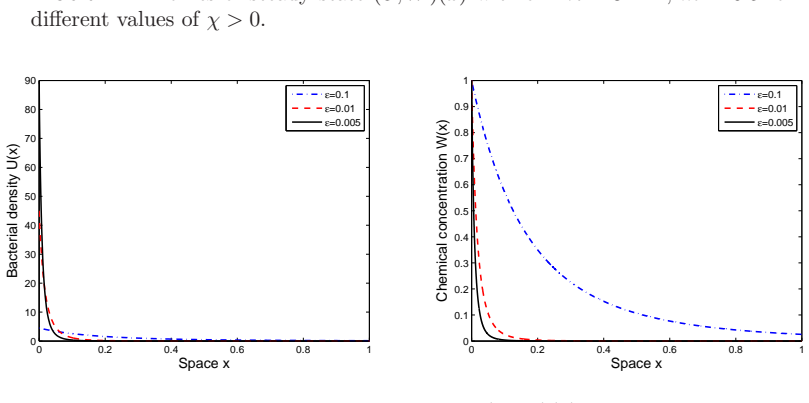
For the Keller-Segel system with zero-flux and Dirichlet boundary conditions, the paper derives explicit formulas for the unique steady state (U,W). As χ→∞ or ε→0, U(x) converges to λδ(x) in the sense of distributions and W(x) tends to a boundary layer of height b and vanishing interior. The main theorem asserts that this steady state is asymptotically stable: if the initial perturbation in the antiderivative variables has zero limits at infinity and is small in appropriate weighted Sobolev spaces, the solution exists globally and satisfies sup_{x∈R+}|(u,v)(·,t)-(U,V)(·,t)|→0 and ‖u(·,t)-U‖_{L1(R+)}→0 as t→∞. The stability holds for all m≥1 with χ>|1-m|, and for 0≤m<1 when χ is sufficiently large.
Load-bearing premise
The stability proof depends on assuming the initial perturbation has zero total mass in the antiderivative variables and that the initial chemical profile satisfies w0x/w0→0 at infinity, conditions that are not implied by the natural decay (u,w)→(0,0).
Editorial extensions
If this is right
- For m=1, the stability result recovers and extends earlier boundary layer stability results, now under zero-flux and Dirichlet boundary conditions.
- The explicit steady-state formulas let one compute spike height and layer width as functions of χ, ε, b and λ, giving quantitative predictions for boundary accumulation experiments.
- The antiderivative technique removes the m≠1 barrier, opening the way to global dynamics for the singular Keller-Segel model with any consumption rate.
- The L1 convergence of the bacterial density strengthens pointwise decay and implies that the total mass of the perturbation vanishes in the spike.
Reading between the lines
- The antiderivative method is likely to extend to multidimensional settings by replacing scalar antiderivatives with gradient or divergence operators, but the paper notes that the steady state is no longer explicit and the energy estimates become more involved.
- The proof reveals a Hardy-term threshold χ>5(1-m) for 0≤m<1, although the theorem only states 'χ≫1'; testing numerically whether stability persists below this threshold would clarify whether the condition is technical or essential.
- The zero-mass condition on initial perturbations (φ0(∞)=ψ0(∞)=0) may be a genuine restriction; perturbations with nonzero total mass might drive the system to a different steady state or to a shifted spike, a scenario the paper does not address.
Signed reviews
Editorial analysis
A structured set of objections, weighed in public.
Referee Report
Summary. The paper studies the singular Keller-Segel system (1.1) on the half-line with zero-flux boundary condition for the cell density and Dirichlet condition for the chemical, and with far-field decay to zero. It first solves the steady-state problem explicitly (Proposition 2.1) and shows that, as the chemotactic coefficient or the chemical diffusion tends to zero or infinity, the cell density concentrates as a Dirac mass at the boundary while the chemical forms a boundary layer (Theorem 2.1). The main stability result (Theorem 2.2, with the transfer back to the original variables in Theorem 2.3) asserts that, for sufficiently small weighted Sobolev perturbations with zero mean at infinity, the steady state is nonlinearly stable, with pointwise convergence and L1 convergence of the cell density, for all m ≥ 0 under a large-χ condition when 0 ≤ m < 1. The proof uses a Cole-Hopf transformation, an antiderivative formulation, and weighted energy estimates with Hardy's inequality. The case m ≥ 1 is proved in detail; the case 0 ≤ m < 1 is reduced to a set of lemmas, one of which is asserted without proof.
Significance. If the claims hold, this is a substantial contribution: it provides the first global well-posedness and stability result for the singular Keller-Segel system with nonlinear consumption rate m ≠ 1, and it gives an explicit boundary spike/layer steady state with a clean asymptotic characterization. The paper introduces a plausible and potentially reusable strategy—relegating the logarithmic singularity to a nonlocal term and then working with antiderivatives in carefully chosen weighted spaces. The existence and asymptotic-profile parts are rigorous and transparent, and the weighted-energy framework is well motivated. The main uncertainty concerns the 0 ≤ m < 1 regime, where the H2 a priori bounds are not proved and the 'χ ≫ 1' condition is not quantified; these points need to be resolved before the stability theorem can be considered fully established.
major comments (3)
- [Section 3.3, Lemma 3.7] Lemma 3.7 states the H2 a priori estimates for 0 ≤ m < 1 with the sentence 'For brevity, we omit the details of the proof.' This is not a routine repetition of Lemma 3.3. In the m ≥ 1 proof, the term (m-1)∫ U W^{m-1} e^{-(m-1)ψ} ψ_t^2 in (3.31) is nonnegative and helps close the estimate. For m < 1 that term is negative, so it must be absorbed on the right-hand side; the absorption is not shown. Moreover, for 0 ≤ m < 1 the quantity W^{m-1} is unbounded as x → ∞, so estimates such as ∫ W^{2(m-1)} φ_x^2 in the analogue of (3.28) require the weight w3 = W^{m-1}/U to control W^{2(m-1)} φ_x^2 via (W^{m-1}/U)φ_x^2 · (U W^{m-1}); this additional step is not present in Lemma 3.3. Since Proposition 3.4 and hence Theorem 2.2(2) depend on Lemma 3.7, the proof of the 0 ≤ m < 1 stability result has a genuine gap that must be filled.
- [Theorem 2.2(2), Proposition 3.3, and the calculation after (3.39)] The statement 'χ ≫ 1' for 0 ≤ m < 1 is not quantified anywhere in the paper. In the proof of Lemma 3.5, the coefficient B1 that controls the Hardy term is computed as (b^{m-1}/16β)[χ+3(1-m)][χ-5(1-m)]; positivity of B1 requires χ > 5(1-m), and the coefficient B2 must also be positive for the completing-square argument to work. These are concrete, checkable thresholds, and the theorem would be more precise and more useful if the condition on χ were stated explicitly, for example as χ > C(m, ε, λ, b) with a displayed constant. As written, the condition is an assertion that such a threshold exists, but it is not demonstrated by the estimates in the manuscript.
- [Section 2, equation (2.13) and Theorem 2.3] The passage from the original system to the transformed system imposes the condition v(+∞) = 0, i.e., w_x/w → 0 as x → ∞, and Theorem 2.3 further assumes ψ0(∞) = 0, which means w0(x)/W(x) → 1 as x → ∞. Neither condition is implied by the original far-field condition (u, w) → (0,0) in (1.3). This is a restriction on the admissible initial data that should be stated explicitly in the theorems and discussed as a limitation of the stability result. The issue is not an error in the proof, but it affects the interpretation of the result.
minor comments (5)
- [Section 2, display after (2.13)] The definition 'v0 = w0x/w' should read 'v0 = -w0x/w0' (or equivalently v0 = - (ln w0)_x) to be consistent with the transformation v = -w_x/w in (2.11).
- [Proof of Theorem 2.1(ii)] In the proof of Theorem 2.1(ii) the text says 'U(x) → 0 uniformly on [h,∞) as ε → ∞' but the intended limit is ε → 0; as written this is a typographical error.
- [Proof of Theorem 2.2, after (3.46)] The sentence 'Then from Lemma 3.8, it follows that ‖φx(·,t)‖ as t → +∞' is missing a limit statement; it should read '‖φx(·,t)‖ → 0 as t → +∞', and similarly for the ψx term.
- [Section 3.3, Lemma 3.5] The constants B1 and B2 are introduced in the text only after a long computation; labeling them with equation numbers or a brief definition would improve readability and make the subsequent positivity conditions easier to verify.
- [General notation] The weights w1, w2, w3 are used in the theorems and lemmas, but their domains and the precise sense in which H^k_{ω} is a Hilbert space (with weight multiplying each derivative) are only sketched in Section 2; a formal definition of the norm with the weight appearing in every derivative term would avoid ambiguity.
Circularity Check
No circularity: the steady state is explicitly solved, and stability is proven through self-contained weighted energy estimates with no fitted parameter or conclusion assumed.
full rationale
The paper does not assume its conclusion. The steady state (U,V) is derived explicitly from the steady equations (Proposition 2.1), and the asymptotic stability in Theorem 2.2 is proven by constructing a priori energy estimates for the antiderivative perturbation system (3.5)-(3.7). The weights w1=1/U, w2=W^{1-m}, and w3=W^{m-1}/U are chosen so that the dissipative terms close the estimates; this is a standard energy method, not an input that encodes the target convergence. The main ingredients (Hardy inequality, Sobolev embedding, Taylor expansion of the exponential nonlinearity, and the W^{1,1} decay lemma) are stated and either proved or cited as standard external results. The Cole-Hopf transformation and the antiderivative step are exact algebraic reformulations, not fits. Boundary conditions such as v(+infinity,t)=0 are imposed as regularity/far-field conditions on the transformed problem and are consistent with the desired convergence, but the convergence itself is obtained from the estimates rather than built into the norm. No parameter is fitted to the data whose stability is claimed, and no uniqueness or existence theorem is imported from the authors' own prior work as a load-bearing premise. The omission of the proof of Lemma 3.7 is a potential correctness gap for the case 0<=m<1, but it is not a circular step: the lemma is asserted as an a priori estimate to be proved, not assumed as the conclusion, and its absence does not make the derivation reduce to its inputs.
Assumptions & free parameters
assumptions (4)
- standard math Local well-posedness of the quasilinear parabolic perturbation system (3.5) is taken from a standard reference (Nishida [30]).
- standard math Sobolev embedding H1(R+) ⊂ L∞(R+) is used to control nonlinear terms by the small norm N(t).
- domain assumption The initial antiderivatives vanish at infinity: φ0(∞)=ψ0(∞)=0, and v0(+∞)=0 so that ψ0(∞) is defined.
- domain assumption For 0≤m<1, the parameter regime χ>5(1-m) is needed for positivity of the Hardy-related coefficient B1 in Lemma 3.5.
Cite this review
Pith. "Pith review of Boundary spike-layer solutions of the singular Keller-Segel system: existence and stability." pith.science (2026). https://pith.science/paper/47U7PUBW
@misc{pith2026190807485,
  author       = {Pith},
  title        = {Pith review of: Boundary spike-layer solutions of the singular Keller-Segel system: existence and stability},
  year         = {2026},
  howpublished = {\url{https://pith.science/paper/47U7PUBW}},
  note         = {Machine review of arXiv:1908.07485}
}
read the original abstract
We exploit the existence and nonlinear stability of boundary spike/layer solutions of the Keller-Segel system with logarithmic singular sensitivity in the half space, where the physical zero-flux and Dirichlet boundary conditions are prescribed. We first prove that, under above boundary conditions, the Keller-Segel system admits a unique boundary spike-layer steady state where the first solution component (bacterial density) of the system concentrates at the boundary as a Dirac mass and the second solution component (chemical concentration) forms a boundary layer profile near the boundary as the chemical diffusion coefficient tends to zero. Then we show that this boundary spike-layer steady state is asymptotically nonlinearly stable under appropriate perturbations. As far as we know, this is the first result obtained on the global well-posedness of the singular Keller-Segel system with nonlinear consumption rate. We introduce a novel strategy of relegating the singularity, via a Cole-Hopf type transformation, to a nonlinear nonlocality which is resolved by the technique of "taking antiderivatives", i.e. working at the level of the distribution function. Then, we carefully choose weight functions to prove our main results by suitable weighted energy estimates with Hardy's inequality that fully captures the dissipative structure of the system.
Figures

Reference graph
Works this paper leans on
-
[1]
J. Adler. Chemotaxis in bacteria. Science, 153:708–716, 1966
1966
-
[2]
A. Blanchet, V. Calvez, and J.A. Carrillo. Convergence o f the mass-transport steepest descent scheme for the subcritical Patlak-Keller-Segel mo del. SIAM J. Numer. Anal. , 46(2):691–721, 2008
work page 2008
-
[3]
M. Chae and K. Choi. Nonlinear stability of planar travel ing waves in a chemotaxis model of tumor angiogenesis with chemical diffusion. arXiv:1903.04372v1, 2019
work page Pith review arXiv 1903
-
[4]
M. Chae, K. Choi, K. Kang, and J. Lee. Stability of planar t raveling waves in a Keller-Segel equation on an infinite strip domain. J. Differential Equations , 265:237–279, 2018
work page 2018
-
[5]
K. Choi, M.-J. Kang, Y.-S. Kwon, and A. Vasseur. Contract ion for large perturbations of traveling waves in a hyperbolic-parabolic system arisin g from a chemotaxis model. arXiv:1904.12169v1, 2019
work page Pith review arXiv 1904
- [6]
-
[7]
C. Deng and T. Li. Well-posedness of a 3D parabolic-hyper bolic Keller-Segel system in the sobolev space framework. J. Differential Equations , 257:1311–1332, 2014
work page 2014
- [8]
Show all 43 references
-
[9]
C. Hao. Global well-posedness for a multidimensional ch emotaxis model in critical besov spaces. Z. Angew Math. Phys. , 63:825–834, 2012. EXISTENCE AND STABILITY OF BOUNDARY SPIKE-LAYER STEADY STA TE 23
2012
-
[10]
Q. Hou, C. J. Liu, Y. G. Wang, and Z. Wang. Stability of bou ndary layers for a viscous hyperbolic system arising from chemotaxis: one dimensiona l case. SIAM J. Math. Anal. , 50:3058–3091, 2018
2018
-
[11]
Hou and Z
Q. Hou and Z. Wang. Convergence of boundary layers for th e keller-segel system with singular sensitivity in the half-plane. J. Math. Pures. Appl. , https://doi.org/10.1016/j.matpur.2019.01.008, 2019
2019 doi
-
[12]
Q. Hou, Z. Wang, and K. Zhao. Boundary layer problem on a h yperbolic system arising from chemotaxis. J. Differential Equations , 261:5035–5070, 2016
2016
-
[13]
Jin, J.Y
H.Y. Jin, J.Y. Li, and Z. Wang. Asymptotic stability of t raveling waves of a chemotaxis model with singular sensitivity. J. Differential Equations , 255(2):193–219, 2013
2013
-
[14]
Kalinin, L
Y.V. Kalinin, L. Jiang, Y. Tu, and M. Wu. Logarithmic sen sing in Escherichia coli bacterial chemotaxis. Biophysical J. , 96:2439–2448, 2009
2009
-
[15]
Keller and G.M
E.F. Keller and G.M. Odell. Necessary and sufficient cond itions for chemotactic bands. Math. Biosci. , 27(3-4):309–317, 1975
1975
-
[16]
Keller and L.A
E.F. Keller and L.A. Segel. Traveling bands of chemotac tic bacteria: A theoretical analysis. J. Theor. Biol. , 30:377–380, 1971
1971
-
[17]
Levine, B.D
H.A. Levine, B.D. Sleeman, and M. Nilsen-Hamilton. A ma thematical model for the roles of pericytes and macrophages in the initiation of angiogenesi s. I. the role of protease inhibitors in preventing angiogenesis. Math. Biosci. , 168:71–115, 2000
2000
-
[18]
D. Li, T. Li, and K. Zhao. On a hyperbolic-parabolic syst em modeling chemotaxis. Math. Models Methods Appl. Sci. , 21:1631–1650, 2011
2011
-
[19]
D. Li, R. Pan, and K. Zhao. Quantitative decay of a one-di mensional hybrid chemotaxis model with large data. Nonlinearity, 7:2181–2210, 2015
2015
-
[20]
Li and K
H. Li and K. Zhao. Initial-boundary value problems for a system of hyperbolic balance laws arising from chemotaxis. J. Differential Equations , 258(2):302–338, 2015
2015
-
[21]
J. Li, T. Li, and Z. Wang. Stability of traveling waves of the Keller-Segel system with logarithmic sensitivity. Math. Models Methods Appl. Sci. , 24(14):2819–2849, 2014
2014
-
[22]
T. Li, R. Pan, and K. Zhao. Global dynamics of a hyperboli c-parabolic model arising from chemotaxis. SIAM J. Appl. Math. , 72(1):417–443, 2012
2012
-
[23]
Li and Z
T. Li and Z. Wang. Nonlinear stability of travelling wav es to a hyperbolic-parabolic system modeling chemotaxis. SIAM J. Appl. Math. , 70(5):1522–1541, 2009
2009
-
[24]
Li and Z
T. Li and Z. Wang. Nonlinear stability of large amplitud e viscous shock waves of a hyperbolic-parabolic system arising in chemotaxis. Math. Models Methods Appl. Sci. , 20(10):1967–1998, 2010
1967
-
[25]
Li and Z
T. Li and Z. Wang. Asymptotic nonlinear stability of tra veling waves to conservation laws arising from chemotaxis. J. Differential Equations , 250(3):1310–1333, 2011
2011
-
[26]
Li and Z
T. Li and Z. Wang. Steadily propagating waves of a chemot axis model. Math. Biosci. , 240(2):161–168, 2012
2012
-
[27]
Lui and Z
R. Lui and Z. Wang. Traveling wave solutions from micros copic to macroscopic chemotaxis models. J. Math. Biol. , 61(5):739–761, 2010
2010
-
[28]
Martinez, Z
V. Martinez, Z. Wang, and K. Zhao. Asymptotic and viscou s stability of large-amplitude solutions of a hyperbolic system arising from biology. Indiana Univ. Math. J. , 67:1383– 1424, 2018
2018
-
[29]
Nagai and T
T. Nagai and T. Ikeda. Traveling waves in a chemotactic m odel. J. Math. Biol. , 30(2):169– 184, 1991
1991
-
[30]
T. Nishida. Nonlinear hyperbolic equations and relate d topics in fluid dynamics. Publ. Math., pages 79–02, 1978. 24 JOSE A CARRILLO, JINGYU LI, AND ZHIAN W ANG
1978
-
[31]
R. Nossal. Boundary movement of chemotactic bacterial populations. Math. Biosci., 13:397– 406, 1972
1972
-
[32]
H. Peng, H. Wen, and C. Zhu. Global well-posedness and ze ro diffusion limit of classical solutions to 3D conservation laws arising in chemotaxis. Z. Angew Math. Phys. , 65(6):1167– 1188, 2014
2014
-
[33]
Peng, L.Z
H.Y. Peng, L.Z. Ruan, and C.J. Zhu. Convergence rates of zero diffusion limit on large amplitude solution to a conservation laws arising in chemot axis. Kinetic and Related Models, 5:563–581, 2012
2012
-
[34]
Quittner and P
P. Quittner and P. Souplet. Superlinear parabolic problems: blow-up, global existenc e and steady states. Springer Science & Business Media, 2007
2007
-
[35]
Rebholz, D
L.G. Rebholz, D. Wang, Z. Wang, K. Zhao, and C. Zerfas. In itial boundary value problems for a system of parabolic conservation laws arising from che motaxis in multi-dimensions. Disc. Cont. Dyn. Syst.- Series A , 139:3789–3838, 2019
2019
-
[36]
Schwetlick
H. Schwetlick. Traveling waves for chemotaxis–system s. In PAMM: Proceedings in Applied Mathematics and Mechanics , volume 3, pages 476–478. Wiley Online Library, 2003
2003
-
[37]
Tao, L.H
Y.S. Tao, L.H. Wang, and Z. Wang. Large-time behavior of a parabolic-parabolic chemotaxis model with logarithmic sensitivity in one dimension. Discrete Contin. Dyn. Syst.-Series B. , 18:821–845, 2013
2013
-
[38]
Tuval, L
I. Tuval, L. Cisneros, C. Dombrowski, C.W. Wolgemuth, J .O. Kessler, and R.E. Goldstein. Bacterial swimming and oxygen tranport near contact lines. Proceedings of the National Academy of Sciences , 102:2277–2282, 2005
2005
-
[39]
D. Wang, Z. Wang, and K. Zhao. Cauchy problem of a system o f parabolic conservation laws arising from a Keller-Segel type chemotaxis model in mu lti-dimensions. Indiana Univ. Math. J. , accepted, 2018
2018
-
[40]
Z. Wang. Mathematics of traveling waves in chemotaxis. Disc. Cont. Dyn. Syst.-Series B. , 18(3):601–641, 2013
2013
-
[41]
Z. Wang, Z. Xiang, and P. Yu. Asymptotic dynamics on a sin gular chemotaxis system modeling onset of tumor angiogenesis. J. Differential Equations , 260:2225–2258, 2016
2016
-
[42]
Wang and K
Z. Wang and K. Zhao. Global dynamics and diffusion limit of a one-dimensional repulsive chemotaxis model. Comm. Pure Appl. Anal. , 12:3027–3046, 2013
2013
-
[43]
Zhang and C.J
M. Zhang and C.J. Zhu. Global existence of solutions to a hyperbolic-parabolic system. Proceedings of the American Mathematical Society , 135:1017–1027, 2007. Department of Mathematics, Imperial College London, Londo n SW7 2AZ, United Kingdom E-mail address : carrillo@imperial...
2007
Reviewed August 14, 2026 · model on record in the stance chip above.
Discussion (0). Continue with ORCID to comment.