REVIEW 2 major objections 5 minor 44 references
Distributed Hypothesis Testing over a Noisy Channel: Error-exponents Trade-off
T0 review · 2 major / 5 minor · reviewed 2026-08-14 · deepseek-v4-flash
Pith's one-line read The paper proves that remote distributed hypothesis testing over a noisy channel has an exactly characterized error-exponent trade-off, achieved by separate source-side testing and two-message channel coding.
desk verdict A genuinely new exact characterization for remote testing over noisy channels, but the advertised noiseless-recovery claim outruns Assumption 1 and needs a proper limiting argument. read the letter →
The pith
A machine-rendered reading of the paper's core claim, the machinery that carries it, and where it could break.
The reading
What carries the argument
The log-moment generating function (log-MGF) rate function $\psi^*_{P,f}(\theta) = \sup_{\lambda\in\mathbb{R}}(\theta\lambda - \log\mathbb{E}_P[e^{\lambda f(Z)}])$ carries the argument: it converts a likelihood-ratio threshold test into error exponents. For the source part, $f = \Pi_{P_U,Q_U}$ is the log-likelihood ratio of the two candidate distributions of $U$; for the channel part, $f = \bar\Pi_{\tilde x,x',P_{Y|X}}$ compares the channel output distributions under two input letters. The remote-problem formula takes the componentwise minimum of the two rate functions, one for the local source test and one for the channel-output test, then unions over the joint input type; the separation claim is that this componentwise minimum is the whole region. For the general problem, the SHTCC scheme uses type-based quantization and binning plus an unequal-error-protection channel code, with expurgated exponent $E_x(R,P_{SX})$ and a special-message exponent $E_{sp}(P_{SX},\theta)$; the JHTCC scheme uses hybrid coding with a joint decoding metric.
What would settle it
Compute the right-hand side of the remote characterization for a specific instance where $V$ is unavailable, with a channel that satisfies the mutual absolute continuity assumption, and compare it against the converse bound derived from Proposition 1; any achievable error-exponent pair strictly outside the claimed union would falsify the theorem. A more direct check is to take a channel whose output distributions are not mutually absolutely continuous for some input pair, such as a channel with one deterministic input symbol, and see whether the formula's infinities reveal the need for an explicit limiting argument.
Extended reading notes
Core claim
The paper's central result, Theorem 3, characterizes the optimal type I/type II error-exponent trade-off for remote hypothesis testing, where $V$ is unavailable at the decision maker. For any joint input type $P_{X_0X_1}$ and thresholds $\theta_0,\theta_1$, the achievable exponent pair is $\zeta_0 = \min\{\psi^*_{P_U,\Pi_{P_U,Q_U}}(\theta_0),\ \mathbb{E}_{P_{X_0X_1}}[\psi^*_{P_{Y|X}(\cdot|X_0),\bar\Pi_{X_0,X_1,P_{Y|X}}}(\theta_1)]\}$ and $\zeta_1 = \min\{\psi^*_{P_U,\Pi_{P_U,Q_U}}(\theta_0)-\theta_0,\ \mathbb{E}_{P_{X_0X_1}}[\psi^*_{P_{Y|X}(\cdot|X_0),\bar\Pi_{X_0,X_1,P_{Y|X}}}(\theta_1)]-\theta_1\}$, with the union taken over all joint input types and threshold intervals. This pair is achieved by the observer running the classical likelihood-ratio test on its own $U$ samples, transmitting the one-bit decision through a two-codeword channel code, and the decision maker running the analogous likelihood-ratio test on the channel output; the converse shows that no other scheme can do better. The paper's secondary results, Theorems 4 and 5, give inner bounds for the general DHT problem using type-based quantization with unequal error protection and hybrid coding respectively, recovering the rate-limited noiseless bound and previous corner-point exponents as special cases, and demonstrating a strict gap on a testing-against-dependence example over a binary symmetric channel.
Load-bearing premise
The whole calculation assumes that, for every pair of channel inputs, the two possible output distributions overlap completely (are mutually absolutely continuous), so that all log-moment functions stay finite; the noiseless-channel recovery would need a separate limit argument because a deterministic channel has non-overlapping output distributions.
Editorial extensions
If this is right
- For the remote setting, the exact trade-off means no scheme can beat the simple two-step rule: test $U$ locally, send the binary decision over a channel code, and test the channel output.
- The SHTCC inner bound contains the known rate-limited noiseless bound and the earlier corner-point type II exponent as special cases, so the noisy-channel results reduce cleanly to prior results in the right limits.
- For testing against independence in the vanishing type I limit, the optimal type II exponent depends on the channel only through its capacity, preserving the earlier capacity-only characterization.
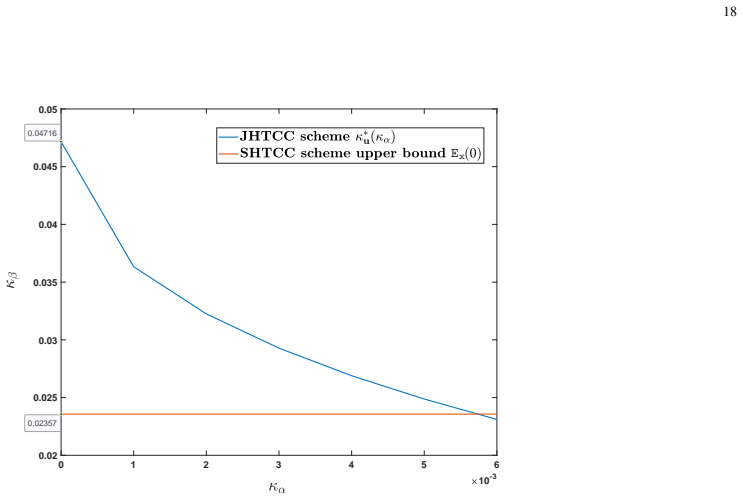
- For testing against dependence over a binary symmetric channel, the joint hybrid-coding bound strictly dominates the separation-based bound for small type I exponents, so the trade-off region is not separation-optimal in general.
- The two inner bounds give explicit formulas that can be evaluated numerically for finite alphabets, making the error-exponent trade-off computable in principle for small systems.
Reading between the lines
- The two-threshold structure of the remote formula suggests a testable extension: at finite blocklength the remote problem should obey a refined trade-off governed by the same two log-MGFs plus channel dispersion terms, so a Berry-Esseen-style analysis would give non-asymptotic bounds.
- Because the remote characterization is exact only under mutual absolute continuity, the paper's own remark about recovering the noiseless case hints that a limiting argument is needed but not written out; making that limit explicit would remove the main technical caveat.
- The SHTCC bound's recovery of the rate-limited case suggests that quantizing $U$ to the type level is not just an analysis tool but may be necessary for optimality; a possible test is to see whether any scheme with finer quantization improves the exponents.
- The demonstrated strict gap between joint and separate schemes is shown at very small type I exponents; optimizing all hybrid-coding parameters might reveal whether the gap persists across the whole trade-off, which would strengthen the case for joint source-channel coding.
Signed reviews
Editorial analysis
A structured set of objections, weighed in public.
Referee Report
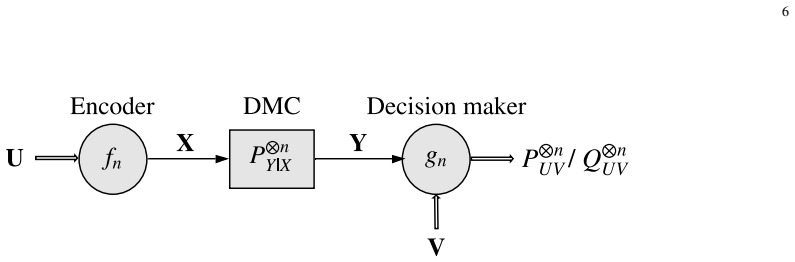
Summary. The paper studies a two-terminal distributed binary hypothesis testing (DHT) problem in which an observer transmits over a discrete memoryless channel to a decision maker who also holds independent samples. The goal is the trade-off between type I and type II error exponents. The main results are: (i) an exact single-letter characterization of the error-exponent region for the remote hypothesis testing (RHT) special case in which the decision maker has no side information V (Theorem 3); (ii) an inner bound for general DHT based on separation of type-based source coding and unequal error-protection channel coding (Theorem 4); and (iii) an inner bound based on joint hybrid coding (Theorem 5), with an example showing that the joint scheme strictly outperforms the separation-based scheme. The paper also claims that Theorem 4 recovers the noiseless Han–Kobayashi bound and prior bounds of the authors.
Significance. If correct, Theorem 3 is a substantial exactness result: it shows that for remote hypothesis testing the optimal error-exponent trade-off is achieved by a separate local Neyman–Pearson test followed by transmission of a single binary decision over the channel, i.e., a form of separation between hypothesis testing and channel coding. Theorems 4 and 5 provide explicit, computable inner bounds for the noisy-channel DHT problem, improving on the earlier inner bound of Weinberger–Kochman–Wigger and recovering several noiseless and Stein-regime results. The proofs are unusually detailed, use standard method-of-types and log-moment-generating machinery, and do not rely on fitted parameters or equivalent-input derivations. The comparison example in Section III-C is concrete and gives a falsifiable separation between the two inner bounds.
major comments (2)
- [IV-B, Eq. (74)] In the converse proof of Theorem 3, Eq. (74) states that β_n(c_n) ≥ P_{Y|X(·|x')}(A_n) for some x'. This inequality is backwards for the argument that follows: β_n is an average over channel inputs, so it is upper bounded by the maximum of P_{Y|X(·|x)}(A_n) over x, not lower bounded by a single term. With the stated lower bound, the later step 'β_n ≤ e^{-n(E-θ)}' does not follow from Proposition 1, because the channel type II error is only a lower bound on the DHT type II error. The converse can be repaired by choosing x' to maximize P_{Y|X(·|x)}(A_n) and replacing (74) with β_n(c_n) ≤ P_{Y|X(·|x')}(A_n), then using the joint type of (argmin_x P_{Y|X(·|x)}(A_n^c), argmax_x P_{Y|X(·|x)}(A_n)) in the application of Proposition 1. As written, the exactness proof of Theorem 3 contains a load-bearing sign error and must be corrected.
- [II-C / Remark 1 (after Theorem 4)] Assumption 1 requires that PY|X(·|x̃) and PY|X(·|x′) be mutually absolutely continuous for every ordered pair of channel inputs. A deterministic noiseless injective channel violates this assumption because outputs of distinct inputs have disjoint supports, so the log-MGF quantities ψ* in Proposition 1 and Theorem 3 are not finite. Nevertheless, Remark 1 claims that Theorem 4 recovers the noiseless Han–Kobayashi bound by 'setting Ex(R,PSX), Em(PSX,θ) and Em(PSX,θ)−θ to ∞, which hold when the channel is noiseless'. No regularizing family of channels satisfying Assumption 1 is supplied, and the limiting behavior of the ψ*-dependent terms is not analyzed. Thus the advertised recovery of [13] is not established as a theorem of the paper; the authors should either provide a rigorous limiting argument (e.g., through a sequence of noisy channels with common support and vanishing noise) or explicitly state that this recovery is formal and outside the assumptions.
minor comments (5)
- [Theorem 5 statement] There is a typo in the statement of Theorem 5: 'κ*_u((κα))' should be 'κ*_u(κα)'.
- [Notation] The symbol R is used both for the error-exponent region in Definition 4 and for the channel-coding rate in Theorem 4 and its proof. This is confusing in statements such as 'R⊆...' versus 'ζ(κα,ω)−ρ(κα,ω)≤R<I_P(X;Y|S)'; consider renaming the rate variable.
- [Proof of Theorem 4, around Eq. (97)] The text says 'As we show later in (177), it follows from ...', but Eq. (97) is the relevant bound and its proof appears in Appendix A; the cross-reference should be updated to the correct equation number.
- [Proof of Theorem 5, final paragraph] The final paragraph of the proof says 'we show that κ(κα) ≥ κ*_h(κα)' before analyzing uncoded transmission, which gives κ*_u(κα). The displayed symbol should be κ*_u(κα) to match the argument.
- [Section III-C, Example 1 and Figure 2] The claim that Ex(0) is an upper bound on κ*_D(κα) for all κα should be justified in the text or figure caption, since it uses monotonicity of the expurgated exponent in R.
Circularity Check
No significant circularity: all error-exponent bounds are derived from standard log-MGF and Neyman-Pearson theory, with self-citations used only as later recovery checks.
full rationale
The paper's derivations are self-contained. Proposition 1 is proved directly via Chernoff bounds for achievability and via the external Theorem 2 for the converse; Theorem 3 combines Proposition 1 with the classical direct HT result in Theorem 1 through an explicit separate NP-test-and-two-message-code construction. Theorems 4 and 5 are proved by explicit random-coding ensembles followed by expurgation, with error events analyzed from first principles. No fitted constants or parameters are calibrated to the final exponents, and no claimed prediction is an input by construction. The authors' self-citations to their earlier works [32], [39], and [10] are used only to show that previously obtained corner points or Stein-regime bounds are recovered as special cases of the new expressions, not as load-bearing assumptions of the proofs. The reviewer's concern about Assumption 1 and the recovery of the noiseless Han-Kobayashi bound in Remark 1 is a technical-scope or boundary-limit issue: Assumption 1 excludes deterministic noiseless channels, and the advertised recovery is asserted by setting certain exponents to infinity rather than through an explicit limiting argument. This is a correctness or rigor concern, not circularity, because the noisy-channel inner bounds are not defined in terms of the noiseless bound they are said to recover. Accordingly, the circularity score is 0.
Assumptions & free parameters
assumptions (5)
- domain assumption Finite alphabets U,V,X,Y and i.i.d. observations under both hypotheses.
- domain assumption The channel is a discrete memoryless channel with transition kernel PY|X and bandwidth ratio 1.
- domain assumption Assumption 1: PY|X(·|x̃) and PY|X(·|x') are mutually absolutely continuous for every ordered input pair.
- standard math Standard large-deviation and method-of-types bounds, including log-MGF convexity, Chernoff bounds, type covering, and expurgation.
- standard math Direct hypothesis testing characterization (Theorem 1) and weighted error lower bound (Theorem 2) from Polyanskiy-Wu.
Cite this review
Pith. "Pith review of Distributed Hypothesis Testing over a Noisy Channel: Error-exponents Trade-off." pith.science (2026). https://pith.science/paper/2JBGLN5Z
@misc{pith2026190807521,
  author       = {Pith},
  title        = {Pith review of: Distributed Hypothesis Testing over a Noisy Channel: Error-exponents Trade-off},
  year         = {2026},
  howpublished = {\url{https://pith.science/paper/2JBGLN5Z}},
  note         = {Machine review of arXiv:1908.07521}
}
abstract
A two-terminal distributed binary hypothesis testing problem over a noisy channel is studied. The two terminals, called the observer and the decision maker, each has access to $n$ independent and identically distributed samples, denoted by $\mathbf{U}$ and $\mathbf{V}$, respectively. The observer communicates to the decision maker over a discrete memoryless channel, and the decision maker performs a binary hypothesis test on the joint probability distribution of $(\mathbf{U},\mathbf{V})$ based on $\mathbf{V}$ and the noisy information received from the observer. The trade-off between the exponents of the type I and type II error probabilities is investigated. Two inner bounds are obtained, one using a separation-based scheme that involves type-based compression and unequal error-protection channel coding, and the other using a joint scheme that incorporates type-based hybrid coding. The separation-based scheme is shown to recover the inner bound obtained by Han and Kobayashi for the special case of a rate-limited noiseless channel, and also the one obtained by the authors previously for a corner point of the trade-off. Finally, we show via an example that the joint scheme achieves a strictly tighter bound than the separation-based scheme for some points of the error-exponents trade-off.
Figures
Reference graph
Works this paper leans on
-
[10]
Distributed hypothesis testing over discrete memoryless channels,
S. Sreekumar and D. G ¨und¨uz, “Distributed hypothesis testing over discrete memoryless channels,” IEEE Trans. Inf. Theory, vol. 66, no. 4, Apr. 2020
work page 2020
-
[39]
Hypothesis testing over a noisy channel,
S. Sreekumar and D. G ¨und¨uz, “Hypothesis testing over a noisy channel,” in Proc. IEEE Int. Symp. Inf. Theory (ISIT) , Paris, France, 2019
2019
-
[36]
Exponent trade-off for hypothesis testing over noisy channels,
N. Weinberger, Y . Kochman, and M. Wigger, “Exponent trade-off for hypothesis testing over noisy channels,” in Proc. IEEE Int. Symp. Inf. Theory (ISIT) , Paris, France, 2019
work page 2019
-
[13]
Exponential-type error probabilities for multiterminal hypothesis testing,
T. S. Han and K. Kobayashi, “Exponential-type error probabilities for multiterminal hypothesis testing,” IEEE Trans. Inf. Theory , vol. 35, no. 1, pp. 2–14, Jan. 1989
1989
-
[1]
On the problem of the most efficient tests of statistical hypotheses,
J. Neyman and E. Pearson, “On the problem of the most efficient tests of statistical hypotheses,” Philos. Trans. of the Royal Society of London, vol. 231, pp. 289–337, Feb. 1933
work page 1933
-
[2]
A measure of asymptotic efficiency for tests of a hypothesis based on a sum of observations,
H. Chernoff, “A measure of asymptotic efficiency for tests of a hypothesis based on a sum of observations,” Ann. Math. Statist. , vol. 23, no. 4, pp. 493–507, 1952
work page 1952
-
[3]
Asymptotically optimal tests for multinominal distributions,
W. Hoeffding, “Asymptotically optimal tests for multinominal distributions,” Ann. Math. Stat. , vol. 36, no. 2, pp. 369–400, 1965
work page 1965
-
[4]
Hypothesis testing and information theory,
R. E. Blahut, “Hypothesis testing and information theory,” IEEE Trans. Inf. Theory , vol. 20, no. 4, pp. 405–417, Jul. 1974
work page 1974
Show all 44 references
-
[5]
On error exponents in hypothesis testing,
E. Tuncel, “On error exponents in hypothesis testing,” IEEE Trans. Inf. Theory , vol. 51, no. 8, pp. 2945–2950, 2005
2005
-
[6]
Hypothesis testing with communication constraints,
R. Ahlswede and I. Csisz ´ar, “Hypothesis testing with communication constraints,” IEEE Trans. Inf. Theory , vol. 32, no. 4, pp. 533–542, Jul. 1986
1986
-
[7]
Hypothesis testing with multiterminal data compression,
T. S. Han, “Hypothesis testing with multiterminal data compression,” IEEE Trans. Inf. Theory , vol. 33, no. 6, pp. 759–772, Nov. 1987
1987
-
[8]
Error bound of hypothesis testing with data compression,
H. Shimokawa, T. S. Han, and S. Amari, “Error bound of hypothesis testing with data compression,” in Proc. IEEE Int. Symp. Inf. Theory (ISIT), Trondheim, Norway, 1994
1994
-
[9]
On the optimality of binning for distributed hypothesis testing,
M. S. Rahman and A. B. Wagner, “On the optimality of binning for distributed hypothesis testing,” IEEE Trans. Inf. Theory , vol. 58, no. 10, pp. 6282–6303, Oct. 2012
2012
-
[11]
Decentralized estimation and decision theory,
T. Berger, “Decentralized estimation and decision theory,” in IEEE 7th. Spring Workshop on Inf. Theory , Mt. Kisco, NY , Sep. 1979
1979
-
[12]
Multiterminal detection with zero-rate data compression,
H. M. H. Shalaby and A. Papamarcou, “Multiterminal detection with zero-rate data compression,” IEEE Trans. Inf. Theory, vol. 38, no. 2, pp. 254–267, Mar. 1992
1992
-
[14]
Successive refinement for hypothesis testing and lossless one-helper problem,
C. Tian and J. Chen, “Successive refinement for hypothesis testing and lossless one-helper problem,” IEEE Trans. Inf. Theory , vol. 54, no. 10, pp. 4666–4681, Oct. 2008
2008
-
[15]
Distributed testing against independence with multiple terminals,
W. Zhao and L. Lai, “Distributed testing against independence with multiple terminals,” in 52nd Annual Allerton Conference on Communication, Control and Computing , Monticello, IL, USA, Oct. 2014
2014
-
[16]
Testing against independence with multiple decision centers,
M. Wigger and R. Timo, “Testing against independence with multiple decision centers,” in Int. Conf. on Signal Processing and Communication, Bengaluru, India, Jun. 2016. 55
2016
-
[17]
Hypothesis testing in multi-hop networks,
S. Salehkalaibar, M. Wigger, and L. Wang, “Hypothesis testing in multi-hop networks,” IEEE Trans. Inf. Theory , vol. 65, no. 7, pp. 4411–4433, Jul. 2019
2019
-
[18]
Optimal rate-exponent region for a class of hypothesis testing against conditional independence problems,
A. Zaidi and I. E. Aguerri, “Optimal rate-exponent region for a class of hypothesis testing against conditional independence problems,” arXiv:1904.03028
1904 arXiv
-
[19]
On secure distributed hypothesis testing,
M. Mhanna and P. Piantanida, “On secure distributed hypothesis testing,” in Proc. IEEE Int. Symp. Inf. Theory (ISIT) , Hong Kong, China, Jun. 2015
2015
-
[20]
Testing against conditional independence under security constraints,
S. Sreekumar and D. G ¨und¨uz, “Testing against conditional independence under security constraints,” in Proc. IEEE Int. Symp. Inf. Theory (ISIT), Vail, CO, USA, Jun. 2018
2018
-
[21]
Privacy-aware distributed hypothesis testing,
S. Sreekumar, A. Cohen, and D. G ¨und¨uz, “Privacy-aware distributed hypothesis testing,” arXiv:1807.02764
-
[22]
Distributed hypothesis testing with privacy constraints,
A. Gilani, S. B. Amor, S. Salehkalaibar, and V . Tan, “Distributed hypothesis testing with privacy constraints,” Entropy, vol. 21, no. 478, pp. 1–27, May 2019
2019
-
[23]
Distributed binary detection with lossy data compression,
G. Katz, P. Piantanida, and M. Debbah, “Distributed binary detection with lossy data compression,” IEEE Trans. Inf. Theory , vol. 63, no. 8, pp. 5207–5227, Mar. 2017
2017
-
[24]
Interactive hypothesis testing with communication constraints,
Y . Xiang and Y . H. Kim, “Interactive hypothesis testing with communication constraints,” in 50th Annual Allerton Conference on Communication, Control, and Computing , Monticello, IL, USA, Oct. 2012
2012
-
[25]
Interactive hypothesis testing against independence,
——, “Interactive hypothesis testing against independence,” in Proc. IEEE Int. Symp. Inf. Theory (ISIT) , Istanbul, Turkey, Nov. 2013
2013
-
[26]
Collaborative distributed hypothesis testing,
G. Katz, P. Piantanida, and M. Debbah, “Collaborative distributed hypothesis testing,” arXiv:1604.01292 [cs.IT], Apr. 2016
2016 arXiv
-
[27]
Error exponents in distributed hypothesis testing of correlations,
U. Hadar, J. Liu, Y . Polyanskiy, and O. Shayevitz, “Error exponents in distributed hypothesis testing of correlations,” in Proc. IEEE Int. Symp. Inf. Theory (ISIT) , 2019, pp. 2674–2678
2019
-
[28]
On binary distributed hypothesis testing,
E. Haim and Y . Kochman, “On binary distributed hypothesis testing,” arXiv:1801.00310
-
[29]
On the reliability function of distributed hypothesis testing under optimal detection,
N. Weinberger and Y . Kochman, “On the reliability function of distributed hypothesis testing under optimal detection,” IEEE Trans. Inf. Theory, vol. 65, no. 8, pp. 4940–4965, Apr. 2019
2019
-
[30]
Neyman-Pearson test for zero-rate multiterminal hypothesis testing,
S. Watanabe, “Neyman-Pearson test for zero-rate multiterminal hypothesis testing,” IEEE Trans. Inf. Theory, vol. 64, no. 7, pp. 4923–4939, Jul. 2018
2018
-
[31]
Csisz ´ar and J
I. Csisz ´ar and J. K ¨orner, Information Theory: Coding Theorems for Discrete Memoryless Systems . Cambridge University Press, 2011
2011
-
[32]
Distributed hypothesis testing over noisy channels,
S. Sreekumar and D. G ¨und¨uz, “Distributed hypothesis testing over noisy channels,” in Proc. IEEE Int. Symp. Inf. Theory (ISIT) , Aachen, Germany, Jun. 2017
2017
-
[33]
Distributed hypothesis testing based on unequal-error protection codes,
S. Salehkalaibar and M. Wigger, “Distributed hypothesis testing based on unequal-error protection codes,” arXiv:1806.05533
-
[34]
A unified approach to hybrid coding,
P. Minero, S. H. Lim, and Y . H. Kim, “A unified approach to hybrid coding,” IEEE Trans. Inf. Theory , vol. 61, no. 4, pp. 1509–1523, Apr. 2015
2015
-
[35]
Unequal error protection: An information-theoretic perspective,
S. Borade, B. Nakibo ˘glu, and L. Zheng, “Unequal error protection: An information-theoretic perspective,” IEEE Trans. Inf. Theory, vol. 55, no. 12, pp. 5511–5539, Dec 2009
2009
-
[37]
On the error exponent of source-channel transmission with a distortion threshold,
I. Csisz ´ar, “On the error exponent of source-channel transmission with a distortion threshold,” IEEE Trans. Inf. Theory , vol. 28, no. 6, pp. 823–828, Nov. 1982
1982
-
[38]
Polyanskiy and Y
Y . Polyanskiy and Y . Wu,Lecture Notes on Information Theory. [Online]. Available: http://people.lids.mit.edu/yp/homepage/data/itlectures v5.pdf, 2017
2017
-
[40]
A simple derivation of the coding theorem and some applications,
R. Gallager, “A simple derivation of the coding theorem and some applications,” IEEE Trans. Inf. Theory , vol. 11, no. 1, pp. 3–18, Jan. 1965
1965
-
[41]
On joint source-channel coding for the Wyner-Ziv source and the Gelfand-Pinsker channel,
N. Merhav and S. Shamai, “On joint source-channel coding for the Wyner-Ziv source and the Gelfand-Pinsker channel,” IEEE Trans. Inf. Theory, vol. 49, no. 11, pp. 2844–2855, Nov 2003
2003
-
[42]
Multiple access channels with arbitrarily correlated sources,
T. Cover, A. E. Gamal, and M. Salehi, “Multiple access channels with arbitrarily correlated sources,” IEEE Trans. Inf. Theory , vol. 26, no. 6, pp. 648–657, Nov. 1980
1980
-
[43]
Joint source-channel error exponent,
I. Csisz ´ar, “Joint source-channel error exponent,” Prob. of Control and Inf. Theory , vol. 9, no. 5, pp. 315–328, Oct. 1980
1980
-
[44]
H. G. Eggleston, Convexity, 6th ed. Cambridge, England York: Cambridge University Press, 1958
1958
Reviewed August 14, 2026 · model on record in the stance chip above.
Discussion (0). Continue with ORCID to comment.