REVIEW 4 major objections 6 minor 54 references
Chance-Constrained and Yield-aware Optimization of Photonic ICs with Non-Gaussian Correlated Process Variations
T0 review · 4 major / 6 minor · reviewed 2026-08-14 · deepseek-v4-flash
Pith's one-line read Photonic yield optimization is reduced to a deterministic polynomial program that needs only tens of simulations.
desk verdict A solid, genuinely useful engineering paper on chance-constrained yield optimization for photonic ICs, with correct core math and a real speedup, but the claimed 'yield guarantee' needs tempering and the surrogate residual needs reporting. read the letter →
The pith
A machine-rendered reading of the paper's core claim, the machinery that carries it, and where it could break.
The reading
What carries the argument
The load-bearing object is a joint quadrature rule in the space of design variables $x$ and non-Gaussian correlated process parameters $\xi$, computed by a three-stage optimization: a quadrature rule for $x$, one for $\xi$, then a joint co-optimization that keeps the total number of simulator calls small. Combining this quadrature with orthonormal polynomial bases for $x$ and for the correlated distribution of $\xi$ gives a polynomial chaos surrogate whose coefficients are obtained by projection. The surrogate supplies closed-form polynomial expressions for the mean and variance of every metric, so the chance constraints $\operatorname{Prob}(y_i(x,\xi)\le u_i)\ge 1-\epsilon_i$ become the deterministic constraint $\mathbb{E}[y_i]+\kappa_{\epsilon_i}\sqrt{\operatorname{var}[y_i]}\le u_i$, which is squared to keep the constraint smooth. This transforms the stochastic design problem into a polynomial optimization solved by semidefinite relaxation.
What would settle it
Take a photonic filter with a deliberately sharp spectral response that changes abruptly when a coupling coefficient crosses a threshold, run the framework with 64 simulations, and compare its predicted yield at the optimized design against $10^4$ Monte Carlo samples; if the surrogate yield misses the Monte Carlo yield by more than a few percent, the smoothness assumption behind the polynomial expansion is the failing link.
Extended reading notes
Core claim
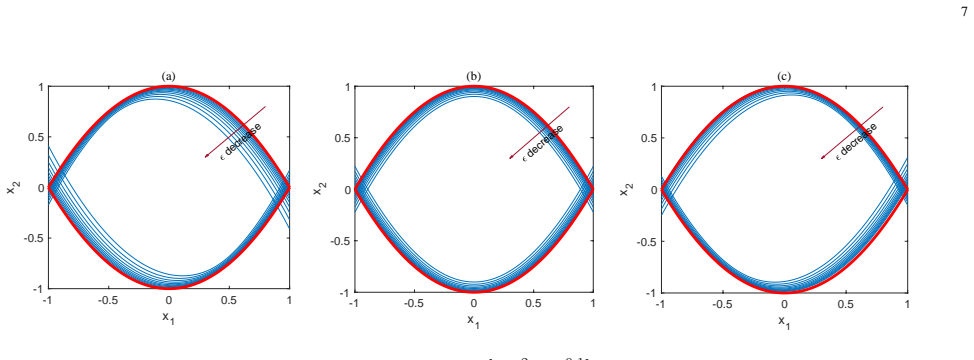
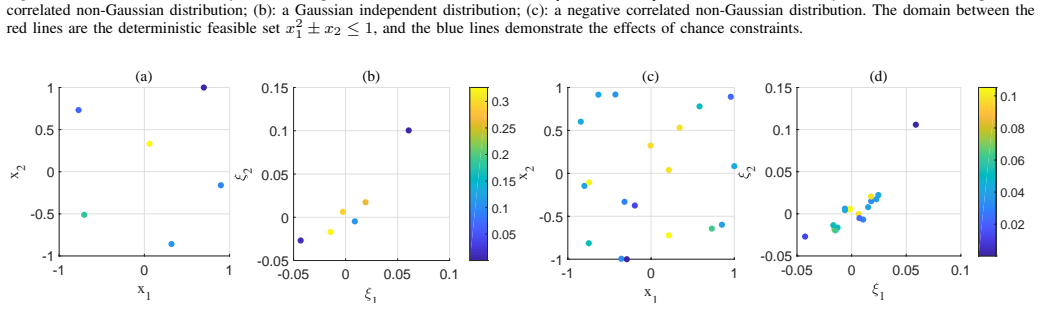
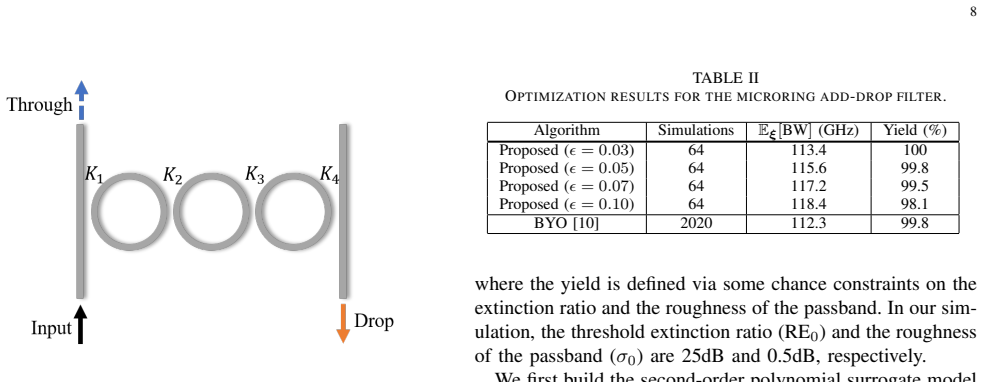
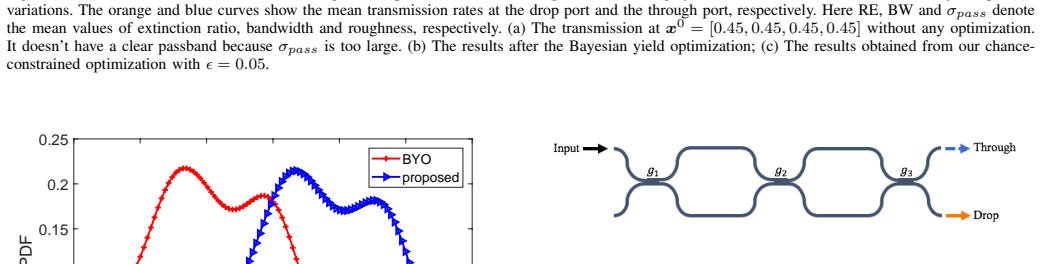
The paper claims that chance-constrained yield optimization under non-Gaussian correlated process variations can be reduced to a deterministic polynomial optimization problem, and that the reduction is accurate enough to design real photonic filters with very few simulations. For each performance metric the framework builds a second-order generalized polynomial chaos expansion over the joint space of design variables and random parameters, using an optimization-based quadrature rule whose points are co-designed across both spaces. The mean and variance of each constraint with respect to the random parameters then become explicit polynomials in the design variables. Applying a one-sided tail inequality turns each chance constraint into $\mathbb{E}[y_i]+\kappa_{\epsilon_i}\sqrt{\operatorname{var}[y_i]}\le u_i$, and squaring the constraint removes the non-smooth square root. On a microring add-drop filter and a Mach-Zehnder interferometer, the optimized designs achieve high yield with 64 and 36 simulations respectively, and the expected bandwidth is larger than the baseline's while the yield is comparable.
Load-bearing premise
The performance metrics must be smooth enough in the design variables and process variations that a low-order polynomial expansion represents them faithfully across the entire design box, and the nonconvex quadrature optimization must converge to a small residual.
Editorial extensions
If this is right
- A photonic design that would normally require many simulation samples per optimization iteration can be designed in one pass of 36 to 64 simulations, because the probability measures are never re-estimated during iteration.
- Smaller risk tolerance $\epsilon$ shrinks the feasible region and raises the achieved yield at the cost of a worse nominal objective, giving designers a tunable performance-yield trade-off.
- Because the reformulated constraints are conservative, every feasible point of the deterministic problem satisfies the original chance constraint whenever the surrogate is accurate, so the optimized design inherits a confidence-level guarantee.
- The same pipeline applies to any smooth black-box simulator with non-Gaussian correlated inputs, not only the two photonic filters tested.
- The chance-constrained formulation avoids the over-conservative designs that can result from optimizing yield alone, since it optimizes a performance metric subject to a yield floor.
Reading between the lines
- The authors only verify the final design against Monte Carlo; a natural extension is to use the final polynomial surrogate as a cheap proposal for adaptive refinement, re-running the joint quadrature around the candidate optimum to confirm the yield estimate.
- The conservative mean-plus-variance reformulation is distribution-free, so the framework would keep its guarantee even if the polynomial chaos surrogate were swapped for another regression model; the real bottleneck is smoothness, not the correlation structure.
- The three-stage quadrature co-optimization could be reused for other stochastic programs where objective and constraints share random parameters, such as robust control or power-system dispatch with correlated renewable uncertainty.
- The polynomial optimization step scales with the number of basis functions, so a testable extension is combining the surrogate with sparse or compressive-sensing bases for high-dimensional design spaces, a direction the paper explicitly leaves open.
Signed reviews
Editorial analysis
A structured set of objections, weighed in public.
Referee Report
Summary. The paper proposes a data-efficient framework for yield-aware optimization of photonic integrated circuits under non-Gaussian correlated process variations. The approach builds a second-order polynomial chaos surrogate in the joint space of design variables and stochastic parameters using an optimized quadrature rule, reformulates the chance-constrained yield optimization problem into a deterministic polynomial optimization via mean-variance constraints derived from Cantelli's inequality, and solves the resulting problem with a global polynomial optimization solver. The framework is validated on a synthetic example, a microring add-drop filter, and a Mach-Zehnder interferometer, claiming a more than 30x reduction in simulation cost and better performance than a Bayesian yield optimization baseline while achieving comparable yield.
Significance. If the surrogate is accurate over the full design box, this is a valuable contribution to yield-aware design automation: it offers a deterministic, derivative-free route to chance-constrained optimization that avoids repeated Monte Carlo estimation at each optimization iterate. The mathematical core is sound: the Cantelli-based sufficiency condition in Appendix A and the variance formula in Appendix B are correct, and the polynomial reformulation in (31) is a valid smooth equivalent of (17) under the stated mean constraints. The numerical results demonstrate substantial simulation savings (2020 vs. 64 and 2020 vs. 36 simulations on the two photonic benchmarks) relative to the Bayesian yield optimization baseline, and the paper provides a link to downloadable MATLAB code. However, the strength of the central claims currently outruns the evidence: the surrogate is validated only at the final design, the quadrature residual of Theorem 1 is unreported, the joint chance constraint is relaxed to individual constraints in the experiments without a post-hoc joint guarantee, and the Monte Carlo yield estimates lack sample sizes and confidence intervals.
major comments (4)
- [Section IV.B, Theorem 1, Eq. (30)] The abstract's 'yield guarantee' is not established by the analysis as written. Constraint (16) is a sufficient condition for the individual chance constraint only when the mean and variance of the true simulator response are used; here they are replaced by surrogate quantities. Theorem 1 bounds the L2 surrogate error by α1δ1 + α2δ2, but the residual δ1 of the nonconvex quadrature problem (28) is never reported, and δ2 is not estimated. Moreover, an L2 error bound on y − y-tilde does not, by itself, bound the error in the chance-constraint probability or ensure that the true mean-variance condition (16) holds at points feasible for (31). I recommend reporting δ1 and an estimate of δ2, and validating the surrogate mean and variance at multiple design points in X, not only at the final optimum.
- [Section III, Eq. (13), and Section V] The joint chance constraint (11) is replaced by individual chance constraints (13), and the paper correctly notes on page 4 that with εi = ε for all i this is a relaxation whose feasible set is enlarged. In all numerical experiments the authors set all risk thresholds to ε, so the solved problem is the relaxed one. Consequently the empirical joint yields reported in Tables II and III (e.g., 99.8%) are not guaranteed by the formulation and could be lower than the nominal 1−ε for the joint event. Please either choose the εi to satisfy the union bound, or state explicitly that the guarantee applies only at the individual-constraint level and verify the joint yield separately.
- [Section V, Tables II and III] The Monte Carlo yield estimates are reported without sample size or confidence intervals. The text before Eq. (34) defines yield as an average over M random ξj, but the value of M used to produce the percentages in Tables II and III is not given. With typical Monte Carlo samples on the order of 10^3, differences such as 99.8% vs. 99.8% in Table II are within sampling error, making the 'similar yield' comparison to Bayesian yield optimization statistically inconclusive as presented. Please report the MC sample size and, ideally, binomial confidence intervals or at least the number of failed samples.
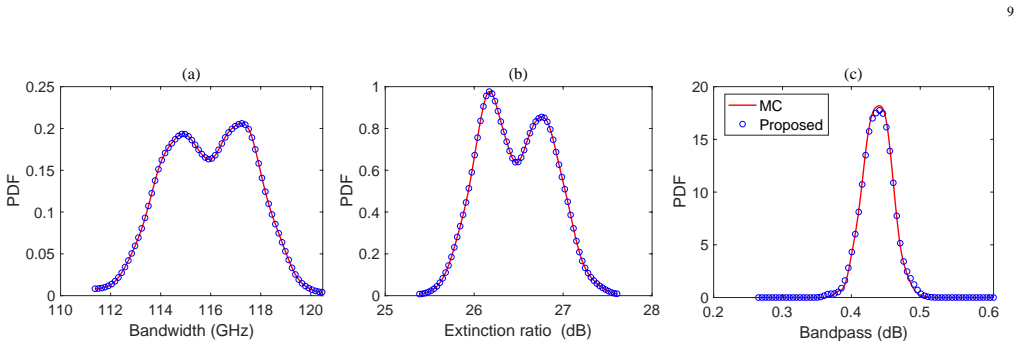
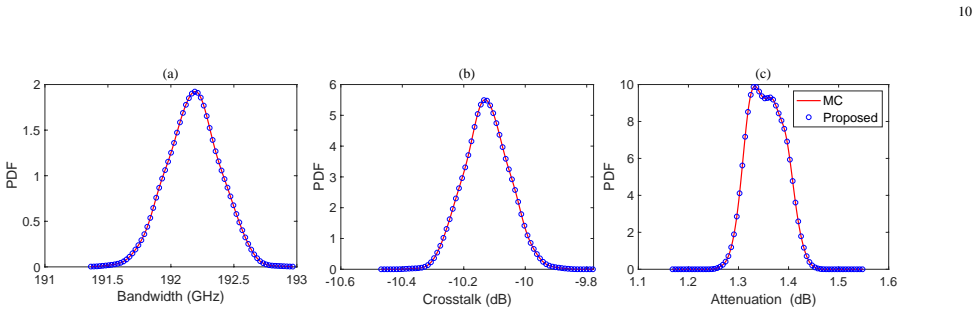
- [Section IV.B and Section V.B/C] The surrogate model is validated only at the optimized design point (Figures 5 and 9). Since the polynomial optimization (31) is solved over the whole design box X, the optimizer may exploit regions where the surrogate is inaccurate. There is no design-space cross-validation, and the residual of the joint quadrature objective (28) is not reported, so the claimed 30x reduction and improved performance cannot yet be separated from surrogate modeling error. I recommend adding a validation of the surrogate's predicted mean and variance against Monte Carlo (or another high-fidelity reference) at a set of design points spread across X and reporting the achieved value of the objective in (28).
minor comments (6)
- [Section II.B, Eq. (6)] The inequality in Eq. (6) is written as Eξ[y(x,ξ)] + κϵ√varξ[y(x,ξ)] ≥ u, but it should be ≤ u to be consistent with Eq. (16) and the derivation in Appendix A. Please correct this typo.
- [Section V.A, Eq. (35)] The text states that the objective is to maximize Eξ[3(x1+ξ1)+(x2+ξ2)], but Eq. (35) uses a minus sign: Eξ[3(x1+ξ1)−(x2+ξ2)]. This inconsistency should be resolved because it affects the interpretation of the reported objective values in Table I.
- [Section V, Eq. (34)] The Monte Carlo sample size in Eq. (34) is also denoted M, which conflicts with the number of quadrature points M used in Algorithm 1 and Eq. (28). Please use distinct symbols, e.g., N_MC for the Monte Carlo yield estimate.
- [Section V.C, Table III and Figure 9] For the same solution with ε = 0.05, Table III reports x* = [300, 111.2, 300] while the caption of Figure 9 reports x* = [0.300, 0.5036, 0.300]. Since the text defines the design variables as gaps g in nm, please clarify whether the reported values are gaps or coupling coefficients κ, and make the notation consistent.
- [Section V, before Eq. (34)] The phrase 'The p subproblem (31)' should read 'The polynomial subproblem (31)' for clarity.
- [Appendix A] In the line 'for any constant u ≥ E[x]', the notation is confusing: x is a vector of design variables, while the random variable in Cantelli's inequality was denoted X. This should read 'u ≥ E[X]' where X = y(ξ).
Circularity Check
No significant circularity: the chance-constrained surrogate optimization is self-contained and independently MC-validated; the only self-citations are non-load-bearing prior UQ tools.
full rationale
The derivation chain is self-contained: (i) the chance constraint is replaced by the sufficient mean-variance constraint (16), proved via Cantelli's inequality in Appendix A; (ii) the black-box objective and constraint functions are approximated by p-th order polynomial chaos surrogates whose coefficients are computed from simulator calls at quadrature points via (25); (iii) the mean and variance formulas (20)-(21) are substituted into (17) and squared to obtain the polynomial program (31); and (iv) the final design is validated by independent Monte Carlo yield estimation via (34). None of these steps defines the claimed output in terms of its own inputs: (31) is an algebraic consequence of the surrogate and the conservative chance-constraint bound, not a restatement of the fitted yield, and the yields reported in Tables I-III are Monte Carlo estimates independent of the surrogate. The self-citations [28],[29] provide a previously published quadrature construction and Theorem 1's error bound, but these are external published results, and the paper's central claims are also empirically checked against independent Monte Carlo simulations and against the Bayesian yield optimization baseline. The fact that Theorem 1's residual delta_1 is not numerically reported is a validation gap or accuracy concern, not circularity. No fitted parameter is relabeled as a prediction, and no equation is defined in terms of the quantity it claims to derive.
Assumptions & free parameters
free parameters (1)
- Polynomial chaos truncation order p =
2 in all experiments
assumptions (4)
- domain assumption Performance metrics y_i(x,xi) and f(x,xi) are smooth and square-integrable so that a low-order polynomial chaos expansion converges.
- standard math The quadrature rule from the authors' prior work [29] satisfies the error bound in Theorem 1 when the residual of (28) is small.
- domain assumption The design variable x is bounded and the objective and constraint functions are defined over the entire box X, with a known density rho(xi) for process variations.
- standard math Cantelli's inequality provides a valid conservative bound for the individual chance constraints.
Cite this review
Pith. "Pith review of Chance-Constrained and Yield-aware Optimization of Photonic ICs with Non-Gaussian Correlated Process Variations." pith.science (2026). https://pith.science/paper/W4I5KK3E
@misc{pith2026190807574,
  author       = {Pith},
  title        = {Pith review of: Chance-Constrained and Yield-aware Optimization of Photonic ICs with Non-Gaussian Correlated Process Variations},
  year         = {2026},
  howpublished = {\url{https://pith.science/paper/W4I5KK3E}},
  note         = {Machine review of arXiv:1908.07574}
}
abstract
Uncertainty quantification has become an efficient tool for uncertainty-aware prediction, but its power in yield-aware optimization has not been well explored from either theoretical or application perspectives. Yield optimization is a much more challenging task. On one side, optimizing the generally non-convex probability measure of performance metrics is difficult. On the other side, evaluating the probability measure in each optimization iteration requires massive simulation data, especially when the process variations are non-Gaussian correlated. This paper proposes a data-efficient framework for the yield-aware optimization of photonic ICs. This framework optimizes the design performance with a yield guarantee, and it consists of two modules: a modeling module that builds stochastic surrogate models for design objectives and chance constraints with a few simulation samples, and a novel yield optimization module that handles probabilistic objectives and chance constraints in an efficient deterministic way. This deterministic treatment avoids repeatedly evaluating probability measures at each iteration, thus it only requires a few simulations in the whole optimization flow. We validate the accuracy and efficiency of the whole framework by a synthetic example and two photonic ICs. Our optimization method can achieve more than $30\times$ reduction of simulation cost and better design performance on the test cases compared with a Bayesian yield optimization approach developed recently.
Figures

Figures from the paper (7 more)



Reference graph
Works this paper leans on
-
[11]
M. Wang, W. Lv, F. Yang, C. Yan, W. Cai, D. Zhou, and X. Zeng, “Efficient yield optimization for analog and SRAM circuits via Gaus- sian process regression and adaptive yield estimation,” IEEE Trans. Computer-Aided Design of Integrated Circuits and Systems , vol. 37, no. 10, pp. 1929–1942, 2018
work page 1929
-
[7]
Stochastic simulation and robust design optimization of integrated photonic filters,
T. W. Weng, D. Melati, A. I. Melloni, L. Daniel et al. , “Stochastic simulation and robust design optimization of integrated photonic filters,” Nanophotonics, vol. 6, no. 1, pp. 299–308, 2017
work page 2017
-
[10]
Efficient Bayesian yield optimization approach for analog and SRAM circuits,
M. Wang, F. Yang, C. Yan, X. Zeng, and X. Hu, “Efficient Bayesian yield optimization approach for analog and SRAM circuits,” in Proc. Design Automation Conference , 2017, pp. 1–6
work page 2017
-
[1]
S. C. Nicholes, M. L. Masanovic, B. Jevremovic, E. Lively, L. A. Coldren, and D. J. Blumenthal, “The world’s first InP 8× 8 monolithic tunable optical router (MOTOR) operating at 40 Gbps line rate per port,” in Proc. Optical Fiber Communication , 2009, pp. 1–3
work page 2009
-
[2]
M. Kato, R. Nagarajan, J. Pleumeekers, P. Evans, A. Chen, A. Mathur, A. Dentai, S. Hurtt, D. Lambert, P. Chavarkar et al. , “40-channel transmitter and receiver photonic integrated circuits operating at a per channel data rate 12.5 Gbit/s,” in National Fiber Optic Engineers Conference. Optical Society of America, 2007, p. JThA89
work page 2007
-
[3]
Process variation in silicon photonic devices,
X. Chen, M. Mohamed, Z. Li, L. Shang, and A. R. Mickelson, “Process variation in silicon photonic devices,” Applied optics , vol. 52, no. 31, pp. 7638–7647, 2013
work page 2013
-
[4]
Systematic nonuniformity anal- ysis of amorphous silicon-on-insulator photonic microring resonators,
T. Lipka, J. M ¨uller, and H. K. Trieu, “Systematic nonuniformity anal- ysis of amorphous silicon-on-insulator photonic microring resonators,” Journal of Lightwave Technology, vol. 34, no. 13, pp. 3163–3170, 2016
work page 2016
-
[5]
Performance prediction for silicon photonics integrated circuits with layout-dependent correlated manufacturing variability,
Z. Lu, J. Jhoja, J. Klein, X. Wang, A. Liu, J. Flueckiger, J. Pond, and L. Chrostowski, “Performance prediction for silicon photonics integrated circuits with layout-dependent correlated manufacturing variability,” Optics express, vol. 25, no. 9, pp. 9712–9733, 2017
2017
Show all 54 references
-
[6]
Predicting the yield of photonic integrated circuits using statis- tical compact modeling,
J. Pond, J. Klein, J. Fl ¨uckiger, X. Wang, Z. Lu, J. Jhoja, and L. Chros- towski, “Predicting the yield of photonic integrated circuits using statis- tical compact modeling,” in Integrated Optics: Physics and Simulations III, vol. 10242, 2017, p. 102420S
2017
-
[8]
An efficient method for parametric yield optimization of MOS integrated circuits,
T.-K. Yu, S.-M. Kang, J. Sacks, and W. J. Welch, “An efficient method for parametric yield optimization of MOS integrated circuits,” in Proc. Intl. Conf. on Computer-Aided Design , 1989, pp. 190–193
1989
-
[9]
DRAM yield analysis and optimization by a statistical design ap- proach,
Y . Li, H. Schneider, F. Schnabel, R. Thewes, and D. Schmitt-Landsiedel, “DRAM yield analysis and optimization by a statistical design ap- proach,” IEEE Transactions on Circuits and Systems I: Regular Papers , vol. 58, no. 12, pp. 2906–2918, 2011
2011
-
[12]
OPERA: optimization with ellipsoidal uncertainty for robust analog IC design,
Y . Xu, K.-L. Hsiung, X. Li, I. Nausieda, S. Boyd, and L. Pileggi, “OPERA: optimization with ellipsoidal uncertainty for robust analog IC design,” in Proc. Design Automation Conference , 2005, pp. 632–637
2005
-
[13]
Robust ana- log/RF circuit design with projection-based performance modeling,
X. Li, P. Gopalakrishnan, Y . Xu, and L. T. Pileggi, “Robust ana- log/RF circuit design with projection-based performance modeling,” IEEE Trans. CAD of Integr. Circ. Syst. , vol. 26, no. 1, pp. 2–15, 2006
2006
-
[14]
Statistical performance modeling and optimization,
X. Li, J. Le, L. T. Pileggi et al. , “Statistical performance modeling and optimization,” Foundations and Trends R© in Electronic Design Automation, vol. 1, no. 4, pp. 331–480, 2007
2007
-
[15]
An efficient Bi-objective optimization framework for statistical chip-level yield analysis under parameter variations,
X. Li, J. Sun, F. Xiao, and J.-S. Tian, “An efficient Bi-objective optimization framework for statistical chip-level yield analysis under parameter variations,” Frontiers of Information Technology & Electronic Engineering, vol. 17, no. 2, pp. 160–172, 2016
2016
-
[16]
Stochastic testing method for transistor-level uncertainty quantification based on generalized polynomial chaos,
Z. Zhang, T. A. El-Moselhy, I. A. M. Elfadel, and L. Daniel, “Stochastic testing method for transistor-level uncertainty quantification based on generalized polynomial chaos,” IEEE Trans. Computer-Aided Design Integr. Circuits Syst., vol. 32, no. 10, pp. 1533–1545, Oct. 2013
2013
-
[17]
Calculation of generalized polynomial-chaos basis functions and Gauss quadrature rules in hierarchical uncertainty quantification,
Z. Zhang, T. A. El-Moselhy, I. M. Elfadel, and L. Daniel, “Calculation of generalized polynomial-chaos basis functions and Gauss quadrature rules in hierarchical uncertainty quantification,” IEEE Trans. CAD of Integrated Circuits and Systems , vol. 33, no. 5, pp. 728–740, 2014
2014
-
[18]
Enabling high-dimensional hierarchical uncertainty quantification by ANOV A and tensor-train decomposition,
Z. Zhang, I. Osledets, X. Yang, G. E. Karniadakis, and L. Daniel, “Enabling high-dimensional hierarchical uncertainty quantification by ANOV A and tensor-train decomposition,” IEEE Trans. CAD of Inte- grated Circuits and Systems , vol. 34, no. 1, pp. 63 – 76, Jan 2015
2015
-
[19]
Big-data tensor recovery for high-dimensional uncertainty quantification of process variations,
Z. Zhang, T.-W. Weng, and L. Daniel, “Big-data tensor recovery for high-dimensional uncertainty quantification of process variations,” IEEE Trans. Components, Packaging and Manufacturing Technology , vol. 7, no. 5, pp. 687–697, 2017
2017
-
[20]
Un- certainty assessment of lossy and dispersive lines in SPICE-type en- vironments,
P. Manfredi, D. V . Ginste, D. De Zutter, and F. G. Canavero, “Un- certainty assessment of lossy and dispersive lines in SPICE-type en- vironments,” IEEE Trans. Components, Packaging and Manufacturing Technology, vol. 3, no. 7, pp. 1252–1258, 2013
2013
-
[21]
Hermite polynomial based interconnect analysis in the presence of process variations,
S. Vrudhula, J. M. Wang, and P. Ghanta, “Hermite polynomial based interconnect analysis in the presence of process variations,” IEEE Trans. Computer-Aided Design of Integrated circuits and systems , vol. 25, no. 10, pp. 2001–2011, 2006
2001
-
[22]
Stochastic formulation of SPICE-type electronic circuit simulation with polynomial chaos,
K. Strunz and Q. Su, “Stochastic formulation of SPICE-type electronic circuit simulation with polynomial chaos,” ACM Trans. Modeling and Computer Simulation, vol. 18, no. 4, p. 15, 2008
2008
-
[23]
Generalized Hermite polynomial chaos for variability analysis of macromodels embedded in nonlinear circuits,
M. R. Rufuie, E. Gad, M. Nakhla, and R. Achar, “Generalized Hermite polynomial chaos for variability analysis of macromodels embedded in nonlinear circuits,” IEEE Trans. Components, Packaging and Manufac- turing Technology, vol. 4, no. 4, pp. 673–684, 2013
2013
-
[24]
Stochas- tic sparse-grid collocation algorithm (SSCA) for periodic steady-state analysis of nonlinear system with process variations,
J. Tao, X. Zeng, W. Cai, Y . Su, D. Zhou, and C. Chiang, “Stochas- tic sparse-grid collocation algorithm (SSCA) for periodic steady-state analysis of nonlinear system with process variations,” in Proc. Asia and South Pacific Design Automation Conference , 2007, pp. 474–479
2007
-
[25]
Variational capacitance extraction and modeling based on orthogonal polynomial method,
R. Shen, S. X.-D. Tan, J. Cui, W. Yu, Y . Cai, and G.-S. Chen, “Variational capacitance extraction and modeling based on orthogonal polynomial method,” IEEE transactions on very large scale integration (VLSI) systems, vol. 18, no. 11, pp. 1556–1566, 2009
2009
-
[26]
Uncertainty quantifi- cation and stochastic modelling of photonic device from experimental data through polynomial chaos expansion,
A. Waqas, D. Melati, Z. Mushtaq, and A. Melloni, “Uncertainty quantifi- cation and stochastic modelling of photonic device from experimental data through polynomial chaos expansion,” in Integrated Optics: De- vices, Materials, and Technologies XXII , vol. 10535. International S...
2018
-
[27]
Stochastic process design kits for photonic circuits based on polynomial chaos augmented macro-modelling,
A. Waqas, D. Melati, P. Manfredi, and A. Melloni, “Stochastic process design kits for photonic circuits based on polynomial chaos augmented macro-modelling,” Optics express, vol. 26, no. 5, pp. 5894–5907, 2018
2018
-
[28]
Stochastic collocation with non- Gaussian correlated parameters via a new quadrature rule,
C. Cui, M. Gershman, and Z. Zhang, “Stochastic collocation with non- Gaussian correlated parameters via a new quadrature rule,” in Proc. 27th IEEE Conference on Electrical Performance of Electronic Packaging and Systems, 2018, pp. 57–59
2018
-
[29]
Stochastic collocation with non-Gaussian cor- related process variations: Theory, algorithms and applications,
C. Cui and Z. Zhang, “Stochastic collocation with non-Gaussian cor- related process variations: Theory, algorithms and applications,” IEEE Trans. Components, Packaging and Manufacturing Technology , vol. 9, no. 7, pp. 1362–1375, July 2019
2019
-
[30]
Uncertainty quantification of silicon photonic devices with correlated and non-Gaussian random parameters,
T.-W. Weng, Z. Zhang, Z. Su, Y . Marzouk, A. Melloni, and L. Daniel, “Uncertainty quantification of silicon photonic devices with correlated and non-Gaussian random parameters,” Optics Express, vol. 23, no. 4, pp. 4242–4254, 2015
2015
-
[31]
Chance constrained program- ming approach to process optimization under uncertainty,
P. Li, H. Arellano-Garcia, and G. Wozny, “Chance constrained program- ming approach to process optimization under uncertainty,” Computers & chemical engineering , vol. 32, no. 1-2, pp. 25–45, 2008
2008
-
[32]
Stochastic nonlinear model predictive control with probabilistic constraints,
A. Mesbah, S. Streif, R. Findeisen, and R. D. Braatz, “Stochastic nonlinear model predictive control with probabilistic constraints,” in American Control Conference, 2014, pp. 2413–2419
2014
-
[33]
A proba- bilistic particle-control approximation of chance-constrained stochastic predictive control,
L. Blackmore, M. Ono, A. Bektassov, and B. C. Williams, “A proba- bilistic particle-control approximation of chance-constrained stochastic predictive control,” IEEE Trans. Robotics , vol. 26, no. 3, pp. 502–517, 2010
2010
-
[34]
Energy storage planning in active distribution grids: A chance-constrained optimization with non- parametric probability functions,
H. Akhavan-Hejazi and H. Mohsenian-Rad, “Energy storage planning in active distribution grids: A chance-constrained optimization with non- parametric probability functions,” IEEE Transactions on Smart Grid , vol. 9, no. 3, pp. 1972–1985, 2018. 13
1972
-
[35]
Chance- constrained economic dispatch with non-Gaussian correlated wind power uncertainty,
Z. Wang, C. Shen, F. Liu, X. Wu, C.-C. Liu, and F. Gao, “Chance- constrained economic dispatch with non-Gaussian correlated wind power uncertainty,”IEEE Trans. Power Systems, vol. 32, no. 6, pp. 4880–4893, 2017
2017
-
[36]
Convex approximations of chance constrained programs,
A. Nemirovski and A. Shapiro, “Convex approximations of chance constrained programs,” SIAM Journal on Optimization , vol. 17, no. 4, pp. 969–996, 2006
2006
-
[37]
Distributionally robust chance- constrained linear programs with applications,
G. Calafiore, L. El Ghaoui et al. , “Distributionally robust chance- constrained linear programs with applications,” Techical Report, DAUIN, Politecnico di Torino, Torino, Italy , 2005
2005
-
[38]
On generating orthogonal polynomials,
W. Gautschi, “On generating orthogonal polynomials,” SIAM J. Sci. Stat. Comput., vol. 3, no. 3, pp. 289–317, Sept. 1982
1982
-
[39]
Ghanem and P
R. Ghanem and P. Spanos, Stochastic finite elements: a spectral ap- proach. Springer-Verlag, 1991
1991
-
[40]
High-order collocation methods for differential equations with random inputs,
D. Xiu and J. S. Hesthaven, “High-order collocation methods for differential equations with random inputs,” SIAM J. Sci. Comp., vol. 27, no. 3, pp. 1118–1139, Mar 2005
2005
-
[41]
Finding deterministic solution from under-determined equation: large-scale performance variability modeling of analog/RF circuits,
X. Li, “Finding deterministic solution from under-determined equation: large-scale performance variability modeling of analog/RF circuits,” IEEE Transactions on Computer-Aided Design of Integrated Circuits and Systems, vol. 29, no. 11, pp. 1661–1668, 2010
2010
-
[42]
Stochastic testing simulator for integrated circuits and MEMS: Hierarchical and sparse techniques,
Z. Zhang, X. Yang, G. Marucci, P. Maffezzoni, I. M. Elfadel, G. Karni- adakis, and L. Daniel, “Stochastic testing simulator for integrated circuits and MEMS: Hierarchical and sparse techniques,” in Proc. IEEE Custom Integrated Circuits Conf. San Jose, CA, Sept. 2014, pp. 1–8
2014
-
[43]
High-dimensional uncertainty quantification of electronic and photonic IC with non-Gaussian correlated process variations,
C. Cui and Z. Zhang, “High-dimensional uncertainty quantification of electronic and photonic IC with non-Gaussian correlated process variations,” IEEE Trans. Computer Aided Design of Integrated Circuits and Systems, June 2019, doi: 10.1109/TCAD.2019.2925340
2019
-
[44]
Uncertainty quantification of electronic and photonic ICs with non-Gaussian correlated process variations,
——, “Uncertainty quantification of electronic and photonic ICs with non-Gaussian correlated process variations,” in Proc. Intl. Conf. Computer-Aided Design, 2018, pp. 1–8
2018
-
[45]
The Wiener–Askey polynomial chaos for stochastic differential ezquations,
D. Xiu and G. E. Karniadakis, “The Wiener–Askey polynomial chaos for stochastic differential ezquations,”SIAM journal on scientific computing, vol. 24, no. 2, pp. 619–644, 2002
2002
-
[46]
GloptiPoly 3: moments, optimization and semidefinite programming,
D. Henrion, J.-B. Lasserre, and J. L ¨ofberg, “GloptiPoly 3: moments, optimization and semidefinite programming,” Optimization Methods & Software, vol. 24, no. 4-5, pp. 761–779, 2009
2009
-
[47]
High dimensional polynomial interpolation on sparse grids,
V . Barthelmann, E. Novak, and K. Ritter, “High dimensional polynomial interpolation on sparse grids,” Adv. Comput. Math. , vol. 12, no. 4, pp. 273–288, Mar. 2000
2000
-
[48]
Numerical integration using sparse grids,
T. Gerstner and M. Griebel, “Numerical integration using sparse grids,” Numer. Algor., vol. 18, pp. 209–232, Mar. 1998
1998
-
[49]
F. H. Clarke, Optimization and nonsmooth analysis. Siam, 1990, vol. 5
1990
-
[50]
Sums of squares and semidefinite program relaxations for polynomial optimization problems with structured sparsity,
H. Waki, S. Kim, M. Kojima, and M. Muramatsu, “Sums of squares and semidefinite program relaxations for polynomial optimization problems with structured sparsity,” SIAM Journal on Optimization , vol. 17, no. 1, pp. 218–242, 2006
2006
-
[51]
An exact Jacobian SDP relaxation for polynomial optimization,
J. Nie, “An exact Jacobian SDP relaxation for polynomial optimization,” Mathematical Programming, vol. 137, no. 1-2, pp. 225–255, 2013
2013
-
[52]
Synthesis of multiple- ring-resonator filters for optical systems,
R. Orta, P. Savi, R. Tascone, and D. Trinchero, “Synthesis of multiple- ring-resonator filters for optical systems,” IEEE Photonics Technology Letters, vol. 7, no. 12, pp. 1447–1449, 1995
1995
-
[53]
Analysis and design of microring-based switching elements in a silicon photonic integrated transponder aggregator,
P. Pintus, P. Contu, N. Andriolli, A. DErrico, F. Di Pasquale, and F. Testa, “Analysis and design of microring-based switching elements in a silicon photonic integrated transponder aggregator,” Journal of Lightwave Technology, vol. 31, no. 24, pp. 3943–3955, 2013
2013
-
[54]
Sui confini della probabilita,
F. P. Cantelli, “Sui confini della probabilita,” in Atti del Congresso Internazionale dei Matematici: Bologna del 3 al 10 de settembre di 1928, 1929, pp. 47–60. Chunfeng Cui received the Ph.D. degree in com- putational mathematics from Chinese Academy of Sciences, Beijing, Chin...
1928
Reviewed August 14, 2026 · model on record in the stance chip above.
Discussion (0). Continue with ORCID to comment.