REVIEW 4 major objections 3 minor 48 references
Renormalization of pionless effective field theory in the A-body sector
T0 review · 4 major / 3 minor · reviewed 2026-08-14 · deepseek-v4-flash
Pith's one-line read Pionless EFT counterterms can be made independent of the A-body sector by renormalizing equivalent vacuum diagrams.
desk verdict The paper's only worked example is wrong: the RPA particle-hole bubble is UV finite, so the cutting procedure manufactures a spurious counterterm and the A-independence claim is unsupported. read the letter →
The pith
A machine-rendered reading of the paper's core claim, the machinery that carries it, and where it could break.
The reading
What carries the argument
The load-bearing machinery is the cutting procedure together with two classical theorems. The cutting procedure maps a time-ordered in-medium diagram to a diagram made only of particle propagators by cutting internal hole lines and replacing external hole lines; this is legitimate because hole momenta for finite A occupy a compact region, so only particle lines can produce ultraviolet divergences. Weinberg's asymptotic theorem then guarantees that UV convergence of such a particle-only diagram is the same as convergence of the identical diagram built from in-vacuum propagators, since their asymptotic coefficients coincide. The BPHZ forest formula generates the systematic set of counterterm diagrams that subtracts the divergent subgraphs in the vacuum theory; carrying those counterterms back through the inverse cutting step produces A-independent counterterms.
What would settle it
Take a finite-temperature in-medium diagram, where hole momenta are no longer compactly supported, and check whether the counterterm fixed from the corresponding vacuum diagram cancels the UV divergence at two different A values; a residual cutoff dependence that differs between A and A′ would refute the claimed A-independence.
Extended reading notes
Core claim
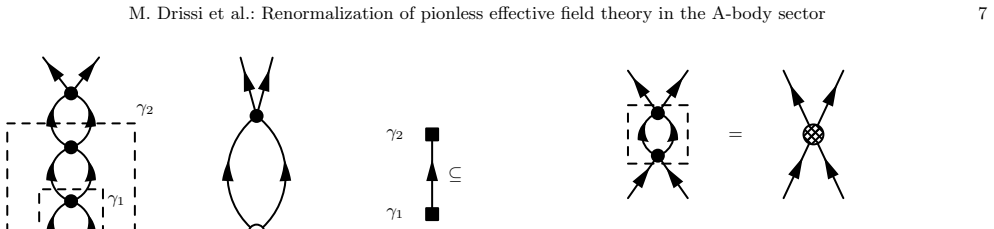
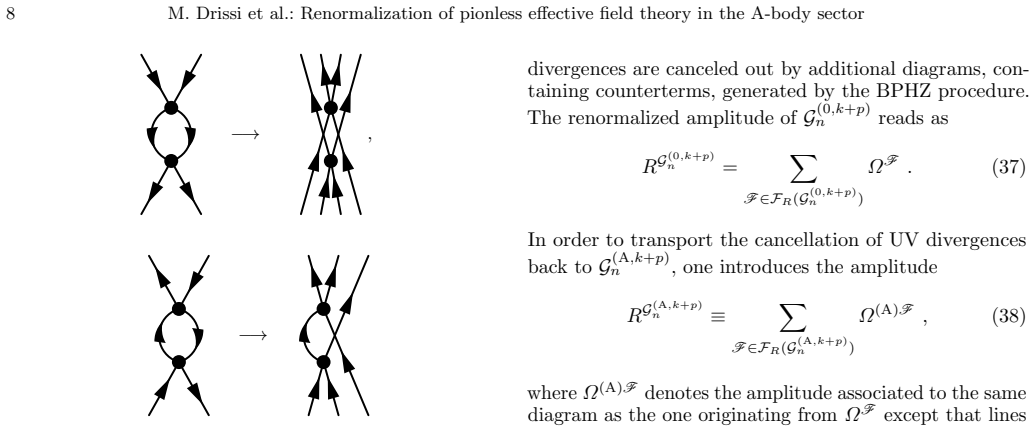
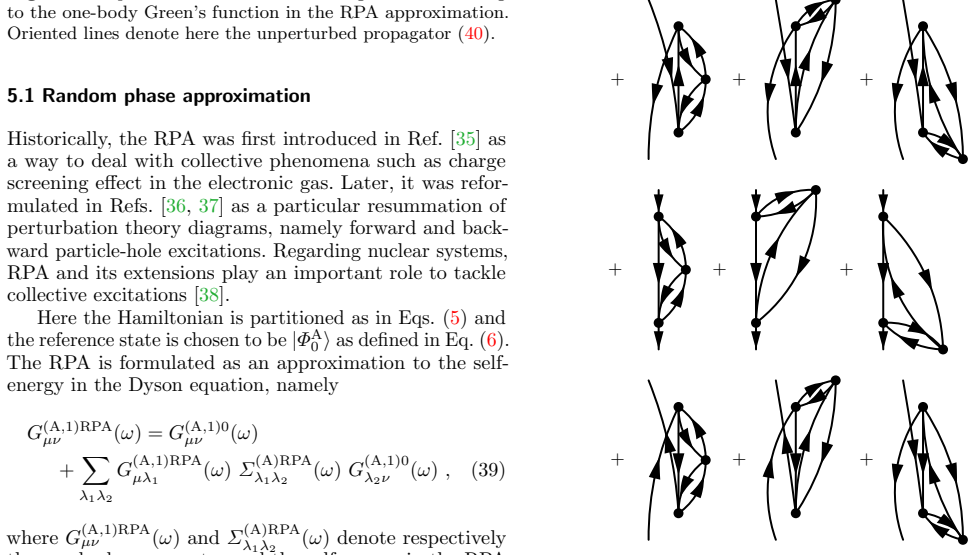
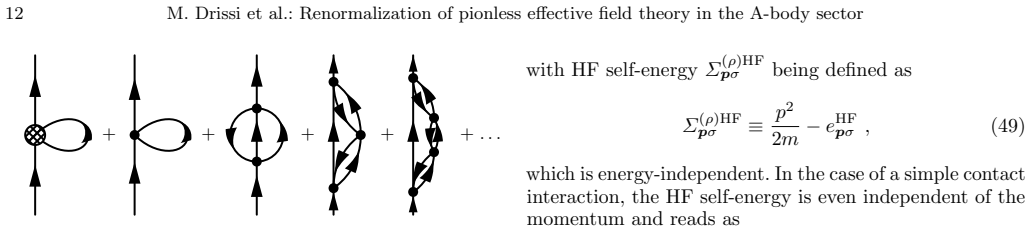
The central claim is that the ultraviolet behavior of any approximated in-medium k-body Green's function is identical to that of an in-vacuum (k+p)-body Green's function built from the same vertices, where p counts the internal hole lines. The mechanism is a cutting step: each internal hole line is cut into an external particle line, and each particle propagator is then replaced by a vacuum propagator. Because the particle propagator and the vacuum propagator have the same asymptotic coefficients, Weinberg's asymptotic theorem transfers convergence and divergence properties between the two diagrams; BPHZ in the vacuum theory supplies counterterms that, after closing cut lines back into hole lines, render the in-medium diagrams finite for every A≥k. In the RPA example, the only divergent diagram is the one-loop, two-vertex in-vacuum two-body diagram, and the counterterm $\delta C_0^{\mathrm{RPA}}(\Lambda)=\frac{4\pi}{m}\frac{2}{\pi}\left(\int_0^\infty dq\, v_\Lambda^2(2q)\right)a_0^2$, fixed by the scattering length $a_0$, regularizes the in-medium one-body Green's function for any A.
Load-bearing premise
The argument depends on the claim that all ultraviolet divergences of an in-medium diagram can be reduced to those of its particle-only diagram, which rests on hole states occupying a compact region of momentum space and on particle and vacuum propagators having identical asymptotic scaling; if either fails, counterterms would generally depend on A.
Editorial extensions
If this is right
- Low-energy constants for a chosen many-body approximation can be fixed by matching in-vacuum (k+p)-body Green's functions to observables, rather than by repeating matching in every A-body system.
- Any truncation whose vacuum diagrams need only the two-body counterterm $\delta C_0$ will, under the procedure, need only $\delta C_0$ in every A-body sector with $A \ge k$.
- For RPA at leading order in pure neutron matter, a single zero-derivative two-body contact counterterm determined by the scattering length renders the in-medium propagator ultraviolet finite at any density and any particle number.
- The degeneracy factor of the fermions controls which counterterms are needed, because Pauli blocking can forbid divergent topologies; the counterterm content is therefore not purely a property of the diagrams' topology.
Reading between the lines
- Beyond the paper, the same construction should extend to Hartree-Fock or momentum-dependent single-particle partitionings as long as the asymptotic coefficients of the particle propagator match the vacuum propagator; the paper sketches the Hartree-Fock case but leaves energy-dependent self-energies open.
- A numerical test of A-independence would be to compute RPA neutron-matter observables for several A or Fermi momenta using the formula for $\delta C_0^{\mathrm{RPA}}$ and check that residual cutoff dependence vanishes as $\Lambda \to \infty$.
- If the compact-hole reduction fails, for example for finite-temperature Green's functions where hole states occupy a non-compact momentum distribution, the equality of asymptotic coefficients could break and counterterms would generically become A-dependent; the paper's conclusion does not automatically cover that regime.
Editorial analysis
A structured set of objections, weighed in public.
Referee Report
Summary. The manuscript proposes a renormalization procedure for pionless effective field theory when the theory is solved approximately through many-body perturbation theory around an A-body Slater-determinant reference state. The central claim is that, for any truncated set of in-medium diagrams defining an approximation to the k-body Green's function, the counterterms needed for ultraviolet finiteness can be transported from in-vacuum (k+p)-body Green's functions by a 'cutting' procedure in which internal hole lines are cut into external particle lines. The counterterms are then argued to be independent of the A-body sector. The procedure is illustrated on the random phase approximation, where the paper concludes that the only counterterm is a two-body contact term δC0^{RPA} fixed by the scattering length and applicable to any A.
Significance. If correct, the paper would address a real obstacle in applying EFT power counting to large-A many-body systems: it would justify reusing vacuum few-body counterterms in in-medium approximations without recomputing low-energy constants for each A. The choice of Weinberg's asymptotic theorem and BPHZ as tools is natural, and the paper is candid about the conjectural status of the sufficiency of two-body counterterms. The matching of C0^R to the in-vacuum scattering length is an external benchmark and is not circular. However, the central equivalence on which the whole construction rests is demonstrably false, and the worked RPA example exhibits exactly the failure. The paper therefore does not deliver the significance it claims.
major comments (4)
- [Sec. 4.1, Eq. (10), Fig. 3] The cutting procedure is the load-bearing step, and it is incorrect. Compactness of the hole-momentum support means that a loop containing a hole line has a bounded integration domain and is UV finite; it does not imply that the diagram's UV behaviour is the same as that of the diagram obtained by cutting the hole line into two external particle lines. Cutting removes the θ(k_F − |p_h|) constraint and can create a divergence that was never present in the original integral. The manuscript asserts that 'the UV behaviour of G(A,k)_n is the same as the UV behaviour of an associated diagram made only of particle propagators' without proving that no new loop is opened by the cut; in the RPA example below, a new particle loop is precisely what is opened.
- [Sec. 5.1, Table 1, Eqs. (44), (45b)] The RPA application confirms the problem rather than demonstrating the procedure. The n=2 in-medium self-energy diagram G(A,1)_2 is a particle-hole bubble: the hole momentum is restricted to |q|<k_F and the internal frequency integral has poles on opposite sides, so the amplitude is finite for any fixed Λ and converges to a finite value as Λ→∞. The cut partner G(0,2)_2 has D=1 according to Eq. (44) and is linearly divergent in vacuum. Eq. (45b) then instructs one to add a counterterm δC0^{RPA}(Λ) that grows with Λ to a diagram that is already finite. The resulting renormalized in-medium self-energy would be Λ-dependent, not Λ-independent. The statement that 'there is only one UV divergent diagram' in the RPA set is therefore false for the in-medium diagrams as written.
- [Sec. 4.2, Eq. (36)] The equality α_+(S)=α_0(S) for individual particle propagators is sound, but it is applied to the wrong object. After the cut, the integration domain of the loop is no longer constrained by the hole θ-function, so the asymptotic coefficients of the individual propagators do not describe the original in-medium integral. The application of Weinberg's asymptotic theorem in this step compares the cut diagram with a vacuum diagram, not the original in-medium diagram with anything. This is not a gap that additional detail could fill; the equivalence asserted in Sec. 4.1 is false.
- [Sec. 4.4 and Sec. 6] The paper's own caveats that the sufficiency of δC0 counterterms is a conjecture and that extensions to non-perturbative methods remain open are appropriate. However, they do not cure the central problem: the result that k-body counterterms are A-independent is derived from the cutting procedure, and since the cutting procedure fails on the simplest nontrivial example, the conclusion in Sec. 6 is unsupported. A substantially different identification of the in-medium subgraphs that actually require renormalization would be needed before the A-independence claim can be assessed.
minor comments (3)
- [Sec. 4.1] The notation p ≡ #I− is used before the set I− is clearly defined in Eq. (10); a few lines of explicit definition would help the reader.
- [Sec. 5.1, Table 1] The rows with n=3 and n=4 show two distinct diagrams with the same values of p and D; labeling the different topologies would avoid confusion.
- [Sec. 2.3.3, Eq. (13)] The regulator is introduced as vΛ(q)vΛ(q′) with q and q′ the incoming and outgoing relative momenta, but Eq. (45b) uses vΛ^2(2q) without discussing the relation between these arguments; this should be clarified.
Circularity Check
No significant circularity: the RPA counterterm is fixed by external two-body data and the A-independence claim rests on an asymptotic-equivalence argument, not on a fit to the predicted observable.
full rationale
The derivation is self-contained with respect to its central claim. The LEC C0^R and the RPA counterterm δC0^{RPA}(Λ) are fixed by matching the one-loop in-vacuum two-body Green's function to the scattering length a0 (Eqs. 45a-45b), an external low-energy datum; no in-medium RPA observable enters that matching, so the in-medium self-energy is an output, not an input. The A-independence of the counterterms is not a renamed fit: it follows from the cutting procedure plus the equality α+(S)=α0(S) (Eq. 36), which identifies the UV content of particle-propagator diagrams with the corresponding vacuum diagrams, while the BPHZ forest formula (Eq. 35) supplies the counterterms from an external theorem. The self-citation invoked as a supporting theorem is Ref. [33], the first author's thesis, used to state that the Sect. 3 theorems can be used with an in-medium reference state; this is background support and does not carry the central transposition, which applies BPHZ to the vacuum diagram and transports the resulting counterterm vertices. The paper itself flags unproven parts, e.g. the sufficiency of δC0 counterterms for all n and k in pure neutron systems (Sec. 4.4), which are honest limitations rather than circular reductions. The skeptic's objection that the RPA particle-hole bubble is finite is a correctness challenge to the cutting procedure, not an exhibited circularity of the type Eq. X = Eq. Y or fit-renamed-as-prediction, and therefore does not raise the circularity score.
Assumptions & free parameters
free parameters (2)
- C0^R (renormalized low-energy constant) =
4π/(m a0)
- Regulator vΛ(q) and cutoff Λ
assumptions (6)
- standard math Weinberg's asymptotic theorem
- standard math BPHZ theorem and forest formula
- domain assumption Kinetic-energy partitioning of the Hamiltonian
- domain assumption Compactness of hole-state momenta
- domain assumption Asymptotic coefficient equality α_+(S) = α_0(S)
- ad hoc to paper Sufficiency of δC0 counterterms at all orders
Cite this review
Pith. "Pith review of Renormalization of pionless effective field theory in the A-body sector." pith.science (2026). https://pith.science/paper/TJWNI3JM
@misc{pith2026190807578,
  author       = {Pith},
  title        = {Pith review of: Renormalization of pionless effective field theory in the A-body sector},
  year         = {2026},
  howpublished = {\url{https://pith.science/paper/TJWNI3JM}},
  note         = {Machine review of arXiv:1908.07578}
}
read the original abstract
Current models of inter-nucleon interactions are built within the frame of Effective Field Theories (EFTs). Contrary to traditional nuclear potentials, EFT interactions require a renormalization of their parameters in order to derive meaningful estimations of observable. In this paper, a renormalization procedure is designed in connection with many-body approximations applicable to large-A systems and formulated within the frame of many-body perturbation theory. The procedure is shown to generate counterterms that are independent of the targeted A-body sector. As an example, the procedure is applied to the random phase approximation. This work constitutes one step towards the design of a practical EFT for many-body systems.
Figures

Figures from the paper (3 more)

Reference graph
Works this paper leans on
-
[1]
Som` a, The European Physical Journal Plus133, 434 (2018)
V. Som` a, The European Physical Journal Plus133, 434 (2018)
work page 2018
-
[2]
Weinberg, Physics Letters B 251, 288 (1990)
S. Weinberg, Physics Letters B 251, 288 (1990)
1990
-
[3]
Weinberg, Nuclear Physics, Section B 363, 3 (1991)
S. Weinberg, Nuclear Physics, Section B 363, 3 (1991)
work page 1991
-
[4]
Rho, Physical Review Letters 66, 1275 (1991)
M. Rho, Physical Review Letters 66, 1275 (1991)
work page 1991
-
[5]
U. van Kolck, Les Houches Lectures on Effective Field Theories for Nuclear and (some) Atomic Physics (2019)
work page 2019
-
[6]
H. W. Hammer, S. K¨ onig, and U. van Kolck, (2019), arXiv:1906.12122 [nucl-th]
arXiv 2019
- [7]
-
[8]
Weinberg, Physical Review 118, 838 (1960)
S. Weinberg, Physical Review 118, 838 (1960)
work page 1960
Show all 48 references
-
[9]
N. N. Bogoliubov and O. S. Parasiuk, Acta Mathemat- ica 97, 227 (1957)
1957
-
[10]
Hepp, Communications in Mathematical Physics 2, 301 (1966)
K. Hepp, Communications in Mathematical Physics 2, 301 (1966)
1966
-
[11]
Hahn and W
Y. Hahn and W. Zimmermann, Communications in Mathematical Physics 10, 330 (1968)
1968
-
[12]
Zimmermann, Communications in Mathematical Physics 11, 1 (1968)
W. Zimmermann, Communications in Mathematical Physics 11, 1 (1968)
1968
-
[13]
Zimmermann, Communications in Mathematical Physics 15, 208 (1969)
W. Zimmermann, Communications in Mathematical Physics 15, 208 (1969)
1969
-
[14]
J. H. Lowenstein and W. Zimmermann, Communica- tions in Mathematical Physics 44, 73 (1975)
1975
-
[15]
Weinberg, Physica A: Statistical Mechanics and its Applications 96, 327 (1979)
S. Weinberg, Physica A: Statistical Mechanics and its Applications 96, 327 (1979)
1979
-
[16]
Ord´ o˜ nez and U
C. Ord´ o˜ nez and U. van Kolck, Physics Letters B291, 459 (1992)
1992
-
[17]
D. B. Kaplan, M. J. Savage, and M. B. Wise, Nuclear Physics B 478, 629 (1996)
1996
-
[18]
P. F. Bedaque and U. van Kolck, Annual Review of Nuclear and Particle Science 52, 339 (2002)
2002
-
[19]
P. F. Bedaque, H. W. Hammer, and U. van Kolck, Nuclear Physics A 676, 357 (2000). 14 M. Drissi et al.: Renormalization of pionless effective field theory in the A-body sector
2000
-
[20]
Platter, H.-W
L. Platter, H.-W. Hammer, and U.-G. Meißner, Phys- ical Review A 70, 052101 (2004)
2004
-
[21]
W. H. Dickhoff and C. Barbieri, Prog. Part. Nucl. Phys. 52, 377 (2004)
2004
-
[22]
Carbone, A
A. Carbone, A. Cipollone, C. Barbieri, A. Rios, and A. Polls, Phys. Rev. C 88, 054326 (2013)
2013
-
[23]
Som` a, A
V. Som` a, A. Cipollone, C. Barbieri, P. Navr´ atil, and T. Duguet, Phys. Rev. C 89, 061301(R) (2014)
2014
-
[24]
Hagen, T
G. Hagen, T. Papenbrock, M. Hjorth-Jensen, and D. J. Dean, Reports on Progress in Physics 77, 096302 (2014)
2014
-
[25]
Binder, J
S. Binder, J. Langhammer, A. Calci, and R. Roth, Physics Letters B 736, 119 (2014)
2014
-
[26]
Tsukiyama, S
K. Tsukiyama, S. K. Bogner, and A. Schwenk, Physical Review Letters 106, 222502 (2011)
2011
-
[27]
Hergert, S
H. Hergert, S. K. Bogner, T. D. Morris, A. Schwenk, and K. Tsukiyama, Phys. Rep. 621, 165 (2016)
2016
-
[28]
Goldstone, Proceedings of the Royal Society A: Mathematical, Physical and Engineering Sciences 239, 267 (1957)
J. Goldstone, Proceedings of the Royal Society A: Mathematical, Physical and Engineering Sciences 239, 267 (1957)
1957
-
[29]
Tichai, J
A. Tichai, J. Langhammer, S. Binder, and R. Roth, Physics Letters B 756, 283 (2016)
2016
-
[30]
Tichai, P
A. Tichai, P. Arthuis, T. Duguet, H. Hergert, V. Som` a, and R. Roth, Phys. Lett. B 786, 195 (2018)
2018
-
[31]
Gell-Mann and F
M. Gell-Mann and F. Low, Physical Review 84, 350 (1951)
1951
-
[32]
J. C. Collins, Renormalization : an introduction to renormalization, the renormalization group, and the operator-product expansion (Cambridge University Press, 1984) p. 380
1984
-
[33]
Drissi, Renormalization invariance of many- body observables within pionless effective field theory , Ph.D
M. Drissi, Renormalization invariance of many- body observables within pionless effective field theory , Ph.D. thesis, Universit´ e Paris-Saclay (2018),<NNT : 2018SACLS414>
2018
-
[34]
Wellenhofer, C
C. Wellenhofer, C. Drischler, and A. Schwenk, (2018), arXiv:1812.08444 [nucl-th]
2018 arXiv
-
[35]
Bohm and D
D. Bohm and D. Pines, Physical Review 92, 609 (1953)
1953
-
[36]
Gell-Mann and K
M. Gell-Mann and K. A. Brueckner, Physical Review 106, 364 (1957)
1957
-
[37]
Hubbard, Proceedings of the Royal Society A: Math- ematical, Physical and Engineering Sciences 240, 539 (1957)
J. Hubbard, Proceedings of the Royal Society A: Math- ematical, Physical and Engineering Sciences 240, 539 (1957)
1957
-
[38]
Czerski, W
P. Czerski, W. H. Dickhoff, A. Faessler, and H. M¨ uther, Physical Review C 33, 1753 (1986)
1986
-
[39]
Le Bellac, Thermal Field Theory (Cambridge Uni- versity Press, 1996) p
M. Le Bellac, Thermal Field Theory (Cambridge Uni- versity Press, 1996) p. 272
1996
-
[40]
van Hees and J
H. van Hees and J. Knoll, Physical Review D - Particles, Fields, Gravitation and Cosmology 65, 025010 (2002)
2002
-
[41]
J. P. Blaizot, E. Iancu, and U. Reinosa, Nuclear Physics A 736, 149 (2004)
2004
-
[42]
Berges, S
J. Berges, S. Bors´ anyi, U. Reinosa, and J. Serreau, Annals of Physics (2005), 10.1016/j.aop.2005.06.001
2005 doi
-
[43]
Duguet and A
T. Duguet and A. Signoracci, Journal of Physics G: Nuclear and Particle Physics 44, 015103 (2016)
2016
-
[44]
Arthuis, T
P. Arthuis, T. Duguet, A. Tichai, R. D. Lasseri, and J. P. Ebran, Comput. Phys. Commun. 240, 202 (2019)
2019
-
[45]
Signoracci, T
A. Signoracci, T. Duguet, G. Hagen, and G. R. Jansen, Physical Review C 91, 064320 (2015)
2015
-
[46]
Som` a, T
V. Som` a, T. Duguet, and C. Barbieri, Physical Review C 84, 064317 (2011)
2011
-
[47]
Gorkov and T
L. Gorkov and T. Melik-Barkhudarov, Sov. Phys. JETP 13, 1018 (1961)
1961
-
[48]
Papenbrock and G
T. Papenbrock and G. F. Bertsch, Physical Review C 59, 2052 (1999)
1999
Reviewed August 14, 2026 · model on record in the stance chip above.
Discussion (0). Continue with ORCID to comment.