REVIEW 4 major objections 5 minor 40 references
Magic high-order harmonics from a quasi-one-dimensional hexagonal solid
T0 review · 4 major / 5 minor · reviewed 2026-08-14 · deepseek-v4-flash
Pith's one-line read Circularly polarized light in hexagonal BaTiS3 should produce only the 1st, 5th, 7th, and 11th harmonics, leaving the 3rd and 9th orders absent.
desk verdict The magic-harmonic prediction for BaTiS3 is probably correct, but the paper's subgroup mechanism is invalid and the 'new' effect is a known C6 selection rule. read the letter →
The pith
A machine-rendered reading of the paper's core claim, the machinery that carries it, and where it could break.
The reading
What carries the argument
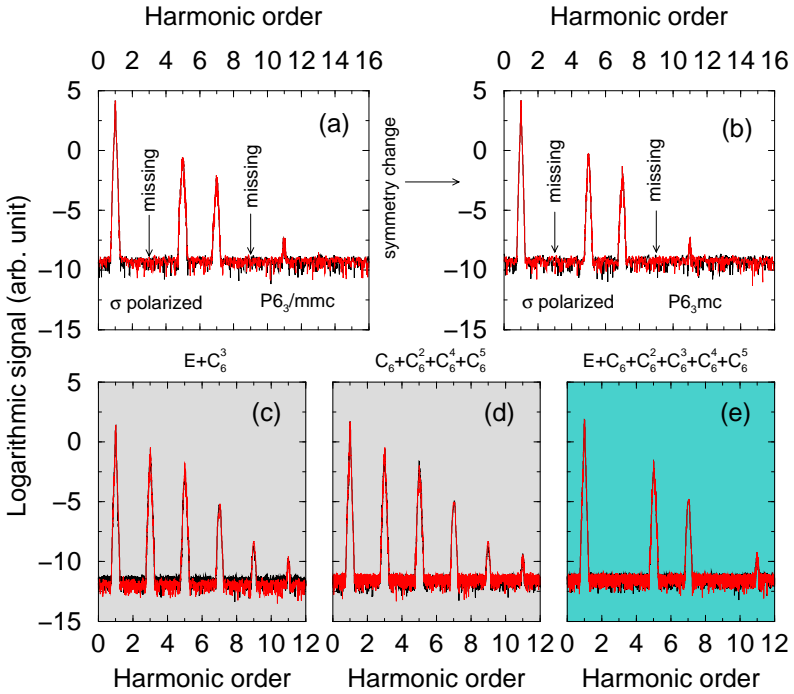
The central machinery is the symmetry-resolved decomposition of the harmonic signal, $P_k(t) = \sum_{s=1}^{6} P_k^s(t) + \sum_{q=1}^{6} P_k^q(t)$, splitting the current at each crystal momentum into six proper rotations and six improper rotations of the hexagonal point group. Within this decomposition, subgroup A = {E, $C6^{3}$} accounts for the disappearance of even harmonics, while subgroup B = {C6, $C6^{2}$, $C6^{4}$, $C6^{5}$} accounts for the operations that exchange sulfur atoms while leaving titanium chains intact. The paper claims the destructive interference between the spectra generated by these two subgroups cancels the third and ninth harmonics, while the remaining orders survive. The same two-subgroup logic is applied to the six improper rotations. This decomposition is what lets the calculation move from a full k-point simulation to a single k point and still reproduce the full magic spectrum.
What would settle it
A circularly polarized HHG measurement on hexagonal BaTiS3 with 1.6 eV pulses should show peaks only at orders 1, 5, 7, and 11; a visible 3rd or 9th harmonic would refute the prediction, as would a recomputed symmetry-resolved simulation that restores those orders when the four-rotation set is not treated as a subgroup.
Extended reading notes
Core claim
The paper's central claim is that circularly polarized excitation of hexagonal BaTiS3 yields only first, fifth, seventh, and eleventh harmonics; third and ninth are missing regardless of laser duration or photon energy. This happens for both centrosymmetric space group P63/mmc and non-centrosymmetric space group P63mc structures, so the effect is tied to the common hexagonal symmetry rather than to inversion. The paper explains the missing orders by a symmetry-resolved decomposition of the time-dependent current: separating the signal into contributions from six proper rotations and six improper rotations, two subgroups—one containing the identity and 180-degree rotation, the other containing the four 60-degree rotations—interfere destructively and exactly cancel the third and ninth harmonics. Since neither cubic nor tetragonal crystals possess this hexagonal subgroup structure, the appearance of these magic harmonics would identify the phase as hexagonal. The paper further argues this could turn high-order harmonic generation into a practical probe of hexagonal-to-cubic or hexagonal-to-orthorhombic phase transitions.
Load-bearing premise
The explanation assumes that four of the six rotations of the hexagonal symmetry operations act together as a subgroup whose interference with the other two erases the 3rd and 9th harmonics; those four rotations do not form a subgroup, since they lack the identity operation and are not closed under multiplication.
Editorial extensions
If this is right
- If the prediction is correct, circularly polarized high-order harmonic generation from any hexagonal crystal should show a characteristic gap at harmonic orders 3 and 9, while linearly polarized generation should not.
- The same experiment on cubic or tetragonal crystals should not show this gap, making the missing orders a direct symmetry test.
- The effect is robust to inversion symmetry, so it can probe a hexagonal phase even in centrosymmetric samples where even-order harmonics are absent.
- Observing the presence or absence of the 3rd and 9th harmonics across a temperature-driven phase transition could map hexagonal-to-noncubic transformations without structural diffraction.
- The predicted difference between P63/mmc and P63mc—even-order harmonics along the c axis only for the non-centrosymmetric structure—gives a second, independent symmetry test.
Reading between the lines
- The paper's subgroup explanation is not mathematically closed as written: the set {C6, C6^2, C6^4, C6^5} contains no identity and is not closed under multiplication, so it is not a subgroup; a repair would need to derive the same cancellation from the full sixfold point-group selection rules.
- A natural extension is to test whether the same 1-5-7-11 pattern appears for any hexagonal crystal with a small gap and strong chain anisotropy, not just BaTiS3; BaVS3, with its known hexagonal-to-orthorhombic transition, is an explicit candidate the paper names.
- One can also ask whether the magic orders reflect a selection rule tied to the rotational symmetry of circular polarization itself; if so, varying the ellipticity should continuously restore the 3rd and 9th harmonics, an experimentally measurable prediction.
- Because the missing orders are an all-or-nothing pattern, a noisy or angle-averaged measurement may still reveal the gap; this robustness, if confirmed, would make the probe easier to implement than resolving absolute harmonic amplitudes.
Signed reviews
Editorial analysis
A structured set of objections, weighed in public.
Referee Report
Summary. The paper reports first-principles time-dependent density functional theory calculations of high-order harmonic generation (HHG) in hexagonal BaTiS3. For circularly polarized laser excitation in the ab plane, the computed harmonic spectra show only the 1st, 5th, 7th, and 11th orders, with the 3rd and 9th orders missing; the authors call these 'magic harmonics.' They attribute the effect to destructive interference between two allegedly distinct symmetry subgroups of the hexagonal point group, labeled A and B, and they further claim that neither cubic nor tetragonal systems show this behavior, proposing HHG as a crystal-structure characterization tool for hexagonal-to-nonhexagonal phase transitions. The manuscript also reports structural optimization and electronic structure results for BaTiS3, comparing the P6_3/mmc and P6_3mc space groups.
Significance. If the central spectral prediction is correct, the paper provides a concrete material realization of symmetry-controlled harmonic selection in a quasi-one-dimensional hexagonal solid, which could be useful for future experiments and for phase-transition diagnostics. The computed spectra in Fig. 4 are consistent with the standard rotational selection rule for circularly polarized excitation, so the observation itself is plausible and does not rely on the defective subgroup argument. However, the paper's proposed mechanism is mathematically incorrect, and the claimed novelty is overstated because the selection rule q ≡ ±1 mod n for n-fold rotational symmetry is well established. The contribution should be reframed as a material-specific demonstration of a known symmetry constraint rather than a new symmetry principle. The strength of the paper lies in the explicit DFT simulation of a specific material; the authors are also to be credited for not fitting free parameters to experimental data, but the lack of convergence tests and parameter scans weakens the claimed universality.
major comments (4)
- [Sec. III.C, Eqs. (6)-(7), Fig. 4(c)-(e)] The set B = {C6, C6^2, C6^4, C6^5} is not a subgroup of the hexagonal point group: it contains no identity element and is not closed under multiplication (for example, C6·C6^2 = C6^3, which is not in B). Therefore the claimed 'destructive interference between two symmetry subgroups A and B' cannot be the mechanism that cancels the 3rd and 9th harmonics. The same objection applies to the assertion that the four remaining improper rotations form another subgroup. The correct explanation is the full-group selection rule for C6 rotational symmetry under circularly polarized light, which forbids harmonics with q ≡ ±3 mod 6 and yields exactly the observed orders 1, 5, 7, 11.
- [Sec. III.C, Eq. (5)] The decomposition of P_k(t) into contributions from each of the 12 symmetry operations at a single k point is not justified. For a general k point such as (0.05, 0.05, 0), the proper rotations map k to distinct points Rk in the Brillouin zone, so the symmetry action does not decompose the current at fixed k. The physically meaningful quantity is the Brillouin-zone sum in Eq. (3), and the selection rule applies after integration over the full zone. As written, Eq. (5) is an ad hoc ansatz, not a derived symmetry relation, and the single-k spectra in Fig. 4(c)-(e) do not provide a valid explanation of the full-spectrum result.
- [Abstract; Sec. III.C] The claims that these 'magic harmonics' are 'completely new' and 'never been reported before' are not supported by the manuscript. The selection rule for circularly polarized light in a medium with n-fold rotational symmetry, q ≡ ±1 mod n, is standard in the HHG literature and for n=6 gives exactly the observed orders 1, 5, 7, 11 while forbidding 3 and 9. The authors do not cite or discuss this rule, and the paper should be revised to present the result as a material-specific realization of a known symmetry constraint rather than a new phenomenon.
- [Sec. III.C and Fig. 4] The abstract claims that the magic harmonics are independent of laser pulse duration and photon energy, but only a single pulse (48 fs, 1.6 eV) is simulated and no parameter scans are shown. Likewise, the statement that neither cubic nor tetragonal systems exhibit magic harmonics is supported only by a reference to the authors' earlier tetragonal calculation; no cubic calculation or systematic comparison is presented. To substantiate the claimed generality, the manuscript should provide at least a representative scan over pulse parameters and intensity, and a convergence test with respect to the k mesh and energy-window truncation.
minor comments (5)
- [Throughout] The manuscript contains many typographical errors and OCR-like artifacts (e.g., 'cohere nt', 'polariza tion', 'Huster’s structure information'); a thorough proofreading pass is needed.
- [Fig. 3(b)] The labels 'z (original)' and 'z (subtracted)' are described in the caption, but the curves are not clearly distinguishable in the figure; please use distinct line styles or annotations.
- [Sec. III.C, Eq. (5)] The summation index q in Eq. (5) is also used for harmonic order in the text and figures; please use a different index (e.g., r) to avoid confusion.
- [Sec. III.C and Fig. 4(c)-(e)] The claim that the same conclusion holds for the six improper rotations is not supported by any shown data; a corresponding figure or explicit description of the improper-rotation decomposition would be helpful.
- [Sec. II] The statement that the hyper-Gaussian window function 'does not alter the amplitude of the harmonic signal' is presented without evidence; a comparison of spectra with and without the window would substantiate this claim.
Circularity Check
No significant circularity: first-principles HHG spectrum is computed directly; flawed subgroup mechanism is a correctness issue, not circular.
full rationale
The central numerical prediction (Fig. 4(a,b)) is obtained by solving the time-dependent Liouville equation (Eq. 2) and Fourier transforming the computed momentum expectation value (Eqs. 3-4); no harmonic-order selection rule is inserted as an input, and no parameter is fitted to the spectrum. The group-theoretic account in Sec. III.C is presented after the numerical result: the decomposition in Eq. (5) is a bookkeeping identity, and the claim that 'subgroup B' = {C6, C6^2, C6^4, C6^5} is mathematically unsupported because this set is not closed and lacks the identity, so the stated A-B interference mechanism is a correctness defect rather than a circular reduction. The only author-self reference used comparatively is [7] for tetragonal monolayers, which is an external published calculation and not an input fitted here; the 'unprecedented' novelty claim may be overbroad, but overclaiming novelty is not circularity. I therefore find no equation-level reduction of the prediction to its inputs: no step is equivalent to the target result by construction.
Assumptions & free parameters
free parameters (4)
- Laser pulse duration =
48 fs
- Photon energy =
1.6 eV
- Window function parameters a and b =
a = 0.035/fs, b = 5e-9
- Laser intensity / field amplitude =
not stated
assumptions (4)
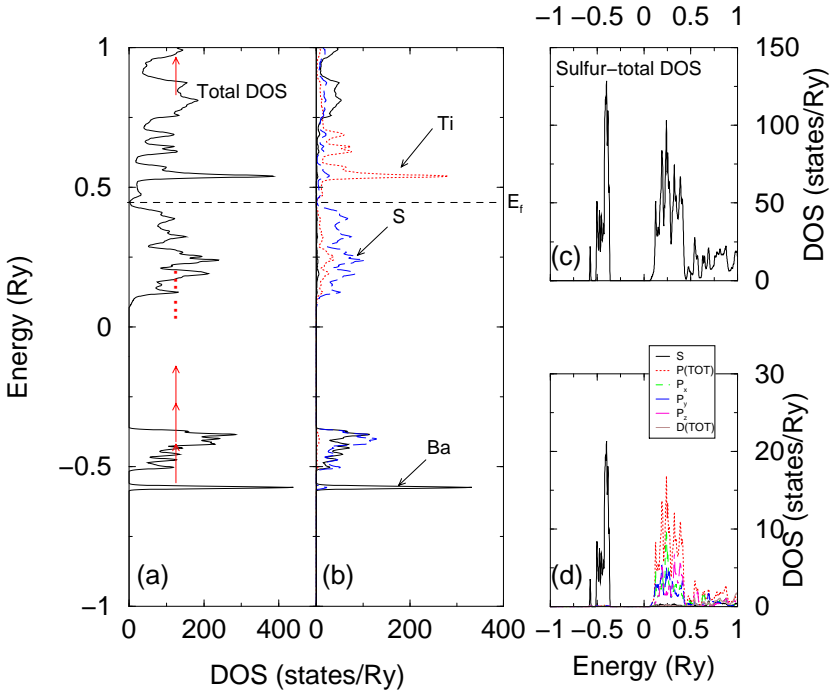
- domain assumption PBE-GGA density functional theory with spin-orbit coupling gives an accurate electronic structure for BaTiS3.
- domain assumption The semiclassical time-dependent Liouville equation with the momentum operator describes HHG in solids.
- ad hoc to paper At a single crystal momentum k, the time-dependent current can be decomposed into contributions from each of the 12 symmetry operations.
- ad hoc to paper The four rotations C6, C6^2, C6^4, C6^5 form a subgroup B of the hexagonal group.
Cite this review
Pith. "Pith review of Magic high-order harmonics from a quasi-one-dimensional hexagonal solid." pith.science (2026). https://pith.science/paper/WJKLJ5V6
@misc{pith2026190807580,
  author       = {Pith},
  title        = {Pith review of: Magic high-order harmonics from a quasi-one-dimensional hexagonal solid},
  year         = {2026},
  howpublished = {\url{https://pith.science/paper/WJKLJ5V6}},
  note         = {Machine review of arXiv:1908.07580}
}
read the original abstract
High-order harmonic generation (HHG) from atoms is a coherent light source that opens up attosecond physics, but it is the application of HHG to solids that brings much of excitement for the last decade. Here we report a completely new kind of harmonics in a quasi-one-dimensional and hexagonal barium titanium sulfide: Under circularly polarized laser excitation, harmonics are generated only at first, fifth, seventh and eleventh orders. These magic harmonics appear only with circularly polarized light, not with linearly polarized light. Neither cubic nor tetragonal cells have magic harmonics even with circularly polarized light. Through a careful group-theory analysis, we find that two subgroups of symmetry operations unique to the hexagonal symmetry cancel out third and ninth harmonics. This feature presents a rare opportunity to develop HHG into a crystal-structure characterization tool for phase transitions between hexagonal and nonhexagonal structures.
Figures


Figures from the paper (1 more)
Reference graph
Works this paper leans on
-
[1]
Gy. Farkas, Cs. T´ oth, S. D. Moustaizis, N. A. Papadogian nis, and C. Fotakis, Observation of multiple-harmonic radiation induced from a gold surface by picosecond neodymium-doped yttrium aluminum garnet laser pulses, Phys. Rev. A 46, R3605 (1992)
work page 1992
-
[2]
K. A. Pronin, A. Bandrauk, and A. A. Ovchinnikov, Harmoni c generation by a one-dimensional conductor: Exact results, Phys. Rev. B 50, 3473 (1994)
work page 1994
-
[3]
G. P. Zhang, Optical high harmonic generations in C 60, Phys. Rev. Lett. 95, 047401 (2005)
work page 2005
- [4]
-
[5]
R. A. Ganeev, High-Order Harmonic Generation in Laser Plasma Plumes , (Imperial College Press, London, 2013)
work page 2013
-
[6]
S. Ghimire, E. Sistrunk, P. Agostini, L. F. DiMauro, and D . A. Reis, Observation of high-order harmonic generation in a bulk crystal, Nat. Phys. 7, 138 (2011). 9 (August 22, 2019)
work page 2011
-
[7]
G. P. Zhang, M. S. Si, M. Murakami, Y. H. Bai, and T. F. Georg e, Generating high-order optical and spin harmonics from ferromagnetic monolayers, Nat. Commun. 9, 3031 (2018)
work page 2018
-
[8]
S. Y. Kruchinin, F. Krausz and V. S. Yakovlev, Colloquium : Strong-field phenomena in periodic systems, Rev. Mod. Phys. 90, 021002 (2018)
work page 2018
Show all 40 references
-
[9]
Beaurepaire, J
E. Beaurepaire, J. C. Merle, A. Daunois, and J.-Y. Bigot, Ultrafast spin dynamics in ferro- magnetic nickel, Phys. Rev. Lett. 76, 4250 (1996)
1996
-
[10]
Vampa, T
G. Vampa, T. J. Hammond, N. Thire, B. E. Schmidt, F. Legar e, C. R. McDonald, T. Brabec, D. D. Klug, and P. B. Corkum, All-optical reconstruction of c rystal band structure, Phys. Rev. Lett. 115, 193603 (2015)
2015
-
[11]
Niu et al
S. Niu et al. , Giant optical anisotropy in a quasi-one-dimensional crys tal, Nat. Photon. 12, 392 (2018)
2018
-
[12]
G. P. Agrawal, C. Cojan, and C. Flytzanis, Nonlinear opt ical properties of one-dimensional semiconductors and conjugated polymers, Phys. Rev. B 17, 776, (1978)
1978
-
[13]
G. P. Zhang, Frequency dependence of scaling exponents of hyperpolarizability in polyenes: A density-matrix renormalization-group approach, Phys. R ev. B 60, 11482 (1999)
1999
-
[14]
Hellwarth, Third-order optical susceptibilities o f liquids and solids, Prog
R. Hellwarth, Third-order optical susceptibilities o f liquids and solids, Prog. Quant. Electron. 5, 1 (1977)
1977
-
[15]
P. N. Butcher and D. Cotter, The Elements of Nonlinear Optics , Cambridge University Press, (1990)
1990
-
[16]
Shang and H
C. Shang and H. Hsu, The spatial symmetric forms of third -order nonlinear susceptibility, IEEE J. Quant. Electron. 23, 177 (1987)
1987
-
[17]
R. W. Boyd, Nonlinear Optics , Academic Press (1991)
1991
-
[18]
Our finding complements the prior studies using linearly polarized light [6, 29, 30] well
in varieties of materials [19–28]. Our finding complements the prior studies using linearly polarized light [6, 29, 30] well. The rest of the paper is arranged as follows. In Sec. II, we outline o ur theoretical formalism. Our main results are presented in Sec. III, where we pr...
2019
-
[19]
Y. A. Izyumov and V. N. Syromyatnikov, Phase Transitions and crystal Symmetry , Kluwer Academic Publishers, (1990)
1990
-
[20]
Iwata and J
A. Iwata and J. Akedo, Hexagonal to cubic crystal struct ure transformation during aerosol deposition of aluminum nitride, J. Cryst. Grow. 275, e1269 (2005)
2005
-
[21]
Menniger, U
J. Menniger, U. Jahn, O. Brandt, H. Yang, and K. Ploog, Id entification of optical transitions in cubic and hexagonal GaN by spatially resolved cathodolum inescence, Phys. Rev. B 53, 1881 (1996)
1996
-
[22]
H. J. Milledge, E. Nave, and F. H. Weller, Transformatio n of cubic boron nitride to a graphitic form of hexagonal boron nitride, Nature 184, 715 (1959). 10 (August 22, 2019)
1959
-
[23]
Olander and K
J. Olander and K. Larsson, Initial growth of hexagonal a nd cubic boron nitride: A theoretical study, Phys. Rev. B 68, 075411 (2003)
2003
-
[24]
M. Halo, C. Pisani, L. Maschio, S. Casassa, M. Sch¨ utz, a nd D. Usvyat, Electron correlation decides the stability of cubic versus hexagonal boron nitri de, Phys. Rev. B 83, 035117 (2011)
2011
-
[25]
Gomez-Castano, J
M. Gomez-Castano, J. L. Paua and A. Redondo-Cubero, Ide ntification of the cubic-to- hexagonal phase transition for the production of stable zin c oxynitride layers, CrystEngComm 20, 3666 (2018)
2018
-
[26]
S. Saha, R. G. S. Pala, and S. Sivakumar, Catalyzing cubi c-to-hexagonal phase transition in NaYF4 via ligand enhanced surface ordering, Cryst. Growth Des. 18, 5080 (2018)
2018
-
[27]
Concas, J
G. Concas, J. K. Dewhurst, A. Sanna, S. Sharma, and S. Mas sidda, Anisotropic exchange interaction between nonmagnetic europium cations in Eu 2O3, Phys. Rev. B 84, 014427 (2011)
2011
-
[28]
Arizpechavez, F
H. Arizpechavez, F. J. Espinoza-Beltran, R. Ramirez-B on, O. Zelaya-Angel, and J. Gonzlez- Hernandez, Cubic to hexagonal phase transition in CdTe poly crystalline thin films by oxygen incorporation, Solid State Commun. 101, 39 (1997)
1997
-
[29]
Castedo, J
A. Castedo, J. Sanchez, J. Fullea, M. C. Andrade, and P. L . de Andres, Ab initio study of the cubic-to-hexagonal phase transition promoted by intersti tial hydrogen in iron, Phys. Rev. B 84, 094101 (2011)
2011
-
[30]
Y. S. You, D. A. Reis and S. Ghimire, Anisotropic high-ha rmonic generation in bulk crystals, Nature Phys. 13, 345 (2017)
2017
-
[31]
Lakhotia, M
H. Lakhotia, M. Zhan, H.-Y. Kim, and E. Goulielmakis, A r eal space perspective of high harmonic generation in crystalline solids, CLEO, FF2P.5, ( 2018)
2018
-
[32]
Huster, Die Kristallstruktur von BaTiS3, Z
J. Huster, Die Kristallstruktur von BaTiS3, Z. Naturfo rsch. 35b, 775 (1980)
1980
-
[33]
Blaha, K
P. Blaha, K. Schwarz, G. K. H. Madsen, D. Kvasnicka, and J . Luitz, WIEN2k, An Augmented Plane Wave + Local Orbitals Program for Calculating Crystal Properties (Karlheinz Schwarz, Techn. Universit¨ at Wien, Austria, 2001)
2001
-
[34]
G. P. Zhang, W. H¨ ubner, G. Lefkidis, Y. Bai, and T. F. Geo rge, Paradigm of the time-resolved magneto-optical Kerr effect for femtosecond magnetism, Nat. Phys. 5, 499 (2009)
2009
-
[35]
G. P. Zhang, Y. H. Bai, and T. F. George, Energy- and cryst al momentum-resolved study of laser-induced femtosecond magnetism, Phys. Rev. B 80, 214415 (2009)
2009
-
[36]
J. P. Perdew, K. Burke, and M. Ernzerhof, Generalized gr adient approximation made simple, Phys. Rev. Lett. 77, 3865 (1996). 11 (August 22, 2019) TABLE I. Wyckoff positions of BaTiS 3 determined by Huster [31]. His structure is of BaNiO3- type and has symmetry group No. 194, P6...
1996
-
[37]
G. P. Zhang and T. F. George, Ellipticity dependence of o ptical harmonic generation in C 60, Phys. Rev. A 74, 023811 (2006)
2006
-
[38]
Theo Hahn, International Tables for Crystallography (Dordrecht: Kluwer Academic Publish- ers, 2002)
2002
-
[39]
Lax, Symmetry Principles in Solid State and Molecula r Physics, J
M. Lax, Symmetry Principles in Solid State and Molecula r Physics, J. Wiley and Sons, Inc., New York (1974)
1974
-
[40]
cleaner” spectrum labeled with “z ( subtracted)
S. Fagot, P. Foury-Leylekian, S. Ravy, J. P. Pouget, M. A nne, G. Popov, M. V. Lobanov, and M. Greenblatt, Structural aspects of the metal-insulat or transition in BaVS 3, Solid State Science 7, 718 (2005). 12 (August 22, 2019) FIG. 1. High harmonic generation in BaTiS 3. (a) ...
2005
Reviewed August 14, 2026 · model on record in the stance chip above.
Discussion (0). Continue with ORCID to comment.