REVIEW 2 major objections 4 minor 138 references
The W and Z scattering as a probe of physics beyond the Standard Model: Effective Field Theory approach
T0 review · 2 major / 4 minor · reviewed 2026-08-14 · deepseek-v4-flash
Pith's one-line read This thesis claims that same-sign WW scattering at the HL-LHC and HE-LHC can discover new physics described by single dimension-8 EFT operators, provided the EFT is used only up to the energy scale where perturbative unitarity breaks down.
desk verdict A careful, self-contained doctoral thesis built from the author's own prior papers, whose central non-empty discovery-region claim rests on an on-shell unitarity cutoff that is plausible but never quantitatively validated for off-shell W's. read the letter →
The pith
A machine-rendered reading of the paper's core claim, the machinery that carries it, and where it could break.
The reading
What carries the argument
The central object is the EFT 'model': the Standard Model Lagrangian plus one genuine quartic-gauge-coupling operator (dimension-8 in SMEFT, primary dimension dp=8 in HEFT), with a Wilson coefficient f_i. The argument runs through the on-shell elastic W+W+ -> W+W+ helicity amplitudes and their partial-wave projections: tree-level amplitudes that grow with energy violate perturbative unitarity at a scale $\sqrt$(sU), and this scale sets the upper end of the EFT's validity, $Lambda^{2}$ <= sU. The polarization completeness identity (Eq. 7.7) connects these on-shell amplitudes to the off-shell process pp -> 2j + l nu_l l' nu'_l, justifying the transfer of qualitative and quantitative conclusions. For each operator, the paper derives analytic leading-energy forms of helicity amplitudes and partial waves, identifies which helicity configuration violates unitarity first, and uses that to define $\sqrt$(sU), then computes expected significances at HL-LHC and HE-LHC with the EFT truncated at that scale.
What would settle it
Compute the full off-shell matrix elements for pp -> 2j + l nu_l l' nu'_l keeping the auxiliary polarization state in Eq. (7.7) and check whether the on-shell approximation reproduces the high-MWW region; if off-shell contributions are not suppressed by the propagators, the sqrt(sU) cutoff is wrong. Alternatively, measure the WW invariant mass distribution at the HL-LHC: if a 5-sigma excess attributed to a single dimension-8 operator appears only for MWW above the sqrt(sU) of the best-fit Wilson coefficient, the EFT is being used beyond its claimed validity and the non-empty discovery-region conclusion fails.
Extended reading notes
Core claim
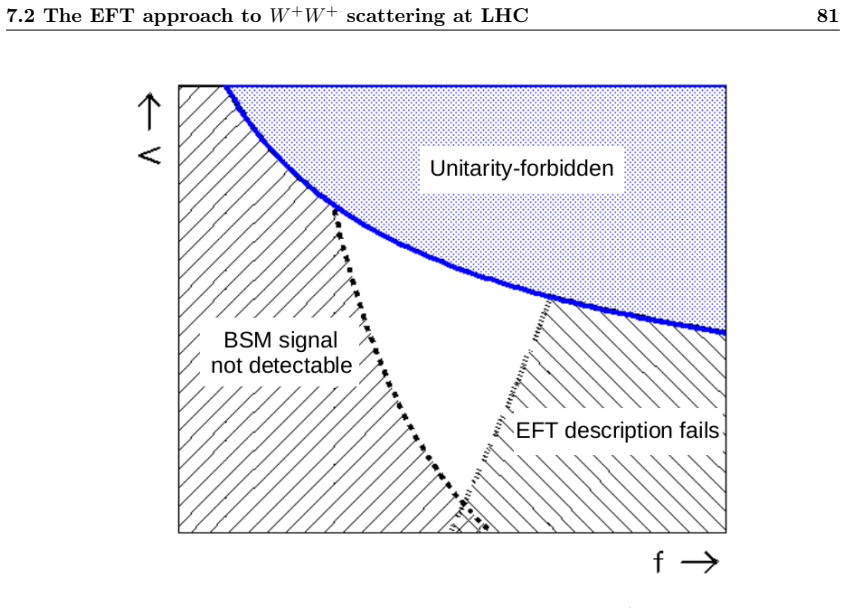
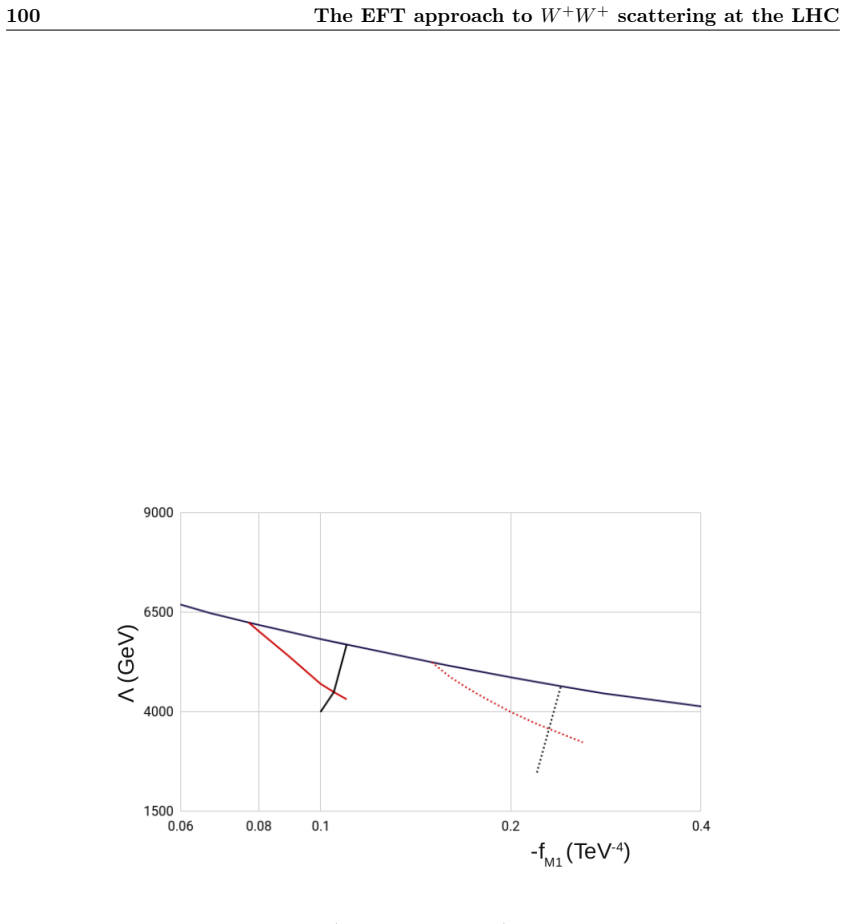
Using the EFT only in its region of validity, the expected significance of the dimension-8 (or dp=8) genuine quartic-gauge-coupling effects in same-sign WW scattering can exceed 5 sigma at the HL-LHC or HE-LHC for every single-operator EFT model considered, regardless of whether the SMEFT or HEFT basis is chosen. The region of validity is defined by the perturbative partial-wave unitarity bound sqrt(sU), computed from on-shell W+W+ and W+W- scattering amplitudes, including the stronger of the same- and opposite-sign limits and, in most cases, a helicity-space diagonalization of partial waves. The off-shell LHC process is related to the on-shell amplitudes through the polarization completeness identity, so that far off-shell contributions are suppressed and the qualitative behavior is governed by on-shell helicity amplitudes. The thesis presents the resulting discovery regions in the Wilson-coefficient space, compares SMEFT and HEFT signatures, and shows that raising the pp collision energy from 14 TeV (HL-LHC) to 27 TeV (HE-LHC) enlarges the discovery regions.
Load-bearing premise
The whole discovery-region calculation assumes that the on-shell W+W+ scattering amplitudes, cut off at the energy where tree-level perturbative unitarity fails, faithfully describe the full off-shell LHC process pp -> 2j + l nu_l l' nu'_l; if far off-shell W's contribute significantly, or if loop effects extend the EFT's range, the discovery regions are miscalibrated.
Editorial extensions
If this is right
- For each of the single-operator SMEFT and HEFT models studied, there is at least one Wilson-coefficient value for which the expected significance at the HL-LHC is above 5 sigma even though the EFT is used only up to its unitarity bound.
- The correct validity scale for WW-scattering EFT analyses is the stronger unitarity limit from both same-sign and opposite-sign WW scattering, not the same-sign process alone; for M-type operators the opposite-sign channel provides the limiting bound.
- Raising the pp collision energy from 14 TeV (HL-LHC) to 27 TeV (HE-LHC) moves and generally enlarges the discovery regions in the Wilson-coefficient space.
- SMEFT and HEFT give different experimental signatures in same-sign WW scattering; in particular, the HEFT operators T42 and T44 enhance the --00 and -+00 polarization fractions, which is not seen for the SMEFT dimension-8 operators.
- The proposed method for defining discovery regions is in principle not limited to the single-operator truncation and can be applied to models with several operators of arbitrary dimension, although the thesis works out the single-operator case.
Reading between the lines
- If the off-shell-to-on-shell mapping holds, the same discovery-region method transfers to other VBS channels such as WZ and ZZ scattering, and to future lepton colliders, because the polarization completeness identity is process-independent, though the amplitude set must be re-derived.
- A measurement of final-state W polarizations in same-sign WW events could discriminate not only SMEFT from HEFT but also the S, M, and T operator classes within each basis, since the thesis shows distinct saturating helicity configurations for each class.
- The single-operator truncation becomes more defensible if positivity bounds hold, because they imply dimension-8 gQGC coefficients can dominate dimension-6 ones; the thesis cites these bounds as motivation but does not rely on them for the main claim.
- A null result at the HL-LHC at 5 sigma would exclude the studied single-operator models only within their unitarity-limited parameter space, leaving open the possibility of effects at larger Wilson coefficients where the EFT description is no longer valid.
Editorial analysis
A structured set of objections, weighed in public.
Referee Report
Summary. This doctoral thesis develops an EFT analysis of same-sign W pair production in pp→2j+W*W*→2j+lνl'ν' at HL-LHC and HE-LHC, using both SMEFT and HEFT bases. It defines EFT 'models' as the SM plus one dimension-8 (SMEFT) or dp=8 (HEFT) genuine quartic gauge coupling operator. In Ch. 4 it derives perturbative partial-wave unitarity bounds, and in Ch. 7.1 it computes on-shell W+W+→W+W+ and W+W−→W+W− amplitudes to define for each model a validity scale √sU(f_i) from the diagonalized |Re T|≤1/2 bound. The discovery-region analysis of Sec. 7.2 then restricts the full off-shell process to m_WW<√sU and finds, for every operator studied, values of the Wilson coefficient for which the expected significance exceeds 5σ. The thesis also compares SMEFT versus HEFT polarization signatures, identifying e.g. the T42/T44 enhancement of −−00 and −+00 fractions as a distinct non-linear feature, and studies the gain from HE-LHC.
Significance. The paper has real strengths: the helicity-amplitude calculations are detailed and cross-checked against VBFNLO, FeynRules, and FeynCalc; the unitarity analysis includes both same- and opposite-sign WW scattering and uses helicity-space diagonalization; and the main output is a set of falsifiable predictions (non-empty discovery regions) rather than only exclusion limits. If the validity-cutoff prescription survives scrutiny, the non-emptiness result is an important, non-obvious statement: it indicates that EFT searches in VBS can be sensitive to BSM physics even when the EFT is used only up to its unitarity bound, and the SMEFT/HEFT signature comparison provides a useful discriminator between linear and non-linear electroweak symmetry breaking. The thesis is largely a compilation of published papers [a-d], but the self-contained derivation of the unitarity framework gives it added value as a reference.
major comments (2)
- [Sec. 7.1.3, Eq. (7.7)-(7.10); Sec. 7.2] The central non-emptiness claim depends on using the on-shell unitarity scale √sU as a hard upper cutoff on the WW invariant mass in the off-shell process. The argument in Sec. 7.1.3 is asymptotic and does not quantitatively control the decomposition in Eq. (7.10): the propagator suppression of large k_i^2 is not the same as a bound on the individual virtualities, and the auxiliary-polarization amplitudes in Eq. (7.10) have no on-shell counterpart whose partial waves were constrained by Eqs. (4.34)/(4.36). Events with one W far off shell can therefore contribute to the selected sample even when m_WW<√sU, and if the EFT expansion parameter is controlled by the largest k_i^2 rather than by m_WW, the true breakdown scale can lie below √sU, changing or emptying the 5σ regions. The manuscript provides no numerical validation of the equivalence, such as distributions of k_i^2 in the signal region or a comparison of the full off-shell amplitudes with their on-shell approximation as a function of m_WW. Please add such a check, or restrict the significance calculation to a phase-space region where the on-shell mapping is demonstrated.
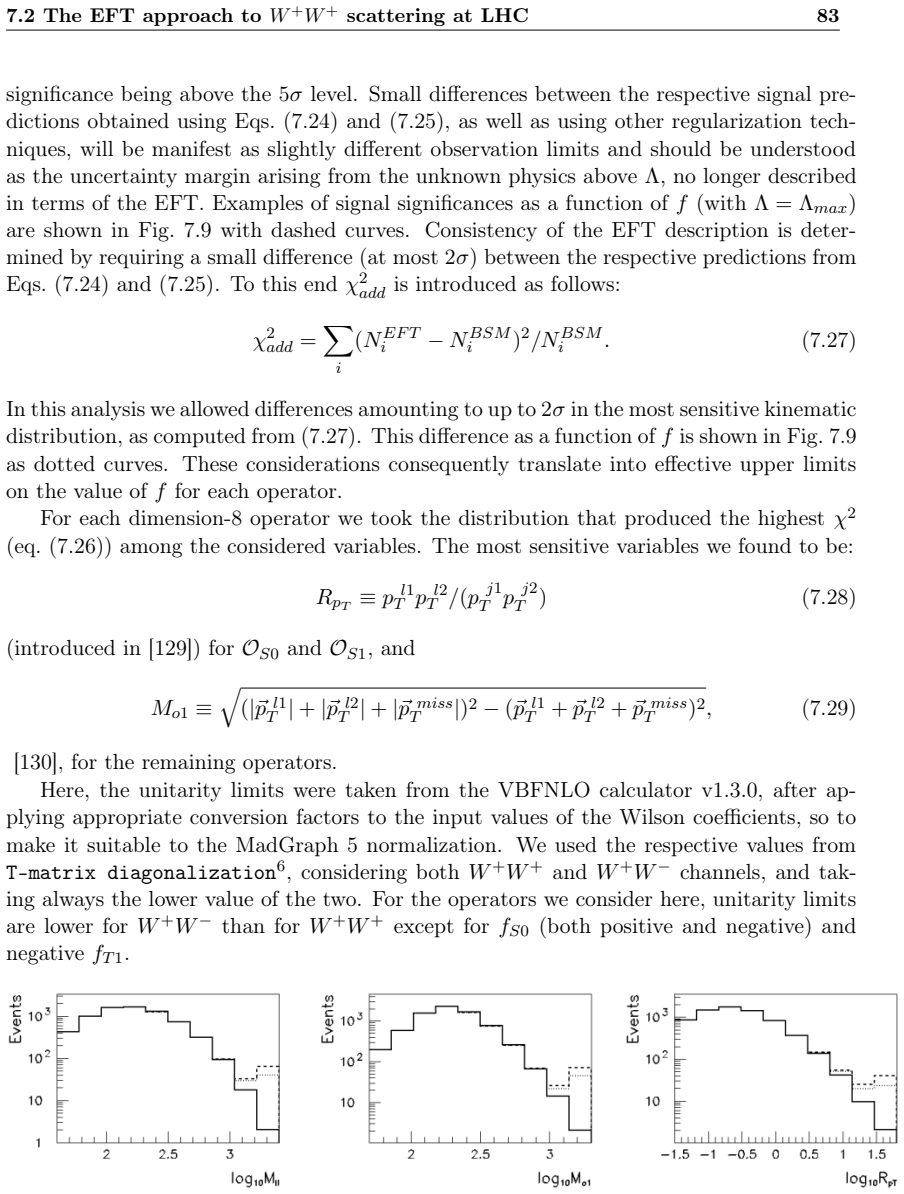
- [Sec. 4, Eqs. (4.34)/(4.36); Sec. 7.2] The paper identifies the EFT validity limit with the scale at which the tree-level partial waves violate |Re T|≤1/2. This is a standard and useful criterion, but it is a necessary rather than a sufficient condition: loop corrections in a non-renormalizable EFT can become large before the tree-level bound is saturated, particularly for dimension-8 operators whose amplitudes grow as s^2/Λ^4 and for which the loop expansion parameter near √sU can be O(1); the √sU values in Tables 7.1-7.2 are a few TeV, so s/(16π^2v^2) is not parametrically small. Since the discovery regions are defined by integrating up to √sU, an earlier actual breakdown would shrink them. Please state explicitly that √sU is an upper bound on the validity region and provide an estimate of the size of one-loop corrections, or an NDA-based argument, showing that the bound is not over-optimistic.
minor comments (4)
- [Eq. (7.8)] The printed formula for the auxiliary polarization is malformed: the denominator as typeset, k^2−m_W^2 k^2 m_W^2, is not a well-formed expression and should be replaced by a single square-root formula, presumably √(k^2(k^2−m_W^2)) or the intended equivalent.
- [Chapter 1 (Introduction)] The cross-references to 'Sec. 1', 'Sec. 2', ..., 'Sec. 7' do not match the actual chapter numbering (the Standard Model is Ch. 2, the conclusions are Ch. 8, etc.). Please correct the section cross-references.
- [Tables 7.1-7.2 and appendix tables] The units quoted for the Wilson coefficients are inconsistent: the captions write 'TeV4' where TeV^{-4} is meant for the dimension-8 SMEFT coefficients, while the HEFT operators have TeV^{-2} or dimensionless coefficients. Please standardize the notation for f_i and c_i throughout.
- [Sec. 7.2 and figures] A short summary table in the main text listing the final discovery regions (operator, sign of f_i, f_i range, √sU range, and maximum significance) would greatly improve readability, since the numerical results are otherwise distributed over long appendices.
Circularity Check
No circular derivation: the unitarity cutoff and the discovery significance are computed from the same EFT Lagrangian as a consistency condition, not as a fitted prediction; the thesis reproduces its prior-work results and does not rely on load-bearing self-citations.
full rationale
The central claims are not circular. The discovery regions are defined by requiring expected significance above 5 sigma while restricting the EFT to energies below the tree-level partial-wave unitarity bound sqrt(sU). Both quantities are computed from the same Lagrangian and Wilson coefficient, but this is a self-consistency requirement, not an input-output identity: the significance is an event-counting prediction and the unitarity bound is an independent theoretical constraint. The paper does not fit sqrt(sU) to the significance, nor does it define the EFT model in terms of the discovery region. The Sec. 7.1.3 polarization-completeness argument (Eq. 7.7) is an approximate matching between on-shell and off-shell kinematics; even if that approximation were quantitatively inadequate, that would be a validity/correctness concern, not circularity, because the full pp significance is not constructed to equal the on-shell unitarity bound by definition. The reliance on the author's prior papers [a-d] is bibliographic: the thesis includes the derivations, analytic amplitudes, and cross-checks with VBFNLO, FeynRules, and FeynCalc, so the cited results are reproduced rather than imported as unverified premises. No uniqueness theorem or ansatz is smuggled in via self-citation. The only mild caveat is the thesis's opening statement that it is 'based on the results of [a-d]', which is a normal self-reference and is not load-bearing for the derivation presented in the thesis.
Assumptions & free parameters
free parameters (1)
- Wilson coefficients f_i of dimension-8/dp=8 gQGC operators =
Scanned over ranges such as |f| = 0.01 to 10 TeV^-4 (SMEFT) and corresponding HEFT coefficients
assumptions (3)
- ad hoc to paper Tree-level partial wave unitarity bounds (|Re T| <= 1/2, or the diagonalized version) mark the maximum energy at which the EFT is valid.
- domain assumption On-shell WW scattering amplitudes provide a valid proxy for the off-shell process pp -> WWjj at high WW invariant mass.
- domain assumption Dimension-8 (or dp=8) genuine quartic-gauge-coupling operators dominate over dimension-6 operators in same-sign WW scattering.
Cite this review
Pith. "Pith review of The W and Z scattering as a probe of physics beyond the Standard Model: Effective Field Theory approach." pith.science (2026). https://pith.science/paper/K32DXCSY
@misc{pith2026190807596,
  author       = {Pith},
  title        = {Pith review of: The W and Z scattering as a probe of physics beyond the Standard Model: Effective Field Theory approach},
  year         = {2026},
  howpublished = {\url{https://pith.science/paper/K32DXCSY}},
  note         = {Machine review of arXiv:1908.07596}
}
abstract
In this work the vector boson scattering process is investigated through the reaction $pp\rightarrow 2 \mathrm{jets} + W^\ast W^\ast \rightarrow 2 \mathrm{jets} + l\nu_l l'\nu_l'$, where $W^\ast$ denote in general off-shell $W^+$, in the EFT approach with the HL-LHC and HE-LHC experiments in mind. We have investigated the discovery potential of certain classes of the EFT "models" of both the SMEFT and HEFT bases with the particular emphasis on using the EFT "models" in their region of validity. A novel method has been proposed for determining the discovery regions of physics beyond the SM, described by the EFT "models". Independent of the basis chosen, the discovery regions are found to be non-empty. We then compare differences in experimental signatures between SMEFT and HEFT, which is an important step for distinguishing between the two hypotheses in the future data. Finally, we investigated what the effect on the discovery regions is when increasing the $pp$ collision energy.
Figures

Figures from the paper (28 more)











Reference graph
Works this paper leans on
-
[1]
S. L. Glashow, Nucl. Phys.22, 579 (1961). doi:10.1016/0029-5582(61)90469-2
-
[2]
S. Weinberg, Phys. Rev. Lett.19, 1264 (1967). doi:10.1103/PhysRevLett.19.1264
-
[3]
Salam, Conf
A. Salam, Conf. Proc. C680519, 367 (1968)
1968
-
[4]
G. ’t Hooft and M. J. G. Veltman, Nucl. Phys. B44, 189 (1972). doi:10.1016/0550-3213(72)90279-9
-
[5]
F. Englert and R. Brout, Phys. Rev. Lett.13, 321 (1964). doi:10.1103/PhysRevLett.13.321
-
[6]
P. W. Higgs, Phys. Lett.12, 132 (1964). doi:10.1016/0031-9163(64)91136-9
-
[7]
P. W. Higgs, Phys. Rev. Lett.13, 508 (1964). doi:10.1103/PhysRevLett.13.508
-
[8]
G. S. Guralnik, C. R. Hagen and T. W. B. Kibble, Phys. Rev. Lett.13, 585 (1964). doi:10.1103/PhysRevLett.13.585
Show all 138 references
-
[9]
P. W. Higgs, Phys. Rev.145, 1156 (1966). doi:10.1103/PhysRev.145.1156
1966 doi
-
[10]
T. W. B. Kibble, Phys. Rev.155, 1554 (1967). doi:10.1103/PhysRev.155.1554
1967 doi
-
[11]
A. V. Manohar, arXiv:1804.05863 [hep-ph]
-
[12]
Pich, Acta Phys
A. Pich, Acta Phys. Polon. B47, 151 (2016) doi:10.5506/APhysPolB.47.151 [arXiv:1512.08749 [hep-ph]]
2016 arXiv
-
[13]
Buchmuller and D
W. Buchmuller and D. Wyler, Nucl. Phys. B268, 621 (1986). doi:10.1016/0550-3213(86)90262-2
1986 doi
-
[14]
Grzadkowski, M
B. Grzadkowski, M. Iskrzynski, M. Misiak and J. Rosiek, JHEP1010, 085 (2010) doi:10.1007/JHEP10(2010)085 [arXiv:1008.4884 [hep-ph]]
2010 arXiv
- [15]
-
[16]
Grinstein and M
B. Grinstein and M. Trott, Phys. Rev.D76 (2007) 073002, [arXiv:0704.1505]
2007 arXiv
-
[17]
Contino, C
R. Contino, C. Grojean, M. Moretti, F. Piccinini, and R. Rattazzi, JHEP05 (2010) 089, [arXiv:1002.1011]
2010 arXiv
-
[18]
Alonso, M
R. Alonso, M. B. Gavela, L. Merlo, S. Rigolin, and J. Yepes, Phys. Lett.B722 (2013) 330–335, [arXiv:1212.3305], [Erratum: Phys. Lett.B726,926(2013)]
2013 arXiv
-
[19]
Alonso, M
R. Alonso, M. B. Gavela, L. Merlo, S. Rigolin, and J. Yepes, Phys. Rev.D87 (2013), no. 5 055019, [arXiv:1212.3307]
2013 arXiv
-
[20]
Buchalla, O
G. Buchalla, O. Cata, and C. Krause, Nucl. Phys.B880 (2014) 552–573, [arXiv:1307.5017], [Erratum: Nucl. Phys.B913,475(2016)]. BIBLIOGRAPHY 151
2014 arXiv
-
[21]
Brivio, T
I. Brivio, T. Corbett, O. J. P. Eboli, M. B. Gavela, J. Gonzalez-Fraile, M. C. Gonzalez-Garcia, L. Merlo, and S. Rigolin, JHEP03 (2014) 024, [arXiv:1311.1823]
2014 arXiv
-
[22]
Brivio, O
I. Brivio, O. J. P. Eboli, M. B. Gavela, M. C. Gonzalez-Garcia, L. Merlo, and S. Rigolin, JHEP12 (2014) 004, [arXiv:1405.5412]
2014 arXiv
-
[23]
M. B. Gavela, J. Gonzalez-Fraile, M. C. Gonzalez-Garcia, L. Merlo, S. Rigolin, and J. Yepes, JHEP10 (2014) 044, [arXiv:1406.6367]
2014 arXiv
-
[24]
M. B. Gavela, K. Kanshin, P. A. N. Machado, and S. Saa, JHEP03 (2015) 043, [arXiv:1409.1571]
2015 arXiv
-
[25]
O. J. P. Eboli and M. C. Gonzalez-Garcia, Phys. Rev.D93 (2016), no. 9 093013, [arXiv:1604.03555]
2016 arXiv
-
[26]
Brivio, J
I. Brivio, J. Gonzalez-Fraile, M. C. Gonzalez-Garcia, and L. Merlo, Eur. Phys. J. C76 (2016), no. 7 416, [arXiv:1604.06801]
2016 arXiv
-
[27]
de Florianet
LHC Higgs Cross Section Working GroupCollaboration, D. de Florianet. al., [arXiv:1610.07922]
-
[28]
Merlo, S
L. Merlo, S. Saa, and M. Sacristan-Barbero, Eur. Phys. J.C77 (2017), no. 3 185, [arXiv:1612.04832]
2017 arXiv
-
[29]
Buchalla, O
G. Buchalla, O. Cata, A. Celis, M. Knecht, and C. Krause, Nucl. Phys.B928 (2018) 93–106, [arXiv:1710.06412]
2018 arXiv
-
[30]
Alonso, K
R. Alonso, K. Kanshin, and S. Saa, Phys. Rev.D97 (2018), no. 3 035010, [arXiv:1710.06848]
2018 arXiv
-
[31]
A. Pich, I. Rosell, J. Santos and J. J. Sanz-Cillero, Phys. Rev. D93, no. 5, 055041 (2016) doi:10.1103/PhysRevD.93.055041 [arXiv:1510.03114 [hep-ph]]
2016 arXiv
-
[32]
A. Pich, I. Rosell, J. Santos and J. J. Sanz-Cillero, JHEP1704, 012 (2017) doi:10.1007/JHEP04(2017)012 [arXiv:1609.06659 [hep-ph]]
2017 arXiv
-
[33]
H. K. Dreiner, H. E. Haber and S. P. Martin, Phys. Rept.494, 1 (2010) doi:10.1016/j.physrep.2010.05.002 [arXiv:0812.1594 [hep-ph]]
2010 arXiv
-
[34]
Goldstone, Nuovo Cim.19, 154 (1961)
J. Goldstone, Nuovo Cim.19, 154 (1961). doi:10.1007/BF02812722 Y. Nambu, Phys. Rev. 117, 648 (1960). doi:10.1103/PhysRev.117.648 Y. Nambu and G. Jona-Lasinio, Phys. Rev.122, 345 (1961). doi:10.1103/PhysRev.122.345 Y. Nambu and G. Jona-Lasinio, Phys. Rev.124, 246 (1961). doi:10...
1961 doi
-
[35]
Nakamuraet al
K. Nakamuraet al. [Particle Data Group], J. Phys. G37, 075021 (2010). doi:10.1088/0954-3899/37/7A/075021
2010 doi
-
[36]
Nir, ”The Standard Model and Flavor Physics”, available at http://indico.ictp.it/event/7968/ (under ”The SM and Flavor”)
(Lecture notes) Y. Nir, ”The Standard Model and Flavor Physics”, available at http://indico.ictp.it/event/7968/ (under ”The SM and Flavor”)
-
[37]
Grossman and P
Y. Grossman and P. Tanedo, doi:10.1142/9789813233348_0004 arXiv:1711.03624 [hep-ph]
- [38]
-
[39]
Hanneke, S
D. Hanneke, S. Fogwell and G. Gabrielse, Phys. Rev. Lett.100, 120801 (2008) doi:10.1103/PhysRevLett.100.120801 [arXiv:0801.1134 [physics.atom-ph]]. 152 BIBLIOGRAPHY
2008 arXiv
- [40]
-
[41]
LEP Electroweak Working Group [ALEPH and CDF and D0 and DELPHI and L3 and OPAL and SLD Collaborations and LEP Electroweak Working Group and Tevatron Electroweak Working Group and SLD Electroweak and Heavy Flavour Groups], arXiv:1012.2367 [hep-ex]; http://www.cern.ch/LEPEWWG/
-
[42]
[CDF and D0 Collaborations and Tevatron Electroweak Working Group], arXiv:1107.5255 [hep-ex]
-
[43]
M. Baak, M. Goebel, J. Haller, A. Hoecker, D. Ludwig, K. Moenig, M. Schott and J. Stelzer, Eur. Phys. J. C72, 2003 (2012) doi:10.1140/epjc/s10052-012-2003-4 [arXiv:1107.0975 [hep-ph]]
2012 arXiv
-
[44]
Aad et al
G. Aad et al. [ATLAS Collaboration], Phys. Lett. B716, 1 (2012) doi:10.1016/j.physletb.2012.08.020 [arXiv:1207.7214 [hep-ex]]
2012 arXiv
-
[45]
Chatrchyanet al
S. Chatrchyanet al. [CMS Collaboration], Phys. Lett. B716, 30 (2012) doi:10.1016/j.physletb.2012.08.021 [arXiv:1207.7235 [hep-ex]]
2012 arXiv
-
[46]
Aad et al
G. Aad et al. [ATLAS Collaboration], JINST3, S08003 (2008). doi:10.1088/1748-0221/3/08/S08003
2008 doi
-
[47]
Chatrchyanet al
S. Chatrchyanet al. [CMS Collaboration], JINST3, S08004 (2008). doi:10.1088/1748-0221/3/08/S08004
2008 doi
-
[48]
Aad et al
G. Aad et al. [ATLAS and CMS Collaborations], Phys. Rev. Lett.114, 191803 (2015) doi:10.1103/PhysRevLett.114.191803 [arXiv:1503.07589 [hep-ex]]
2015 arXiv
-
[49]
Aad et al
G. Aad et al. [ATLAS Collaboration], Eur. Phys. J. C75, no. 10, 476 (2015) Erratum: [Eur. Phys. J. C76, no. 3, 152 (2016)] doi:10.1140/epjc/s10052-015-3685-1, 10.1140/epjc/s10052-016-3934-y [arXiv:1506.05669 [hep-ex]]
2015 arXiv
-
[50]
Khachatryan et al
V. Khachatryan et al. [CMS Collaboration], Phys. Rev. D92, no. 1, 012004 (2015) doi:10.1103/PhysRevD.92.012004 [arXiv:1411.3441 [hep-ex]]
2015 arXiv
-
[51]
Aad et al
G. Aad et al. [ATLAS and CMS Collaborations], JHEP1608, 045 (2016) doi:10.1007/JHEP08(2016)045 [arXiv:1606.02266 [hep-ex]]
2016 arXiv
-
[52]
Aad et al
G. Aad et al. [ATLAS Collaboration], JHEP1512, 061 (2015) doi:10.1007/JHEP12(2015)061 [arXiv:1509.06047 [hep-ex]]; V. Khachatryanet al. [CMS Collaboration], JHEP1702, 079 (2017) doi:10.1007/JHEP02(2017)079 [arXiv:1610.04857 [hep-ex]]
2015 arXiv
-
[53]
Aad et al
G. Aad et al. [ATLAS Collaboration], Eur. Phys. J. C77, no. 2, 70 (2017) doi:10.1140/epjc/s10052-017-4624-0 [arXiv:1604.07730 [hep-ex]]; V. Khachatryanet al. [CMS Collaboration], Phys. Lett. B763, 472 (2016) doi:10.1016/j.physletb.2016.09.062 [arXiv:1607.03561 [hep-ex]]; CMS C...
2017 arXiv
-
[54]
Pokorski, doi:10.1007/1-4020-3733-3_9 hep-ph/0502132
S. Pokorski, doi:10.1007/1-4020-3733-3_9 hep-ph/0502132
-
[55]
Fajfer, J
For example: S. Fajfer, J. F. Kamenik and I. Nisandzic, Phys. Rev. D85, 094025 (2012) doi:10.1103/PhysRevD.85.094025 [arXiv:1203.2654 [hep-ph]]
2012 arXiv
-
[56]
Pomarol and F
For example: A. Pomarol and F. Riva, JHEP1401, 151 (2014) doi:10.1007/JHEP01(2014)151 [arXiv:1308.2803 [hep-ph]]. BIBLIOGRAPHY 153
2014 arXiv
-
[57]
Kilian, T
W. Kilian, T. Ohl, J. Reuter, and M. Sekulla, Phys. Rev.D91 (2015) 096007, [arXiv:1408.6207]
2015 arXiv
-
[58]
Brass, C
S. Brass, C. Fleper, W. Kilian, J. Reuter, and M. Sekulla, Eur. Phys. J.C78 (2018), no. 11 931, [arXiv:1807.02512]
2018 arXiv
- [59]
-
[60]
Espriu and B
D. Espriu and B. Yencho, Phys. Rev.D87 (2013), no. 5 055017, [arXiv:1212.4158]
2013 arXiv
-
[61]
Espriu, F
D. Espriu, F. Mescia, and B. Yencho, Phys. Rev.D88 (2013) 055002, [arXiv:1307.2400]
2013 arXiv
-
[62]
R. L. Delgado, A. Dobado, and F. J. Llanes-Estrada, J. Phys.G41 (2014) 025002, [arXiv:1308.1629]
2014 arXiv
-
[63]
R. L. Delgado, A. Dobado, and F. J. Llanes-Estrada, JHEP02 (2014) 121, [arXiv:1311.5993]
2014 arXiv
-
[64]
Espriu and F
D. Espriu and F. Mescia, Phys. Rev.D90 (2014), no. 1 015035, [ arXiv:1403.7386]
2014 arXiv
-
[65]
R. L. Delgado, A. Dobado, M. J. Herrero, and J. J. Sanz-Cillero, JHEP07 (2014) 149, [arXiv:1404.2866]
2014 arXiv
-
[66]
R. L. Delgado, A. Dobado, D. Espriu, C. García-Garcia, M. J. Herrero, X. Marcano, and J. J. Sanz-Cillero, JHEP11(2017) 098, [arXiv:1707.04580]
2017 arXiv
-
[67]
Aad et al
G. Aad et al. [ATLAS Collaboration], Phys. Rev. Lett.113, no. 14, 141803 (2014) doi:10.1103/PhysRevLett.113.141803 [arXiv:1405.6241 [hep-ex]]
2014 arXiv
-
[68]
Khachatryan et al
V. Khachatryan et al. [CMS Collaboration], Phys. Rev. Lett.114, no. 5, 051801 (2015) doi:10.1103/PhysRevLett.114.051801 [arXiv:1410.6315 [hep-ex]]
2015 arXiv
-
[69]
A. M. Sirunyanet al. [CMS Collaboration], Phys. Rev. Lett.120, no. 8, 081801 (2018) doi:10.1103/PhysRevLett.120.081801 [arXiv:1709.05822 [hep-ex]]
2018 arXiv
-
[70]
Aad et al
G. Aad et al. [ATLAS Collaboration], Phys. Rev. D93, no. 9, 092004 (2016) doi:10.1103/PhysRevD.93.092004 [arXiv:1603.02151 [hep-ex]]
2016 arXiv
-
[71]
A. M. Sirunyanet al. [CMS Collaboration], Phys. Lett. B774, 682 (2017) doi:10.1016/j.physletb.2017.10.020 [arXiv:1708.02812 [hep-ex]]
2017 arXiv
-
[72]
The ATLAS Collaboration, ATLAS-CONF-2018-030
2018
-
[73]
Aad et al
G. Aad et al. [ATLAS Collaboration], Eur. Phys. J. C72, 2173 (2012) doi:10.1140/epjc/s10052-012-2173-0 [arXiv:1208.1390 [hep-ex]]
2012 arXiv
-
[74]
Khachatryan et al
V. Khachatryan et al. [CMS Collaboration], Eur. Phys. J. C77, no. 4, 236 (2017) doi:10.1140/epjc/s10052-017-4730-z [arXiv:1609.05721 [hep-ex]]
2017 arXiv
-
[75]
Khachatryan et al
V. Khachatryan et al. [CMS Collaboration], Phys. Lett. B766, 268 (2017) doi:10.1016/j.physletb.2017.01.011 [arXiv:1607.06943 [hep-ex]]
2017 arXiv
-
[76]
D. R. Green, P. Meade and M. A. Pleier, Rev. Mod. Phys.89, no. 3, 035008 (2017) doi:10.1103/RevModPhys.89.035008 [arXiv:1610.07572 [hep-ex]]
2017 arXiv
-
[77]
Chankowski, lecture notes available at https://www.fuw.edu.pl/ chank/qftoei.html
P. Chankowski, lecture notes available at https://www.fuw.edu.pl/ chank/qftoei.html. 154 BIBLIOGRAPHY
-
[78]
de Rham, S
C. de Rham, S. Melville, A. J. Tolley and S. Y. Zhou, JHEP1803, 011 (2018) doi:10.1007/JHEP03(2018)011 [arXiv:1706.02712 [hep-th]]: the relations are discussed in the Appendix E
2018 arXiv
-
[79]
J. M. Cornwall, D. N. Levin and G. Tiktopoulos, Phys. Rev. D10, 1145 (1974) Erratum: [Phys. Rev. D11, 972 (1975)]. doi:10.1103/PhysRevD.10.1145, 10.1103/PhysRevD.11.972
1974 doi
-
[80]
C. H. Llewellyn Smith, Phys. Lett.46B, 233 (1973). doi:10.1016/0370-2693(73)90692-8
1973 doi
-
[81]
Fermi, Ric
E. Fermi, Ric. Sci.4, 491 (1933)
1933
-
[82]
Falkowski, B
See the discussion in A. Falkowski, B. Fuks, K. Mawatari, K. Mimasu, F. Riva and V. Sanz, Eur. Phys. J. C75, no. 12, 583 (2015) doi:10.1140/epjc/s10052-015-3806-x [arXiv:1508.05895 [hep-ph]]
2015 arXiv
- [83]
-
[84]
Pich, Rept
A. Pich, Rept. Prog. Phys.58, 563 (1995) doi:10.1088/0034-4885/58/6/001 [hep-ph/9502366]
1995 arXiv
- [85]
- [86]
-
[87]
J. C. Criado and M. PErez-Victoria, JHEP1903, 038 (2019) doi:10.1007/JHEP03(2019)038 [arXiv:1811.09413 [hep-ph]]
2019 arXiv
-
[88]
S. R. Coleman, J. Wess and B. Zumino, Phys. Rev.177, 2239 (1969). doi:10.1103/PhysRev.177.2239
1969 doi
-
[89]
C. G. Callan, Jr., S. R. Coleman, J. Wess and B. Zumino, Phys. Rev.177, 2247 (1969). doi:10.1103/PhysRev.177.2247
1969 doi
-
[90]
Weinberg, Physica A96, no
S. Weinberg, Physica A96, no. 1-2, 327 (1979). doi:10.1016/0378-4371(79)90223-1
1979 doi
-
[91]
Gasser and H
J. Gasser and H. Leutwyler, Annals Phys.158, 142 (1984). doi:10.1016/0003-4916(84)90242-2
1984 doi
-
[92]
Gasser and H
J. Gasser and H. Leutwyler, Nucl. Phys. B250, 465 (1985). doi:10.1016/0550-3213(85)90492-4
1985 doi
-
[93]
Bijnens, G
J. Bijnens, G. Colangelo and G. Ecker, JHEP9902, 020 (1999) doi:10.1088/1126-6708/1999/02/020 [hep-ph/9902437]
1999 arXiv
- [94]
-
[95]
Bijnens, L
J. Bijnens, L. Girlanda and P. Talavera, Eur. Phys. J. C23, 539 (2002) doi:10.1007/s100520100887 [hep-ph/0110400]
2002 arXiv
-
[96]
Ebertshauser, H
T. Ebertshauser, H. W. Fearing and S. Scherer, Phys. Rev. D65, 054033 (2002) doi:10.1103/PhysRevD.65.054033 [hep-ph/0110261]
2002 arXiv
-
[97]
B. M. Gavela, E. E. Jenkins, A. V. Manohar and L. Merlo, Eur. Phys. J. C76, no. 9, 485 (2016) doi:10.1140/epjc/s10052-016-4332-1 [arXiv:1601.07551 [hep-ph]]
2016 arXiv
-
[98]
Appelquist and C
T. Appelquist and C. W. Bernard, Phys. Rev. D22, 200 (1980). doi:10.1103/PhysRevD.22.200 BIBLIOGRAPHY 155
1980 doi
-
[99]
Dobado and M
A. Dobado and M. J. Herrero, Phys. Lett.B228 (1989) 495–502
1989
-
[100]
Dobado and M
A. Dobado and M. J. Herrero, Phys. Lett.B233 (1989) 505–511
1989
-
[101]
Dobado, M
A. Dobado, M. J. Herrero, and T. N. Truong, Phys. Lett.B235 (1990) 129
1990
-
[102]
Dobado, M
A. Dobado, M. J. Herrero, and J. Terron, Z. Phys.C50 (1991) 205–220
1991
-
[103]
Dobado, M
A. Dobado, M. J. Herrero, J. R. Pelaez, E. Ruiz Morales, and M. T. Urdiales, Phys. Lett. B352 (1995) 400–410, [hep-ph/9502309]
1995 arXiv
-
[104]
Dobado, M
A. Dobado, M. J. Herrero, J. R. Pelaez, and E. Ruiz Morales, Phys. Rev.D62 (2000) 055011, [hep-ph/9912224]
2000 arXiv
-
[105]
Alboteanu, W
A. Alboteanu, W. Kilian, and J. Reuter, JHEP11 (2008) 010, [arXiv:0806.4145]
2008 arXiv
-
[106]
G. F. Giudice, C. Grojean, A. Pomarol and R. Rattazzi, JHEP0706, 045 (2007) doi:10.1088/1126-6708/2007/06/045 [hep-ph/0703164]
2007 arXiv
- [107]
-
[108]
Dimopoulos and L
S. Dimopoulos and L. Susskind, Nucl. Phys. B155, 237 (1979). doi:10.1016/0550-3213(79)90364-X
1979 doi
-
[109]
Dimopoulos and J
S. Dimopoulos and J. Preskill, Nucl. Phys. B199, 206 (1982). doi:10.1016/0550-3213(82)90345-5
1982 doi
-
[110]
Contino, doi:10.1142/9789814327183_0005 arXiv:1005.4269 [hep-ph]
R. Contino, doi:10.1142/9789814327183_0005 arXiv:1005.4269 [hep-ph]
-
[111]
Panico and A
G. Panico and A. Wulzer, Lect. Notes Phys.913, pp.1 (2016) doi:10.1007/978-3-319-22617-0 [arXiv:1506.01961 [hep-ph]]
2016 arXiv
-
[112]
Alonso, I
R. Alonso, I. Brivio, B. Gavela, L. Merlo and S. Rigolin, JHEP1412, 034 (2014) doi:10.1007/JHEP12(2014)034 [arXiv:1409.1589 [hep-ph]]
2014 arXiv
-
[113]
Brivio, M
I. Brivio, M. B. Gavela, L. Merlo, K. Mimasu, J. M. No, R. del Rey, and V. Sanz, Non-Linear Higgs Portal to Dark Matter , JHEP04 (2016) 141, [arXiv:1511.01099]
2016 arXiv
-
[114]
Brivio, M
I. Brivio, M. B. Gavela, L. Merlo, K. Mimasu, J. M. No, R. del Rey, and V. Sanz, Eur. Phys. J.C77 (2017), no. 8 572, [arXiv:1701.05379]
2017 arXiv
-
[115]
Butter, O
A. Butter, O. J. P. Eboli, J. Gonzalez-Fraile, M. C. Gonzalez-Garcia, T. Plehn and M. Rauch, JHEP1607, 152 (2016) doi:10.1007/JHEP07(2016)152 [arXiv:1604.03105 [hep-ph]]
2016 arXiv
-
[116]
Falkowski, M
A. Falkowski, M. Gonzalez-Alonso, A. Greljo, D. Marzocca and M. Son, JHEP 1702, 115 (2017) doi:10.1007/JHEP02(2017)115 [arXiv:1609.06312 [hep-ph]]
2017 arXiv
-
[117]
Adams, N
A. Adams, N. Arkani-Hamed, S. Dubovsky, A. Nicolis and R. Rattazzi, JHEP 0610, 014 (2006) doi:10.1088/1126-6708/2006/10/014 [hep-th/0602178]
2006 arXiv
-
[118]
de Rham, S
C. de Rham, S. Melville, A. J. Tolley and S. Y. Zhou, Phys. Rev. D96, no. 8, 081702 (2017) doi:10.1103/PhysRevD.96.081702 [arXiv:1702.06134 [hep-th]]
2017 arXiv
- [119]
-
[120]
Degrande et al., arXiv:1309.7890 [hep-ph]
C. Degrande et al., arXiv:1309.7890 [hep-ph]. 156 BIBLIOGRAPHY
-
[121]
Arnold et al., Comput
K. Arnold et al., Comput. Phys. Commun.180, 1661 (2009) doi:10.1016/j.cpc.2009.03.006 [arXiv:0811.4559 [hep-ph]]; J. Baglioet al., arXiv:1107.4038 [hep-ph]; J. Baglioet al., arXiv:1404.3940 [hep-ph]
2009 arXiv
-
[122]
N. D. Christensen and C. Duhr, Comput. Phys. Commun.180, 1614 (2009) doi:10.1016/j.cpc.2009.02.018 [arXiv:0806.4194 [hep-ph]]; A. Alloul, N. D. Christensen, C. Degrande, C. Duhr and B. Fuks, Comput. Phys. Commun. 185, 2250 (2014) doi:10.1016/j.cpc.2014.04.012 [arXiv:1310.1921 ...
2009 arXiv
-
[123]
Mertig, M
R. Mertig, M. Bohm and A. Denner, Comput. Phys. Commun.64, 345 (1991). doi:10.1016/0010-4655(91)90130-D; V. Shtabovenko, R. Mertig and F. Orellana, Comput. Phys. Commun.207, 432 (2016) doi:10.1016/j.cpc.2016.06.008 [arXiv:1601.01167 [hep-ph]]
1991 arXiv
-
[124]
J. C. Romao, arXiv:1603.04251 [hep-ph]
-
[125]
Azatov, R
A. Azatov, R. Contino, C. S. Machado and F. Riva, Phys. Rev. D95, no. 6, 065014 (2017) doi:10.1103/PhysRevD.95.065014 [arXiv:1607.05236 [hep-ph]]
2017 arXiv
-
[126]
Alwall et al., JHEP1407, 079 (2014) doi:10.1007/JHEP07(2014)079 [arXiv:1405.0301 [hep-ph]]
J. Alwall et al., JHEP1407, 079 (2014) doi:10.1007/JHEP07(2014)079 [arXiv:1405.0301 [hep-ph]]
2014 arXiv
-
[127]
Degrande, C
C. Degrande, C. Duhr, B. Fuks, D. Grellscheid, O. Mattelaer and T. Reiter, Comput. Phys. Commun.183, 1201 (2012) doi:10.1016/j.cpc.2012.01.022 [arXiv:1108.2040 [hep-ph]]
2012 arXiv
-
[128]
Sjostrand, S
T. Sjostrand, S. Mrenna and P. Z. Skands, JHEP0605, 026 (2006) doi:10.1088/1126-6708/2006/05/026 [hep-ph/0603175]; T. SjÃűstrandet al., Comput. Phys. Commun.191, 159 (2015) doi:10.1016/j.cpc.2015.01.024 [arXiv:1410.3012 [hep-ph]]
2006 arXiv
-
[129]
Doroba, J
K. Doroba, J. Kalinowski, J. Kuczmarski, S. Pokorski, J. Rosiek, M. Szleper and S. Tkaczyk, Phys. Rev. D86, 036011 (2012) doi:10.1103/PhysRevD.86.036011 [arXiv:1201.2768 [hep-ph]]
2012 arXiv
-
[130]
Todt, Ph.D
S. Todt, Ph.D. Thesis CERN-THESIS-2015-018, TU Dresden, 2015
2015
-
[131]
Degrande et al., arXiv:1309.7452 [physics.comp-ph]
C. Degrande et al., arXiv:1309.7452 [physics.comp-ph]
-
[132]
Conte, B
E. Conte, B. Fuks and G. Serret, Comput. Phys. Commun.184, 222 (2013) doi:10.1016/j.cpc.2012.09.009 [arXiv:1206.1599 [hep-ph]]; E. Conte, B. Dumont, B. Fuks and C. Wymant, Eur. Phys. J. C74, no. 10, 3103 (2014) doi:10.1140/epjc/s10052-014-3103-0 [arXiv:1405.3982 [hep-ph]]; B. ...
2013 arXiv
-
[133]
Cacciari, G
M. Cacciari, G. P. Salam and G. Soyez, Eur. Phys. J. C72, 1896 (2012) doi:10.1140/epjc/s10052-012-1896-2 [arXiv:1111.6097 [hep-ph]]
2012 arXiv
-
[134]
I. M. Hierro, L. Merlo, and S. Rigolin, JHEP04 (2016) 016, [arXiv:1510.07899]
2016 arXiv
-
[135]
Feruglio, B
F. Feruglio, B. Gavela, K. Kanshin, P. A. N. Machado, S. Rigolin, and S. Saa, JHEP 06 (2016) 038, [arXiv:1603.05668]
2016 arXiv
-
[136]
D. B. Kaplan and H. Georgi, Phys. Lett.B136 (1984) 183–186
1984
-
[137]
Ballestrero, E
A. Ballestrero, E. Maina and G. Pelliccioli, JHEP1803, 170 (2018) doi:10.1007/JHEP03(2018)170 [arXiv:1710.09339 [hep-ph]]. BIBLIOGRAPHY 157
2018 arXiv
-
[138]
Q. Bi, C. Zhang and S. Y. Zhou, JHEP1906, 137 (2019) doi:10.1007/JHEP06(2019)137 [arXiv:1902.08977 [hep-ph]]
2019 arXiv
Reviewed August 14, 2026 · model on record in the stance chip above.
Discussion (0). Continue with ORCID to comment.