REVIEW 3 major objections 5 minor 95 references
Fracton-like phases from subsystem symmetries
T0 review · 3 major / 5 minor · reviewed 2026-08-14 · deepseek-v4-flash
Pith's one-line read The paper claims that a $\mathbb{Z}_2$ lattice gauge theory with subsystem symmetries in three dimensions realizes an exactly solvable fracton-like phase, with ground-state degeneracy $2^{L_xL_y+L_xL_z+L_yL_z}$ on a 3-ball, immobile flux…
desk verdict A plausible and genuinely new 3D fracton-like Z2 lattice model; the central counting and entropy claims hold up on inspection, though the paper leaves some proofs as pictures and sketches. read the letter →
The pith
A machine-rendered reading of the paper's core claim, the machinery that carries it, and where it could break.
The reading
What carries the argument
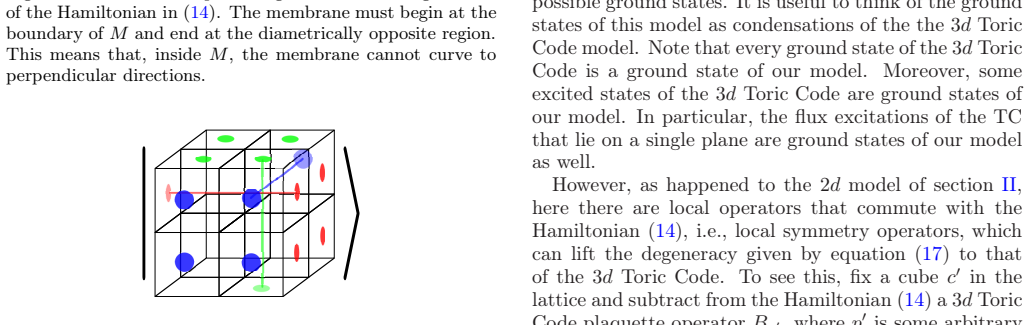
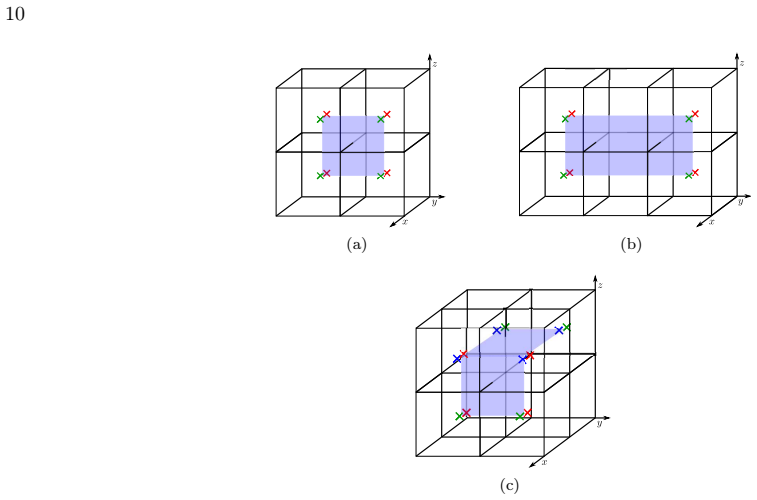
The load-bearing objects are the cube operators $B_c^{(\mu)}$ for $\mu=x,y,z$, each defined as a projector that compares the holonomies of the two opposite plaquettes of cube $c$ orthogonal to $\mu$; a ground state must satisfy all three at once, which forces any dual membrane representing a $\mathbb{Z}_2$ flux to be straight and non-bending in the interior and to end on the boundary. Together with the vertex gauge projectors $A_v$, these operators form a commuting set, making the Hamiltonian exactly solvable. The degeneracy count then reduces to a boundary combinatorics problem: drawing independent dot configurations on each of the three pairs of opposite boundary faces, yielding $2^{L_xL_y+L_xL_z+L_yL_z}$.
What would settle it
Take a small 3-ball lattice, say $L_x=L_y=L_z=2$, and directly enumerate all states satisfying every vertex and cube projector in the Hamiltonian. If the ground-state dimension is not $2^{12}=4096$ as Eq. (17) predicts, or if two different boundary dot configurations produce the same logical state, then the straight-membrane counting assumption fails.
Extended reading notes
Core claim
The central claim is that the Hamiltonian $H=-\sum_v A_v-\sum_c(B_c^{(x)}+B_c^{(y)}+B_c^{(z)})$ on a cubic lattice is exactly solvable by simultaneous diagonalization of its commuting projectors, and that its ground-state sector on a 3-ball is spanned by states represented by straight, non-bending dual membranes that start and end at opposite boundary faces. Counting independent boundary endpoints gives Eq. (17), $\mathrm{GSD}=2^{L_xL_y+L_xL_z+L_yL_z}$. The elementary excitations are $\mu$-fluxes located at membrane corners; they cannot move individually because moving one would require bending a membrane, which excites cube operators, whereas bound pairs can move along straight lines. The vertex charges are the same as in the 3D toric code and are fully mobile. Adding plaquette 1-holonomy terms to the Hamiltonian breaks the subsystem symmetry; in the limit of adding them everywhere, the ground-state sector becomes exactly that of the 3D toric code, so the model is a subsystem-symmetry-enriched topological phase rather than an intrinsically protected fracton phase.
Load-bearing premise
The count in Eq. (17) assumes every ground state on the 3-ball is uniquely represented by an independent choice of straight membrane endpoints on each pair of opposite boundary faces, with no additional equivalence relations among those choices.
Editorial extensions
If this is right
- On a 3-ball, the model has ground-state degeneracy $2^{L_xL_y+L_xL_z+L_yL_z}$, so the degeneracy grows exponentially with boundary area rather than with volume.
- The spectrum contains fully mobile charge excitations identical to those of the 3D toric code, alongside $\mu$-flux fractons at membrane corners that are immobile unless moved in pairs.
- Adding 3D toric-code plaquette operators for all plaquettes reduces the ground-state degeneracy to the toric code's topological value, realizing a subsystem-symmetry-enriched topological phase.
- For a subregion $A$, the entanglement entropy obeys $S_A=\log(\mathrm{GSD}_{\tilde A})$, with the constant term equal to the 3D toric code's topological entanglement entropy.
- The construction extends to arbitrary finite gauge groups, with commuting projectors whose algebra is the quantum double $D(G)$, offering a route to non-Abelian flux quasi-particles without dyons in the 2D case.
Reading between the lines
- Beyond the paper: on manifolds with nontrivial topology, the same dot-counting should combine with non-contractible closed membrane sectors, and one could check whether the total degeneracy is a sum or a product of the exponential term and the topological terms; the authors only identify the topological contribution qualitatively on the 3-torus.
- Beyond the paper: the 2D model's connection to a classical eight-vertex-type model suggests a classical statistical-mechanical dual for the 3D model whose partition function would reproduce the area-law degeneracy, and computing that partition function on finite lattices would provide an independent check of Eq. (17).
- Beyond the paper: the paper shows that symmetry-breaking local terms collapse the exponential degeneracy, but it does not analyze generic local perturbations that preserve the subsystem symmetry; testing stability under such symmetric perturbations would determine whether the exponential degeneracy survives as a subsystem-symmetry-protected feature.
Editorial analysis
A structured set of objections, weighed in public.
Referee Report
Summary. The paper studies exactly solvable Z2 lattice gauge theory models with subsystem symmetries in two and three spatial dimensions. The 2D model, equivalent to the Xu-Moore/plaquette Ising model, is claimed to have GSD = 2^{Lx+Ly} on an Lx by Ly rectangle. The central 3D model, defined by vertex operators A_v and cube operators B_c^{(x)}, B_c^{(y)}, B_c^{(z)}, is claimed to have GSD = 2^{LxLy+LxLz+LyLz} on a 3-ball (Eq. 17), with immobile mu-flux fractons and fully mobile charges; adding local 3D toric-code plaquette operators is claimed to reduce the model to the 3D toric code. The paper also computes entanglement entropy S_A for subregion A and claims S_A = log(GSD_{\tilde A}) for a suitably restricted model (Eqs. 33 and 45). Section V sketches generalizations to arbitrary finite groups, with several claims deferred to future work.
Significance. If the 3D claims are fully established, the paper provides a new example of fracton-like order in a standard Z2 lattice gauge theory, with ground-state degeneracy growing exponentially in the square of the linear size and with mobile charges coexisting with immobile fractons. The model is exactly solvable through commuting projectors, and the route from the 3D toric code to the fracton-like model via condensing non-contractible ribbon excitations is conceptually interesting. The entanglement-entropy relation S_A = log(GSD_{\tilde A}) is a useful diagnostic and is derived from first principles in the 2D case. However, the 3D GSD counting and the 3D entanglement-entropy derivation currently rest on informal geometric arguments rather than rigorous proofs; these are the load-bearing points of the paper.
major comments (3)
- [Section III B 1, Eq. (17)] The counting leading to Eq. (17) is an assertion rather than a proof. The text assumes that every ground state is represented by a set of straight, non-bending membranes ending at opposite boundary faces, that each boundary plaquette can be independently marked with a dot, and that distinct dot configurations give gauge-inequivalent states. No argument is provided for completeness (that every solution of the stabilizer constraints is of this form) or for uniqueness (that membranes in different directions do not impose additional consistency conditions, and that no two different boundary configurations are related by vertex gauge transformations). Since Eq. (17) is the central quantitative claim of the paper, a rigorous derivation, for example by explicitly solving the stabilizer conditions or using a cohomological count of the gauge orbits, should be supplied.
- [Section IV B, Eqs. (44) and (45)] The 3D entanglement-entropy formula is not derived. After Eq. (44), the paper states Eq. (45) without computing the order |G_{\tilde A}| of the surviving subgroup or dim(H_B). The subsequent check of Eq. (33) is also arithmetically incorrect as written: the text says 'GSD_{\tilde A} = RxRy+RxRz+RyRz + 2(RxRy+RxRz+RyRz)+2', which adds the number of boundary gauge transformations to the area-law exponent, whereas the stated S_A = 3(RxRy+RxRz+RyRz)+2 requires GSD_{\tilde A} = 2^{3(RxRy+RxRz+RyRz)+2}, i.e., the area exponent plus the boundary-vertex count in the exponent. This error, together with the missing counting of |G_{\tilde A}|, prevents the reader from verifying the claimed agreement with Eq. (33) in 3D.
- [Section IV B, Eq. (43)] The claim that only operators supported in the interior region \tilde A survive the partial trace over B is justified only by a brief statement about gauge transformations on the boundary of A. It is not demonstrated that cube operators B_c^{(\mu)} that cross the boundary of A always vanish under the trace, nor is the dimension of the surviving subgroup computed. A detailed derivation of |G_{\tilde A}|, including the treatment of cube operators and vertex operators near the boundary, is necessary to support the central entanglement-entropy result.
minor comments (5)
- [Section V B] The statements that no local vertex operator commuting with all cube operators exists for arbitrary non-Abelian groups, and that the operators satisfy the quantum double algebra of G, are asserted without proof and with the proof deferred to future work. This section should be clearly labeled as a sketch or outlook, or the missing derivations should be included.
- [Equations (10)-(13) and (38)-(40)] The diagrams defining A_v, B_c^{(\mu)}, and Z_c^{(\mu)} appear as empty placeholders in the text; the published version must ensure that these operators are explicitly shown, since the definitions are otherwise incomplete.
- [Equation (37)] The identity B_c^{(x)} B_c^{(y)} B_c^{(z)} = (1/4)(1+Z^{(x)}+Z^{(y)}+Z^{(z)}) uses the relation Z^{(x)} Z^{(y)} Z^{(z)} = 1, which is not explicitly justified in the text; this should be stated for clarity.
- [Section IV A, after Eq. (29)] The subgroup G_A should be defined explicitly as the set of products of plaquette operators b_p whose support lies entirely in region A; this would make the computation of |G_A| transparent.
- [Throughout] There are several typographical errors, including 'condensations of the the 3d Toric Code model' (Section III B 1), 'an TC excitation' (Section III B 1), and 'in the follwing way' (Section V B). These should be corrected.
Circularity Check
No circularity: GSD and entanglement entropy derivations are self-contained; the only self-citation is non-load-bearing.
full rationale
I traced the derivation chain for the two load-bearing results: the 3D ground-state degeneracy count in Eq. (17) and the entanglement relation SA = log(GSD_~A) in Eqs. (32)-(35) and (44)-(45). The 3D GSD count follows from the commuting-projector structure: ground states are gauge orbits of spin configurations whose opposite cube faces have equal holonomy, and on a 3-ball this reduces to independent straight membrane boundary data, giving 2^{LxLy+LxLz+LyLz} states. This is a direct count of the state space, not an input fitted to the result. The entanglement entropy is computed by an explicit partial trace over the Pauli-stabilizer group, and the restricted-model degeneracy GSD_~A is counted separately, first for the 2D model by a domain-wall count and then for the 3D model by adding boundary gauge transformations to the ball degeneracy. The 3D text omits the exponents in the final GSD_~A expression, but the intended multiplicative form is clear from the preceding sentence and from Eq. (45). No fitted parameter is promoted to a prediction, no uniqueness theorem is imported from prior work, and no ansatz is smuggled in through a citation. The only self-citation is to the authors' companion paper [62] for the same entropy-degeneracy relation, but the present paper derives SA and GSD_~A from the Hamiltonian and trace independently, so [62] is corroborative rather than load-bearing. The remaining geometric-completeness concern about the straight-membrane count is a correctness risk, not circularity.
Assumptions & free parameters
assumptions (4)
- domain assumption The specified vertex and cube operators are mutually commuting projectors, allowing exact diagonalization.
- ad hoc to paper Ground states on a 3-ball are counted by independent boundary dot configurations with straight non-bending membranes.
- ad hoc to paper The restricted region A_tilde is defined by dropping gauge transformations on the boundary of A, matching the trace calculation for the reduced density matrix.
- ad hoc to paper The non-Abelian generalizations satisfy a quantum double algebra D(G) and the operators commute.
Cite this review
Pith. "Pith review of Fracton-like phases from subsystem symmetries." pith.science (2026). https://pith.science/paper/43GX5TTT
@misc{pith2026190807601,
  author       = {Pith},
  title        = {Pith review of: Fracton-like phases from subsystem symmetries},
  year         = {2026},
  howpublished = {\url{https://pith.science/paper/43GX5TTT}},
  note         = {Machine review of arXiv:1908.07601}
}
abstract
We study models with fracton-like order based on $\mathbb{Z}_2$ lattice gauge theories with subsystem symmetries in $d=2$ and $d=3$ spatial dimensions. The $3d$ model reduces to the $3$-dimensional Toric Code when subsystem symmetry is broken, giving an example of a subsystem symmetry enriched topological phase (SSET). Although not topologically protected, its ground state degeneracy has as leading contribution a term which grows exponentially with the square of the linear size of the system. Also, there are completely mobile gauge charges living along with immobile fractons. Our method shows that fracton-like phases are also present in more usual lattice gauge theories. We calculate the entanglement entropy $S_A$ of these models in a sub-region $A$ of the lattice and show that it is equal to the logarithm of the ground state degeneracy of a particular restriction of the full model to $A$.
Figures


Figures from the paper (7 more)



Reference graph
Works this paper leans on
-
[62]
R. Raussendorf, C. Okay, D. S. Wang, D. T. Stephen, and H. P. Nautrup. Computationally universal phase of quantum matter. Phys. Rev. Lett. , 122:090501, 2019
work page 2019
-
[1]
More- over, the operators A and Bp are projectors, so their spectrum is known
Ground State Degeneracy Since the operators A and Bp commute for every pla- quette p, we can solve this Hamiltonian exactly. More- over, the operators A and Bp are projectors, so their spectrum is known. This allows us to characterize the ground state subspace of the model as: H0 = {|ψ ⟩ ∈ H |A |ψ ⟩ = |ψ ⟩ and Bp |ψ ⟩ = |ψ ⟩}, for every plaquette p ∈ K2. ...
-
[2]
(4) The global Z2 operator X given by X = ⨂ v∈K0 σ x v (5) commutes with H
and (3), the Hamiltonian is defined by: H = −A − ∑ p Bp. (4) The global Z2 operator X given by X = ⨂ v∈K0 σ x v (5) commutes with H. B. Fracton properties There seems to be three essential features that charac- terize fracton phases of matter: the subextensive behav- ior of the ground state degeneracy, the fact that ground states are topologically protecte...
-
[3]
This means that domain walls are enough to represent gauge equivalence classes of basis states, or physical states
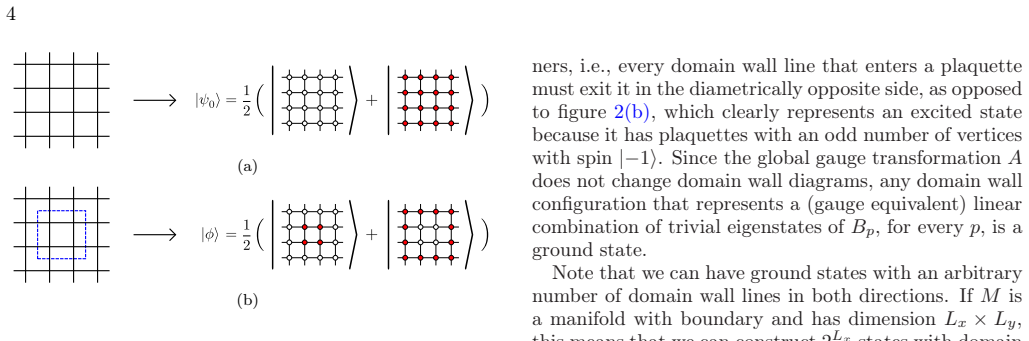
However, because of the global gauge transformation the two basis states associated to one domain wall diagram are gauge equivalent. This means that domain walls are enough to represent gauge equivalence classes of basis states, or physical states. For example, in figure 2 we show two domain wall diagrams and the respective states they represent. The trivi...
-
[4]
In case M has no boundary, the starting points of the blue domain wall lines must be identified with its ending points
The domain wall lines must begin and end at the boundary of M . In case M has no boundary, the starting points of the blue domain wall lines must be identified with its ending points. Essentially, domain wall lines cannot have cor- ners, i.e., every domain wall line that enters a plaquette must exit it in the diametrically opposite side, as opposed to figur...
-
[5]
As we will see in more detail in section V A, we can define, for every link l ∈K1 in the lattice, the 0-holonomy operator [22, 62] Bl = 1 2 ( ⨂ v∈∂l 1v + ⨂ v∈∂l σ z v )
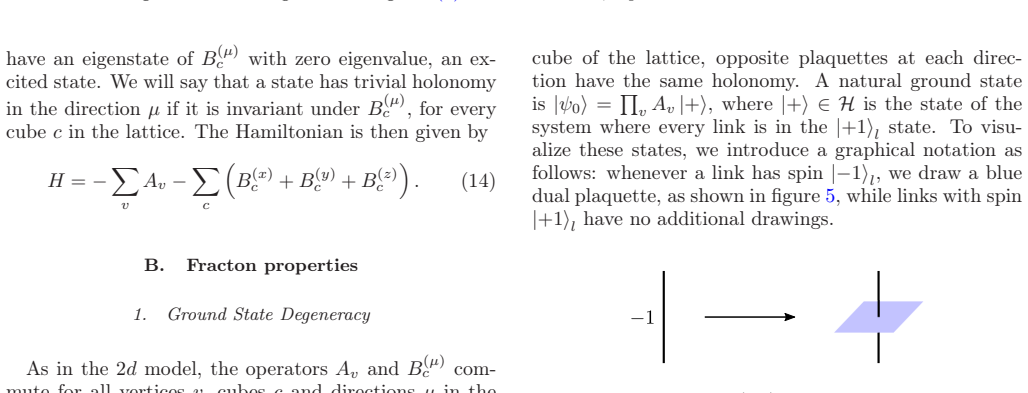
which may destroy this degeneracy. As we will see in more detail in section V A, we can define, for every link l ∈K1 in the lattice, the 0-holonomy operator [22, 62] Bl = 1 2 ( ⨂ v∈∂l 1v + ⨂ v∈∂l σ z v ) . (7) For each plaquette p ∈ K2, Bp can be regarded as an operator that compares the 0-holonomy of parallel links that belong to the boundary ∂p of p. By ...
-
[6]
We can move from one state in the ground state subspace to another by applying combinations of 0-holonomy operators
by adding local 0-holonomy operators, and therefore the ground states are not topologically protected. We can move from one state in the ground state subspace to another by applying combinations of 0-holonomy operators. This discussion can be summarized by noting that the model has subsystem symmetries given by operators that flip all spins along a straigh...
-
[7]
It fol- lows that, when the subsystem symmetry is respected, i.e., when perturbations don’t break this symmetry, the model presents fracton-like order
can be calculated by count- ing the number of such operators, and the 0-holonomy operators explicitly break this subsystem symmetry, thus drastically reducing the number of ground states. It fol- lows that, when the subsystem symmetry is respected, i.e., when perturbations don’t break this symmetry, the model presents fracton-like order
Show all 95 references
-
[8]
The excited state coming from the condition on the A operator is usually called charge
Fracton excitations The excited states of the model |φ⟩ ∈ H are states for which either A |φ⟩ = 0 or, for some plaquette p ∈ K2, Bp |φ⟩ = 0. The excited state coming from the condition on the A operator is usually called charge. It is created by acting locally with σ z on a si...
-
[9]
Therefore, plaquette excitations in this model are completely im- mobile fractons, and indeed the system described by the Hamiltonian in equation (
We can move pairs of excitations along straight lines, but individual exci- tations cannot be moved without costing energy to the system, and so they are essentially immobile. Therefore, plaquette excitations in this model are completely im- mobile fractons, and indeed the sys...
-
[10]
The arguments made for the calculation of the fracton properties of this model will be important to the study of other models we will define in the follow- ing sections
exhibits fracton-like order in two dimensions. The arguments made for the calculation of the fracton properties of this model will be important to the study of other models we will define in the follow- ing sections. III. FRACTON-LIKE ORDER IN THREE DIMENSIONS Here we introduce...
-
[11]
Also, the operators defined in equations ( 10), ( 11), ( 12) and (13) are all projectors
Ground State Degeneracy As in the 2d model, the operators Av and B(µ ) c com- mute for all vertices v, cubes c and directions µ in the lattice, so they can be diagonalized simultaneously. Also, the operators defined in equations ( 10), ( 11), ( 12) and (13) are all projectors. ...
-
[12]
For each boundary plane ofM , there can be 2Np configurations of plaquettes with dots, where Np is the number of plaquettes on the plane in question
Each plaquette in the boundary of M either has a dot on it or it doesn’t. For each boundary plane ofM , there can be 2Np configurations of plaquettes with dots, where Np is the number of plaquettes on the plane in question. Since M has dimensions Lx ×Ly ×Lz, the number of plaqu...
-
[13]
Y. M. Lu and A. Vishwanath. Classification and prop- erties of symmetry-enriched topological phases: Chern- simons approach with applications to z2 spin liquids. Phys. Rev. B , 93:155121, 2016
2016
-
[14]
Now, the ground state of the model must have the four chosen plaquettes with holonomy equal to one
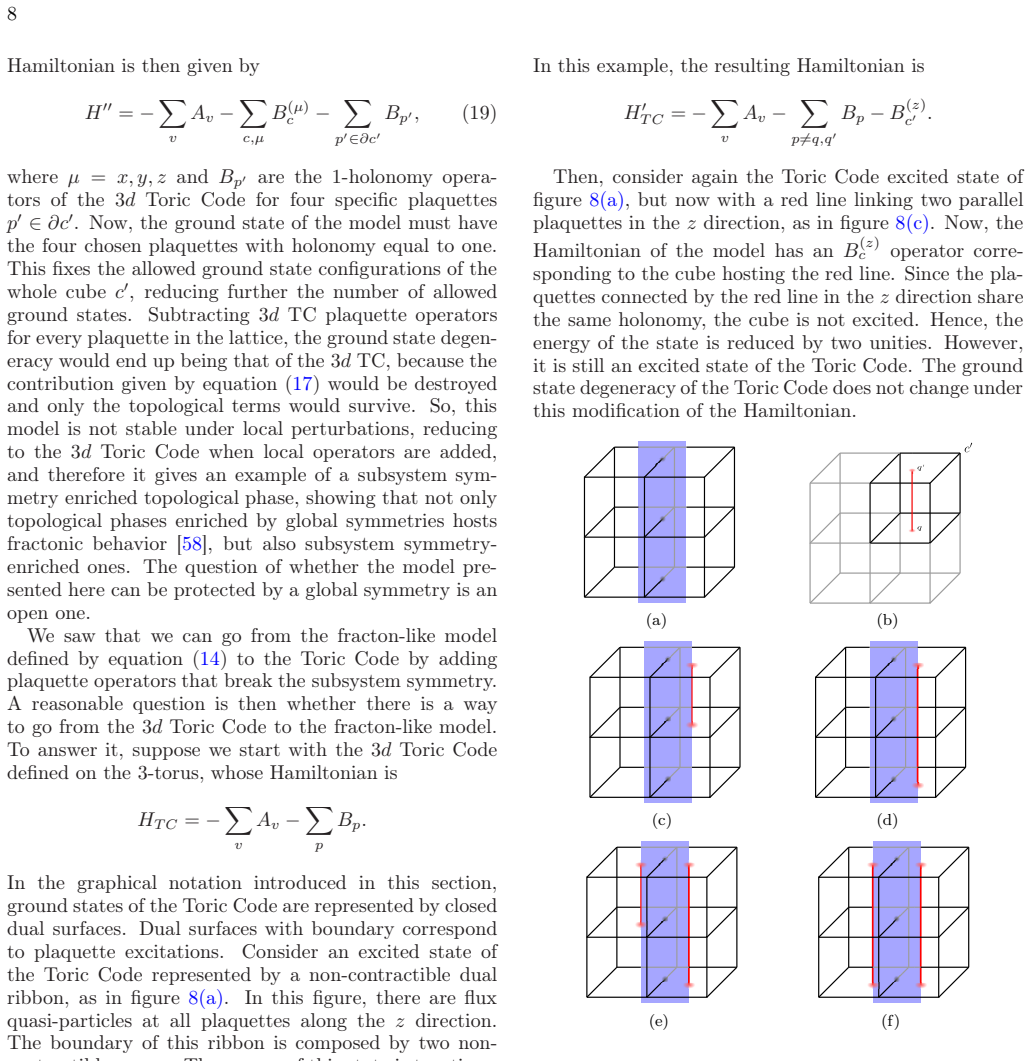
3d Toric Code plaquette operators Bp′ for four of the six plaquettes in the boundary ∂c ′ of c′, the new 8 Hamiltonian is then given by H ′′ = − ∑ v Av − ∑ c,µ B(µ ) c − ∑ p′∈∂c ′ Bp′, (19) where µ = x,y,z and Bp′ are the 1-holonomy opera- tors of the 3d Toric Code for four sp...
-
[15]
A reasonable question is then whether there is a way to go from the 3d Toric Code to the fracton-like model
to the Toric Code by adding plaquette operators that break the subsystem symmetry. A reasonable question is then whether there is a way to go from the 3d Toric Code to the fracton-like model. To answer it, suppose we start with the 3d Toric Code defined on the 3-torus, whose Ha...
-
[16]
A string of σ z operators, beginning at a vertex v and ending at a vertex v′, creates excitations of Av andAv′ , also called charge excitations
Fracton excitations The elementary excited states |φ⟩ ∈ H are such that either Av |φ⟩ = 0 , for some vertex v, or B(µ ) c |φ⟩ = 0 , for some cube c and direction µ . A string of σ z operators, beginning at a vertex v and ending at a vertex v′, creates excitations of Av andAv′ ...
-
[17]
would be destroyed and only the topological terms would survive. So, this model is not stable under local perturbations, reducing to the 3d Toric Code when local operators are added, and therefore it gives an example of a subsystem sym- metry enriched topological phase, showin...
-
[18]
Note that whether this operator acts on a link along the x,y or z-axis will result on certain combinations of x,y and z-fluxes
The simplest µ -flux excited state is created by the action of a σ x operator on a single site over a ground state of the model. Note that whether this operator acts on a link along the x,y or z-axis will result on certain combinations of x,y and z-fluxes. For instance, acting w...
-
[19]
is equal to zero, and we have ρA = 1 2GSDTr B ( ∏ p Bp ) . (26) Now, using equation ( 2), we can expand the product∏ pBp into the sum given by equation ( 27): ∏ p Bp = ∏ p 1 2 ( ⨂ v∈p 1v + ⨂ v∈p σ z v ) = 1 2Np ⨂ v∈K0 1v + ∑ p ⨂ v∈p σ z v + ∑ p⁄=q ⨂ v∈p σ z v ⨂ v′∈q σ z v′ ...
-
[20]
Note that, since the transformations (3) act globally, the only way to exclude such transformations from the boundary ∂A is to exclude them from the whole lattice
restricted to some sub-region A of dimensions Rx ×Ry and without gauge transforma- tions on the boundary ∂A of A. Note that, since the transformations (3) act globally, the only way to exclude such transformations from the boundary ∂A is to exclude them from the whole lattice....
-
[21]
Delcamp and A
C. Delcamp and A. Tiwari. From gauge to higher gauge models of topological phases. J. High Energy Phys. , 2018:49, 2018
2018
-
[22]
R. C. de Almeida, J. P. Ibieta-Jimenez, J. L. Es- piro, and P. Teotonio-Sobrinho. Topological order from a cohomological and higher gauge theory perspective. arXiv preprint arXiv:1711.04186 , 2017
2017 arXiv
-
[23]
C. Chamon. Quantum glassiness in strongly correlated clean systems: an example of topological overprotection. Phys. Rev. Lett. , 94:040402, 2005
2005
-
[24]
D. C. Tsui, H. L. Stormer, and A. C. Gossard. Two- dimensional magnetotransport in the extreme quantum limit. Phys. Rev. Lett. , 48:1559, 1982. 15
1982
-
[25]
As we will see more clearly in what follows, the product ∏ pBp can be written as a sum over plaque- ttes of products of σ z matrices
multiplies a σ x matrix to every vertex in the lattice. As we will see more clearly in what follows, the product ∏ pBp can be written as a sum over plaque- ttes of products of σ z matrices. In this sum, there will be terms where there will be no σ z matrix acting on the re- gi...
-
[26]
R. B. Laughlin. Anomalous quantum hall effect: an in- compressible quantum fluid with fractionally charged ex- citations. Phys. Rev. Lett. , 50:1395, 1983
1983
-
[27]
X. G. Wen and Q. Niu. Ground-state degeneracy of the fractional quantum hall states in the presence of a random potential and on high-genus riemann surfaces. Phys. Rev. B , 41:9377, 1990
1990
-
[28]
X. Chen, Z. C. Gu, and X. G. Wen. Local uni- tary transformation, long-range quantum entanglement, wave function renormalization, and topological order. Phys. Rev. B , 82:155138, 2010
2010
-
[29]
A. Yu. Kitaev. Fault-tolerant quantum computation by anyons. Ann. Phys. , 303:2–30 , 2003
2003
-
[30]
Nayak, S
C. Nayak, S. H. Simon, A. Stern, M. Freedman, and S. D. Sarma. Non-abelian anyons and topological quan- tum computation. Rev. Mod. Phys. , 80:1083, 2008
2008
-
[31]
Bombin and M
H. Bombin and M. A. Martin-Delgado. Family of non- abelian kitaev models on a lattice: Topological conden- sation and confinement. Phys. Rev. B , 78:115421, 2008
2008
-
[32]
and ( 35) satisfy equation ( 33). B. Entanglement entropy of the 3d fracton-like model Now, consider the 3d fracton-like model of section III, defined on a cubic lattice of size Lx ×Ly ×Lz. The calculation of the entanglement entropy for this model will follow almost exactly th...
-
[33]
The constant term in equation ( 45) is equal to the topological entanglement entropy of the 3d Toric Code
holds. The constant term in equation ( 45) is equal to the topological entanglement entropy of the 3d Toric Code. This is expected because, as we discussed in section III B 1, Toric Code ground states belong to the set of ground states of the fracton-like model. V. REMARKS ON ...
-
[34]
Buerschaper and M
O. Buerschaper and M. Aguado. Mapping kitaev’s quan- tum double lattice models to levin and wen’s string-net models. Phys. Rev. B , 80:155136, 2009
2009
-
[35]
M. J. B. Ferreira, P. Padmanabhan, and P. Teotonio- Sobrinho. 2d quantum double models from a 3d perspec- tive. J. Phys. A: Math. Theor. , 47:375204, 2014
2014
-
[36]
X. Chen, Z. C. Gu, Z. X. Liu, and X. G. Wen. Symmetry protected topological orders and the group cohomology of their symmetry group. Phys. Rev. B. , 87:155114, 2013
2013
-
[37]
Kapustin
A. Kapustin. Symmetry protected topological phases, anomalies, and cobordisms: Beyond group cohomology. arXiv preprint arXiv:1403.1467 , 2014
2014 arXiv
-
[38]
Mesaros and Y
A. Mesaros and Y. Ran. Classification of symmetry en- riched topological phases with exactly solvable models. Phys. Rev. B , 87:155115, 2013
2013
-
[39]
Barkeshli, P
M. Barkeshli, P. Bonderson, M. Cheng, and Z. Wang. Symmetry fractionalization, defects, and gauging of topo- logical phases. Phys. Rev. B , 100:115147, 2019
2019
-
[40]
Cheng, Z
M. Cheng, Z. C. Gu, S. Jiang, and Y. Qi. Exactly solv- able models for symmetry-enriched topological phases. Phys. Rev. B , 96:115107, 2017
2017
-
[41]
V. G. Turaev and A. Virelizier. Monoidal Categories and Topological Field Theory, volume 322. Springer, 2017
2017
-
[42]
M. A. Levin and X. G. Wen. String-net condensation: A physical mechanism for topological phases. Phys. Rev. B , 71:045110, 2005
2005
-
[43]
J. C. Baez and U. Schreiber. Higher gauge theory. arXiv preprint math/0511710 , 2005
2005 arXiv
-
[44]
J. C. Baez and J. Huerta. An invitation to higher gauge theory. Gen. Rel. Grav. , 43:2335–2392 , 2011
2011
-
[45]
Bullivant, M
A. Bullivant, M. Calçada, Z. Kádár, P. Martin, and J. F. Martins. Topological phases from higher gauge symmetry in 3+ 1 dimensions. Phys. Rev. B , 95:155118, 2017
2017
-
[46]
M. Pretko. The fracton gauge principle. Phys. Rev. B , 98:115134, 2018
2018
-
[47]
Vijay, J
S. Vijay, J. Haah, and L. Fu. Fracton topological order, generalized lattice gauge theory, and duality. Phys. Rev. B , 94:235157, 2016
2016
-
[48]
and ( 49), respectively. With these definitions, it is straightforward to check that the operators A and Bp do indeed satisfy the quantum double algebra of G, i.e., ∀g,h ∈G, AgAh =Agh, (57) AgB(µ ) p (h) = B(µ ) p (ghg −1)Ag, (58) for any µ =x,y . The algebra of the operators (...
2015
-
[49]
R. M. Nandkishore and M. Hermele. Fractons. Ann. Rev. Cond. Matt. Phys. , 10:295–313 , 2019
2019
-
[50]
A. Dua, I. H. Kim, M. Cheng, and D. J. Williamson. Sorting topological stabilizer models in three dimensions . Phys. Rev. B , 100:155137, 2019
2019
-
[51]
Weinstein, E
Z. Weinstein, E. Cobanera, G. Ortiz, and Z. Nussinov. Absence of finite temperature phase transitions in the x-cube model and its zp generalization. Ann. Phys. , 412:168018, 2020
2020
-
[52]
J. Haah. Local stabilizer codes in three dimensions with- out string logical operators. Phys. Rev. A , 83:042330, 2011
2011
-
[53]
Castelnovo, C
C. Castelnovo, C. Chamon, and D. Sherrington. Quan- tum mechanical and information theoretic view on clas- sical glass transitions. Phys. Rev. B , 81:184303, 2010
2010
-
[54]
Castelnovo and C
C. Castelnovo and C. Chamon. Topological quantum glassiness. Phil. Mag. , 92:304–323 , 2012
2012
-
[55]
I. H. Kim and J. Haah. Localization from su- perselection rules in translationally invariant systems. Phys. Rev. Lett. , 116:027202, 2016
2016
-
[56]
A. Prem, J. Haah, and R. Nandkishore. Glassy quan- tum dynamics in translation invariant fracton models. Phys. Rev. B , 95:155133, 2017
2017
-
[57]
S. Pai, M. Pretko, and R. M. Nandkishore. Localiza- tion in fractonic random circuits. Phys. Rev. X , 9:021003, 2019
2019
-
[58]
Bravyi and J
S. Bravyi and J. Haah. Energy landscape of 3d spin hamiltonians with topological order. Phys. Rev. Lett. , 107:150504, 2011
2011
-
[59]
Bravyi, B
S. Bravyi, B. Leemhuis, and B. M. Terhal. Topological order in an exactly solvable 3d spin model. Ann. Phys. , 326:839–866 , 2011
2011
-
[60]
I. H. Kim. 3d local qupit quantum code without string logical operator. arXiv preprint arXiv:1202.0052 , 2012
2012 arXiv
-
[61]
Bravyi and J
S. Bravyi and J. Haah. Quantum self-correction in the 3d cubic code model. Phys. Rev. Lett. , 111:200501, 2013
2013
-
[63]
Devakul and D
T. Devakul and D. J. Williamson. Universal quantum computation using fractal symmetry-protected cluster phases. Phys. Rev. A , 98:022332, 2018
2018
-
[64]
D. T. Stephen, H. P. Nautrup, J. Bermejo-Vega, J. Eisert, and R. Raussendorf. Subsystem symmetries, quantum cellular automata, and computational phases of quantum matter. Quantum, 3:142, 2019
2019
-
[65]
M. Pretko. Subdimensional particle structure of higher rank u(1) spin liquids. Phys. Rev. B , 95:115139, 2017
2017
-
[66]
M. Pretko. Generalized electromagnetism of subdimen- sional particles: A spin liquid story. Phys. Rev. B , 96:035119, 2017
2017
-
[67]
Slagle, A
K. Slagle, A. Prem, and M. Pretko. Symmetric tensor gauge theories on curved spaces. Ann. Phys. , 410:167910, 2019
2019
-
[68]
Bulmash and M
D. Bulmash and M. Barkeshli. Higgs mecha- nism in higher-rank symmetric u(1) gauge theories. Phys. Rev. B , 97:235112, 2018. 16 [45] H. Ma, E. Lake, X. Chen, and M. Hermele. Fracton topo- logical order via coupled layers. Phys. Rev. B , 95:245126, 2017
2018
-
[69]
M. Pretko. Emergent gravity of fractons: Mach’s princi- ple revisited. Phys. Rev. D , 96:024051, 2017
2017
-
[70]
Pretko and L
M. Pretko and L. Radzihovsky. Fracton-elasticity duality. Phys. Rev. Lett. , 120:195301, 2018
2018
-
[71]
A. Gromov. Chiral topological elasticity and fracton or- der. Phys. Rev. Lett. , 122:076403, 2019
2019
-
[72]
H. Ma, M. Hermele, and X. Chen. Fracton topological order from the higgs and partial-confinement mechanisms of rank-two gauge theory. Phys. Rev. B , 98:035111, 2018
2018
-
[73]
H. Yan. Hyperbolic fracton model, subsystem symmetry, and holography. Phys. Rev. B , 99:155126, 2019
2019
-
[74]
H. Yan. Hyperbolic fracton model, subsystem sym- metry, and holography. ii. the dual eight-vertex model. Phys. Rev. B , 100:245138, 2019
2019
-
[75]
S. Vijay. Isotropic layer construction and phase diagram for fracton topological phases. arXiv preprint arXiv:1701.00762 , 2017
2017 arXiv
-
[76]
Slagle, D
K. Slagle, D. Aasen, and D. Williamson. Foliated field theory and string-membrane-net condensation picture of fracton order. SciPost Phys. , 6:043, 2019
2019
-
[77]
Shirley, K
W. Shirley, K. Slagle, and X. Chen. Foliated fracton or- der from gauging subsystem symmetries. SciPost Phys. , 6:041, 2019
2019
-
[78]
D. J. Williamson. Fractal symmetries: Ungauging the cubic code. Phys. Rev. B , 94:155128, 2016
2016
-
[79]
H. Song, A. Prem, S. J. Huang, and M. A. Martin- Delgado. Twisted fracton models in three dimensions. Phys. Rev. B , 99:155118, 2019
2019
-
[80]
D. J. Williamson, Z. Bi, and M. Cheng. Fractonic matter in symmetry-enriched u(1) gauge theory. Phys. Rev. B , 100:125150, 2019
2019
-
[81]
Petrova and N
O. Petrova and N. Regnault. Simple anisotropic three- dimensional quantum spin liquid with fractonlike topo- logical order. Phys. Rev. B , 96:224429, 2017
2017
-
[82]
Bulmash and M
D. Bulmash and M. Barkeshli. Gauging fractons: Im- mobile non-abelian quasiparticles, fractals, and positio n- dependent degeneracies. Phys. Rev. B , 100:155146, 2019
2019
-
[83]
Prem and D
A. Prem and D. J. Williamson. Gauging permuta- tion symmetries as a route to non-Abelian fractons. SciPost Phys. , 7:68, 2019
2019
-
[84]
J. P. Ibieta-Jimenez, M. Petrucci, L. N. Xavier, and P. Teotonio-Sobrinho. Topological entanglement en- tropy in d-dimensions for abelian higher gauge theories. J. High Energ. Phys. , 2020(1907.01608):1–44 , 2020
2020 arXiv
-
[85]
Xu and J
C. Xu and J. E. Moore. Strong-weak coupling self- duality in the two-dimensional quantum phase transi- tion of p+ip superconducting arrays. Phys. Rev. Lett. , 93:047003, 2004
2004
-
[86]
Xu and J
C. Xu and J. E. Moore. Reduction of effective dimen- sionality in lattice models of superconducting arrays and frustrated magnets. Nucl. Phys. B , 716:487–508 , 2005
2005
-
[87]
Y. You, T. Devakul, F. J. Burnell, and S. L. Sondhi. Subsystem symmetry protected topological or- der. Phys. Rev. B , 98:035112, 2018
2018
-
[88]
R. J. Baxter. Exactly solved models in statistical mechan- ics. Elsevier, 2016
2016
-
[89]
G. K. Savvidy and F. J. Wegner. Geometrical string and spin systems. Nucl. Phys. B , 413:605–613 , 1994
1994
-
[90]
G. K. Savvidy. The system with exponentially degenerate vacuum state. arXiv preprint cond-mat/0003220 , 2000
2000 arXiv
-
[91]
Espriu and A
D. Espriu and A. Prats. Dynamics of the two-dimensional gonihedric spin model. Phys. Rev. E , 70:046117, 2004
2004
-
[92]
Espriu and A
D. Espriu and A. Prats. On gonihedric loops and quan- tum gravity. J. Phys. A: Math. Gen. , 39:1743, 2006
2006
-
[93]
Slagle and Y
K. Slagle and Y. B. Kim. X-cube model on generic lat- tices: Fracton phases and geometric order. Phys. Rev. B , 97:165106, 2018
2018
-
[94]
Shirley, K
W. Shirley, K. Slagle, Z. Wang, and X. Chen. Frac- ton models on general three-dimensional manifolds. Phys. Rev. X , 8:031051, 2018
2018
-
[95]
A. Prem, S. J. Huang, H. Song, and M. Hermele. Cage- net fracton models. Phys. Rev. X , 9:021010, 2019
2019
Reviewed August 14, 2026 · model on record in the stance chip above.
Discussion (0). Continue with ORCID to comment.