REVIEW 3 major objections 5 minor 71 references
Accessing temperature waves: a dispersion relation perspective
T0 review · 3 major / 5 minor · reviewed 2026-08-14 · deepseek-v4-flash
Pith's one-line read The first-order dual-phase-lag heat equation predicts that heat propagates as a bandpass-filtered wave whose best mode has $Q_{\max}=\sqrt{1/Z-1}$, and for graphite this mode sits at $k=4.3\times10^6\,\mathrm{m^{-1}}$ with $Q=25$.
desk verdict The Q-factor analysis is a genuinely useful analytical tool, but the graphite 'rationalization' fits the same data it claims to explain and should not be read as independent confirmation. read the letter →
The pith
A machine-rendered reading of the paper's core claim, the machinery that carries it, and where it could break.
The reading
What carries the argument
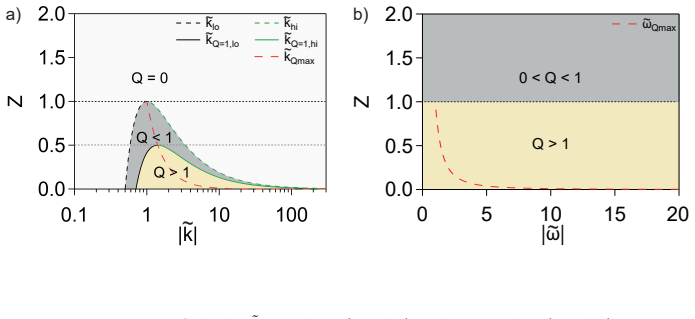
The argument is carried by the Jeffreys-type temperature equation obtained from a first-order Taylor expansion of the DPL constitutive relation $\mathbf{q}(t+\tau_q)=-\kappa_T\nabla T(t+\tau_T)$ combined with energy conservation: $(\tau_q/\alpha)\partial_t^2 T-\partial_x^2 T+\alpha^{-1}\partial_t T-\tau_T\partial_t\partial_x^2 T=0$. In dimensionless form it becomes the complex dispersion relation $\tilde{k}^2(1+iZ\tilde{\omega})=\tilde{\omega}^2(1-i/\tilde{\omega})$, with $Z=\tau_T/\tau_q$. The authors solve this relation in two complementary scenarios—real $\tilde{k}$ with complex $\tilde{\omega}$ (spatial pulse) and real $\tilde{\omega}$ with complex $\tilde{k}$ (forced oscillation)—and define the modal quality factor $Q=|\tilde{\omega}_1|/\tilde{\omega}_2$ (or $Q=|\tilde{k}_1|/|\tilde{k}_2|$) to classify modes. The $Q$-factor is what turns the model into a filter picture: it yields the cutoff wavevectors, the optimal wavevector or frequency, and the maximum attainable quality factor.
What would settle it
Measure the temperature-wave dispersion in graphite at 80 K with transient gratings spanning the predicted passband, especially near the predicted optimum $k=4.3\times10^6\,\mathrm{m^{-1}}$ (period $1.5\,\mu\mathrm{m}$): if no peak in $Q$ appears near that wavevector, or if oscillations persist beyond the predicted upper cutoff $\tilde{k}_{\mathrm{hi}}$, the bandpass picture fails. A more direct check is to measure the Normal and Umklapp phonon lifetimes below 100 K; if $Z=\tau_N/\tau_U$ is not near $1.7\times10^{-3}$, the paper's graphite parameter identification is wrong.
Extended reading notes
Core claim
The central discovery is that the first-order DPL model, although it is a parabolic Jeffreys-type equation, supports genuinely wave-like temperature propagation only inside a finite window of wavevectors, and the window is fixed by the ratio $Z=\tau_T/\tau_q$. For a localized temperature pulse, oscillatory modes with complex $\tilde{\omega}$ and real $\tilde{k}$ exist when $0<Z<1$, and underdamped motion ($Q>1$) occurs only for $0<Z<1/2$, with wavevectors in the passband $\tilde{k}_{Q=1,\mathrm{lo}}<|\tilde{k}|<\tilde{k}_{Q=1,\mathrm{hi}}$. The quality factor reaches its single maximum $Q_{\max}=\sqrt{1/Z-1}$ at $|\tilde{k}|=Z^{-1/2}$; in the forced-oscillation scenario the analogous maximum is $Q_{\max}=Z^{-1/2}$ at $|\tilde{\omega}|=Z^{-1/2}$. In the Cattaneo–Vernotte limit $Z\to0$, the pulse scenario becomes a high-pass filter and the maximum $Q$ diverges. Fitting the graphite transient-grating data with $\tau_T=3\,\mathrm{ps}$ and $\tau_q=1.8\,\mathrm{ns}$ gives $Z=1.7\times10^{-3}$, reproduces the measured dispersion, and yields $Q=2.7$ and $3.3$ for the two dark modes, values the paper argues explain their non-detection.
Load-bearing premise
The load-bearing premise is that the first-order Taylor-expanded dual-phase-lag constitutive equation, rather than the exact DPL relation or some other non-Fourier model, correctly describes heat transport in the materials considered, because only that truncation produces the Jeffreys equation whose passband and Q-factor are analyzed.
Editorial extensions
If this is right
- For graphite at 80 K, the fitted delays set $Z=1.7\times10^{-3}$, so the best-accessible temperature wave sits at $k=4.3\times10^6\,\mathrm{m^{-1}}$ (grating period $1.5\,\mu\mathrm{m}$), with $Q=25$ and oscillation times in the 0.4–10 ns window.
- The two dark modes of the transient-grating experiment fall inside the passband but at low $Q$ (2.7 and 3.3), which the paper argues is why they were not detected.
- In the Cattaneo–Vernotte limit $Z=0$, the pulse scenario becomes a high-pass filter with no upper cutoff; a nonzero $\tau_T$ creates the upper cutoff $\tilde{k}_{\mathrm{hi}}$.
- For solid helium at 0.6 K the same formulas give $Q\approx100$ at $\lambda\approx600\,\mu\mathrm{m}$, and for strongly correlated oxides and iridates they give $Q\approx4$ and $Q\approx100$ on picosecond/nanometer scales, pointing to all-solid-state thermal nanodevices.
- The authors state that the same analysis transfers to mass transport through the generalized Fick law, so mass-density wave-like oscillations should obey the same bandpass conditions.
Reading between the lines
- A testable design rule implicit in the paper: match the excitation periodicity to $k_{Q\max}=(\alpha\tau_q Z)^{-1/2}$, because the passband narrows as $Z$ approaches $1/2$ and the highest-$Q$ mode sits at that wavevector.
- If the graphite parameter identification is right, directly measuring Normal and Umklapp phonon lifetimes below 100 K should give $Z=\tau_N/\tau_U\approx1.7\times10^{-3}$, confirming the picture without fitting.
- Because the two excitation scenarios coincide only for $Q\ge5$, low-$Q$ experiments must choose the pulse or forced-oscillation formulation that matches their geometry; the paper's comparison shows where the difference matters.
- The dual-phase-lag mass-transport analog could be tested in two-phase composites whose $Z$ is tunable by volume fraction and phase thermal conductivities, looking for a passband in mass-density waves.
Signed reviews
Editorial analysis
A structured set of objections, weighed in public.
Referee Report
Summary. The manuscript analyzes the first-order Taylor-expanded dual-phase-lag (DPL) heat-conduction model, which reduces to a Jeffreys-type equation for the temperature field. It derives the complex dispersion relation for two excitation scenarios: a spatially localized temperature pulse (complex frequency, real wavevector) and a forced temporal oscillation (real frequency, complex wavevector). A modal quality factor Q is introduced, and the paper shows that for the spatial-pulse case the system behaves as a bandpass filter in wavevector when Z = tau_T/tau_q is in (0,1/2), with explicit formulas for the passband edges and for the maximum Q. The forced-oscillation case is shown to have a resonant Q maximum at omega = Z^{-1/2}. The results are applied to several material systems, most prominently to graphite, where the model is fitted to the transient thermal grating data of Huberman et al. and used to rationalize the two unobserved 'dark' modes as low-Q modes. The paper also surveys quantum materials and proposes design criteria for thermal nanodevices.
Significance. The analytical core of the paper is a useful contribution. The derivation from Eq. (5) to Eqs. (13)-(18) and (22)-(26) is internally consistent, and the paper provides explicit, closed-form expressions for the bandpass edges and maximum Q-factor that could be readily used by experimentalists. The comparison between the two excitation scenarios (Figs. 5-6) is instructive, and the breadth of the application section gives the formalism practical visibility. The authors are also careful to qualify the 'wave-like' nature of the solutions of a parabolic equation. However, the physical conclusions rest on two assumptions that need substantially more support: the first-order Taylor truncation of the DPL equation is conceded in footnote 1 not to be equivalent to the exact DPL model, and the graphite validation fits the two delay times to the very data that the model then claims to explain. These issues affect the central claims of the paper, but they are addressable with additional analysis and reframing.
major comments (3)
- [Footnote 1 and Eqs. (4)-(20)] The central bandpass result, including Eqs. (16), (18), and (20), is a property of the Jeffreys equation (4), not of the DPL model as such. Footnote 1 concedes that the exact DPL model is equivalent to a single-phase-lag model and that first-order Taylor expansion of DPL and of the single-phase-lag model yield different constitutive equations. The manuscript does not state the range of Z, omega, or k over which the first-order Jeffreys equation faithfully approximates the exact DPL dynamics, nor does it bound the error introduced by the truncation. Without this characterization, the claim that the DPL model predicts a bandpass filter for temperature waves is not fully established. At minimum, the paper should reframe its claims as predictions of the first-order Jeffreys surrogate and provide a quantitative criterion for the validity of the truncation.
- [Section 6, Fig. 7] The graphite case study is circular in its current form. The paper fits tau_T and tau_q to the Huberman et al. experimental omega(k) points and then uses the same fitted values to compute the theoretical dispersion curve and the Q values (2.7 and 3.3) that 'explain' the two dark modes. The agreement therefore does not constitute an independent validation of the model. The authors state that the fitted delays are 'consistent' with expectations from Fig. 8, but this consistency is not quantified. I recommend an out-of-sample test, a propagation of fit uncertainties, or an independent determination of tau_T and tau_q from microscopic data with error bars before the graphite rationalization is used as evidence for the model.
- [Section 6, Fig. 8 and Table 1] The identification tau_T = tau_N and tau_q = tau_U is an ad hoc modeling assumption that is load-bearing for the graphite analysis, and the quantitative support is questionable. The scattering times from graphene are extrapolated from 100 K down to 80 K, while the cited Huberman et al. experiment is titled and reported at temperatures above 100 K. The manuscript states the experiment was performed at 80 K, but the reference says otherwise. This inconsistency needs to be resolved, and the extrapolation should be justified with an estimate of its uncertainty. As written, the values used for the graphite predictions rest on an assumption that may point at the wrong temperature regime.
minor comments (5)
- [Eq. (20)] The displayed formula for k_{Q=1,lo(hi)} is difficult to parse and appears to have a typographical error. Solving Q=1 from Eq. (16) gives k_{Q=1,lo(hi)} = sqrt((1-Z - sqrt(1-2Z))/Z^2) for the lower edge and the corresponding plus-sign expression for the upper edge; the denominator should be Z^2. Please correct the formula and clarify the sign convention.
- [Section 6, paragraph on dark modes] The two dark-mode wavevectors are given as 2.5 x 10^-5 m^-1 and 3 x 10^-5 m^-1, but the grating periodicities quoted in the same paragraph correspond to k = 2.56 x 10^5 m^-1 and 3.0 x 10^5 m^-1. The exponent sign is evidently a typo and should be fixed.
- [Table 1 and Fig. 7] The graphite parameters tau_T = 3 ps and tau_q = 1.8 ns are fit results, yet no uncertainties or confidence intervals are reported. Given that the Q values for the dark modes are derived from these parameters, the absence of error bars makes it difficult to judge whether the Q difference between observed and dark modes is statistically meaningful.
- [Section 3 and 4, definition of Q] The modal quality factor is defined as Q = |omega_1|/omega_2 for the spatial-pulse case and Q = |k_1|/|k_2| for the forced case. This differs from the conventional oscillator quality factor by a factor of 2 (where Q = omega_0/(2 gamma) for e^{-gamma t} cos(omega_0 t)). The convention is internally consistent, but it should be stated explicitly so that readers do not compare these values directly with literature Q factors without conversion.
- [Conclusions] There are a few typographical issues in the final sections, including 'graphine' instead of 'graphene' and 'Aknowledgements' instead of 'Acknowledgements'. These do not affect the technical content.
Circularity Check
Core DPL dispersion and Q-factor derivations are self-contained, but the graphite case study fits tau_T and tau_q to Huberman's omega(k) data and then reuses those same fitted parameters to 'validate' the dispersion, compute Q(k), and compare group velocity, making that application partially circular.
-
fitted input called prediction
[Section 6, graphite case study (after Eq. 16; Figure 7 caption and text following 'we then fit the experimental data of Huberman et al.')]
"we then fit the the experimental data of Huberman et al. via the ω1 vs k dispersion given by Equation 15 (i.e. with the dispersion relation for the case ω˜∈C and k˜∈R) with dimensional variables restored and τT and τQ as fitting parameters. ... The best fit values are found to be τT = 3 ps and τQ=1.8 ns ... The theoretical ω1 vs k dispersion, with the optimal fit parameters inserted, is plotted as a full blue line ... The theoretical ω1 vs k dispersion very well fits the experimental one. ..."
The two delay times are the only free parameters of the fitted dispersion curve, so the statement that Eq. 15 'very well fits' the measured ω1(k) is a report of fit quality, not an independent prediction. The same fitted τT and τQ are then inserted into Eq. 16 to generate the Q(k) curve, including Qmax=25, the pass-band, and the dark-mode values Q=2.7 and 3.3, and into Eq. 21 to obtain vg=3300 m/s for comparison with the measured ~3200 m/s. That group velocity is the derivative of the fitted dispersion curve, so the 3% agreement is an inherited property of the fit rather than an independent check.
full rationale
The analytical core of the paper, Sections 3-5, is not circular: starting from the first-order DPL constitutive equation (Eq. 2) and energy conservation (Eq. 3), the Jeffreys equation (Eq. 4) is derived, and Eqs. (6), (13)-(20), (24)-(26) follow algebraically from the complex exponential ansatz with no fitted parameters. The bandpass edges, the maximum Q expression, and the CV high-pass limit are genuine consequences of the model, not disguised inputs. The self-citation to the authors' earlier work [33] is used only to supply illustrative material parameters for BiSCOO and iridates in Table 1; it is not load-bearing for the central derivation and therefore does not by itself raise the circularity score. Footnote 1 is an honest caveat that the exact DPL model is equivalent to a single-phase-lag model and that only the first-order Taylor expansion produces the Jeffreys equation; this is a modeling assumption about which truncation to use, not a circular step. The circularity concern is confined to the graphite case study in Section 6: tau_T and tau_q are fitted to Huberman's measured omega(k) data, and the same values are then used to plot the 'theoretical' dispersion, compute Q(k) including the dark-mode Q values, and compare the derivative group velocity to experiment. The fit cannot validate the model it was used to calibrate, so those comparisons are partially circular even though the dark-mode Q values are out-of-sample in the sense that no Q data were fitted. Because the central dispersion/Q-factor formalism is derived rather than fitted, the paper is not 8-10 on the circularity scale; because the headline graphite predictions are entangled with the fit, it is not 0-2. A score of 5 reflects this partial, application-level circularity.
Assumptions & free parameters
free parameters (2)
- tau_q (heat flux delay time, graphite fit) =
1.8 ns
- tau_T (temperature gradient delay time, graphite fit) =
3 ps
assumptions (4)
- domain assumption First-order Taylor expansion of the DPL constitutive equation (Eq. 2) governs the systems addressed.
- domain assumption Small temperature variations so kappa_T and C are constant.
- ad hoc to paper For graphite, tau_T=tau_N and tau_q=tau_U (normal and Umklapp phonon scattering times).
- domain assumption Phonon scattering data from graphene are representative of in-plane graphite phonon dynamics.
Cite this review
Pith. "Pith review of Accessing temperature waves: a dispersion relation perspective." pith.science (2026). https://pith.science/paper/QM3KJR35
@misc{pith2026190807612,
  author       = {Pith},
  title        = {Pith review of: Accessing temperature waves: a dispersion relation perspective},
  year         = {2026},
  howpublished = {\url{https://pith.science/paper/QM3KJR35}},
  note         = {Machine review of arXiv:1908.07612}
}
read the original abstract
In order to account for non-Fourier heat transport, occurring on short time and length scales, the often-praised Dual-Phase-Lag (DPL) model was conceived, introducing a causality relation between the onset of heat flux and the temperature gradient. The most prominent aspect of the first-order DPL model is the prediction of wave-like temperature propagation, the detection of which still remains elusive. Among the challenges to make further progress is the capability to disentangle the intertwining of the parameters affecting wave-like behaviour. This work contributes to the quest, providing a straightforward, easy-to-adopt, analytical mean to inspect the optimal conditions to observe temperature wave oscillations. The complex-valued dispersion relation for the temperature scalar field is investigated for the case of a localised temperature pulse in space, and for the case of a forced temperature oscillation in time. A modal quality factor is introduced showing that, for the case of the temperature gradient preceding the heat flux, the material acts as a bandpass filter for the temperature wave. The bandpass filter characteristics are accessed in terms of the relevant delay times entering the DPL model. The optimal region in parameters space is discussed in a variety of systems, covering nine and twelve decades in space and time-scale respectively. The here presented approach is of interest for the design of nanoscale thermal devices operating on ultra-fast and ultra-short time scales, a scenario here addressed for the case of quantum materials and graphite.
Figures


Figures from the paper (5 more)


Reference graph
Works this paper leans on
-
[1]
Fourier, Theorie analytique de la chaleur, par M
J. Fourier, Theorie analytique de la chaleur, par M. Fourier, Chez Firmin Didot, p` ere et fils, 1822
-
[2]
S. Huberman, R. A. Duncan, K. Chen, B. Song, V. Chiloyan, Z. Ding, A. A. Maznev, G. Chen, K. A. Nelson, Observation of second sound in graphite at temperatures above 100 k, Science 364 (6438) (2019) 375–379. doi:10.1126/science.aav3548
-
[3]
C. Ackerman, R. Guyer, Temperature pulses in dielectric solids, Annals of Physics 50 (1) (1968) 128–185
work page 1968
-
[4]
D. G. Cahill, W. K. Ford, K. E. Goodson, G. D. Mahan, A. Majumdar, H. J. Maris, R. Merlin, S. R. Phillpot, Nanoscale thermal transport, Journal of Applied Physics 93 (2) (2003) 793–818. doi:10.1063/1.1524305
-
[5]
D. G. Cahill, P. V. Braun, G. Chen, D. R. Clarke, S. Fan, K. E. Good- son, P. Keblinski, W. P. King, G. D. Mahan, A. Majumdar, H. J. Maris, S. R. Phillpot, E. Pop, L. Shi, Nanoscale thermal transport. ii. 2003-2012, Applied Physics Reviews 1 (1) (2014) 011305. doi:10.1063/1.4832615
-
[6]
S. Volz, J. Ordonez-Miranda, A. Shchepetov, M. Prunnila, J. Ahopelto, T. Pezeril, G. Vaudel, V. Gusev, P. Ruello, E. M. Weig, M. Schu- bert, M. Hettich, M. Grossman, T. Dekorsy, F. Alzina, B. Graczykowski, E. Chavez-Angel, J. Sebastian Reparaz, M. R. Wagner, C. M. Sotomayor- Torres, S. Xiong, S. Neogi, D. Donadio, Nanophononics: state of the art and persp...
doi:10.1140/epjb/ 2016
-
[7]
D. Jou, V. A. Cimmelli, Constitutive equations for heat conduction in nanosystems and nonequilibrium processes: an overview, Communications in Applied and Industrial Mathematics 7 (2) (2016) 196–222
work page 2016
-
[8]
D. Y. Tzou, Macro-to microscale heat transfer: the lagging behavior, John Wiley & Sons, 2014
work page 2014
Show all 71 references
-
[9]
Vermeersch, N
B. Vermeersch, N. Mingo, Quasiballistic heat removal from small sources studied from first principles, Phys. Rev. B 97 (2018) 045205. doi:10.1103/ PhysRevB.97.045205
2018
-
[10]
Cattaneo, Sulla conduzione del calore, Atti Sem
C. Cattaneo, Sulla conduzione del calore, Atti Sem. Mat. Fis. Univ. Modena 3 (1948) 83–101
1948
-
[11]
Cattaneo, A form of heat-conduction equations which eliminates the paradox of instantaneous propagation, Comptes Rendus 247 (1958) 431
C. Cattaneo, A form of heat-conduction equations which eliminates the paradox of instantaneous propagation, Comptes Rendus 247 (1958) 431
1958
-
[12]
Vernotte, Les paradoxes de la theorie continue de l’equation de la chaleur, Compt
P. Vernotte, Les paradoxes de la theorie continue de l’equation de la chaleur, Compt. Rendu 246 (1958) 3154–3155
1958
-
[13]
Vernotte, Some possible complications in the phenomena of thermal conduction, Compte Rendus 252 (1961) 2190–2191
P. Vernotte, Some possible complications in the phenomena of thermal conduction, Compte Rendus 252 (1961) 2190–2191
1961
-
[14]
D. D. Joseph, L. Preziosi, Heat waves, Rev. Mod. Phys. 61 (1989) 41–73. doi:10.1103/RevModPhys.61.41
1989 doi
-
[15]
D. Y. Tzou, A unified field approach for heat conduction from macro-to micro-scales, Journal of Heat Transfer 117 (1) (1995) 8–16
1995
-
[16]
D. Y. Tzou, The generalized lagging response in small-scale and high-rate heating, International Journal of Heat and Mass Transfer 38 (17) (1995) 3231–3240
1995
-
[17]
D. Y. Tzou, Experimental support for the lagging behavior in heat propa- gation, Journal of Thermophysics and Heat Transfer 9 (4) (1995) 686–693. 35
1995
-
[18]
Ord´ o˜ nez-Miranda, J
J. Ord´ o˜ nez-Miranda, J. J. Alvarado-Gil, Exact solution of the dual-phase- lag heat conduction model for a one-dimensional system excited with a periodic heat source, Mechanics Research Communications 37 (3) (2010) 276 – 281. doi:10.1007/s10035-010-0195-6
2010 doi
-
[19]
D. Tang, N. Araki, Wavy, wavelike, diffusive thermal responses of finite rigid slabs to high-speed heating of laser-pulses, International Journal of Heat and Mass Transfer 42 (5) (1999) 855–860
1999
-
[20]
Guyer, K
R. Guyer, K. J.A., Solution of the linearized boltzmann equation, Physical Review 148 (1966) 766–778
1966
-
[21]
Torres, A
P. Torres, A. Ziabari, A. Torell´ o, J. Bafaluy, J. Camacho, X. Cartoix` a, A. Shakouri, F. Alvarez, Emergence of hydrodynamic heat transport in semiconductors at the nanoscale, Physical Review Materials 2 (7) (2018) 076001
2018
-
[22]
K. M. Hoogeboom-Pot, J. N. Hernandez-Charpak, X. Gu, T. D. Frazer, E. H. Anderson, W. Chao, R. W. Falcone, R. Yang, M. M. Murnane, H. C. Kapteyn, et al., A new regime of nanoscale thermal transport: Collec- tive diffusion increases dissipation efficiency, Proceedings of the Natio...
2015
-
[23]
T. D. Frazer, J. L. Knobloch, K. M. Hoogeboom-Pot, D. Nardi, W. Chao, R. W. Falcone, M. M. Murnane, H. C. Kapteyn, J. N. Hernandez-Charpak, Engineering nanoscale thermal transport: Size- and spacing-dependent cooling of nanostructures, Phys. Rev. Applied 11 (2019) 024042. doi:...
2019 doi
-
[24]
J. A. Johnson, A. A. Maznev, J. Cuffe, J. K. Eliason, A. J. Minnich, T. Kehoe, C. M. S. Torres, G. Chen, K. A. Nelson, Direct measure- ment of room-temperature nondiffusive thermal transport over micron distances in a silicon membrane, Phys. Rev. Lett. 110 (2013) 025901. doi:10....
2013 doi
-
[25]
T. Q. Qiu, C. L. Tien, Heat transfer mechanisms during short-pulse laser heating of metals, Journal of Heat Transfer 115 (4) (1993) 835. doi:10. 1115/1.2911377
1993
-
[26]
S. D. Brorson, J. G. Fujimoto, E. P. Ippen, Femtosecond electronic heat- transport dynamics in thin gold films, Phys. Rev. Lett. 59 (1987) 1962–
1987
-
[28]
Ord´ o˜ nez-Miranda, J
J. Ord´ o˜ nez-Miranda, J. Alvarado-Gil, Thermal characterization of granular materials using a thermal-wave resonant cavity under the dual-phase lag model of heat conduction, Granular Matter 12 (2010) 569–577. doi:10. 1007/s10035-010-0195-
2010
-
[29]
L. Wang, X. Wei, Heat conduction in nanofluids, Chaos, Solitons and Frac- tals 39 (5) (2009) 2211–2215. doi:10.1016/j.chaos.2007.06.072
2009 doi
-
[30]
Khayat, J
R. Khayat, J. DeBruyn, M. Niknami, D. Stranges, R. Khorasany, Non- fourier effects in macro- and micro-scale non-isothermal flow of liquids and gases. review, International Journal of Thermal Sciences 97 (2015) 163–177. doi:10.1038/ncomms7290
2015 doi
-
[31]
C. Li, J. Miao, K. Yang, X. Guo, J. Tu, P. Huang, D. Zhang, Fourier and non-fourier bio-heat transfer models to predict ex vivo temperature response to focused ultrasound heating, Journal of Applied Physics 123 (17) (2018). doi:10.1063/1.5022622
2018 doi
-
[32]
M. V. Fran¸ ca, H. R. B. Orlande, Estimation of parameters of the dual- phase-lag model for heat conduction in metal-oxide-semiconductor field- effect transistors, International Communications in Heat and Mass Transfer 92 (2018) 107 – 111. 37
2018
-
[33]
Gandolfi, G
M. Gandolfi, G. L. Celardo, F. Borgonovi, G. Ferrini, A. Avella, F. Banfi, C. Giannetti, Emergent ultrafast phenomena in correlated oxides and heterostructures, Physica Scripta 92 (3) (2017) 034004. doi:10.1088/ 1402-4896/aa54cc
2017
-
[34]
L. Li, L. Zhou, M. Yang, An expanded lattice boltzmann method for dual phase lag model, International Journal of Heat and Mass Transfer 93 (2016) 834–838
2016
-
[35]
T. T. Lam, E. Fong, Heat diffusion vs. wave propagation in solids subjected to exponentially-decaying heat source: analytical solution, International Journal of Thermal Sciences 50 (11) (2011) 2104–2116
2011
-
[36]
T. T. Lam, A unified solution of several heat conduction models, Interna- tional Journal of Heat and Mass Transfer 56 (1-2) (2013) 653–666
2013
-
[37]
Tzou, Z.-Y
D. Tzou, Z.-Y. Guo, Nonlocal behavior in thermal lagging, International Journal of Thermal Sciences 49 (7) (2010) 1133–1137
2010
-
[38]
Ramadan, Semi-analytical solutions for the dual phase lag heat con- duction in multilayered media, International Journal of Thermal Sciences 48 (1) (2009) 14–25
K. Ramadan, Semi-analytical solutions for the dual phase lag heat con- duction in multilayered media, International Journal of Thermal Sciences 48 (1) (2009) 14–25
2009
-
[39]
Zhang, B.-Y
M.-K. Zhang, B.-Y. Cao, Y.-C. Guo, Numerical studies on dispersion of thermal waves, International Journal of Heat and Mass Transfer 67 (2013) 1072–1082
2013
-
[40]
M. Xu, J. Guo, L. Wang, L. Cheng, Thermal wave interference as the origin of the overshooting phenomenon in dual-phase-lagging heat conduction, International Journal of Thermal Sciences 50 (5) (2011) 825–830
2011
-
[41]
Ordonez-Miranda, J
J. Ordonez-Miranda, J. Alvarado-Gil, Thermal wave oscillations and ther- mal relaxation time determination in a hyperbolic heat transport model, International Journal of Thermal Sciences 48 (11) (2009) 2053–2062. 38
2009
-
[42]
Torii, W.-J
S. Torii, W.-J. Yang, Heat transfer mechanisms in thin film with laser heat source, International journal of heat and mass transfer 48 (3-4) (2005) 537–544
2005
-
[43]
Ramadan, M
K. Ramadan, M. Al-Nimr, Analysis of transient heat transfer in multi- layer thin films with nonlinear thermal boundary resistance, International Journal of Thermal Sciences 48 (9) (2009) 1718–1727
2009
-
[45]
Singh, E
A. Singh, E. B. Tadmor, Thermal parameter identification for non-fourier heat transfer from molecular dynamics, Journal of Computational Physics 299 (2015) 667 – 686. doi:https://doi.org/10.1016/j.jcp.2015.07. 008
2015 doi
-
[46]
A. H. Akbarzadeh, Y. Cui, Z. T. Chen, Thermal wave: from nonlocal continuum to molecular dynamics, RSC Advances 7 (2017) 13623–13636. doi:10.1039/C6RA28831F
2017 doi
-
[47]
Ord´ o˜ nez-Miranda, J
J. Ord´ o˜ nez-Miranda, J. J. Alvarado-Gil, Frequency-modulated hyperbolic heat transport and effective thermal properties in layered systems, Inter- national Journal of Thermal Sciences 49 (1) (2010) 209 – 217. doi:https: //doi.org/10.1016/j.ijthermalsci.2009.07.005
2010 doi
-
[48]
Grosso, G
G. Grosso, G. Parravicini, Solid State Physics, Elsevier Science, 2000
2000
-
[49]
Tamura, D
S. Tamura, D. C. Hurley, J. P. Wolfe, Acoustic-phonon propagation in superlattices, Physical Review B 38 (1988) 1427–1449. doi:10.1103/ PhysRevB.38.1427
1988
-
[50]
Giannetti, F
C. Giannetti, F. Banfi, D. Nardi, G. Ferrini, F. Parmigiani, Ultrafast laser pulses to detect and generate fast thermomechanical transients in matter, 39 IEEE Photonics Journal 1 (1) (2009) 21–32. doi:10.1109/JPHOT.2009. 2025050
2009 doi
-
[51]
Travagliati, D
M. Travagliati, D. Nardi, C. Giannetti, V. Gusev, P. Pingue, V. Piazza, G. Ferrini, F. Banfi, Interface nano-confined acoustic waves in polymeric surface phononic crystals, Applied Physics Letters 106 (2) (2015). doi: 10.1063/1.4905850
2015 doi
-
[52]
Cepellotti, G
A. Cepellotti, G. Fugallo, L. Paulatto, M. Lazzeri, F. Mauri, N. Marzari, Phonon hydrodynamics in two-dimensional materials, Nature communica- tions 6 (2015) 6400
2015
-
[53]
P. J. Antaki, New interpretation of non-fourier heat conduction in processed meat, Journal of Heat Transfer 127 (2) (2005) 189–193
2005
-
[54]
Roetzel, N
W. Roetzel, N. Putra, S. K. Das, Experiment and analysis for non-fourier conduction in materials with non-homogeneous inner structure, Interna- tional Journal of Thermal Sciences 42 (6) (2003) 541 – 552. doi:https: //doi.org/10.1016/S1290-0729(03)00020-6
2003 doi
-
[55]
Liu, Y.-S
K.-C. Liu, Y.-S. Chen, Analysis of heat transfer and burn damage in a laser irradiated living tissue with the generalized dual-phase-lag model, International Journal of Thermal Sciences 103 (2016) 1–9
2016
-
[56]
Y. Zhang, Generalized dual-phase lag bioheat equations based on nonequi- librium heat transfer in living biological tissues, International Journal of Heat and Mass Transfer 52 (21-22) (2009) 4829–4834
2009
-
[57]
Afrin, J
N. Afrin, J. Zhou, Y. Zhang, D. Tzou, J. Chen, Numerical simulation of thermal damage to living biological tissues induced by laser irradiation based on a generalized dual phase lag model, Numerical Heat Transfer, Part A: Applications 61 (7) (2012) 483–501
2012
-
[58]
S. H. Chun, K. Jong-Woo, J. Kim, H. Zheng, C. C. Stoumpos, C. D. Malliakas, J. F. Mitchell, K. Mehlawat, Y. Singh, Y. Choi, T. Gog, A. Al- Zein, M. M. Sala, M. Krisch, J. Chaloupka, G. Jackeli, G. Khaliullin, 40 B. J. Kim, Direct evidence for dominant bond-directional interact...
2015 doi
-
[59]
Nembrini, S
N. Nembrini, S. Peli, F. Banfi, G. Ferrini, Y. Singh, P. Gegenwart, R. Comin, K. Foyevtsova, A. Damascelli, A. Avella, C. Giannetti, Track- ing local magnetic dynamics via high-energy charge excitations in a rel- ativistic mott insulator, Physical Review B 94 (2016) 201119. doi...
2016 doi
-
[60]
Ziman, Electrons and Phonons, the Theory of Transport Phenomena in Solids, Oxford University Press, 2001
J. Ziman, Electrons and Phonons, the Theory of Transport Phenomena in Solids, Oxford University Press, 2001
2001
-
[61]
Fugallo, A
G. Fugallo, A. Cepellotti, L. Paulatto, M. Lazzeri, N. Marzari, F. Mauri, Thermal conductivity of graphene and graphite: collective excitations and mean free paths, Nano letters 14 (11) (2014) 6109–6114
2014
-
[62]
H. O. Pierson, Handbook of carbon, graphite, diamonds and fullerenes: processing, properties and applications, William Andrew, 2012
2012
-
[63]
DeSorbo, W
W. DeSorbo, W. Tyler, The specific heat of graphite from 13 to 300 k, The Journal of Chemical Physics 21 (10) (1953) 1660–1663
1953
-
[64]
A. J. Minnich, Multidimensional quasiballistic thermal transport in tran- sient grating spectroscopy, Physical Review B 92 (2015) 085203. doi: 10.1103/PhysRevB.92.085203
2015 doi
-
[65]
Bencivenga, R
F. Bencivenga, R. Mincigrucci, F. Capotondi, L. Foglia, D. Naumenko, A. A. Maznev, E. Pedersoli, A. Simoncig, F. Caporaletti, V. Chiloyan, R. Cucini, F. Dallari, R. A. Duncan, T. D. Frazer, G. Gaio, A. Gessini, L. Giannessi, S. Huberman, H. Kapteyn, J. Knobloch, G. Kurdi, N. M...
2019
-
[66]
Aichlmayr, F
H. Aichlmayr, F. Kulacki, The effective thermal conductivity of saturated porous media, Vol. 39 of Advances in Heat Transfer, Elsevier, 2006, pp. 377 – 460. doi:https://doi.org/10.1016/S0065-2717(06)39004-1
2006 doi
-
[67]
Peterson, C
G. Peterson, C. Li, Heat and mass transfer in fluids with nanoparticle suspensions, Vol. 39 of Advances in Heat Transfer, Elsevier, 2006, pp. 257 – 376. doi:https://doi.org/10.1016/S0065-2717(06)39003-X
2006 doi
-
[68]
L. Wang, X. Wei, Equivalence between dual-phase-lagging and two-phase- system heat conduction processes, International Journal of Heat and Mass Transfer 51 (7) (2008) 1751 – 1756. doi:https://doi.org/10.1016/j. ijheatmasstransfer.2007.07.013
2008 doi
-
[69]
S. Peli, E. Cavaliere, G. Benetti, M. Gandolfi, M. Chiodi, C. Cancellieri, C. Giannetti, G. Ferrini, L. Gavioli, F. Banfi, Mechanical properties of Ag nanoparticle thin films synthesized by supersonic cluster beam deposition, The Journal of Physical Chemistry C 120 (8) (2016) 467...
2016 doi
-
[70]
Benetti, C
G. Benetti, C. Caddeo, C. Melis, G. Ferrini, C. Giannetti, N. Winckel- mans, S. Bals, M. J. Van Bael, E. Cavaliere, L. Gavioli, et al., Bottom-up mechanical nanometrology of granular Ag nanoparticles thin films, The Journal of Physical Chemistry C 121 (40) (2017) 22434–22441. d...
2017 doi
-
[71]
Benetti, M
G. Benetti, M. Gandolfi, M. J. Van Bael, L. Gavioli, C. Giannetti, C. Cad- deo, F. Banfi, Photoacoustic sensing of trapped fluids in nanoporous thin films: device engineering and sensing scheme, ACS Applied Materials & Interfaces 10 (33) (2018) 27947–27954. doi:10.1021/acsami.8b07925
2018 doi
-
[72]
Benetti, E
G. Benetti, E. Cavaliere, R. Brescia, S. Salassi, R. Ferrando, A. Vantomme, L. Pallecchi, S. Pollini, S. Boncompagni, B. Fortuni, et al., Tailored Ag–Cu– 42 Mg multielemental nanoparticles for wide-spectrum antibacterial coating, Nanoscale 11 (4) (2019) 1626–1635. doi:10.1039/...
2019 doi
-
[1965]
doi:10.1103/PhysRevLett.59.1962
1962 doi
Reviewed August 14, 2026 · model on record in the stance chip above.
Discussion (0). Continue with ORCID to comment.