REVIEW 3 major objections 5 minor 59 references
Coupled rate-equation hydrodynamic simulation of a Rydberg gas Gaussian ellipsoid: Classical avalanche and evolution to molecular plasma
T0 review · 3 major / 5 minor · reviewed 2026-08-14 · deepseek-v4-flash
Pith's one-line read A purely classical simulation of a molecular Rydberg gas cannot reproduce the experimentally observed ultracold plasma state.
desk verdict The 'no classical explanation' claim overreaches: the model omits resonant charge transfer, and only two initial conditions are tested. read the letter →
The pith
A machine-rendered reading of the paper's core claim, the machinery that carries it, and where it could break.
The reading
What carries the argument
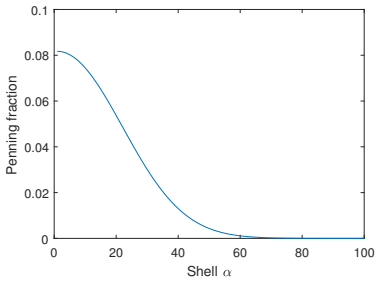
The carrying object is a shell-model coupled rate-equation code: a Gaussian ellipsoid divided into 100 uniform-density shells, each evolving its own Rydberg-level populations and electron density via the rate equations, with one globally shared electron temperature fixed by total energy conservation and an optional quasi-self-similar ambipolar expansion. The avalanche is seeded by the closed-form Penning density $\rho_e(\rho_0,n_0) = (0.9\rho_0/2)(1-e^{-4\pi \rho_0 r_c^3/3})$ from nearest-neighbor pairs within the critical radius $r_c = 1.8\cdot 2n_0^2 a_0$. Rate constants for ionization, three-body recombination, and $n$-changing collisions come from Monte Carlo trajectory simulations, dissociative recombination is a power law in $T_e$, and predissociation is a state-dependent decay with an $n^{-3}$ scaling and $l$-dependent core rates. The shell structure is what allows low-density wings, which predissociate before ionizing, to act as a heat reservoir and slow the global temperature rise, while the expansion step is what converts electron thermal energy into ion radial motion, producing the ballistic velocities that experiments contradict.
What would settle it
Run the same shell-model code with molecular-specific NO rate constants, including rotational and l-changing effects, and scan initial conditions; if any physically motivated combination reproduces the measured 15–30 m/s expansion and survival beyond 1 ms, the paper's central claim is falsified.
Extended reading notes
Core claim
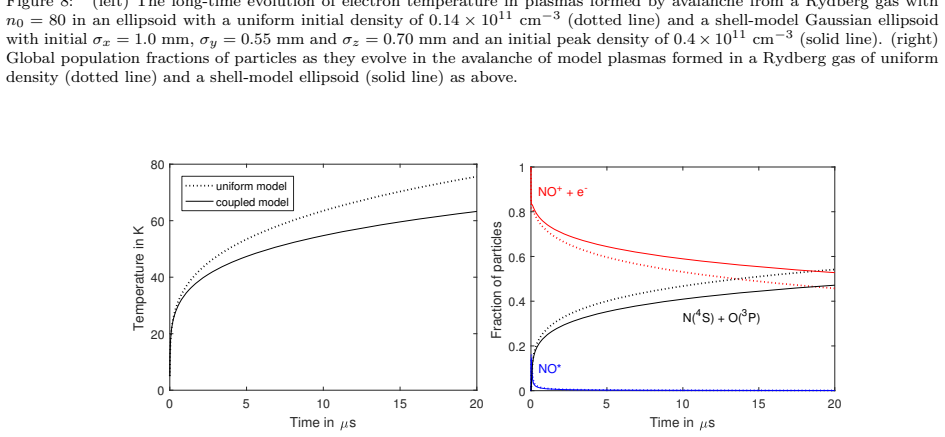
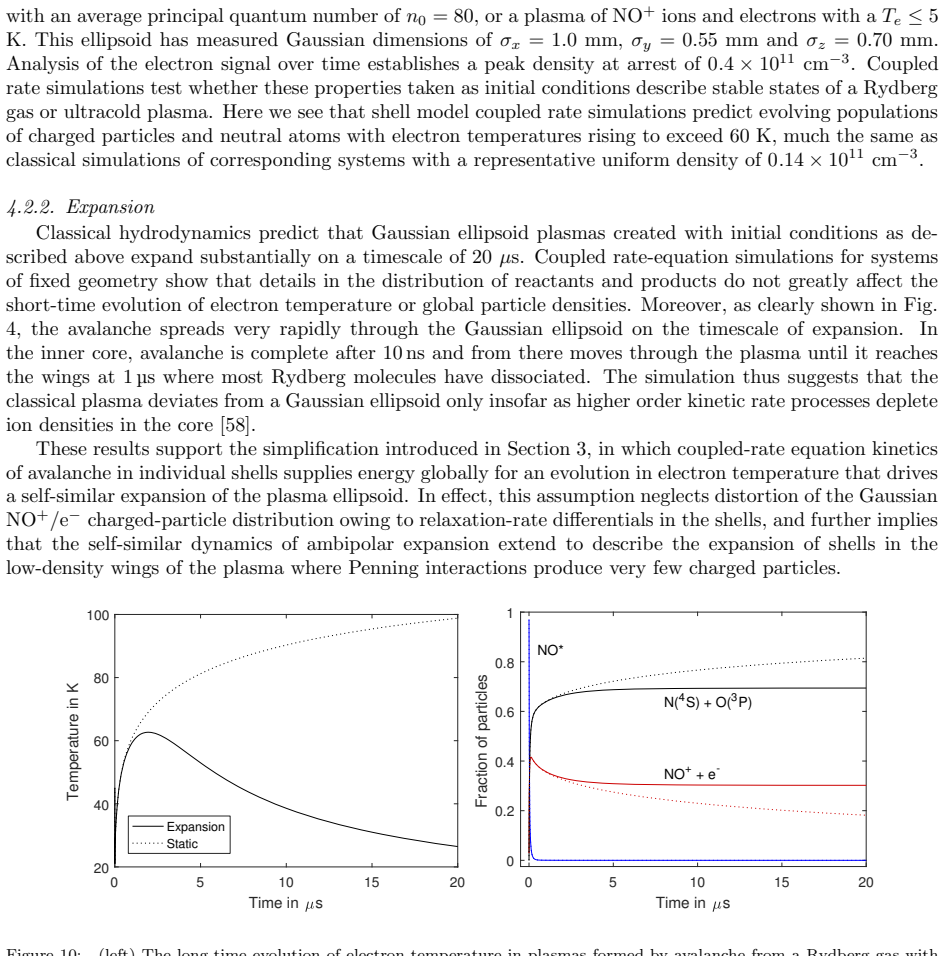
The central discovery is a negative result stated in classical terms: the coupled rate-equation shell model, with kinetics for Penning ionization, electron-impact ionization, three-body recombination, $n$-changing collisions, predissociation, and dissociative recombination, cannot reproduce the experimentally observed arrested ultracold plasma. For a Gaussian ellipsoid with a peak density of $0.5\times 10^{12}$ cm$^{-3}$ and $n_0=49$, the avalanche completes in the dense core within tens of nanoseconds, the remaining Rydberg molecules predissociate before 1 $\mu$s, and the electron gas heats to about 100 K before driving a quasi-self-similar ambipolar expansion at radial velocities of order 150 m/s. Simulations seeded at the measured arrest conditions, either as an $n_0=80$ Rydberg gas or as a $T_e=5$ K plasma at $0.4\times 10^{11}$ cm$^{-3}$, evolve in the same direction, heating above 60 K and expanding at comparable speeds. The paper therefore states that it finds no combination of initial conditions that conforms classically with the arrested relaxation observed experimentally, and points to quantum effects as the remaining explanation.
Load-bearing premise
The load-bearing assumption is that rate constants computed for atomic rubidium and the semi-classical Penning model describe nitric oxide Rydberg molecules accurately; if molecular rotation or other channels change these rates, the predicted fast avalanche and expansion could be an artifact of the model rather than a real failure of classical physics.
Editorial extensions
If this is right
- Any classical simulation that starts from the measured density, temperature, and binding energy of the arrested plasma will heat electrons well above a few kelvin and expand at roughly 150 m/s, so the observed 15–30 m/s expansion and multi-millisecond lifetime cannot be classical.
- The measured survival time means the Rydberg reservoir is not being consumed by predissociation on the model's microsecond timescale, requiring a mechanism that keeps molecules out of dissociative channels or redistributes their energy.
- The classical baseline predicts that inner-shell avalanche completes in nanoseconds while outer shells mostly predissociate, so global ionization fractions depend on the wings of the ellipsoid, not just the core; this is a testable spatial prediction.
- The model's path-insensitivity, where fixed geometry versus stepped expansion gives similar energy totals, suggests that a more elaborate hydrodynamic treatment will not remove the contradiction by itself.
- The electron temperature in the classical description must remain high enough to suppress recombination, and that same temperature necessarily drives fast expansion; any candidate quantum mechanism must break this link.
Reading between the lines
- If the classical baseline is accepted, the most direct experimental test of the quantum-arrest hypothesis is time-resolved measurement of electron temperature in the arrested plasma; the classical model requires tens of kelvin, while a quantum-localized state should stay far colder.
- Because the rate constants are computed for atomic rubidium and applied to molecular NO, a molecular-specific recalculation that includes rotational and $l$-changing channels could shift the avalanche timescale; if such rates slow avalanche enough, part of the claimed contradiction could soften.
- The paper's classical model neglects the resonant charge-exchange step that experiments invoke to explain bifurcation; adding that energy-sequestering channel might produce slower effective expansion and should be tested before concluding that only quantum effects can arrest relaxation.
- The same simulation framework could be run for other molecular Rydberg gases or for a range of densities and principal quantum numbers to map where classical predictions fail, effectively charting the regime where quantum stabilization sets in.
Signed reviews
Editorial analysis
A structured set of objections, weighed in public.
Referee Report
Summary. This paper presents coupled rate-equation simulations of an NO Rydberg gas in a Gaussian ellipsoid, using a shell model for the density inhomogeneity and a quasi-self-similar hydrodynamic expansion. Rate constants for ionization, three-body recombination, n/l-changing collisions, predissociation, and dissociative recombination are adopted from the literature and from the authors' earlier work. The authors test two representative initial conditions for the experimentally observed arrested-relaxation state—an n0=80 Rydberg gas and a fully ionized plasma at Te=5 K—and predict rapid avalanche, essentially complete predissociation within about 1 microsecond, electron heating to roughly 60–100 K, and expansion velocities near 150 m/s, in contrast to the measured 15–30 m/s expansion and survival beyond 1 ms. The paper concludes that no combination of initial conditions conforms classically with the observed arrested relaxation, and that quantum effects may be required.
Significance. If the negative claim were established, the paper would provide a useful classical baseline and strengthen the case that the arrested relaxation of molecular ultracold plasmas is a quantum phenomenon. The shell-model treatment of density gradients, the global energy bookkeeping, and the use of independently derived rate constants are strengths. However, the universal 'no combination' claim is not established by the two initial conditions studied, and the hydrodynamic model omits the resonant charge-transfer channel that the authors themselves invoke in the Introduction and Conclusions to explain the experimental quenching of the ion velocity distribution. The paper is therefore best viewed as a baseline-model study whose central interpretive claim needs additional support.
major comments (3)
- [§3.4, Eqs. (14)–(18); §5] The expansion model accelerates ions only through the electron-pressure gradient; there is no term coupling ion radial velocity to the neutral Rydberg reservoir. This matters because the Introduction and Conclusions attribute the experimentally observed quenching of the ion/Rydberg velocity distribution to resonant charge transfer (NO+ + NO* -> NO* + NO+), which is a classical momentum sink: a fast ion becomes a fast neutral and leaves a cold ion. The predicted 150 m/s velocities in Fig. 12 therefore omit a channel that could plausibly reduce the expansion to the measured 15–30 m/s. The statement in Section 5 that the Rydberg densities needed for this effect 'seem greater than predicted by any classical simulation' is an assertion, not a calculation, and the curve labeled 'Charge exchange' in the figure caption has no corresponding term in the equations. A quantitative estimate of the charge-transfer rate using the simulated Rydberg density field is required before the classical channel can be ruled out.
- [§4.1 and §4.2.2] The abstract and introduction claim 'We find no combination of initial conditions that conforms classically with the state of arrested relaxation observed experimentally.' The presented evidence is limited to two representative initial states (n0 = 80 Rydberg gas and Te = 5 K fully ionized plasma) at a single peak density of 0.4 × 10^11 cm^-3 and a single ellipsoid geometry. No parameter scan over n0, density, Te, or ionization fraction is reported, so the universal negative claim is not supported by the simulations. The conclusion should be restricted to these tested cases, or the parameter space should be scanned and shown to bracket all experimentally plausible combinations.
- [§3.2.2, Eq. (4)] The rate constants kion, ktbr, and kij are taken from Monte Carlo simulations for atomic Rydberg systems [49] and applied without modification to molecular NO. Because these rates control the avalanche time, electron temperature, and expansion velocity—the very quantities compared with experiment—the transferability to NO (including rotational structure and l-changing channels) needs a justification or a sensitivity analysis. The numerical gap between predicted and measured velocities is large, but the manuscript does not show that the prediction is robust to plausible molecular corrections in these rates.
minor comments (5)
- [§3.3, Eq. (13)] Eq. (13) ends with a double period ('...Vα. .'); this typographical error should be fixed.
- [Figures 1–12] The figure captions are corrupted and duplicated ('FIG. 1: Figure 1 ...', 'FIG. 2: Figure 2 ...', etc.) and the in-text figure numbering is inconsistent; the captions should be cleaned and renumbered.
- [§4.1] In the closing paragraph of Section 4.1, the sentence 'the saturated value of ⇡ 0.4i sl e s st h a n the uniform model output' is garbled and should be rewritten.
- [References] References [41] and [49] cite the same paper (Pohl, Vrinceanu, and Sadeghpour, PRL 100, 223201) and should be unified.
- [§3.3] The manuscript states that the differential equations are 'solved by numerical integration' but gives no integrator, timestep, or convergence criteria; a short reproducibility paragraph would be helpful.
Circularity Check
No significant circularity: the central negative result is an emergent simulation outcome, not a restatement of inputs.
full rationale
The derivation is self-contained with respect to the paper's central claim. The rate constants kion, ktbr, and kij are taken from Pohl and coworkers' Monte Carlo trajectory simulations (Ref. 49), dissociative recombination from Schneider et al. (Ref. 50), the Penning seed density from Robicheaux's semiclassical model (Ref. 31), and the ellipsoid dimensions and densities are fixed by the experiment (Sec. 2, Eq. 1). None of these inputs is fitted to the arrested-relaxation datum that the paper claims to contradict. The simulation's outputs—electron temperature evolution, Rydberg depletion, and roughly 150 m/s expansion—emerge by integrating Eqs. 9–18, and are then compared with experimental values of 15–30 m/s and >1 ms survival. This is a falsifiable prediction rather than a circular restatement. The self-citations to the authors' previous predissociation and shell-model work (Refs. 51, 56, 58) are not load-bearing in a circular sense: the predissociation rate is explicitly checked against Vrakking and Lee's measured nf(2) lifetimes (Ref. 55), and the hydrodynamic treatment is anchored to external Vlasov solutions (Refs. 35, 57). The Conclusion itself flags a legitimate completeness limitation—resonant charge exchange is not included in the rate/hydrodynamic equations of Sec. 3.4, so the 'no combination of initial conditions' claim should be read with that caveat—but an omitted process is a robustness or correctness concern, not a circular one, because the prediction is not defined in terms of the experimental target. No circular step meeting the quote-and-reduction standard is present.
Assumptions & free parameters
assumptions (6)
- domain assumption Rate constants kion, ktbr, and kij computed for atomic Rb by Pohl et al. are valid for molecular NO Rydberg states.
- domain assumption Robicheaux's atomic Penning ionization model, with 90 percent probability inside rc = 1.8 times 2 n0^2 a0, applies to NO molecules.
- domain assumption Electron temperature equilibrates instantaneously across all shells, and each shell is quasi-neutral with electrons confined by ion space charge.
- domain assumption Self-similar expansion via Eq. 15, using an averaged gradient term, adequately represents ambipolar forces; shell distortion and shock fronts are neglected.
- ad hoc to paper The experimentally arrested plasma at 10 microseconds can be represented by either an n0=80 Rydberg gas or a fully ionized plasma with Te=5 K in a single Gaussian ellipsoid.
- domain assumption The predissociation rate model Eq. 8, with l-dependent rates from Gallagher and Bixon and n^-3 scaling, gives correct molecular decay lifetimes.
Cite this review
Pith. "Pith review of Coupled rate-equation hydrodynamic simulation of a Rydberg gas Gaussian ellipsoid: Classical avalanche and evolution to molecular plasma." pith.science (2026). https://pith.science/paper/HINJCNCX
@misc{pith2026190807638,
  author       = {Pith},
  title        = {Pith review of: Coupled rate-equation hydrodynamic simulation of a Rydberg gas Gaussian ellipsoid: Classical avalanche and evolution to molecular plasma},
  year         = {2026},
  howpublished = {\url{https://pith.science/paper/HINJCNCX}},
  note         = {Machine review of arXiv:1908.07638}
}
abstract
An ellipsoidal volume of Rydberg molecules, entrained in a supersonic molecular beam, evolves on a nanosecond timescale to form a strongly coupled ultracold plasma. We present coupled rate-equation simulations that model the underlying kinetic processes and molecular dissociation channels in both a uniformly distributed plasma and under the conditions dictated by our experimental geometry. Simulations predict a fast electron-driven collisional avalanche to plasma followed by slow electron-ion recombination. Within 20 $\mu$s, release of Rydberg binding energy raises the electron temperature of a static plasma to $T_e = 100$ K. Providing for a quasi-self-similar expansion, the hot electron gas drives ion radial motion, reducing $T_e$. These simulations provide a classical baseline model from which to consider quantum effects in the evolution of charge gradients and ambipolar forces in an experimental system undergoing responsive avalanche dynamics.
Figures


Figures from the paper (11 more)





Reference graph
Works this paper leans on
-
[49]
T. Pohl, D. Vrinceanu, H. R. Sadeghpour, Rydberg atom formation in ultracold plasmas: small energy transfer with large consequences, Physical review letters 100 (2008) 223201
work page 2008
-
[1]
A. Reinhard, T. C. Liebisch, B. Knuffman, G. Raithel, Level shifts of rubidium Rydberg states due to binary interactions, Physical Review A 75 (2007) 032712
work page 2007
-
[2]
A. Fioretti, D. Comparat, C. Drag, T. F. Gallagher, P. Pillet, Long-Range Forces between Cold Atoms, Physical Review Letters 82 (1999) 1839–1842. 16
work page 1999
-
[3]
L. B´ eguin, A. Vernier, R. Chicireanu, T. Lahaye, A. Browaeys, Direct Measurement of the van der Waals Interaction between Two Rydberg Atoms, Physical Review Letters 110 (2013) 67
work page 2013
-
[4]
D. Comparat, P. Pillet, Dipole blockade in a cold Rydberg atomic sample [Invited], Journal of the Optical Society of America B-Optical Physics 27 (2010) A208
work page 2010
-
[5]
Y. O. Dudin, A. Kuzmich, Strongly Interacting Rydberg Excitations of a Cold Atomic Gas, Science 336 (2012) 887–889
work page 2012
-
[6]
S. Sevin¸ cli, C. Ates, T. Pohl, H. Schempp, C. S. Hofmann, G. G¨ unter, T. Amthor, M. Weidem¨ uller, J. D. Pritchard, D. Maxwell, A. Gauguet, K. J. Weatherill, M. P. A. Jones, C. S. Adams, Quantum interference in interacting three-level Rydberg gases: coherent population trapping and electromagnetically induced transparency, Journal of Physics B: Atomic,...
work page 2011
-
[7]
A. V. Gorshkov, J. Otterbach, M. Fleischhauer, T. Pohl, M. D. Lukin, Photon-Photon Interactions via Rydberg Blockade, Physical Review Letters 107 (2011) 133602
work page 2011
Show all 59 references
-
[8]
M. F. Maghrebi, M. J. Gullans, P. Bienias, S. Choi, I. Mart´ ın, O. Firstenberg, M. D. Lukin, H. P. B¨ uchler, A. V. Gorshkov, Coulomb Bound States of Strongly Interacting Photons, Physical Review Letters 115 (2015) 123601
2015
-
[9]
A. K. Mohapatra, T. R. Jackson, C. S. Adams, Coherent optical detection of highly excited Rydberg states using electromagnetically induced transparency, Physical Review Letters 98 (2007) 113003
2007
-
[10]
Saffman, T
M. Saffman, T. G. Walker, K. Mølmer, Quantum information with Rydberg atoms, Reviews of Modern Physics 82 (2010) 2313
2010
-
[11]
Gorniaczyk, C
H. Gorniaczyk, C. Tresp, J. Schmidt, H. Fedder, S. Hofferberth, Single-Photon Transistor Mediated by Interstate Rydberg Interactions, Physical Review Letters 113 (2014) 053601
2014
-
[12]
Tiarks, S
D. Tiarks, S. Baur, K. Schneider, S. D¨ urr, G. Rempe, Single-Photon Transistor Using a F¨ orster Resonance, Physical Review Letters 113 (2014) 053602
2014
-
[13]
Paredes-Barato, C
D. Paredes-Barato, C. S. Adams, All-Optical Quantum Information Processing Using Rydberg Gates, Physical Review Letters 112 (2014) 040501
2014
-
[14]
Saffman, Quantum computing with atomic qubits and Rydberg interactions: progress and challenges, Journal of Physics B: Atomic, Molecular and Optical Physics 49 (2016) 202001
M. Saffman, Quantum computing with atomic qubits and Rydberg interactions: progress and challenges, Journal of Physics B: Atomic, Molecular and Optical Physics 49 (2016) 202001
2016
-
[15]
D. E. Chang, V. Vuletic, M. D. Lukin, Quantum nonlinear optics — photon by photon, Nature Photonics 8 (2014) 685–694
2014
-
[16]
Firstenberg, C
O. Firstenberg, C. S. Adams, S. Hofferberth, Nonlinear quantum optics mediated by Rydberg interactions, Journal of Physics B: Atomic, Molecular and Optical Physics 49 (2016) 152003
2016
-
[17]
Bendkowsky, B
V. Bendkowsky, B. Butscher, J. Nipper, J. P. Shaffer, R. L¨ ow, T. Pfau, Observation of ultralong-range Rydberg molecules, Nature 458 (2009) 1005–1008
2009
-
[18]
Schauß, M
P. Schauß, M. Cheneau, M. Endres, T. Fukuhara, S. Hild, A. Omran, T. Pohl, C. Gross, S. Kuhr, I. Bloch, Observation of spatially ordered structures in a two-dimensional Rydberg gas, Nature 491 (2012) 87–91
2012
-
[19]
C. Carr, R. Ritter, C. G. Wade, C. S. Adams, K. J. Weatherill, Nonequilibrium Phase Transition in a Dilute Rydberg Ensemble, Physical Review Letters 111 (2013) 113901
2013
-
[20]
A. V. Gorshkov, R. Nath, T. Pohl, Dissipative Many-Body Quantum Optics in Rydberg Media, Physical Review Letters 110 (2013) 153601
2013
-
[21]
A. Gaj, A. T. Krupp, J. B. Balewski, R. L¨ ow, S. Hofferberth, T. Pfau, From molecular spectra to a density shift in dense Rydberg gases, Nature Communications 5 (2014) 4546
2014
-
[22]
Urvoy, F
A. Urvoy, F. Ripka, I. Lesanovsky, D. Booth, J. P. Shaffer, T. Pfau, R. L¨ ow, Strongly Correlated Growth of Rydberg Aggregates in a Vapor Cell, Physical Review Letters 114 (2015) 203002
2015
-
[23]
C. S. Hofmann, G. G¨ unter, H. Schempp, N. L. M. M¨ uller, A. Faber, H. Busche, M. Robert-de Saint-Vincent, S. Whitlock, M. Weidem¨ uller, An experimental approach for investigating many-body phenomena in Rydberg-interacting quantum systems, Frontiers of Physics 9 (2013) 571–586
2013
-
[24]
Bienias, S
P. Bienias, S. Choi, O. Firstenberg, M. F. Maghrebi, M. Gullans, M. D. Lukin, A. V. Gorshkov, H. P. B¨ uchler, Scattering resonances and bound states for strongly interacting Rydberg polaritons, Physical Review A 90 (2014) 053804
2014
-
[25]
Ripka, Y.-H
F. Ripka, Y.-H. Chen, R. L¨ ow, T. Pfau, Rydberg polaritons in a thermal vapor, Physical Review A 93 (2016) 053429
2016
-
[26]
Browaeys, T
A. Browaeys, T. Lahaye, Interacting Cold Rydberg Atoms: A Toy Many-Body System, in: Niels Bohr, 1913-2013, Springer International Publishing, Cham, 2016, pp. 177–198
1913
-
[27]
C. Noh, D. G. Angelakis, Quantum simulations and many-body physics with light, Rep. Prog. Phys. 80 (2016) 016401
2016
-
[28]
A. W. Glaetzle, R. Nath, B. Zhao, G. Pupillo, P. Zoller, Driven-dissipative dynamics of a strongly interacting Rydberg gas, Physical Review A 86 (2012) 208
2012
-
[29]
Li, T.-C
W.-H. Li, T.-C. Hsieh, C.-Y. Mou, D.-W. Wang, Emergence of a Metallic Quantum Solid Phase in a Rydberg-Dressed Fermi Gas, Physical Review Letters 117 (2016) 035301
2016
-
[30]
Z. Lan, W. Li, I. Lesanovsky, Quantum melting of two-component Rydberg crystals, Physical Review A 94 (2016) 051603
2016
-
[31]
Robicheaux, Ionization due to the interaction between two Rydberg atoms, Journal of Physics B: Atomic, Molecular and Optical Physics 38 (2005) S333–S342
F. Robicheaux, Ionization due to the interaction between two Rydberg atoms, Journal of Physics B: Atomic, Molecular and Optical Physics 38 (2005) S333–S342
2005
-
[32]
Sisourat, N
N. Sisourat, N. V. Kryzhevoi, P. Kolorenˇ c, S. Scheit, T. Jahnke, L. S. Cederbaum, Ultralong-range energy transfer by interatomic Coulombic decay in an extreme quantum system, Nature Physics 6 (2010) 508–511
2010
-
[33]
J. P. Morrison, N. Saquet, E. R. Grant, Classical scaling and the correspondence between the coupled rate equation and molecular dynamics models for the evolution of ultracold neutral plasma, Journal of Physics B: Atomic, Molecular and Optical Physics 45 (2012) 025701–7
2012
-
[34]
Ichimaru, Strongly coupled plasmas: high-density classical plasmas and degenerate electron liquids, Reviews of Modern Physics 54 (1982) 1017–1059
S. Ichimaru, Strongly coupled plasmas: high-density classical plasmas and degenerate electron liquids, Reviews of Modern Physics 54 (1982) 1017–1059
1982
-
[35]
Killian, T
T. Killian, T. Pattard, T. Pohl, J. Rost, Ultracold neutral plasmas, Physics Reports 449 (2007) 77–130. 17
2007
-
[36]
T. Pohl, T. Pattard, J. Rost, Kinetic modeling and molecular dynamics simulation of ultracold neutral plasmas including ionic correlations, Physical Review A 70 (2004) 33416
2004
-
[37]
Saquet, J
N. Saquet, J. P. Morrison, E. Grant, Recombinative dissociation and the evolution of a molecular ultracold plasma, J. Phys. B: At. Mol. Opt. Phys 45 (2012) 175302
2012
-
[38]
Schulz-Weiling, E
M. Schulz-Weiling, E. R. Grant, Quantum state control of ultracold plasma fission, Journal of Physics B: Atomic, Molecular and Optical Physics 49 (2016) 064009
2016
-
[39]
J. P. Morrison, C. J. Rennick, J. S. Keller, E. R. Grant, Evolution from a Molecular Rydberg Gas to an Ultracold Plasma in a Seeded Supersonic Expansion of NO, Physical Review Letters 101 (2008) 205005
2008
-
[40]
Haenel, M
R. Haenel, M. Schulz-Weiling, J. Sous, H. Sadeghi, M. Aghigh, L. Melo, J. S. Keller, E. R. Grant, Arrested relaxation in an isolated molecular ultracold plasma, Physical Review A 96 (2017) 023613
2017
-
[41]
T. Pohl, D. Vrinceanu, H. R. Sadeghpour, Rydberg Atom Formation in Ultracold Plasmas: Small Energy Transfer with Large Consequences, Phys. Rev. Lett. 100 (2008) 223201
2008
-
[42]
Niffenegger, K
K. Niffenegger, K. A. Gilmore, F. Robicheaux, Early time properties of ultracold neutral plasmas, Journal of Physics B: Atomic, Molecular and Optical Physics 44 (2011) 145701
2011
-
[43]
Saquet, J
N. Saquet, J. P. Morrison, M. Schulz-Weiling, H. Sadeghi, J. Yiu, C. J. Rennick, E. R. Grant, On the formation and decay of a molecular ultracold plasma, Journal of Physics B: Atomic, Molecular and Optical Physics 44 (2011) 184015
2011
-
[44]
W. Li, M. W. Noel, M. P. Robinson, P. J. Tanner, T. F. Gallagher, D. Comparat, B. L. Tolra, N. Vanhaecke, T. Vogt, N. Zahzam, P. Pillet, D. A. Tate, Evolution dynamics of a dense frozen Rydberg gas to plasma, Physical Review A 70 (2004) 10
2004
-
[45]
Walz-Flannigan, J
A. Walz-Flannigan, J. R. Guest, J. H. Choi, G. Raithel, Cold-Rydberg-gas dynamics, Physical Review A 69 (2004) 063405
2004
-
[46]
T. F. Gallagher, Rydberg Atoms, Cambridge University Press, 2005
2005
-
[47]
Patel, N
R. Patel, N. Jones, H. Fielding, Rotational-state-selective field ionization of molecular Rydberg states, Phys Rev A 76 (2007) 043413
2007
-
[48]
Torquato, B
S. Torquato, B. Lu, J. Rubinstein, Nearest-neighbor distribution functions in many-body systems, Physical Review A 41 (1990) 2059–2075
1990
-
[50]
I. F. Schneider, I. Rabad´ an, L. Carata, L. H. Andersen, A. Suzor-Weiner, J. Tennyson, Dissociative recombination of NO+: Calculations and comparison with experiment, Journal of Physics B: Atomic, Molecular and Optical Physics 33 (2000) 4849
2000
-
[51]
Saquet, J
N. Saquet, J. P. Morrison, E. Grant, Recombinative dissociation and the evolution of a molecular ultracold plasma, Journal of Physics B: Atomic, Molecular and Optical Physics 45 (2012) 175302
2012
-
[52]
Murgu, J
E. Murgu, J. D. D. Martin, T. F. Gallagher, Stabilization of predissociating nitric oxide Rydberg molecules using microwave and radio-frequency fields, The Journal of Chemical Physics 115 (2001) 7032–7040
2001
-
[53]
Bixon, J
M. Bixon, J. Jortner, The dynamics of predissociating high Rydberg states of NO, The Journal of Chemical Physics 105 (1996) 1363–1382
1996
-
[54]
W. A. Chupka, Factors affecting lifetimes and resolution of Rydberg states observed in zero–electron–kinetic–energy spectroscopy, The Journal of Chemical Physics 98 (1993) 4520–4530
1993
-
[55]
M. J. J. Vrakking, Y. T. Lee, Lifetimes of Rydberg states in zero–electron–kinetic–energy experiments. I. Electric field induced and collisional enhancement of NO predissociation lifetimes, The Journal of Chemical Physics 102 (1995) 8818– 8832
1995
-
[56]
Schulz-Weiling, H
M. Schulz-Weiling, H. Sadeghi, J. Hung, E. Grant, On the evolution of the phase-space distributions of a non-spherical molecular ultracold plasma in a supersonic beam, Journal of Physics B: Atomic, Molecular and Optical Physics 49 (2016) 193001
2016
-
[57]
D. S. Dorozhkina, V. E. Semenov, Exact Solution of Vlasov Equations for Quasineutral Expansion of Plasma Bunch into Vacuum, Physical review letters 81 (1998) 2691–2694
1998
-
[58]
Sadeghi, E
H. Sadeghi, E. R. Grant, Dissociative recombination slows the expansion of a molecular ultracold plasma, Physical Review A 86 (2012) 052701
2012
-
[59]
J. Sous, E. R. Grant, Possible many-body localization in a long-lived finite-temperature ultracold quasi-neutral molecular plasma, Physical Review Letters 120 (2018) 110601. 18
2018
Reviewed August 14, 2026 · model on record in the stance chip above.
Discussion (0). Continue with ORCID to comment.